Category: Queensland History

  • No Charts, No Worries

    A schooner of the early 1800s. Courtesy State Library of Queensland.

    When Captain George Browning sailed the small schooner Caledonia from Sydney in December 1831, he intended to follow the coast north as far as the Tropic of Capricorn.   There he was to collect salvage from a ship that had been wrecked in the Bunker Islands and return it to Sydney to be sold.   But on the way, he was to call in at the Moreton Bay Penal Settlement to collect a whaleboat the crew had used to escape the wreck.   That was where things began to go wrong for the young master mariner.

    While anchored in Moreton Bay his ship was seized by a band of convicts who sent the crew ashore and ordered Browning to take them to the tiny South Pacific Island of Rotuma some 1,500 nautical miles or 3,000 kilometres away over open ocean.   See my blog “The Caledonia’s perilous last voyage,” for a more detailed account.

    Among the many challenges he faced, he had no charts covering the South Pacific.  Yet, Browning had to find a way to deliver his unwanted passengers to their destination if he was to have any chance of saving his ship and preserving his own life.   He consulted his “Epitome of Practical Navigation,” a book all master mariners kept close at hand.   The regularly updated volume was considered the standard text on maritime navigation and was packed with charts and tables to help mariners navigate the world’s oceans.   

    Example from The American Practical Navigator, 1837. There were several such books used by master mariners.

    Browning referred to a table of South Pacific Islands with their corresponding geographic coordinates.  With this information, he flipped over one of his coastal charts and drew a grid labelling the key lines of longitudes and latitudes for the waters he would be sailing and marked the various known islands and features identified in the table, albeit with many reefs, shoals and other hazards left unrecorded.   Notwithstanding its limitations, he could now take observations and plot his whereabouts and relate that to his destination – Rotuma – and any other islands in the course of his travels.   

    Using his makeshift chart, Browning navigated from Moreton Bay to New Caledonia where they stopped to collect fresh drinking water.   From there he charted a course to Rotuma and when he was directed to leave that island at a moment’s notice and make for Wallis Island he did that too.  

    Perhaps the chart’s greatest value came as they sailed towards Wallis Island.   A couple of the convicts warned Browning that their leader intended to scuttle the Caledonia and do away with its captain once they had arrived.   He knew Wallis Island lay a short distance over the horizon and they would likely arrive late that afternoon.  

    He shaped the sails to slow the ship’s progress until nightfall.   Then, during the hours of darkness, he picked up speed again and was able to slip by Wallis thereby prolonging his life a little longer.   A couple of days later they pulled in at the Samoan island of Savai’i.   There the Caledonia was scuttled but Browning was befriended by a local chief and escaped the convicts’ clutches.  He eventually returned to Australia to tell his amazing story.

    The full story is told in A Treacherous Coast: Ten Tales of Shipwreck and Survival from Queensland Waters available through Amazon.

    © Copyright C.J. Ison / Tales from the Quarterdeck, 2022.

    To be notified of future blog posts, please enter your email address below.

  • The Orete’s Robinson Crusoe-like Castaway

    Schooner Orete (left), Donald Mackenzie (right)

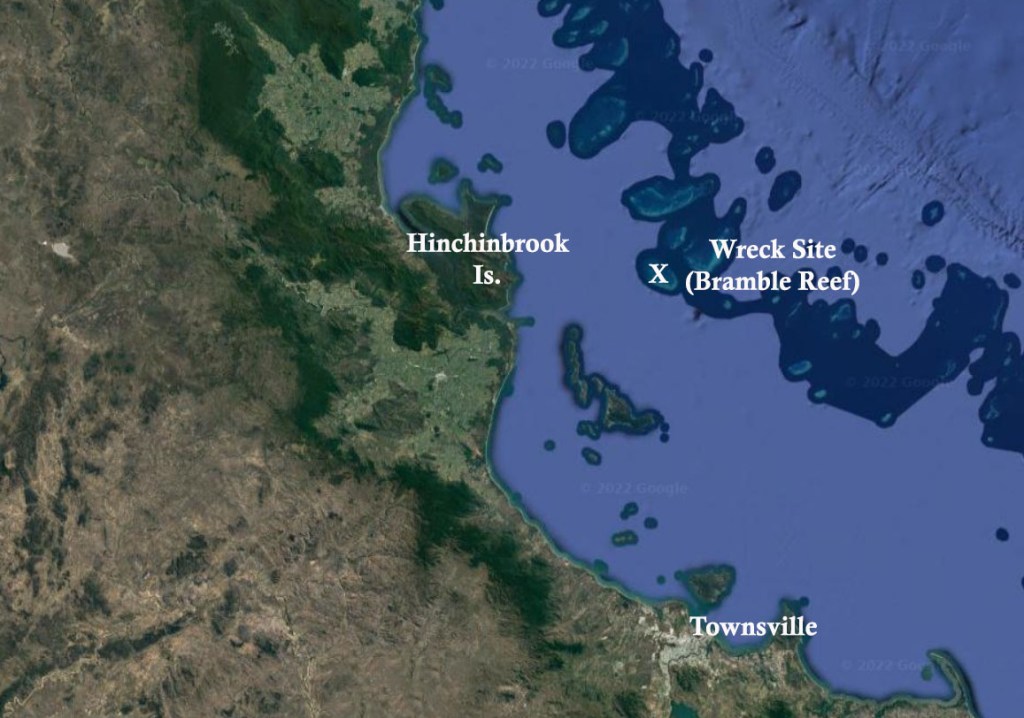
       In January 1918, Donald Mackenzie found himself marooned on a tiny uninhabited island after his vessel sank during one of the most powerful cyclones to cross the Central Queensland coast.

       The tough 56-year-old Scott was a seaman on the coastal auxiliary schooner Orete, which had sailed from Maryborough bound for Mackay with a cargo of sawn timber. She was heavily laden. Once the hold had been filled, more timber had been stacked on deck, pushing her deeper in the water. The captain thought the tough little vessel could handle it and set off down the Mary River, where its mouth opened into Hervey Bay. Even as they crossed the usually calm waters protected by Fraser Island (K’Gari), they could see that the weather was deteriorating. As they bore north, the sea conditions got progressively worse. These were the days before ships carried radios, and little did they know a massive cyclone was forming ahead of them. By the time they reached the Percy Islands, and were only 200 km from their destination, the barometer plummeted. Huge seas pummelled the overloaded vessel. Rather than continue to sail into the encroaching storm, the captain decided to anchor in the lee of Pine Islet to ride it out.   

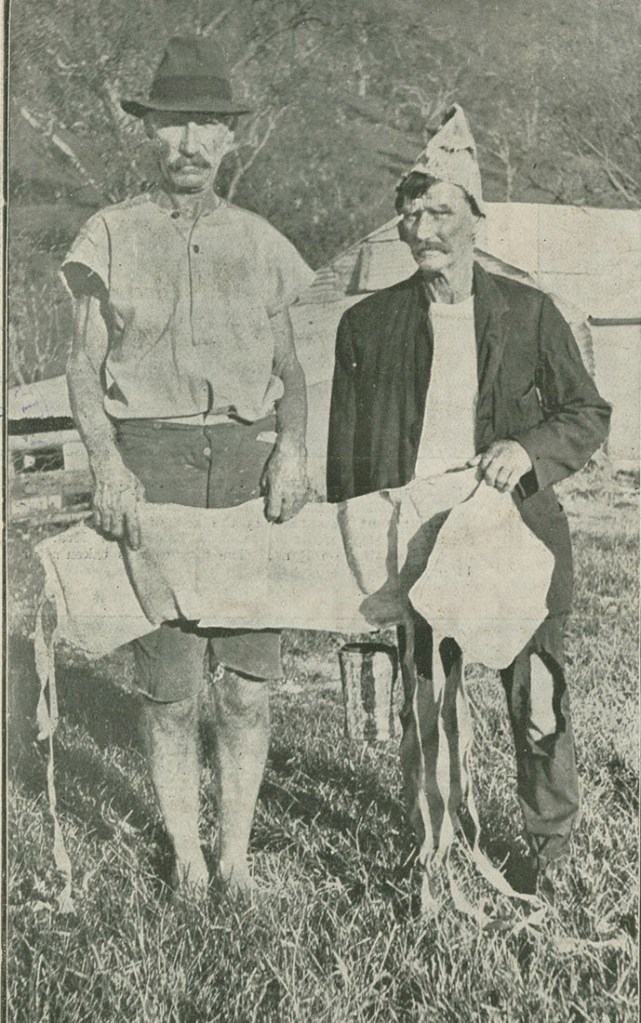
    However, as the cyclone approached the coast, the wind shifted, and the anchors began to drag. The Orete was blown from her anchorage under bare poles. They tried cutting away the deck cargo to lighten the load, but in the process, the captain broke his leg when the timbers moved. Then the mate tried to launch their lifeboat, but it was washed away before they could board it. In the end, the captain, the mate and two crewmen huddled below deck to see out the storm. Unfortunately, the schooner soon foundered, trapping all four men in the cabin to go down with the ship. Mackenzie and another sailor were only spared because they had been on deck when the schooner capsized. Both men were plunged into the heaving sea, but Mackenzie wore a life belt tied around his waist. He swam to a floating cabin door and held on as the storm raged around him. His mate was not so lucky and was never seen again. After four or five hours, Mackenzie washed up on a beach surrounded by flotsam from the wrecked ship.

    Orete survivor, Donald Mackenzie (right) holding his life preserver. Source: The Queenslander Pictorial Supplement, 9 March 1918.

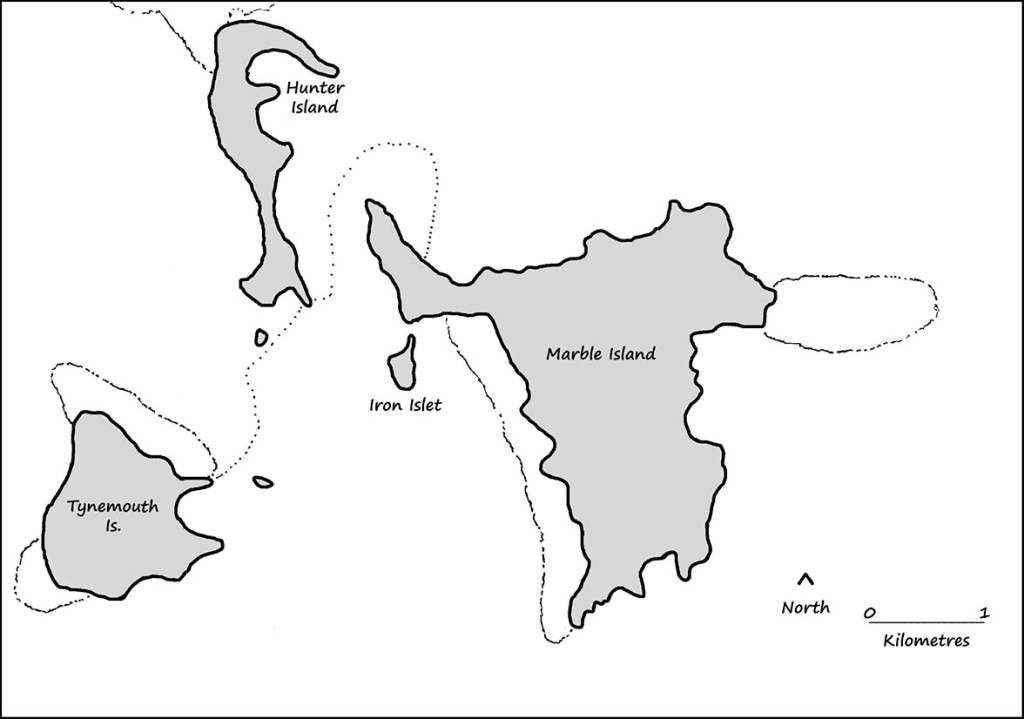
       When the weather subsided, Mackenzie took stock of his situation. He had no idea where he had landed; he would later learn it was Tynemouth Island. The foreshore was littered with timber and other debris, but among the mess of litter, he found a few onions and pumpkins. They would be his sole source of food for the coming days. Perhaps key to his ultimate survival, he also found a crate of kerosene cans.

       A quick search of the small uninhabited island had revealed no permanent supply of water. So he emptied the kerosene cans of their contents and filled them with fresh water before the puddles dried up. Looking out from the east coast, Mackenzie could see another island, and he thought he could see several buildings. That would later prove to be Iron Islet.

       Without the means to make a fire or attract attention, Mackenzie resolved to build a raft to cross the expanse of water. He broke apart the kerosene crate and salvaged the nails. He then used them to fix long planks together to form a raft. After ten days, Mackenzie was ready to make the crossing to Iron Islet.   

    That time had not come soon enough. Hunger and the blazing hot conditions were taking their toll on him. Several days had passed since he had eaten the last of the raw vegetables, and he had been subsisting on shellfish smashed from the rocks ever since. During the day, there was no respite from the searing tropical sun. And, at night, he was tormented ceaselessly by mosquitoes and ants, making sleep all but impossible.

    Donald Mackenzie’s raft. Source: The Queenslander Pictorial Supplement, 9 March 1918.

       Mackenzie dragged his raft into the water and started towards Iron Islet using a broad timber plank for a paddle. But he was soon caught in a strong current ripping through the passage separating the two islands. He was swept along by the current, which threatened to take him out into the vastness of the Coral Sea. Mackenzie made the difficult decision to abandon his raft and swim back to Tynemouth Island while he still had a chance of reaching land.

       Disheartened as Mackenzie was, he knew he was growing weaker by the day. If he was ever going to survive, he had to build another raft. This one took him eight days to complete. Then, on Sunday, 10 February, he dragged his cumbersome craft into the water, straddled it, and started paddling away from shore.

       He was caught in the strong current for a second time. He used every ounce of strength his fatigued muscles could give him and inched the raft across the passage. After an almost super-human effort, Mackenzie reached the southern end of Hunter Island, north of Iron islet. There, he rested before setting off again to cross the one-kilometre channel that now separated him from his destination.    Again, he was caught in a powerful current. This one was even stronger than the last. He paddled furiously, but it was hopeless. He had no control over the craft, and as he looked back he could see the buildings of Iron Islet disappearing from sight.

    Mackenzie’s approximate course,

       At one time or another, most people experience that sinking feeling when success—so close at hand—slips away and all seems lost. This was Mackenzie’s darkest moment. He had survived the wreck that had claimed the lives of his shipmates. He had been cast away, Robinson Crusoe-like, on a deserted island for 19 days, suffering from hunger and exposure. He had built two rafts with his bare hands and escaped. But it had all been for nothing. Mackenzie was rocketing out into the vast Pacific Ocean, and there was nothing he could do to stop it. He was mentally exhausted, and the most recent frenzied paddling had left him physically spent. But as the channel widened, the current slackened and the raft’s headlong progress slowed.   

    Mackenzie looked towards an island to his right and could not believe his eyes.  There he saw sheep grazing in a field. With renewed spirit, he drew on his last reserves of energy and paddled towards shore. As he got closer, he saw the distinctive outline of a cottage roof partly obscured by trees. He kept paddling until the prow of the raft ran up onto a sandy beach, where he waded ashore on unsteady legs. He would soon learn he had landed on Marble Island. Most importantly, he had survived; his ordeal was over.

    The full story is told in A Treacherous Coast: Ten Tales of Shipwreck and Survival from Queensland Waters available through Amazon.

    © Copyright C.J. Ison / Tales from the Quarterdeck, 2022.

    To be notified of future blog posts, please enter your email address below.

  • The Caledonia’s perilous last voyage

    A schooner of the early 1800s. Courtesy State Library of Queensland.

    On a hot December night in 1831, a storm rolled across Moreton Bay as they often do at that time of year. Outside the Amity Point pilot house, nearly a dozen convicts huddled under a sheet of canvas as they bided their time. There was a small schooner anchored a short distance offshore, and the storm would provide the soaking prisoners with a rare opportunity to escape.

       But what the hapless runaways did not know as they seized the Caledonia and sailed her out of Moreton Bay, their self-appointed leader was a dangerous psychopath, and they would be swapping one reign of terror for another far worse. Three of them would soon be murdered. A fourth would be abandoned on an inhospitable island, and the rest would flee for their lives at the earliest opportunity.

       The Caledonia had pulled into Moreton Bay the previous day to collect a whaleboat, which belonged to the sailing ship America. The crew had used it to reach Moreton Bay after their ship was wrecked further north. Two Sydney businessmen had purchased the salvage rights to the wrecked ship and sent Captain George Browning north to retrieve the boat and strip the America of everything of value. Browning had reported to the Amity Point pilot station and explained their unexpected visit. He was now waiting for the boat to be brought down the Brisbane River before he continued on his way to the wreck site.

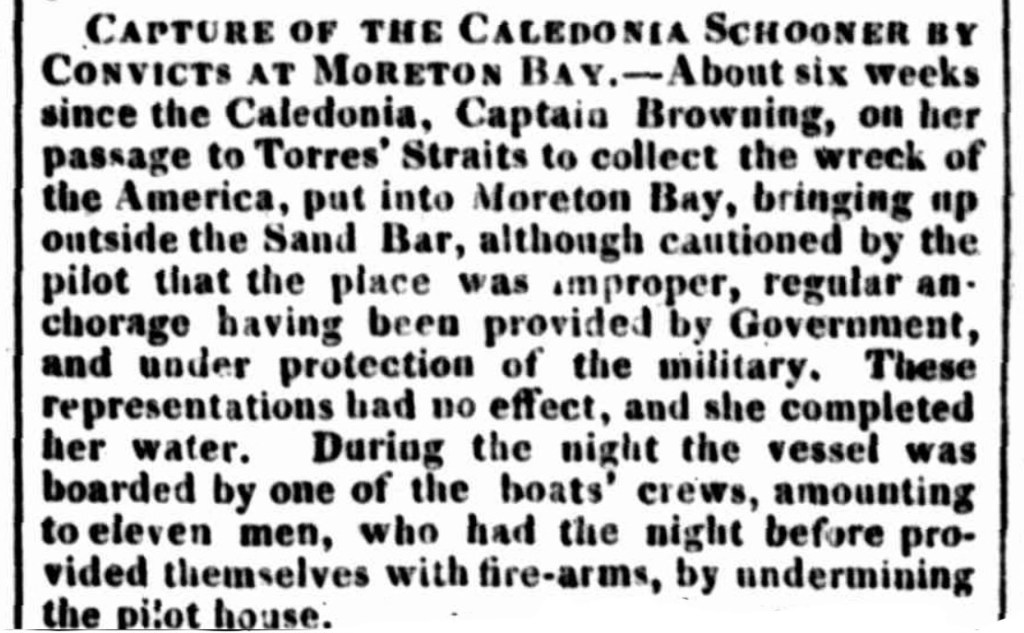
    Sydney Herald, 20 Feb 1832, p. 3.

    That night, as lightning streaked across the sky and deafening claps of thunder boomed around them, the convicts got to work. The guard had taken shelter and the raging storm muffled any noise they made. They easily dug down through the sand and tunnelled under the pilothouse wall. A couple of them crawled inside, stole the keys to the boat shed and armed themselves with muskets and pistols while the pilot and a guard slept. Then they jumped into the pilot boat and rowed out to the Caledonia. No guard had been posted on deck, and the crew were easily overwhelmed before they had fully awoken. The Caledonia’s crew were ordered into the pilot boat to make their way back to Amity Point using only one oar. However, the convicts held on to Captain Browning. He was needed to navigate the schooner to the tiny island of Rotuma, 3000 km away. By dawn, the Caledonia was heading out to sea, as the crew drifted back to shore to raise the alarm.

       The leader of the runaways was a former sailor named William Evans. He was unusual, for he had come to New South Wales as part of the crew of a merchant ship. One night while moored in Sydney Harbour, Evans had broken into the captain’s cabin and stolen a purse full of money. He was spotted leaving the ship in a small dinghy and was soon caught. Evans was found guilty and sentenced to seven years’ hard labour at Moreton Bay. Now, in the closing days of 1831, Evans still had three more years of back-breaking toil, poor rations and loathsome living conditions to endure. When he realised there was a chance he could make his escape on the schooner, he pounced, convincing the rest of the prisoners to join him.

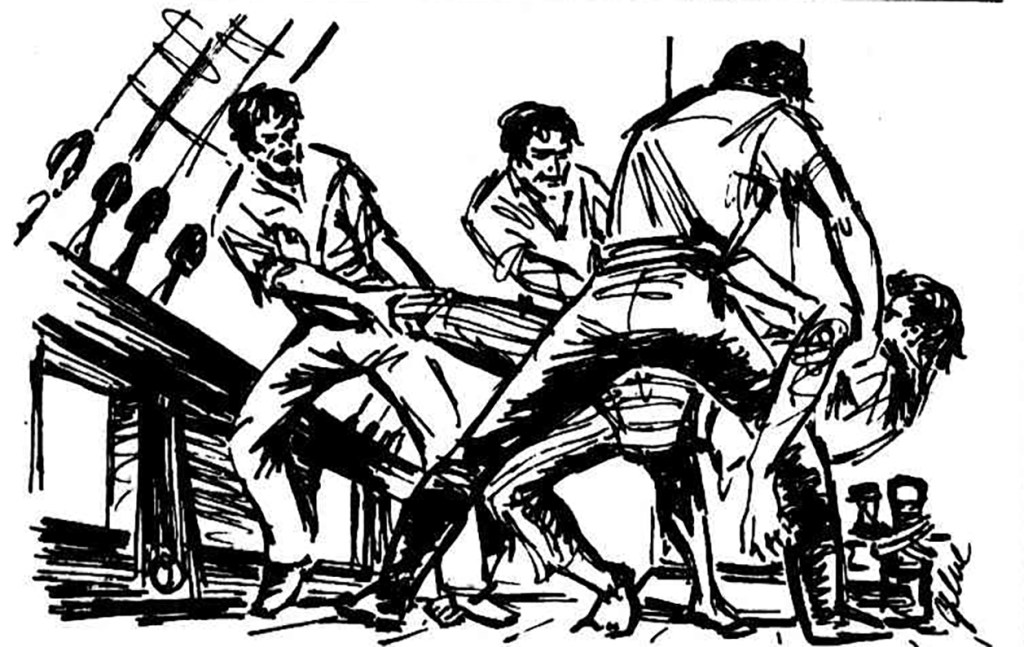
    Newspaper illustration of Evans and others throwing convict over the side of the Caledonia. The Argus, circa 1950s

       After they had been at sea for a week, tensions came to a head among the convicts. The common purpose that had seen them work together to seize the ship and escape had been replaced by bitterness and division. After hearing a rumour that a mutiny was looming, Evans struck first. He stood outside the entrance to the crew’s cabin, backed up by two mates, and ordered one of the mutineers to come on deck. As he emerged, Evans shot him point-blank in the head. Evans then ordered two others to come out, and they were killed on the spot. That ended any thought of challenging his leadership.

       About a week later, the schoonerstopped at New Caledonia for water. Evans’ right-hand man, Hugh Hastings, and a couple of others took a boat out to fill the water barrels. But, while they were gone, a party of Islanders came out to the schooner, indicating that they wanted to trade. As the Islanders outnumbered those on the schooner, they were barred from boarding. Only a volley of shots fired over their heads saw them leave. Fearing they might return under the cover of darkness, Evans had the Caledonia taken out to sea. But, when Hastings returned to find the schooner missing, he thought the worst and swore he would kill Evans for his treachery.

       Hastings and the others spent an uncomfortable night in the boat, but in the morning the Caledonia returned to pick them up. When Evans heard that Hastings had threatened him, he gave his mate two choices. Either stay on the island and take his chances with the hostile natives, or be shot. Hastings remained on the island when the Caledonia sailed away.

    Likely route taken by the Caledonia from Moreton Bay to Savai’i Island

       The Caledonia continued back out to sea and headed for the tiny island of Rotuma, still 1000 km away. Evans had heard rumours that whaling ships regularly stopped there for water and fresh supplies. He planned to join the next American whaler to visit Rotuma and work his way to the United States.

       The Caledonia dropped anchor off Rotuma a week or so later, however, their stay was cut short. One of the convicts bragged that they had just escaped from Moreton Bay. When Evans found out, he was furious and vowed to kill the man, but he fled into the bush before the threat could be carried out. Evans felt it was no longer safe to stay on Rotuma, so he ordered Captain Browning to set sail.

       The Caledonia eventually pulled up off Savai’i Island in Samoa. As soon as they dropped anchor, three more of the convicts jumped ship and fled inland, taking with them three women Evans had kidnapped off Rotuma. Of the ten convicts who escaped with Evans, only three were left.

       Evans went ashore and learned that whaling ships regularly called in there for supplies, so he scuttled the Caledonia and awaited the next ship. Browning, whose life had hung in the balance since leaving Moreton Bay, was finally able to escape Evans’s clutches. A local chief had taken a liking to Browning and gave him protection as Evans and his mates kept their distance. When, a fortnight later, the whaler Oldham dropped anchor, Browning raced out to meet the captain. Browning told him that Evans was an escaped convict and had murdered three men since fleeing Moreton Bay. The Oldham’s captain and crew went ashore and brought Evans back to their ship in chains. Evans’ mates, by then, had taken off into the bush. However, Evans would never front court for his crimes. On the way back to Sydney, he jumped over the side of the ship, preferring to drown rather than face the hangman.

       Several months after the Caledonia sailed out of Moreton Bay, Captain Browning arrived back in Sydney, long after he had been given up for dead.

    The full story is told in A Treacherous Coast: Ten Tales of Shipwreck and Survival from Queensland Waters available through Amazon.

    © Copyright C.J. Ison / Tales from the Quarterdeck, 2022.

    To be notified of future blog posts, please enter your email address below.

  • The Tragic Loss of RMS Quetta

    In 1890 the Quetta sank bow first in just 3 minutes. Courtesy: State Library of Queensland.

    In 1890 Queensland experienced one of its worst maritime disasters when the passenger steamer Quetta sank in Torres Strait in just three minutes with the loss of 133 lives.

    The R.M.S. Quetta was a 3,300-ton coal-powered, iron-clad steamer measuring 116 metres (380 feet) in length and could travel at a top speed of 13 knots (24 kms per hour).   She was built in 1881 and on this voyage from Brisbane to London she carried nearly 300 people – passengers and crew.

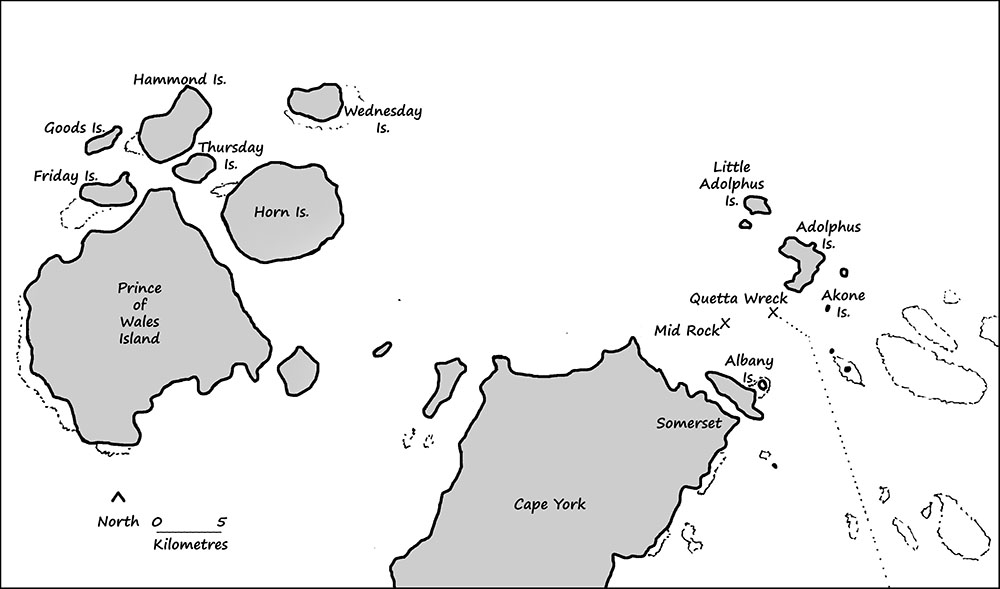
    At 9.14 on the evening of 28 February a sharp jolt and a shudder ran through the Quetta as she was being piloted through the Albany Passage.   Initially, the pilot and captain were more perplexed than alarmed.  The pilot was sure they were miles from any known hazards and it didn’t feel like they had hit anything substantial.  None-the-less Captain Sanders followed protocol and ordered the engines stopped, the lifeboats got ready and the carpenter to sound the wells.

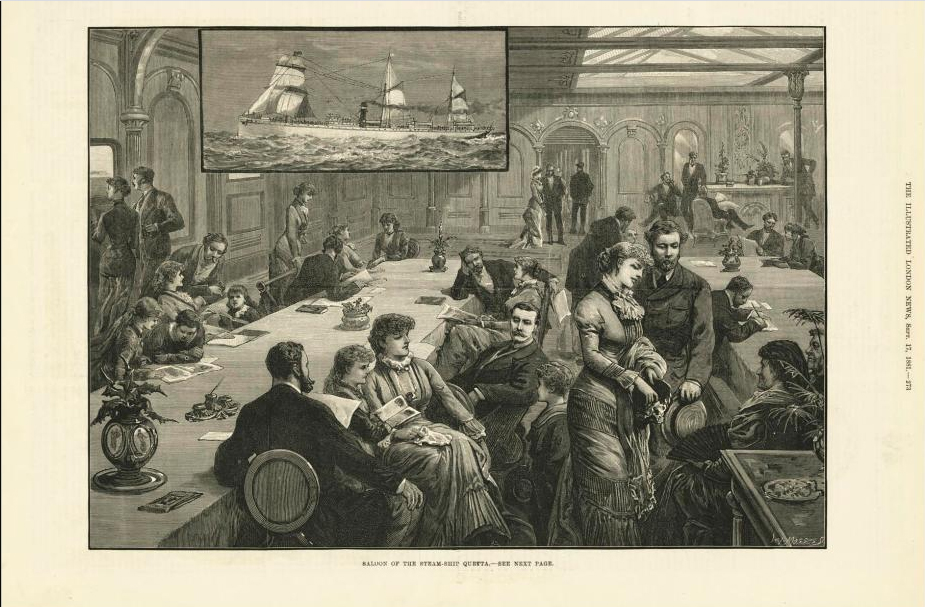
    The Quetta Saloon from The Illustrated London News, 1881.

    Moments later the carpenter cried out “she’s sinking.”   Water was pouring into the ship at an unimaginable rate.    What no one realised at the time was they had struck an uncharted rock pinnacle right in the middle of the main shipping channel through Torres Strait.   A gapping hole had been torn in the Quetta’s hull from bow to midship one to two metres wide.  

    The ship was already starting to settle by the bow as Captain Sanders ran aft encouraging passengers to make their way there.    At the time many of the first-class passengers were in the saloon rehearsing for an upcoming concert and were oblivious to what was taking place outside.   The crew were still frantically trying to get the lifeboats out when water began lapping at their feet only a minute or two later.

    Then the stern reared up out of the water and the ship plummeted below the surface of the sea spilling scores of people into the water.   Many others were trapped in the saloon, their cabins or under the ship’s sun awnings and drowned.  

    RMS Quetta showing the sun awnings covering the decks. Photo courtesy SLQ

    The Quetta sank in just 3 minutes.   Most of those who survived were already on the aft deck when the ship sank or were lucky to swim clear as she slid below the surface.  

    All was confusion in the water as people thrashed around in panic trying to find something to keep themselves afloat.  Eventually a measure of order was restored and one of the lifeboats, now floating free, was used to rescue as many people as it would hold.   A second lifeboat, though damaged, was filled with people and they all made their way to land a few kilometres away.

    About one hundred people made it to safety on Little Adolphus Island where they spent an uncomfortable night but they were alive.   Captain Sanders was among them.   The next morning he set off in the lifeboat manned by some of his men and made for Somerset to report the loss of the ship and get help for those still missing.   Apart from the people he had left on the island without food or water, there were many others who had washed up on other islands or were still clinging to pieces of wreckage out in the Strait.

    When the news reached authorities on Thursday Island a government steamer was dispatched to search for survivors.   Fishing boats from Somerset also combed the waters in the days that followed.    In all, about 160 people were saved, many had stories of lucky escapes.

    The full story of the Quetta’s loss is told in A Treacherous Coast: Ten Tales of Shipwreck and Survival from Queensland Waters, available as a kindle eBook or paperback through Amazon.

    © Copyright C.J. Ison, Tales from the Quarterdeck, 2022.

    To be notified of future blog posts please enter your email address below.

  • The Norna and the Conman Commodore

    The Norna’s sister ship Cornet.

       In the early 1900s, many hard-working sailing vessels saw out their days plying the waters between Australia and the islands of the South Pacific. Few, however, would have had such a fascinating history as that of the Norna.

       The Norna was built in New York in 1879 as a luxury ocean-going schooner rigged yacht. She was lavishly fitted out and built to be a fleet-footed racer. For the next decade or more, she held her own in many long-distance ocean races.

       Then, in 1895, she was purchased by self-styled “Commander” Nicholas Weaver, who claimed to represent a Boston newspaper empire seeking to establish a presence in New York. He was, in fact, a brazen conman.

       A few years earlier, Weaver had fallen foul of the law and only escaped gaol by testifying against his partner. He then hustled himself off to the West Coast, where he no doubt perfected his craft.

    Nicholas J Weaver, The Pacific Commercial Advertiser (Honolulu), 17 April 1900, p. 7.

       Now back in New York, he planned to take the Norna on a round-the-world cruise, sending back stories of his adventures which would be syndicated in America’s Sunday newspapers. He found several financial backers willing to cover his expenses in exchange for a share of the syndication fees. They founded a company, and Weaver sailed for the warm climes of the Caribbean.

       There, he made himself a favourite among the members of the Royal Bermuda Yacht Club, representing himself as the “Acting Commodore” of the prestigious Atlantic Yacht Club. The good people of Bermuda were not necessarily any more gullible than anyone else whom Weaver had separated from their money. But when someone sails into harbour aboard a 115-foot luxury yacht with a sailing crew of ten plus a cook and steward, few questions are likely to be raised. It also helped that Weaver himself was handsome, self-assured, and very charismatic.

       Weaver lived life to the full and spared himself no expense. He began hosting poker parties on his yacht, inviting only Bermuda’s most well-heeled residents. Though he proved to be uncannily lucky at cards, the winnings could not have covered his expenses. He funded his lavish lifestyle by chalking up credit with local merchants where possible, passing dud cheques if necessary, or forwarding invoices to his financial backers in New York.

       However, it was only a matter of time before things began to unravel. But before the inevitable day of reckoning, Bermudans awoke one fine morning to find the Norna and its flamboyant owner had cleared out in the dead of night.

    Yacht Norna leaving Honolulu. The Pacific Commercial Advertiser (Honolulu), 17 April 1900, p. 7.

       Weavers’ backers eventually realised they had been scammed and that they would never recoup their money. They wound up the company and stopped sending him money. But that did not deter Weaver from continuing on his round-the-world cruise.

       He visited many ports over the next couple of years, where he dazzled the wealthy with his largesse, while taking them to the cleaners at the poker table. He cruised around the Mediterranean, stopping long enough to run his con but always skipping out before debts became due.

       At the outbreak of the Spanish-American War, in April 1898, he and his American-flagged Norna found themselves in hostile waters. Realising his yacht might be seized, he set sail at his best speed with the Spanish navy in hot pursuit. Despite Weaver’s many character flaws, he was a superb mariner. Thanks to his skill and the luxury yacht’s fast sailing lines, the Norna outpaced the Spaniards, crossing into the safe waters of British-owned Gibraltar. There, he repaid his welcome by passing a fraudulent cheque for $5,000 and was once again on his way.

       During his travels around Europe, Weaver made the acquaintance of a man named Petersen, a fellow grifter. Together, they would prove a formidable team.

       Weaver and Pedersen would arrive in a new city independently, only to be introduced to one another by someone local, or they would fabricate a chance meeting as if they were strangers. Regardless of how they met, the result was always the same. They would get a high-stakes poker game going where one or the other would clean up.

       When Weaver reached Ceylon (present-day Sri Lanka), he was introduced to Petersen, who just happened to have recently arrived by steamer. They quickly got to work separating the wealthy from their wealth before moving on again. The pair repeated the same stunt in Sumatra, in the Dutch East Indies (now Indonesia), as well as in Hong Kong and Yokohama, Japan. At each port, they fleeced the local high society and vanished before alarm bells rang.    In Yokohama, Weaver passed himself off as the commodore of the New York Yacht Club and flew its pennant from his vessel. Weaver and Pedersen befriended each other and enjoyed many an evening with others playing poker on the Norna. Then, one morning, the yacht was gone. Pedersen joined the chorus baying for Weaver’s blood, claiming he, too, had been taken for a fortune. He then quietly slipped away on the next steamer leaving port.

    Schooner Norna circa 1911 now sporting a cabin on her aft deck. The Sun, 17 July 1911, p. 1.

       From Yokohama, the Norna made its way to Honolulu, where Weaver and Petersen briefly reunited. But when Weaver left Hawaii, Petersen remained. It seems as though the partnership had come to an end. The Norna stopped at Samoa long enough for Weaver to fleece the locals, then sailed on to New Zealand. At Auckland, Weaver began his now well-honed con, though this time without the able assistance of Petersen.

       Weaver racked up considerable debts, but before he could make his departure, the Norna was seized as surety. Realising the game was up, Weaver caught the next steamer bound for Sydney, vowing he would return to Auckland with the necessary funds to have his beloved yacht released. Not surprisingly, he vanished, and the yacht was put up for sale. It was purchased by a Sydney merchant and brought across the Tasman in June 1900.

       The Norna was stripped of her luxurious fittings, and the cabins were removed to make way for a spacious hold more fitting for her new working life. The Norna passed through several hands over the next 13 years. She served as a pearling lugger in Torres Strait and a trading vessel among the Pacific Islands. One owner even used her to salvage copper and other valuables from old shipwrecks far out in the Coral Sea. But, in June 1913, she, herself, was wrecked on Masthead Reef 50 km northeast of Gladstone Harbour. So ended the Norna’s fascinating and colourful career.

    © Copyright Tales from the Quarterdeck / C.J. Ison, 2022.

    To be notified of future blog posts, enter your email address below.