Category: Queensland History

  • The Spanish Silver of Torres Strait

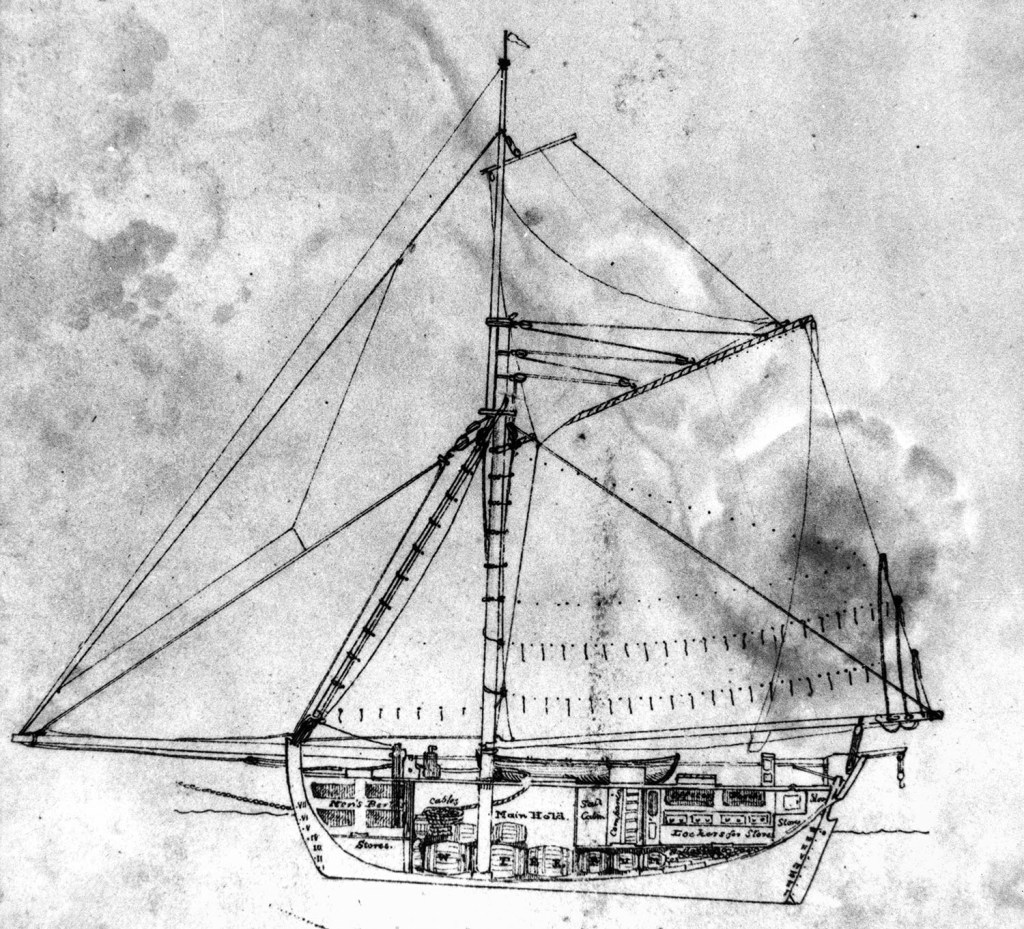
    Example of a mechant brig, similar to the Sun. Source: “L’Album De Marine Du Duc D’Orleans,” 1827.

       Sometime around 1891, a group of beche-de-mer fishermen stumbled upon a huge hoard of Spanish silver coins. The men had been fishing in the shallow waters of the Eastern Fields at the eastern approach to Torres Strait when they made the surprise discovery.

       At low tide, when much of the reef was exposed, they spotted an old, coral-encrusted anchor fluke jutting from the reef’s surface. The shoals of Torres Strait had claimed many a ship during the 19th Century, and the fishermen were keen to see what else they might find.

       They began chipping away at the decades of accumulated growth until the anchor finally broke free from the surrounding coral. When it was rolled clear, a mass of silver coins, all fused together by time and saltwater, was revealed. Buoyed by the find, the fishermen forgot about the beche-de-mer and extended their excavations. Each day, as soon as the falling tide exposed the reef, they got to work chipping away at the coral. In the end, they uncovered a staggering 410 kgs (900 pounds) of silver. It took them two trips to carry it all back to Somerset, the fishing and cattle station near the tip of Cape York owned by the early pioneering family of Frank Jardine.

    Spanish silver coins as circulated in the early days of New South Wales.

       At the time, it was supposed that the coins might have been carried on a Spanish ship on her way to Manila to pay the wages of the civil and military staff. Either that, or it was to be used to purchase spices from traders in the Indonesian Archipelago, further to the west. Regardless, the ship that had been carrying the fortune in silver had ended its voyage on that remote coral outcrop many decades earlier. They knew it was an old wreck, for by 1891, the timbers had long since rotted away.

       The mystery was only solved years later. It turned out not to have been a Spanish galleon at all. Instead, the fishermen had stumbled upon the remains of the English brig, Sun, which had been lost in Torres Strait in May 1826. Earlier that same year, the Sun had delivered a cargo of tea from China to merchants in Hobart and Sydney. In Sydney, a local businessman had entrusted the ship and her captain with a new cargo of between 30,000 and 40,000 Spanish silver dollars. At the time, one Spanish dollar was worth 4 shillings and 4 pence, which would have valued the somewhere between £7,000 and £10,000. In today’s money, the silver content alone would be worth well over one million Australian dollars.

       The Sun sailed from Sydney on 7 May, bound for Singapore by way of Torres Strait. But it never arrived. The voyage was cut short three weeks later when the Sun struck a submerged reef as it attempted to navigate the dangerous waters separating Cape York from New Guinea.
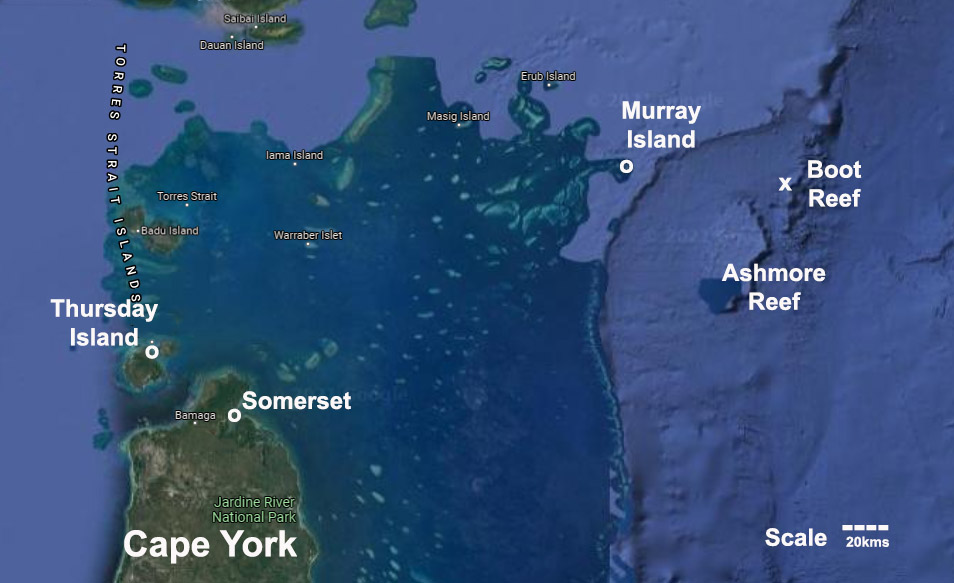
    Torres Strait. Source: Google Maps.

       The ship broke up almost immediately. Captain Gillet and his crew took to the longboat and jolly boat and made for Murray Island, about 30 nm (60 km) away. Such was the haste with which they were forced to abandon the ship that there was certainly no time to save the silver. The crew didn’t even have time to provision the boats with food or water before they pushed away from the wreck. Fortunately, they would only be at sea for two days before sighting land.

       As fate would have it, just as their safety seemed assured, the longboat struck a reef and capsized, spilling all the occupants into the water. The first and second mates, plus 22 lascar sailors, drowned. Only the jolly boat with the ship’s captain and 11 remaining seamen reached Murray Island, where they were looked after by the Islanders. Three days later, Captain Gillet and his men were rescued by a passing ship and eventually delivered to Calcutta, where he reported the loss of his ship.   

    So, there the Spanish silver dollars remained undisturbed for the next 65 years as the Sun slowly disintegrated around them. As the employer of the fishermen, Frank Jardine claimed the lion’s share of the haul. He reportedly had at least some of the coins melted down and made into silver tableware and cutlery for the Jardine Homestead.

    © Copyright C.J. Ison, Tales from the Quarterdeck, 2021.

    Enter your email address below to be notified of new posts.
  • Thomas Pamphlett and the Remarkable Castaways of Moreton Bay

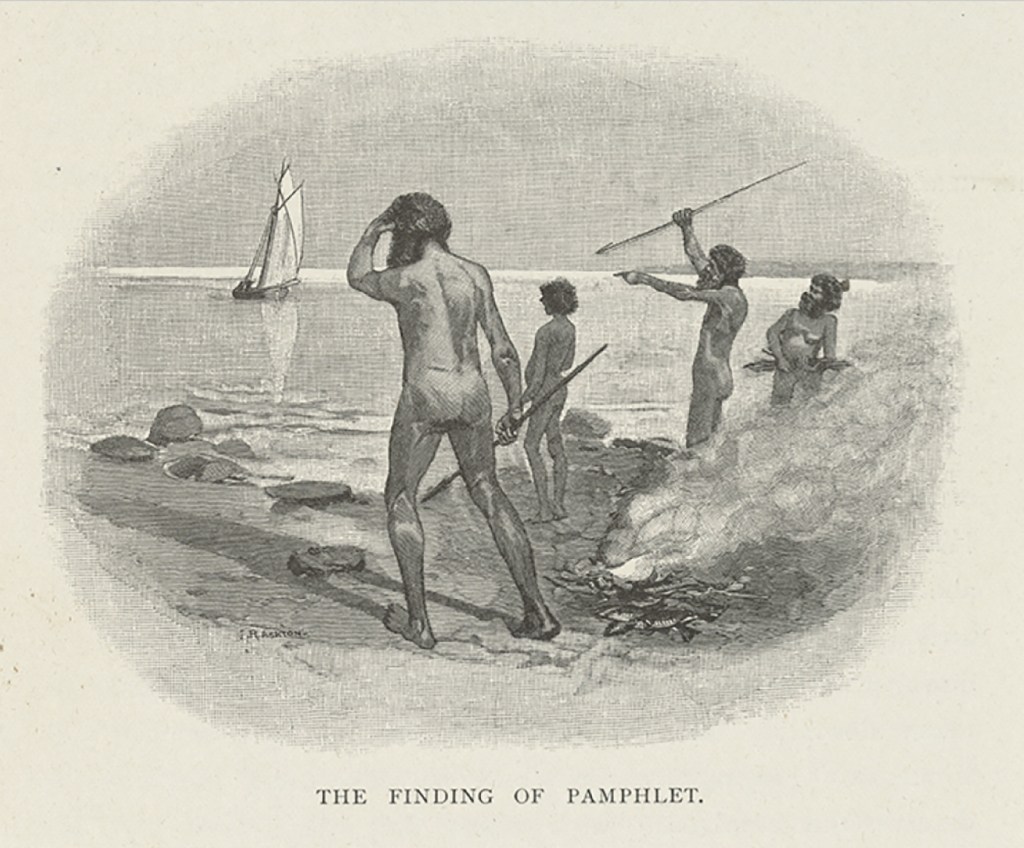
    Source: ‘The Finding of Pamphlet’, Picturesque Atlas of Australasia, vol. II, 1886, nla.cat-vn1654251.

    Most Queensland school children are taught that the first non-Aboriginal people to settle in their state were convicts and their gaolers who arrived in September 1824.   But actually the first white-skinned people to live in what would become Queensland were three castaway ex-convicts who came ashore 18 months earlier.

    In 1823 Governor Brisbane sent the NSW Surveyor General, John Oxley, to determine if Moreton Bay, 800 kilometres north of Sydney, would make a suitable penal settlement to house the colony’s worst and most incorrigible convicts.

    On 29 November the small government cutter Mermaid, carrying Oxley and his party, dropped anchor in Pumicestone Passage separating Bribie Island from the mainland.   To their astonishment, among the Aborigines they could see on shore stood a taller, lighter-skinned man excitedly haling them.    His name was Thomas Pamphlett and he and two mates had been living with the local Aboriginal peoples for the past seven months.

    This is their story.     On 21 March 1823 four ticket-of-leave men, Thomas Pamphlett, John Finnegan, Richard Parsons and John Thompson, sailed from Sydney in a 10-metre-long open boat bound south to the Illawarra to gather cedar logs for sale in Sydney.

    However, they were caught in a ferocious storm which battered the craft mercilessly for five days.   They were driven far from the coast under a bare mast and when the storm finally cleared five days later they had no idea where they were.     They thought they had been blown south towards Van Diemen’s Land but in fact they had been taken north.    So, when they could finally hoist a sail they bore north in search of Sydney.  

    Their water had run out days earlier and they only had rum to quench their thirst.    All four were in a bad way but John Thompson became delirious and died from thirst.   They kept him in the boat for several days until the smell drove them to bury him at sea.  

    They finally sighted land about three weeks after setting off from Sydney.   This turned out to be Moreton Island though that was not known to them at the time.   They could see a freshwater stream flowing across the beach so Pamphlett swam ashore with the water keg in tow.   He drank his fill but was too weak to swim back to the boat.    The others, crazed with thirst, brought the boat closer to shore but it got caught in the surf and was smashed to pieces.

    The three men were alive but stranded.   They salvaged some flour, a bucket, an axe, a pair of scissors, the water keg but little else.    They soon came across an Aboriginal camp in the sand dunes and were befriended by the people.    The three castaways lived with their hosts for a couple of months then they decided to set off north thinking they would eventually reach Sydney.

    First they went south to cross over to Stradbroke Island then onto the mainland where they ventured north around Moreton Bay   All the time they were accompanied by different bands of Yuggera.   Pamphlett and Finnegan decided to stop at Bribie Island on the northern edge of the bay and lived with the Joondoobarrie people until they were found by Oxley and his party.     Parsons, still determined to return to Sydney kept heading north and may have gone as far as Harvey Bay before it was made clear to him his presence among the Butchella people was not welcomed.  

    The cutter Mermaid. Photo State Library of Queensland

    He returned to Bribie Island many months later only to find his comrades had been taken away on the Mermaid.   However, the party of explorers left a message in a bottle for Parson should he ever pass that way again.   Unfortunately, he was illiterate and could not read the message that had been left for him, but he remained in that area in the hope that another ship might pass that way.    He was in luck.   The brig Amity sailed into Moreton Bay in September the following year with 30 convicts and their guards to establish the first settlement at Redcliffe.   When they came ashore Parsons was standing on the beach waiting for them.  

    Richard Parsons was returned to Sydney and found work as a bullock driver. John Finnegan later returned to Moreton Bay and took up a post piloting ships in and out of the bay. Thomas Pamphlett also returned to Moreton Bay, but it was not of his own choosing. He stole two bags of flour in 1826 and was sentenced to spend seven years toiling at Moreton Bay penal settlement.

    For more interesting stories from Australia’s maritime past check out  A Treacherous Coast: Ten Tales of Shipwreck and Survival from Queensland Waters, available now as a Kindle eBook or paperback through Amazon.

    (c) C. J. Ison / Tales from the Quarterdeck, 2021.

    To be notified of future blog posts, please enter your email address below.