Category: Queensland History

  • HMCS SPITFIRE: Australia’s first locally built warship

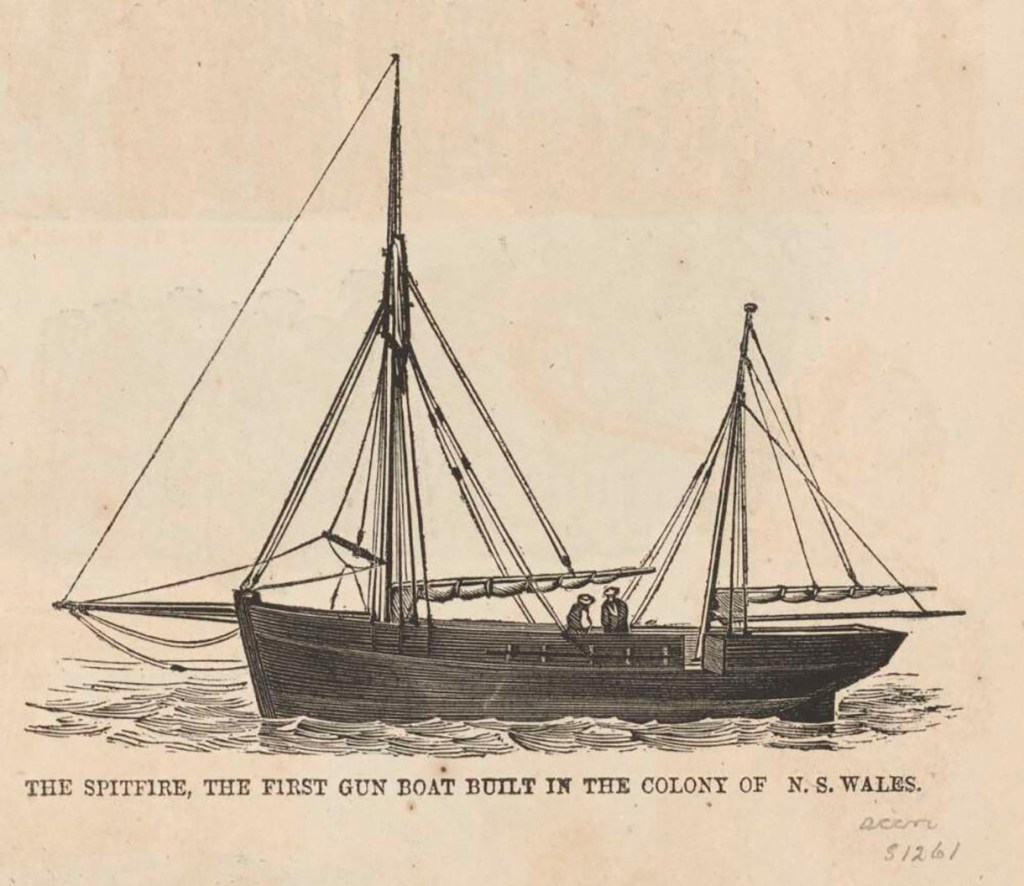
    The Spitfire, The first gun boat built in the colony of N. S. Wales. Image courtesy NLA nla.obj 138450394-1

    Launched in 1855, HMCS Spitfire has the distinction of being Australia’s first locally built naval vessel.   Originally conceived as a gunboat to bolster Sydney Harbour’s defences, she never fired a shot in anger. Nonetheless she went on to serve New South Wales and Queensland in a variety of important roles, some of which she was patently ill-suited to.  The Spitfire eventually saw out her days as a fishing boat operating in Far North Queensland waters in a career spanning some 43 years.   This is her fascinating story.

    In October 1853, war erupted between Russia and the Ottoman Empire, and in March the following year Britain joined on the side of the Ottomans.   Fearing that Sydney might come under attack from Russian naval forces based in the North Pacific, the colonial NSW government commissioned the Spitfire to help defend Port Jackson.

    The Spitfire glided into the untroubled waters of Darling Harbour at 10 o’clock in the morning on 7 April 1855. The proceedings were attended by great fanfare, pomp and the cheers from a large crowd of onlookers, though the NSW Governor was conspicuously absent from the ceremony.

    Built at Cuthbert’s Shipyard (in the vicinity of present-day Barangaroo), the Spitfire was a vessel of 60 tons, measuring 62 feet (18.9 m) in overall length, with a beam of 16 feet (4.9 m) and a draft of five feet six inches (1.7 m). The small ketch-rigged vessel was constructed of ironbark and blackbutt and sheathed with copper plate. She was built more robustly than usual to accommodate a 32-pound smooth-bore gun amidships on a traversing carriage. The bulwarks on either side could be lowered to allow the gun to engage targets to port and starboard.1
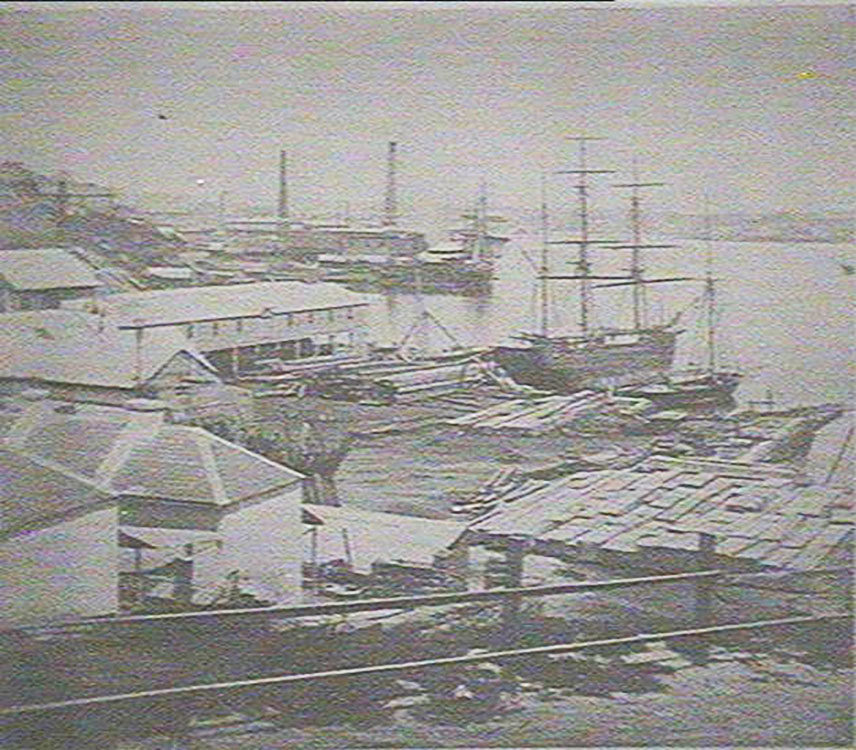
    Cuthbert’s shipyard, Darling Harbour. Image courtesy State Library of NSW.

    The Spitfire did not have its own full-time gunners. Rather, it was to rely on appropriately trained members from the local volunteer artillery should they ever be needed. However, though designated a “gunboat,” the main armament seems to have never actually been fitted.

    Even though the government had paid for the Spitfire’s construction, it was less forthcoming when it came to paying for its ongoing operational and maintenance costs. And there was some debate in the corridors of power as to just how a single vessel would be deployed in the event of a Russian attack. But, fortunately that soon became a mute point.

    Ten months after the Spitfire‘s launch, the Crimean War came to an end, as did any threat posed by Russia.   The Spitfire was then put to use as a general utility vessel, conveying stores and personnel to lighthouses dotting the New South Wales coast.  Then in July 1857 she was sent to Moreton Bay to maintain, set and recover that port’s navigation buoys. And when Queensland separated from New South Wales in December 1859, ownership of the Spitfire transferred to the new colonial government.

    She was stationed at the Moreton Island Pilot Station at Cowan Cowan. Primarily the Spitfire was used to ferry pilots out to ships so they could be safely guided into the bay. From there, she could also readily attend to the navigation buoys as needed. However, from the outset she proved ill-suited for that task as she lacked the necessary maneuverability.

    Between August and October 1860, the Spitfire was sent on a voyage of discovery under the command of Lt J W Smith, a Royal Navy officer seconded from HMS Herald. The party included the master of the Spitfire, Queensland’s Commissioner of Crown Lands, George Dalrymple, surveyor, R P Stone, and a botanical collector named Eugene Fitzalan. They were joined by seven seamen and two Aborigines, bringing the party to 14 in total.2

    Eleven years earlier, explorer Ludwig Leichhardt had crossed a wide river on his 1849 inland expedition to Port Essington. He named the river after one of his sponsors, Thomas Burdekin. The Spitfire’s job was to locate where the Burdekin River flowed into the Pacific Ocean.

    She returned to Moreton Bay in October, the voyage a resounding success. The mouth of the river was found to open into a bay north of Cape Upstart, Fitzalan returned with over 100 botanical specimens, and the future site of Bowen was surveyed. 

    While landed there, the party was confronted by a band of Aborigines. Thinking they had some hostile intent, the expeditioners drove them off. Years later, we would learn that the Aborigines had simply tried to alert Dalrymple and the others to the presence among them of James Morell, a sailor who had been shipwrecked back in 1846.3 See my blog “The Peruvian’s Lone Survivor” for his story.
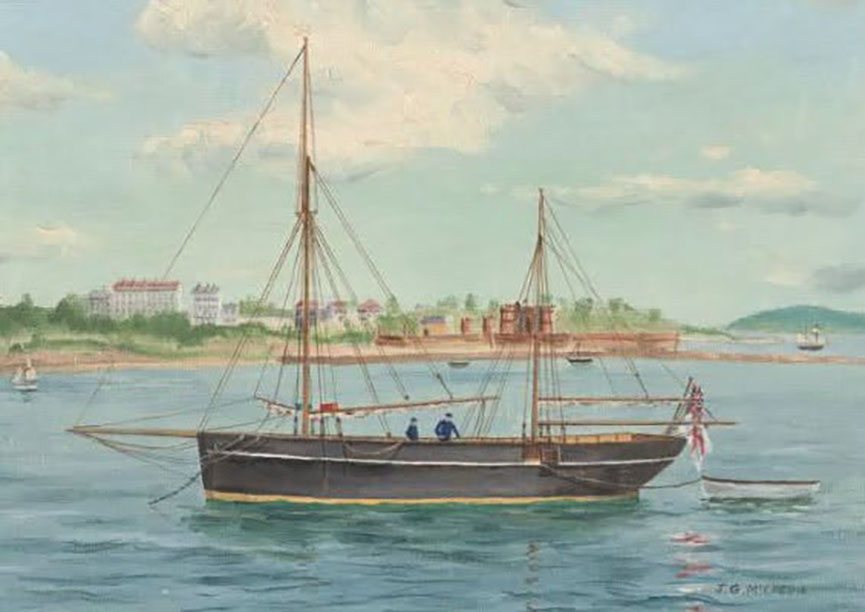
    HMCS Spitfire. Image courtesy Naval Association Australia Queensland Section.

    Once back at Moreton Bay, the Spitfire returned to her routine duties, and it is probably a testament to the men who sailed her, that she continued in service for so many years. One critic wrote that she was “totally unfit for her work, as everything afloat can leave her astern.”4

    In January 1874, disaster struck which almost saw the end of the schooner and the lives of her seven man crew. After delivering a pilot to a ship waiting to enter the bay, the Spitfire was caught in a violent storm. As she approached the passage into Moreton Bay she was dismasted by huge seas and gale force winds. The crew battled to get a pair of anchors over the side as the maelstrom raging around them. Thankfully, they succeed and the anchors held, preventing the schooner from being driven ashore and smashed to pieces. 

    The captain and three volunteers then managed to get a whaleboat over the side and went in search of help while their shipmates remained with the Spitfire. They rowed for some 10 hours without a break and eventually reached the Lady Bowen anchored about 8 miles away. After the storm had subsided, the steamer took the Spitfire in tow and brought her safely into Moreton Bay.5

    However, by now the Spitfire was long past her prime and even the authorities had to acknowledge that she was no longer suitable for continued service as Moreton Bay’s pilot boat. But rather than scrap her, she was given a new role in Far North Queensland.

    Gold had been discovered on the Palmer River 100 km inland from what would become Cooktown on the banks of the Endeavour River. Thousands of miners flooded into the area, and the busy port was in want of a new pilot boat. The Spitfire was sent to fill the role.
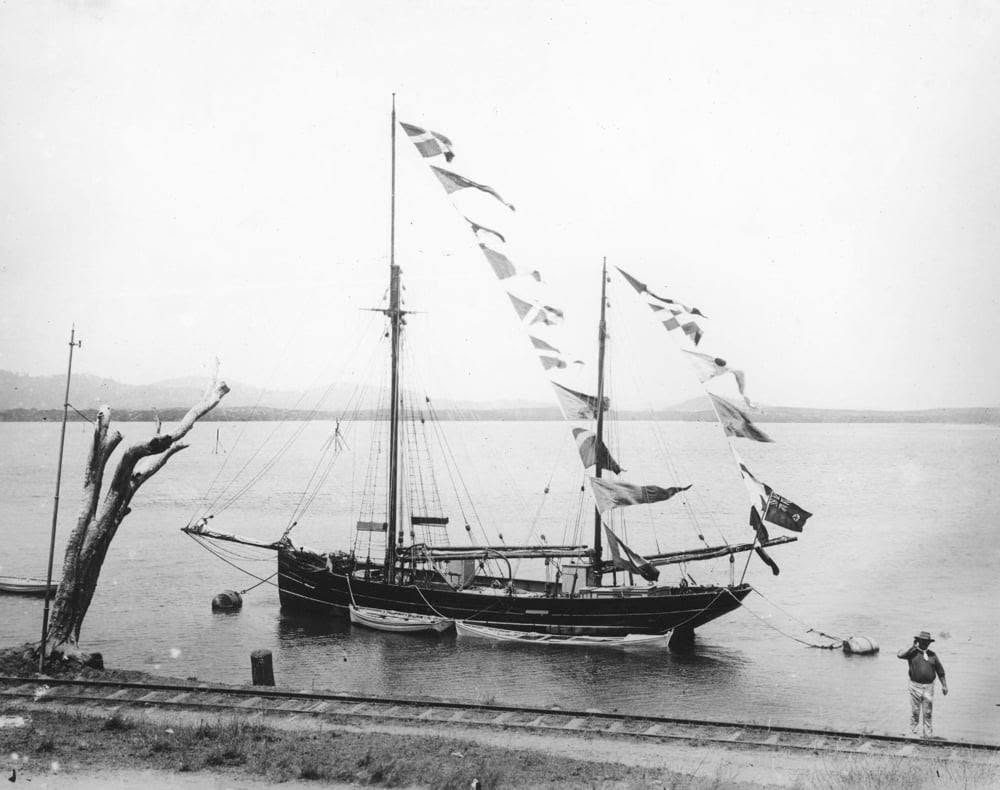
    Though her limitations followed her, she still provided valuable service. She was regularly called upon to investigate reports of shipwrecks and to go in search of survivors in those remote waters.  One such instance occurred shortly after the Spitfire arrived in Cooktown. She was sent to search for a white woman rumoured to be living with Aborigines near Cape Melville, however, after a couple of weeks in the area, no such woman was found.  

    More typically, the schooner was tasked with maintaining the lightships and navigation beacons safeguarding vessels making their way along Queensland’s northern coast.

    Then, in January 1882, the Spitfire and her crew were given the melancholy task of retrieving the remains of Mary Watson (21), her infant son and a Chinese servant named Ah Sam. Mary’s husband Robert Watson and his business partner had established a Beche de Mer fishing station on Lizard Island. In September 1881, he and the rest of the men went in search of trepang, leaving his wife, son and two Chinese servants alone at the station. A party of Aborigines landed on the island and attacked them, killing one of the Chinese servants and wounding the other.

    Mary Watson fled in a metal boiling tank with her son Ferrier and the wounded Ah Sam.   Though adequately provisioned with food, they had left with only a small amount of fresh water. For the next eight days they drifted northwest with the current, and finally beached on one of the Howick Islands about 50 km away. However, before they were found, Ah Sam died from his wounds, and Watson and her son from dehydration. She left a poignant diary recording her final days.6
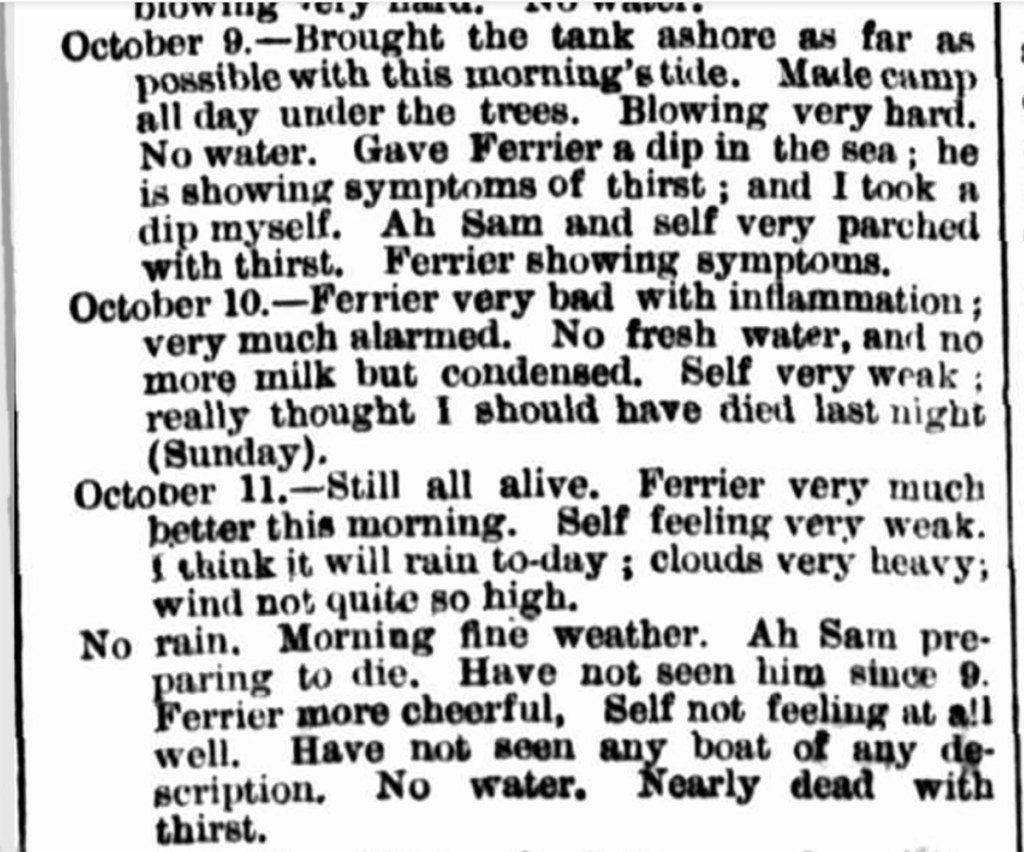
    Darling Downs Gazette, 10 Feb 1882, p. 5.

    Despite being solidly constructed, or perhaps because of it, she proved a fairly poor sailer. One critic wrote, “Although she is periodically pitched and patched, the old tub is growing more shaky and useless every year. … She can make about 5½ to 6 knots with the wind over her quarter, but in beating to windward she gains about 10 miles in 24 hours going crab-like on every tack.” 7

    In mid-July 1885, the Queensland government finally made the decision to auction off the now 30-year-old Spitfire.  The new owners paid £300 for her and fitted her out for Beche de Mer fishing.

    Over the next 14 years, she passed through several hands for Beche de Mer fishing was not for the faint hearted. Based out of Cooktown, the Spitfire would be gone for months at a time. The fishermen would establish a camp and a smokehouse on one of the Great Barrier Reef islands and harvest trepang from the surrounding waters.   When the hold was filled, the Spitfire would return to port to offload the dried Beche de Mer and stock up with supplies before heading back out again.

    In 1896, she was nearly lost off Hinchinbrook Island during a cyclone. With jury-rigged mast and sails, the Spitfire limped back to Cairns for repairs. But three years later her luck finally ran out.

    On 21 August 1899, the Spitfire sprang a leak during rough weather, and her captain had little choice but to run her aground on a reef about 15 km south of the Piper Island lightship. All hands were subsequently rescued and a Marine Board Enquiry found the captain blameless for the little schooner’s loss.8

    Thus ended the career of Australia’s first locally built gunboat. Although she was often criticised for being unsuited to many of the jobs she was called upon to do, she still provided valuable service for over four decades.

    SOURCES

    1.           Launch of the First Australian Gunboat, The Empire, 5 Apr 1855, p. 4.

    2.           Report of the proceedings of the Queensland Government schooner “Spitfire” in search of the mouth of the River Burdekin, on the north-eastern coast of Australia  … Brisbane: [Queensland Govt.], 1860

    3.           Gregory. Edmund, 1866, Sketch of the Residence of James Morrill among the Aborigines of Northern Queensland, Courier General Printing Office, Brisbane, p. 13.

    4.        The Courier, 23 Dec 1863, p. 2.

    5. The Telegraph, 31 Jan 1874, p. 3.

    6.         Darling Downs Gazette, 23 Jan 1882, p. 3.

    7.         The Brisbane Courier, 17 Jun 1884, p. 5.

    8.         The Telegraph, 10 Sept 1898, p. 7, Morning Post, 15 Sept 1898, p. 4, and Tasmanian News, 2 Nov 1898, p. 2.

    © Copyright C.J. Ison / Tales from the Quarterdeck, 2026.

    Please enter your email address below to be notified of future blogs.
  • Four Years in Torres Strait: The Extraordinary Tale of Barbara Thompson

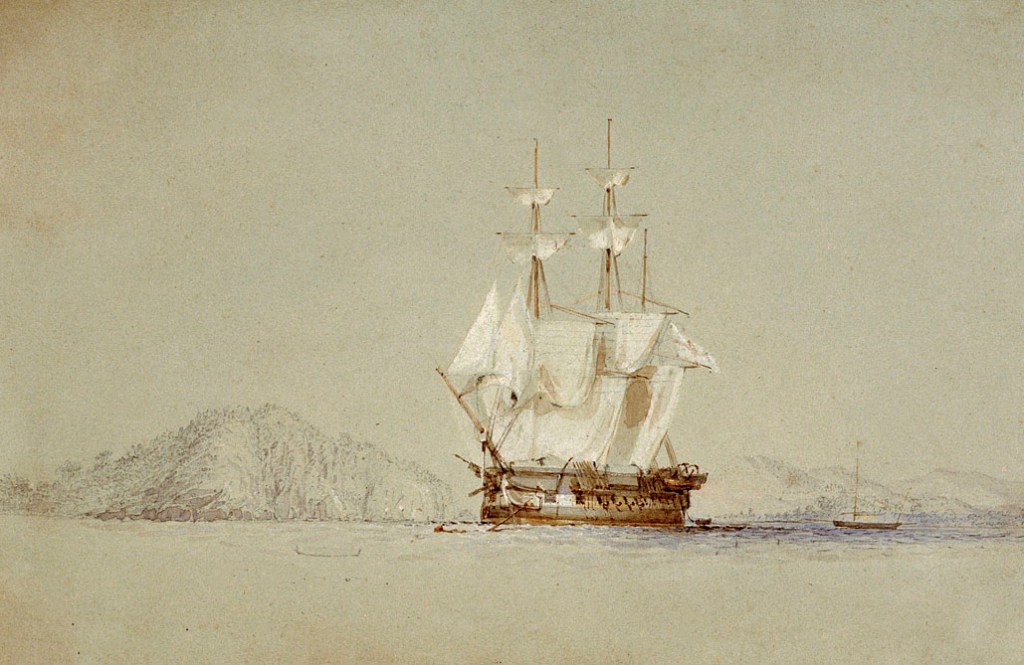
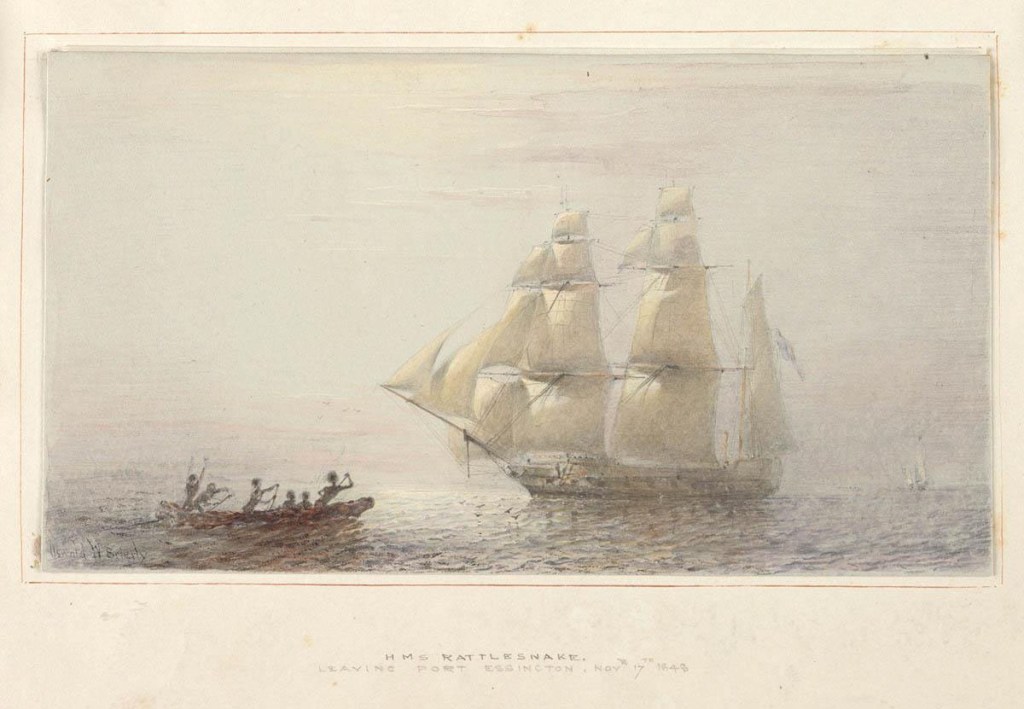
    HMS Rattlesnake circa 1848. Courtesy State Library of NSW.

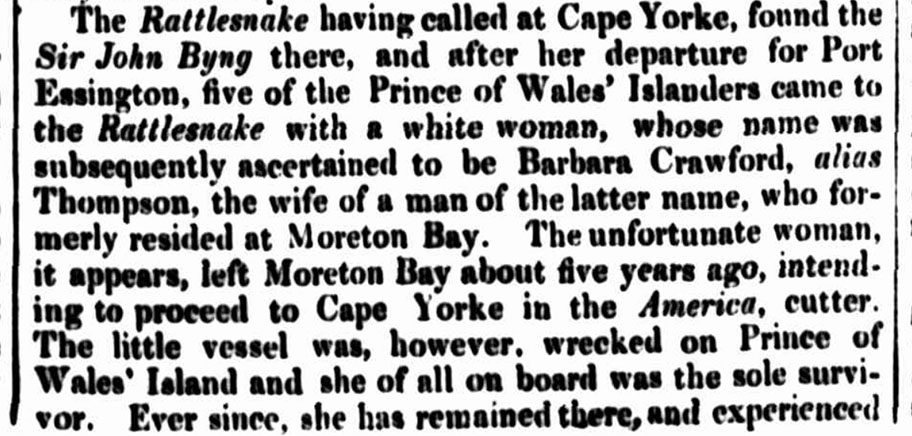
    In 1845, a small cutter quietly slipped out of Moreton Bay, supposedly bound 300 km up the coast to salvage whatever they could from a ship reported to have been wrecked in that vicinity.  The three-ton vessel and her crew were never heard of again, at least not for nearly five years. Then, in late 1849, sailors from HMS Rattlesnake were ashore near the tip of Cape York when they were approached by a white woman seeking their protection.  In halting English, she claimed to be Barbara Thompson, the only survivor from the missing cutter. This is her remarkable story.

    Born in Aberdeen in the late 1820s. Barbara Crawford arrived in New South Wales with her parents as free settlers on the convict transport John Barry. Her father, a tinsmith by trade, had left Scotland to start a new life for himself and his children in Sydney. By 1845, Barbara had left the family home in Pyrmont, married a man named William Thompson and was living in Moreton Bay.

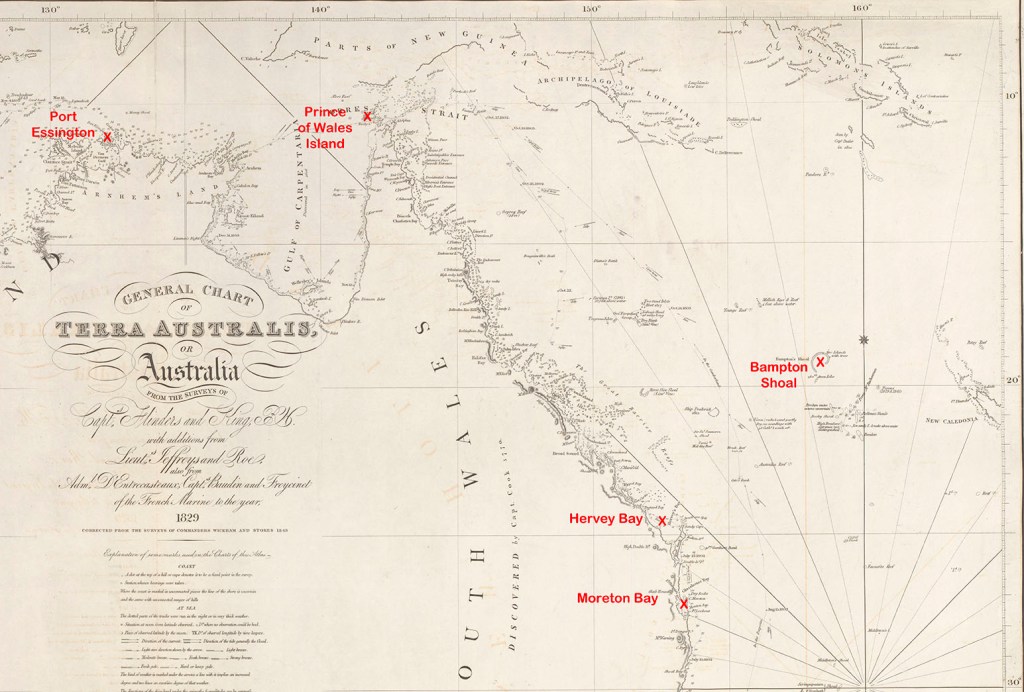
    Around the middle of 1845, it seems William Thompson thought he had found an easy way to make some money. He had learned that a ship filled with whale oil had run aground on Bampton Shoals, over 1,000 km away in the vast expanse of the Coral Sea. Despite having no salvage rights to do so, he decided to search for the ship and take as many barrels of oil as his tiny vessel could carry.

    A year earlier, in June 1844, the American whaler Clarence had run aground at Horseshoe Reef in the Bamptons. Unable to get his off, the captain made the difficult decision to abandon her and make for Moreton Bay in the boats.    Salvage rights to the Clarence and her valuable cargo were sold at auction in Sydney to a man named Cole. He quickly dispatched the schooner Elizabeth, under the command of Captain Riley, to Bampton Shoals to make good on his investment.   Purchasing the salvage rights to any wreck, sight unseen, in such a remote and dangerous part of the world, was always risky. Cole would have to wait to see if his gamble would pay off.

    Background map courtesy National Library of Australia.

    After Captain Riley arrived at the wreck site and carefully examined the damage to the Clarence, he was convinced he could not only retrieve the whale oil, but he could also save the ship and sail it back to Sydney.  So, he loaded the Clarence’s more valuable stores onto his schooner and sailed for home with the good news. He then returned to Bampton Shoals with a couple of shipwrights and the necessary equipment to repair the whaler’s hull and refloat her. However, Riley’s luck took a turn for the worse in January 1845, when a ferocious storm swept the Elizabeth from her moorings and out to sea. Captain Riley and six of his men were now stranded, having taken shelter on the Clarence during the storm. After waiting six weeks for the Elizabeth to return, Riley accepted that his schooner had likely sunk during the storm.  He had the shipwrights prepare their longboat for the hazardous open-ocean voyage to the Australian mainland by raising the freeboard and building a temporary deck. Once work was complete, they set sail for Moreton Bay with just an old hand compass to guide them. The passage would take them 37 gruelling days.

    At Moreton Bay, Captain Riley sold the longboat to William Thompson, who named the three-ton cutter-rigged vessel America. By now, it was mid-1845.   Thompson told people that he intended to salvage the remains of a ship Captain Riley said he had spotted aground on the northern end of Fraser Island (K’Gari).  In reality, Thompson planned to sail to Bampton Shoals and fill his hold with the Clarence’s whale oil before continuing through Torres Strait and on to Port Essington with his spoils.   While Thompson had bought the Elizabeth’s longboat, it’s unlikely he had also bought the salvage rights to the Clarence and her cargo. They would still have belonged to Cole.

    The America set sail from Moreton Bay around August or September 1845.  Joining Thompson were his young wife Barbara and four crew, one of whom was likely a man named Harris who had been on the Elizabeth and said he knew where to find the Clarence.  

    It seems to have been an unhappy vessel.  They were plagued by foul weather, and according to Barbara, there was much “quarrelling on board.”  Two of the crew even drowned during the voyage, though the circumstances remain a mystery.  As it turned out, Harris was unable to find the Clarence or even Bampton Shoals, for that matter. With their provisions almost depleted, Thompson abandoned the search and made for Port Essington via Torres Strait. Somewhere along the way, he put Harris ashore under circumstances that are not entirely clear.  Harris would spend eight months as a castaway somewhere on Cape York before being rescued by a passing ship and taken on to Hong Kong.  

    Meanwhile, Thompson, his wife and one remaining member of the crew cleared the tip of Cape York, but the America struck a reef off the eastern end of Prince of Wales Island (Muralag) during bad weather.  Thompson and the seaman drowned when they tried to swim ashore through the surging seas.   Barbara was left trapped on the cutter until she was rescued by Islanders returning from a turtle hunt after the weather had moderated.

    One of her rescuers, a man named Boroto, claimed Barbara as his wife, something she had no say in. Despite this, she also later claimed she had been well-treated by the Kaurareg. Her place in the community was assured after an elder declared that Barbara was the reincarnated form of his deceased daughter, Giaom. Barbara was renamed Giaom in her honour.

    Giaom, as she was now called, lived with the Kaurareg for the next four years. She learned their language, customs, and way of life. She shared their good times and bad and seems to have been well-liked. That is not to say her life was easy. Life with the Kaurareg would have been challenging for any white person of that era to adapt to. But adapt she did.  

    The only restriction placed on her was that she was barred from communicating with any of the scores of ships that passed through Torres Strait each year. It is quite likely that she always harboured a dream to return to her former life, and a few years later, she got her chance.

    In October 1849, a friend told her that a ship had stopped near the tip of Cape York.  She enlisted the help of several female friends, and they made the crossing to the mainland. She had assured them that she only wanted to meet the white men and shake their hands. Actually, she had already decided to leave the Kaurareg and hoped to do so on that ship. She figured this might be the only chance she had to make it back to Sydney to see her family again. When her husband, Boroto, was told what she was up to, he and several of his mates set off in pursuit.

    HMS Rattlesnake at anchor circa 1850. By Capt. Owen Stanley.

    On 16 October, Barbara Thompson and her friends stumbled on a party of seamen from the British survey ship HMS Rattlesnake.  Barbara was not immediately recognised as a white woman. For though naked but for a fringe of leaves strung around her waist, her skin was so deeply tanned and blistered by long exposure to the tropical sun as to make her indistinguishable from the other Aboriginal women. Barbara was reportedly “wretched in appearance,” and blind in one eye, and it was only when she spoke a few halting words that they realised she was a British subject. “I am a white woman. Why do you leave me?” she pleaded, wanting to be taken back to their ship. She was clearly awkward about her nudity in the company of white men, so the sailors gave her two shirts to cover herself and then took her back to the Rattlesnake.

    It was not long before Boroto was alongside in a canoe demanding that she be returned to him.   Meanwhile, Captain Owen Stanley had listened to her story and told her that the choice to stay or go was hers alone to make.  She chose to remain on the Rattlesnake. Captain Stanely remained at Cape York for several more days, and during that time, many of Barbara’s friends came out to visit her. Even Boroto was allowed on board to speak with his wife. At first, he tried using soft talk and promises to convince her to change her mind and come back home. When that didn’t work, he grew furious and threatened to kill her if she did not do as she was told. Boroto finally stormed off the ship empty-handed.

    While on the Rattlesnake, Barbara AKA Giaom was befriended by the Rattlesnake’s naturalist, John MacGillivray. Barbara proved to be a godsend when it came to understanding the ways of the local peoples. She added several hundred Kaurareg words and their English translations to his dictionary, and she also helped him to understand how Kaurareg grammar worked. She also freely shared her knowledge of the manners, customs, and daily life of her adopted people, giving MacGillivray insights he could never have gained on his own.   MacGillivray’s account of the Rattlesnake’s expedition, Narrative of the Voyage of HMS Rattlesnake, published in 1852, is dotted with references to Giaom’s contributions on the Kaurareg people of Torres Strait.

    Barbara Thompson’s health improved with medical attention and a return to a Western diet. The Rattlesnake arrived back in Sydney in February 1850, where Barbara was reunited with her parents.

    © Copyright C.J. Ison / Tales from the Quarterdeck, 2026.

    If you would like to be notified of future blog posts, please enter your email address below.

  • Tales from the Quarterdeck

    Sixty bite-sized stories from Australia’s maritime past

    The melancholy loss of H.M.S Sirius off Norfolk Island by George. Raper. Source National Library of Australia 136507434-1

    I have just launched a new book titled Tales from the Quarterdeck: Sixty bite-sized stories from Australia’s maritime past. Sixty of the most popular posts have been reedited. In some cases, I’ve rewritten a couple and updated a few where new information has come to light since first writing them.

    For those who would value ready access to the stories in their bookcase, Tales from the Quarterdeck is available in Kindle ebook and paperback formats through Amazon.

    The stories are organised in chronological order, starting with the Tryall shipwreck off the Western Australian coast in 1622, and finishing with the Second World War exploits of the Krait. See below for a full list of the stories covered in the book.

    Sydney Gazette 22 May 1808, p. 2.

    1622 – The Tryall: Australia’s earliest shipwreck

    1629 – The Batavia Tragedy

    1688 – William Dampier: Navigator, naturalist, writer, pirate

    1770  – The Endeavour’s Crappy Repair

    1788 – Loss of La Astrolabe and La Boussole, a 40-Year Mystery                        

    1789 – Bligh’s Epic Voyage to Timor

    1789 – HMS Guardian: All Hands to the Pumps

    1790 – The Loss of HMS Sirius

    1790 – Sydney’s First Desperate Escape

    1791 – HMS Pandora: Queensland’s earliest recorded Shipwreck

    1791 – William Bryant’s Great Escape

    1797 – The Loss of the Sydney Cove

    1803 – Loss of HMS Porpoise

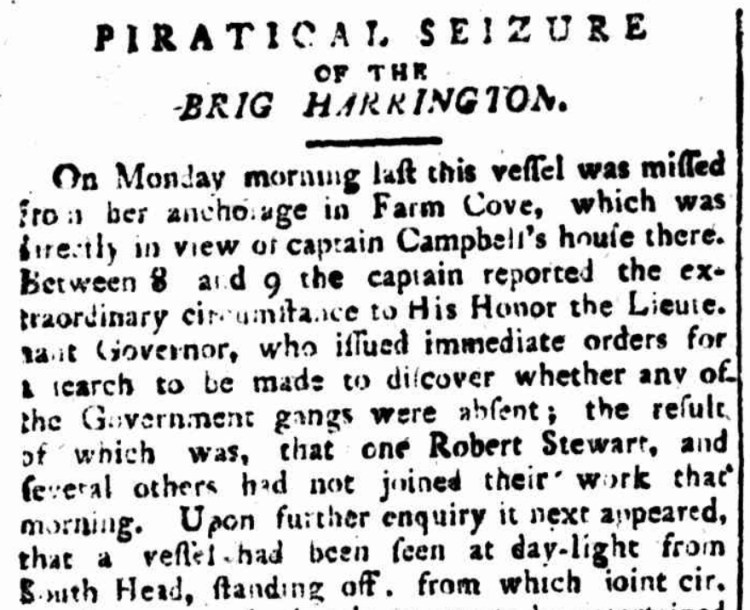
    1808 – Robert Stewart and the Seizure of the Harrington

    1814 – Wreck of the Morning Star

    1816 – The Life and Loss of HMSC Mermaid

    1824 – The Brig Amity’s Amazing Career

    1829 – The Cyprus mutiny 

    1831 – The Caledonia’s perilous last voyage

    1833 – The Badger’s Textbook Escape

    1835 – The Loss of the Convict Ship Neva

    1835 – The Post Office in the middle of nowhere

    1835 – The Tragic Loss of George III

    1845 – The Cataraqui: Australia’s worst shipwreck

    1846 – The Peruvian’s Lone Survivor

    1847 – The Foundering of the Sovereign

    1850 – The Loss of the Enchantress: A first-hand account

    1851 – The Countess of Minto’s brush with Disaster

    1852 – The Bourneuf’s Tragic Last Voyage

    1852 – The Nelson Gold Heist

    Woodbury, Walter B. (Walter Bentley), 1834-1885. Hamlet’s Ghost, Sourabaya [Surabaya], Java [Boat with Passengers and Crew], ca. 1865. Walter B. Woodbury Photograph Collection (PH 003). Special Collections and University Archives, University of Massachusetts Amherst Libraries

    1854 – Bato to the Rescue 

    1854 – HMS Torch and the rescue of the Ningpo

    1856 – The Loss of the Duroc and the Rise of La Deliverance

    1858 – The Loss of the Saint Paul and its Horrific Aftermath

    1858 – Narcisse Pelletier, An Extraordinary Tale of Survival

    1859 – The Indian Queen’s Icy Encounter

    1859 – The Sapphire and Marina

    1863 – The loss of the Grafton: Marooned for twenty months

    1864 – The Invercauld shipwreck

    1865 – The CSS Shenandoah: Victoria’s link to the American Civil War

    1866 – The Loss of the SS Cawarra: Bad luck or an avoidable tragedy?

    1868 – The Bogus Count and Hamlet’s Ghost

    1871 – The Mystery of the Peri

    1872 – The Loss of the Maria, A Cautionary Tale

    1875 – The Tragedy behind the Gothenburg Medals

    1876 – The Catalpa rescue

    1876 – The Banshee’s Terrible Loss

    1878 – The Loch Ard Tragedy

    1884 – The Macabre case of the Mignonette

    1885 – The Douro and its Piratical Captain

    1889 – The Windjammer Grace Harwar

    1891 – The Spanish Silver of Torres Strait

    1893 – The Foundering of the SS Alert

    1895 – The Norna and the Conman Commodore

    1899 – Cyclone Mahina

    1911 – The Loss of the Mandalay

    1918 – The Orete’s Robinson Crusoe-like Castaway

    1935 – The Life and Loss of  the SS Maheno

    1943 – Surviving the Centaur Sinking

    1943 – The Amazing Krait

  • Wreck of the Morning Star – 1814

    Example of a Brig. Source: Winston’s Cumulative Loose-Leaf Encyclopedia 1918

       On Sunday, 3 July 1814, the merchant ship Morning Star sailed out of Sydney Harbour bound for Calcutta by way of Torres Strait and Batavia.  However, her voyage north ended abruptly on a coral reef south of the Forbes Islands off the far north Queensland coast. The vessel was a 140-ton Calcutta-built brig owned by the Indian-based trading house Lackersteen and Co. When she left Sydney, the crew numbered 37 men, a mix of European and Indian seamen, all under the command of Captain Robert Smart. Only six of them would survive the ordeal.

       No account exists of how the ship was lost, but from the location of the wreck site, it appears that Captain Smart was sailing within the Great Barrier Reef when he ran aground and had to abandon ship.

       Lieutenant James Cook had charted the route back in 1770, and he had only narrowly avoided total disaster on what he would name Endeavour Reef, some 450 km south of where the Morning Star was lost.

       The passage was fraught with danger. Thousands of reefs, many hidden just below the surface, dotted the coastal waters inside the Great Barrier Reef. However, the route had two distinct advantages. Rarely did a ship have to stray far from land, so refuge could be sought should disaster strike. There were also ample safe anchorages where ships could lay up overnight or when the conditions made it difficult to detect hazards lying in their path. Later, mariners would prefer a route that took them far out into the Coral Sea as they made their way north. They would cross the Barrier Reef near Raine Island or other similar narrow passages to pass through Torres Strait. This “outer passage” avoided the labyrinth of reefs but came with its own set of dangers.

    Booby Island. Image courtesy National Library of Australia

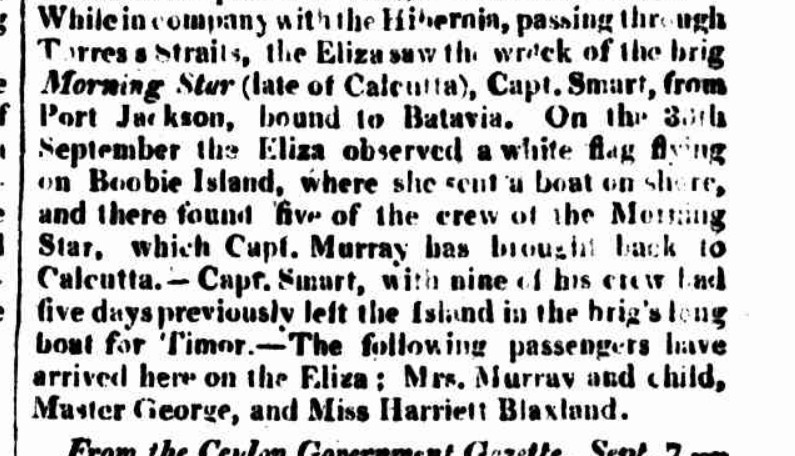
       On 30 September, the fully rigged Ship Eliza was sailing through Torres Strait when the lookout spotted a white flag flying from a staff on Booby Island.   The captain heaved to and sent a boat across to investigate. When it returned, she carried five marooned sailors from the Morning Star. This is the first recorded instance of shipwrecked sailors seeking refuge on Booby Island. Later, it would be stocked with food and water to assist shipwrecked sailors. A primitive post office with a logbook would also be established, so passing mariners could pass on the location of any uncharted reefs they may have discovered.

       The castaways had been among 15 men who had taken to the Morning Star’s longboat and made the perilous journey north after abandoning the wreck. They reported that Captain Smart and nine other sailors had left Booby Island five days earlier, intending to make for the Dutch port of Kupang on Timor Island. There is no record of them ever arriving there or anywhere else, for that matter.

    Morning Star reported wrecked on a reef south of Forbes Islands. Courtesy: Google Maps.

       The remaining 22 members of the Morning Star’s crew were thought to have perished as a result of the wreck or some calamity that befell them sometime afterwards. But four years later, another Morning Star survivor was found living with the Islanders on Murray Island on the Eastern entrance to Torres Strait.   

    The Claudine had anchored off Murray Island in September 1818 and sent a jolly boat ashore to meet with the islanders. To the astonishment of all, an Indian sailor was there to greet them in Hindustani. Fortunately, one of the sailors in the jolly boat spoke the language and was able to translate for the others. He told the sailors from the Claudine that he had been on the Morning Star when it ran aground and that since then he had been living with the Murray Islanders. He had learned their language and been accepted into their community, but the circumstances of his arrival on the island and the fate of his shipmates were not recorded. When the Claudine set sail, the Indian castaway was with them.

       The Morning Star is just one of many hundreds of vessels, large and small, that came to grief in Queensland’s northern waters from the late 18th and into the early part of the 20th Century.

    © Copyright C.J. Ison / Tales from the Quarterdeck, 2025.

    Please enter your email address below to be notified of future blogs.
  • An 1829 Narrative of a Voyage Through Torres Strait

    A ship passing through the Great Barrier Reef at Raine Island. Illustrated Australian News for Home Readers.

    Passing through the Great Barrier Reef during the age of sail must have been both terrifying and exhilarating in equal parts.    The following account, written by an anonymous passenger on a ship sailing through Torres Strait in 1829, was published in the Sydney Times on 19 Sept 1834.   It is a fascinating read and has been posted with only minor alterations to improve readability.

    A Narrative of a Voyage Through Torres Strait – 1829

    “Perhaps there is no part of the navigable world which offers the adventurous mariner a more terrific picture than the passage through Torres Strait — none more mis-represented — and none contemplated with greater horror. … There are three routes by which the passage through Torres Strait can be made, known among nautical men as the Inner, Middle, and Outer passages.

    Of these, the preference is generally given to the first, both because it affords convenient anchorage for the night, when it would be dangerous for a vessel to continue her course among the reefs, and because the mainland of New Holland is constantly in sight, and consequently easily attainable in case of wreck. Yet this of all is the most dangerous and intricate, and never could be preferred were it not for the reasons just mentioned.

    The middle passage was that through which the writer of these remarks passed in 1829, and if ever a satisfaction from disappointment were realised, it was in the accomplishment of this voyage, which had been before regarded as holding out but a mere chance of escape from the miseries of shipwreck.

    Detail of the 1846 Barrier Reef chart showing Pandora, and Raine Island Entrances – Courtesy: National Library of Australia.

    On the fourteenth day after our departure from Sydney, the man at the mast head called out reefs on the “starboard bow.”   Everyone was anxiously looking for this intelligence, for on that morning, the altitude of the sun proved we were within a few leagues of them.

    The reef soon proved to be the “great barrier” in latitude 11° 54 south, reaching across the ocean in a direction from the N. W. to the S. E. until the surf created by its breakers was lost to the sight beneath the horizon.

    All sail was immediately crowded on the vessel in order to make the entrance of the reef by noon, when the sun would not prevent the bed of the shoals from being distinctly marked.

    By noon, we had reached the spot we had desired and were within half a mile of the reef, which from its immense extent seemed to shut out all intercourse with the opposite part of the ocean.

    As we approached it more closely, we discovered that it contained two or three small openings, or passages of about a cable’s length in breadth, and through one of which our course was directed.

    The wind, was high, and there was a considerable swell, but beyond the wall-edge of the mighty reef, which served as a breakwater to the ocean, and upon which the whole volume of water was thrown, all was calm as a basin; — upon its broad surface there was but a ripple, while the rush and roar of waters, breaking as it were in anger on its side, presented a scene of mingled horror and beauty.

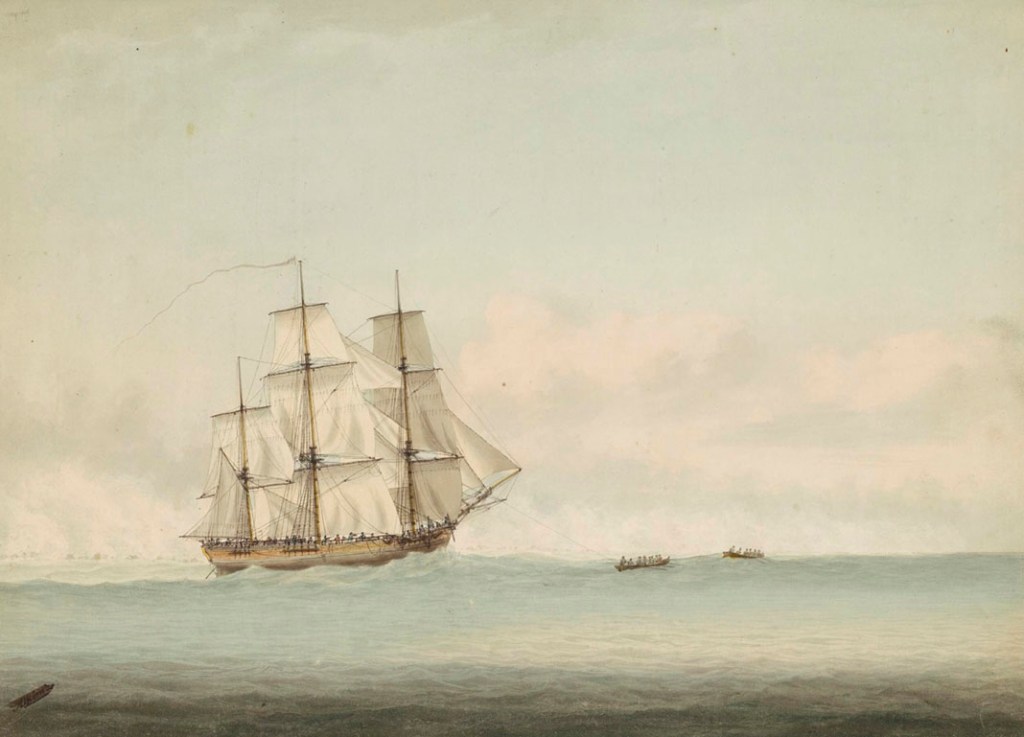
    In 1770, Cook charted what would become known as the Inner Passage. The Endeavour was nearly lost in the attempt. Painting by Samuel Atkins (1787-1808). National Library of Australia.

    We sailed on, we were close upon it and could fully discover the small opening through which our vessel was to pass. There was a breathless silence throughout the ship, save at intervals the voice of the captain giving instructions to the man at the helm.

    A deviation of a hair’s breadth and we might be lost forever. On either side the narrow passage was total and instant destruction; our vessel entered, and as she glided into the smooth channel, she felt the force of the current more powerfully, which being concentrated and brought into so close a space, swept her through with a velocity that no wind, however violent, could effect.

    It occupied but a quarter of an hour to pass through this channel, which formed the great danger of our voyage; but during that time, I had gone to the main top with a military officer who was on board to look upon the reefs.

    What a splendid scene was there; I had seen nothing like it before in nature or art, and perhaps never shall again. As far as the eye could reach, the sea was filled with white coral reefs, whose surface was just covered with water, and partaking of its hue, presented to the view the appearance of beautiful meadows so slightly inundated as to preserve their colouring.

    HMS Pandora came to grief when it tried to pass through the Great Barrier Reef in 1791. Photo courtesy SLQ.

    The shades of green produced by the sea flowing upon the white coral were most beautiful and variegated, and in proportion as the reefs deepened or became shallow, the colouring was diversified.

    But the most striking feature in the scene was the snow-like bordering which encompassed the whole, keeping out as it appeared, all influx of the ruder wave, while that upon the surface of the reef was as a calm lake. This was produced by the breaking of the sea on the sides of the reefs, and became more conspicuous in proportion as the coral approached the surface of the water.

    What a field was here for the contemplation of the artist or the philosopher, whether their time were given to look on Nature’s beauty, girt as it was with desolation, or in searching on the reefs, amid the conflux of currents, for the materials of science, they would be alike repaid for the anxiety the anticipated danger of such a route might produce.

    For myself, I can say that the impression of that picture is fresh upon me, and rests alone within a memory filled with the recollections of that beautiful voyage.”

    © Copyright C.J. Ison / Tales from the Quarterdeck, 2025. If you wish to be notified when new stories are posted, please enter your email address below.