Category: Queensland History

  • HMS Torch and the rescue of the Ningpo castaways

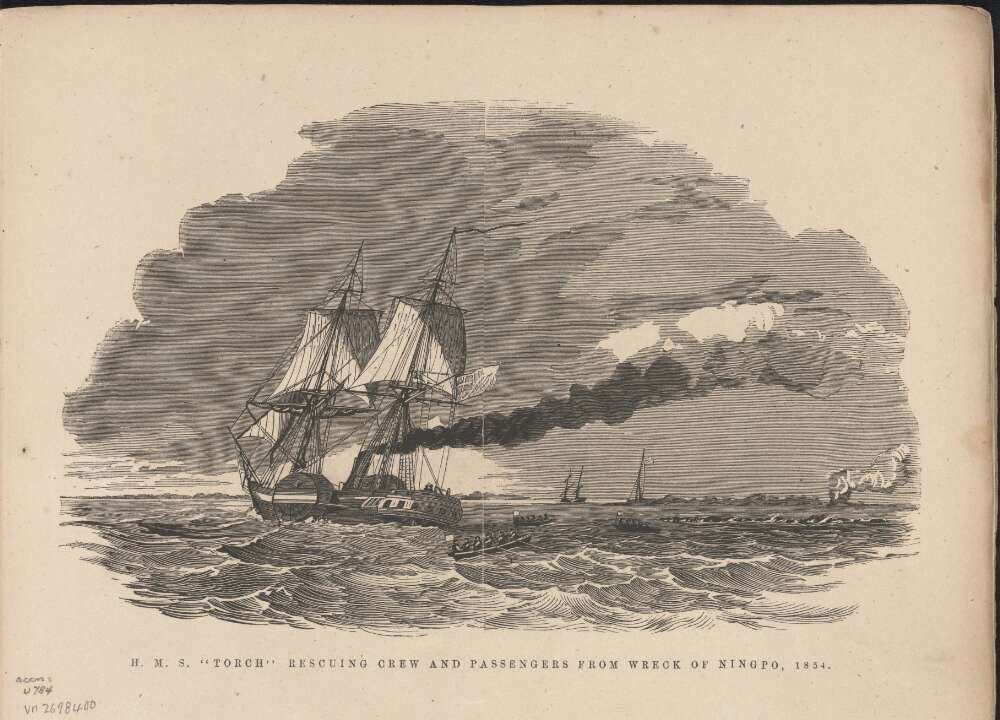
    HMS Torch rescuing crew and passengers from the wreck of the Ningpo, 1854. Illustration courtesy NLA.

       As Lieutenant William Chimmo was making HMS Torch ready for a return to sea, he was unexpectedly tasked with an urgent mission. Word had just reached Sydney that nearly 20 people had been marooned for two months on a remote island far out in the Coral Sea. By chance, his paddle steamer had just completed repairs and was eminently suited to the task at hand.

       Second Mate William Tough of the 150-ton junk-rigged schooner Ningpo had arrived in Sydney on 2 October 1854. He had staggered in to Moreton Bay with a tale of personal heroism and a plea for help to save his stranded shipmates, but there was no vessel there that could go to the Ningpo’s rescue. Tough was patched up and sent to Sydney on the next ship heading south.

       The Ningpo had departed Hong Kong on 15 April 1854, bound for Melbourne to take up new duties as a lighter in Hobson’s Bay. The voyage south had been a difficult one, plagued by storms, rough seas and a nagging leak which just kept getting worse. To add to Captain Billings’ woes, his chronometer stopped working. Unable to determine his longitude, accurate navigation had been reduced to nothing more than an aspirational stab in the dark. Billings decided they should pull into the French settlement at the Isle of Pines for repairs the Ningpo’s hull. But while still north of New Caledonia, he inexplicably changed his mind, opting to head for Moreton Bay instead.

       This meant sailing dangerously close to the D’Entrecasteaux Reef, a two-thousand-square-kilometre maze of submerged coral reefs, small islets, and sandbars. Its discoverer, French Admiral Antoine Bruni D’Entrecasteaux, called it “the most dangerous reef he ever saw.”

    Map of D’Entrecasteaux Reef

       By 8 p.m. on 28 July, Billings estimated that he was clear of those dangerous waters, but he was wrong. Minutes later, the Ningpo ran onto a submerged coral outcrop and began filling with water.

       Unable to get the Ningpo off, Captain Billings made the decision to abandon ship. He, his crew and two passengers made for a small sand island a few kilometres away. They set up camp using timber spars and canvas sails. They fabricated a still to distil fresh water from the sea. Food proved plentiful, as the waters surrounding the island teemed with fish, and the island itself was a nesting ground for turtles and was also home to thousands of seabirds.

       With their immediate necessities well catered for, thoughts turned to how they might escape. Their only means of leaving the island was a four-metre (13 ft) dinghy, the only lifeboat the Ningpo carried. Billings wanted to try to make the Isle of Pines about 600 km away, but his crew refused, fearing they would be killed by the inhabitants of New Caledonia long before they reached their destination. They wanted to send a small party to Moreton Bay, despite it being twice as far away. The captain and his crew were at an impasse.

       Even after they had been stranded for more than a month, they sill could not agree where they should go to seek help. Frustrated with the inaction, Tough and two others set off in the dinghy to make the perilous voyage to Moreton Bay without first seeking the captain’s permission. Billings was furious when he discovered that his boat, compass, and nautical chart were all missing. He was convinced that they would fail, and in so doing, Tough’s recklessness had condemned the rest of them to an endless stay on the island. However, most of the crew held on to the belief that they would soon be found by a passing ship. Billings was not so optimistic, for he knew he had taken his ship far from regular shipping routes and that no sailing ship would intentionally venture into these treacherous waters.

       But, despite Billings’ doubts, Tough and his companions reached Wide Bay on the Australian mainland 14 days later. As they beached their dinghy, a party of Aborigines attacked them, stole the boat and left them for dead. Ten days after that, however, the seriously injured Tough staggered into Brisbane, assisted by a couple of more hospitable Aborigines. Unfortunately, his companions were not so lucky, having died along the way. With no vessel available in Moreton Bay that could go to the rescue, Tough was sent to Sydney with a letter addressed to the Colonial Secretary, seeking assistance. After being stranded for more than 10 weeks, there was no guarantee that the Ningpo castaways would be found alive, but the authorities believed they were duty-bound to try.

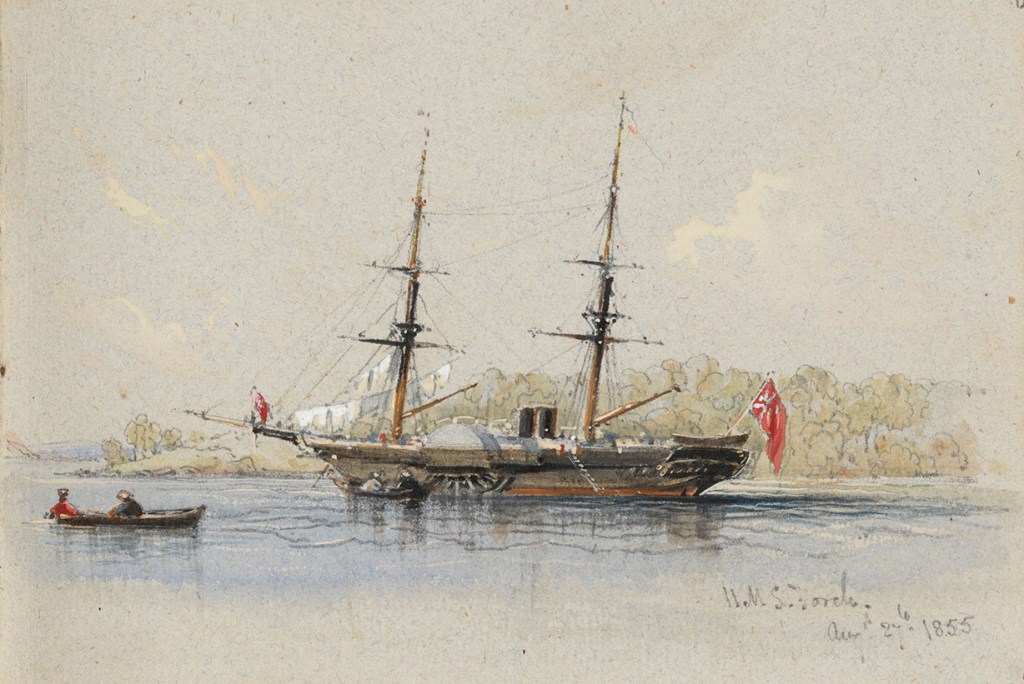
    HMS Torch at anchor, (probably in Sydney Harbour), by Conrad Martens. Courtesy State Library of NSW.

       Lt. Chimmo was ordered to steam out of port as soon as possible. Fortunately, his preparations to return to Fijian waters to continue his survey work were well advanced, so he was able to clear Sydney Heads the following night. He stopped in Newcastle only long enough to fill his coal bunkers before continuing north.

       Chimmo only knew that the Ningpo had run aground near a small island in the vicinity of latitude 18° 36’ South, the coordinate supplied by Tough and presumably recorded by Billings. The only charts available in Sydney that covered that stretch of ocean showed that the Ningpo was probably stranded somewhere near the Huon Islands. But the scale of the map offered little detail. HMS Torch would have to carefully pick its way through the reefs and shoals to find the castaways.

       The Torch battled unseasonal north-westerly winds for the first 11 days. Then the south-easterly trades finally resumed, and they made much faster progress. By mid-October, they had arrived at the search area, but then another delay beset them. Storm clouds began gathering, and Chimmo had no choice but to make for deeper waters until the weather cleared or risk the destruction of his ship.

       Meanwhile, Billings had finally convinced his men that they should wait no longer for help to arrive. After three months, it was clear that if they were ever to get off the island, it would be by their own means. He proposed building a boat from the remains of the Ningpo, and had already manufactured some rudimentary shipwright’s tools from cutlasses, knives and other metal objects they had salvaged from the schooner. Finally, his men realised they had a chance of success and embraced the idea. Unfortunately, the same storm that chased the Torch away also lashed their island, and Billings was forced to put their plans on hold for the time being.   

    When the storm finally cleared, Chimmo began his search of the Huon Islands. He sent search parties out in small boats to inspect each sandbar and islet they came across, but none showed any sign of recent habitation. Frequent rain squalls and strong winds hampered the search, and on one occasion, a boat capsized in the choppy seas, but no lives were lost. Then on the morning of 26 October, he spotted two islands in the distance.  

    The Ningpo wreck site. Map courtesy NLA.

       After the storm had passed, Billings and his men began preparing to go out to the Ningpo in a dugout canoe found in the bushy interior of the island. How it got there was a mystery, but it had been a godsend to the stranded sailors. But before they headed off to the wreck, a lookout spotted a ship in the distance, the first such sighting since they had landed. Signal fires were lit, and everyone lined the beach in anticipation of being rescued.

       As Lt Chimmo drew near to one of the islands, he saw two columns of smoke. Then, he spotted the stranded ship further off in the distance. Finally, he could make out people clustered on the beach. He fired a cannon to let them know they had been seen and gingerly made his way through the reef-strewn lagoon.

       Fearing the weather could deteriorate at any moment, boats were sent across the last couple of kilometres to collect the castaways. One of the first to step ashore was the Ningpo’s second mate, William Tough, who had volunteered to accompany the rescue. He had brought help, as promised, to the utter amazement of Captain Billings.   

    The whole boarding operation was completed that day. The Torch then sailed for Sydney, arriving on 10 December 1854, having completed a round trip of more than 4000 km.

    © Copyright C.J. Ison / Tales from the Quarterdeck, 2022.

    To be notified of future blogs, please enter your email address below.
  • The Loss of the Enchantress: A first-hand account.

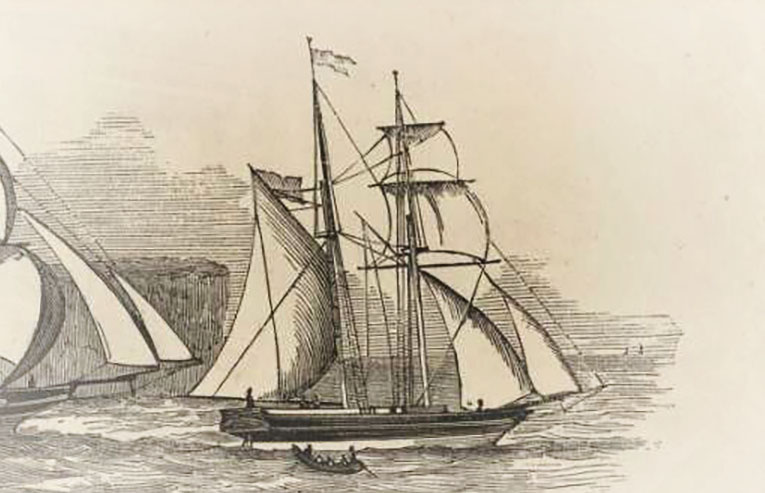
    A Brig leaving Port Jackson in the 1850s.. Image courtesy National Library of Australia.

        The loss of some ships plying Australian waters was only ever noted by a brief paragraph in newspaper shipping columns. Months after leaving port, they would be reported as having never arrived at their destination. The exact circumstances of their loss and what might have happened to the souls on board will never be known. But far more often, people did survive, even if the ship did not. Captains had the grim duty to report the loss of the vessel to its owners, while passengers often wrote to loved ones about their unanticipated adventure. Such records are the sources for many a shipwreck tale.

       On 24 July 1850, the 146-ton brig Enchantress was wrecked near Raine Island while trying to pass through the Great Barrier Reef. Navigating the tricky passages leading to Torres Strait could prove challenging in those early days. Between 1791 and 1887, no less than 37 ships came to grief near Raine Island. Many more were lost on reefs and shoals dotting Queensland’s northern waters.

       Mr B. Buchanan was a passenger on the Enchantress and also an employee of the company that owned the vessel. While en route to Kupang in the Dutch East Indies (present-day Indonesia), after being rescued, he penned a letter to his employers, notifying them of the loss of their ship. This letter, written 175 years ago, provides a firsthand account of the incident.

    A ship off Raine Island, Torres Strait. Illustrated Australian News for Home Readers Thu 30 Jan 1873 Page 9.

       Messrs. Smith, Campbell, and Co., Sydney.

       At Sea, approaching Kupang,

       August 3rd, 1850.

       Dear Sirs, – It is my unpleasant task to inform you of the loss of the brig Enchantress. She struck and grounded on the reef running out from Raine’s Island, on the afternoon of the 24th July.

       From the time of leaving Sydney, the weather was favourable. We joined company with the brig Lady Margaret off Newcastle. On the 24th, about noon, being a little ahead of our companion, we sighted the Barrier below the detached reef, between it and Yule’s Reef. We hauled up to the eastward, and made out the beacon on Raine’s Island between two and three pm.

       Captain L’Anson then stood in for the southern passage, but unfortunately got too near the reef running out from the island. He tried to put her about, but she missed stays; he filled on her again, and again tried it, but a second time she missed. There was no room to wear, the wind being fresh and the current strong, and we tried a third time to stay her, but to no purpose. The strong northerly set and flood tide prevented her [from] coming round, and we were driven on the point of the reef.

       Every sea sent us further on, the surf washing the lower masts’ heads. An attempt was made to take off the sails, but it was becoming dark, we had the reef to cross to get to the island, and the brig was thrown more over by every wave.

       We therefore got out the longboat, saving the chronometer, my papers, and some clothes. The jolly boat was washed away. We crossed the reef without difficulty and took shelter in the beacon.

    Map showing location of wreck at Raine Island. Courtesy Google Maps.

       At three a.m. of Thursday, the 25th, Captain L’Anson, it being low tide, started with the boat, manned by the majority of the crew, with the intention of saving all he could from the wreck. He got the boat alongside, but the sea was breaking so heavily that it was not possible to remain; they brought away some provisions, cooking utensils, and nearly all my things, but could save nothing pertaining to the ship. They were afraid of the boat being swamped.

       At the time of our first attempting to stay the brig, the Lady Margaret was following close, but immediately went about. Captain Grant stood off that night, bore down again in the morning, and worked on and off all day.

       We knew that it would be out of all reason to expect him to bring up after having once entered, before he got to anchorage ground, about twenty-five miles from Raine’s Island; and saw also that he was unwilling to pass without communicating with us (we learnt afterwards that he was afraid we were without provisions or water).

       Meanwhile, the weather had assumed a threatening aspect, we therefore dispatched the boat with five of the people, under Mr Wood, the chief officer, to the Lady Margaret; they succeeded in reaching her after a very long and laborious pull.

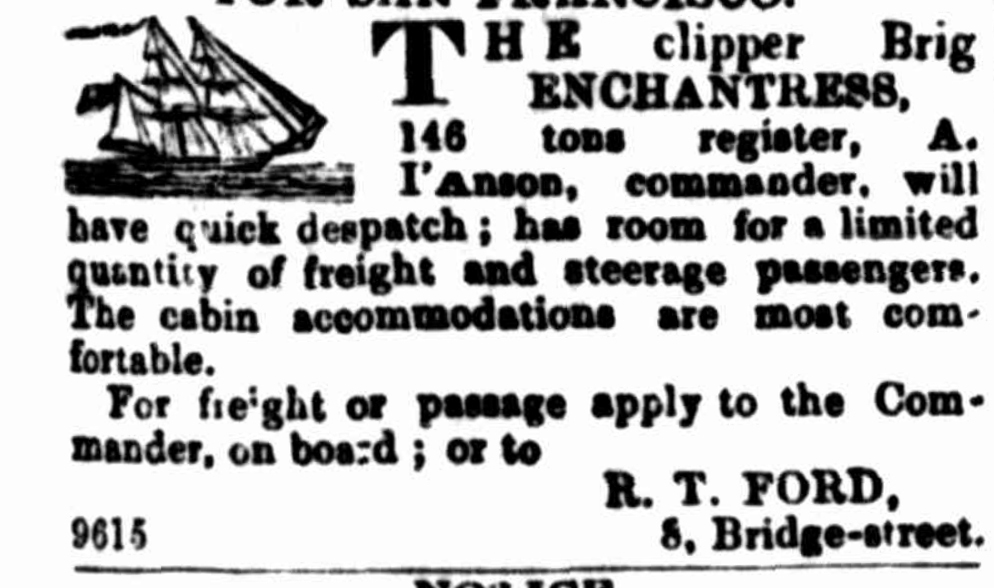
    Advertisement for passage on the Enhantress. SMH 30 May 1850, p. 1.

       I had written to Captain Grant, with suggestions for relieving us, but his position was one of such danger that he could give no attention thereto; his anxiety was to get us on board at once, and be off, and to attain this he despatched his second officer with his jolly boat to the island immediately, our own boat returning at the same time to aid in bringing what clothes we had saved.

       We left the island at four p.m., and were taken on board the Lady Margaret at dusk. She stood out to sea, and in the morning entered by the Southern Passage.

       The poor Enchantress when last seen by us was being between twenty and thirty yards from the point of the reef – bows on the water, masts standing.

    [The letter was published in the Sydney Morning Herald newspaper on 3 December 1850. Here, it is re-published as it first appeared in print, but for a few minor changes to spelling and punctuation.]

    [The letter was first published in the Sydney Morning Herald newspaper on 3 December 1850.   Here, it is reproduced as it appeared in the newspaper, but for a few minor changes to spelling and punctuation.]

    © Copyright C.J. Ison / Tales from the Quarterdeck, 2022.

    To be notified of future blogs, please enter your email address below.

  • The Cambus Wallace: did a shipwreck split an island in two?

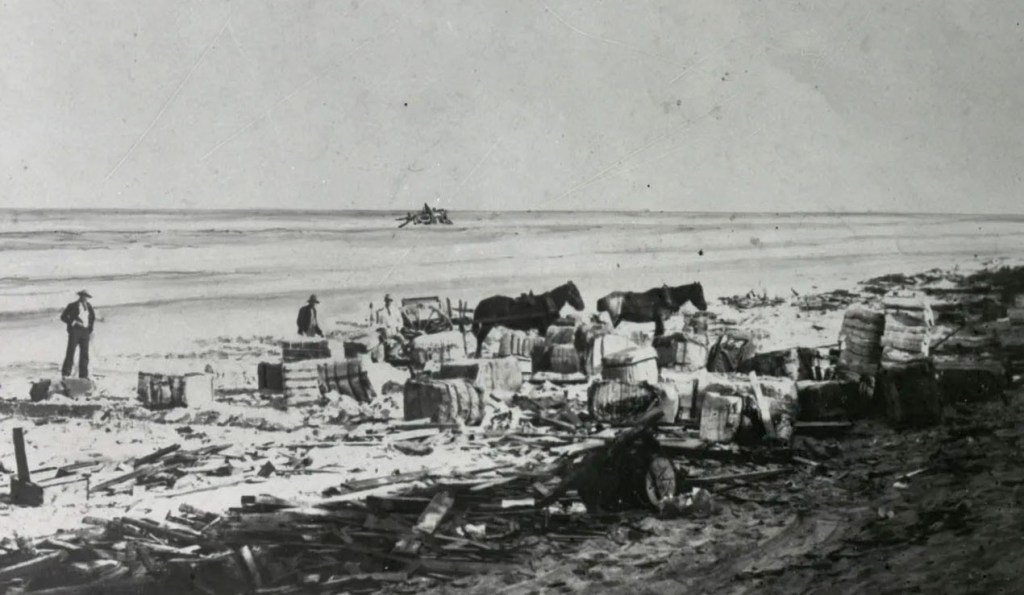
    The Cambus Wallace. Photo Courtesy State Library of Queensland.

    In September 1894 the 1600-ton iron barque Cambus Wallace ran aground on Stradbroke Island spilling its cargo of salt, Scottish whiskey and dynamite to be strewn along the beach.   Six seamen lost their lives in the tragedy and the wreck may also have contributed to the island splitting in two.

    The Cambus Wallace had sailed from Glasgow four months earlier on her maiden voyage and had experienced more than her fair share of bad weather on the passage out.   As she made their way up the Australian coast the crew battled strong winds, high seas and heavy rain.   Then, around 5 o’clock on the morning of 3 September, disaster struck when they were only hours away from reaching their destination at Moreton Bay.

    Lookouts had been posted but they were of little help in the thick weather.   By the time someone saw breaking waves ahead, it was too late to avoid catastrophe.    The ship struck sand near Jumpinpin and came to a halt broadside to the seas about 200m from the beach.   Powerful waves swept over the stranded vessel washing away two lifeboats.   They had lost a third during an earlier bout of rough weather.  

    Some of the 21 survivors of the wreck. The Queenslander, 15 Sept 1894, p. 505.

    There were 27 men on board, and they were now down to just a single lifeboat but the conditions were far too dangerous to launch it.   Most of the crew took shelter on the poop, while Captain Leggat and several others climbed into the mizzen mast rigging.   The steward chose to remain in his cabin and wait for help.   He paid for that poor decision with his life.

    Two young seamen tried to swim a line across to the beach, so tantalisingly close, to help the rest of the men pull themselves to safety.   But the roiling seas and white water made for a dangerous crossing.   One of the men ran into difficulties and was pulled back to the ship by the line tied around his waist.    A Swedish sailor, Gustav Kindmark, reached land but without a line, he could do nothing but go in search of help.   

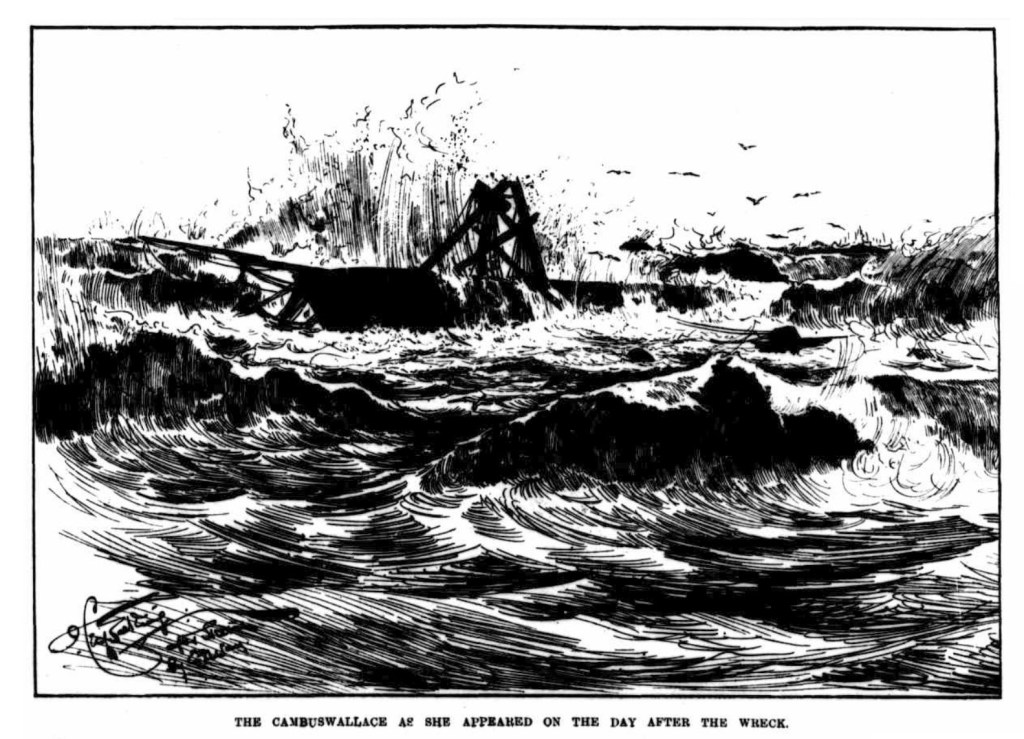
    Illustration of the Cambus Wallace “as she appeared on the day after the wreck.” The Queenslander, 15 Sept 1894 p. 506.

    Meanwhile, the situation on the barque became dire.   Below decks were awash with water. Around midday, the First Mate was swept off the ship but he was able to make it to shore, albeit somewhat battered and bruised.    Captain Leggat was knocked from his perch by falling debris but managed to get back into the rigging before he was washed overboard.   It was clear they could not wait any longer for help to arrive.   The ship was beginning to break up.

    Captain Leggat tried again to lower their last lifeboat.   This time they got it into the water.   The carpenter was washed off the deck and drowned while waiting to board the boat.   One of the apprentices was also swept away but he was able to swim to shore.   The cook drowned after he tried to jump into the boat but missed.   Several others dove into the sea and swam towards land.    The captain was the last to leave the ship. With the swing of an axe, he cut the rope holding the lifeboat fast and they headed towards the beach.

    In all, 22 men made it ashore alive but one older seaman died a short time later as a result of the ordeal.    Kindermark returned to the beach with several fishermen he had found on the sheltered side of the island and they erected tents to provide shelter for the near-naked survivors.

    Salvaging cargo from the Cambus Wallace. Photo: Queensland State Archive, ITM436348.

    As the ship broke apart cargo began washing ashore.   Among the debris were cases of whiskey and other liquor as well as several hundred boxes of dynamite.     A customs officer from Brisbane had the unenviable task of preventing the “duty free” spirits from falling into the hands of local fishermen and boaties drawn to the bounty on offer.   But perhaps, of greater concern were the boxes of water-damaged high explosives littering the beach.       

    A decision was made to gather the dynamite and blow it up in place.   The explosions were so violent they reportedly shook houses and shattered windows 20 kilometres away.   An eyewitness to one of the detonations claimed sand was blown high into the air to fall like a “heavy show of rain” into the bay on the lee side of the Island.  

    Wreck site: courtesy Google Maps

    During a particularly high tide four months later, the sea washed over the island at its narrowest point which also happened to be where the Cambus Wallace had been wrecked and the dynamite disposed of.      Then during a powerful storm in May 1898 a deep channel 650m wide was cut right across the island and washed away the graves of the six seamen who had been buried there after the shipwreck.    While it is possible the channel might have formed anyway, it is also conceivable the massive explosions on the narrow strip of sand contributed to its breaching.    The channel separates North and South Stradbroke Islands to this day.

    © Copyright C.J. Ison / Tales from the Quarterdeck, 2022.

    To be notified of future blogs, please enter your email address below.
  • Loss of La Astrolabe and La Boussole: a 40 Year Mystery

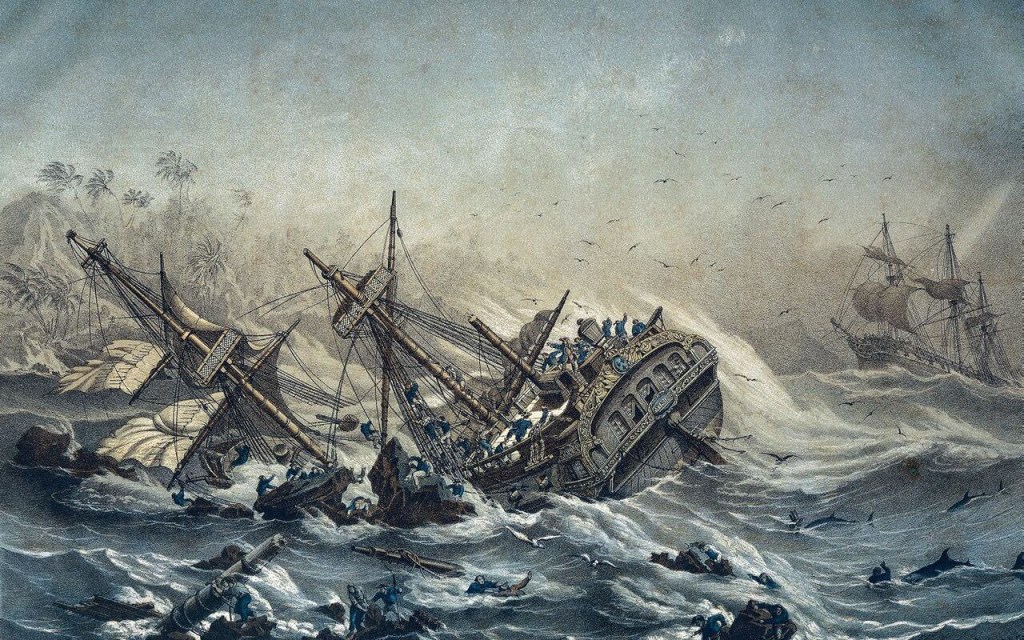
    19th Century lithograph of the sinking of La Astrolabe at Vanikoro by Louis Le Breton. Courtesy Public domain, Wikimedia commons.

    One of the great maritime mysteries of the late 18th and early 19th centuries was the disappearance of the French ships La Astrolabe and La Boussole under the command of La Perouse. They were last sighted leaving Botany Bay in 1788 but it would be another 40 years before the world discovered what became of them.   

    In 1785, Louis XVI appointed Jean-François Comte de La Perouse to lead an expedition of discovery to the far reaches of the world. The objectives were primarily scientific, but La Perouse was also to look out for economic opportunities that might benefit France. He was given two ships, La Astrolabe and La Boussole, with a total complement of some 220 men. The expedition included a botanist, geologist, physicist, astronomer, and several naturalists and illustrators – ten men of science in all. Even the ships’ two chaplains had received scientific training. Rarely had such a body of learned men been assembled for such a voyage.


    Louis XVI giving La Pérouse his instructions on 29 June 1785, by Nicolas-André Monsiau – Chateau de Versailles, Public Domain, https://commons.wikimedia.org

    The La Astrolabe and La Boussole sailed from Brest on 1 August 1785 and bore south into the Atlantic Ocean to round Cape Horn. They stopped briefly in Chile and then proceeded to the Sandwich Islands (now known as Hawaii). From there, they continued north as far as Alaska and then traced the North American coast south to a point that is now Monterey in California. La Perouse then took his two ships across the Pacific Ocean to the Portuguese colony of Macau and then headed north again. They arrived at the Russian outpost of Petropavlovsk on the Kamchatka Peninsula in September 1787 to find fresh orders awaiting them. The French Court was aware that the British had assembled a fleet of ships to sail for New South Wales. La Perouse was instructed to make directly for Botany Bay to investigate the new settlement being established there.   

    La Perouse arrived at Botany Bay on 24 January 1788, only days after the First Fleet under Governor Phillip had arrived from England. The French mariners spent six weeks there, resting and replenishing their food and water supplies. Before sailing, La Perouse left a package of letters, journals and charts with the captain of a returning British convict transport to be forwarded to Paris. In his correspondence, La Perouse wrote that he intended to sail to New Caledonia and the Santa Cruz Islands before turning back for home. They had been gone for two and a half years when they sailed from Botany Bay. He also anticipated that they would be back in France by June the following year. On 10 March 1788, the two French ships set sail and were never seen again, at least not by any Europeans.

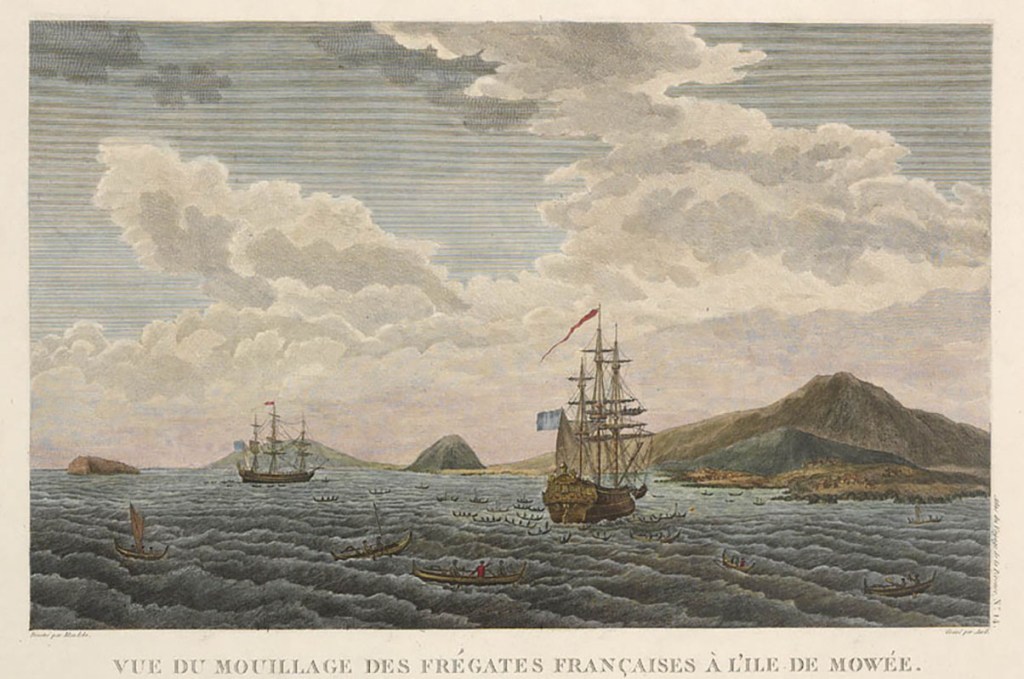
    French frigates La Astrolabe and La Boussole in Hawaii. Image courtesy State Library of NSW.

    Then, in 1826, an Irish mariner, Peter Dillon, made a startling discovery. While at Vanikoro, he came into possession of some artifacts clearly of French origin. He learned that relics from the French ships had been circulating among the inhabitants of Santa Cruz and neighbouring islands for years. On inquiring about the origin of the pieces, he was told that they had come from two large ships that had been wrecked there many years earlier.

       Dillon was sure the artifacts, one of which was a sword guard of French design, had come from La Perouse’s expedition. Upon returning to India, he reported his discoveries to the East India Company, which provided him with a ship to explore the waters around Vanikoro more closely.   

    In 1827, Dillon found the wreck site and retrieved several artefacts, including a bell which had clearly belonged to a French ship. He also learned from the older villagers on Vanikoro that the two French ships had run aground on a coral reef during a violent storm with great loss of life. The survivors had built a new vessel from timbers salvaged from the wrecks and sailed away. They had probably tried making for Kupang in the Dutch East Indies (Indonesia). That would have been the closest port where they might find help and passage back home. It would, however, require them to cross the Great Barrier Reef and pass through Torres Strait. Most of the French seamen left in the new ship, but a few men opted to remain on Vanikoro, where they lived out their days. By the time Dillon visited the island, they had all since passed away.

    Map showing Vanikoro and Murray Island. Courtesy Google Maps.

    There is a final clue as to what may have happened to La Perouse’s men who sailed away from Vanikoro. An Indian seaman had been found living among the inhabitants of Murray Island (Mer) in 1818. His name was Shaik Jumaul, a seaman on the Morning Star, which had been wrecked in Torres Strait four years earlier, while on a voyage from Sydney to Batavia.

       He said that he had come across many items of European manufacture, including muskets, cutlasses, a compass, and even a gold watch, while visiting nearby islands. When he asked where they had come from, he was told that about 30 years earlier, a large ship had been wrecked near Murray Island. Several boatloads of men came ashore, but a fight ensued, and most were killed. Some fled to other islands where they met the same fate. The only survivor was a young boy. He lived among the Islanders for many years and rose to be held in high esteem in his adopted community.

    Jean Francois Comte de La Perouse. Image: public domain, https://commons.wikimedia.org.

    More recently, ANU academic Dr Garrick Hitchcock came across the original newspaper article published in the Madras Courier in 1818. Jumaul’s story was later republished in the Sydney Gazette in July 1819. The Sydney Gazette article even speculated that the ship might have been one of La Perouse’s, but it appears that possibility was never seriously followed up.   

    Hitchcock thinks the vessel might have been the one constructed from salvage on Vanikoro. The timing certainly fits. After some detective work, Hitchcock discovered that a boy named Francois Mordelle had accompanied the expedition, and it was possible that he was the one who had lived among the Torres Strait Islanders for all those years.

    © Copyright C.J. Ison / Tales from the Quarterdeck, 2022.

    To be notified of future blogs, please enter your email address below.

  • The Long Search for the Yongala

    Postcard showing the SS Yongala, circa 1905. Courtesy State Library of Queensland.

    In March 1911 the SS Yongala sank during a powerful cyclone with the loss of 122 lives making it one of Queensland’s worst maritime disasters.   Despite efforts to locate the wreck, the ship’s final resting place would remain a mystery for almost half a century.

    The Yongala departed Brisbane on 21 March bound for Townsville.   On 23 March she stopped briefly at Mackay to disembark passengers but by now the weather was rapidly deteriorating.   When she got under way again, she unwittingly carried 50 passengers and 72 crew towards a powerful storm brewing somewhere to the north.    

    Later the same day the Dent Island lighthouse keeper noted the Yongala passing through the Whitsunday Passage.     She soon faded from sight, enveloped by a curtain of rain and sea mist, as she ploughed towards Townsville.

    When the Yongala failed to arrive as scheduled there was no immediate concern.   It was assumed the captain had sought shelter to escape the cyclone and the ship would soon make its appearance.   But then reports reached Townsville of wreckage washed ashore on Palm and Hinchinbrook Islands 50 and 100 kilometres to the north.

    “The Missing Steamer Yongala” The Australasian, 1 Apr 1811, p. 41.

    It was clear the debris, including hatch covers, parts of lifeboats, ornate cabin fittings and other miscellanea, had come from the Yongala.   It spoke of a terrible tragedy having befallen the passenger steamer and all those onboard.   Oddly, not a single body was ever recovered.

    The waters and coastline between Townsville and the Whitsunday’s were scoured in hopes of finding survivors or the wreck but nothing but more debris was found.  A Marine Board Inquiry investigated the loss of the ship as best it could under the circumstances. With no eyewitnesses to what happened and no wreck to inspect, they had little to go on.   The Inquiry concluded that rumours about the ship’s stability were groundless and it found no fault with the ship’s construction or the competency of its captain.    A £1,000 reward was even offered for anyone who could pinpoint the wreck.

    In October 1911 Dr Cassidy believed he and his crew on the salvage schooner Norna had located the Yongala in deep water about 20kms off Cape Bowling Green.   They had discovered traces of oil bubbling up from the depths and believed that marked the resting place of the lost ship.   However, owing to the depth of the water and strong currents, they were unable to put a diver down to confirm the find or collect the reward.  

    Map showing location of the Yongala wreck. Courtesy Google Maps.

    For decades mystery surrounded the disappearance of the ship.   There were even far-fetched sightings of a “ghost ship” steaming through North Queensland waters periodically reported in the tabloid press.  

    Then in 1947, the navy survey ship HMAS Lachlan located the wreck using “anti-submarine instruments,” more commonly known today as sonar.    Three years earlier a minesweeper had snagged something they thought to be a reef rising steeply from the seabed in the middle of the regular shipping lane south of Townsville.   They had marked the spot on their chart as an unknown obstruction and reported it to Naval Headquarters.   They were about 20kms east of Cape Bowling Green where the Norna had found the oil slick all those years ago.

    After HMAS Lachlan made several passes over the “obstruction” the sonar operators were convinced they had found the remains of a “fair-sized steamer.”   It was thought to be the Yongala for it was the only such vessel to have been lost in the vicinity.  

    HMAS Lachlan. By Allan C. Green, Courtesy State Library of Victoria.

    However, it would be another 11 years before anyone visually confirmed that what the Lachlan had found was in fact a shipwreck.   In 1958 a diver named George Konrat finally descended into the deep and found the ship sitting on its keel in 30 metres of water with a distinct list to starboard.   He recovered a Chubb safe with part of the serial number still evident which would later prove to have been installed in the Yongala during her construction.

    Konrat speculated that the steamer had struck another vessel during the storm and sank for he also saw the remains of an old sailing ship nearby.   However, with the passage of so many years and no survivors to recount what happened, the actual reason why the ship foundered during the cyclone will likely never be known.

    Yongala Bell, Courtesy wikimedia commons.

    Today, some artifacts collected from the wreck and other memorabilia can be found in the Townsville Maritime Museum which is well worth a visit.   The Yongala, itself, is a popular dive site.

    © Copyright C.J. Ison / Tales from the Quarterdeck, 2022.

    To be notified of future blogs, please enter your email address below.