Category: Piracy

  • No Charts, No Worries

    A schooner of the early 1800s. Courtesy State Library of Queensland.

    When Captain George Browning sailed the small schooner Caledonia from Sydney in December 1831, he intended to follow the coast north as far as the Tropic of Capricorn.   There he was to collect salvage from a ship that had been wrecked in the Bunker Islands and return it to Sydney to be sold.   But on the way, he was to call in at the Moreton Bay Penal Settlement to collect a whaleboat the crew had used to escape the wreck.   That was where things began to go wrong for the young master mariner.

    While anchored in Moreton Bay his ship was seized by a band of convicts who sent the crew ashore and ordered Browning to take them to the tiny South Pacific Island of Rotuma some 1,500 nautical miles or 3,000 kilometres away over open ocean.   See my blog “The Caledonia’s perilous last voyage,” for a more detailed account.

    Among the many challenges he faced, he had no charts covering the South Pacific.  Yet, Browning had to find a way to deliver his unwanted passengers to their destination if he was to have any chance of saving his ship and preserving his own life.   He consulted his “Epitome of Practical Navigation,” a book all master mariners kept close at hand.   The regularly updated volume was considered the standard text on maritime navigation and was packed with charts and tables to help mariners navigate the world’s oceans.   

    Example from The American Practical Navigator, 1837. There were several such books used by master mariners.

    Browning referred to a table of South Pacific Islands with their corresponding geographic coordinates.  With this information, he flipped over one of his coastal charts and drew a grid labelling the key lines of longitudes and latitudes for the waters he would be sailing and marked the various known islands and features identified in the table, albeit with many reefs, shoals and other hazards left unrecorded.   Notwithstanding its limitations, he could now take observations and plot his whereabouts and relate that to his destination – Rotuma – and any other islands in the course of his travels.   

    Using his makeshift chart, Browning navigated from Moreton Bay to New Caledonia where they stopped to collect fresh drinking water.   From there he charted a course to Rotuma and when he was directed to leave that island at a moment’s notice and make for Wallis Island he did that too.  

    Perhaps the chart’s greatest value came as they sailed towards Wallis Island.   A couple of the convicts warned Browning that their leader intended to scuttle the Caledonia and do away with its captain once they had arrived.   He knew Wallis Island lay a short distance over the horizon and they would likely arrive late that afternoon.  

    He shaped the sails to slow the ship’s progress until nightfall.   Then, during the hours of darkness, he picked up speed again and was able to slip by Wallis thereby prolonging his life a little longer.   A couple of days later they pulled in at the Samoan island of Savai’i.   There the Caledonia was scuttled but Browning was befriended by a local chief and escaped the convicts’ clutches.  He eventually returned to Australia to tell his amazing story.

    The full story is told in A Treacherous Coast: Ten Tales of Shipwreck and Survival from Queensland Waters available through Amazon.

    © Copyright C.J. Ison / Tales from the Quarterdeck, 2022.

    To be notified of future blog posts, please enter your email address below.

  • Mutiny on the Ariel

    Hong Kong circa 1840s

    In 1845 the trading schooner Ariel was seized off the coast of China while carrying a valuable cargo worth millions of dollars in today’s money.   This act of piracy was unusual because it was not carried out by a band of desperate cutthroats but by two of the ship’s own officers.

    The schooner Ariel was owned by the powerful trading company Jardine Matheson and was a fast-sailing coastal merchant vessel, probably around the 100-ton class.   She was also well-armed with cannons to ward off marauders in those dangerous waters.   The Ariel was crewed by British officers comprising the captain, first mate, and gunner.   The only other Englishman on board being a young apprentice.   The sailing crew were all Filipino, or “Manila men” as they were called at the time.  A young Chinese woman was also on board who was likely the captain’s mistress although she was variously described as his cook or cabin steward.

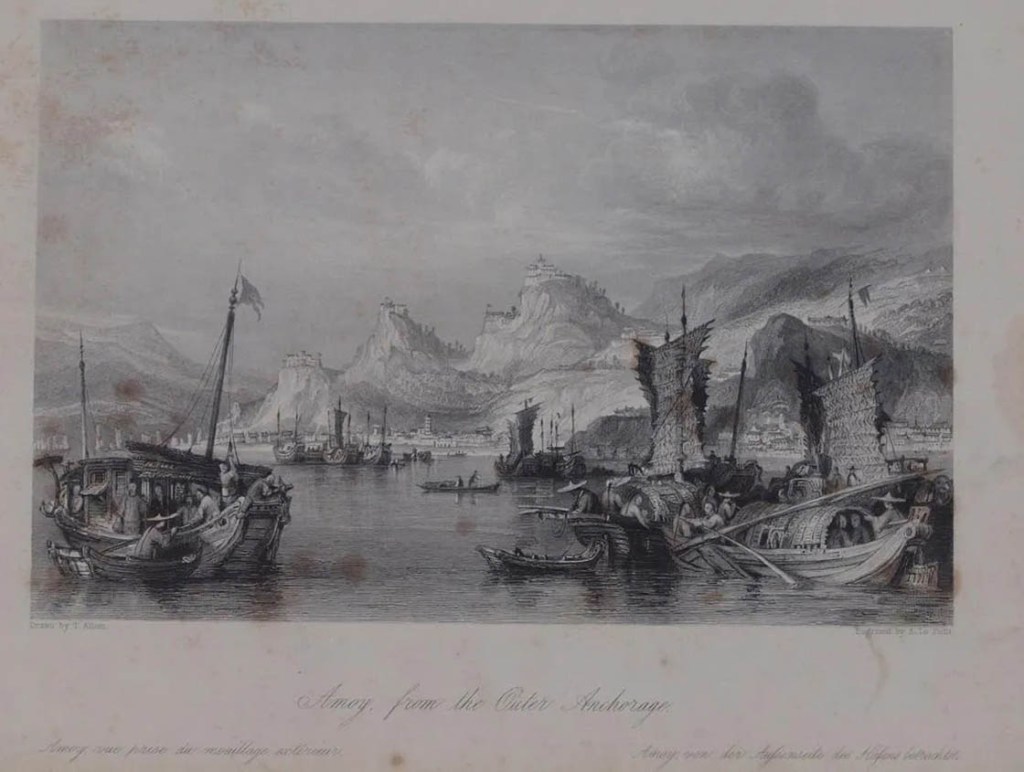
    Amoy from the outer anchorage, circa 1845.

    The Ariel regularly cruised between Chinese ports carrying all manner of goods.   This time she was sailing from Xiamen (then called Amoy) bound for Hong Kong with a very valuable cargo.   One account had the ship carrying $100,000 in Spanish silver Reales, the currency of trade at the time.     Another had her carrying a shipment of opium plus a quantity of gold and silver coin.  Either way, the value of the cargo was substantial, probably equivalent to many millions of dollars today, and it proved a temptation too irresistible to the mate and gunner.

    The evening they sailed from Xiamen, Wilkinson, the first mate, called Captain Macfarlane to come up from his cabin.   They were now off Nan’ao Island 160kms south of Xiamen and about one-third of the way through their passage to Hong Kong.   When Macfarlane came on deck he was confronted by Wilkinson and the gunner both armed with cutlass and pistols.   Wilkinson told Macfarlane they had seized the ship and they would be making for Singapore.    The pair offered to make Macfarlane an equal partner in their crime, for there were more than enough riches to go around.   But the captain refused to have any part in it and tried to persuade the men to give up their brazen heist.   

    Map of China showing coast between Amoy and Hong Kong, circa 1850s.

    Meanwhile, the crew was gathered on the forecastle and though they appeared not to be participating in the mutiny, Wilkinson said they were on his side.   The threat was obvious.   Captain Macfarlane was on his own.   Macfarlane was locked in his cabin with the assurance he would be released unharmed as long as he did nothing to disrupt their plans.   

    The next morning the captain asked to be let go in the longboat but the mate refused, telling him they were too close to Hong Kong and he would not risk capture should the captain raise the alarm before they were well out to sea.   A little later the Chinese girl went forward and spoke with the Filipino crew and learned they wanted nothing to do with the mutiny.   They armed themselves with knives and the cannon’s ramrods on the captain’s command and attacked the mate and gunner.   Meanwhile, several men smashed open the cabin skylight to rescue the captain.

    Hong Kong circa 1840s

    By the time Macfarlane was hauled out through the skylight, the mate was lying bashed, stabbed, and bleeding to death on the deck while the gunner had taken refuge in the cabin just vacated by the captain.

    Captain Macfarlane, now back in command of his ship, found a fowling piece (shotgun) belonging to the gunner and ordered him to surrender.   When the gunner opened the hatch leading to the ship’s gunpowder magazine and threatened to blow everything up, Macfarlane shot him in the leg.   He was then quickly overpowered and taken to Hong Kong to stand trial.   Wilkinson died from his wounds before they reached port.   The gunner, whose name is not recorded, was found guilty of piracy and sentenced to transportation for life.

    © Copyright C.J. Ison / Tales from the Quarterdeck, 2022.

    To be notified of future blog posts, please enter your email address below.