Example of a Brig. Source: Winston’s Cumulative Loose-Leaf Encyclopedia 1918
On Sunday, 3 July 1814, the merchant ship Morning Star sailed out of Sydney Harbour bound for Calcutta by way of Torres Strait and Batavia. However, her voyage north ended abruptly on a coral reef south of the Forbes Islands off the far north Queensland coast. The vessel was a 140-ton Calcutta-built brig owned by the Indian-based trading house Lackersteen and Co. When she left Sydney, the crew numbered 37 men, a mix of European and Indian seamen, all under the command of Captain Robert Smart. Only six of them would survive the ordeal.
No account exists of how the ship was lost, but from the location of the wreck site, it appears that Captain Smart was sailing within the Great Barrier Reef when he ran aground and had to abandon ship.
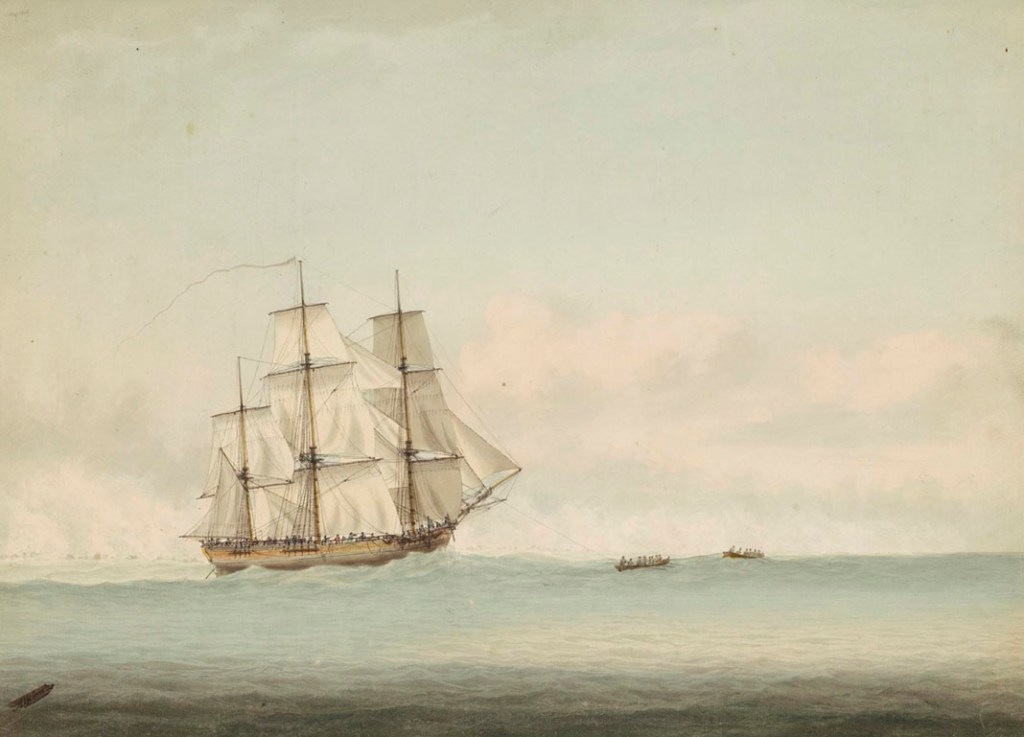
Lieutenant James Cook had charted the route back in 1770, and he had only narrowly avoided total disaster on what he would name Endeavour Reef, some 450 km south of where the Morning Star was lost.
The passage was fraught with danger. Thousands of reefs, many hidden just below the surface, dotted the coastal waters inside the Great Barrier Reef. However, the route had two distinct advantages. Rarely did a ship have to stray far from land, so refuge could be sought should disaster strike. There were also ample safe anchorages where ships could lay up overnight or when the conditions made it difficult to detect hazards lying in their path. Later, mariners would prefer a route that took them far out into the Coral Sea as they made their way north. They would cross the Barrier Reef near Raine Island or other similar narrow passages to pass through Torres Strait. This “outer passage” avoided the labyrinth of reefs but came with its own set of dangers.
Booby Island. Image courtesy National Library of Australia
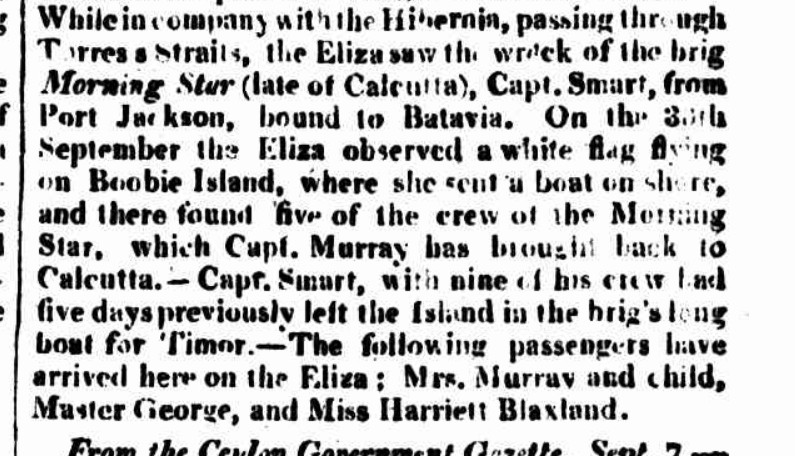
On 30 September, the fully rigged Ship Eliza was sailing through Torres Strait when the lookout spotted a white flag flying from a staff on Booby Island. The captain heaved to and sent a boat across to investigate. When it returned, she carried five marooned sailors from the Morning Star. This is the first recorded instance of shipwrecked sailors seeking refuge on Booby Island. Later, it would be stocked with food and water to assist shipwrecked sailors. A primitive post office with a logbook would also be established, so passing mariners could pass on the location of any uncharted reefs they may have discovered.
The castaways had been among 15 men who had taken to the Morning Star’s longboat and made the perilous journey north after abandoning the wreck. They reported that Captain Smart and nine other sailors had left Booby Island five days earlier, intending to make for the Dutch port of Kupang on Timor Island. There is no record of them ever arriving there or anywhere else, for that matter.
Morning Star reported wrecked on a reef south of Forbes Islands. Courtesy: Google Maps.
The remaining 22 members of the Morning Star’s crew were thought to have perished as a result of the wreck or some calamity that befell them sometime afterwards. But four years later, another Morning Star survivor was found living with the Islanders on Murray Island on the Eastern entrance to Torres Strait.
The Claudine had anchored off Murray Island in September 1818 and sent a jolly boat ashore to meet with the islanders. To the astonishment of all, an Indian sailor was there to greet them in Hindustani. Fortunately, one of the sailors in the jolly boat spoke the language and was able to translate for the others. He told the sailors from the Claudine that he had been on the Morning Star when it ran aground and that since then he had been living with the Murray Islanders. He had learned their language and been accepted into their community, but the circumstances of his arrival on the island and the fate of his shipmates were not recorded. When the Claudine set sail, the Indian castaway was with them.
The Morning Star is just one of many hundreds of vessels, large and small, that came to grief in Queensland’s northern waters from the late 18th and into the early part of the 20th Century.
A ship passing through the Great Barrier Reef at Raine Island. Illustrated Australian News for Home Readers.
Passing through the Great Barrier Reef during the age of sail must have been both terrifying and exhilarating in equal parts. The following account, written by an anonymous passenger on a ship sailing through Torres Strait in 1829, was published in the Sydney Times on 19 Sept 1834. It is a fascinating read and has been posted with only minor alterations to improve readability.
A Narrative of a Voyage Through Torres Strait – 1829
“Perhaps there is no part of the navigable world which offers the adventurous mariner a more terrific picture than the passage through Torres Strait — none more mis-represented — and none contemplated with greater horror. … There are three routes by which the passage through Torres Strait can be made, known among nautical men as the Inner, Middle, and Outer passages.
Of these, the preference is generally given to the first, both because it affords convenient anchorage for the night, when it would be dangerous for a vessel to continue her course among the reefs, and because the mainland of New Holland is constantly in sight, and consequently easily attainable in case of wreck. Yet this of all is the most dangerous and intricate, and never could be preferred were it not for the reasons just mentioned.
The middle passage was that through which the writer of these remarks passed in 1829, and if ever a satisfaction from disappointment were realised, it was in the accomplishment of this voyage, which had been before regarded as holding out but a mere chance of escape from the miseries of shipwreck.
Detail of the 1846 Barrier Reef chart showing Pandora, and Raine Island Entrances – Courtesy: National Library of Australia.
On the fourteenth day after our departure from Sydney, the man at the mast head called out reefs on the “starboard bow.” Everyone was anxiously looking for this intelligence, for on that morning, the altitude of the sun proved we were within a few leagues of them.
The reef soon proved to be the “great barrier” in latitude 11° 54 south, reaching across the ocean in a direction from the N. W. to the S. E. until the surf created by its breakers was lost to the sight beneath the horizon.
All sail was immediately crowded on the vessel in order to make the entrance of the reef by noon, when the sun would not prevent the bed of the shoals from being distinctly marked.
By noon, we had reached the spot we had desired and were within half a mile of the reef, which from its immense extent seemed to shut out all intercourse with the opposite part of the ocean.
As we approached it more closely, we discovered that it contained two or three small openings, or passages of about a cable’s length in breadth, and through one of which our course was directed.
The wind, was high, and there was a considerable swell, but beyond the wall-edge of the mighty reef, which served as a breakwater to the ocean, and upon which the whole volume of water was thrown, all was calm as a basin; — upon its broad surface there was but a ripple, while the rush and roar of waters, breaking as it were in anger on its side, presented a scene of mingled horror and beauty.
In 1770, Cook charted what would become known as the Inner Passage. The Endeavour was nearly lost in the attempt. Painting by Samuel Atkins (1787-1808). National Library of Australia.
We sailed on, we were close upon it and could fully discover the small opening through which our vessel was to pass. There was a breathless silence throughout the ship, save at intervals the voice of the captain giving instructions to the man at the helm.
A deviation of a hair’s breadth and we might be lost forever. On either side the narrow passage was total and instant destruction; our vessel entered, and as she glided into the smooth channel, she felt the force of the current more powerfully, which being concentrated and brought into so close a space, swept her through with a velocity that no wind, however violent, could effect.
It occupied but a quarter of an hour to pass through this channel, which formed the great danger of our voyage; but during that time, I had gone to the main top with a military officer who was on board to look upon the reefs.
What a splendid scene was there; I had seen nothing like it before in nature or art, and perhaps never shall again. As far as the eye could reach, the sea was filled with white coral reefs, whose surface was just covered with water, and partaking of its hue, presented to the view the appearance of beautiful meadows so slightly inundated as to preserve their colouring.
HMS Pandora came to grief when it tried to pass through the Great Barrier Reef in 1791. Photo courtesy SLQ.
The shades of green produced by the sea flowing upon the white coral were most beautiful and variegated, and in proportion as the reefs deepened or became shallow, the colouring was diversified.
But the most striking feature in the scene was the snow-like bordering which encompassed the whole, keeping out as it appeared, all influx of the ruder wave, while that upon the surface of the reef was as a calm lake. This was produced by the breaking of the sea on the sides of the reefs, and became more conspicuous in proportion as the coral approached the surface of the water.
What a field was here for the contemplation of the artist or the philosopher, whether their time were given to look on Nature’s beauty, girt as it was with desolation, or in searching on the reefs, amid the conflux of currents, for the materials of science, they would be alike repaid for the anxiety the anticipated danger of such a route might produce.
For myself, I can say that the impression of that picture is fresh upon me, and rests alone within a memory filled with the recollections of that beautiful voyage.”
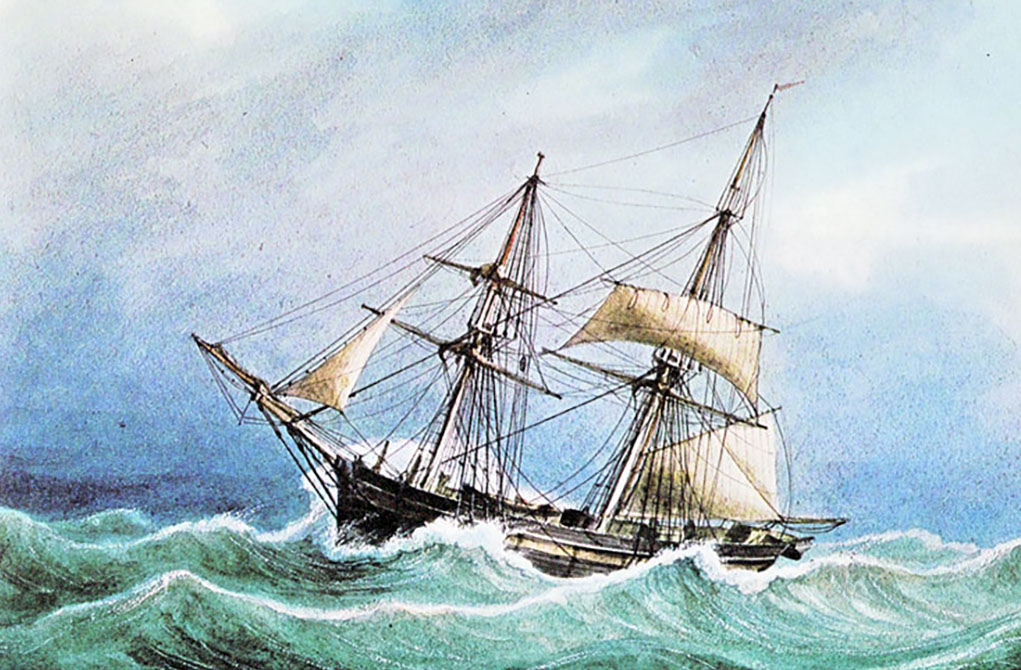
Example of a merchant Brig of the era. (Water colours by Frederic Roux 1827-1828)
By December 1833, the penal settlement at Macquarie Harbour in southwest Tasmania was all but deserted. Only a dozen convicts remained to complete the 120-ton brig Frederick. She would be the last of nearly 100 vessels to be built there. Once launched, they were supposed to sail her around to the newly established station at Port Arthur. However, ten of the convicts had a much more distant destination in mind.
But, to seize the ship involved overpowering the soldiers and officers left behind to watch over them. Tackling armed men with just bare hands was daunting, but they had a plan. One of the convicts, John Barker, happened to be a master blacksmith. He manufactured two flintlock pistols using discarded scraps of metal and a musket barrel found in the blacksmith shop. He also forged a pair of tomahawks to add to their small arsenal.
The Frederick was finished on 10 January 1834, and at 10 am the next day they set sail. Captain Taw sailed down the length of Macquarie Harbour but dropped anchor inside the heads. He judged the weather too foul to safely pass through the narrow passage of Hells Gate and out to sea. So they waited. Then, on Monday, 13 January, the wind eased, signalling their imminent departure.
For the ten convicts, the time to strike had arrived. If they did not seize the ship now, they likely never would. However, they were up against nine men, seven of whom were armed.
Then, good fortune smiled upon them, and the odds shifted in their favour. Two of the soldiers went fishing and took a boat out with a convict at the oars. He was one of two prisoners not in on the plan. So, with them gone, nine had been reduced to six.
Boat building Yard on Sarah Island, Macquarie Harbour by William Gould, 1833, Courtesy State Library of NSW.
Around 6 o’clock in the evening, a prisoner beckoned a sentry to join him by the forecastle hatchway. When the unsuspecting soldier obliged, he was jabbed in the chest with one of Barker’s pistols and ordered down the ladder into the crew’s cabin. Meanwhile, two other convicts armed with hatchets pounce on the only other two men on deck. They subdued the remaining soldier and the terrified mate, bundling them too into the forecastle cabin. A convict stood guard, and a heavy kedge anchor was dragged across the hatchway cover in case they tried to escape. The convicts now had control of the deck. Three men were confined in the forecastle, and another three were out fishing, oblivious to what was unfolding on the Frederick. This just left Captain Taw, David Hoy the shipyard supervisor, and the convict steward William Nicholls. All were in the captain’s cabin
The convicts, now armed with the soldiers’ muskets, were ready to confront the last men standing between them and liberty. Three men stormed down the ladder and attacked Captain Taw and the others, hoping to quickly get the best of them. However, Taw and Hoy fought back. Hoy wrestled a pistol from one of the convicts, and the attackers retreated back up the ladder, leaving Taw, Hoy and Nicholls trapped in the cabin, bloodied and bruised from the brief but violent encounter.
Taw and Hoy were trapped in the cabin. The convicts would pay dearly if they attacked again, but the captain knew he could not retake the ship. They were at a stalemate. But Captain Taw had one small bargaining chip. He had possession of the Frederick’s navigation instruments, items the convicts would need to escape. The impasse lasted about ninety minutes, with occasional shots fired through the cabin’s skylight and each side calling for the other to surrender.
The Globe (London), 9 Jul 1834, p. 4.
Around 7.30 in the evening, someone called for the pitch pot to be brought over and threatened to empty its boiling contents into the cabin if the trio did not immediately surrender. Hoy and Taw agreed there was nothing to be gained by holding out any longer and gave themselves up.
Meanwhile, the fishing party had returned to the brig after hearing gunfire, only to find the prisoners already in charge. The rest of Frederick’s men joined them in the boat, and they were sent ashore with half the ship’s provisions.
Taw and Hoy assessed their situation. There was plenty of food, so they would not be going hungry any time soon. However, how long would it be before a ship was sent to investigate the whereabouts of the Frederick? Taw had no intention of waiting to find out. They set off on foot for the nearest settlement, 150 kilometres away. It would take Taw over two weeks to eventually reach Hobart to report the incident.
In those two weeks, the mutineers did not waste any time making good their escape. James Porter, one of the convicts, wrote the only record of what happened to the Frederick next.
Porter was not a typical convict transported to Australia. For a start, he was born into a respectable middle-class family. When he was 12, he dropped out of school and, by his own account, began mixing with the wrong kind of people. Porter soon got himself in trouble with the law, but his father pulled some strings, and the charges were dropped. However, to prevent Porter from getting into any more trouble, he was sent to sea to serve an apprenticeship and found himself bound for Rio de Janeiro.
So began his career as a seaman. After changing ships several times, Porter claimed he had spent 12 months on the armed schooner Liberta helping the Chileans win their independence from Spanish rule. However, by late 1821, he had had enough of life in South America and returned to England.
A year later, Porter was caught breaking into a house and was transported to Van Diemen’s Land for life. He landed in Hobart in January 1824 but was soon caught stealing and sent to Macquarie Harbour.
When he was chosen to remain behind to finish work on the Frederick, a plan started to take shape in his mind, and South America once again beckoned. His companions comprised a mix of experienced seamen like himself, shipwrights and the blacksmith John Barker who had been schooled in celestial navigation, though he proved to be no seafarer.
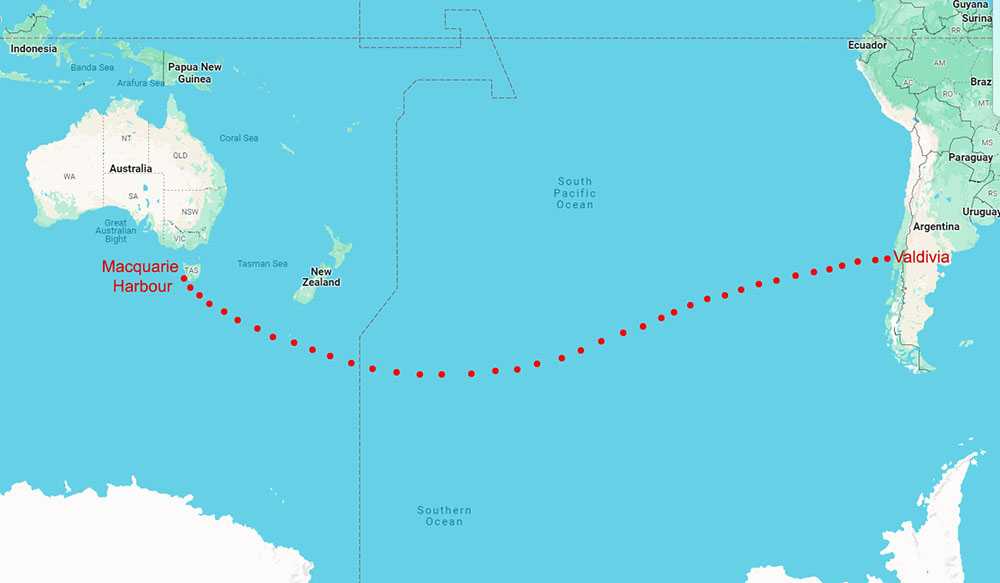
The Frederick was sailed from Macquarie Harbour to South America where it was left to sink. Courtesy Google Maps.
The Frederick no sooner made it out to sea when the wind freshened to a heavy gale. It blew hard with mountainous seas for the next nine days as they bore south, then east under much-reduced canvas. The burden of sailing fell heavily on the shoulders of the seasoned sailors. The rest of the men, unused to such sea conditions, rarely left their bunks, suffering severely from sea sickness. Barker was particularly prone to the malady, only coming on deck periodically to make observations and plot their course.
After being at sea for about three weeks with few opportunities to take observations, Barker found they had strayed too far south into the dangerous icy waters of the “Furious Fifties”. He set a northeasterly course for the helmsmen and then retired to his quarters again. Shortly after this, their voyage nearly came to an end when the Frederick was heeled over on her side by a powerful wind gust.
Fortunately, the ship righted herself once the canvas had been brought in. Then, about six weeks out, they spotted land for the first time since leaving Tasmania. They had sailed nearly 5,400 nautical miles (10,000 km) and arrived off the coast of South America.
On 27 February, they boarded the longboat and left the Frederick to sink as, by now, she was taking on a lot of water. The next morning, they made landfall near the mouth of the Rio Bueno in Chile. A week later, they arrived at the provincial capital of Valdivia, where they were promptly thrown in gaol for entering the country in a “clandestine manner.”
It was obvious to the Chilean officials that the men claiming to be shipwrecked sailors were not what they claimed to be. Now that they were behind bars and facing an uncertain future, Porter and his comrades decided to admit to being runaway convicts and beg the Governor for asylum.
Illustration of a brig. Source: Nautical Dictionary by Arthur Young, published in 1863.
They found a sympathetic ear in Governor Sanchez, and he agreed to petition the President of Chile in Santiago on their behalf. They were released from gaol after promising not to leave town. All ten men found work at the local shipbuilding yard, where their skills were much in demand. As time passed, they settled into their new lives and felt their troubles had been put behind them.
But the British Consul in Santiago had learned of their presence in Valdivia unbeknownst to Porter and his colleagues. He, in turn, had called on the Royal Navy to dispatch a ship to apprehend the runaways.
Eight months later, in February 1835, HMS Blonde dropped anchor at the mouth of the Valdivia River to collect the runaway convicts. However, Governor Sanchez refused to hand them over, and the British warship left empty-handed. While Porter and the others had avoided arrest this time, it was clear to them that the British knew where they were.
Life settled back into its regular routines until a few months later, when Governor Sanchez was replaced by a man far less sympathetic to the runaway convicts. Within a month, three of the convicts departed on a merchant ship bound for North America. Then Barker and two others left in the dead of night in a whaleboat they had been building for the new governor. The governor was furious and gaoled Porter and the other three until they could be handed over to the Royal Navy.
They were put on board the next British warship that stopped at Valdivia and returned to England. As they had escaped from Van Diemen’s Land, it was decided to return them there to stand trial for piracy. They arrived back in Hobart on 29 Mar 1837 after an absence of more than three years.
In a novel legal argument, Porter contended that because the Frederick had never been officially registered, it could not be considered a ship. Instead, it was just a collection of timber, ropes, canvas and such like, which just happened to resemble a brig. Consequently, he argued, they could not be found guilty of piracy. The jury was unconvinced, and after 30 minutes of deliberation, they returned a guilty verdict, and the four men were banished to Norfolk Island for life.
The wreck of the Steamer Gothenburg. Source: Australasian Sketcher, 20 Mar 1875, p. 13.
TEN: SOVEREIGN, 1847.
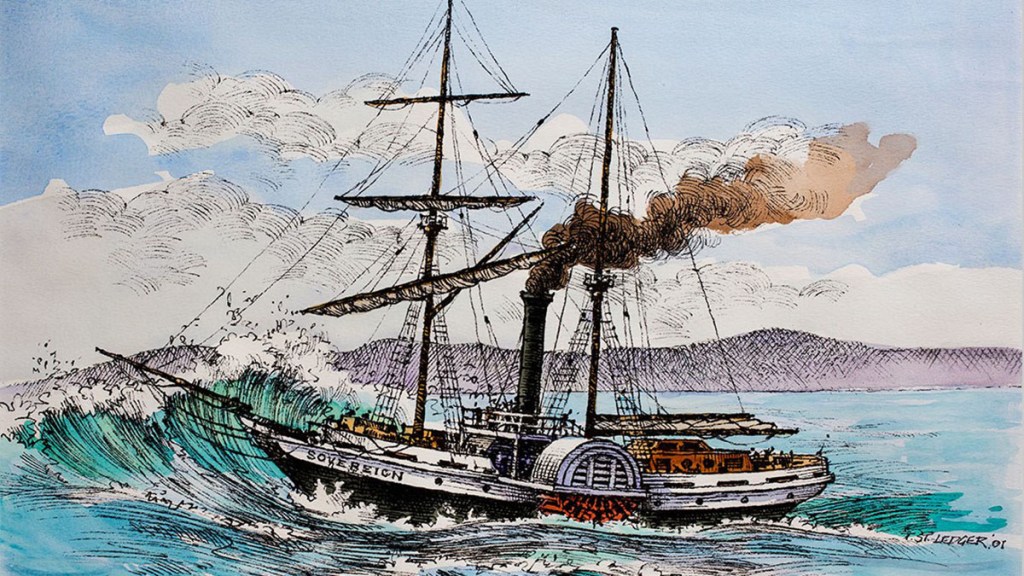
The Sovereign. Image courtesy Stradbroke Island Heritage Museum.
The paddle steamer Sovereign, with 54 persons on board, sailed from Moreton Bay via the southern channel on 11 March 1847. As she ploughed through the large swells funnelled into the passage between Moreton and Stradbroke Islands, her engines failed at a critical moment. The force of the breaking waves quickly drove her onto a sand spit projecting from the southern point of Moreton Island, where she broke up. Forty-four people lost their lives. The owners of the vessel would later claim the engines had been working fine and blamed the captain for the loss.
NINE: MERSEY, 1804.
On 24 May 1804, the 350-ton merchant ship Mersey sailed from Sydney bound for Bengal, India, via Torres Strait. In mid-June she was wrecked while trying to negotiate the dangerous waters of Torres Strait. Neither the location or the circumstances of the tragedy are known, other than the captain and either 12 or 17 of the crew took to the longboat and made it safely to Timor Island to report the loss. She reportedly sailed with 73 hands which means 56 or 61 people lost their lives.
EIGHT: PERI, 1871.
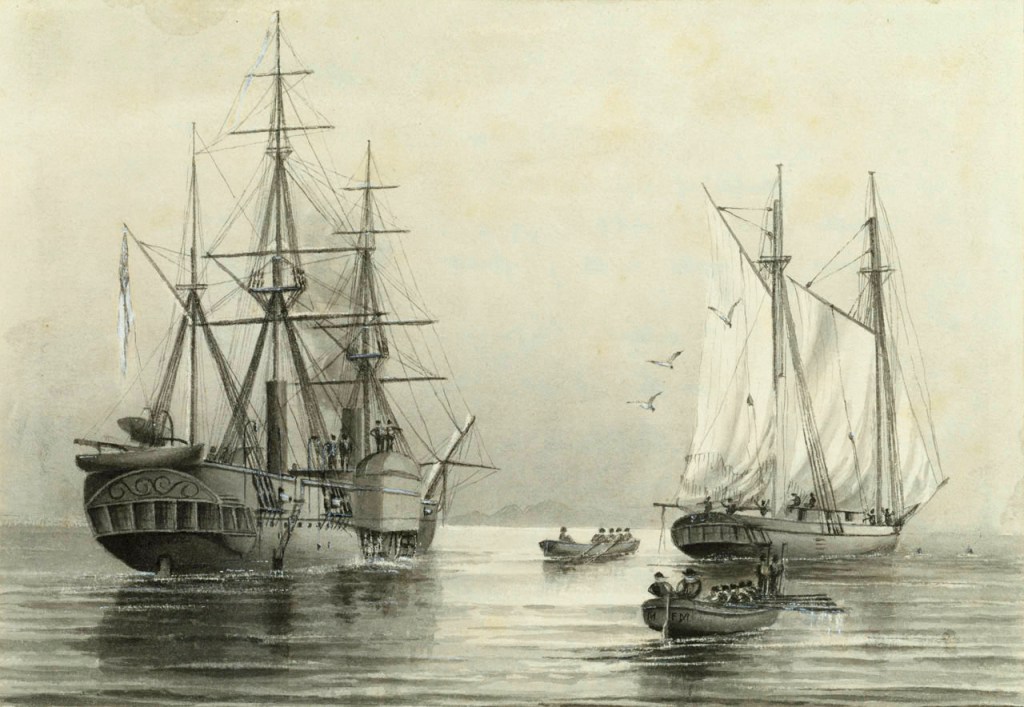
HMS Basilisk and the Peri. Image Courtesy the British National Maritime Museum, Greenwich.
In early February 1871 HMS Basilisk discovered a schooner, later identified as the Peri, adrift and seemingly abandoned a short distance off the Queensland near Cardwell. When a boat was sent across to investigate, they discovered 14 emaciated Solomon Islanders, three corpses, no food or fresh water and five feet of putrid seawater in the hold. The Peri had last been seen about six weeks earlier in Fiji carrying around 80 or 90 blackbirded Islanders bound for Fijian cotton plantations. It seems that the Islanders had overpowered their kidnappers and taken control of the schooner. They then sailed or drifted west across almost 3,000 km of open ocean, withstood at least one severe tropical storm, and passed through a gap in the Great Barrier Reef before being found. As many as 75 people likely died during the ordeal.
Map showing 10 worst maritime disasters off Queensland. Courtesy Google Maps
SEVEN: SYBIL, 1902.
The labour schooner Sybil disappeared sometime after leaving the Solomon Islands on 19 April 1902 bound for Townsville with a fresh batch of South Seas labourers. By August, grave fears were held for the Sybil, for the voyage should not have taken more than two or three weeks. Searches were made of the islands along the outer Great Barrier Reef and in the Coral Sea but no trace of the vessel or any of those on board were found. She had a crew of 12 and on the previous two voyages, she had carried 90 and 98 labour recruits, so it is thought no less than 100 lives were lost.
SIX: GOTHENBURG, 1875
Gothenburg. Photo Courtesy SLQ
The steamer Gothenburg sailed from Darwin on 17 February 1875 bound for Adelaide via Australia’s east coast. On 24 February the Gothenburg was steaming down the coast in the vicinity of Cape Bowling Green. Bad weather meant they could not see the regular landmarks to aid their navigation. The captain was unaware strong currents were pushing the ship towards the Great Barrier Reef until it was too late. The Gothenburg ran aground on Old Reef. The ship and all aboard her would likely have been saved but for a powerful cyclone bearing down on them. As the storm worsened, the captain ordered the evacuation of the passengers, but as the women and children were being loaded into the lifeboats a succession of huge waves swept over the ship. Only 22 people survived. As many as 112 passengers and crew lost their lives.
FIVE: YONGALA, 1911
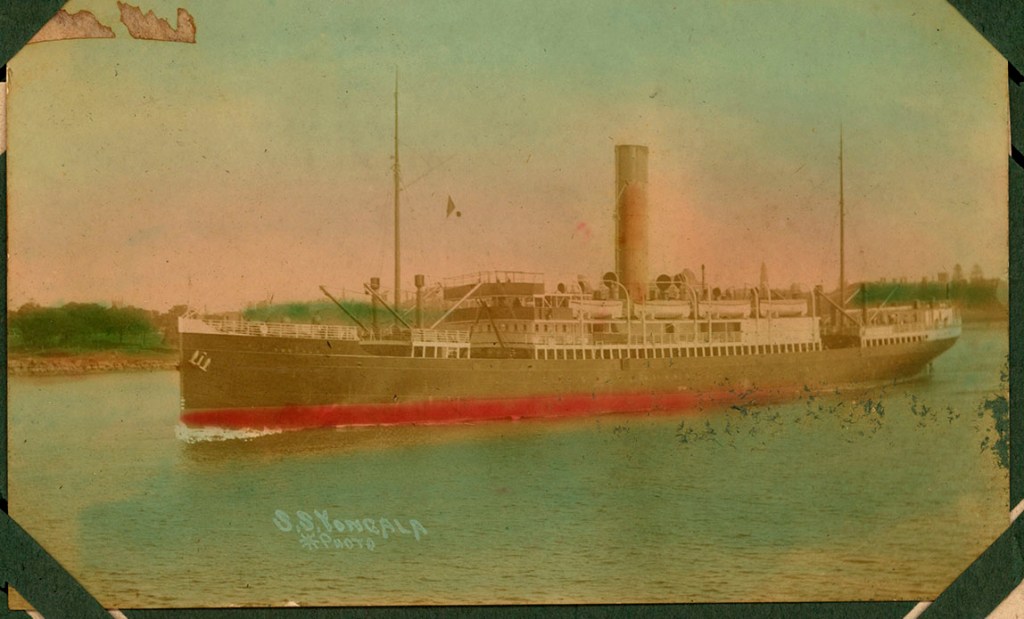
S.S. Yongala. Photo Courtesy SLQ.
The Yongala sank during a tropical cyclone near Cape Bowling Green on 11 March 1911 with the loss of all 122 people on board. When the ship failed to arrive in Townsville as scheduled, concerns were raised. Then, wreckage began washing ashore along the coast as far away as Hinchinbrook Island. However, there was no sign of the ship or any hint as to where she might have sunk. Nearly half a century would pass before the final resting place of the Yongala was conclusively located.
FOUR: QUETTA, 1890
RMS Quetta. Photo courtesy SLQ
While the Mail Steamer Quetta was steaming through Torres Strait on the night of 28 February 1890, it struck an uncharted rock pinnacle as it passed Adolphus Island. The Quetta had departed from Brisbane bound for London carrying nearly 300 people comprising the passengers and crew when disaster struck. The collision tore a gaping hole in the hull from bow to amidship, and the ship sank in just three minutes. One hundred people made it safely to Little Adolphus Island where they were later rescued. Dozens more were pulled from the water the following day. 133 people lost their lives in the tragedy.
THREE: AHS CENTAUR, 1943
AHS Centaur. Photo Courtesy State Library of Queensland
At 4 am on 14 May 1943, the Australian Hospital Ship (AHS) Centaur was torpedoed and sunk by a Japanese submarine. The Centaur was about 35km off Moreton Island having departed Sydney with medical staff from the Army’s 2/12 Field Ambulance bound for Port Moresby. In all, there were 332 people on board. 268 lost their lives. 64 survived by clinging to debris and two damaged lifeboats until they were rescued 36 hours later.
TWO: CYCLONE MAHINA, 1899
Cyclone tracks for Cyclone Mahina.
On the night of 4/5 March 1899, a powerful cyclone crossed the coast at Bathurst Bay on Cape York Peninsula. Lying directly in its path was the North Queensland pearling fleet which had sought shelter there. Nearly 60 vessels – from large schooners to pearling luggers – were sunk or driven ashore with horrendous loss of life. Between 300-400 people died in what is no doubt Queensland’s worst natural disaster. The loss was most keenly felt on Thursday Island where the pearling fleet was based.
ONE: GRIMENEZA, 1854
Artists impression of the Grimeneza . Image Courtesy SLQ
The worst shipwreck off the Queensland coast occurred on 3 July 1854. The Peruvian ship Grimeneza was sailing from China with some 600 Chinese labourers bound for the Callao guano mines in Peru. When they struck a reef at Bampton Shoals in the Coral Sea, the captain and six others immediately abandoned the ship leaving the rest of the crew and the passengers to their fate. The rest of the crew tried to back the ship off, but when that failed, they too took to the lifeboats and were picked up 12 days later. Miraculously, the Grimeneza floated off with the next high tide. The labourers sailed the damaged ship west towards the Queensland coast with the pumps being worked around the clock. But after three days of exhausting work, she foundered. Six men were found clinging to a piece of wreckage 300 km off the coast a few days later. The rest had all drowned or been taken by sharks.
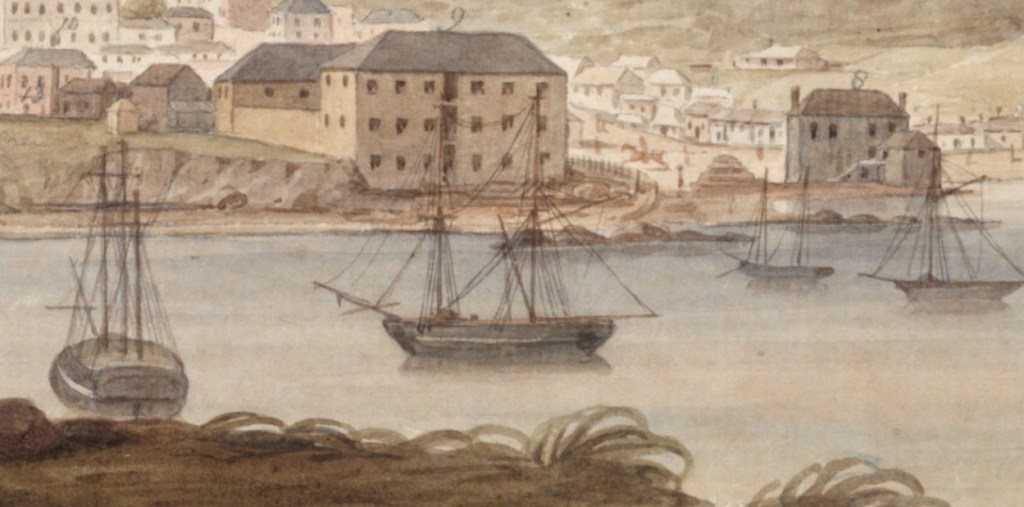
Detail reputedly showing the brig Cyprus (centre) from a panorama of Hobart 1828 – watercolour drawings by Augustus Earle, Courtesy State Library of NSW.
In August 1829, the brig Cyprus sailed from Hobart bound for Macquarie Harbour with provisions and 31 convicts sentenced to serve hard labour at that infamous penal settlement. However, while windbound at Recherche Bay in Tasmania’s south, the prisoners rose up, overpowered their guards and seized control of the ship. Thus began one of the most extraordinary escapes of Australia’s convict era.
Their leader was a 37-year-old convict named William Swallow. He was likely the only man among the prisoners who had any seagoing experience, so in true pirate tradition, the men voted for him to be their captain. Swallow had once earned a living as a seaman on colliers plying England’s coastal waters. That was until he tired of the seagoing life and found it was more lucrative to break into portside houses or ships moored in harbour. He finally came undone when the police suspected him of being involved in several recent burglaries and raided his house. A large haul of stolen property was found in the house, and Swallow was whisked off to gaol. This took place in 1821 when Swallow was going by the name William Walker. He was found guilty of housebreaking and sentenced to be transported to Van Diemen’s Land (Tasmania) for seven years.
William Swallow, however, had no intention of going quietly, leaving his wife and three children to fend for themselves. His first attempt to escape took place even before he had left England. He and a fellow prisoner jumped from the ship carrying them to the prison hulks to await the next Australia-bound convict transport. His mate drowned in the attempt, but Swallow survived and returned to his hometown. However, he was quickly recaptured and charged with returning from transportation. This time, he was loaded on a ship and sent to Van Diemen’s Land.
Swallow made a second attempt to escape eight months after arriving in Hobart. He and three other convicts seized a small schooner, crossed Bass Strait and made it to within 80 kilometres of Sydney before they ran aground and were taken back into custody. Swallow received 150 lashes and was sentenced to serve hard labour at Macquarie Harbour Penal Settlement. But he escaped again before ever setting foot in that much-feared hellhole. This time, he escaped from gaol and stowed away on a merchant ship bound for England. There, he lived free until being discovered in 1828. This time, he was sent to Van Diemen’s Land for life. But Swallow was still not ready to give up and accept his fate. Shortly after arriving back in Hobart, he stowed away on the very ship that had so recently brought him from England. By now, guards were masters at finding stowaways, and Swallow was taken off before it left port. He was flogged again and was on his way to Macquarie Harbour on the Cyprus when, in 1829, he and the other convicts seized the ship.
A tranquil Recherche Bay in southern Tasmania in 2019. Photo CJ Ison.
On 13 August, while the Cyprus was windbound in Recherche Bay, the convicts pounced, catching their guards by surprise and wresting control of the ship. They put the soldiers, captain and crew ashore and the following morning, hauled up the anchor, unfurled the sails and gave three hearty cheers as they got underway. The castaways would remain stranded in that remote and inhospitable corner of Tasmania for two weeks before they were discovered. That gave Swallow and his men ample time to get far away from Van Diemen’s Land before the alarm was raised.
It was supposed by the authorities that the runaways would try to make their way across the Pacific, where they would scuttle the Cyprus and pass themselves off as shipwrecked sailors at some unsuspecting South American port. But Swallow and the others had another idea in mind as Van Diemen’s Land disappeared over the horizon behind them.
The Cyprus was well stocked with food, for it carried sufficient supplies to see the Macquarie Harbour Penal Settlement through the coming winter months when it was all but cut off from the outside world. Swallow set a course to take them to New Zealand, where the men painted the vessel’s hull black and renamed her the Friends of Boston. Passing themselves off as an American-flagged ship, they then sailed north towards the Friendly Islands, known today as Tonga.
However, this leg of their voyage was far from smooth sailing. One man was lost overboard during a powerful storm, and the common purpose that had seen the convicts unite to capture the brig had begun to dissipate. After they reached the island of Tongatapu, present-day Nukualofa, seven men chose to remain there when the Cyprus set sail. Swallow continued north across the equator and eventually reached southern Japan after an impressive voyage of nearly 12,500 km. They pulled into a sheltered bay on the island of Shikoku in January 1830, hoping to resupply with firewood and fresh water. However, at the time, Japan was unwelcoming of foreigners. Despite the language barriers, the Japanese made it clear that the Cyprus had to be gone by sunset; otherwise, it would be fired upon.
Swallow heeded the warning, hoping to resupply somewhere more friendly, but as the sun dipped towards the horizon, the wind dropped and the ship was becalmed. The Japanese coastal battery opened fire as they warned they would, and one of the cannonballs struck the vessel on the waterline. But before any more damage could be inflicted, a breeze sprang up, and Swallow wasted no time getting the ship underway. They followed the Ryukyu Island chain south before crossing the East China Sea, all the time taking on water.
In February 1830, the Cyprus was off the coast of China, near the estuary of the Pearl River (Zhu Jiang River). By now, the leak had worsened, and the pumps had to be manned constantly to keep the ship afloat. Several of the runaways had had enough and wanted to abandon the ship. However, Swallow wasn’t ready to give up on the Cyprus just yet, despite the risk of being discovered by British naval vessels in the area. He hoped they might repair the ship and soon be on their way. However, those wishing to go ashore went below and punched a hole in the hull. They then boarded a lifeboat and left the Cyprus to sink. Swallow and his few remaining loyalists could not stem the steady inflow of water and were forced to abandon the ship a few hours later in the remaining lifeboat and make their way to Canton (Guangzhou).
View of the Canton factories by William Daniell, circa early 1800s. Courtesy British National Maritime Museum via Wikipedia.
The unexpected arrival of British subjects in the trading enclave raised the interest of the local East India Company officials. William Swallow was asked to visit their offices, where he was questioned at length.
As news of the seizure of Cyprus had yet to reach that port, Swallow passed himself off as Captain William Waldon and late master of the 200-ton English brig Edward. His story was a mixture of fact and fiction. He said that they had left London on 14 December 1828, bound for Rio de Janeiro and had then rounded Cape Horn and crossed the Pacific to Japan, where they were fired upon. The Edward, he said, had steadily taken on water as he tried to make for Manila, but his ship had finally foundered near Formosa (Taiwan).
He told the East India Company officials that he and his crew had boarded two lifeboats and headed for the Chinese mainland, but on the way, he lost contact with the second boat. On the strength that Swallow, AKA Waldon, had a sextant engraved with the ship’s name in his possession, and he had arrived in a longboat bearing the name “Edward of London,” his story was accepted. The East India Company officials gave Swallow and his men free passage to London on a merchant ship about to depart from Canton. The escaped convicts might just have got away with the subterfuge but for a stroke of bad luck.
A second boat arrived at the docks just days after they left. The men on that boat also claimed to be survivors from the Edward. But their version of the story was at odds with the one provided by Swallow. One of the new arrivals was immediately detained, but the rest fled Canton on an outbound ship one step ahead of the law. Then, two more men from the Cyprus turned up in Canton. They had been found on one of the Ryukyu islands and taken to Canton for questioning. When news of the seizure of the Cyprus finally reached the British enclave, the men in custody were questioned more closely, and they eventually confessed to who they were.
A letter was dispatched to London on the next ship to leave, warning the police to be on the lookout for Swallow and the others. That ship arrived in London before Swallow, and the police were waiting. However, by pure luck, he had disembarked at Margate rather than travel up the River Thames to London. The rest of Swallow’s travelling companions were arrested at the dock, and a couple of weeks later, Swallow was tracked down to a Lambeth boarding house, living under an assumed name.
In October 1830, Swallow and four others stood trial for piracy. The jury found the others guilty as charged, but acquitted William Swallow after he convincingly pleaded that he had been forced to take part in the mutiny against his will. Although Swallow escaped punishment for piracy, there was still the matter of his returning to England illegally. He was once again sent to Van Diemen’s Land, where he died at Port Arthur Penal Settlement on 12 May 1834.

















 Tales from the Quarterdeck