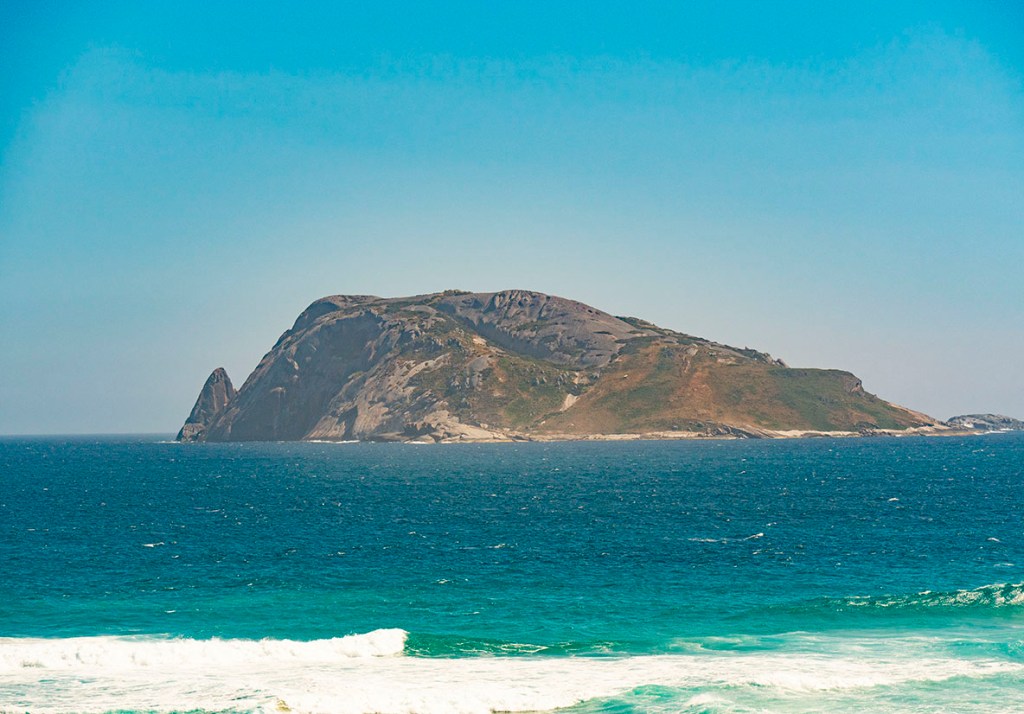
Tag: Ship

  • The Sapphire and Marina: Three Months in a Leaky Boat

       At midday on 8 September 1859, the 749-ton merchant shipSapphire weighed anchor and began slowly making her way out of Port Curtis (present-day Gladstone, Queensland). She was ultimately bound for India via Torres Strait, with a consignment of 60 Australian horses purchased by the British Indian Army. But before the ship could clear the natural harbour, she ran aground on a sandbar and had to wait for the rising tide to lift her off.  So began a voyage that would cost 18 men their lives and last five gruelling months, only for the few survivors to wind up back where they had started. Their story is a remarkable one of perseverance in the face of unimaginable hardship, served with a healthy measure of good luck.   

    The Sapphire bore out into the Coral Sea and then headed north outside the Great Barrier Reef. On 23 September, Captain Bowden calculated he was somewhere off Raine Island. That afternoon, the lookout sighted a line of breaking surf heralding the outer edge of the reef. Bowden had the ship put about, and they tacked back and forth through the late afternoon. Captain Bowden intended to hold his position in deep water overnight and make his way through the reef first thing in the morning.
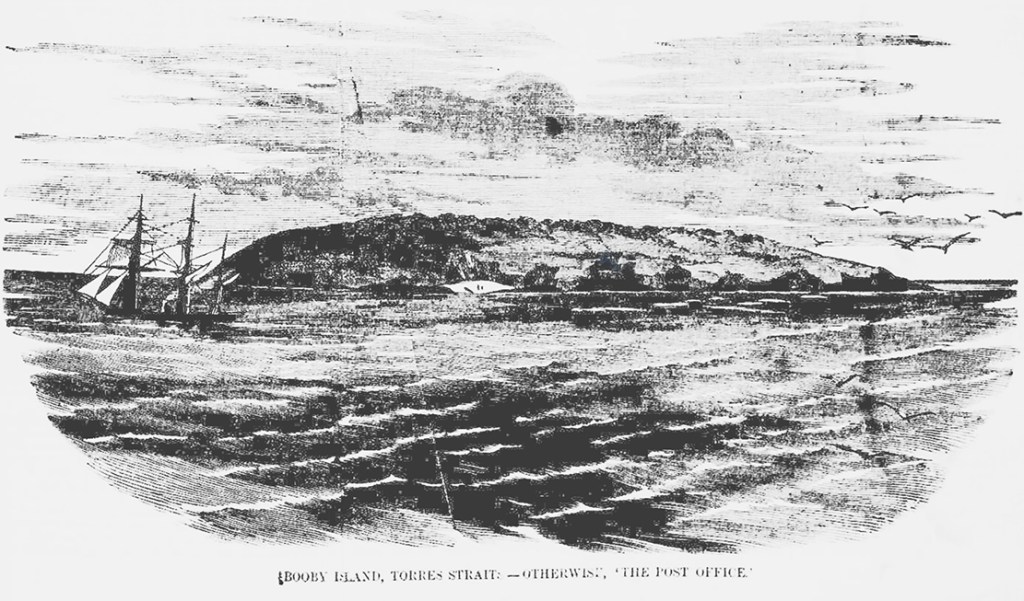
    Illustration of Booby Island, Torres Strait – Otherwise, Post Office. From the Illustrated Sydney News, Fri 16 Dec 1864, Page 9.

        But shortly after sunset, the alarm was raised. A lookout sighted a long, uninterrupted curve of white water directly in their path. By the time the ship responded to the call to pull hard about, the breakers were just 500 metres off the leeward bow. There was now insufficient sea room to turn the ship around and point her back out to sea.  The Sapphire struck the coral reef broadside. Huge waves swept her deck. The force of the collision brought down the fore-top-gallant mast, and one of their lifeboats was swept from its davits. The ship heeled over, and all seemed lost. Captain Bowden ordered the main mast cut away, hoping the vessel might right itself. When the mast came down, it landed on the deck, smashing the longboat to pieces. It also brought down the mizzen mast, which in turn crashed onto the lifeboat, damaging it. Within minutes, three of the Sapphire’s five boats were lost. Everyone spent a harrowing night sheltering as best they could while the terrified horses remained trapped in the hold.

       Breaking with maritime convention, by leaving his ship, Captain Bowden set off in the morning to search for somewhere to land. First Mate William Beveridge was left in charge of the stranded vessel. Beveridge began preparations to abandon the ship and also had the carpenters try to repair the two badly damaged boats, only half expecting that Bowden might return. It seems that Beveridge and Bowden did not see eye to eye, and the first mate may even have blamed his captain for running aground. However, Bowden did return to the Sapphire, having found a suitable refuge on Sir Charles Hardy Island about 85 km away.

       The Sapphire’s crew of 28 men took to the two surviving boats and headed to the island, abandoning the ship and the 60 horses still trapped below. Captain Bowden decided they should return to Port Curtis, 1,500 kilometres to the south, and they left messages in a bottle hung from a tree telling of their intentions. They set off south on October 6 but immediately encountered strong headwinds. Bowden soon gave up on heading south, turning his boat around to head north, through Torres Strait, intending to make for Booby Island. In another unusual turn of events, Beveridge did not follow suit. He continued trying to push south for another day or two before he also gave up and turned around.
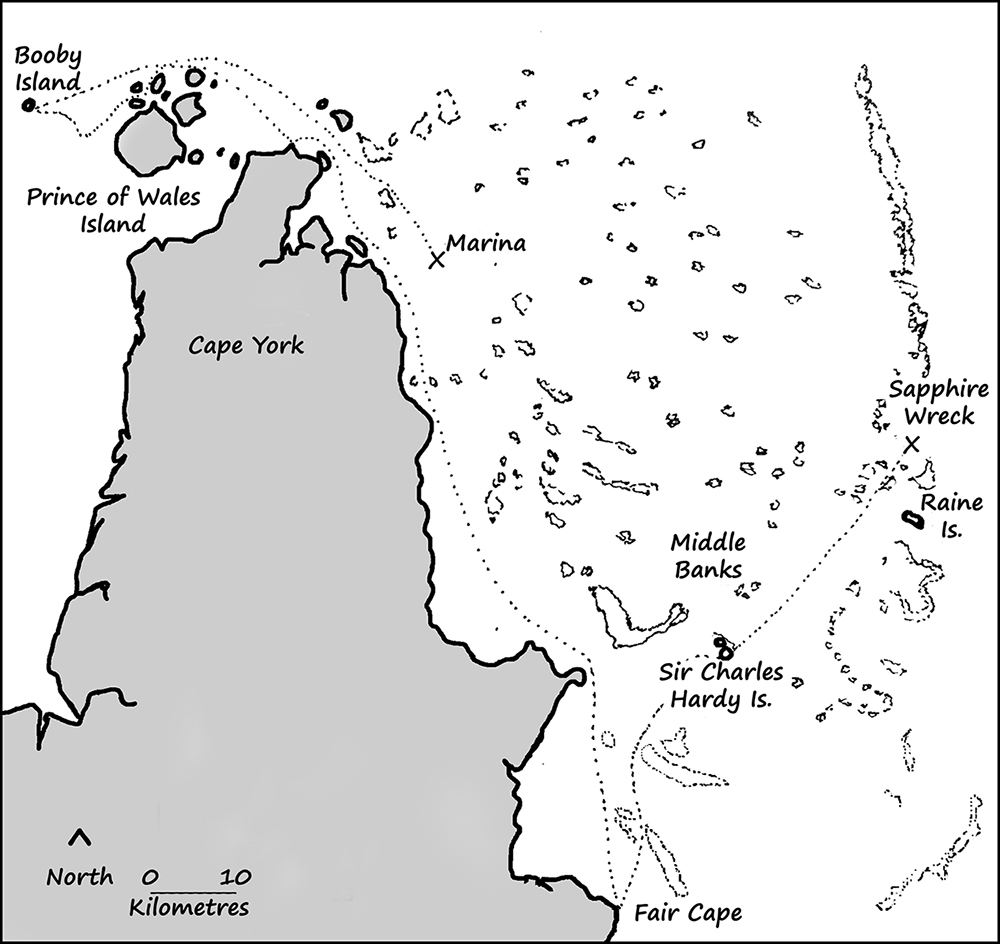
    Sapphire survivors route through Torres Strait from leaving the Sapphire and finding the Marina.

       Beveridge reached Booby Island in mid-October to find Bowden and the rest of the men already there. By now, they had been roaming the seas around Torres Strait for almost a month. The provisions they found there were a godsend for the hungry sailors, but they would not last indefinitely. Bowden and Beveridge agreed that they would have to leave there sooner or later. It was approaching cyclone season, and they had not seen another vessel since becoming marooned. They would likely not see another ship pass by Booby Island until April or even May the next year.

       Bowden and Beveridge put their differences aside and decided to make another attempt to return to Port Curtis, despite their recent failure. But as soon as they got clear of the island, they were struck by the same contrary winds that had plagued them earlier.

       While Beveridge and his boat were off Friday Island, they were set upon by Torres Strait Islanders and one of the men was speared to death. Meanwhile, Captain Bowden’s boat was off Hammond Island. They had stopped to trade with a party of Islanders, but in what seemed like an unprovoked attack, a volley of spears and arrows was launched into their overcrowded boat. Only one man was able to jump clear and swim away. He would later be rescued by Beveridge, who had gone in search of Bowden’s boat.

       Beveridge and his men continued pushing back east and eventually made it around the tip of Cape York. They then picked their way through the maze of coral reefs, and their luck finally changed for the better.

       They spotted a ship in the distance, the first they had seen since abandoning their own vessel some six weeks earlier. But, as they drew closer, they found it was deserted. The ship proved to be the barque Marina, which had run aground around the same time the Sapphire had been wrecked. It too had been abandoned by its crew, and they had also made it to Sir Charles Hardy, reaching it only hours after the Sapphire castaways had left. Miraculously, the Marina had floated off the reef on a spring tide only to drift around Torres Strait for the next several weeks.

    Marina’s course down the Queensland Coast. Source Google Maps.

       The Marina’s crew had then set off south for Port Curtis, and after 43 days of arduous sailing, they made it safely to port and notified the authorities of the loss of their own ship and also of the Sapphire. HMS Cordelia was dispatched north to search for the Sapphire’s missing men. However, she only steamed as far as Cape Upstart, thinking the lost sailors could not still be any further north. But they were wrong. By now, it was late January 1860, and the Sapphire’s crew was anchored off Lizard Island in the Marina, 500 km further north.

       Back in late November, Beveridge had decided they should sail the Marina to Port Curtis rather than try to do so in their small pinnace. Setting off on the 26th, they battled the same contrary winds and currents that had previously frustrated them. For the next two months, they made painfully slow progress. They anchored for days and weeks at a time, waiting for the south-easterlies to fall off. In the first month, they travelled just 180 km.

       They spent tiring Christmas Day kedging the stranded barque off a sandbar, and they would run aground twice more in the weeks that followed. The Marina’s hull was so damaged that water flowed freely in and out of the hold. The only thing keeping the ship afloat was her cargo of tightly packed Kauri logs.

       On 9 February, they were anchored off Palm Island.   In the past two and a half months, they had covered a little more than half the distance to Port Curtis. They still had another 800 km or more to go.   All seemed lost.   Their food had all but run out, and they were slowly starving to death.    

    Finally, their luck turned around. The wind started blowing from the north. They put to sea and made steady progress south. Three days later, Beveridge sighted Cape Upstart off the port bow. The next day, they were cruising through the Whitsundays. They were now only 400 km from Port Curtis. A couple of days after that, they crossed Keppel Bay, and the next day, 17 February, they anchored off Facing Island just outside Port Curtis. No one had the strength to manoeuvre the crippled vessel into port. They took to the Sapphire’s pinnace again and surprised everyone with their return, for they had long been given up for dead.

    The Sapphire’s full story is told in A Treacherous Coast: Ten Tales of Shipwreck and Survival from Queensland Waters, available as an eBook or paperback through Amazon.

    © Copyright C.J. Ison, Tales from the Quarterdeck, 2021.

    Enter your email address in the form below to be notified of new posts.

  • The Spanish Silver of Torres Strait

    Example of a mechant brig, similar to the Sun. Source: “L’Album De Marine Du Duc D’Orleans,” 1827.

       Sometime around 1891, a group of beche-de-mer fishermen stumbled upon a huge hoard of Spanish silver coins. The men had been fishing in the shallow waters of the Eastern Fields at the eastern approach to Torres Strait when they made the surprise discovery.

       At low tide, when much of the reef was exposed, they spotted an old, coral-encrusted anchor fluke jutting from the reef’s surface. The shoals of Torres Strait had claimed many a ship during the 19th Century, and the fishermen were keen to see what else they might find.

       They began chipping away at the decades of accumulated growth until the anchor finally broke free from the surrounding coral. When it was rolled clear, a mass of silver coins, all fused together by time and saltwater, was revealed. Buoyed by the find, the fishermen forgot about the beche-de-mer and extended their excavations. Each day, as soon as the falling tide exposed the reef, they got to work chipping away at the coral. In the end, they uncovered a staggering 410 kgs (900 pounds) of silver. It took them two trips to carry it all back to Somerset, the fishing and cattle station near the tip of Cape York owned by the early pioneering family of Frank Jardine.

    Spanish silver coins as circulated in the early days of New South Wales.

       At the time, it was supposed that the coins might have been carried on a Spanish ship on her way to Manila to pay the wages of the civil and military staff. Either that, or it was to be used to purchase spices from traders in the Indonesian Archipelago, further to the west. Regardless, the ship that had been carrying the fortune in silver had ended its voyage on that remote coral outcrop many decades earlier. They knew it was an old wreck, for by 1891, the timbers had long since rotted away.

       The mystery was only solved years later. It turned out not to have been a Spanish galleon at all. Instead, the fishermen had stumbled upon the remains of the English brig, Sun, which had been lost in Torres Strait in May 1826. Earlier that same year, the Sun had delivered a cargo of tea from China to merchants in Hobart and Sydney. In Sydney, a local businessman had entrusted the ship and her captain with a new cargo of between 30,000 and 40,000 Spanish silver dollars. At the time, one Spanish dollar was worth 4 shillings and 4 pence, which would have valued the somewhere between £7,000 and £10,000. In today’s money, the silver content alone would be worth well over one million Australian dollars.

       The Sun sailed from Sydney on 7 May, bound for Singapore by way of Torres Strait. But it never arrived. The voyage was cut short three weeks later when the Sun struck a submerged reef as it attempted to navigate the dangerous waters separating Cape York from New Guinea.

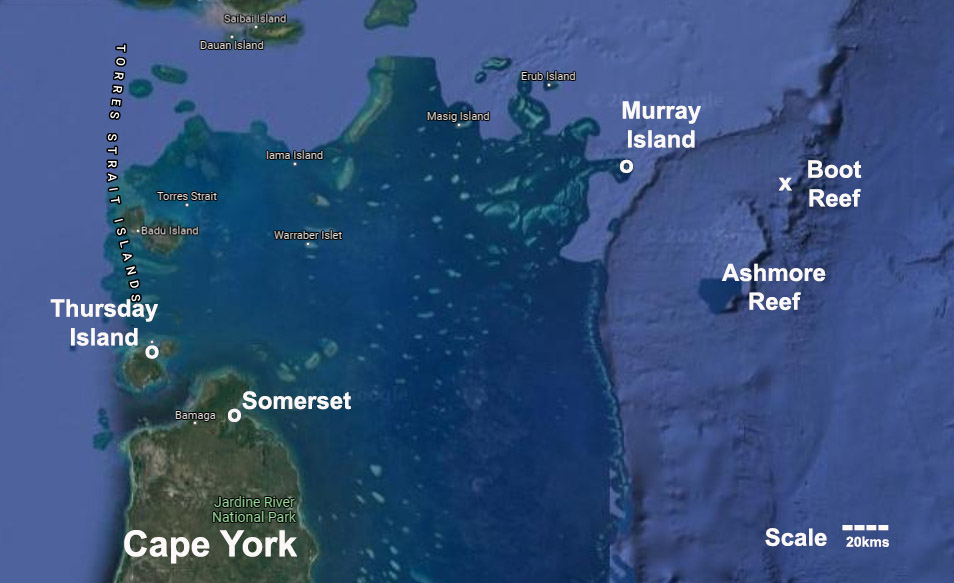
    Torres Strait. Source: Google Maps.

       The ship broke up almost immediately. Captain Gillet and his crew took to the longboat and jolly boat and made for Murray Island, about 30 nm (60 km) away. Such was the haste with which they were forced to abandon the ship that there was certainly no time to save the silver. The crew didn’t even have time to provision the boats with food or water before they pushed away from the wreck. Fortunately, they would only be at sea for two days before sighting land.

       As fate would have it, just as their safety seemed assured, the longboat struck a reef and capsized, spilling all the occupants into the water. The first and second mates, plus 22 lascar sailors, drowned. Only the jolly boat with the ship’s captain and 11 remaining seamen reached Murray Island, where they were looked after by the Islanders. Three days later, Captain Gillet and his men were rescued by a passing ship and eventually delivered to Calcutta, where he reported the loss of his ship.   

    So, there the Spanish silver dollars remained undisturbed for the next 65 years as the Sun slowly disintegrated around them. As the employer of the fishermen, Frank Jardine claimed the lion’s share of the haul. He reportedly had at least some of the coins melted down and made into silver tableware and cutlery for the Jardine Homestead.

    © Copyright C.J. Ison, Tales from the Quarterdeck, 2021.

    Enter your email address below to be notified of new posts.

  • The Bogus Count and Hamlet’s Ghost

    Hamlet’s Ghost at Surabaya, Indonesia, 1868. Photo Courtesy: Walter B Woodbury Photograph Collection, Robert S. Cox Special Collections and University Archives Research Center, UMass Amherst Libraries.

       Some things you can’t make up. This is the improbable story of how a young man impersonating an Austrian aristocrat came to cruise up the Queensland coast on a resurrected vessel named Hamlet’s Ghost.

       In May 1868, a dashing young man stepped ashore in Sydney claiming to be Count Ignaz Von Attems, a blood relative of Archduke Albert of Austria. The Von Attems family traced its aristocratic lineage back to the 12th Century. To Australia’s class-conscious and pretentious squattocracy, the young count gracing their presence was a man to be feted.

       Von Attems knew how the game was played, for he was a master far beyond his 25 years might suggest. He dressed extravagantly, splashed money around with abandon, hinted at a lavish monthly stipend and generally loved to court attention. He was a man to be seen and, more importantly, to many in colonial society, a man to be seen with. No social gathering of the day would be complete without the aristocratic Count attending. He would often dress in the full uniform of an Austrian cavalry officer, complete with sword, even when wandering about town.

       But, after spending just four weeks in Sydney being wined and dined by the city’s social elite, he up and left for Brisbane, promising he would return after doing a spot of hunting in the recently separated colony to the north.


    “The Gallant Count Von Attems” newspaper article from the 1940s. Source: Trove.

       Count Ignaz’s reception in Brisbane was no less exuberant than it had been in Sydney. The Premier of Queensland, Robert Mackenzie, hosted a champagne lunch in Von Attems’s honour, attended by the colony’s leading citizens, for no other reason than he had deigned to visit their humble domain.

       As in Sydney, he borrowed heavily on lines of credit with the colonial banks and convinced local merchants and new acquaintances alike to temporarily cover his expenses. His usual excuse, and one rarely questioned, was that he was waiting for his monthly allowance to catch up with him.

       By now, Count Von Attems, or Curt Oswald Schmulz as he was better known to his family back in Austria, had perfected his – far from petty – grift. Schmulz was charismatic, urbane, and exceedingly generous with “his” money. He was everything one would expect from a well-bred Austrian gentleman. Born into a middle-class family in Saxony, the young Schmulz attended a Commercial Academy and worked in a counting house (an accounting firm) while completing his studies. He also began mixing with friends from wealthier families who enjoyed a far more lavish lifestyle than he could afford. That did not deter the young man from living life to the full. Unfortunately, by the time young Curt Schmulz celebrated his 20th birthday, he had amassed debts neither he nor his father could repay.

    The man dressed in white is likely Curt Schmulz AKA Count von Attems on board Hamlet’s Ghost at Surabaya 1868. Walter B Woodbury Photograph Collection, Robert S. Cox Special Collections and University Archives Research Center, UMass Amherst Libraries.

       He quietly boarded an American-bound ship, leaving Europe and his financial troubles behind. However, the United States was embroiled in its own problems. The Civil War was raging, and Schmulz joined the Union Army, where he apparently served with some distinction. By the time he was mustered out at the end of hostilities, he had risen to the rank of Captain.

       For the next two years or so, he travelled through South America, Africa, and the Middle East before returning to Europe. He supported himself by using forged letters of introduction and drawing on fictitious lines of credit with banks far from where he happened to be at the time. No doubt his earlier employment at the counting house stood him in good stead, for he would have known how the financial system worked and how he could exploit it in those early days. He never stayed anywhere for long and assumed the personas of many different people, real and imagined. He also became adept at assuming the airs of a European aristocrat.

       When he left Sydney, he had no intention of ever returning. To do so would have courted disaster, for it would only be a matter of time before the trail of crumbs he had left behind him caught up. When it was time for him to leave Brisbane, he intended to keep heading north and make for Batavia in the Dutch East Indies (present-day Indonesia) to start anew.   

    And, one day, he found the ideal vessel to take him there. He purchased a luxurious pleasure craft enigmatically named Hamlet’s Ghost. It had a story just as interesting as the bogus Counts. A clue to its origin, for students of Shakespeare, can be found in the yacht’s name. Hamlet’s Ghost had been born from the carcass of the whaling schooner, Prince of Denmark.

    Example of an 1860s whaling Schooner.

       The Prince of Denmark had run aground on one of the Chesterfield Islands far out in the Coral Sea during a heavy storm in 1863. The prospect that they might be rescued by a passing ship was extremely remote. So, the captain got his men to work on building a new boat from the remains of his wrecked ship. Captain Bennett and his crew of Solomon Islanders then sailed her to Moreton Bay, where he sold the vessel. He and his men then boarded the next ship bound for Sydney.

       Hamlet’s Ghost first saw service as a lighter in Moreton Bay, transferring cargo from ships to shore. Then, three years later, a well-heeled merchant named George Harris purchased the craft. He had seen her hidden potential. After the shipwrights had finished with her, Hamelt’s Ghost had been transformed from a utilitarian workboat into a fine pleasure yacht. She was now a schooner-rigged vessel of about 8-10 tons with an elliptical stern and an overhanging bow. The hull had been sheathed in cedar and copper-plated to ward off seaworms. She had been fitted with a spacious cabin amidships, featuring a large central skylight that protruded above the deck, providing full headroom and an abundance of light.    “The vessel’s cabin is splendidly fitted up,” wrote one reporter. “The panelling is of grained maple mounted with gold mouldings, and a large pier glass fills up one end of the cabin.”

    Hamlet’s Ghost at Surabaya, 1868. Photo courtesy: Walter B Woodbury Photograph Collection, Robert S. Cox Special Collections and University Archives Research Center, UMass Amherst Libraries.

       She was also armed with three brass swivel guns to ward off any threats when cruising in remote or dangerous waters. But for the most part, Harris was content to sail her down the Brisbane River and around Moreton Bay.

       When the bogus count saw Hamlet’s Ghost, he knew it was the perfect vessel for what he had in mind. Von Attems told everyone that he intended to explore the warm waters along the Queensland coast, perhaps as far as Cleveland Bay (present-day Townsville), before returning to Brisbane. Harris was too canny a businessman to relinquish his vessel without first receiving full payment, no matter how esteemed the purchaser was. So, the count purchased the yacht with borrowed money to the sum of £500.  Von Attems crewed it with a captain, chief officer, three seamen, a cook/steward and, of course, a manservant.

       Three weeks after his sensational arrival, Count Ignaz Von Attems bid Brisbane “Auf Wiedersehen,” leaving another mountain of debt in his wake. He even had the audacity to direct creditors to the Prussian Consulate for payment shortly before he set sail.

       Curt Schmulz did not leave Brisbane too soon, for a month later, a warrant for his arrest issued in Sydney had reached the stunned city. By then, the bogus count was rounding Cape York Peninsula, but it had been anything but fair sailing up the Queensland coast.

       Hamlet’s Ghost had pulled in at Maryborough, Rockhampton and Cleveland Bay, where the leaving citizens, thrilled to be in such august company, entertained the dashing and gracious young man. But, for the crew, Count Von Attems had proved to be a particularly obnoxious creature to work for. By the time Hamlet’s Ghost had reached the government outpost of Somerset near the top of Cape York, the captain had had enough of the arrogant Count. Their latest argument escalated to the point where both men brandished their pistols, threatening to shoot each other. Cooler heads stepped in before either was hurt, and order was restored. However, the captain and the steward left the yacht at Somerset. Von Attems was only able to convince the rest of the crew to stay by promising them more money. They then left Queensland behind, passed through Torres Strait and on towards the Dutch East Indies.

       Count Von Attems, AKA Curt Schmulz, finally ran out of luck at Surabaya. There, he was arrested after passing several fraudulent bank bills. While waiting his day in court, Von Attems escaped the prison hospital and almost managed to flee the East Indies before being recaptured.

       He was finally tried, found guilty and served 10 years in Batavia’s notorious Glodok Prison. Hamlet’s Ghost was never returned to Queensland. The Dutch colonial government reportedly sold her off for £100, and her final years are unknown.

    (C) Copyright Tales from the quarterdeck / C.J. Ison 2021.

    To be notified of future blog posts please enter your email address below.

  • The Brig Amity’s Amazing Career

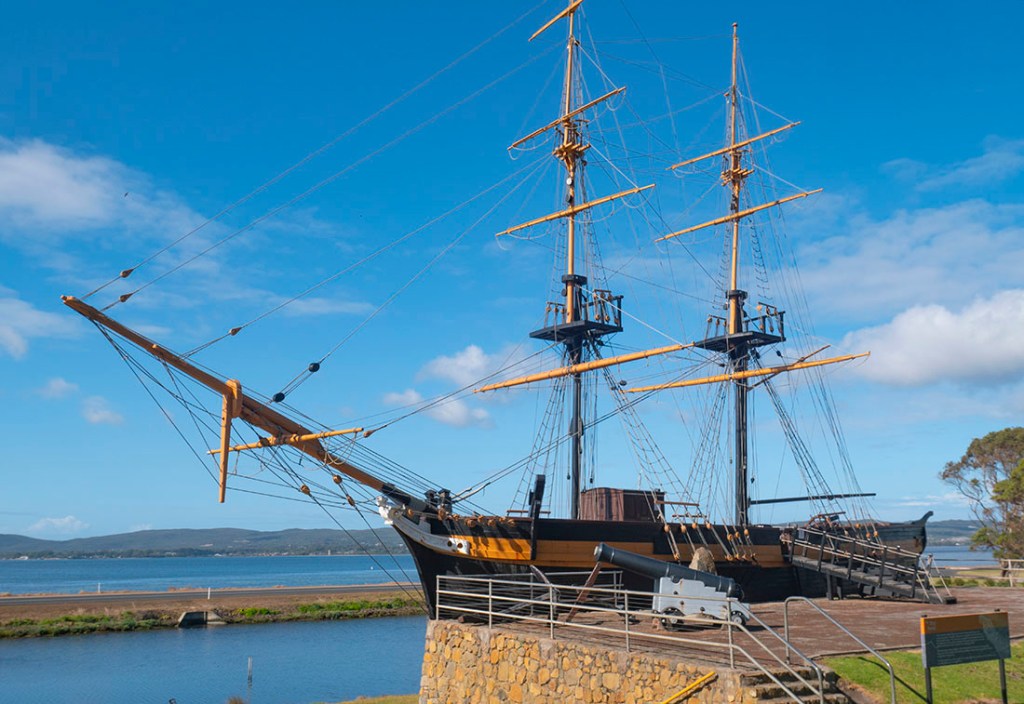
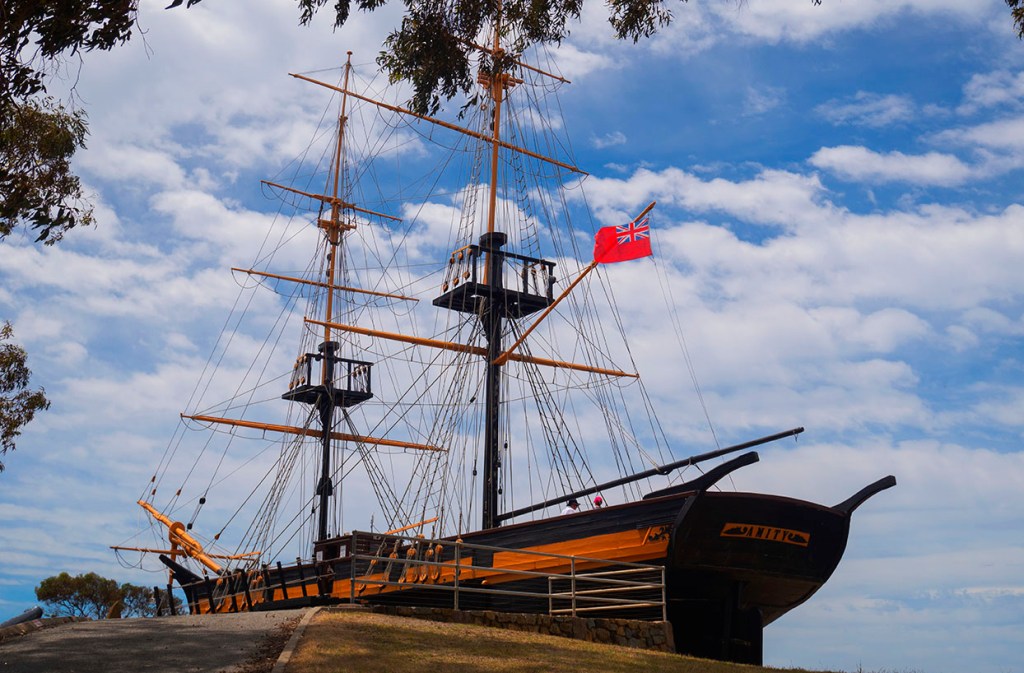
    Brig Amity replica at Albany Western Australia. Photo: C.J. Ison.

       All Australian school children learn of the Endeavour’s role in the history of Australia. Some people may have heard of the First Fleet’s flagship, Sirius, or the Investigator, which Matthew Flinders used to chart much of Australia’s coastline. But, I would wager few have ever heard of the brig Amity or know of her contribution to our colonial past.

       During the brig Amity’s six years as a colonial government vessel, she was employed to establish two new settlements in what would one day become Queensland and Western Australia. She went to the rescue of the Royal Charlotte survivors after that ship ran aground on Frederick Reef in Australia’s dangerous northern waters. She regularly transported convicts, soldiers, and supplies from Sydney to outlying settlements and circumnavigated the continent on two occasions.   

    The Amity was built in New Brunswick, Canada and launched in 1816. She was a modest-sized vessel even by the standards of the day, at 148 tons, measuring a fraction over 23 metres (75 feet) in length. But she was a sound ship and could handle rough weather.

    Officer’s stateroom with tiny individual sleeping cabins leading off the main room. Photo: C.J. Ison.

       The little brig spent the first few years of her life hauling cargo back and forth across the North Atlantic between North America and Britain. In 1823, a Scotsman named Robert Ralston purchased her, having decided to emigrate to Van Diemen’s Land with his large family. He fitted the vessel out for the long voyage and filled its hold with cargo and livestock for his new adopted home.

       After a five-month voyage, the Amity sailed up the Derwent River and dropped anchor in Hobart Town on 15 April 1824. Ralston and his family purchased land and established several businesses in Hobart and Launceston, and a few months after their arrival, he put the vessel up for sale.   

    The New South Wales colonial government purchased the Amity in August 1824. The brig’s first assignment was to establish a new settlement at Moreton Bay. Two years earlier, the Bigge Report had recommended establishing a place of secondary transportation somewhere far north of Sydney for convicts who had committed additional crimes in the colony.

    The Moreton Bay Penal Settlement about 10 years after its founding. Photo Courtesy SLQ.

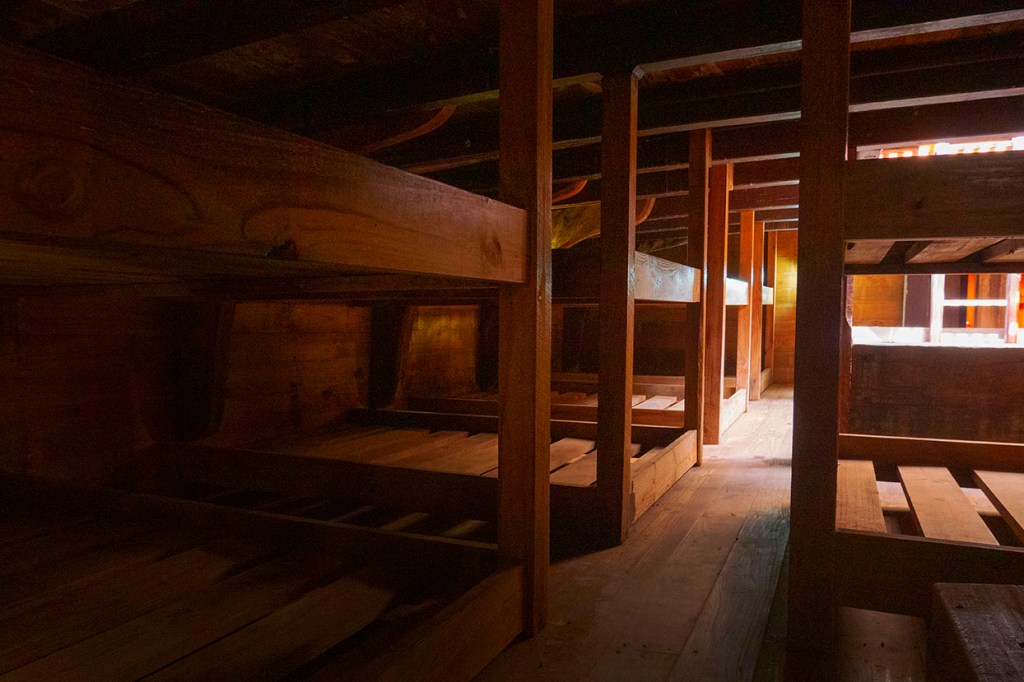
       On 1 September, the Amity and her crew sailed with a military officer, 20 soldiers, plus wives and children, a handful of civilian administrators, plus 30 convicts. The journey took 11 days and was marked by severe storms. Accommodation between decks measured just 1.5 metres (5 feet) high. Here, the seasick soldiers, wives, and convicts spent a miserable time packed in with the new settlement’s pigs, goats and poultry. Nonetheless, they made it at Moreton Bay and her passengers and stores were disembarked at Redcliffe, where John Oxley decided the new settlement would be established.

       Later in the month, the ship was nearly wrecked. She had been anchored out in Moreton Bay when a storm blew up. The Amity’s anchors started to drag as she was pushed towards shore. A third anchor was dropped, and the ship was held in place, averting disaster. Soon after that, she left the new settlement and returned to Sydney for more stores. On her third trip to Moreton Bay, in mid-1825, she helped relocate the settlement. Redcliffe had proved not as suitable as Oxley had thought it would be. The new location, on the north bank of the Brisbane River, was thought to be a far more suitable one.

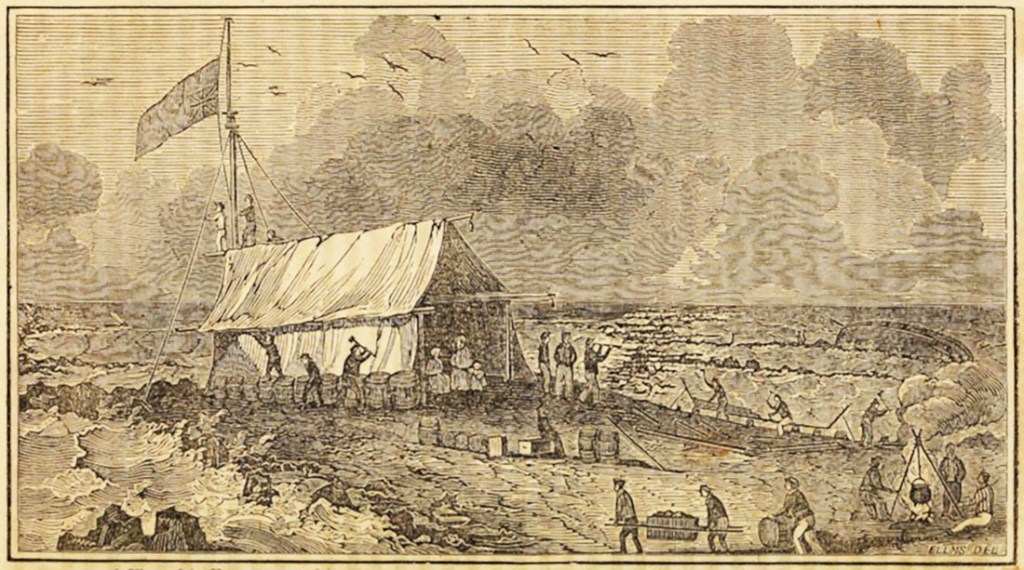
       While anchored in Moreton Bay, one of the crew spotted an unfamiliar longboat coming towards them. This turned out to be the first mate and several survivors from the ship Royal Charlotte, which had run aground a month earlier on Frederick Reef, some 720 km (almost 400 nautical miles) north in the Coral Sea.

       The first mate reported that there were still nearly one hundred souls, many of them women and children, stranded on a small sand cay which was almost awash at high tide. The Amity was immediately sent to rescue the castaways and arrived off the reef on 28 July. Getting close to the survivors proved a dangerous operation with powerful breakers crashing into the reef, threatening any vessel that got too close. The Amity eventually anchored several miles distant and its whaleboat was sent to evacuate the survivors and salvage as much as they could from the wreck. With an additional hundred people squeezed into the small brig, she sailed directly for Sydney, arriving there ten days later.

    A view of the encampment of the shipwrecked company of the Royal Charlotte on Frederick’s Reef. Illustration by Charles Ellms (circa 1848)

       For the next 18 months or so the Amity was in constant use ferrying convicts and supplies between Sydney and the outlying settlements at Norfolk Island, Moreton Bay and Port Macquarie. But, in late 1826, Governor Darling, who had recently replaced Governor Brisbane, had another important mission for the Amity and her crew.

       She was ordered to take three officers and a small detachment of soldiers, 23 convicts, plus a handful of civilian officials under the overall command of Major Edmund Lockyer to establish a new settlement. This one was to be located in the remote south-west of the continent at King George Sound (Albany).

    Convicts and other passengers were accommodated between decks which measured just five feet in height. Photo: C.J. Ison.

       Until then, Australia’s southern coast from Bass Strait to Cape Leeuwin was little known outside its indigenous peoples and the haunt of sealers who lived largely outside the law. Darling was increasingly concerned that the French, whom he had learned had recently visited the area, might try to establish a permanent presence there. 

       The small brig weighed anchor on 9 November 1826, but she soon ran into a severe storm, which saw her put into George Town on the Tamar River in Van Diemen’s Land for repairs. She finally anchored safely in King George Sound on Christmas Day, and the next morning, she began disembarking her passengers and cargo. A month later, the Amity returned to Sydney and resumed her regular resupply duties.   

    In May 1827, she accompanied HMS Supply and the brig Mary Elizabeth on a voyage via Torres Strait to Fort Dundas on Melville Island, not too far distant from present-day Darwin in the Northern Territory. Fort Dundas had been established three years earlier to facilitate trade with visiting Macassan fishermen, but it was eventually abandoned, due in part to the determined resistance put up by the indigenous Tiwi people.

    Sketch of Fort Dundas – 1824 by JS Roe. Picture courtesy State Library of Western Australia.

       Leaving Fort Dundas and the other two ships, the Amity continued circumnavigating the continent, stopping to drop off supplies at King George Sound before returning to Sydney via Bass Strait.

       In 1828-29, she paid another visit to the remote northern and western settlements when she dropped off stores before returning to her home port of Sydney, thereby completing a second circumnavigation.

       The following year, December 1830, the New South Wales government sold the brig off. She made her way back to Hobart and passed through several hands over the next decade. A couple of owners tried whaling while others employed her as a cargo ship, but they all seemed to struggle to turn a decent profit.

       In 1842, the Amity was now 26 years old and no doubt past her prime. Her new owner, a Hobart butcher named Gilbert, used her to transport livestock across Bass Strait from the mainland to Van Diemen’s Land.

       On 18 June 1845, she was driven onto a shoal off Flinders Island during one of the ferocious storms Bass Strait is rightly known for.   The ship was destroyed, but fortunately, the captain, owner and crew, numbering 11 in all, survived.    In 1976, a full-size replica of the Amity was completed in Albany to celebrate that town’s 150th anniversary. The replica provides a fascinating close-up look at an early 19th-century sailing ship and to stoop around below decks highlights just how small she really was.

    Brig Amity replica at Albany Western Australia. Photo: C.J. Ison.

    For more interesting stories from Australia’s maritime past check out A Treacherous Coast, Bolters and Tales from the Quarterdeck. All are available now as a Kindle eBook or paperback through Amazon.

    © Copyright: Tales from the Quarterdeck / C.J. Ison, 2020.

    To receive notifications of future blog posts please enter your email address below.

  • The Loss of the Mandalay: Between a Rock and a Hard Place

    Postcard of the Mandalay of Farsund Norway which was shipwrecked at Mandalay Beach near Walpole Western Australia in 1911.

        As Captain Emile Tonnessen saw the sheer granite walls of Chatham Island loom into sight, he knew his ship and crew of 12 men were in serious trouble. He had been pushed dangerously close to Western Australia’s southern coast by unrelenting gale-force wind and high seas for the past several days. And now his 913-ton iron barque Mandalay was in imminent danger. His chart showed that, should he escape crashing into Chatham Island, there was still an uninterrupted line of cliffs beyond which he knew he could not avoid

       The Mandalay had sailed from Delagoa Bay (now Maputo), Mozambique, in early April 1911, bound for Albany WA to take on a cargo of Karri logs destined for Buenos Aires, Argentina. It was to be the 68-year-old captain’s final voyage before retiring to spend time with his children and grandchildren, whom he had seen little of during his more than half a century at sea. But for a last-minute change of plan, he would have returned to his home in Norway directly from Southern Africa.

       The voyage was largely uneventful until Saturday, 13 May, when they neared the Western Australia coast in the vicinity of Cape Leeuwin. The weather had rapidly deteriorated. South-westerly winds grew to hurricane strength, and mountainous seas washed over the vessel. All canvas was taken in, and the Mandalay was swept along under bare poles. The ferocious weather continued for two days, pushing the helpless vessel towards the rugged and sparsely populated coast.

       The crew tried everything they could to get control of the ship. But the only sail they could put up was on the fore-top mast. It was insufficient to deviate the ship from the course the storm was relentlessly pushing them. They had no chance of putting out into open water.

    Chatham Island viewed from Mandalay beach. Photo C.J. Ison.

       On Monday morning, 15 May, they cleared the kilometre-wide and 90-metre-high granite outcrop that is Chatham Island with only a few hundred metres to spare. Tonnessen later recalled that the waves were so large and powerful they crashed completely over the island as his ship raced past.

       While they had escaped being smashed against the granite slopes of the island, it was clear they would not be so lucky to get past the sheer cliffs of Long Point now lying somewhere ahead through the torrential rain. The captain took the only action he could.

       He would have to sacrifice his ship to give his crew a fighting chance of survival. In all his years seafaring, he had never been shipwrecked, but now he was going to deliberately run his vessel aground. It was no doubt made doubly hard for him, as he was a part-owner of the Mandalay, and he knew her to be underinsured.

    The Mandalay stranded on the beach.

       It was now about one o’clock in the afternoon. Tonnessen lined up to run the ship ashore on the only beach he could see, hoping for the best. The crew hoisted as much sail as they could, then donned their cork lifebelts and braced for the impact. About 100 metres from the beach, the bow struck the sand hard. The top main mast came crashing down, and the ship bounced along the seabed as successive waves lifted the ship and pushed it a little closer to shore. Then the Mandalay swung broadside to the ocean swells, and breakers crashed over the deck, sweeping it clean of anything not securely tied down.

       The crew lowered a lifeboat over the lee side, but the seas were too turbulent to safely cross the short distance to land. One of the young seamen, Knut Knutsen, tied a rope to his lifebelt and dived into the sea, intent on getting a line ashore.

       Unfortunately, the rope became entangled around his legs, and he floundered in the chaotic surf. Knutsen was close to drowning when a second sailor, Frank Ward, dived into the maelstrom to rescue him. Ward managed to get his friend to shore, and the two of them anchored their end of the rope. With one end of a line attached to the ship and the other end with Ward and Knutsen on shore, the lifeboat was able to ferry the rest of the men to safety.

    L-R Frank Ward and Knut Knutsen at Fremantle after the wreck of the Norwegian barque Mandalay. Photo published in the Western Mail, 3 June 1911, p. 27.

       The castaways were able to get sufficient materials ashore to build a shelter using some of the ship’s sails and spars. Unfortunately, they soon discovered that most of the food they salvaged had been contaminated with seawater.  They ate it regardless, figuring it was better than starving.

       They spent several miserable days camped on the beach, hoping they might be rescued. They placed a pole high on a sand dune with a distress signal flying. Several ships were seen passing in the distance, but none deviated from their course. Thonnessen knew it would have been suicide to try to get a boat ashore in the appalling conditions. But he hoped that at least one of the ships had seen the wreck and the fluttering flags and reported the disaster to the port authorities in Albany.

    The crew of the barque Mandalay. Photo courtesy Walpole Nornalup and District Historical Society.

       While Captain Tonnessen and the others remained camped on the beach, the first mate, Lars Gjoem, and two seamen set off on Tuesday, the day after the wreck, with compass and chart to see if they could find their way cross-country to the nearest settlement. Two days later, they returned to the beach cold, wet and exhausted, unable to find a path through the dense bush.

       On Friday, 19 May, the day after the party returned, the second mate, Frederick Fincki, climbed the highest hill behind the beach, and from that vantage point, he thought he could see a route through the maze of broken ground. He briefly returned to the camp to collect a staff and a knife and set off towards what he would later learn was Nornalup Inlet.

       He soon found himself wading through a swamp. But he doggedly pushed on for several hours, praying he would eventually reach dry land. Fincki made it to Nornalup inlet, arriving just as a local settler, Frank Thompson, was returning in his boat with supplies from Albany. Fincki was lucky, for that was a trip Thompson only did once every three months.

       Thompson, picked up Fincki and took him to his home, wondering to himself what would have happened had he not been passing when he did. It was bitterly cold, night was fast approaching, and the young Norwegian had been far from dry land. Thompson thought his chances of surviving would have been poor.

       The following day, Thompson, his son and the second mate returned to the beach to rescue the remaining men. Over the next several days, the shipwrecked sailors were cared for by Thompson and other settlers until they could be delivered to the small settlement of Denmark, located further down the coast. From there they were taken on to Albany, where they caught the train to Perth.

    Mandalay Beach with Long Point in the background. The wreck lies approximately in the centre of the photo. Photo C.J. Ison.

       Frank Thompson was presented with a gold fob watch by a grateful Norwegian Consul. Thompson and the other settlers who came to the crew’s aid earned the undying gratitude of Captain Tonnessen and his men. The Mandalay was never refloated and slowly rusted away on the beach that now bears her name. Its remains are periodically exposed when the conditions are right.

    ©Copyright C.J. Ison / Tales from the Quarterdeck, 2020.

    To receive notification of future blog posts, enter your email address below.