Category: RN / RAN Ships

  • The Loss of HMS Sirius – 1790

    “The melancholy loss of H.M.S Sirius off Norfolk Island” by George. Raper. Courtesy: National Library of Australia 136507434-1

    When HMS Sirius was wrecked off Norfolk Island in 1790, the loss was keenly felt back in Sydney. She was one of only two ships available to Governor Phillip, and he desperately needed both of them. Sydney had so far been unable to grow sufficient food to feed itself and was now facing starvation. The loss of the Sirius only compounded the colony’s problems. 

       HMS Sirius had sailed from Portsmouth on 13 March 1787 as part of the First Fleet, a social experiment to rid England of its most troublesome and unwanted folk. They arrived in New South Wales in January 1788. A month later HMS Supply sailed for Norfolk Island with a small number of convicts and a detachment of guards to establish a penal settlement there. By October of the same year, Governor Phillip realised that Sydney would soon be facing starvation unless something was urgently done. He ordered Captain John Hunter to sail HMS Sirius to the Cape of Good Hope and purchase livestock, grain and other provisions for the fledgling colony.   

    Some months after her return, the Sirius, in company with HMS Supply, was ordered to sail for Norfolk Island with desperately needed provisions along with additional convicts and guards.

    First Fleet entering Sydney Heads January 1788. By E. Le Bihan, Courtesy State Library of NSW.

       They reached Norfolk Island on 13 March 1790, and over the next few days, they disembarked their passengers; however, the sea conditions were such that neither ship was able to land its stores. On 15 March, the unrelenting gale-force southerly forced them to leave the island. By the 19th, the wind had moderated and shifted around to the southeast, so Captain Hunter made landfall again, hoping to begin unloading.

       As Sirius neared the island, Captain Hunter saw the Supply already anchored in Sydney Bay, and there were signals flying on shore that longboats could land without danger from the surf. Hunter took his ship in as close as he dared, loaded the boats and sent them away, but then the wind freshened.

    “Part of the Reef in Sydney Bay, Norfolk Island, on which the Sirius was wreck’d. 19 March 1790.’ by William Bradley.

         Hunter ordered his men to haul up the anchor and make for open water, but before he could do so, the Sirius was driven onto the rocks. Powerful surf crashed around the stricken ship. Soon after they struck, the carpenter reported that water was pouring into the hold. The masts were cut away in the hope that the lightened vessel might be driven higher onto the reef, where the crew would have a better chance of saving their lives.

       By now, it was about 11 a.m. The provisions were brought up from the hold and stacked on deck so they might be floated ashore if the opportunity arose. However, the sea conditions continued to deteriorate. Towards evening, Hunter received word from shore urging him to abandon ship as it would be too dangerous to remain overnight. A rope was tied to an empty barrel and floated through the surf to waiting hands ashore. Then a seven-inch-thick hawser was sent across the narrow stretch of reef and surging seas and tied to a tree. Now the crew could be hauled ashore three or four at a time. Most sported cuts or bruises by the time the reached land from being bashed against the rocks on the perilous passage. The operation stopped only when it became too dark to continue safely, and the remaining men were taken off the following day.

       A couple of days later, two convicts volunteered to go aboard the Sirius to get the livestock ashore. They got a number of pigs and some poultry over the side and the current did the rest. However, as evening turned to night, the two convicts refused to leave the ship. They had found a cask of rum sometime during the day, and by evening, they were drunk as lords. Probably in an effort to keep themselves warm, they lit two fires, but they soon got out of hand and did significant damage to the ship. The following day, guards were sent out to the ship to forcibly return them to shore, where they were clapped in irons for their troubles.

       When the weather finally eased, Hunter sent some of his men across to begin ferrying the remaining provisions ashore using the hawser. Other stores, sealed in timber casks, were thrown into the water with the hope that they would wash ashore through the surf. Some made it. Some sank to the bottom.

       While the Supply had managed to unload its provisions on the sheltered side of the island, with so many additional mouths to feed, rations for everyone on Norfolk were cut in half.

    The Settlement on Norfolk Island, May 16th 1790 / George Raper. Courtesy State Library of NSW, FL541331.

    Captain Hunter and his crew would be stranded on Norfolk Island for several months before they could return to Sydney. Meanwhile, Governor Phillip was stunned to learn of the Sirius’ loss. He had been relying on her to go on another resupply mission to keep the struggling colony fed.

       His problems just kept mounting. The second fleet had recently arrived, delivering 800 extra mouths to feed, many were already in a terrible physical state when they came ashore. They were too ill to help cultivate crops or contribute in any other meaningful way. One of the fleet’s two supply ships, HMS Guardian, had been wrecked in the Southern Ocean, placing a greater strain on the settlement’s already meagre provisions. Food was tightly rationed and no distinction was made between the lowest convict and the Governor himself. Everyone received the same ration, one and a half pounds (700 g) of flour, two pounds (900 g) of salt pork, one pound (450 g) of rice and one pint (500ml) of peas per week.   

    The few privately owned boats in Sydney were requisitioned and sent out to catch fish. Hunting parties roamed the outskirts in search of game, and guards had to be stationed around the public vegetable gardens to prevent theft. HMS Supply was sent to Batavia for supplies, leaving Sydney without a single ship at its disposal. One hundred forty-three people died of sickness or malnutrition in Sydney that year. There was probably no other time when the existence of the settlement looked so tenuous. 

    © Copyright C.J. Ison / Tales from the Quarterdeck, 2023.

    To be notified of future blogs, please enter your email address below.

  • The Life and Loss of HMSC MERMAID

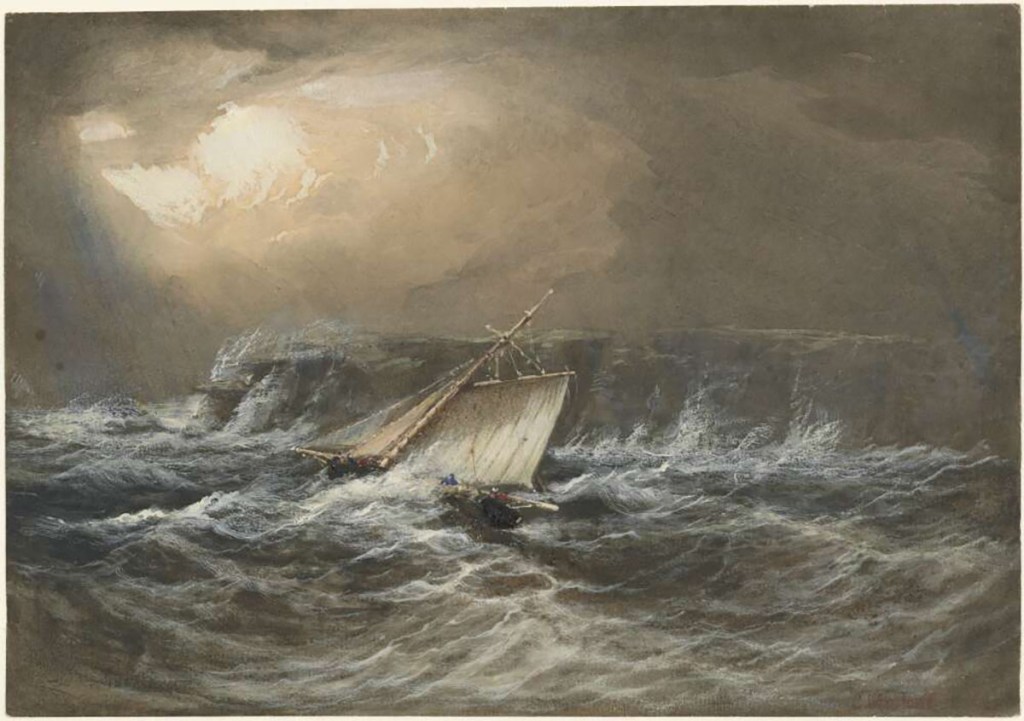
    HMSC Mermaid off Cape Banks, Dec. 4, 1820, by Conrad Martens. Image Courtesy National Library of Australia.

       Between 1818 and 1820, the small survey cutter HMSC Mermaid played an important role in charting Australia’s vast coastline. So, it is perhaps ironic that her last voyage should have been cut short on an uncharted reef off the north Queensland coast.

       The Mermaid was an 84-ton cutter launched in Calcutta in 1816. She arrived in New South Wales the following year and was soon purchased by the Government to undertake survey work requested by the British Admiralty.

       Lieutenant Phillip Parker King was dispatched to Australia to carry out a detailed survey of the Australian coastline, particularly those areas bypassed by Matthew Flinders. The son of former NSW Governor Phillip Gidley King, he had been born on Norfolk Island in 1791. On the family’s return to England and completion of his schooling, the young King joined the Royal Navy. He was given command of the Mermaid and got to work.

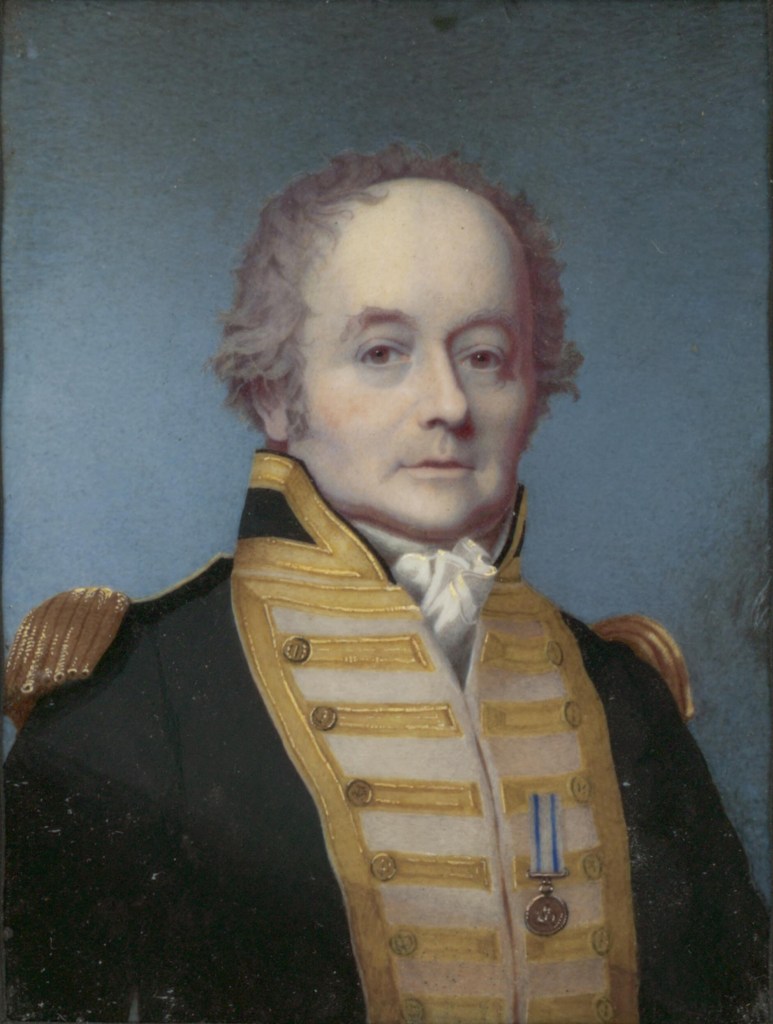
    Lt Phillip Parker King. Unknown artist. Courtesy State Library of NSW,

       HMSC Mermaid made three extensive voyages under King. They sailed from Sydney on 22 Dec 1817, bound for Australia’s northern and northwest coasts via Bass Strait and Cape Leeuwin. The crew included two sailing masters, 12 seamen and two boys. On board were also the botanist Allan Cunningham and Bungaree, a Kuring-gai man from Broken Bay who had also circumnavigated the continent with Matthew Flinders on the Investigator.

       At Northwest Cape, King surveyed and named Exmouth Gulf before continuing north along the coast until they reached Van Diemen’s Gulf and Cobourg Peninsula. From there, they sailed to Kupang on Timor Island to resupply, where they remained for two weeks. King then set sail for Sydney, returning down the West Australian coast. The return trip was marred by rough weather and a shortage of manpower. Several of the crew had become seriously ill shortly after leaving Timor, and one of them subsequently died. Despite the hardships, the Mermaid arrived back in Sydney on 29 July 1818 after an absence of seven months and seven days.

       Between December 1818 and January 1819, King sailed to Van Diemen’s Land and undertook a survey of Macquarie Harbour, which would soon become the site of one of the convict era’s most brutal places of punishment. Their work done there, the Mermaid was back in Sydney in late February, and in May she was off again.

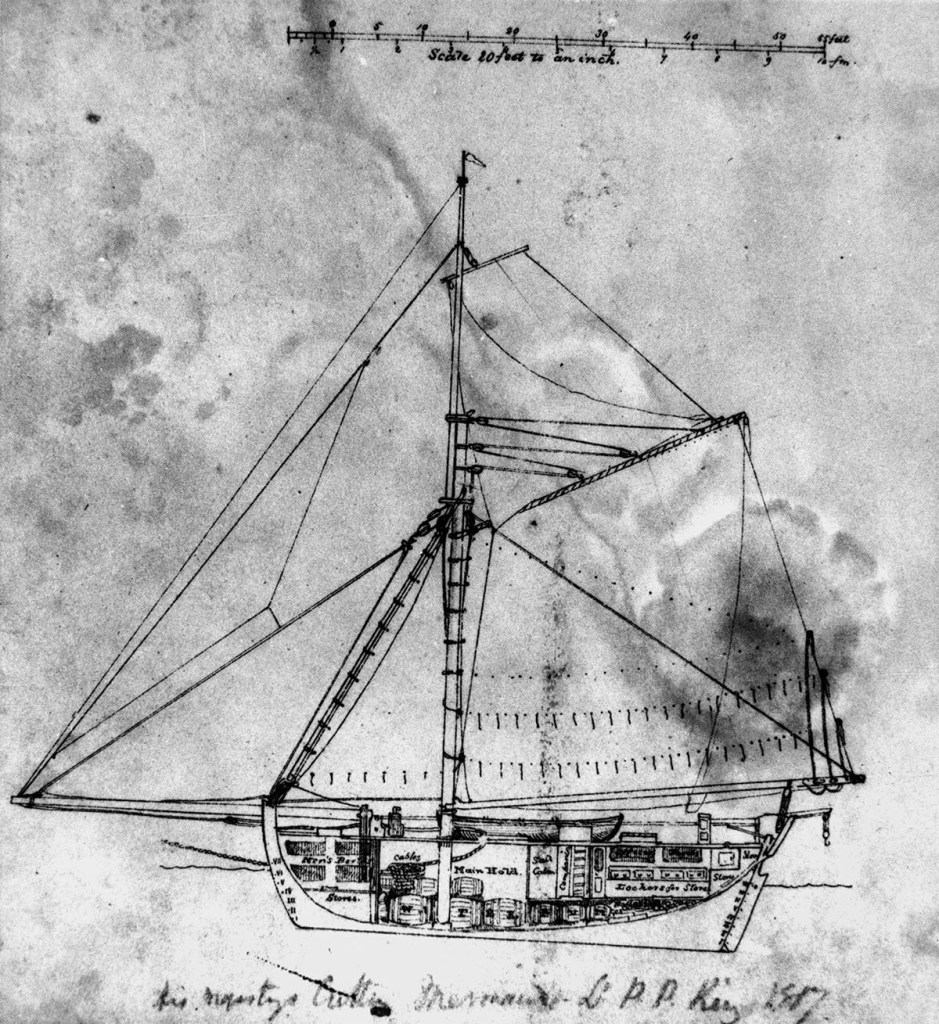
    Lt King’s survey cutter ‘Mermaid’ Photo courtesy State Library of Queensland.

       The third voyage, and King’s last in the Mermaid, saw them sail up the east coast of Australia on a circumnavigation of the continent. On 20 July, while sheltering in a bay he named Port Bowen at latitude 22.5 S (not to be confused with the present-day township of Bowen), the Mermaid ran aground and became stuck. It was only after considerable effort that the crew were able to warp the vessel into deep water, but she sustained serious hull damage in the process. The full extent of the injury would only become apparent months later.

       The Mermaid continued north, passed through Torres Strait and King again started making a detailed survey of the north-west coast. However, the cutter had been taking on water ever since its beaching at Port Bowen. By September, she was leaking so badly that King was compelled to careen the vessel and attend to the leaking hull. With repairs completed as best they could, he then cut short his survey and ran down the west coast, across the Great Australian Bight, returning to Sydney in December. However, the Mermaid was very nearly wrecked within sight of her home port.

       As they passed Jervis Bay, the wind was blowing strongly from the east-south-east and visibility was much reduced by heavy rain. Lt King steered a course that he thought would find them off Sydney Heads the following morning. But at 2 o’clock in the morning, King, thinking they were still 30 km from land, was surprised when a bolt of lightning revealed they were sailing directly towards Botany Bay’s south head. The Mermaid only just cleared that hazard but lodged on a rock off the north head before being lifted off by a large wave. She ploughed through breakers within metres of the rocky promontory with the sea surging and foaming around them. It was a very close call, but they were soon safely inside Sydney Harbour without further incident.

       Lt King made his fourth and final survey in the Bathurst while the Mermaid underwent much-needed repairs.   But that was not the end of the little cutter’s adventures.   She was decommissioned from the Royal Navy and taken over by the NSW colonial government, where she continued to serve with distinction.

    Mermaid being repaired during King’s voyage. Engraving by John Murray 1825. Image courtesy National Library of Australia.

       In 1828, the Mermaid received a major overhaul, including re-planking, new copper sheathing, and, most importantly, being re-rigged as a two-masted schooner. Then, in early 1829, she was tasked with helping dismantle the failed settlement at Raffles Bay on the Cobourg Peninsula. Once done there, they were to make for the remote settlement of King George Sound (present-day Albany) to deliver stores and dispatches. Under the command of Captain Nolbrow, the Mermaid departed Sydney on 16 May and headed north, keeping to the inner passage inside the Great Barrier Reef.

       Tragedy struck at 6 o’clock in the morning on 13 June when, about 35 km south of present-day Cairns, the Mermaid ran grounded on a reef not recorded on King’s recently published naval chart. At 8 p.m., Captain Nolbrow and his crew, 13 men in all, took to the lifeboat with the hold bilged and water already over the cabin deck.

       Twelve days later, as they continued north towards Torres Strait, the castaways were picked up by the Admiral Gifford. The Admiral Gifford was a 34-ton schooner on a speculative voyage through Australia’s northern waters and was ill-equipped to carry so many additional passengers. On 3 July, Nolbrow and his crew were transferred to the much larger Swiftsure, possibly in the vicinity of Pipon Island. Unfortunately, the Swiftsure was wrecked two days later near Cape Sidmouth and her crew, along with the Mermaid’s, were rescued by the Brig Resource.

       Captain Nolbrow and his men eventually made it back to Sydney via the Swan River settlement (present-day Perth) in November 1829. The remains of the Mermaid were discovered on Flora Reef in 2009.

     © Copyright C.J. Ison / Tales from the Quarterdeck, 2023.

    To be notified of future blogs, please enter your email address below.

  • HMS Torch and the rescue of the Ningpo castaways

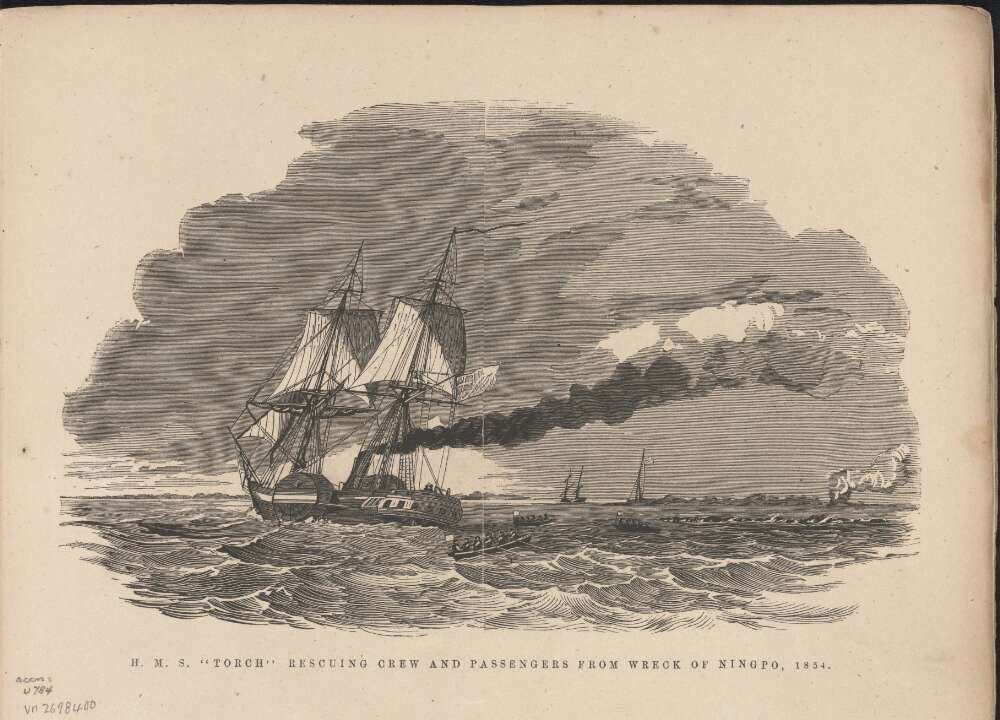
    HMS Torch rescuing crew and passengers from the wreck of the Ningpo, 1854. Illustration courtesy NLA.

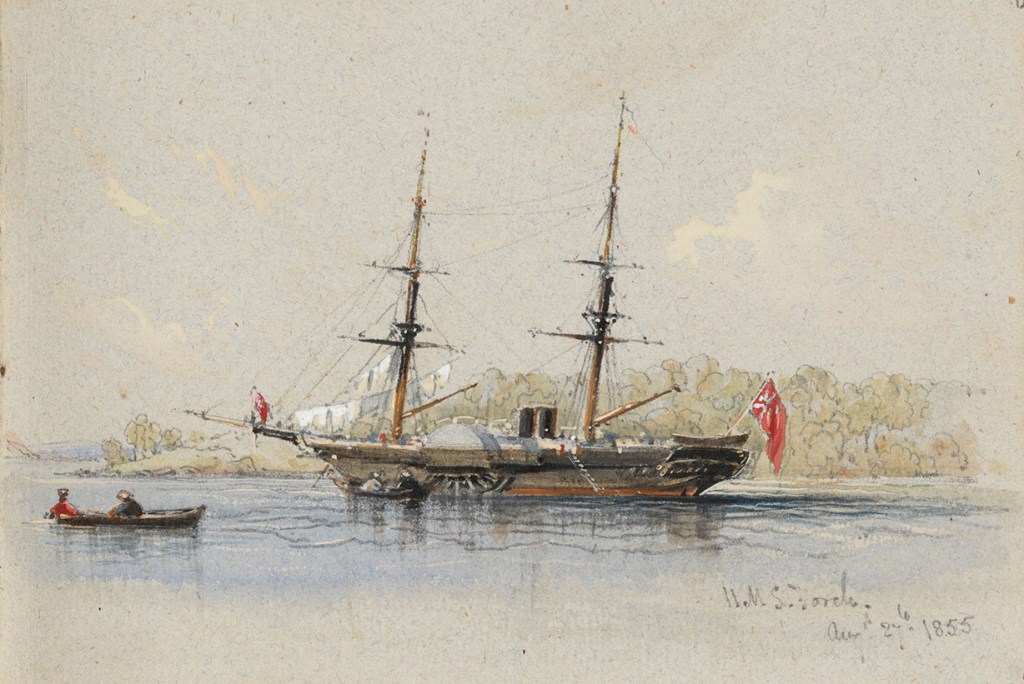
       As Lieutenant William Chimmo was making HMS Torch ready for a return to sea, he was unexpectedly tasked with an urgent mission. Word had just reached Sydney that nearly 20 people had been marooned for two months on a remote island far out in the Coral Sea. By chance, his paddle steamer had just completed repairs and was eminently suited to the task at hand.

       Second Mate William Tough of the 150-ton junk-rigged schooner Ningpo had arrived in Sydney on 2 October 1854. He had staggered in to Moreton Bay with a tale of personal heroism and a plea for help to save his stranded shipmates, but there was no vessel there that could go to the Ningpo’s rescue. Tough was patched up and sent to Sydney on the next ship heading south.

       The Ningpo had departed Hong Kong on 15 April 1854, bound for Melbourne to take up new duties as a lighter in Hobson’s Bay. The voyage south had been a difficult one, plagued by storms, rough seas and a nagging leak which just kept getting worse. To add to Captain Billings’ woes, his chronometer stopped working. Unable to determine his longitude, accurate navigation had been reduced to nothing more than an aspirational stab in the dark. Billings decided they should pull into the French settlement at the Isle of Pines for repairs the Ningpo’s hull. But while still north of New Caledonia, he inexplicably changed his mind, opting to head for Moreton Bay instead.

       This meant sailing dangerously close to the D’Entrecasteaux Reef, a two-thousand-square-kilometre maze of submerged coral reefs, small islets, and sandbars. Its discoverer, French Admiral Antoine Bruni D’Entrecasteaux, called it “the most dangerous reef he ever saw.”

    Map of D’Entrecasteaux Reef

       By 8 p.m. on 28 July, Billings estimated that he was clear of those dangerous waters, but he was wrong. Minutes later, the Ningpo ran onto a submerged coral outcrop and began filling with water.

       Unable to get the Ningpo off, Captain Billings made the decision to abandon ship. He, his crew and two passengers made for a small sand island a few kilometres away. They set up camp using timber spars and canvas sails. They fabricated a still to distil fresh water from the sea. Food proved plentiful, as the waters surrounding the island teemed with fish, and the island itself was a nesting ground for turtles and was also home to thousands of seabirds.

       With their immediate necessities well catered for, thoughts turned to how they might escape. Their only means of leaving the island was a four-metre (13 ft) dinghy, the only lifeboat the Ningpo carried. Billings wanted to try to make the Isle of Pines about 600 km away, but his crew refused, fearing they would be killed by the inhabitants of New Caledonia long before they reached their destination. They wanted to send a small party to Moreton Bay, despite it being twice as far away. The captain and his crew were at an impasse.

       Even after they had been stranded for more than a month, they sill could not agree where they should go to seek help. Frustrated with the inaction, Tough and two others set off in the dinghy to make the perilous voyage to Moreton Bay without first seeking the captain’s permission. Billings was furious when he discovered that his boat, compass, and nautical chart were all missing. He was convinced that they would fail, and in so doing, Tough’s recklessness had condemned the rest of them to an endless stay on the island. However, most of the crew held on to the belief that they would soon be found by a passing ship. Billings was not so optimistic, for he knew he had taken his ship far from regular shipping routes and that no sailing ship would intentionally venture into these treacherous waters.

       But, despite Billings’ doubts, Tough and his companions reached Wide Bay on the Australian mainland 14 days later. As they beached their dinghy, a party of Aborigines attacked them, stole the boat and left them for dead. Ten days after that, however, the seriously injured Tough staggered into Brisbane, assisted by a couple of more hospitable Aborigines. Unfortunately, his companions were not so lucky, having died along the way. With no vessel available in Moreton Bay that could go to the rescue, Tough was sent to Sydney with a letter addressed to the Colonial Secretary, seeking assistance. After being stranded for more than 10 weeks, there was no guarantee that the Ningpo castaways would be found alive, but the authorities believed they were duty-bound to try.

    HMS Torch at anchor, (probably in Sydney Harbour), by Conrad Martens. Courtesy State Library of NSW.

       Lt. Chimmo was ordered to steam out of port as soon as possible. Fortunately, his preparations to return to Fijian waters to continue his survey work were well advanced, so he was able to clear Sydney Heads the following night. He stopped in Newcastle only long enough to fill his coal bunkers before continuing north.

       Chimmo only knew that the Ningpo had run aground near a small island in the vicinity of latitude 18° 36’ South, the coordinate supplied by Tough and presumably recorded by Billings. The only charts available in Sydney that covered that stretch of ocean showed that the Ningpo was probably stranded somewhere near the Huon Islands. But the scale of the map offered little detail. HMS Torch would have to carefully pick its way through the reefs and shoals to find the castaways.

       The Torch battled unseasonal north-westerly winds for the first 11 days. Then the south-easterly trades finally resumed, and they made much faster progress. By mid-October, they had arrived at the search area, but then another delay beset them. Storm clouds began gathering, and Chimmo had no choice but to make for deeper waters until the weather cleared or risk the destruction of his ship.

       Meanwhile, Billings had finally convinced his men that they should wait no longer for help to arrive. After three months, it was clear that if they were ever to get off the island, it would be by their own means. He proposed building a boat from the remains of the Ningpo, and had already manufactured some rudimentary shipwright’s tools from cutlasses, knives and other metal objects they had salvaged from the schooner. Finally, his men realised they had a chance of success and embraced the idea. Unfortunately, the same storm that chased the Torch away also lashed their island, and Billings was forced to put their plans on hold for the time being.   

    When the storm finally cleared, Chimmo began his search of the Huon Islands. He sent search parties out in small boats to inspect each sandbar and islet they came across, but none showed any sign of recent habitation. Frequent rain squalls and strong winds hampered the search, and on one occasion, a boat capsized in the choppy seas, but no lives were lost. Then on the morning of 26 October, he spotted two islands in the distance.  

    The Ningpo wreck site. Map courtesy NLA.

       After the storm had passed, Billings and his men began preparing to go out to the Ningpo in a dugout canoe found in the bushy interior of the island. How it got there was a mystery, but it had been a godsend to the stranded sailors. But before they headed off to the wreck, a lookout spotted a ship in the distance, the first such sighting since they had landed. Signal fires were lit, and everyone lined the beach in anticipation of being rescued.

       As Lt Chimmo drew near to one of the islands, he saw two columns of smoke. Then, he spotted the stranded ship further off in the distance. Finally, he could make out people clustered on the beach. He fired a cannon to let them know they had been seen and gingerly made his way through the reef-strewn lagoon.

       Fearing the weather could deteriorate at any moment, boats were sent across the last couple of kilometres to collect the castaways. One of the first to step ashore was the Ningpo’s second mate, William Tough, who had volunteered to accompany the rescue. He had brought help, as promised, to the utter amazement of Captain Billings.   

    The whole boarding operation was completed that day. The Torch then sailed for Sydney, arriving on 10 December 1854, having completed a round trip of more than 4000 km.

    © Copyright C.J. Ison / Tales from the Quarterdeck, 2022.

    To be notified of future blogs, please enter your email address below.

  • Matthew Flinders and the loss of HMS Porpoise – 1803

    Loss of the Porpoise & Cato. Courtesy Wikipedia.


         Shortly after Matthew Flinders completed his historic circumnavigation of Australia, he was farewelled from Sydney to return to England as a passenger on board HMS Porpoise. To everyone’s astonishment, he returned to Sydney a month later to report that the Porpoise and another ship had run aground on a reef far out in the Coral Sea.

       HMS Porpoise, under the command of Lt Fowler, along with the merchant ships Cato and Bridgewater, departed Port Jackson on 10 August 1803, intending to remain together as they sailed north through the remote waters of north Australia. Ships regularly travelled in company, so one might come to the other’s aid should they get into difficulty. After all, the next European outpost after leaving Sydney was Kupang on Timor Island, 2,000 km west of Torres Strait and over 5,000 km from Sydney.

       On the afternoon of 17 August, the three ships passed a small island marked on the chart, which confirmed their position about 160nm (300 km) NE of Sandy Cape at the northern end of Fraser Island (K’gari). The chart showed no other obstacles in their path until they were ready to pass through the Great Barrier Reef, much further to the north.    As night took hold, they continued bearing NNE under reduced sail, pushed along by a southerly breeze. The Porpoise was out in front with the Cato and Bridgewater off her port and starboard quarters, respectively. Then, around 9.30 pm, the Porpoise’s lookout called “breakers ahead.” The Porpoise tried to veer off but without success, and she struck the uncharted reef. Likewise, the Cato attempted to steer away from the line of white water that indicated danger. However, she had insufficient room to manoeuvre and ran aground about 400m from where the Porpoise struck.

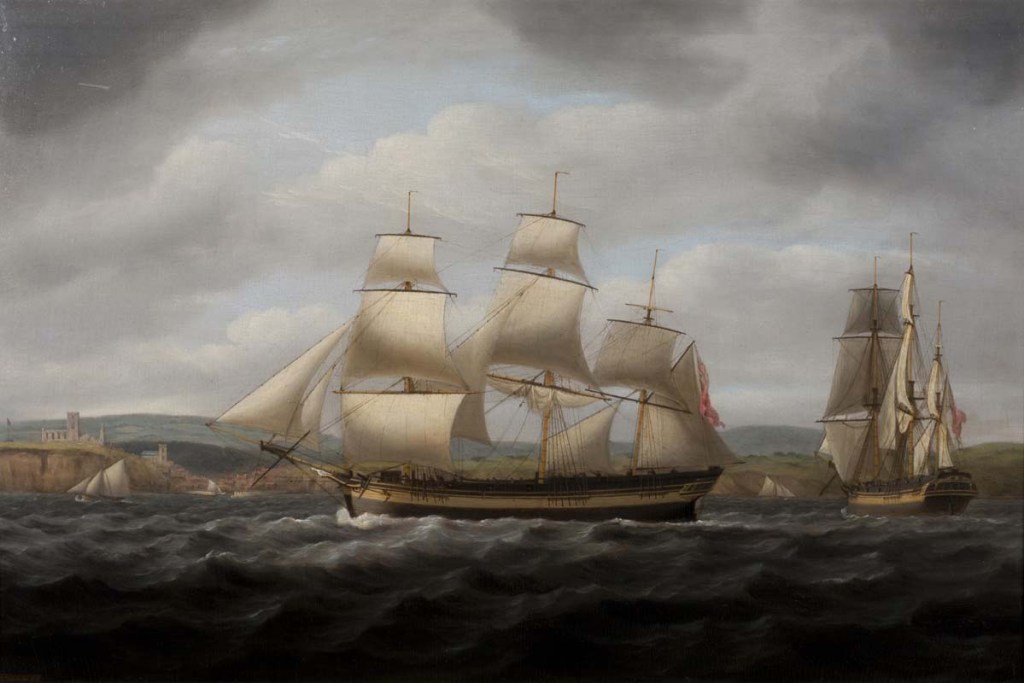
    The 430-ton Cato by Thomas Luny cira 1800.

         Fortunately, the Bridgewater missed the reef that claimed the other two ships. Her captain spent the rest of the night and the following morning trying to return so they might help any survivors. However, contrary winds and large seas hampered him, and he could not get close to the reef without risking his own vessel. He reluctantly continued on his way, leaving the survivors from the Porpoise and Cato to their fate.

       Meanwhile, the men on the stranded ships waited out the night. HMS Porpoise had gone aground broadside to the reef and heeled over so her strong hull took the brunt of the crashing waves. The Cato was not so lucky. She had also run aground broadside to the reef, only her deck lay exposed to the full force of the powerful waves, and she soon started breaking up. Her crew spent an anxious night clinging for dear life to the inner forechains.

       The next morning, the Porpoise’s small gig and a six-oar cutter were used to ferry the crews of both ships to a small sandy islet a short distance away. Over the next several days, they salvaged as much as they could from the two stranded wrecks. Casks of water, flour, salt meat, rice and spirits, along with live sheep and pigs were all brought ashore. They found they had sufficient provisions to feed the 94 castaways for the next three months. Most shipwreck survivors fared far worse.

    Captain Matthew Flinders, RN, by Toussaint Antoine DE CHAZAL DE Chamerel. Courtesy Wikipedia.

       On the morning of the 19th of August, Captain Matthew Flinders took command as the most senior naval officer present. Flinders, in consultation with Lt Fowler and the Cato’s captain, John Park, decided he should take the largest cutter and return to Sydney to get help. The three also agreed on a contingency plan should Flinders and his party fail to reach Sydney and alert the authorities. The ship’s carpenters would begin building two new boats from materials salvaged from the wrecks. If, after two months, the remaining survivors had not been rescued, Lt Fowler and the rest of the men should try to make for Sydney themselves in the new boats.   

    Flinders’ cutter was fitted out with a deck to make it better handle the rough seas on the long voyage ahead. She was christened “Hope” and, on 26 August, nine days after striking the reef, Flinders, Park and twelve sailors set off to three loud cheers from their shipmates lining the shore.    They took sufficient provisions to last them three weeks, and Flinders set a course west so they would strike the Australian coast. On the evening of 28 August, they made land near Indian Head on K’gari Island and headed south, hugging the coast until they reached Sydney ten days later.

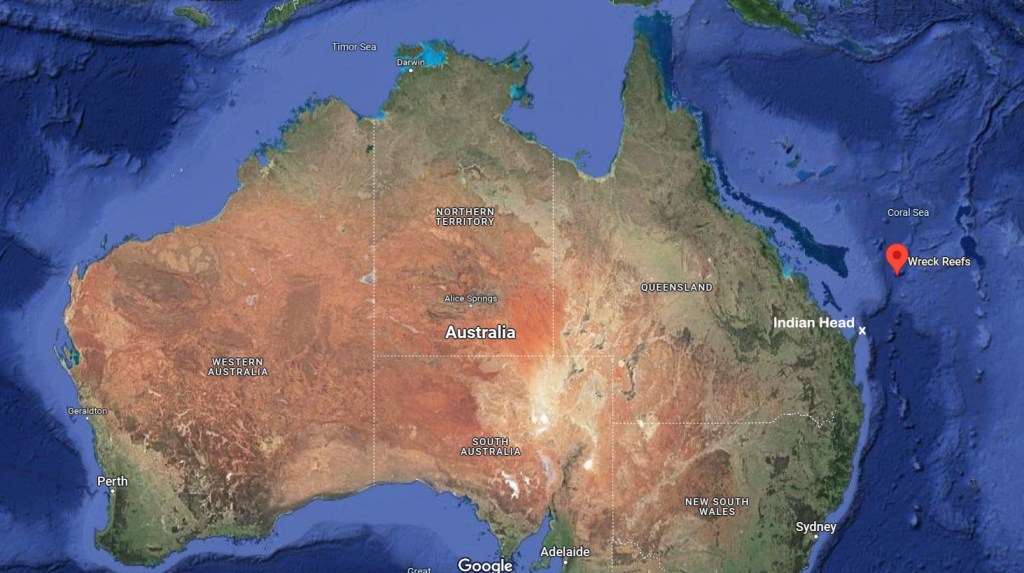
    Map showing Wreck Reefs where the Cato and Porpoise were wrecked in 1803. Courtesy Google Maps.

       Meanwhile, the carpenters got to work building the first of the two new boats. They named it Resource and had her afloat in about two weeks.  However, as they were working on the second boat, their supply of coal for the armourer’s forge ran out, halting construction. Lt. Fowler ordered that the Resource be sent with a work party to an island to the south to produce sufficient charcoal to complete the second boat.

    But, before they set off, the welcome sight of three rescue ships sailed into view. Flinders had made it to Sydney and returned with the fully-rigged ship Rolla, and the colonial schooners Cumberland and Francis, to rescue the survivors. Flinders might have got there a little earlier, but he had spent a couple of anxious days trying to find the uncharted reef. Most of the men were put on to the Rolla, which was on its way to China, while Flinders returned to Sydney on the Cumberland. Much of the stores and salvage from the wrecked ships were taken back to Sydney on the Francis and the newly built Resource. Remarkably, only three men were lost during the ordeal. The site of the disaster is now known as Wreck Reefs.

       Captain Flinders’ adventures did not end there. By the time he next left for England, Britain was at war with France. When his ship stopped at Mauritius, he was placed in detention until the end of hostilities. Flinders did not return to England until 1810. His book “A Voyage to Terra Australis”, detailing his voyages, was published in 1814.

    © Copyright C.J. Ison / Tales from the Quarterdeck, 2022.

    To be notified of future blogs, please enter your email address below.

  • Von Mucke’s Great Escape

    The Emden shore party at Cocos Island with the Ayesha moored in the distance. Photo courtesy Australian War Memorial.

    Before the German Cruiser Emden was engaged by HMAS Sydney, a fifty-strong party was sent ashore at Cocos Island to destroy the telegraph station linking Australia to South Africa.   As the two ships exchanged shells in a battle that lasted ten hours, the shore party could do little but watch on and hope for the best.  

    On 9 November 1914 Lt von Mucke had been ordered to lead a party ashore to disable the cable station on Cocos Island.   But shortly after the Germans had disabled the station and rounded up the telegraph operators, the Emden signalled for them to return to the ship.   Then von Mucke saw the Emden raise its battle flag and fire a salvo at a target then hidden from his sight.  

    The Emden then steamed off leaving the shore party stranded on the island.   They had no chance of catching up to the fast-moving cruiser then fighting for its life.    As the Emden continued to engage HMAS Sydney, von Mucke immediately declared Martial Law over the island and deployed his four machine guns and 30 or so sailors to defend against any landing.

    Lt. Hellmuth von Mucke. Photo by Oscar Brockhus, Novitas Verlag Berlin.

    At one time German sailors and Australian telegraph operators stood together watching the naval battle play out in front of them.   But eventually, the two ships disappeared over the horizon, the Emden clearly the worse for the ongoing encounter.  

    Von Mucke held out little hope that his ship would return for them victorious.   The mortally damaged Emden was deliberately run aground the next day and the survivors surrendered to HMAS Sydney.   Von Mucke also realised that he and his men would eventually have no choice but to surrender should they remain on the island.   He decided to leave while they still could, seizing the schooner Ayesha.

    The three-masted schooner was the property of John Clunies-Ross, who also happened to own the Cocos Islands themselves.   His Great Grandfather had claimed the uninhabited islands in the 1820s and began a coconut plantation using workers brought from Malaya.

    Von Mucke requisitioned provisions to last his men 8 weeks at sea and had them loaded onboard.    The departure had an oddly festive quality to it.   Residents asked for autographs from the Germans, and also had them pose for photographs.   Then, as the sun set in the west, von Mucke bid the residents “auf wiedersehen” and sailed out of the harbour to three resounding cheers.

    Schooner Ayesha.

    Before leaving he hinted they were bound for East Africa to throw any pursuers off his scent.   However, his real intention was to head north to the Dutch port of Padang on the island of Sumatra.    Von Mucke and his men arrived at Padang on 26 November after 17 days sailing.   There, he hoped to get help from any German ships in port while he planned the next leg of his return to Germany.    While the Dutch were neutral during the First World War, that meant they would neither hinder nor aid any of the combatants.   “The master of the port declined to let us have, not only charts, but also clothing and toothbrushes,” as he rigorously enforced the port’s neutrality, von Mucke later lamented.    The Dutch authorities asked von Mucke and his men to surrender themselves to internment but the German officer declined and 24 hours later they left the harbour.   

    For two weeks they remained close to the Sumatran coast hoping to cross paths with a German ship while avoiding Allied naval vessels patrolling those waters.       Their luck held out and on 16 December the German merchant ship Choising, which had been undergoing repairs at Padang, came into sight.   

    Map showing von Mucke’s escape route. Source: The Story of the Great War, Vol 3.

    Von Mucke and his men transferred onto the ship and with heavy hearts, they scuttled the schooner which had been their home for the past six weeks.     The Choising to the port of Al Hudaydah in the Red Sea.   From there the men made their way to Damascus and then on to Constantinople in Turkey.   Von Mucke finally reported to the German Embassy there on 9 May 1915.    For his efforts, he was awarded an Iron Cross.

    Source: The Story of the Great War, Vol III, Chapter 31, “Story of the Emden.”

    © Copyright C.J. Ison / Tales from the Quarterdeck, 2022.

    To be notified of future blogs, please enter your email address below.