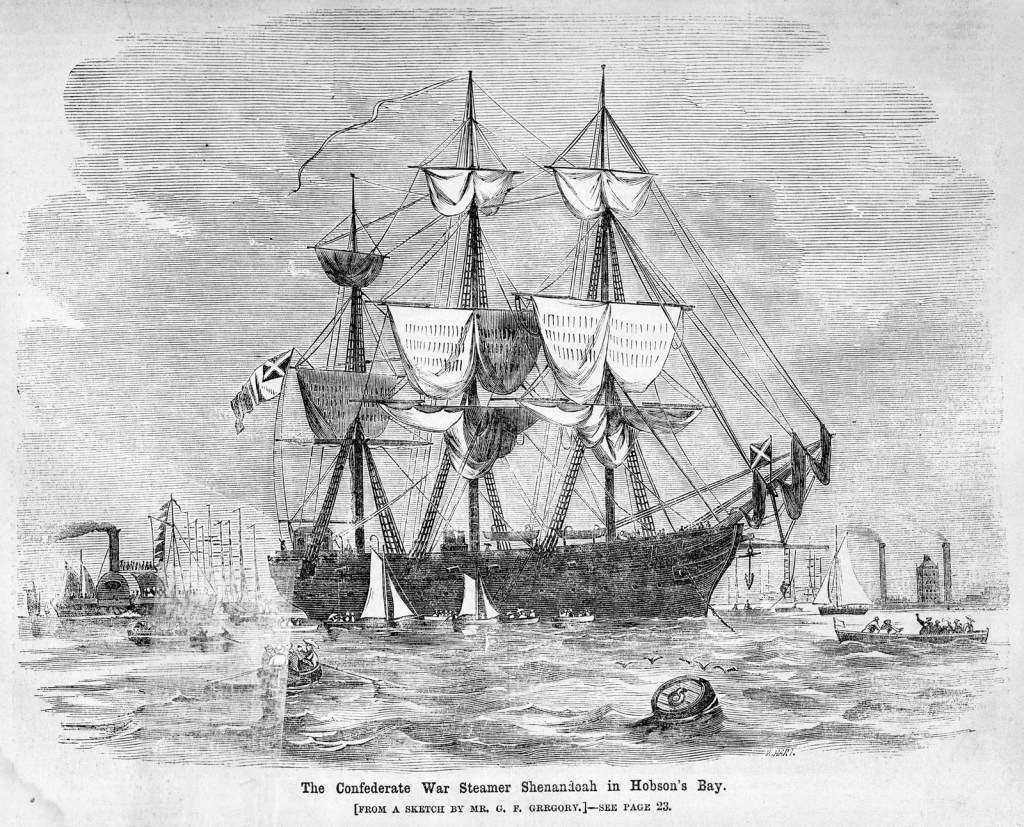
On 25 January 1865, a large foreign warship unexpectedly sailed into Port Phillip Bay and dropped anchor off Melbourne. The arrival caused considerable consternation in Victoria’s Legislature, which long feared the colony was inadequately defended. The ship proved to be the 1160-ton, eight-gun auxiliary steamer CSS Shenandoah of the Confederate States of America. Her captain, James Wadell, reported to the port authorities that he had been forced to pull in to make urgent repairs.
Five years earlier, America’s Southern states had seceded from the Union over the question of slavery, and the country had been embroiled in a brutal civil war ever since. The Shenandoah had been particularly busy in the three months before arriving in Australian waters. She had captured or sunk no less than 11 merchant ships belonging to the United States and was holding some of the sailors prisoner.
Britain and, by extension, the colonies in Australia had declared neutrality in the hostilities between the North and the South. The arrival of an armed warship posed a delicate diplomatic problem for Victoria’s Governor, Sir Charles Darling.

Captain Waddell sent an officer ashore seeking permission to remain in port until they could make repairs to the Shenandoah’s propeller, which had been damaged during a recent storm. He also hoped to replenish his depleted bunkers with coal, purchase fresh supplies, and land his prisoners.
One thing he neglected to ask permission for was recruiting replacement sailors, although he intended to do so anyway.
Governor Darling allowed Waddell to repair the Shenandoah’s propeller and take on supplies, thinking the ship would be on its way again in a couple of days’ time. However, after engineers examined the propeller and shaft more carefully, they discovered the damage was far worse than they had first thought. The ship would have to be slipped so the repairs could be carried out, and that would take time.
Conscious of their obligations of neutrality, the colonial government decided to allow the ship to be dry-docked, but “no other work should be performed on the vessel than absolutely and necessarily required,” to enable the Shenandoah to safely return to sea.
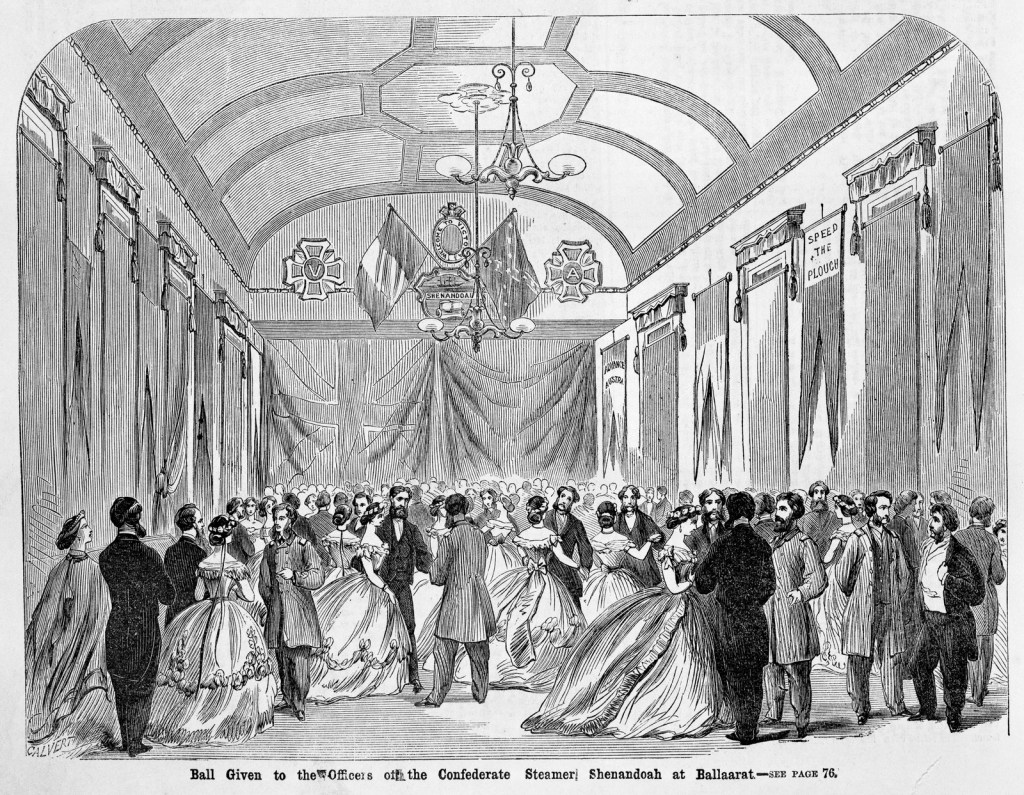
While the government was careful to abide by the requirements of Britain’s proclaimed neutrality, the wider public was far less concerned. The arrival of the Confederate warship caused a sensation. During the first weekend the Shenandoah was in port, more than 12000 people went to take a close look at her. That amounted to 10 per cent of Melbourne’s total population. The visiting Americans were made as welcome as anyone possibly could be. A gala ball was held in their honour in the nearby goldfield town of Ballarat. And, Captain Waddell and his officers were also wined and dined by many of Melbourne’s leading citizens.
Meanwhile, as the bunkers were being filled with coal, supplies were loaded onboard, and repairs progressing, Waddell’s officers began surreptitiously recruiting seamen from Melbourne’s docks. It was rumoured that the captain was offering anyone willing to join his ship an £8 sign-on bonus, plus a share of any prize money, on top of a £6 per month salary.
When the authorities learned what was going on, they were compelled to put a stop to it. A warrant was issued to search the ship, and the police had orders to remove any British subjects they found illegally on board. By now, the repairs had been completed, but the Shenandoah was still high and dry on the slip.
A standoff ensued with Captain Waddell refusing to allow the police to board his ship, and port authorities prevented the Shenandoah from being launched. Waddell wrote to the Governor denying that any British subjects had joined his ship. However, four men were later arrested by the police after they were seen leaving the vessel. Waddell feigned ignorance of their presence, claiming they must have been stowaways.
The Shenandoah was allowed to leave on 19 February, and a diplomatic crisis was averted. Or so Governor Darling thought. Then, in a parting shot, Waddell wrote that he felt that he and the Confederate States of America had been ill-treated at the hands of Victorian officials and that he would be informing his government at his earliest opportunity. However, that was likely just bluster, for it seems that when the Shenandoah sailed out of Port Phillip Bay, there were 40 newly recruited sailors, despite Captain Waddell’s assurances to the contrary.

In the final months of the American Civil War, the Shenandoah ravaged the United States’ North Pacific whaling fleet. The predation only ceased after the surrender of the South.
After the war, the United States Government proved that Britain had given assistance to Southern warships despite proclaiming neutrality. Britain would later pay millions of dollars (billions in today’s money) in compensation for losses to Union shipping caused by three Southern raiders, one of them being the Shenandoah.

© Copyright C.J. Ison / Tales from the Quarterdeck, 2022.
To be notified of future blogs, please enter your email address below.
 Tales from the Quarterdeck