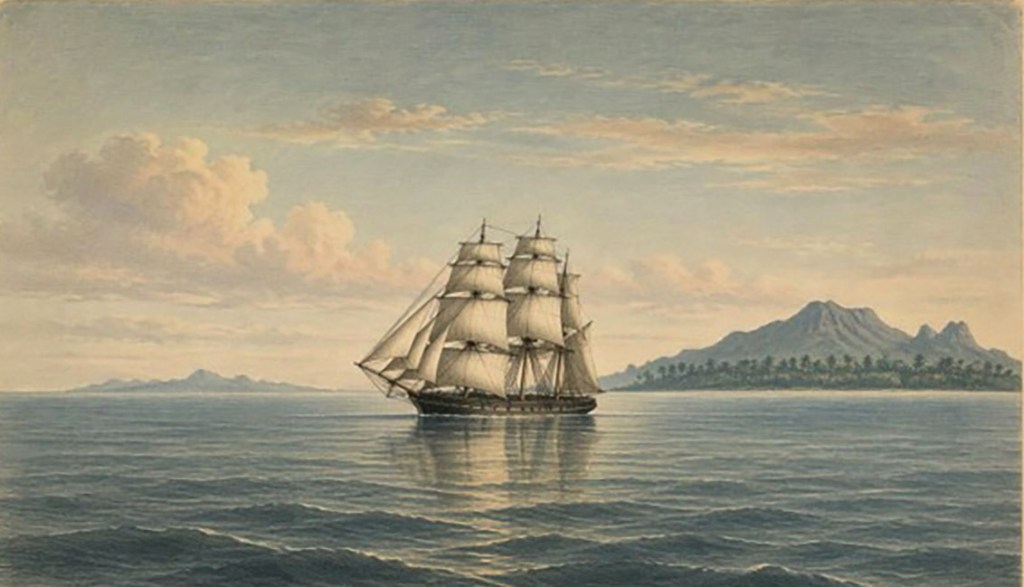
In early 1858, four American sailors landed near Merimbula on the NSW South Coast claiming to be shipwreck survivors. However, their behaviour, especially that of their leader, soon had people questioning whether they were truly what they claimed to be. Then an American whaling ship dropped anchor in Sydney Harbour, and its surviving officers recounted a harrowing tale of mutiny and murder. This is the intriguing story of the Junior mutiny.
In the middle of 1857, the American whaling ship Junior sailed from New Bedford, Massachusetts, under the command of Captain Archibald Mellen. Aged 27, this was his first time in charge of his own ship, and it would also prove to be his last. By year’s end, they had been at sea for six long months and had not caught a single whale to show for their time away from home. Life on board had become unbearable for the crew, even by the standards of the day. The food was said to be almost inedible, and conditions on the ship were harsh. The officers, particularly the chief mater, habitually abused the men verbally, threatened their lives, and had taken to beating them for any perceived transgression. Finally, the simmering tensions came to a head far out in the Tasman Sea.
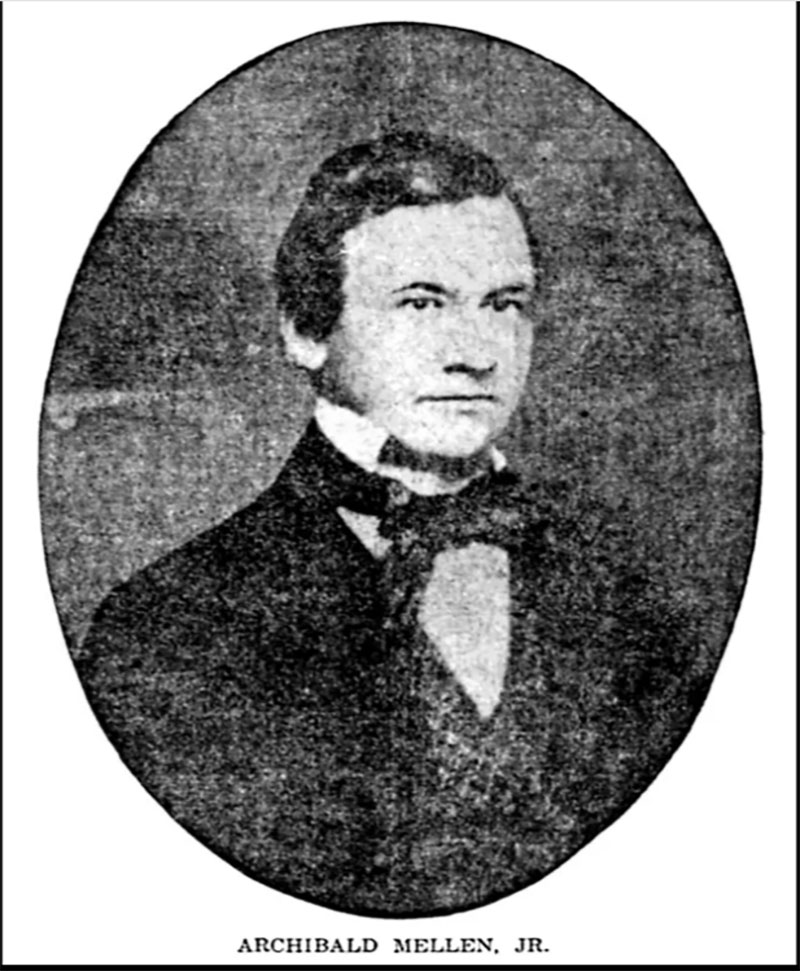
On Christmas Day, Captain Mellen issued a rum ration to the crew to mark the festive season, but there was little “festive” about it. According to William Nelson Provost, the ship’s Chief Mate, sail was shortened around 8 PM, and all the officers retired for the night. So, presumably, the deck was left in charge of one of the senior sailors. In light of what happened next, it was most likely a disgruntled boat steerer named Cyrus Plummer.
One hour after midnight, Plummer, along with John Hall, Richard Cartha, Cornelius Burns, and William Herbert, quietly made their way aft to the officer’s quarters. When they were all in position, Plummer gave the order to “FIRE!”
Plummer shot Captain Mellen with a whaling gun loaded with three large metal balls, each measuring about 1 inch in diameter. The balls hit Mellen in his left side, passed through his torso and exited out the right to slam into the side of the ship. The shot, according to Provost, did not kill him immediately as one might have expected. Rather Mellen spang to his feet where Plummer grabbed him by his hair and laid into him with a hatchet until he thought he was dead.
Meanwhile, John Hall, fired a second whaling gun at the Chief Mate at close range. But the shot only grazed his cheek before striking his left shoulder. The muzzle blast also set Provost’s bedding to smoulder. Cornelius Burns stabbed the third mate, John Smith, to death with a boarding knife and later his head was cleaved off with a whaling shovel. Cartha slashed at the second mate, Henry Lord, with his knife but when Lord fought back Catha pulled out a pocket pistol and shot him in the chest, thus ending their struggle.1 After the fusillade of gunfire, the mutineers retreated from the officer’s quarters but blocked the companionway, preventing any of the other crew from going to their aid.
Provost went to check on the captain to find him drawing his last breath. He then retrieved a revolver, loaded it with three cartridges, blew out the lamp, and waited in the captain’s quarters for his attackers to return. However, he was soon forced to abandon his position as a thick pall of smoke billowed around him from the fire, which by now was raging in his own cabin. Provost called out for someone to extinguish the flames, promising he would not shoot at them. He then retreated to the hold to escape the smoke. Meanwhile, Henry Lord, who had only been wounded, scrambled on deck and begged for his life to be spared.
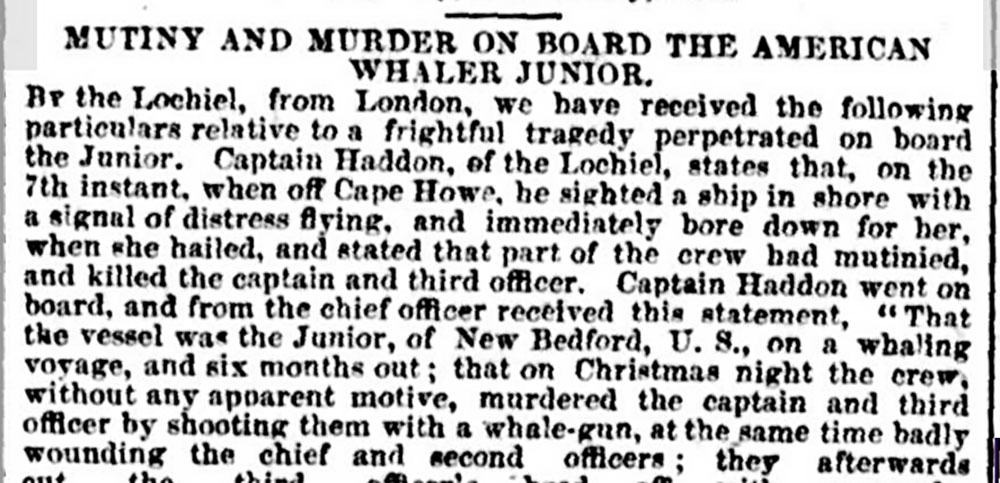
The bloody attack was over in a minute or so. Provost would later state he believed the mutineers’ intention had been to kill all the officers and then sail the Junior to NSW, where they would leave the ship and perhaps make their way to the gold fields.2
Plummer took charge of the ship, ordered the fire put out, had the two corpses thrown over the side and set a course he thought would take them to the New South Wales south coast about 1500 km away. As the Chief Mate was still at large somewhere on the ship, the crew were ordered to arm themselves and watch over the hatchways in case he tried to emerge on deck.
Meanwhile, Provost spent five agonising days hiding in the deepest recesses of the hold without access to food or water as his injured shoulder festered. At the end of that time, he gave himself up after being assured that his life would be spared. As it turned out, the mutineers still needed the Chief Mate alive.
As Provost emerged on deck, Catha, who held a deep-seated grudge against the man, aimed his gun and would have shot him, had Plummer not intervened. Provost was given food and water, and his wound was cleaned and dressed. When fit enough to do so, Provost determined the ship’s position and bearing and found they were on a course that would take them to Lord Howe Island, far to the north. He set a new course southwest by west towards Cape Howe and Gabo Island.
The Junior arrived about 20 nautical miles (37 km) off the NSW coast on 3 January 1858, where Plummer and the other four mutineers left the ship. They were joined by five other members of the crew who had had enough of life on the Junior – Charles Stanley, Jacob Ricke, William Samson, Joseph Brookes and Adam Canel, – though Plummer had made it clear in a log entry that only he and his four confederates had been responsible for the mutiny and the two murders.3
The ten men set off for shore in two whaleboats loaded with weapons, rations, water and just about everything of value they had found in the officer’s quarters. They followed the coast south for about 150 km until they reached 90-Mile Beach, where one of the boats managed to pass through the pounding surf and put ashore. When Plummer tried, he was caught in the dangerous surf, and the boat was very nearly lost. However, they were able to get back out to open water. Not wishing to try a second time, they returned north and landed at Twofold Bay several days later, where they claimed to be castaways.4
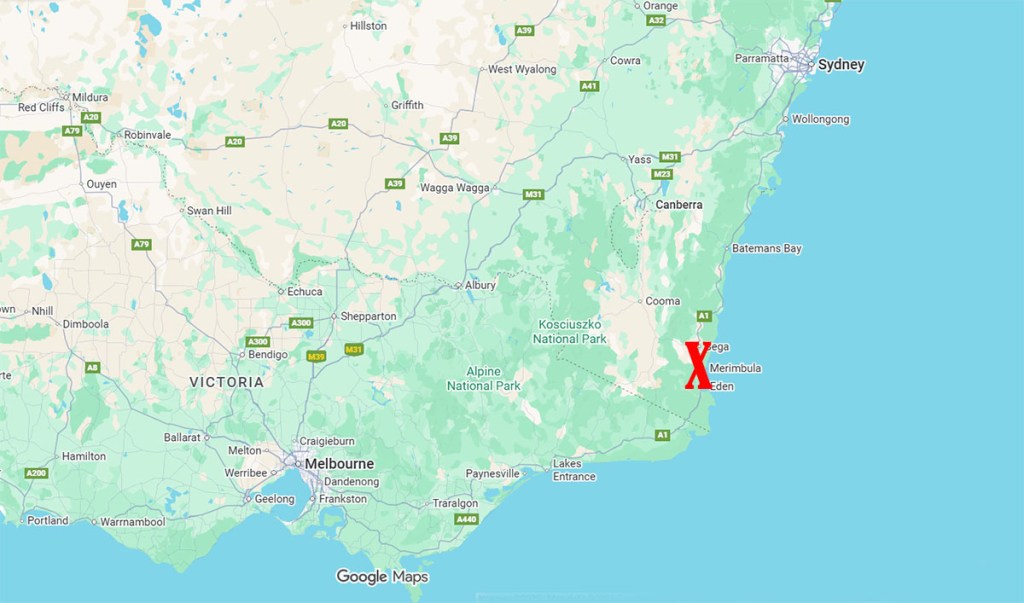
All four “castaways” were dressed as ordinary seamen when they first put ashore, and after a week or so in the boat they easily passed for unfortunate sailors who had survived a calamity at sea. But the next time anyone saw them, they were all flamboyantly attired in fine clothes they had stolen from the Junior’s officers. Plummer, now calling himself Captain Wilson, swaggered around in a tasselled jacket with Captain Mellen’s revolver jammed in his belt. Cartha, Ricke and Stanley were just as outlandishly dressed.
For several days they spent much of their time going from tavern to tavern in Merimbula and Eden, drinking heavily, spending freely, entertaining the ladies, and generally living it up. It was not long before people thought they were more likely smugglers than shipwrecked sailors. A constable from Pambula was sent for, and he presented the strangers to the local magistrate. But, with nothing but people’s suspicions as evidence, the magistrate let them go. However, he ordered them to report to the police station daily.5
The mutineers might just have got away with their crimes had they quickly made their way to one of the NSW or Victorian goldfields and lost themselves among the throngs of newcomers. But when news of the Junior mutiny reached town, it was already too late. They took off into the bush with a posse of police on their heels. Cyrus Plummer, Jacob Ricke and Charles Stanley were quickly captured, but Richard Cartha managed to elude them for a while. However, he too was eventually tracked down, arrested, and sent to Sydney to join the others.
Meanwhile, the six men who had landed on 90-Mile Beach made their way southwest on foot, following the coast. They found an Aborigine who agreed to act as a guide, but he eventually abandoned them, presumably once he had reached the extent of his country. They continued alone through the dense mallee scrub, and the authorities believed they likely perished in the summer heat or had been trapped by one of the several bushfires raging on that part of the coast at the time.
But the authorities underestimated the Junior’s sailors. Four of them – Samson, Brookes, Canel and Herbert – were arrested a couple of months later near Port Albert, where they had been working as labourers. There is no record of what happened to Hall and Burns, but they were never heard of again.
As the crimes took place in international waters on an American-flagged ship, the mutineers were handed over to the American Consul in Sydney, who arranged for them to be sent to the United States to stand trial. Catha, Herbert and Stanley were all found guilty of manslaughter and sentenced to five years and ten months’ hard labour and fined $2000. Plummer was found guilty of murder and sentenced to death.6 However, that was later commuted to life after the US President received a petition with some 20,000 signatures calling for clemency.
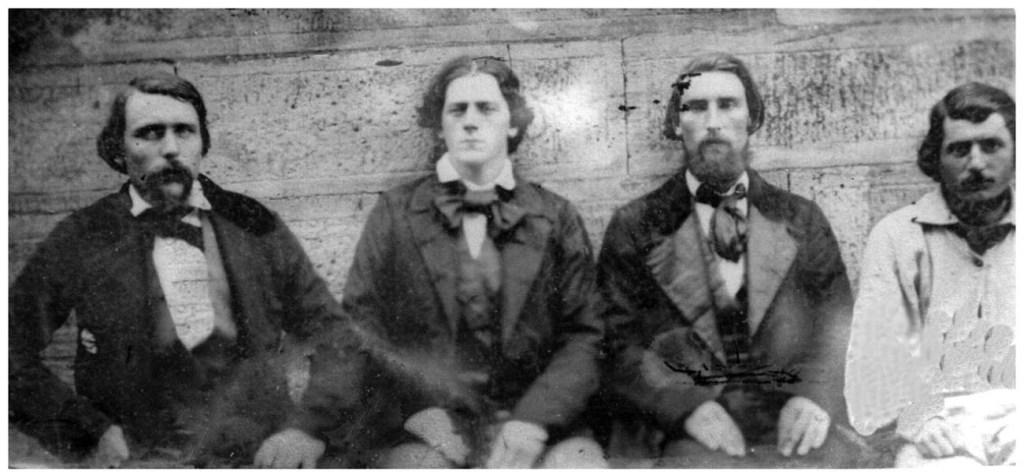
It turned out Cyrus Plummer had some powerful friends and had made several striking alegations in his defence that cast doubt on what had actually taken place on the Junior that night. Until then, the version of events had been largely based on William Provost’s words. Firstly, Plummer said that his shot had missed Captain Mellen, and that it was actually a sailor named Charles Fifield who had killed him with an axe. Plummer also claimed that their intention that night had been only to detain the officers and take control of the ship, but that things had gone horribly wrong. Finally, he declared that Provost was the “real culprit – the most guilty person in my judgment – the one whose contriving brain and intriguing heart were the instigating cause of the conspiracy and mutiny on board the Junior.”7
Plummer’s claims may have had some foundation. For instance, a signed statement presented to court, penned by a ship’s officer who accompanied Provost back to the United States, said that Chief Mate had admitted to him that he was as guilty as the rest of the men.8 Furthermore, the captain who had returned the Junior to the United States reported that, after examining the trajectory of the shot, Captain Mellen could not possibly have been hit had he been lying prone in his bunk, as stated.9
Perhaps after spending so long at sea, William Provost was as keen to get off the ship as the mutineers and had encouraged them to act. And perhaps, the plan was never to kill the captain or anyone else, but simply to seize the ship and get put ashore. But after being shot, Provost’s allegiance might have changed, and he hid his role in what had unfolded. Or perhaps Plummer was lying, and Provost played no part in the mutiny at all.
Either way, that is the intriguing story of the mutiny on the Junior.
SOURCES
1. William Provost’s statement recorded in the ship’s log, Sydney Morning Herald, 10 Feb 1855, p. 8.
2. ibid.
3. ibid.
4. Sydney Morning Herald, 23 Jan 1858, p. 4.
5. ibid.
6. New York Tribune, 23 April 1859, news report on the trial, reprinted in the Bendigo Advertiser, 26 Jul 1859, p. 3.
7. Ibid.
8. Deposition by George Patrick of the India, quoted in the Sydney Morning Herald, 30 Aug 1859, p. 3.
9. Deposition by Alfred Gardner, late master of the Louisiana, quoted in the Sydney Morning Herald, 30 Aug 1859, p. 3.
© Copyright C.J. Ison / Tales from the Quarterdeck, 2026.
Please enter your email address below to be notified of future blogs.

