Tag: true crime

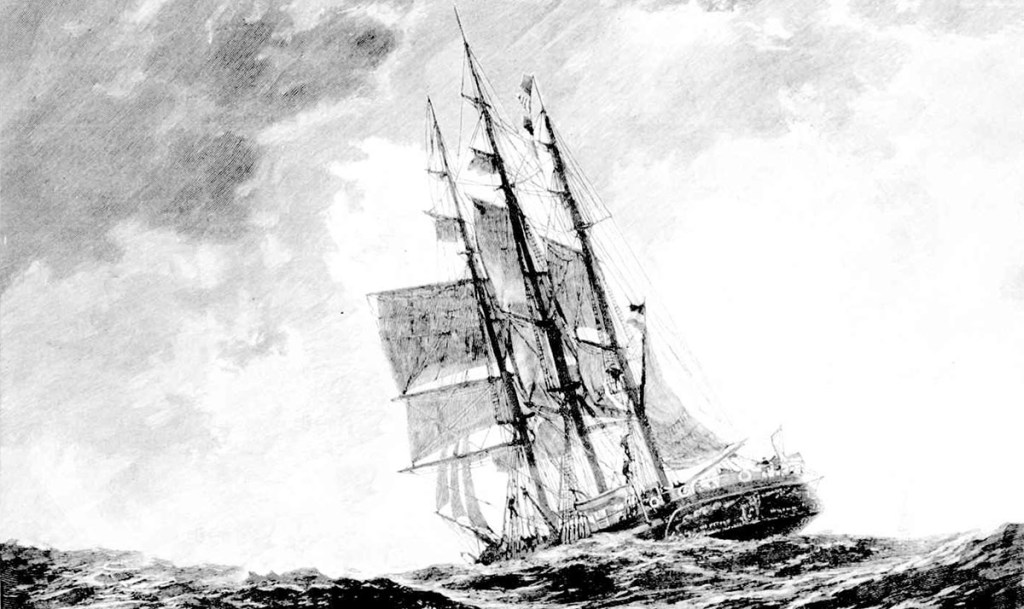
  • The search for the Sydney Cove – 1797

    On the night of 2 October 1797, fourteen convicts stole a boat and made their way down the Paramatta River across Sydney harbour and out through the Heads.  When the men were discovered missing, the authorities sent boats in pursuit, but they returned a few days later, having never caught sight of the runaways.    As a storm had swept the area shortly after they had escaped, it was thought the bolters had died at sea.   However, that was no more than wishful thinking.    Their story is one of desperation, betrayal, and ultimately defeat.

    The runaways’ leaders were John Boroughbridge and Michael Gibson.   They had been labouring away in the back blocks of Paramatta when they convinced 12 other desperate men to join them in an audacious escape.    Their plan was to find the remains of the 250-ton Sydney Cove, a ship that had recently been wrecked somewhere far to the south of Sydney.   Boroughbridge and Gibson were sure they could build a new vessel from the timbers and fittings and make for some distant port far from the clutches of British law.   That the Sydney Cove had been carrying a massive cargo of rum and other alcoholic spirits added to its allure.

    Painting of Sydney, Port Jackson. circa 1804.

    Boroughbridge was serving 14 years for some unspecified crime and had landed in New South Wales only four months earlier and was keen to leave at the first opportunity.  Gibson had already spent five long years there, but with nine more to serve, he was no less eager to put the place behind him.     It seems they had little difficulty finding 12 others willing to join them.

    With nothing more than a small pocket compass and the knowledge that the wreck lay somewhere far to the south, they headed out through Sydney Heads and turned right.    A day or so later, the weather turned nasty, but Boroughbridge and his mates ploughed on.   Twice, their boat was driven ashore, and both times, they were lucky to avoid serious damage.  

    In time, the weather eased, and they continued following the coast and unknowingly strayed into Bass Strait.   In 1797, no one knew that a body of water separated Van Diemen’s Land from the rest of Australia.    All Boroughbridge and the others would have known was that the Sydney Cove was aground on an island somewhere off the coast.   They likely had no accurate idea how far they had come or how much further they had to go.   They certainly could not have known that they needed to cross 200 km of open water to reach the beached ship.   By now, the compass would have shown that they were heading in a south-westerly rather than southerly direction as they doggedly follow the contours of the coast.

    Finally, they ran out of food and fresh water.   In desperation, they put ashore on one of the small islands in the vicinity of Wilson’s Promontory.   There, they found a ready supply of fresh water, while seabirds and seals made easy prey for the starving men.    But, the trying conditions took their toll.   By now, many of the runaways would have gladly returned to Sydney to face any punishment short of death if it meant an end to their suffering.  

    Any sense of common purpose they may have once possessed had since evaporated.   They could not agree on what they should do next.   Should they stick to their original plan and continue searching for the elusive Sydney Cove?   Or should they abandon the search and head back north?   Then, one night, in a callous act of betrayal, Boroughbridge, Gibson and five others quietly set off in the boat, abandoning the rest of the men as they slept. 

    After leaving their comrades to their fate and giving up the search for the Sydney Cove, they returned north again.   Bypassing the entrance to Sydney Harbour, they continued on to the mouth of the Hawkesbury River, where it emptied into Broken Bay.   It cannot have been lost on the weary men that after three or four months on the run, they were now barely a day’s sailing from where they had started.   

    After months at sea, their boat was in such a derelict state that they did not trust it to carry them any further.    The men agreed they would continue sailing north, but to do so, they would have to find another boat.     They did not have long to wait.

    Boroughbridge and his men seized a passing vessel and set a course north. Their plan now was to make for Timor in the Dutch East Indies as William Bryant, his wife Mary and others had done some six years earlier.   News that Mary and some of the other runaways had reached England and been pardoned had only recently reached Sydney offering hope for anyone contemplating following in their wake.   
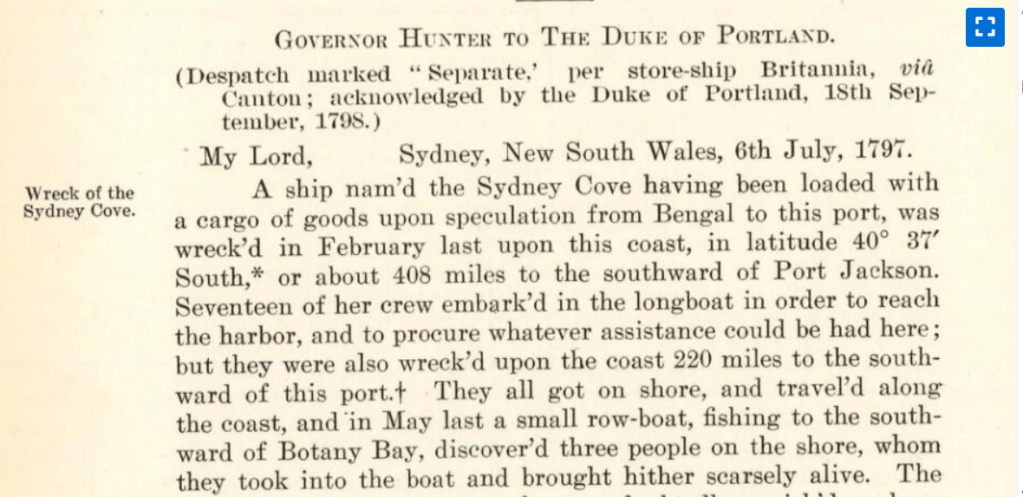
    Nothing more was heard of them for another couple of months.  Then, in late March 1798, they returned to Broken Bay and hailed down a passing boat.  Boroughbridge handed a letter to the boatswain asking him to deliver it to the NSW Governor.   The letter, signed by Boroughbridge, Gibson and three remaining runaways, claimed they wished to give themselves up and begged for clemency.   They wrote that they had sailed about 400 nautical miles (750 km) north, which would have put them on either Stradbroke or Moreton Island.   Then, they claimed, disaster struck.    When they tried to run ashore, their boat was caught in the surf and driven hard onto the beach, where it broke apart with the pounding of successive waves.   They were stranded on an inhospitable stretch of coast.   But all was not lost.   They were able to salvage enough timber from the wreckage to build a smaller craft and put back out to sea.   However, by now, they had all had enough of life on the run.  They decided that rather than continue sailing north, they would return to Sydney and beg for mercy. 

    Their plea for mercy fell on deaf ears, for the Governor had learned that Boroughbridge and the rest of the men seeking clemency had callously abandoned half their mates to die on the island in Bass Strait.   In an unlikely turn of events, they had been found by George Bass while he was endeavouring to prove the existence of the body of water which now bears his name.   Unable to carry all seven back to Sydney on his small boat, he ferried five across to the mainland, gave them a compass, a musket and as much food as he could spare and told them to follow the coast north to Sydney.   They were never heard of again.   Two men, too weak to walk, remained with Bass.   He returned to Sydney on 25 February and handed the pair to the authorities and they reported what had befallen them.     

    In April, Boroughbridge and the four remaining runaways were returned to Sydney, where they were tried for piracy and found guilty.   Jonathon Boroughbridge and Michael Gibson were hanged, while their three companions were only given clemency at the last minute as they stood before the gallows contemplating their final moments of life.

    © Copyright C.J. Ison / Tales from the Quarterdeck, 2024.

    Please enter your email address below to be notified of future blogs.

  • The Nelson Gold Heist – 1852

    The Nelson Gold Robbery. The World’s News, 5 Aug 1950, p. 9.

       In the early hours of Friday, 2nd April 1852, a band of villains climbed aboard the barque Nelson while moored in Melbourne’s Hobsons Bay and made off with over 8,000 ounces of pure gold, worth tens of millions of dollars in today’s money. The heist was as simple as it was audacious and ranks among the largest robberies in Australian history. Most of the thieves never saw the inside of prison, and only a fraction of the gold was ever recovered.

       The 603-ton barque Nelson had sailed from London on 4 July 1851, around the same time that prospectors discovered a vast quantity of alluvial gold near Mount Alexander. The barque dropped anchor in Hobsons Bay on 11 October, only for its captain, Walter Wright, to learn Victoria was in the midst of a gold rush.

       The Nelson disembarked its passengers and unloaded merchandise at Williamstown, then sailed across to nearby Geelong. There, the crew deserted the ship and headed off to the gold fields to try their luck, leaving just the captain and first mate behind. Over the next couple of months, the Nelson’s hold was filled with bales of wool, casks of tallow, and, most importantly to this story, 11 boxes of gold totalling 2083 ounces, all bound for London. By March 1852, the barque was once again anchored off Melbourne in Hobsons Bay, ready to return home as soon as enough men could be found to crew her.

    Ships, deserted by their crews, lying in Hobson’s Bay, By E Thomas.

       On Thursday night, 1 April, the Nelson was still anchored a short distance off the Point Gellibrand Lighthouse, along with scores of other ships stranded for lack of crew. Captain Wright was ashore for the night, leaving his chief mate, Henry Draper, in charge. With him were the second mate Carr Dudley, an officer from a neighbouring ship, plus a handful of seamen they had managed to recruit.

       Despite a fortune in gold being on board, no watch had been posted. The crew had refused Draper’s order to stand guard through the night, saying there were too few of them to do so, and besides, they had not signed on as night watchmen. All Draper could do was lock the boxes of gold in the lazarette, (a storeroom of sorts) for safekeeping. By now, the number of boxes had grown to over twenty as the captain continued to accept new consignments.

       Henry Draper, Carr Dudley, and two officers from nearby ships spent the evening playing cards and drinking. Then, sometime around 11 p.m., the card game wrapped up, and one of the visiting officers returned to his ship. Draper and Dudley tottered off to their cabin, leaving William Davis, the Royal George’s second mate, to sleep off the evening’s entertainment on the cabin’s lounge. Meanwhile, the rest of the crew had long since retired to their berths in the forecastle.

       Around two hours later, two boats carrying 22 men rowed up to the Nelson, the sound oftheir oars muffled by blankets to mask their approach. They pulled alongside, and a dozen of them, armed with pistols and swords, climbed onto the deck.

       Some went forward and secured the crew in the forecastle while the rest poured into the main cabin aft. As they swarmed onto the deck, Carr Dudley woke Draper up to tell him he thought he could hear movement above. Draper went on deck to investigate and was confronted by several well-armed men, all dressed in black with hats pulled low over their heads and handkerchiefs covering the lower portions of their faces.   

    “We’ve come for the gold,” the ringleader told Draper, “And the gold we’ll bloody well have.” Draper had gone on deck dressed only in his nightshirt and asked if he could return to his cabin to put on a pair of trousers. While he was fumbling to get dressed, a robber, still pointing a pistol at him, warned, “We’ve not come here to be played with, so make haste. ”Draper and Dudley were forced into the main cabin to join Davis, who had been rudely awoken with a gun pointed at his head. They were eventually joined by the rest of the crew brought aft from the forecastle.

    The Sun, 30 May 1948, p. 3.

       Draper was forced to unlock the lazarette, and the thieves helped themselves to 23 cedar boxes containing over 200 kilograms of gold. During the proceedings, one of the robbers’ pistols accidentally discharged, and the bullet grazed Draper’s thigh. Once the gold was loaded onto the boats, the slightly wounded Draper and the rest of the crew were locked in the lazarette. The robbers then hopped in their boats and were rowed back to shore.

       Draper and the others would have remained imprisoned in the lazarette until well into the day had they not had a minor stroke of luck. The cook had been woken by the noise of the thieves climbing on deck, and he had hidden in a dark recess under his bunk, remaining undiscovered during the robbery. He resurfaced once he saw that the robbers had left and went aft to find his shipmates locked in the lazarette. Once released, Draper wasted no time reporting the heist to the Williamstown water police office.

       Boats were sent out to scour Hobson’s Bay, but they were too late. The robbers had got away. Shortly after daylight, the water police found one of the whaleboats pulled up on the beach at Williamstown and the other across the bay near Sandridge (present day South Melbourne). Tracks were seen leading off the beach where the boat had been abandoned.   

    The police were galvanised into action. Mounted officers and constables fanned out across Melbourne looking for the robbers and the missing gold. The robbery was a severe embarrassment to the police and the colonial government, and both were widely condemned in the newspapers when it became public. The Governor offered a £250 reward, and that was matched pound for pound by the Nelson’s shipping agents.

    The Argus 3 Apr 1852, p. 5.

       The empty gold boxes were discovered by an employee of the Argus newspaper a few days later, hidden in scrubland not far from the beach at Sandridge, but most of the gold was long gone. Only some slight traces of gold dust could be seen mixed in the sand where the boxes had been busted open. Over the next several days, police rounded up anyone who looked remotely suspicious, and the watchhouses were filled to bursting.

       The police finally got a lucky break when a band of men turned up at a hotel in Geelong late one night wanting a room. They were dressed far beyond their station in life and spent their money freely. The publican alerted the Geelong police, and they were arrested a couple of days later. These seven men were detained while the police searched for evidence of their involvement in the Nelson robbery. Two more men were captured in Portland on Victoria’s western coast. Most of the individual suspects were found to possess more than £500, five times the average yearly wage at the time.

       Of these nine men, only three were found guilty of the robbery and sentenced to long terms in prison. The most compelling evidence against them was that they had been recognised by Henry Draper, or the Royal George’s second mate, William Davis. Drape and Davis claimed they recognised the robbers because their handkerchiefs had slipped down, revealing their faces. Draper and Davis also claimed they recognised two other men who likely had nothing to do with the robbery. One had a slew of witnesses testify at his trial that he had been on the gold fields at the time, but the jury did not believe them. However, he was quietly released a couple of months later when it was clear he and his witnesses had been telling the truth. The other hapless soul spent many years at hard labour for a crime he never committed.

       For years, rumours circulated around Melbourne about who might have been involved. Ongoing interest was fuelled by the fact that most of the gold was never recovered. But it remained a baffling mystery.

       Writing in the Sydney Morning Herald 30 years later, Marcus Clarke pondered some of the many rumours associated with the heist. It was often said that a gentleman of standing in Melbourne society had masterminded the robbery and paid thugs to steal the gold on his behalf. It was also rumoured that several prominent men about town had benefited financially from the robbery. Yet another rumour had it that a notorious publican had fenced the gold and then left the colony a very wealthy man. Clarke finally concluded that after the passing of so many years, the whole story would never be known.

       But was he right? Since first writing this blog post in April 2024, I have unearthed some tantalising clues that point to the identity of the brazen thieves. But more about that some other time.

    © Copyright C.J. Ison / Tales from the Quarterdeck, 2024.

    Please enter your email address below to be notified of future blogs.

  • The Norna and the Conman Commodore

    The Norna’s sister ship Cornet.

       In the early 1900s, many hard-working sailing vessels saw out their days plying the waters between Australia and the islands of the South Pacific. Few, however, would have had such a fascinating history as that of the Norna.

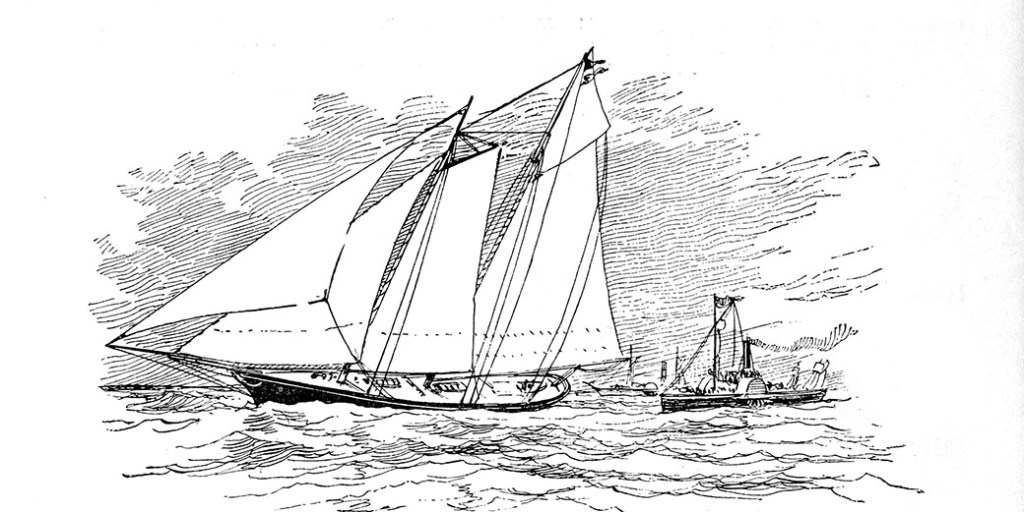
       The Norna was built in New York in 1879 as a luxury ocean-going schooner rigged yacht. She was lavishly fitted out and built to be a fleet-footed racer. For the next decade or more, she held her own in many long-distance ocean races.

       Then, in 1895, she was purchased by self-styled “Commander” Nicholas Weaver, who claimed to represent a Boston newspaper empire seeking to establish a presence in New York. He was, in fact, a brazen conman.

       A few years earlier, Weaver had fallen foul of the law and only escaped gaol by testifying against his partner. He then hustled himself off to the West Coast, where he no doubt perfected his craft.

    Nicholas J Weaver, The Pacific Commercial Advertiser (Honolulu), 17 April 1900, p. 7.

       Now back in New York, he planned to take the Norna on a round-the-world cruise, sending back stories of his adventures which would be syndicated in America’s Sunday newspapers. He found several financial backers willing to cover his expenses in exchange for a share of the syndication fees. They founded a company, and Weaver sailed for the warm climes of the Caribbean.

       There, he made himself a favourite among the members of the Royal Bermuda Yacht Club, representing himself as the “Acting Commodore” of the prestigious Atlantic Yacht Club. The good people of Bermuda were not necessarily any more gullible than anyone else whom Weaver had separated from their money. But when someone sails into harbour aboard a 115-foot luxury yacht with a sailing crew of ten plus a cook and steward, few questions are likely to be raised. It also helped that Weaver himself was handsome, self-assured, and very charismatic.

       Weaver lived life to the full and spared himself no expense. He began hosting poker parties on his yacht, inviting only Bermuda’s most well-heeled residents. Though he proved to be uncannily lucky at cards, the winnings could not have covered his expenses. He funded his lavish lifestyle by chalking up credit with local merchants where possible, passing dud cheques if necessary, or forwarding invoices to his financial backers in New York.

       However, it was only a matter of time before things began to unravel. But before the inevitable day of reckoning, Bermudans awoke one fine morning to find the Norna and its flamboyant owner had cleared out in the dead of night.

    Yacht Norna leaving Honolulu. The Pacific Commercial Advertiser (Honolulu), 17 April 1900, p. 7.

       Weavers’ backers eventually realised they had been scammed and that they would never recoup their money. They wound up the company and stopped sending him money. But that did not deter Weaver from continuing on his round-the-world cruise.

       He visited many ports over the next couple of years, where he dazzled the wealthy with his largesse, while taking them to the cleaners at the poker table. He cruised around the Mediterranean, stopping long enough to run his con but always skipping out before debts became due.

       At the outbreak of the Spanish-American War, in April 1898, he and his American-flagged Norna found themselves in hostile waters. Realising his yacht might be seized, he set sail at his best speed with the Spanish navy in hot pursuit. Despite Weaver’s many character flaws, he was a superb mariner. Thanks to his skill and the luxury yacht’s fast sailing lines, the Norna outpaced the Spaniards, crossing into the safe waters of British-owned Gibraltar. There, he repaid his welcome by passing a fraudulent cheque for $5,000 and was once again on his way.

       During his travels around Europe, Weaver made the acquaintance of a man named Petersen, a fellow grifter. Together, they would prove a formidable team.

       Weaver and Pedersen would arrive in a new city independently, only to be introduced to one another by someone local, or they would fabricate a chance meeting as if they were strangers. Regardless of how they met, the result was always the same. They would get a high-stakes poker game going where one or the other would clean up.

       When Weaver reached Ceylon (present-day Sri Lanka), he was introduced to Petersen, who just happened to have recently arrived by steamer. They quickly got to work separating the wealthy from their wealth before moving on again. The pair repeated the same stunt in Sumatra, in the Dutch East Indies (now Indonesia), as well as in Hong Kong and Yokohama, Japan. At each port, they fleeced the local high society and vanished before alarm bells rang.    In Yokohama, Weaver passed himself off as the commodore of the New York Yacht Club and flew its pennant from his vessel. Weaver and Pedersen befriended each other and enjoyed many an evening with others playing poker on the Norna. Then, one morning, the yacht was gone. Pedersen joined the chorus baying for Weaver’s blood, claiming he, too, had been taken for a fortune. He then quietly slipped away on the next steamer leaving port.

    Schooner Norna circa 1911 now sporting a cabin on her aft deck. The Sun, 17 July 1911, p. 1.

       From Yokohama, the Norna made its way to Honolulu, where Weaver and Petersen briefly reunited. But when Weaver left Hawaii, Petersen remained. It seems as though the partnership had come to an end. The Norna stopped at Samoa long enough for Weaver to fleece the locals, then sailed on to New Zealand. At Auckland, Weaver began his now well-honed con, though this time without the able assistance of Petersen.

       Weaver racked up considerable debts, but before he could make his departure, the Norna was seized as surety. Realising the game was up, Weaver caught the next steamer bound for Sydney, vowing he would return to Auckland with the necessary funds to have his beloved yacht released. Not surprisingly, he vanished, and the yacht was put up for sale. It was purchased by a Sydney merchant and brought across the Tasman in June 1900.

       The Norna was stripped of her luxurious fittings, and the cabins were removed to make way for a spacious hold more fitting for her new working life. The Norna passed through several hands over the next 13 years. She served as a pearling lugger in Torres Strait and a trading vessel among the Pacific Islands. One owner even used her to salvage copper and other valuables from old shipwrecks far out in the Coral Sea. But, in June 1913, she, herself, was wrecked on Masthead Reef 50 km northeast of Gladstone Harbour. So ended the Norna’s fascinating and colourful career.

    © Copyright Tales from the Quarterdeck / C.J. Ison, 2022.

    To be notified of future blog posts, enter your email address below.

  • The Bogus Count and Hamlet’s Ghost

    Hamlet’s Ghost at Surabaya, Indonesia, 1868. Photo Courtesy: Walter B Woodbury Photograph Collection, Robert S. Cox Special Collections and University Archives Research Center, UMass Amherst Libraries.

       Some things you can’t make up. This is the improbable story of how a young man impersonating an Austrian aristocrat came to cruise up the Queensland coast on a resurrected vessel named Hamlet’s Ghost.

       In May 1868, a dashing young man stepped ashore in Sydney claiming to be Count Ignaz Von Attems, a blood relative of Archduke Albert of Austria. The Von Attems family traced its aristocratic lineage back to the 12th Century. To Australia’s class-conscious and pretentious squattocracy, the young count gracing their presence was a man to be feted.

       Von Attems knew how the game was played, for he was a master far beyond his 25 years might suggest. He dressed extravagantly, splashed money around with abandon, hinted at a lavish monthly stipend and generally loved to court attention. He was a man to be seen and, more importantly, to many in colonial society, a man to be seen with. No social gathering of the day would be complete without the aristocratic Count attending. He would often dress in the full uniform of an Austrian cavalry officer, complete with sword, even when wandering about town.

       But, after spending just four weeks in Sydney being wined and dined by the city’s social elite, he up and left for Brisbane, promising he would return after doing a spot of hunting in the recently separated colony to the north.


    “The Gallant Count Von Attems” newspaper article from the 1940s. Source: Trove.

       Count Ignaz’s reception in Brisbane was no less exuberant than it had been in Sydney. The Premier of Queensland, Robert Mackenzie, hosted a champagne lunch in Von Attems’s honour, attended by the colony’s leading citizens, for no other reason than he had deigned to visit their humble domain.

       As in Sydney, he borrowed heavily on lines of credit with the colonial banks and convinced local merchants and new acquaintances alike to temporarily cover his expenses. His usual excuse, and one rarely questioned, was that he was waiting for his monthly allowance to catch up with him.

       By now, Count Von Attems, or Curt Oswald Schmulz as he was better known to his family back in Austria, had perfected his – far from petty – grift. Schmulz was charismatic, urbane, and exceedingly generous with “his” money. He was everything one would expect from a well-bred Austrian gentleman. Born into a middle-class family in Saxony, the young Schmulz attended a Commercial Academy and worked in a counting house (an accounting firm) while completing his studies. He also began mixing with friends from wealthier families who enjoyed a far more lavish lifestyle than he could afford. That did not deter the young man from living life to the full. Unfortunately, by the time young Curt Schmulz celebrated his 20th birthday, he had amassed debts neither he nor his father could repay.

    The man dressed in white is likely Curt Schmulz AKA Count von Attems on board Hamlet’s Ghost at Surabaya 1868. Walter B Woodbury Photograph Collection, Robert S. Cox Special Collections and University Archives Research Center, UMass Amherst Libraries.

       He quietly boarded an American-bound ship, leaving Europe and his financial troubles behind. However, the United States was embroiled in its own problems. The Civil War was raging, and Schmulz joined the Union Army, where he apparently served with some distinction. By the time he was mustered out at the end of hostilities, he had risen to the rank of Captain.

       For the next two years or so, he travelled through South America, Africa, and the Middle East before returning to Europe. He supported himself by using forged letters of introduction and drawing on fictitious lines of credit with banks far from where he happened to be at the time. No doubt his earlier employment at the counting house stood him in good stead, for he would have known how the financial system worked and how he could exploit it in those early days. He never stayed anywhere for long and assumed the personas of many different people, real and imagined. He also became adept at assuming the airs of a European aristocrat.

       When he left Sydney, he had no intention of ever returning. To do so would have courted disaster, for it would only be a matter of time before the trail of crumbs he had left behind him caught up. When it was time for him to leave Brisbane, he intended to keep heading north and make for Batavia in the Dutch East Indies (present-day Indonesia) to start anew.   

    And, one day, he found the ideal vessel to take him there. He purchased a luxurious pleasure craft enigmatically named Hamlet’s Ghost. It had a story just as interesting as the bogus Counts. A clue to its origin, for students of Shakespeare, can be found in the yacht’s name. Hamlet’s Ghost had been born from the carcass of the whaling schooner, Prince of Denmark.

    Example of an 1860s whaling Schooner.

       The Prince of Denmark had run aground on one of the Chesterfield Islands far out in the Coral Sea during a heavy storm in 1863. The prospect that they might be rescued by a passing ship was extremely remote. So, the captain got his men to work on building a new boat from the remains of his wrecked ship. Captain Bennett and his crew of Solomon Islanders then sailed her to Moreton Bay, where he sold the vessel. He and his men then boarded the next ship bound for Sydney.

       Hamlet’s Ghost first saw service as a lighter in Moreton Bay, transferring cargo from ships to shore. Then, three years later, a well-heeled merchant named George Harris purchased the craft. He had seen her hidden potential. After the shipwrights had finished with her, Hamelt’s Ghost had been transformed from a utilitarian workboat into a fine pleasure yacht. She was now a schooner-rigged vessel of about 8-10 tons with an elliptical stern and an overhanging bow. The hull had been sheathed in cedar and copper-plated to ward off seaworms. She had been fitted with a spacious cabin amidships, featuring a large central skylight that protruded above the deck, providing full headroom and an abundance of light.    “The vessel’s cabin is splendidly fitted up,” wrote one reporter. “The panelling is of grained maple mounted with gold mouldings, and a large pier glass fills up one end of the cabin.”

    Hamlet’s Ghost at Surabaya, 1868. Photo courtesy: Walter B Woodbury Photograph Collection, Robert S. Cox Special Collections and University Archives Research Center, UMass Amherst Libraries.

       She was also armed with three brass swivel guns to ward off any threats when cruising in remote or dangerous waters. But for the most part, Harris was content to sail her down the Brisbane River and around Moreton Bay.

       When the bogus count saw Hamlet’s Ghost, he knew it was the perfect vessel for what he had in mind. Von Attems told everyone that he intended to explore the warm waters along the Queensland coast, perhaps as far as Cleveland Bay (present-day Townsville), before returning to Brisbane. Harris was too canny a businessman to relinquish his vessel without first receiving full payment, no matter how esteemed the purchaser was. So, the count purchased the yacht with borrowed money to the sum of £500.  Von Attems crewed it with a captain, chief officer, three seamen, a cook/steward and, of course, a manservant.

       Three weeks after his sensational arrival, Count Ignaz Von Attems bid Brisbane “Auf Wiedersehen,” leaving another mountain of debt in his wake. He even had the audacity to direct creditors to the Prussian Consulate for payment shortly before he set sail.

       Curt Schmulz did not leave Brisbane too soon, for a month later, a warrant for his arrest issued in Sydney had reached the stunned city. By then, the bogus count was rounding Cape York Peninsula, but it had been anything but fair sailing up the Queensland coast.

       Hamlet’s Ghost had pulled in at Maryborough, Rockhampton and Cleveland Bay, where the leaving citizens, thrilled to be in such august company, entertained the dashing and gracious young man. But, for the crew, Count Von Attems had proved to be a particularly obnoxious creature to work for. By the time Hamlet’s Ghost had reached the government outpost of Somerset near the top of Cape York, the captain had had enough of the arrogant Count. Their latest argument escalated to the point where both men brandished their pistols, threatening to shoot each other. Cooler heads stepped in before either was hurt, and order was restored. However, the captain and the steward left the yacht at Somerset. Von Attems was only able to convince the rest of the crew to stay by promising them more money. They then left Queensland behind, passed through Torres Strait and on towards the Dutch East Indies.

       Count Von Attems, AKA Curt Schmulz, finally ran out of luck at Surabaya. There, he was arrested after passing several fraudulent bank bills. While waiting his day in court, Von Attems escaped the prison hospital and almost managed to flee the East Indies before being recaptured.

       He was finally tried, found guilty and served 10 years in Batavia’s notorious Glodok Prison. Hamlet’s Ghost was never returned to Queensland. The Dutch colonial government reportedly sold her off for £100, and her final years are unknown.

    (C) Copyright Tales from the quarterdeck / C.J. Ison 2021.

    To be notified of future blog posts please enter your email address below.