Tag: Tonga

  • A Textbook Escape – The Badger 1833.

    Example of an English Cutter of early 1800s. Source: All About Ships, Dorling, 1912.

       In July 1833, the colonial cutter Badger left Hobart with its hold filled with supplies intended for Port Arthur. Only this time, as she set off down the Derwent River instead of rounding Cape Raoul and delivering her stores, she kept heading east, past Tasman Island, past Cape Pillar and out to sea. The captain and crew, all convicts still under sentence, had likely been planning their escape for some time. Now they were putting it into action.

       The Badger had a crew of four under the command of Captain William Philp.   All the men had been mariners before they had run afoul of the law and been banished to Van Diemen’s Land. All but one were serving life sentences, meaning there was no likelihood they would ever return home. Their captain was a former master mariner who had been found guilty of “Wilfully and maliciously destroying the sloop Jane”. Philp had been a part-owner of the vessel as well as its captain. Late one night, he loaded it with gunpowder and blew it up in Penzance Harbour after a falling out with his business partners.

       He was tried, found guilty and sentenced to transportation for life. Aged 51, Philp was sent out to Van Diemen’s Land on the convict transport Argyle in 1831. During the passage, he was suspected of conspiring with others to seize the ship and make their escape. The evidence was circumstantial and most likely supplied by a convict informant, but that was enough for Philp and eight or so others to be clapped in chains and separated from the rest of the prisoners. On the Argyle’s arrival in Hobart, the conspirators, including Philp, were tried, found guilty and sentenced to serve hard labour at Macquarie Harbour. 

       On his eventual return to Hobart, Philp finally got a break. He was put in charge of the 25-ton schooner Badger, ferrying stores from Hobart to Port Arthur about 70 kilometres sailing down the Derwent River. Port Arthur had recently been established to replace Macquarie Harbour, which was about to be shut down the following year.

    The Colonist, 6 Aug 1833, p. 3.

       By 1833, the Badger’s entire crew were experienced seamen. It was not uncommon for the authorities to assign sailors to work on government vessels, for they already had the necessary skills. However, there was always the obvious risk that the colonial administrators were giving them the means of effecting their own escape. Such was the case with the Badger. Governor Arthur was mercilessly criticised for allowing such a situation to eventuate.

       On Tuesday, 23 July 1833, William Philp took the Badger out of Sullivan Cove and headed down the Derwent River much as he had done many times before. As well as carrying plenty of provisions, on this trip the Badger was also well equipped with nautical charts, navigation instruments and several muskets recently procured by Philp and his men. What’s more, as many as a dozen convicts had also been smuggled aboard and hidden in the hold.

       The Badger left the wharf unchallenged and did not raise any suspicion as she sailed under the guns of Battery Point. To everyone but those on board, she was on her regular passage to Port Arthur. But before she had gone more than five kilometres down the Derwent, she briefly pulled into shore and picked up a final passenger, one George Harding Darby.

       Darby, like all the rest of the men on the Badger, was a convict still under sentence. But he enjoyed many privileges not accorded to ordinary convicts sent out to the colonies. A gentleman by birth, he was a member of the same class as the military officers and administrators governing Van Diemen’s Land. At the time, he was employed as a signalman at Mount Nelson Signal Station, which relayed messages from Port Arthur to Hobart. He had also worked at the Water Bailiff’s office and was likely the person who got Philp his job as the Badger’s master and ensured he had a crew of loyal and competent sailors.

    Courtesy Google Maps

       Darby and Philp, both nautical men, had become friends while held in a prison hulk awaiting transportation. Darby had come out to Van Diemen’s Land on the William Glen Anderson the same year as Philp had come out on the Argyle. George Darby had served in the Royal Navy and, during Greece’s war of independence from the Ottoman Empire, had commanded a naval vessel under Lord Cochrane. He was also reputed to have served with distinction during the battle of Navarino in 1827 further enhancing his reputation among Hobart’s administrators. However, by 1830, he had left the navy and had found employment as a clerk. By 30 March 1830, he was standing in the docks answering charges of stealing £90 from a fellow gentleman. He was found guilty and sentenced to be transported for life.

       Several days passed before anyone realised the Badger had not delivered her stores to Port Arthur. Boats were sent out to track her down. It was thought that Philp might have sought refuge in the Bay of Islands in New Zealand.   So, the brig Isabella was even sent to investigate with a party of soldiers on board. However, she returned to Hobart in late September, having found no trace of the missing Badger. Philp, Darby, and the others had somewhere much further afield in mind when they sailed away from Hobart. They had made their way north, first through the Tasman and from there into the Coral Sea. In September, they pulled into Lifuka in the Friendly Islands (present-day Tonga) before resuming their journey north across the equator and on towards the Philippines.

       Philp, Darby and the rest of the runaways eventually arrived in Manila in a longboat, claiming their ship had sunk not far from that port. It is certainly possible that they ran into trouble close to their destination, as they claimed. But it is more likely they had deliberately scuttled the ship rather than risk it being identified as the missing Badger. Philp and Darby would have known that Governor Arthur would have sent a description of the Badger and its runaways far and wide in his effort to track them down.

    The Pria Granda, Macao, by Thomas Allom, from a sketch by Lieut. White, Royal Marines. (1843)

       The bolters did not linger in Manila for very long. They boarded a Spanish ship bound for the Portuguese colony of Macau. But in Macau, their luck nearly ran out. William Philp was spotted by the master of the British merchant ship Mermaid, which happened to be in port. Before taking command of the Mermaid, Captain Stavers had served as the mate on the convict transport Argyle. He immediately recognised Philp as one of the convicts who was suspected of plotting to seize his ship.

       Stavers tried to have the Portuguese colonial authorities detain the Philp and his mates. He showed the officials an old copy of the Sydney Herald newspaper, which included a report on the seizure of the Badger as evidence. Philp and Darby were picked up and questioned by a Portuguese official, but they claimed to have never heard of the Badger.

       As Philp and the others had kept their noses clean while in Macau, the Governor was not inclined to lock them up on the say-so of a foreigner brandishing an old newspaper in a language he did not understand. Philp and Darby were released to go about their business unmolested, but now that their true identities were known, they thought it was time to move on in. Apparently, most of the runaways had already found berths on an American-flagged ship about to leave port. Philp was last seen in Macau after kindly declining an invitation to join a ship bound for Sydney, telling the British captain, “[he] did not wish to go so far southward.”

    Philp, Darby and the rest of the men who fled from Van Diemen’s Land on the Badger are among a very select group of convicts. Of the many hundreds who escaped in stolen or seized vessels, very few are known to have made it to a friendly port. None of the Badger’s men were ever heard of again after leaving Macau.


    © Copyright C.J. Ison / Tales from the Quarterdeck, 2024.

    Please enter your email address below to be notified of future blogs.

  • Bligh’s Epic Open-Boat Voyage

    The Mutineers turning Lieut. Bligh and part of the officers and crew adrift from his Majesty’s Ship the Bounty / painted and engraved by Robert Dodd, 1790 London

    On 28 April 1789, Lt William Bligh was startled awake by his first mate, Fletcher Christian, and several other HMS Bounty sailors threatening his life. He, along with 18 members of his crew who wanted nothing to do with the unfolding mutiny, would soon be unceremoniously herded into a launch and set adrift. So began one of the great open-boat voyages in maritime history.

       To say the launch was overcrowded is an understatement. Measuring 23 feet (7 metres) in length, there was room for just half those on board. But, in addition to Bligh and his men, space had to be made for their provisions.

       The mutineers allowed them 70 kg of sea biscuits, 10 kg of salted pork, seven litres of rum, six bottles of wine, and 130 litres of water. For navigation, they were provided with only a quadrant and a compass. Fletcher Christian would not allow them to take a chronometer or any of the charts. A few clothes were thrown into the launch at the last moment, as well as four cutlasses for personal protection should they be foolish enough to venture onto any of the neighbouring islands. Lastly, the carpenter was allowed to take his toolbox, and the ship’s clerk had collected some of Bligh’s papers and belongings, including the captain’s nautical almanac. With the launch so heavily weighed down, it was in imminent danger of being swamped.


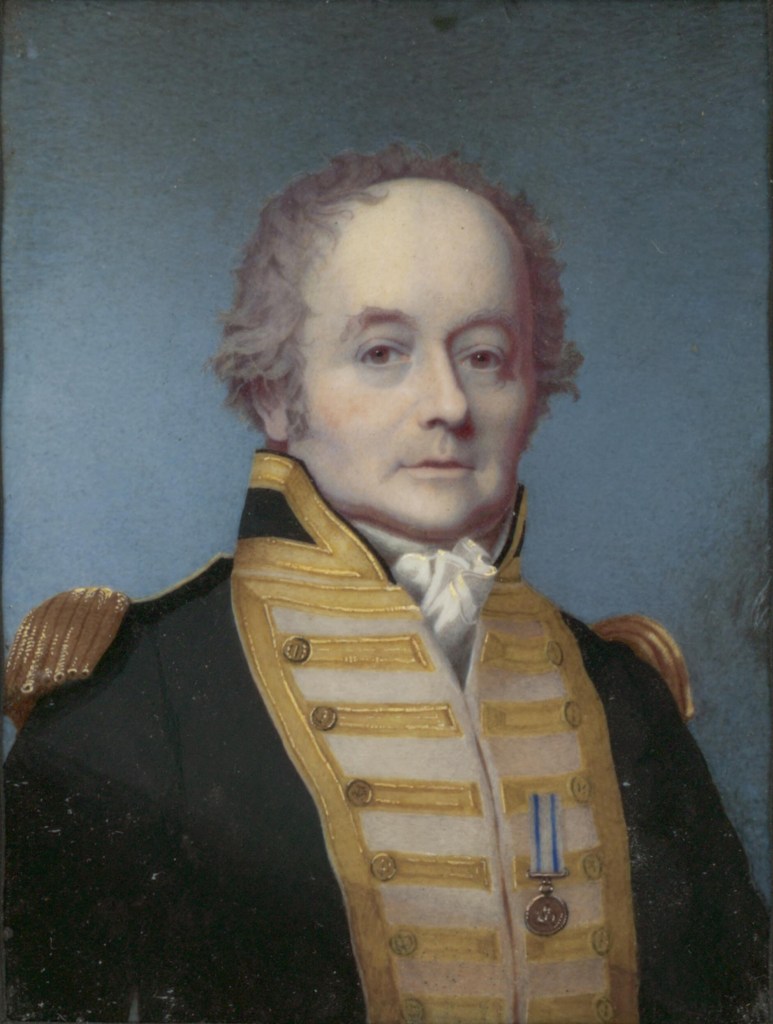
    Portrait of William Bligh By Alexander Huey – National Library of Australia, Public

    As the Bounty sailed away, Bligh and the others found themselves adrift in the South Pacific Ocean, a very long way from the nearest European settlements. With no viable alternatives, Bligh convinced his men that they should make for the Dutch settlement of Kupang on Timor Island, some 3,500nm (7,000 km) away. But before they could set off on the long voyage, Blight felt they needed to add to their stores. At first glance, the provisions might seem bountiful, but shared among so many people, they would last little more than a week without strict rationing.

       Bligh made for the nearest land, Tofua Island, about 50 km away, to stock up on fresh produce. Initially, the Islanders seemed friendly and happy to trade. But after a couple of days, the mood inexplicably changed. Bligh and his men suddenly found themselves fleeing for their lives under a hail of hurled rocks. One man was felled on the beach, but the rest managed to get away in the launch.   

    But the assault continued. Rocks still rained down among them, thrown by islanders who pursued them in a canoe. Reprieve only came when the launch finally outdistanced the attackers. Bligh noted in his journal that almost all of them had been injured to some extent from the barrage of stones. But they had escaped, though at the cost of one life. Bligh then set a course west through the South Pacific Islands towards New Holland (Australia). He decided that they would not risk stopping anywhere else along the way.

    A page from William Bligh’s logbook. Courtesy State Library of NSW.

    Sacrifices had to be made if they were ever to make it to Timor. Spare clothes, ropes and anything else not essential were tossed overboard to lighten the load and make more room. Even so, conditions remained so cramped in the boat that no one had room to stretch out their legs. Those not seated on the thwarts had to find room where they could, often on the floor with their backsides in a few inches of water. The carpenter’s chest was emptied of tools so it could be filled with sea biscuits to keep them out of the water sloshing around in the bottom of the boat.

       Bligh organised the men into two watches as they sailed west-north-west towards the Fijian Islands and beyond. Beginning on 4 May, they were battered by a powerful storm with gale-force winds and high seas. Water poured into the boat, forcing the men to bail continuously to keep afloat. The storm raged until the following evening, when the weather eased off for a short while.

       Over the next several days and weeks, they passed through the Fijian Islands and then the islands of Vanuatu as they steadily made their way west. The nights were brutally cold, but there was little let-up in the weather, and they remained soaked to the skin for days on end. The only reprieve from their misery came in the form of a small daily ration of rum.

       Even though Bligh had no chart, he was able to compare his observations, when he could make them, with known landmarks recorded in his almanac. Though they passed close to several islands, there was no appetite to go ashore for food despite their growing hunger. Their experience on Tofua was still fresh in their minds.

    Route sailed by the Bounty’s launch. Courtesy Google Maps.

    They began bearing more westerly as they crossed the Coral Sea and weathered several more powerful squalls. Mountainous seas and torrential rain again kept them bailing as hard as they could to remain afloat.

       Then, on 24 May, they were bathed in full sunshine for the first time in nearly two weeks. Over the following few days, they caught several seabirds. The precious little meat was shared out evenly and eagerly eaten raw. The birds also offered hope of another sort, for they signalled that they were approaching the Australian mainland.

       On 28 May, they reached the outer edge of the Great Barrier Reef, clearly delineated by a line of breaking white surf. Bligh pointed the bow towards a gap in the reef, and everyone hung on as they raced through the narrow passage. Once through the coral jaws, they found themselves in calm water in the vicinity of Cape Melville. Bligh then bore north, remaining close to the inside of the reef in hopes that they might catch some fish to supplement their diet.

       A couple of days later, they stepped ashore on what Bligh would name Restitution Island. After being confined to the boat for so long, they were all barely able to walk. Nonetheless, a fire was started using Bligh’s magnifying glass to focus the sun’s rays, and a stew of sea biscuit and salted pork was augmented by some berries, oysters and other shellfish foraged from their surroundings.

       After several days recuperating, they reboarded the boat and island-hopped north until they reached Torres Strait. They then headed west again across open seas until Bligh estimated they were off the southern coast of Timor Island. On 14 June 1789, they sailed into Kupang Harbour, 47 days after the Bounty mutineers cast them adrift. Bligh noted that they were “nothing but skin and bones; our limbs were full of sores; [and] we were clothed in rags.” But they had survived a voyage few would have thought possible.

       The Dutch authorities tended to the survivors and arranged passage back to England; however, five would never see home, dying in their weakened state, probably from malaria, a disease not well understood at the time.     Bligh arrived back in the United Kingdom in March 1790, not to a hero’s welcome but to face a court-martial to explain the loss of his ship. The Court exonerated him and the incident had no noticeable impact on his career. Bligh eventually rose to the rank of Vice Admiral before retiring. He also served a tumultuous two years as the Governor of New South Wales until officers of the NSW Corps deposed him, but that’s a story for another occasion.

    © Copyright C.J. Ison / Tales from the Quarterdeck, 2023.

    To be notified of future blogs, please enter your email address below.