Tag: Sydney Cove

  • Tales from the Quarterdeck

    Sixty bite-sized stories from Australia’s maritime past

    The melancholy loss of H.M.S Sirius off Norfolk Island by George. Raper. Source National Library of Australia 136507434-1

    I have just launched a new book titled Tales from the Quarterdeck: Sixty bite-sized stories from Australia’s maritime past. Sixty of the most popular posts have been reedited. In some cases, I’ve rewritten a couple and updated a few where new information has come to light since first writing them.

    For those who would value ready access to the stories in their bookcase, Tales from the Quarterdeck is available in Kindle ebook and paperback formats through Amazon.

    The stories are organised in chronological order, starting with the Tryall shipwreck off the Western Australian coast in 1622, and finishing with the Second World War exploits of the Krait. See below for a full list of the stories covered in the book.
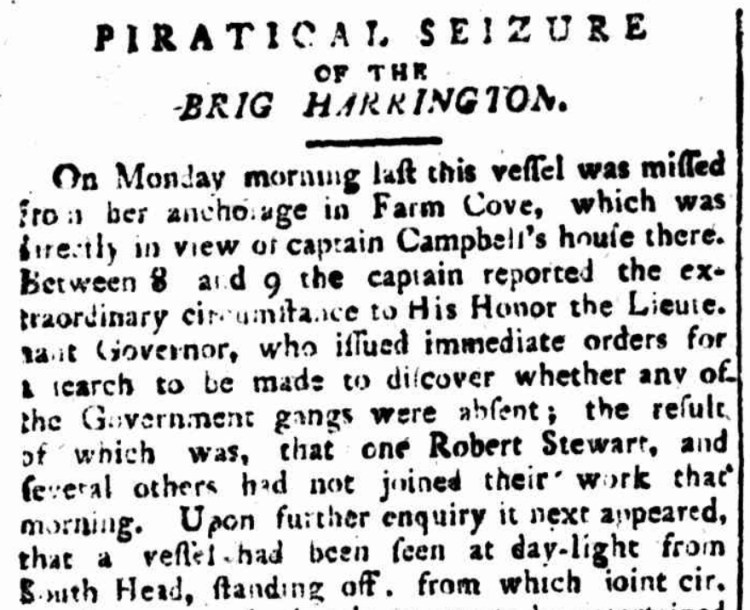
    Sydney Gazette 22 May 1808, p. 2.

    1622 – The Tryall: Australia’s earliest shipwreck

    1629 – The Batavia Tragedy

    1688 – William Dampier: Navigator, naturalist, writer, pirate

    1770  – The Endeavour’s Crappy Repair

    1788 – Loss of La Astrolabe and La Boussole, a 40-Year Mystery                        

    1789 – Bligh’s Epic Voyage to Timor

    1789 – HMS Guardian: All Hands to the Pumps

    1790 – The Loss of HMS Sirius

    1790 – Sydney’s First Desperate Escape

    1791 – HMS Pandora: Queensland’s earliest recorded Shipwreck

    1791 – William Bryant’s Great Escape

    1797 – The Loss of the Sydney Cove

    1803 – Loss of HMS Porpoise

    1808 – Robert Stewart and the Seizure of the Harrington

    1814 – Wreck of the Morning Star

    1816 – The Life and Loss of HMSC Mermaid

    1824 – The Brig Amity’s Amazing Career

    1829 – The Cyprus mutiny 

    1831 – The Caledonia’s perilous last voyage

    1833 – The Badger’s Textbook Escape

    1835 – The Loss of the Convict Ship Neva

    1835 – The Post Office in the middle of nowhere

    1835 – The Tragic Loss of George III

    1845 – The Cataraqui: Australia’s worst shipwreck

    1846 – The Peruvian’s Lone Survivor

    1847 – The Foundering of the Sovereign

    1850 – The Loss of the Enchantress: A first-hand account

    1851 – The Countess of Minto’s brush with Disaster

    1852 – The Bourneuf’s Tragic Last Voyage

    1852 – The Nelson Gold Heist

    Woodbury, Walter B. (Walter Bentley), 1834-1885. Hamlet’s Ghost, Sourabaya [Surabaya], Java [Boat with Passengers and Crew], ca. 1865. Walter B. Woodbury Photograph Collection (PH 003). Special Collections and University Archives, University of Massachusetts Amherst Libraries

    1854 – Bato to the Rescue 

    1854 – HMS Torch and the rescue of the Ningpo

    1856 – The Loss of the Duroc and the Rise of La Deliverance

    1858 – The Loss of the Saint Paul and its Horrific Aftermath

    1858 – Narcisse Pelletier, An Extraordinary Tale of Survival

    1859 – The Indian Queen’s Icy Encounter

    1859 – The Sapphire and Marina

    1863 – The loss of the Grafton: Marooned for twenty months

    1864 – The Invercauld shipwreck

    1865 – The CSS Shenandoah: Victoria’s link to the American Civil War

    1866 – The Loss of the SS Cawarra: Bad luck or an avoidable tragedy?

    1868 – The Bogus Count and Hamlet’s Ghost

    1871 – The Mystery of the Peri

    1872 – The Loss of the Maria, A Cautionary Tale

    1875 – The Tragedy behind the Gothenburg Medals

    1876 – The Catalpa rescue

    1876 – The Banshee’s Terrible Loss

    1878 – The Loch Ard Tragedy

    1884 – The Macabre case of the Mignonette

    1885 – The Douro and its Piratical Captain

    1889 – The Windjammer Grace Harwar

    1891 – The Spanish Silver of Torres Strait

    1893 – The Foundering of the SS Alert

    1895 – The Norna and the Conman Commodore

    1899 – Cyclone Mahina

    1911 – The Loss of the Mandalay

    1918 – The Orete’s Robinson Crusoe-like Castaway

    1935 – The Life and Loss of  the SS Maheno

    1943 – Surviving the Centaur Sinking

    1943 – The Amazing Krait

  • The search for the Sydney Cove – 1797

    On the night of 2 October 1797, fourteen convicts stole a boat and made their way down the Paramatta River across Sydney harbour and out through the Heads.  When the men were discovered missing, the authorities sent boats in pursuit, but they returned a few days later, having never caught sight of the runaways.    As a storm had swept the area shortly after they had escaped, it was thought the bolters had died at sea.   However, that was no more than wishful thinking.    Their story is one of desperation, betrayal, and ultimately defeat.

    The runaways’ leaders were John Boroughbridge and Michael Gibson.   They had been labouring away in the back blocks of Paramatta when they convinced 12 other desperate men to join them in an audacious escape.    Their plan was to find the remains of the 250-ton Sydney Cove, a ship that had recently been wrecked somewhere far to the south of Sydney.   Boroughbridge and Gibson were sure they could build a new vessel from the timbers and fittings and make for some distant port far from the clutches of British law.   That the Sydney Cove had been carrying a massive cargo of rum and other alcoholic spirits added to its allure.

    Painting of Sydney, Port Jackson. circa 1804.

    Boroughbridge was serving 14 years for some unspecified crime and had landed in New South Wales only four months earlier and was keen to leave at the first opportunity.  Gibson had already spent five long years there, but with nine more to serve, he was no less eager to put the place behind him.     It seems they had little difficulty finding 12 others willing to join them.

    With nothing more than a small pocket compass and the knowledge that the wreck lay somewhere far to the south, they headed out through Sydney Heads and turned right.    A day or so later, the weather turned nasty, but Boroughbridge and his mates ploughed on.   Twice, their boat was driven ashore, and both times, they were lucky to avoid serious damage.  

    In time, the weather eased, and they continued following the coast and unknowingly strayed into Bass Strait.   In 1797, no one knew that a body of water separated Van Diemen’s Land from the rest of Australia.    All Boroughbridge and the others would have known was that the Sydney Cove was aground on an island somewhere off the coast.   They likely had no accurate idea how far they had come or how much further they had to go.   They certainly could not have known that they needed to cross 200 km of open water to reach the beached ship.   By now, the compass would have shown that they were heading in a south-westerly rather than southerly direction as they doggedly follow the contours of the coast.

    Finally, they ran out of food and fresh water.   In desperation, they put ashore on one of the small islands in the vicinity of Wilson’s Promontory.   There, they found a ready supply of fresh water, while seabirds and seals made easy prey for the starving men.    But, the trying conditions took their toll.   By now, many of the runaways would have gladly returned to Sydney to face any punishment short of death if it meant an end to their suffering.  

    Any sense of common purpose they may have once possessed had since evaporated.   They could not agree on what they should do next.   Should they stick to their original plan and continue searching for the elusive Sydney Cove?   Or should they abandon the search and head back north?   Then, one night, in a callous act of betrayal, Boroughbridge, Gibson and five others quietly set off in the boat, abandoning the rest of the men as they slept. 

    After leaving their comrades to their fate and giving up the search for the Sydney Cove, they returned north again.   Bypassing the entrance to Sydney Harbour, they continued on to the mouth of the Hawkesbury River, where it emptied into Broken Bay.   It cannot have been lost on the weary men that after three or four months on the run, they were now barely a day’s sailing from where they had started.   

    After months at sea, their boat was in such a derelict state that they did not trust it to carry them any further.    The men agreed they would continue sailing north, but to do so, they would have to find another boat.     They did not have long to wait.

    Boroughbridge and his men seized a passing vessel and set a course north. Their plan now was to make for Timor in the Dutch East Indies as William Bryant, his wife Mary and others had done some six years earlier.   News that Mary and some of the other runaways had reached England and been pardoned had only recently reached Sydney offering hope for anyone contemplating following in their wake.   

    Nothing more was heard of them for another couple of months.  Then, in late March 1798, they returned to Broken Bay and hailed down a passing boat.  Boroughbridge handed a letter to the boatswain asking him to deliver it to the NSW Governor.   The letter, signed by Boroughbridge, Gibson and three remaining runaways, claimed they wished to give themselves up and begged for clemency.   They wrote that they had sailed about 400 nautical miles (750 km) north, which would have put them on either Stradbroke or Moreton Island.   Then, they claimed, disaster struck.    When they tried to run ashore, their boat was caught in the surf and driven hard onto the beach, where it broke apart with the pounding of successive waves.   They were stranded on an inhospitable stretch of coast.   But all was not lost.   They were able to salvage enough timber from the wreckage to build a smaller craft and put back out to sea.   However, by now, they had all had enough of life on the run.  They decided that rather than continue sailing north, they would return to Sydney and beg for mercy. 

    Their plea for mercy fell on deaf ears, for the Governor had learned that Boroughbridge and the rest of the men seeking clemency had callously abandoned half their mates to die on the island in Bass Strait.   In an unlikely turn of events, they had been found by George Bass while he was endeavouring to prove the existence of the body of water which now bears his name.   Unable to carry all seven back to Sydney on his small boat, he ferried five across to the mainland, gave them a compass, a musket and as much food as he could spare and told them to follow the coast north to Sydney.   They were never heard of again.   Two men, too weak to walk, remained with Bass.   He returned to Sydney on 25 February and handed the pair to the authorities and they reported what had befallen them.     

    In April, Boroughbridge and the four remaining runaways were returned to Sydney, where they were tried for piracy and found guilty.   Jonathon Boroughbridge and Michael Gibson were hanged, while their three companions were only given clemency at the last minute as they stood before the gallows contemplating their final moments of life.

    © Copyright C.J. Ison / Tales from the Quarterdeck, 2024.

    Please enter your email address below to be notified of future blogs.

  • The Loss of the Sydney Cove – 1797

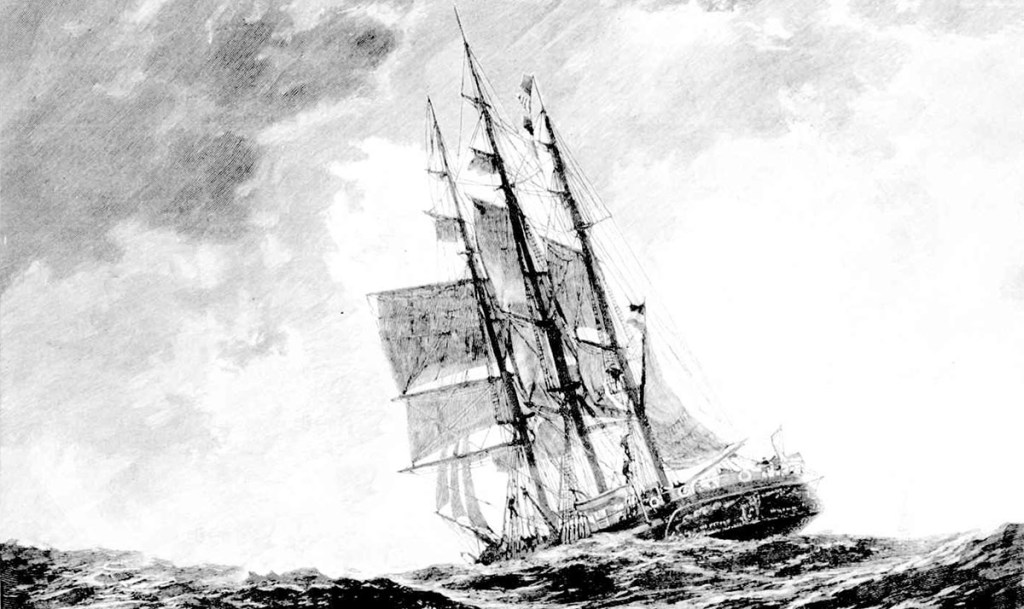
    A barque caught in heavy weather. Source: Tales of Shipwrecks and Adventures at Sea, 1856.

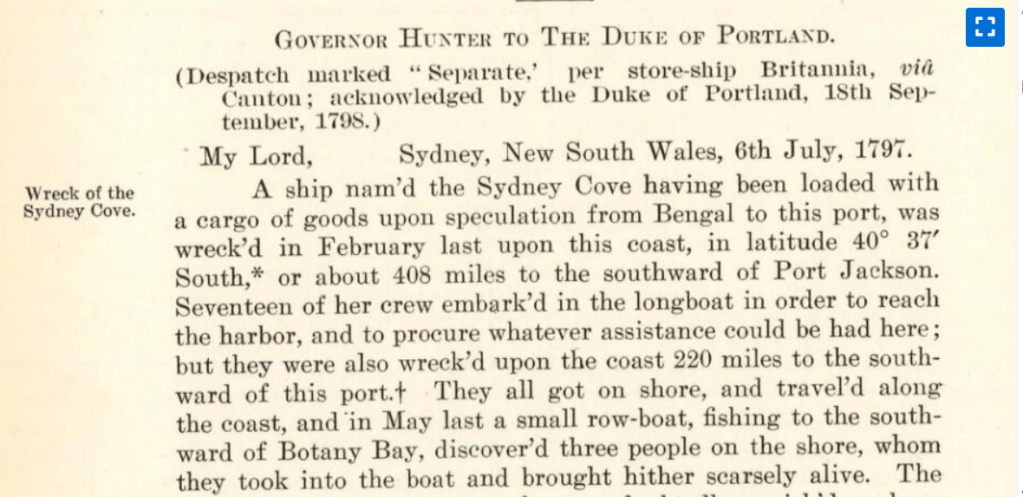
       In May 1797, a fishing party returned to Sydney with more than their daily catch. They had found three shipwreck survivors south of Botany Bay who told them that the merchant ship Sydney Cove had been wrecked somewhere far to the south. The survivors had trekked over 600 km along New South Wales’s rugged southern coast seeking help for their captain and shipmates who were still stranded with the ship.

       On 10 November 1796, the 250-ton Sydney Cove had sailed from Calcutta with her hold full of Indian goods and produce the owners hoped to sell in Sydney. The crew, numbering close to fifty men, was a mix of Indian and European seamen under the command of Captain Guy Hamilton. About a month out, as she cleaved her way south through the Indian Ocean, the Sydney Cove was caught in a terrible storm and began taking on water. Initially, the leak was easily managed with the pumps, so Hamilton continued on his course to round Van Diemen’s Land (Tasmania) before heading north again and on up the New South Wales coast to Sydney.

       By January, as they sailed into the latitudes south of Tasmania, the ship was caught in the grip of another powerful storm. The leak began to worsen, and soon the pumps had to operate continuously to prevent the ship from sinking.

       As they headed up Tasmania’s east coast, they encountered yet more wild weather and heavy seas. By now, water was pouring into the hold faster than the men at the pumps could clear it. The barque was slowly filling with water. Captain Hamilton ordered all non-essential gear to be jettisoned to lighten the load, but that only put off the inevitable.   

    By 9 February, the water in the hold was lapping at the lower-deck hatches. Captain Hamilton realised he had no choice but to beach his ship to save her from foundering in deep water. If that were to happen, he would not only lose his ship and its precious cargo but also much of his crew, for they would not all fit on the Sydney Cove’s two boats. He found a sandy beach on what is today called Preservation Island in the Furneaux group and ran her ashore. Although Hamilton had saved the ship from sinking, his troubles were far from over.

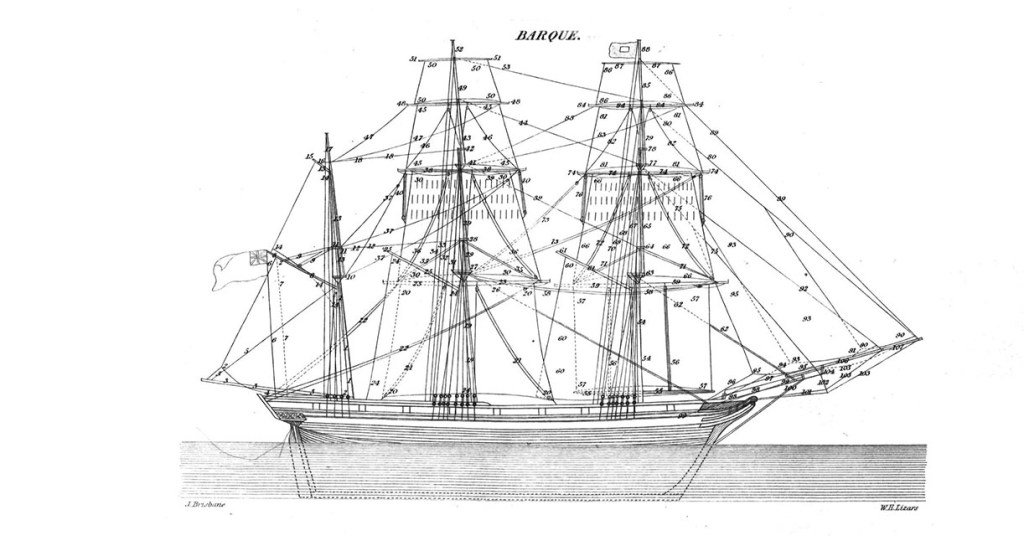
    No illustration of the Sydney Cove exists but it likely looked similar to this example. Source: Nautical Dictionary by Arthur Young, published in 1863.

       Exhausted from constant bailing and battling through rough seas, Hamilton got the crew unloading much of the ship’s stores and cargo onto Preservation Island. But then the weary men discovered the casks of rum stacked among the cargo. Hamilton had to have the liquor taken to a neighbouring island to prevent his men from pillaging it. Captain Hamilton then organised his crew for a prolonged stay, for they had come ashore at a very remote part of the world. The crew erected shelters using sails and spars to give them refuge from the elements. Hamilton rationed everyone to one cup of rice per day, and though they sank a well and found water, it proved so brackish it was barely drinkable. However, their immediate needs were met. Then he turned his mind to their rescue.

       If they were ever to leave Preservation Island, they would have to send for help. It was agreed that the First Mate, Hugh Thomson, with 17 men, would sail north, keeping close to the New South Wales coast until they reached Sydney. Captain Hamilton and the remaining crew, numbering about 30, would remain with the ship.

       Several days after setting off, the longboat was driven ashore on Ninety-Mile Beach and smashed to pieces. Thomson and his men escaped with their lives, but they had little else. With no way to return to the Sydney Cove, their only chance of survival lay in continuing to Sydney, 600 km away, on foot.

       Thomson hugged the coast, knowing that as long as they kept the sea on their right, they would eventually arrive at the young settlement. However, that meant crossing many wide river mouths and scrambling over numerous rocky promontories along the way. The journey was gruelling and took a heavy toll on the men. Encounters with the indigenous peoples varied in nature. Some provided the castaways with food and water, while others were less sympathetic but allowed them to pass unhindered. Yet others set upon the interlopers on their land. Their numbers dwindled as some drowned crossing rivers or otherwise fell victim to the harsh and unforgiving terrain.

    The Sydney Cove party as depicted by Smiths’ Weekly in 1939. Smith’s Weekly 30 Sep 1939 p. 8.

       By late April, there were only three men left. However, they had managed to reach within 20 km of Botany Bay when fishermen finally discovered them. The fishermen took the survivors the rest of the way to Sydney in their boat. On learning of the loss of the Sydney Cove, Governor Hunter ordered vessels to be sent to rescue the remaining sailors and salvage the ship’s cargo.

       After being marooned for some four months, Captain Hamilton and the rest of the crew were in dire straits. Winter was fast approaching. Successive storms had mercilessly battered their shelters, and now they had gaping tears, offering the men little protection from the bitter weather. While they had been able to supplement their rice ration with seabirds nesting on the island, their diet still barely sustained life. To add to their sense of abandonment, they had seen several ships pass in the distance but had been unable to alert any of them to their presence.

       Then, on 10 June 1798, salvation arrived when the sloop Eliza sailed into view and dropped anchor a short distance off the beach. It was later joined by the schooner Francis, under the command of Lt Matthew Flinders. Both ships had left Sydney 10 days earlier under Governor Hunter’s orders. The crews loaded as much of the salvaged cargo as they dared, leaving five volunteers behind to watch over the remaining goods until it could be collected at a later date. Captain Hamilton and his men boarded the Francis and Eliza, and they headed for Sydney.   

    The weather was no less kind as the two small ships battled their way home. It took 15 days of hard sailing through storms and high seas for the Francis to reach Port Jackson. The Eliza never made it back to Sydney and was presumed to have sunk in the terrible weather with the loss of her own crew, plus eight shipwreck survivors. In total, about half of the crew of the Sydney Cove lost their lives.

       The shipwreck is historically significant for the trek undertaken by Thomson and the others. They were the first Europeans to note an outcrop of coal in the Illawarra, which has defined the region to this day. Also, Captain Hamilton recorded strong south-westerly currents during his time on Preservation Island, suggesting there was a large body of water separating Van Diemen’s Land and the Australian mainland. The existence of the strait would later be confirmed by Matthew Flinders and George Bass and named after the latter.

    © Copyright C.J. Ison / Tales from the Quarterdeck, 2023.

    To be notified of future blogs, please enter your email address below.