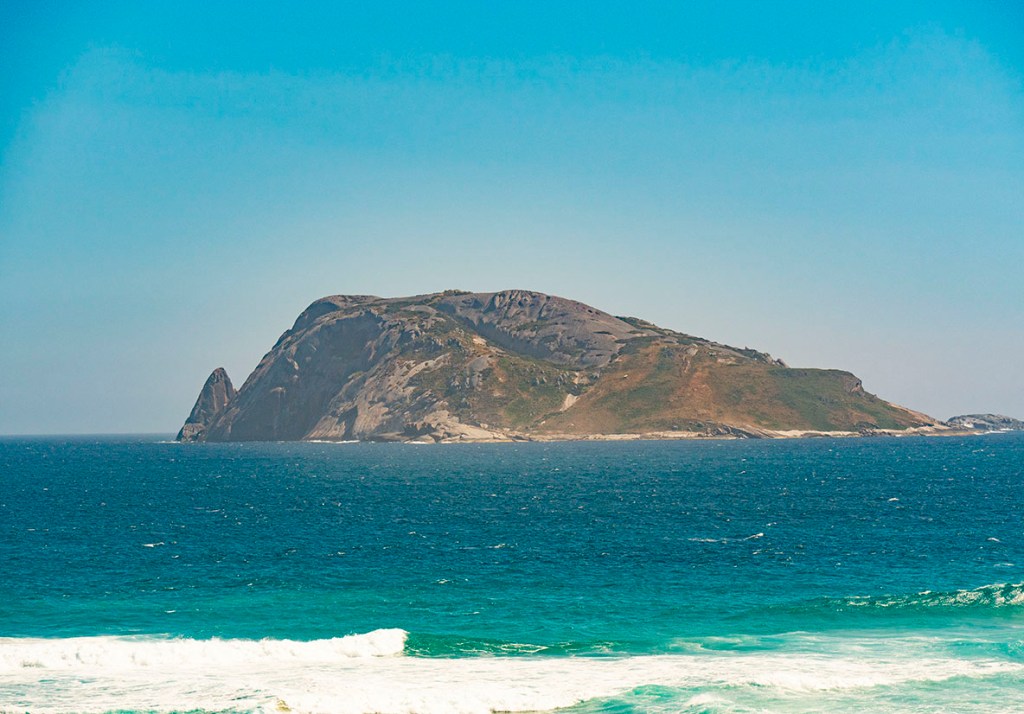
Tag: Storm

  • The Banshee’s Terrible Loss, 1876.

    Australian Illustrated News, 15 May 1876.

       The Banshee steamed out of Townsville at 6 o’clock on the morning of Tuesday, 21 March 1876, bound for Cooktown, some 240 nautical miles (450 km) up the Queensland coast. Captain Daniel Owen had command of the 58-ton steamer and its crew of 10 men.   On this trip, the Banshee was carrying 30 paying passengers, and 12 stowaways.   Almost everyone was on their way to the Palmer River, where gold had recently been discovered.   But disaster would strike long before they reached their destination.

       A moderate breeze blew from the southeast, accompanied by some drizzling rain, as they left Townsville.   But nothing about the dismal weather hinted at the violent storm that would engulf them seven hours later.   At 1.30 p.m., when a few kilometres off the southern end of Hinchinbrook Island, they were lashed by hurricane-force winds, high seas, and torrential rain. Visibility was reduced almost to zero.

       Captain Owen did not see land again for over an hour as he steered a north-north-westerly course along Hinchinbrook’s east coast. In his 35 years at sea, he had never experienced such ferocious weather. So, he decided to exercise caution and seek shelter at Sandwich Bay. Once some normality had returned to the world, he would continue on to Cooktown. Captain Owen ordered the engines slowed to half speed and he placed a lookout forward to warn of any dangers.   

    Then, a little after 3 o’clock, the lookout sighted land dead ahead. The rocky cliffs of Cape Sandwich loomed out of the pelting rain before them. Captain Owen ordered the helmsman to steer “hard a port” and for the engines to increase to full speed. The bow started to come around, but it was too little, too late. The Banshee struck aft and was slammed broadside onto the rocks. Had they cleared that promontory, they would have made it safely into the sheltered waters beyond. But that was not to be.

    Map showing Banshee wreck site. Courtesy Google Maps.

       The ship almost immediately started breaking up. The saloon house gave way under Captain Owen’s feet. “I jumped from the saloon to the top of the steam chest, and from there to the top of the house aft,” Owen later recalled, “and stuck to the mizzen rigging.”

       Around the same time one of the passengers, Charles Price, grabbed hold of the boom as the ship ran aground, but when the funnel came crashing down, it knocked him onto the deck. From there, he climbed up on the side rail and leapt onto the rocks. Not all the passengers were so lucky. Many jumped into the sea in panic and drowned before they could scramble to safety. Price went to the aid of one female passenger clinging to the rocks as the waves crashed about her. He reached down but only got a handful of hair before she was swept away.

       The ship’s stewardess had a lucky escape. She was seen clinging to a piece of wreckage in that dangerous space between the ship and the rocks. Before anyone could get to her, she was dragged under the vessel before coming back up again. This time, she caught hold of a rope and was pulled to safety. Price tried to save another passenger who he saw struggling to get clear of the waves. But before he could reach the man, he was washed from the rocks and crushed by the ship.

       Another pair to have a lucky escape were the Banshee’s cook and a stowaway. They had remained with the ship until it was washed high on the rocks and then stepped off through a rent in the hull.
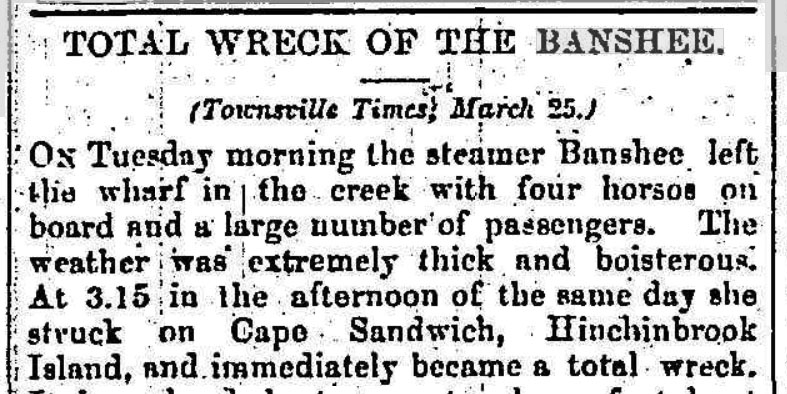
    Total Wreck of the Banshee. Mackay Mercury, 1 Apr 1876, p. 3.

       Captain Owen lost his perch in the mizzen rigging and found himself fighting for his life in the water. Twice he reached the rocks and twice he was washed back out into the cauldron. But on the third attempt, he got a firm hold and was able to clamber to safety above the pull of the waves.

       A passenger named Elliot Mullens was reading in the saloon when he heard someone call, “We are going aground.” He rushed onto the main deck just as the Banshee struck. Mullens climbed onto the bridge and, from there, launched himself across to a rock but was immediately washed off by a giant wave. Fortunately, he latched onto another rock, and despite being pummelled by successive waves, he scrambled out of the danger zone somewhat unscathed.

       “I turned, and just then the saloon … was smashed to atoms, burying beneath it four women and four children, whom we never saw again,” he later recalled. “Five minutes from the time of striking, all was over – all were saved or hopelessly gone from our sight forever.”

    In all, 17 people lost their lives, including all the children and women on board, except the stewardess. The survivors, most nursing deep cuts, bruises or broken bones, spent a cold, wet and miserable night on land. The next morning, two bodies were found washed ashore. Captain Owen held a brief service over them as they were buried where they lay.   

    By now, the storm had blown itself out, leaving a dead calm in its place. Six men volunteered to cross Hinchinbrook’s thickly forested and mountainous interior so they could signal the small settlement of Cardwell for help. Meanwhile, Captain Owen and everyone else remained where they were, but they did not have long to wait to be rescued.

    Hinchinbrook Passage circa 1880s. Source: Picturesque atlas of Australasia 1886.

       Around 6 p.m., someone cried out, “Sail Ho.” And, sure enough, there was a sailing vessel out to sea heading south. A large red flannel blanket was hastily hoisted on a makeshift mast, and everyone waited, praying that they would be seen.

       Five minutes later, the schooner The Spunkie turned towards land to investigate. But it was only by chance that the survivors had been spotted. The Spunkie’s mate had recently purchased a new telescope and was want to look through it at any opportunity. Luckily, when he brought it to his eye this day, he spotted the red flag and the bedraggled survivors lining the shore. By 10 o’clock that night, everyone had been transferred to the schooner, and they continued on their way to Townsville. The six men who crossed the island were picked up by the steamer Leichhardt as it was passing through the Hinchinbrook Passage.   

    A Marine Board Inquiry concluded the Banshee was lost due to the stress of the weather. Although they believed that Captain Owen had erred in not heading further offshore than he did, they found that “he acted as he believed for the best under very trying circumstances.”

    © Copyright C.J. Ison / Tales from the Quarterdeck, 2024.

    Please enter your email address below to be notified of future blogs.

  • The Loss of the Mandalay: Between a Rock and a Hard Place

    Postcard of the Mandalay of Farsund Norway which was shipwrecked at Mandalay Beach near Walpole Western Australia in 1911.

        As Captain Emile Tonnessen saw the sheer granite walls of Chatham Island loom into sight, he knew his ship and crew of 12 men were in serious trouble. He had been pushed dangerously close to Western Australia’s southern coast by unrelenting gale-force wind and high seas for the past several days. And now his 913-ton iron barque Mandalay was in imminent danger. His chart showed that, should he escape crashing into Chatham Island, there was still an uninterrupted line of cliffs beyond which he knew he could not avoid

       The Mandalay had sailed from Delagoa Bay (now Maputo), Mozambique, in early April 1911, bound for Albany WA to take on a cargo of Karri logs destined for Buenos Aires, Argentina. It was to be the 68-year-old captain’s final voyage before retiring to spend time with his children and grandchildren, whom he had seen little of during his more than half a century at sea. But for a last-minute change of plan, he would have returned to his home in Norway directly from Southern Africa.

       The voyage was largely uneventful until Saturday, 13 May, when they neared the Western Australia coast in the vicinity of Cape Leeuwin. The weather had rapidly deteriorated. South-westerly winds grew to hurricane strength, and mountainous seas washed over the vessel. All canvas was taken in, and the Mandalay was swept along under bare poles. The ferocious weather continued for two days, pushing the helpless vessel towards the rugged and sparsely populated coast.

       The crew tried everything they could to get control of the ship. But the only sail they could put up was on the fore-top mast. It was insufficient to deviate the ship from the course the storm was relentlessly pushing them. They had no chance of putting out into open water.

    Chatham Island viewed from Mandalay beach. Photo C.J. Ison.

       On Monday morning, 15 May, they cleared the kilometre-wide and 90-metre-high granite outcrop that is Chatham Island with only a few hundred metres to spare. Tonnessen later recalled that the waves were so large and powerful they crashed completely over the island as his ship raced past.

       While they had escaped being smashed against the granite slopes of the island, it was clear they would not be so lucky to get past the sheer cliffs of Long Point now lying somewhere ahead through the torrential rain. The captain took the only action he could.

       He would have to sacrifice his ship to give his crew a fighting chance of survival. In all his years seafaring, he had never been shipwrecked, but now he was going to deliberately run his vessel aground. It was no doubt made doubly hard for him, as he was a part-owner of the Mandalay, and he knew her to be underinsured.

    The Mandalay stranded on the beach.

       It was now about one o’clock in the afternoon. Tonnessen lined up to run the ship ashore on the only beach he could see, hoping for the best. The crew hoisted as much sail as they could, then donned their cork lifebelts and braced for the impact. About 100 metres from the beach, the bow struck the sand hard. The top main mast came crashing down, and the ship bounced along the seabed as successive waves lifted the ship and pushed it a little closer to shore. Then the Mandalay swung broadside to the ocean swells, and breakers crashed over the deck, sweeping it clean of anything not securely tied down.

       The crew lowered a lifeboat over the lee side, but the seas were too turbulent to safely cross the short distance to land. One of the young seamen, Knut Knutsen, tied a rope to his lifebelt and dived into the sea, intent on getting a line ashore.

       Unfortunately, the rope became entangled around his legs, and he floundered in the chaotic surf. Knutsen was close to drowning when a second sailor, Frank Ward, dived into the maelstrom to rescue him. Ward managed to get his friend to shore, and the two of them anchored their end of the rope. With one end of a line attached to the ship and the other end with Ward and Knutsen on shore, the lifeboat was able to ferry the rest of the men to safety.

    L-R Frank Ward and Knut Knutsen at Fremantle after the wreck of the Norwegian barque Mandalay. Photo published in the Western Mail, 3 June 1911, p. 27.

       The castaways were able to get sufficient materials ashore to build a shelter using some of the ship’s sails and spars. Unfortunately, they soon discovered that most of the food they salvaged had been contaminated with seawater.  They ate it regardless, figuring it was better than starving.

       They spent several miserable days camped on the beach, hoping they might be rescued. They placed a pole high on a sand dune with a distress signal flying. Several ships were seen passing in the distance, but none deviated from their course. Thonnessen knew it would have been suicide to try to get a boat ashore in the appalling conditions. But he hoped that at least one of the ships had seen the wreck and the fluttering flags and reported the disaster to the port authorities in Albany.

    The crew of the barque Mandalay. Photo courtesy Walpole Nornalup and District Historical Society.

       While Captain Tonnessen and the others remained camped on the beach, the first mate, Lars Gjoem, and two seamen set off on Tuesday, the day after the wreck, with compass and chart to see if they could find their way cross-country to the nearest settlement. Two days later, they returned to the beach cold, wet and exhausted, unable to find a path through the dense bush.

       On Friday, 19 May, the day after the party returned, the second mate, Frederick Fincki, climbed the highest hill behind the beach, and from that vantage point, he thought he could see a route through the maze of broken ground. He briefly returned to the camp to collect a staff and a knife and set off towards what he would later learn was Nornalup Inlet.

       He soon found himself wading through a swamp. But he doggedly pushed on for several hours, praying he would eventually reach dry land. Fincki made it to Nornalup inlet, arriving just as a local settler, Frank Thompson, was returning in his boat with supplies from Albany. Fincki was lucky, for that was a trip Thompson only did once every three months.

       Thompson, picked up Fincki and took him to his home, wondering to himself what would have happened had he not been passing when he did. It was bitterly cold, night was fast approaching, and the young Norwegian had been far from dry land. Thompson thought his chances of surviving would have been poor.

       The following day, Thompson, his son and the second mate returned to the beach to rescue the remaining men. Over the next several days, the shipwrecked sailors were cared for by Thompson and other settlers until they could be delivered to the small settlement of Denmark, located further down the coast. From there they were taken on to Albany, where they caught the train to Perth.

    Mandalay Beach with Long Point in the background. The wreck lies approximately in the centre of the photo. Photo C.J. Ison.

       Frank Thompson was presented with a gold fob watch by a grateful Norwegian Consul. Thompson and the other settlers who came to the crew’s aid earned the undying gratitude of Captain Tonnessen and his men. The Mandalay was never refloated and slowly rusted away on the beach that now bears her name. Its remains are periodically exposed when the conditions are right.

    ©Copyright C.J. Ison / Tales from the Quarterdeck, 2020.

    To receive notification of future blog posts, enter your email address below.