Sixty bite-sized stories from Australia’s maritime past
The melancholy loss of H.M.S Sirius off Norfolk Island by George. Raper. Source National Library of Australia 136507434-1
I have just launched a new book titled Tales from the Quarterdeck: Sixty bite-sized stories from Australia’s maritime past. Sixty of the most popular posts have been reedited. In some cases, I’ve rewritten a couple and updated a few where new information has come to light since first writing them.
For those who would value ready access to the stories in their bookcase, Tales from the Quarterdeck is available in Kindle ebook and paperback formats through Amazon.
The stories are organised in chronological order, starting with the Tryall shipwreck off the Western Australian coast in 1622, and finishing with the Second World War exploits of the Krait. See below for a full list of the stories covered in the book.
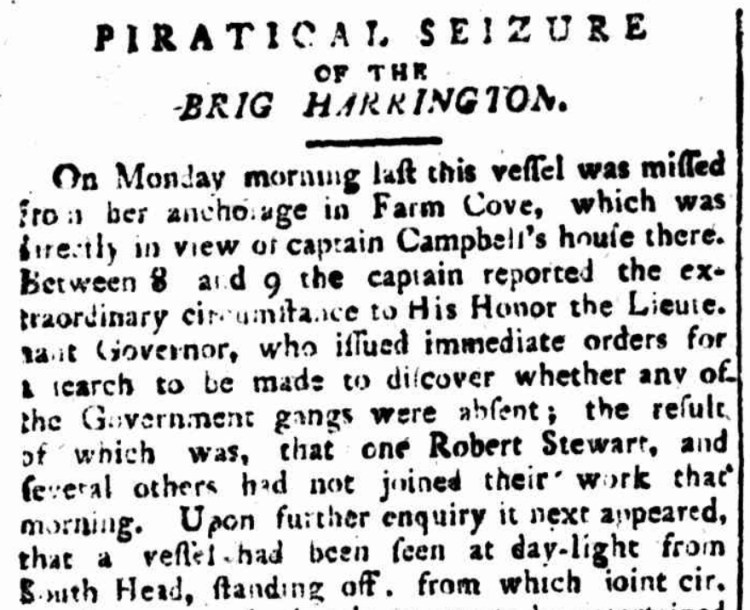
Sydney Gazette 22 May 1808, p. 2.
1622 – The Tryall: Australia’s earliest shipwreck
1629 – The Batavia Tragedy
1688 – William Dampier: Navigator, naturalist, writer, pirate
1770 – The Endeavour’s Crappy Repair
1788 – Loss of La Astrolabe and La Boussole, a 40-Year Mystery
1789 – Bligh’s Epic Voyage to Timor
1789 – HMS Guardian: All Hands to the Pumps
1790 – The Loss of HMS Sirius
1790 – Sydney’s First Desperate Escape
1791 – HMS Pandora: Queensland’s earliest recorded Shipwreck
1791 – William Bryant’s Great Escape
1797 – The Loss of the Sydney Cove
1803 – Loss of HMS Porpoise
1808 – Robert Stewart and the Seizure of the Harrington
1814 – Wreck of the Morning Star
1816 – The Life and Loss of HMSC Mermaid
1824 – The Brig Amity’s Amazing Career
1829 – The Cyprus mutiny
1831 – The Caledonia’s perilous last voyage
1833 – The Badger’s Textbook Escape
1835 – The Loss of the Convict Ship Neva
1835 – The Post Office in the middle of nowhere
1835 – The Tragic Loss of George III
1845 – The Cataraqui: Australia’s worst shipwreck
1846 – The Peruvian’s Lone Survivor
1847 – The Foundering of the Sovereign
1850 – The Loss of the Enchantress: A first-hand account
1851 – The Countess of Minto’s brush with Disaster
1852 – The Bourneuf’s Tragic Last Voyage
1852 – The Nelson Gold Heist
Woodbury, Walter B. (Walter Bentley), 1834-1885. Hamlet’s Ghost, Sourabaya [Surabaya], Java [Boat with Passengers and Crew], ca. 1865. Walter B. Woodbury Photograph Collection (PH 003). Special Collections and University Archives, University of Massachusetts Amherst Libraries
1854 – Bato to the Rescue
1854 – HMS Torch and the rescue of the Ningpo
1856 – The Loss of the Duroc and the Rise of La Deliverance
1858 – The Loss of the Saint Paul and its Horrific Aftermath
1858 – Narcisse Pelletier, An Extraordinary Tale of Survival
1859 – The Indian Queen’s Icy Encounter
1859 – The Sapphire and Marina
1863 – The loss of the Grafton: Marooned for twenty months
1864 – The Invercauld shipwreck
1865 – The CSS Shenandoah: Victoria’s link to the American Civil War
1866 – The Loss of the SS Cawarra: Bad luck or an avoidable tragedy?
The Bessemer. The Penny Illustrated Paper, 10 Apr 1875, p. 1.
One September afternoon in 1874, Miss Bessie Wright cracked a bottle of champagne across the bow of a new steamer and sent it gliding into the Humber River. Thus, one of the strangest vessels ever to come off a naval architect’s drawing board was launched.
S.S. Bessemer Saloon Steamship was the brainchild of little Bessie’s grandfather, Sir Henry Bessemer. He had found investors who stumped up some £250,000 to make his vision a reality. The resulting paddle steamer measuring 350 ft (106.6m) at the waterline and had four paddle wheels, two on the port side and two starboard. The fore and aft were identical, and there were two bridges and two helms meaning she could travel as quickly in either direction at an anticipated top speed of 20 miles per hour. But what set the Bessemer apart from any other steamer was her swinging saloon.
Positioned in the middle of the ship was a 70 ft (21m) cabin, which would remain stable regardless of the pitch and roll of the rest of the vessel. The gyroscopic apparatus powered by a dedicated steam turbine had been designed and patented by Henry Bessemer himself. This complex piece of engineering was to ensure that the steamers’ first-class passengers were spared the indignity of mal de mer or seasickness in all but the roughest of sea conditions. Second-class passengers were not so well catered for. They would occupy a separate, more conventional cabin mounted upon the ship’s superstructure.
Sir Henry Bessemer.
The Bessemer was purpose-built to negotiate the lumpy waters of the English Channel. She would travel between Dover and Calais, and at her top speed, it would take just one hour to cross the 20-nautical mile gap. Henry Bessemer was convinced that the first-class passengers would disembark as hail and hearty as they had boarded his modern marvel. Nonetheless, the designers had thought to include two “retiring rooms” for ladies and gentlemen to “withdraw from the public gaze,” should anyone still feel the ill effects of the sea.
Not surprisingly, the novel design attracted its fair share of sceptics. Some naval architects felt the gyroscopic apparatus would do little to stop the saloon from pitching and rolling in rough seas. Their main concern was that the mechanism would be unable to respond fast enough to the sea to ensure the saloon maintained its equilibrium.
After the Bessemer had been launched it was moored in the Hull Roads while her plush interior was fitted out. A Daily News reporter would later describe the Bressemer’s saloon akin to a “superbly furnished floating clubhouse.” The steamer was furnished with a large smoking saloon, several staterooms on the upper deck, refreshment bars, an office for small parcels, umbrella and cloakrooms, and “delightful promenades high above the reach of ocean spray.”
Deck of the Besser Saloon steamship. The Illustrated London News, 27 Mar 1875, p. 293
The only hiccup while the steamer was being fitted out was when she dragged her anchors during a mighty gale that battered much of the UK on 21 October. The Bessemer was driven onto a mudflat on the northern bank of the Humber River, but she was easily floated off at high tide on that same day.
By late January 1875, the Bessemer had completed her first set of sea trials on the Humber. She reportedly steered well and reached a top speed of 18 knots (33 km/h). Her gyroscopic apparatus was said to have performed splendidly, but that assertion would soon be brought into question.
In March, the Bessemer made the voyage from Hull to Gravesend on the Thames in 24 hours while steaming into a strong headwind. There, she underwent more sea trials, and on 12 April, the Bessemer Saloon Steamship made her much-anticipated first crossing to Calais. As the steamer had yet to receive her passenger certification from the Board of Trade, the only people on board were the crew and a handful of men connected with the company.
The Bessemer. The Penny Illustrated Paper, 3 Oct 1874, p. 13.
She left Gravesend at 8.30 on Saturday morning and made her way down the Thames and out into the English Channel. There, she was buffeted by a strong easterly wind and heavy seas. Despite the inclement weather, the passage was reported to have been “remarkably steady”, and there had been no opportunity to test the ship’s swinging saloon. She averaged 11 knots (20km/h) for the 75 nm (145 km) passage and arrived in that French port at 3.30 in the afternoon. There, a great many of Calais’ residents gathered on the pier to witness the arrival of the unique ship. Unfortunately, as she was docking, one of her paddles was damaged when it struck the pier.
Finally, the big day arrived on 12 April 1875. The Bessemer steamed out of Dover with 350 invited guests onboard anticipating being the first to see the swinging saloon in action. Several members of the press were among them, no doubt there to extol the virtues of the fine new vessel. However, the Observer’s correspondent, for one, was clearly underwhelmed by the experience.
He reported that the screws fastening the moveable saloon were never loosened, which would have allowed the passengers to witness for themselves the effect of Henry Bessemer’s invention. Several reasons were put forward for why the gyroscopic apparatus was not employed, but the reporter wrote that he had been reliably informed that the equipment simply did not work. It could shift the saloon from side to side, but it was not up to the task of “regulating the rise and fall of the saloon with sufficient precision to secure stable equilibrium.”
S.S. Bessemer. By Henry Spernon Tozer – The Illustrated London News,
To cap off the 90-minute non-event, the Bessemer entered Calais’s harbour far too quickly to manoeuvrer safely around the small, enclosed port. The collision with the pier on her last visit to Calais had been attributed to the Bessemer’s poor response to her helm when travelling at low speed. This time, the captain came in a little faster. However, the steamer was caught in a tidal current and spun around. The Bessemer struck the pier with considerable force but sustained little damage to itself.
However, the same could not be said for the wharf. “When at last the Bessemer was stopped, some 50 or 60 yards of the pier were knocked down like nine-pins in a skittle alley, and the water of the harbour was covered with broken planks and beams.”
“The Bessemer is too long a vessel for Calais harbour,” the reporter opined, “there must always be a certain amount of risk in her entering so narrow a port with the velocity required to carry her across the bars.” A month later, the Calais Municipality sent the Saloon Ship Company a bill for £2,800 to cover the cost of repairing the pier.
The Bessemer saloon ship running foul of Calais Pier. The Illustrated London News, 15 May 1875, p. 20.
That was the Bessemer’s final voyage but for her return to England. The investors cut their losses, and the company was wound up. The engines, the swinging saloon and other fittings were removed, and by the end of the following year, the remainder of the ship was sold off as scrap. So ended the short but lively career of the Bessemer Saloon Steamship.
Foundering of the SS Alert. Source: The Queenslander 13 Jan 1894, p. 71.
On Friday, 29 December 1893, around 11 o’clock in the morning, two ladies were strolling along Sorrento Ocean Beach on the Mornington Peninsula when they discovered an unconscious man washed up on the sand. He would prove to be the sole survivor of the steamer Alert, which sank during foul weather.
The SS Alert had left Bairnsdale on Victoria’s southeast coast at 4 p.m. two days earlier, bound for Port Albert and Melbourne. But a little more than 24 hours later, she would be lying at the bottom of Bass Strait off Jubilee Point.
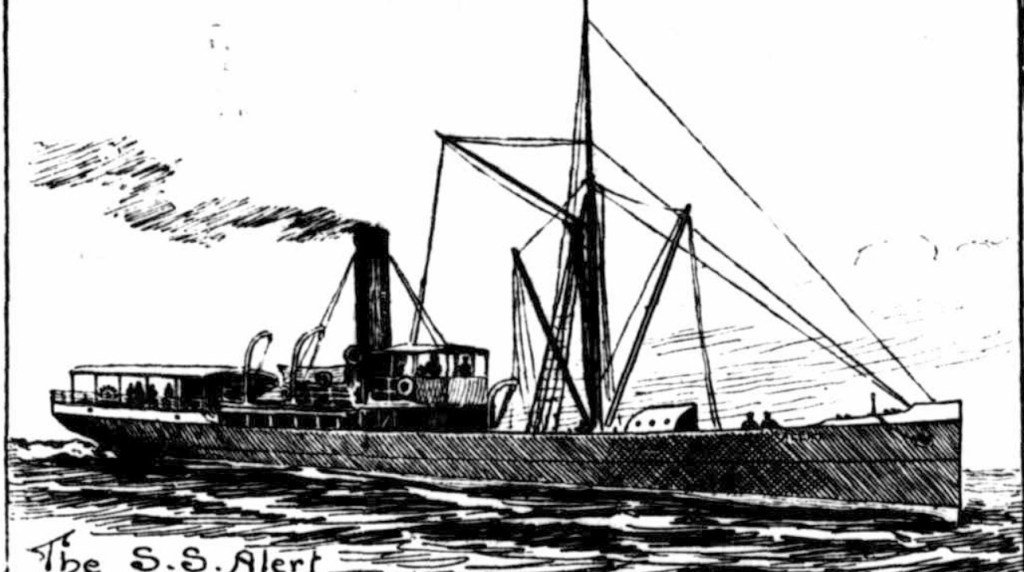
The Alert was a 16-year-old 243-ton iron screw steamer owned by Huddart and Parker. She had recently been refurbished and, for the past two months, had been carrying passengers and cargo between Gippsland and Melbourne. Prior to that, the Alert had been a favourite of the excursion fleet, which ferried passengers between Melbourne and Geelong.
From the moment the little steamer cleared the Gippsland Lakes, she felt the full fury of a storm lashing the Victorian coast. Nonetheless, Captain Albert Mathieson thought the sea conditions were nothing his ship could not handle. They stopped briefly at Port Albert, 150 kilometres down the coast, to deliver some cargo and then continued on towards the entrance to Port Phillip Bay and respite from the atrocious weather.
S.S. Alert. Source: Leader, 6 Jan 1894, p. 30.
By 4 p.m. Thursday, they were off Cape Schanck, just 30 kilometres short of Port Phillip Bay. Owing to the trying conditions, Captain Mathieson had remained on the bridge the entire trip. Such were the conditions that it required two men at the helm to keep the steamer pointed on its course. Then disaster struck.
About half an hour later, the Alert was struck by a massive rogue wave that swamped the deck with tons of water and pushed the steamer over onto her side. Then, they were hit by a second large wave before the water from the first had time to drain away. The saloon skylight and a porthole window were smashed, and the sea poured in. The helm was unresponsive by now, and the ship’s lee rail was pushed underwater. Another wave swept over the bridge as seawater snuffed out the struggling steamer’s engine fires.
The captain ordered everyone to don their lifebelts as he vainly tried to head the stricken steamer into the wind, but to no avail. He ordered the lifeboats to be lowered, but one had already been swept off its davits, and the other had seas continuously sweeping over it. There was nothing anyone could do now.
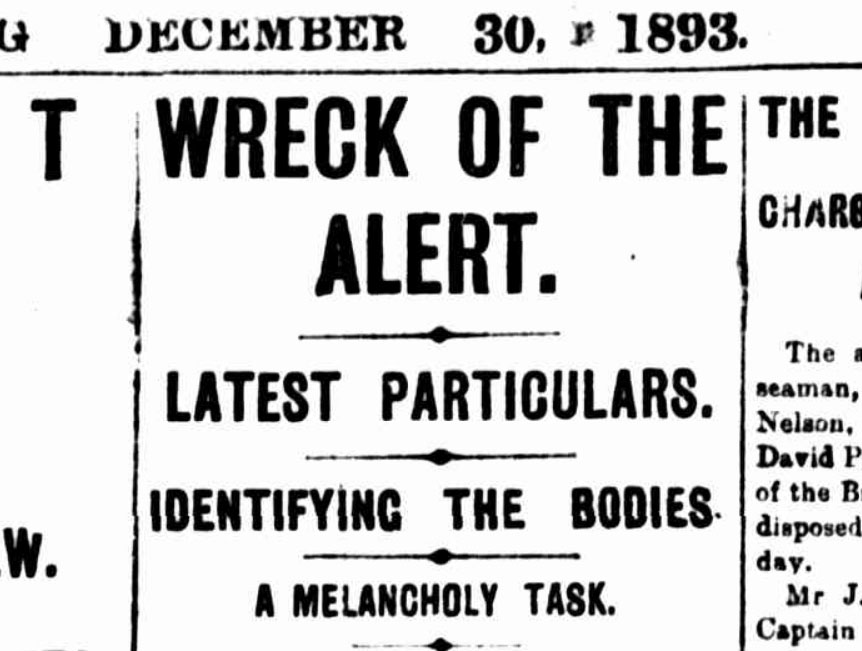
The Herald, 30 Dec 1893, p. 2.
Robert Ponting, the ship’s cook, joined the rest of the crew on deck, and minutes later, the Alert went to the bottom. Ponting climbed onto a hatch cover, but in the turbulent seas, it kept turning over and flipping him into the water. He eventually lost hold of it altogether and began swimming. He spotted the ship’s steward nearby and kept pace with him. Ponting and the steward remained together until the poor fellow could no longer keep his head above water and drowned. Around this time, Ponting spotted Captain Mathieson swimming strongly, but lost sight of him again shortly after.
Ponting spent the night swimming about in the cold Bass Strait waters within view of the Cape Schanck Lighthouse. The cold water chilled him to the bone, and he eventually passed out. He continued drifting with the current, slowly pushing him towards land. Then, around daybreak, he felt himself being tumbled ashore and used the last of his strength to drag himself away from the pull of the surf. He had spent over 12 hours in the water and would spend another five or six hours passed out on the beach.
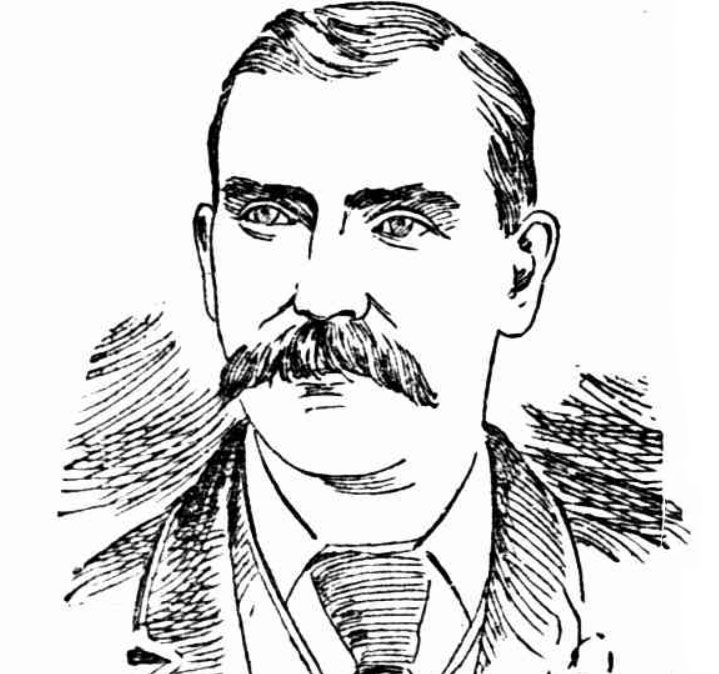
Robert Ponting. Source. Weekly Times (Melb), 6 Jan 1894, p. 19..
When, around 11 o’clock, he came too, he found he was surrounded by a group of ladies and a gentleman who had been walking along the beach. The first ladies to discover the unconscious man had called on the others to come to Ponting’s aid. Among his saviours was Douglas Ramsay, a doctor on holiday from his practice in Elsternwick. At first, Ramsay thought that Ponting was dead. He had tried to find a pulse but could not. and “his eyes were shut and all sanded over, his nostrils were also clogged with sand, and his body was stiff and cold,” he later recalled. The doctor didn’t give up, though. He opened Ponting’s mouth and poured some drops of brandy down his throat while vigorously working his arms “to restore animation.” After about ten minutes of this bizarre medical attention, Ponting began to show signs of life.
Ramsay then dragged him behind a rock to shelter him from the cold wind and one of the ladies removed her jacket and wrapped it around his frozen feet. A couple of the other ladies began the long walk back to their carriage and headed to Sorrento for assistance. Meanwhile, Dr Ramsay continued with his ministrations. While they were waiting for help to arrive, another man happened on the scene while walking his giant St Bernard dog. He had his huge canine nestle up against Ponting for warmth. That, and a steady administration of medicinal brandy, brought some colour back to Ponting’s cheeks.
After a while, he was able to tell his rescuers his name and what had befallen him. He also asked that someone send his wife a telegram to tell her he was alive. He did not want her to think he had perished with everyone else when news of the shipwreck broke. Eventually, he was taken to the Mornington Hotel in Sorrento, where a couple of local doctors cared for him. As apparently was best practice in such cases during the late 1800s, the good doctors rubbed his entire body with mustard and poured hot brandy down his throat. In response – or perhaps despite it – Ponting made a full recovery.
The Argus, 30 Dec 1893, p. 7.
Over the next couple of days, several bodies and much wreckage washed up on Mornington Peninsula’s rugged ocean beaches. In all, 14 men lost their lives: 11 crew and three passengers. Robert Ponting was the only one to survive the catastrophe.
A marine board inquiry concluded that the Alert had insufficient ballast for the prevailing sea conditions, which had made her ride higher in the water and less stable on her final voyage. The board also felt that Captain Mathieson should have found shelter in Western Port rather than continue down the coast to Port Phillip Bay. It chose not to give an opinion on the captain’s handling of the vessel in its final minutes due to insufficient evidence.
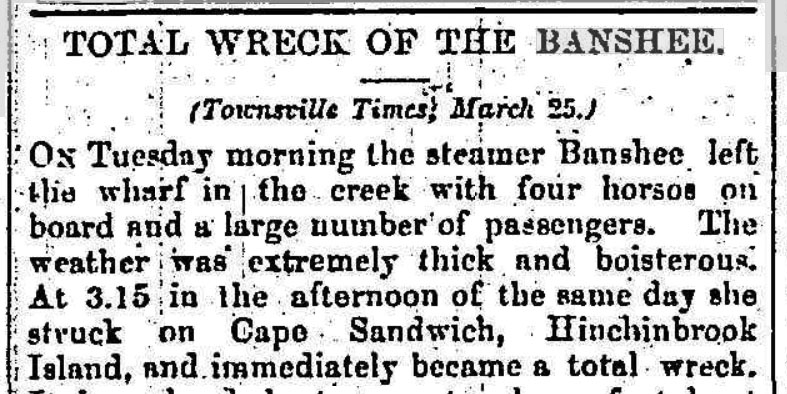
The Banshee steamed out of Townsville at 6 o’clock on the morning of Tuesday, 21 March 1876, bound for Cooktown, some 240 nautical miles (450 km) up the Queensland coast. Captain Daniel Owen had command of the 58-ton steamer and its crew of 10 men. On this trip, the Banshee was carrying 30 paying passengers, and 12 stowaways. Almost everyone was on their way to the Palmer River, where gold had recently been discovered. But disaster would strike long before they reached their destination.
A moderate breeze blew from the southeast, accompanied by some drizzling rain, as they left Townsville. But nothing about the dismal weather hinted at the violent storm that would engulf them seven hours later. At 1.30 p.m., when a few kilometres off the southern end of Hinchinbrook Island, they were lashed by hurricane-force winds, high seas, and torrential rain. Visibility was reduced almost to zero.
Captain Owen did not see land again for over an hour as he steered a north-north-westerly course along Hinchinbrook’s east coast. In his 35 years at sea, he had never experienced such ferocious weather. So, he decided to exercise caution and seek shelter at Sandwich Bay. Once some normality had returned to the world, he would continue on to Cooktown. Captain Owen ordered the engines slowed to half speed and he placed a lookout forward to warn of any dangers.
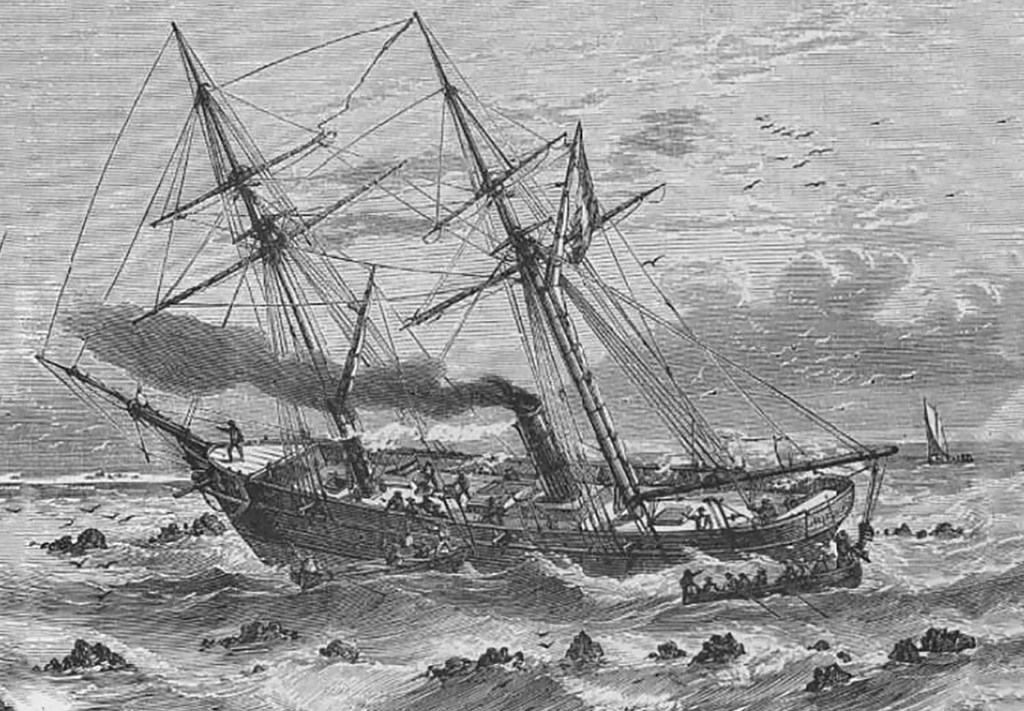
Then, a little after 3 o’clock, the lookout sighted land dead ahead. The rocky cliffs of Cape Sandwich loomed out of the pelting rain before them. Captain Owen ordered the helmsman to steer “hard a port” and for the engines to increase to full speed. The bow started to come around, but it was too little, too late. The Banshee struck aft and was slammed broadside onto the rocks. Had they cleared that promontory, they would have made it safely into the sheltered waters beyond. But that was not to be.
Map showing Banshee wreck site. Courtesy Google Maps.
The ship almost immediately started breaking up. The saloon house gave way under Captain Owen’s feet. “I jumped from the saloon to the top of the steam chest, and from there to the top of the house aft,” Owen later recalled, “and stuck to the mizzen rigging.”
Around the same time one of the passengers, Charles Price, grabbed hold of the boom as the ship ran aground, but when the funnel came crashing down, it knocked him onto the deck. From there, he climbed up on the side rail and leapt onto the rocks. Not all the passengers were so lucky. Many jumped into the sea in panic and drowned before they could scramble to safety. Price went to the aid of one female passenger clinging to the rocks as the waves crashed about her. He reached down but only got a handful of hair before she was swept away.
The ship’s stewardess had a lucky escape. She was seen clinging to a piece of wreckage in that dangerous space between the ship and the rocks. Before anyone could get to her, she was dragged under the vessel before coming back up again. This time, she caught hold of a rope and was pulled to safety. Price tried to save another passenger who he saw struggling to get clear of the waves. But before he could reach the man, he was washed from the rocks and crushed by the ship.
Another pair to have a lucky escape were the Banshee’s cook and a stowaway. They had remained with the ship until it was washed high on the rocks and then stepped off through a rent in the hull.
Total Wreck of the Banshee. Mackay Mercury, 1 Apr 1876, p. 3.
Captain Owen lost his perch in the mizzen rigging and found himself fighting for his life in the water. Twice he reached the rocks and twice he was washed back out into the cauldron. But on the third attempt, he got a firm hold and was able to clamber to safety above the pull of the waves.
A passenger named Elliot Mullens was reading in the saloon when he heard someone call, “We are going aground.” He rushed onto the main deck just as the Banshee struck. Mullens climbed onto the bridge and, from there, launched himself across to a rock but was immediately washed off by a giant wave. Fortunately, he latched onto another rock, and despite being pummelled by successive waves, he scrambled out of the danger zone somewhat unscathed.
“I turned, and just then the saloon … was smashed to atoms, burying beneath it four women and four children, whom we never saw again,” he later recalled. “Five minutes from the time of striking, all was over – all were saved or hopelessly gone from our sight forever.”
In all, 17 people lost their lives, including all the children and women on board, except the stewardess. The survivors, most nursing deep cuts, bruises or broken bones, spent a cold, wet and miserable night on land. The next morning, two bodies were found washed ashore. Captain Owen held a brief service over them as they were buried where they lay.
By now, the storm had blown itself out, leaving a dead calm in its place. Six men volunteered to cross Hinchinbrook’s thickly forested and mountainous interior so they could signal the small settlement of Cardwell for help. Meanwhile, Captain Owen and everyone else remained where they were, but they did not have long to wait to be rescued.
Hinchinbrook Passage circa 1880s. Source: Picturesque atlas of Australasia 1886.
Around 6 p.m., someone cried out, “Sail Ho.” And, sure enough, there was a sailing vessel out to sea heading south. A large red flannel blanket was hastily hoisted on a makeshift mast, and everyone waited, praying that they would be seen.
Five minutes later, the schooner The Spunkie turned towards land to investigate. But it was only by chance that the survivors had been spotted. The Spunkie’s mate had recently purchased a new telescope and was want to look through it at any opportunity. Luckily, when he brought it to his eye this day, he spotted the red flag and the bedraggled survivors lining the shore. By 10 o’clock that night, everyone had been transferred to the schooner, and they continued on their way to Townsville. The six men who crossed the island were picked up by the steamer Leichhardt as it was passing through the Hinchinbrook Passage.
A Marine Board Inquiry concluded the Banshee was lost due to the stress of the weather. Although they believed that Captain Owen had erred in not heading further offshore than he did, they found that “he acted as he believed for the best under very trying circumstances.”
The French steamer Duroc wrecked on Mellish Reef. Source: Wikicommons.
On the night of 12-13 August 1856, the French Naval steam corvette Duroc was wrecked on Mellish Reef about 800 km off the Queensland coast. After the ship ran aground, her passengers and crew, numbering 70 people, made it onto a small sand cay where they were safe for the time being. However, they were stranded far from regular shipping channels, and the chance of their being rescued was remote. Captain Vissiere thought their only chance of getting off the islet was to build a new boat from the wreckage of the old.
The Duroc had set off from Port de France (Noumea), New Caledonia, five days earlier, but on that night she ran aground on a submerged coral reef and could not get off. Each passing swell pounded the hull onto the reef, and she began taking on water. Fearing the ship might break apart during the night, Captain Vissiere ordered the crew to start bringing all stores, provisions, and water casks up on deck. He also had the four lifeboats prepared in case they had to abandon ship during the night. Then Vissiere had an anxious wait until morning, when he could better assess their situation.
Daylight revealed the ship was well and truly lodged on the reef, and they were surrounded by breaking seas. But about four kilometres away, there was a small, low-lying sandy islet which seemed to offer a place of refuge. So began the laborious task of ferrying all the ship’s stores and personnel to dry land. Over the next 10 days, they stripped the Duroc of its masts, bowsprit, sails, spars, blacksmith’s forge, a water distillation plant and the cook’s oven. By 23 August, they had emptied the stranded vessel of anything useful and established a comfortable camp on the tiny cay. Captain Vissiere was satisfied that their immediate survival was assured, but they were stranded nearly 800 km from the nearest land, and rescue seemed unlikely.
Survivors of the wrecked Duroc on Mellish Reef building the La Deliverance. Source: Wikicommons.
Vissiere prided himself on being a competent master mariner, and he could not account for how his ship had run aground. He took several unhurried astrological observations on the island and would later claim that the reef he had struck was, in fact, some distance from where it was laid down on his chart. Feeling vindicated, the captain then turned his mind to finding a way back to civilisation, for not only was he responsible for his crew, but his wife and baby daughter accompanied him.
Captain Vissiere felt that his best course of action would be to make for Australia’s east coast, where he could expect to find help from a passing ship. However, the lifeboats could carry only a fraction of those stranded on the small island. So, Captain Vissiere opted to send his First Mate, Lieutenant Vaisseau, off with the three largest boats and about half the crew. He would remain on the island with his wife, daughter, and about 30 others. They would construct a new vessel from the timber they had salvaged from the Duroc and make their escape if no one had come for them in the interim.
The three boats set off on 25 August with instructions to make for Cape Tribulation, where, with any luck, they would meet a British ship sailing the Great Barrier Reef’s inner passage. Cape Tribulation was probably chosen because it was easily recognisable and it was where the reef pinched in close to the coast, funnelling any passing ships close to land.
Mellish Reef. Courtesy Google Maps
After setting off from Mellish Reef, the three boats encountered rough weather, which threatened to capsize the heavily overloaded craft. Lt Vaisseau tried tethering the three boats together so they would not become separated, but in the rough seas, this proved dangerous, and the lines were cut. After weathering the conditions for two days, Vaisseau decided they should jettison everything non-essential to lighten the load and raise their freeboard.
Then, one day, while Lt Vaisseau was taking his noon observation, his boat was struck by a rogue wave, tossing him into the sea. Unable to swim against the current to make it back on board his lifeboat, he would have drowned had another boat trailing astern not been able to come close enough to rescue him. Vaisseau had a lucky escape, for he was only plucked from the water as his strength was beginning to fail him.
After five days at sea, on the evening of 30 August, they crossed through the Great Barrier Reef near Cape Tribulation and anchored in calm waters for the night. The men thought the worst of the ordeal was behind them, and they would soon fall in with a passing ship. Lt Vaisseau noted they still had 72 kgs of sea biscuits, 20 litres of brandy and 60 litres of wine when they reached the Australian coast. However, shared among 36 hungry men, that would last them only another few days.
The next day, they made land, filled their water casks, and then bore north, hugging the shore, pushed along by the prevailing southerly winds. They stopped each night in the lee of islands, foraged for roots, greens and shellfish, and cast out lines hoping to catch fish. They only delved into the supply of sea biscuits when their efforts failed to find enough food.
By 9 September, they had reached Albany Island in the Torres Strait. They continued sailing past Booby Island, unaware that there was an emergency store of food and water there to aid shipwrecked sailors. Having sighted not a single ship while off the Australian coast, they ventured out into the Arafura Sea. Lt Vaisseau decided they should head for the Dutch settlement of Kupang on Timor Island. The three boats finally arrived on the evening of 22 September, and not a moment too soon, for their food had run out several days earlier.
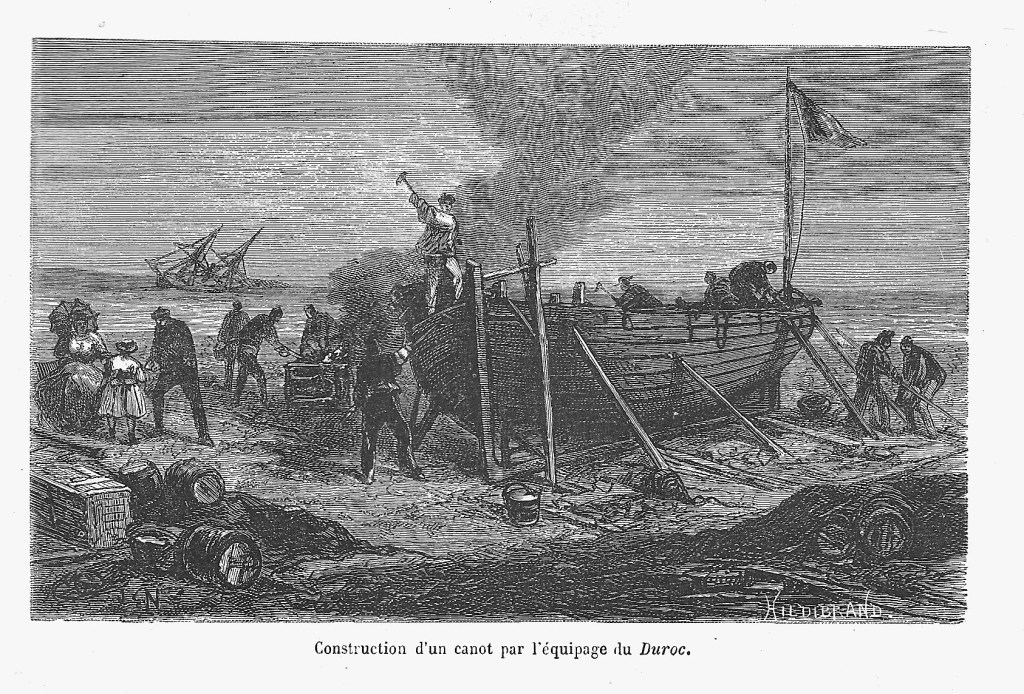
Construction of a new vessel La Deliverance from the wreckage of the Duroc on Mellish Reef. Source: Wikicommons.
Meanwhile, Captain Vissiere and the remaining men had been kept busy constructing the new vessel, which they named La Deliverance. Under the directions from the ship’s master carpenter, they sawed the Duroc’s lower masts into planks and fixed them to a frame. The new craft measured 14 metres in length and was completed around the time Lt Vaisseau and his party reached Timor Island.
On 2 October, La Deliverance was launched, and they sailed away from the island they had called home for the past six weeks. Captain Vissiere intended to make for the Australian mainland, just as his lieutenant and the three boats had done. Once off land, he would decide whether they should head north, through Torres Strait and on to Kupang, or turn south towards Port Curtis (Gladstone), which was the most northerly settlement on the east coast at the time. When he reached the Australian coast, he found the same southerly trade winds that Lt Vaisseau had.
Despite the seemingly optimistic start, the passage was arduous, hampered as it was by unpredictable weather. Prolonged calms left them stranded for days at a time. The doldrums were only relieved by violent storms that lashed them mercilessly and threatened the safety of the vessel. By the time they were rounding Cape York, the boat was leaking alarmingly. Captain Vissiere pulled in at Albany Island so urgent repairs could be made before they left the relative safety of the Australian mainland. Once the leaks were plugged, they got underway, ready to cross the Arafura Sea. On 30 October, four weeks after setting off from Mellish Reef, La Deliverance sailed into Kupang harbour.
Though they suffered greatly during the ordeal, Captain Vissiere did not lose a single person as a result of the wreck or the 4000 km voyages undertaken by the survivors to reach Kupang.








 Tales from the Quarterdeck