Tag: Solomon Islands

  • The Mystery of the Peri

    HMS Basilisk overhauls the Peri off the Queensland coast. Courtesy: National Maritime Museum, Greenwich London.

       In February 1872, the crew of HMS Basilisk found 14 men barely clinging to life on a derelict schooner adrift off the far north Queensland coast. The vessel’s name was not immediately apparent, and none of the survivors spoke English. It was a mystery as to how the ship came to be in those remote northern waters, and one that would take some time to solve.

       The side paddle steamer HMS Basilisk was steaming up the Queensland coast on a three-month cruise around Torres Strait. They were to deliver stores to the government settlement at Somerset, chart several recently reported navigation hazards and generally show the flag in that remote part of the continent.

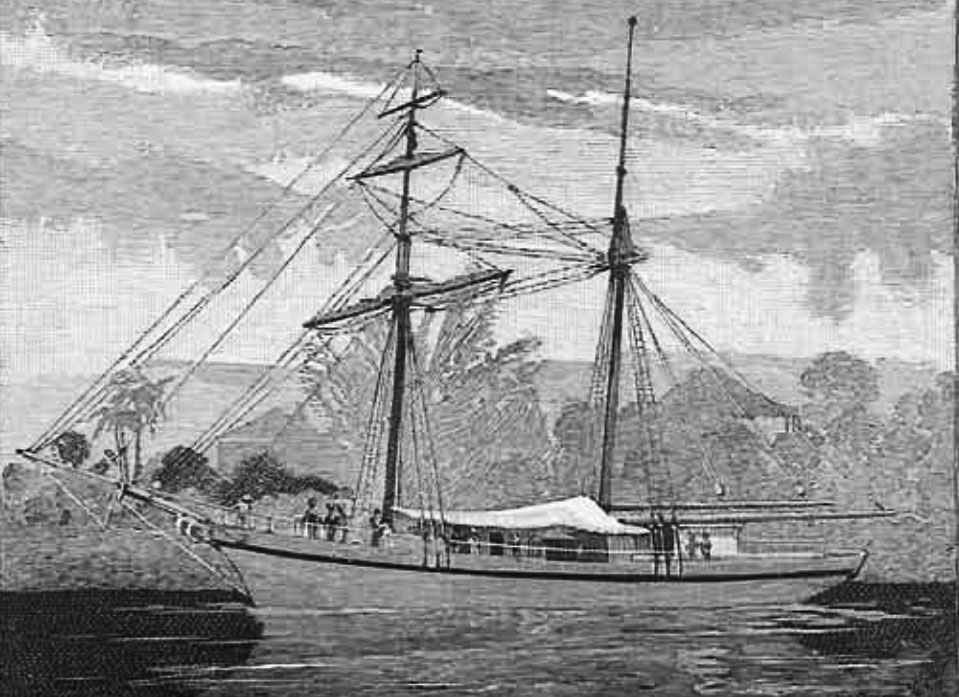
       When the Basilisk was in the vicinity of Hinchinbrook Island, a lookout sighted a small fore-and-aft schooner off in the distance. It was rare to come upon another ship in those waters, so Captain John Moresby called for his telescope and examined the ship more closely. It was immediately clear to the master mariner that not all was as it should be with the strange vessel.

       Moresby noticed that the schooner sat heavily in the water as she sluggishly rode the long, smooth swells. His first thought was that her crew must have abandoned her for some reason. As the Basilisk drew closer, Moresby could see that her weather-beaten sails were poorly set and flapping loosely in the light breeze. The rigging was slack, and there was no sign of anyone on deck.

    Illustration of the Basilisk’s discovery of the Peri. Source: Illustrated Australian News for Home Readers, 29 Feb 1872, p. 53

       When the Basilisk raised her ensign, signalling to the strange vessel to identify itself, they got no response. But as they drew nearer still, a couple of Pacific Islanders armed with muskets staggered to their feet near the schooner’s stern. Moresby then spotted several more men lying scattered on the deck. He sent two boats across to investigate.

       What the sailors found is best summed up in Captain Moresby’s own words: “… they were living skeletons, creatures dazed with fear and mortal weakness. As our crews boarded, other half-dead wretches tottered to their feet, fumbling too at rusty, lockless muskets. … They were dreadful to look at – being in the last stage of famine, wasted to the bone; some were barely alive, and the sleeping figures were dead bodies fast losing the shape of humanity, on a deck foul with blood.”

       The boarding party found several dead and decomposing bodies on the deck. There was five feet of putrid water sloshing about in the hold. The cabin had been ransacked, and the deck bore the marks of numerous axe strokes. Parts of the deck were also stained brown by large pools of what appeared to be dried blood. And, there was no fresh water or food anywhere to be found. All the evidence, Captain Moresby later recalled, pointed to a violent and tragic incident having taken place on board the schooner.    Moresby held a funeral service for the dead and buried them at sea. He then steamed towards Cardwell, 40 km away with the schooner in tow. He landed the 14 survivors, none of whom spoke any English, but for the word “Solomon.” Moresby assumed they meant they were from the Solomon Islands. He then continued North towards Torres Strait, leaving Midshipman Sabben in charge of several sailors and the schooner. He would collect them in a couple of months on his return to Sydney.

    HMS Basilisk commander – Captain John Moresby. Photo sourced from his autobiography Two Admirals.

        The pieces of the puzzle would slowly come together over the next weeks and months. After Sabben’s men had scrubbed the headboards clean, they discovered the schooner was called the Peri. The Peri had recently been reported missing in Fijian waters. On 27 December 1871, she had sailed from Viti Levu with approximately 90 “indentured” Pacific Islanders bound for a cotton plantation on Taveuni, 100 km away, but she never arrived.

       About 30 of those 90 men had been kidnapped in the Solomon Islands and taken to Levuka in Fiji. At the time, the South Pacific was in the midst of a cotton boom, and the white plantation owners struggled to find enough field workers or kanakas to tend their crops. Many Islanders fell victim to more unscrupulous “recruiters” who stopped at nothing to fill their quotas.

       At Levuka, kanakas were disembarked and sold to plantation owners to serve three-year contracts. At the completion of their time, it was the plantation owners’ responsibility to pay off their workers and return them to their home islands. The kanakas themselves were supposed to have willingly agreed to the arrangements and be appropriately compensated for their labour; however, that was not always the case.

       In this instance, the kidnapped Solomon Islanders were sent to an Australian plantation owner on Taveuni Island. But while in transit, they seized control of the cutter and escaped. The vessel was later found aground on a small island in the Yasawa group, and most of the men were recaptured a couple of weeks later.

       The other 60 or so Islanders who had been on the Peri had likely also been recently kidnapped. They had fallen into the clutches of a notorious blackbirder named Captain McLever. By December 1871, both groups of kidnapped men had been transferred to the Peri and were about to be sent to work on a plantation on Taveuni Island.   

    It is not entirely clear what happened next, but it seems the 90 kanakas rebelled, killed the captain and crew and seized the ship. Over the next six weeks, they sailed or drifted nearly 3500 km west until they were found by the Basilisk off the Australian coast. From the water in the hold and the general state of the ship, Moresby believed they had weathered at least one severe tropical storm during their passage. And judging by their emaciated state, food and water had run out long before they were rescued. The blood stains and axe marks led some to speculate that the survivors may have resorted to cannibalism, but that was never conclusively proved, and none of the bodies found showed signs of having been butchered.
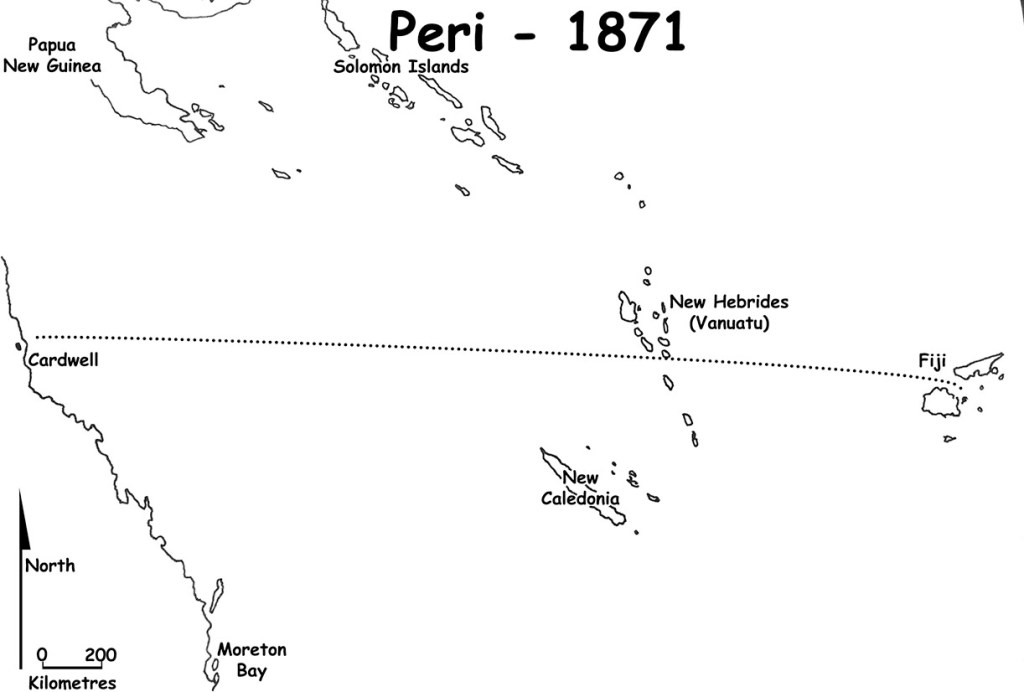
    Approx track of the Peri.

    By the time the Basilisks crew boarded the schooner, there were just 14 men still alive. One more would succumb soon after being put ashore at Cardwell.

       The remaining 13 Solomon Islanders were taken to Sydney by the Basilisk on her return from Torres Strait and eventually sent back to Fiji on HMS Cossack so they might be repatriated. However, eight jumped ship when the Cossack stopped briefly at Matuku Island, perhaps fearing they were being returned to Fiji to be punished. When the last five Peri survivors were finally questioned through an interpreter in Levuka, they told the British Consul that they had been kidnapped. They described how, when they paddled out to Captain McLever’s ship, their canoes were sunk and they had been beaten and locked in the hold.   

    McLever was arrested, and the Solomon Islanders were taken back to Sydney so they could testify at his trial. However, no one had thought to send a translator, and the case was dismissed for lack of evidence. The Islanders were sent back to Fiji, but what happened to them after that is unknown.

    1.Moresby. John RN, Discoveries and Surveys in New Guinea and D’Entrecasteaux Islands, John Murray, London, 1876, p.4.

    © Copyright C.J. Ison / Tales from the Quarterdeck, 2022.

    To be notified of future blogs, please enter your email address below.
  • Loss of La Astrolabe and La Boussole: a 40 Year Mystery

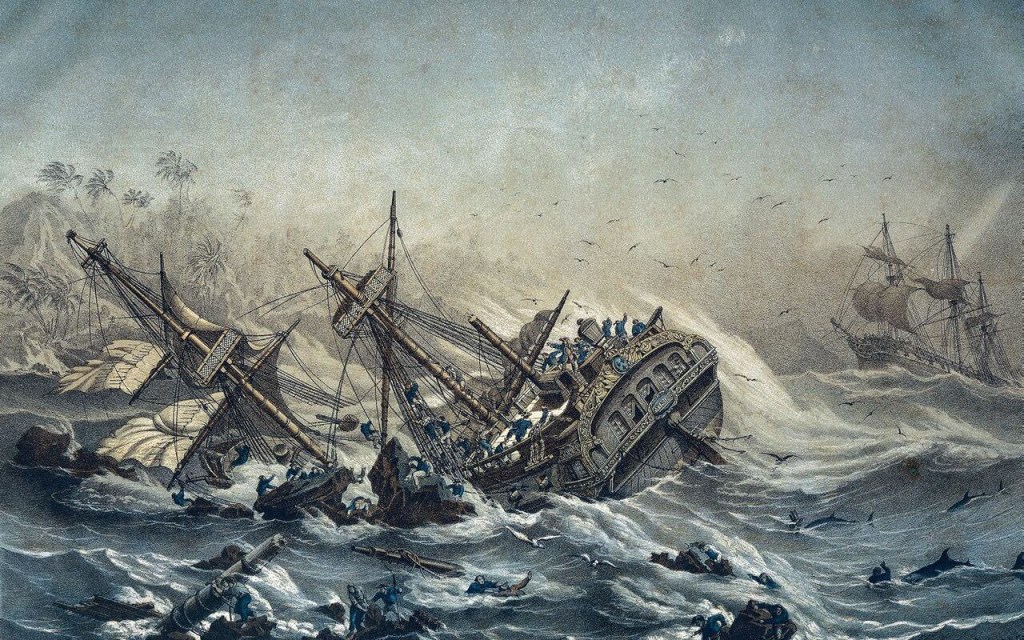
    19th Century lithograph of the sinking of La Astrolabe at Vanikoro by Louis Le Breton. Courtesy Public domain, Wikimedia commons.

    One of the great maritime mysteries of the late 18th and early 19th centuries was the disappearance of the French ships La Astrolabe and La Boussole under the command of La Perouse. They were last sighted leaving Botany Bay in 1788 but it would be another 40 years before the world discovered what became of them.   

    In 1785, Louis XVI appointed Jean-François Comte de La Perouse to lead an expedition of discovery to the far reaches of the world. The objectives were primarily scientific, but La Perouse was also to look out for economic opportunities that might benefit France. He was given two ships, La Astrolabe and La Boussole, with a total complement of some 220 men. The expedition included a botanist, geologist, physicist, astronomer, and several naturalists and illustrators – ten men of science in all. Even the ships’ two chaplains had received scientific training. Rarely had such a body of learned men been assembled for such a voyage.


    Louis XVI giving La Pérouse his instructions on 29 June 1785, by Nicolas-André Monsiau – Chateau de Versailles, Public Domain, https://commons.wikimedia.org

    The La Astrolabe and La Boussole sailed from Brest on 1 August 1785 and bore south into the Atlantic Ocean to round Cape Horn. They stopped briefly in Chile and then proceeded to the Sandwich Islands (now known as Hawaii). From there, they continued north as far as Alaska and then traced the North American coast south to a point that is now Monterey in California. La Perouse then took his two ships across the Pacific Ocean to the Portuguese colony of Macau and then headed north again. They arrived at the Russian outpost of Petropavlovsk on the Kamchatka Peninsula in September 1787 to find fresh orders awaiting them. The French Court was aware that the British had assembled a fleet of ships to sail for New South Wales. La Perouse was instructed to make directly for Botany Bay to investigate the new settlement being established there.   

    La Perouse arrived at Botany Bay on 24 January 1788, only days after the First Fleet under Governor Phillip had arrived from England. The French mariners spent six weeks there, resting and replenishing their food and water supplies. Before sailing, La Perouse left a package of letters, journals and charts with the captain of a returning British convict transport to be forwarded to Paris. In his correspondence, La Perouse wrote that he intended to sail to New Caledonia and the Santa Cruz Islands before turning back for home. They had been gone for two and a half years when they sailed from Botany Bay. He also anticipated that they would be back in France by June the following year. On 10 March 1788, the two French ships set sail and were never seen again, at least not by any Europeans.

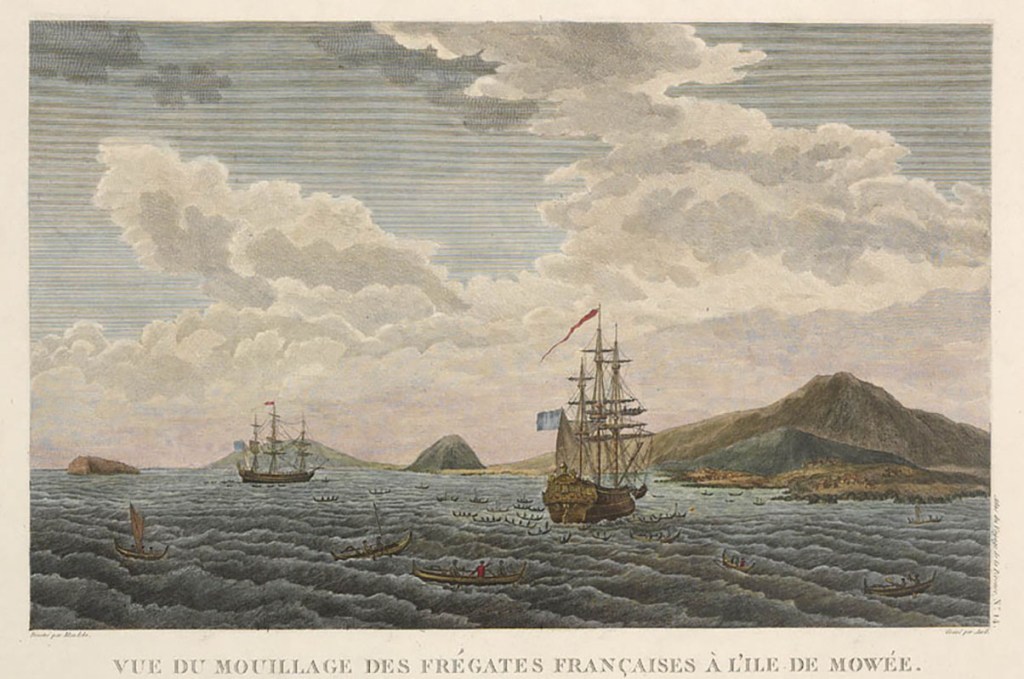
    French frigates La Astrolabe and La Boussole in Hawaii. Image courtesy State Library of NSW.

    Then, in 1826, an Irish mariner, Peter Dillon, made a startling discovery. While at Vanikoro, he came into possession of some artifacts clearly of French origin. He learned that relics from the French ships had been circulating among the inhabitants of Santa Cruz and neighbouring islands for years. On inquiring about the origin of the pieces, he was told that they had come from two large ships that had been wrecked there many years earlier.

       Dillon was sure the artifacts, one of which was a sword guard of French design, had come from La Perouse’s expedition. Upon returning to India, he reported his discoveries to the East India Company, which provided him with a ship to explore the waters around Vanikoro more closely.   

    In 1827, Dillon found the wreck site and retrieved several artefacts, including a bell which had clearly belonged to a French ship. He also learned from the older villagers on Vanikoro that the two French ships had run aground on a coral reef during a violent storm with great loss of life. The survivors had built a new vessel from timbers salvaged from the wrecks and sailed away. They had probably tried making for Kupang in the Dutch East Indies (Indonesia). That would have been the closest port where they might find help and passage back home. It would, however, require them to cross the Great Barrier Reef and pass through Torres Strait. Most of the French seamen left in the new ship, but a few men opted to remain on Vanikoro, where they lived out their days. By the time Dillon visited the island, they had all since passed away.

    Map showing Vanikoro and Murray Island. Courtesy Google Maps.

    There is a final clue as to what may have happened to La Perouse’s men who sailed away from Vanikoro. An Indian seaman had been found living among the inhabitants of Murray Island (Mer) in 1818. His name was Shaik Jumaul, a seaman on the Morning Star, which had been wrecked in Torres Strait four years earlier, while on a voyage from Sydney to Batavia.

       He said that he had come across many items of European manufacture, including muskets, cutlasses, a compass, and even a gold watch, while visiting nearby islands. When he asked where they had come from, he was told that about 30 years earlier, a large ship had been wrecked near Murray Island. Several boatloads of men came ashore, but a fight ensued, and most were killed. Some fled to other islands where they met the same fate. The only survivor was a young boy. He lived among the Islanders for many years and rose to be held in high esteem in his adopted community.

    Jean Francois Comte de La Perouse. Image: public domain, https://commons.wikimedia.org.

    More recently, ANU academic Dr Garrick Hitchcock came across the original newspaper article published in the Madras Courier in 1818. Jumaul’s story was later republished in the Sydney Gazette in July 1819. The Sydney Gazette article even speculated that the ship might have been one of La Perouse’s, but it appears that possibility was never seriously followed up.   

    Hitchcock thinks the vessel might have been the one constructed from salvage on Vanikoro. The timing certainly fits. After some detective work, Hitchcock discovered that a boy named Francois Mordelle had accompanied the expedition, and it was possible that he was the one who had lived among the Torres Strait Islanders for all those years.

    © Copyright C.J. Ison / Tales from the Quarterdeck, 2022.

    To be notified of future blogs, please enter your email address below.

  • The Douro and its Piratical Captain

    A typical trading schooner in the South Seas. Source: Picturesque atlas of Australasia, 1886.

       In the 19th Century, the ship’s captain often considered himself the undisputed master of his vessel, especially when they were at sea. Most, to varying degrees, kept a rein on their power, while others ruled with an iron fist. Then there were those tyrannical few, like Neil Peter Sorensen, who went completely rogue. And, out among the South Pacific islands where the Royal Navy only sporadically patrolled, there were few restraints on those bent on causing trouble.

       In August 1885, a portion of the crew from the schooner Douro put ashore in Cooktown with a harrowing tale of kidnapping and piracy. The culprit, they said, was their own former captain. The Douro’s first mate, Otto Ashe, and two other seamen told authorities that Captain Sorensen was out of control and terrorising communities in the Solomon Islands. They had grown so concerned with Sorensen’s behaviour that they preferred to risk being charged with deserting their ship than to be implicated in their captain’s depredations.

       As he and the others had only joined the Douro in Sydney four months earlier, they had no idea what they were signing on for. Until recently, the Douro had been registered as a British vessel named the Albert, and as such, had been subject to British laws. The ship’s owner registered her as a Portuguese-flagged ship at that country’s Sydney Consulate. They claimed they had done so to save their ship from being seized in the event of war breaking out between Britain and Russia, a genuine concern at the time. In reality, the change in registration and name had more to do with placing the ship and its captain outside the bounds of the British legal system. Sorensen was installed as the Douro’s new captain. He was formerly the Albert’s first mate and was no stranger to the South Pacific or operating outside the law. But this would be his first taste of command.

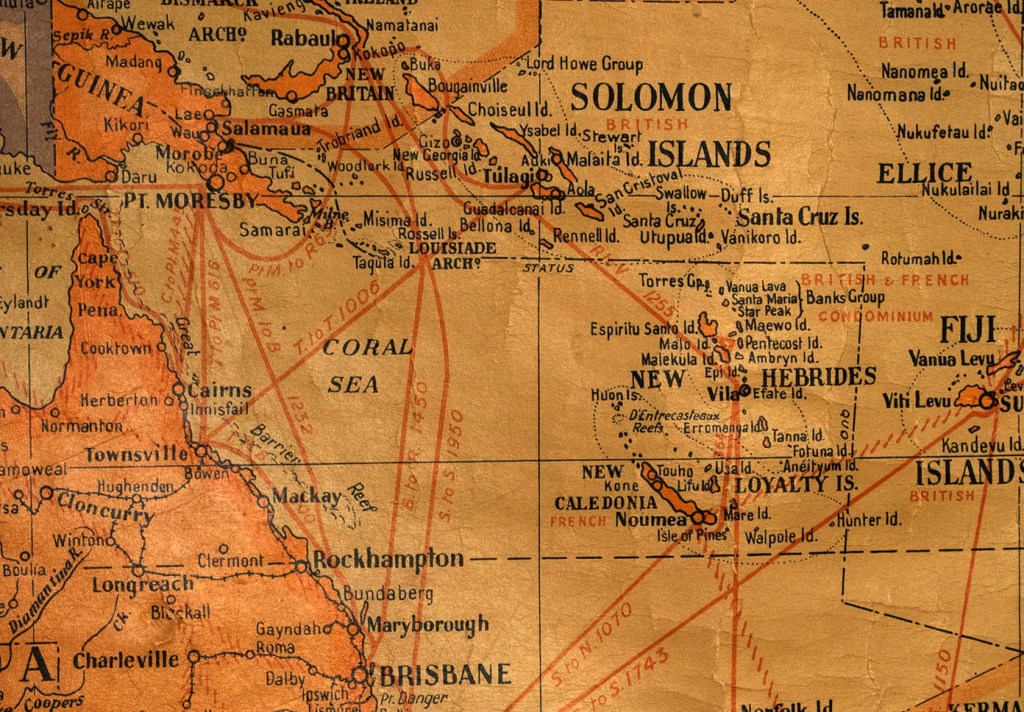
    Map showing Australia and the Solomon Islands.

       The Douro sailed from Sydney in late April, on a fishing venture around the Solomon Islands. Pearl shell and beche-de-mere both commanded high prices in Sydney, but Sorensen needed to hire local divers. Sorensen landed at a village on San Cristobal Island for recruits, but the village chiefs remembered him from a previous visit. Sorensen had promised to return the men at the end of his last fishing trip, but he never did. Now, no one trusted him.

       Sorensen was forced to go further afield to find his much-needed divers and fishermen. The Douro stopped at a couple of other islands and was able to recruit men on the promise that they would be gone from their villages for only four or five months. This was a lie, for Sorensen expected to be away for at least a year and probably longer.   

    As time passed, the situation on the Douro became intolerable for the crew. Otto Ashe claimed that Sorensen relentlessly bullied and threatened his men. While anchored off Guadalcanal, he beat the schooner’s cook senseless over some perceived infraction of his rules. None of the crew was prepared to stand up to him, for Sorensen was always heavily armed. But as bad as the treatment of his white crew was, it was nothing compared to how he treated most of the Solomon Islanders.

    Newspaper coverage at the time.

       At Isobel Island, he had two chiefs forcibly brought out to the schooner and only released them in exchange for six recruits. Off Wagina Island, the Douro came across a chief and several of his men out fishing in their canoes. He welcomed them aboard and then invited the chief to dinner in his cabin. Sorensen clapped the chief in irons and kept him hostage. He then went back on deck armed with a rifle and ordered the rest of the Islanders to leave. Sorensen only released the village chief after his people had handed over 4000 beche-de-mer, 24 sea turtles, a pig and three “boys,” whom he would exploit as unpaid labour.   

    On one of the Carteret Islands, he took his plundering to a new level.   Sorensen kidnapped four girls and brought them back to the schooner for the men’s entertainment. He then went ashore, armed to the teeth, at the head of a band of Solomon Islanders who had no qualms about following his orders. Sorensen forced the local chief to sign over possession of the island to him. Sorensen and his men then went from hut to hut, gathering up all the weapons. The haul included an assortment of traditional spears, clubs, and tomahawks, as well as an old Snider rifle and two shotguns. After everyone had been disarmed, he forced the menfolk to collect pearl shell and beche-de-mer on his behalf.

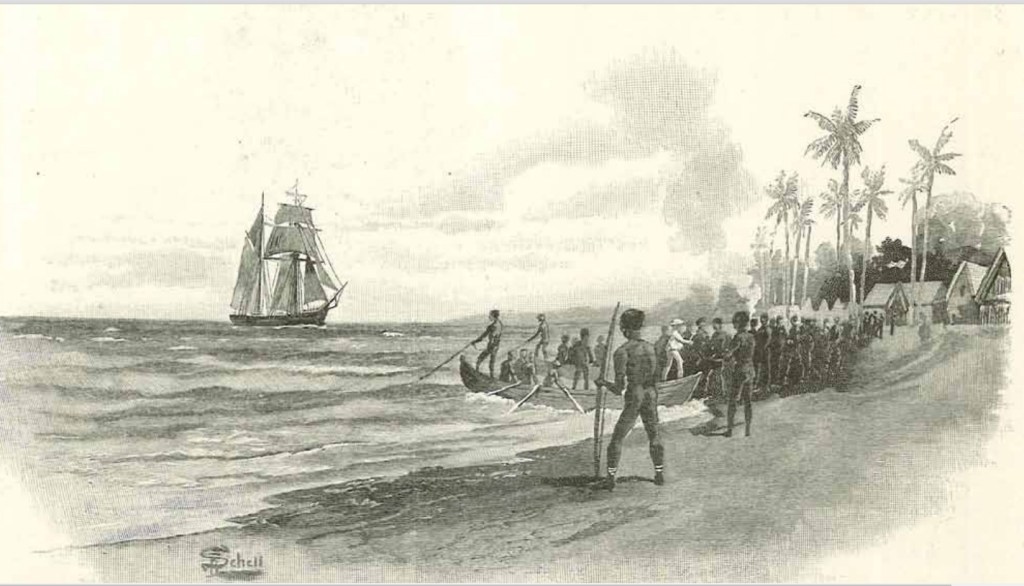
    A typical South Sea Islands trading schooner circa 1885.

    By now, the first mate had seen enough and wanted no part of it.   Fearing that Sorensen would continue his reign of terror through the islands, he took the first opportunity to escape. On 23 June, he took off in the schooner’s longboat with two other white seamen and seven Solomon Islanders. They landed in New Britain and reported Sorensen’s crimes to the German Consul there. They then set off in the boat for Australia, eventually landing at Cooktown, where they told the Queensland authorities the same story.

       When the Douro finally sailed into Brisbane in March the following year, the police were waiting. The schooner was seized, and Sorensen was charged with assault and robbery and placed under arrest. He was also charged with sodomy, but that was later dropped because the principal witness was “now in a lunatic asylum,” as the Brisbane Courier reported it at the time. Sorensen denied all the allegations, but a jury found him guilty, and he was sent to prison for ten years. While this episode was particularly heinous, it is a sad indictment that the conviction and hefty sentence were unusual for the times.

    © Copyright C.J. Ison / Tales from the Quarterdeck, 2022.

    1    Brisbane Courier, 25 Mar 1886, p.6.

    To be notified of future blog posts, please enter your email address below.