Tag: Silver

  • The Mystery of the Zuydorp

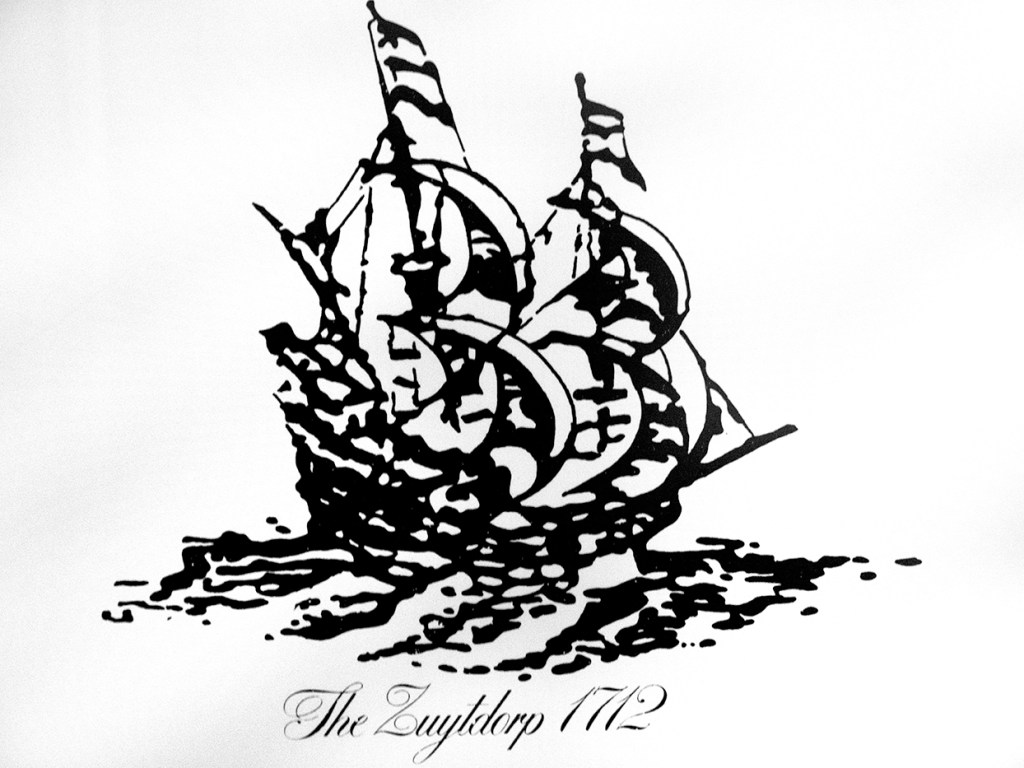
    Illustration of the Dutch ship Zuytdorp, 1712. Western Australian Shipwreck Museum.

    In August 1711 the Zuydorp sailed from the Netherlands bound for Batavia (Jakarta) in the Dutch East Indies (Indonesia).   However, after rounding the Cape of Good Hope, the ship vanished without a trace.    For more than 200 years the fate of the ship and all those on board her remained a mystery. 

    The Zuydorp was a large merchant ship around 30 to 50 metres long carrying 200 or more people and cargo including a large quantity of freshly minted silver coins.   Unlike other ships to come to grief on New Holland’s dangerous coast, no survivors made it to Batavia to tell what happened.

    It was not until 1927 when the head stockman at Tamala Station, Tom Pepper and his family discovered relics from the long-lost ship about 60kms north of Kalbarri on the Murchison River.   Some of the artefacts were silver coins minted in 1711 which helped identify the wreck.   By 1954 the site where the survivors had landed was examined in more detail, and a decade later divers finally found the wreck site and its trove of silver coins.
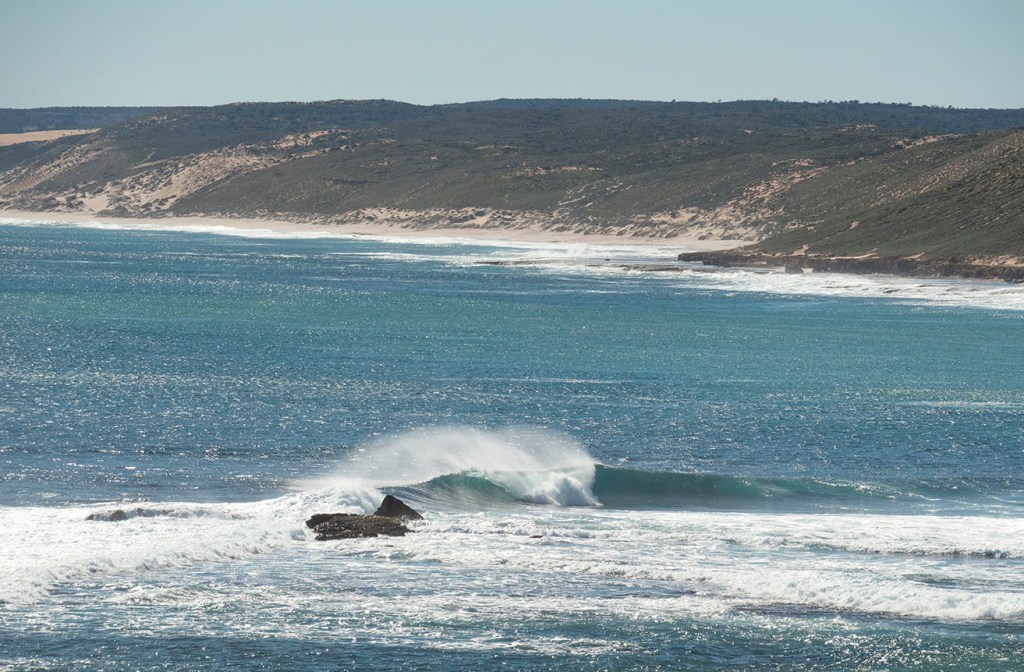
    Looking north from the mouth of the Murchison River towards the rugged coast where the Zuydorp was wrecked. Photo CJ Ison.

    At the time the Zuydorp was on her way to Batavia, ships were using the “Roaring Forties” to push them across the southern Indian Ocean before bearing north following the coast of New Holland to reach the East Indies.    It seems the captain misjudged his position and the Zuydorp struck the reef at the base of cliffs that now bear the ship’s name.

    The accident probably happened at night, the captain unaware of how close he was to land.   The archaeological evidence suggests that an unknown number of people survived the wreck and managed to get ashore.   The remains of what may have been signaling fires have been found on top of the cliffs but apart from a scattering of other artefact nothing remains to hint at what befell the survivors.    The place is devoid of fresh water for much of the year and no one could have lived long without the help of the local Nhanta people who inhabit that stretch of coast.    

    Interestingly in 1834, an Aboriginal man told settlers in Perth that there had been a ship wrecked far to the north of Perth.   From his description, it was thought to be somewhere in the vicinity of Shark Bay, a bit further north than where the Zuydorp was ultimately discovered, but they also thought the wreck he was referring to was recent.   A search party was dispatched to investigate but no wreck or survivors were found.   It is quite likely he was drawing on oral history passed down the generations which had recorded the loss of the Dutch ship.
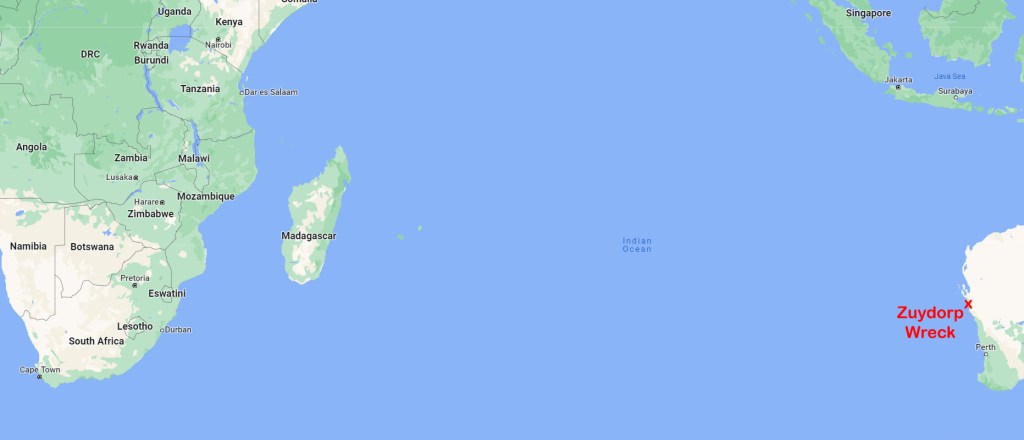
    Courtesy Google Maps.

    © Copyright C.J. Ison / Tales from the Quarterdeck, 2022.

    To be notified of future blogs, please enter your email address below.

  • The Spanish Silver of Torres Strait

    Example of a mechant brig, similar to the Sun. Source: “L’Album De Marine Du Duc D’Orleans,” 1827.

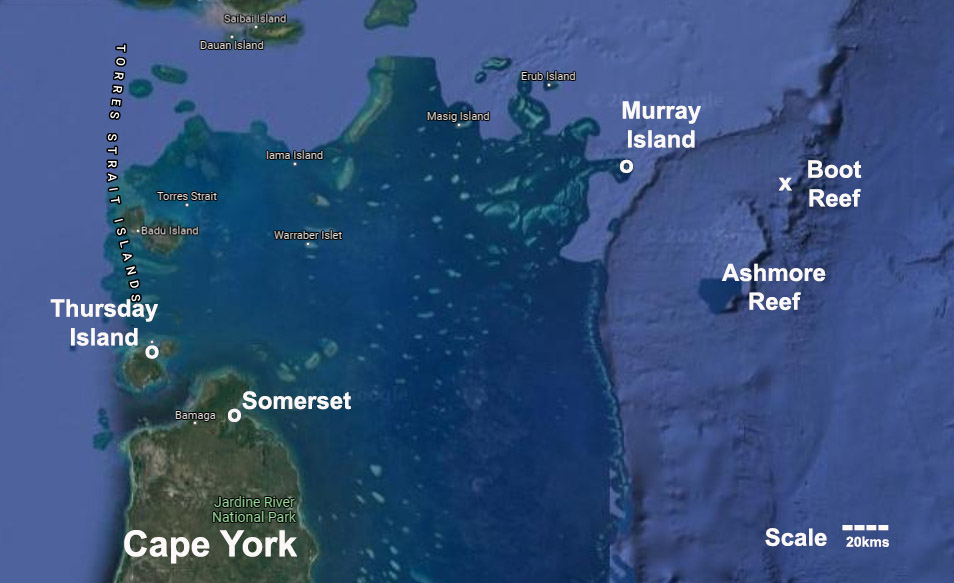
       Sometime around 1891, a group of beche-de-mer fishermen stumbled upon a huge hoard of Spanish silver coins. The men had been fishing in the shallow waters of the Eastern Fields at the eastern approach to Torres Strait when they made the surprise discovery.

       At low tide, when much of the reef was exposed, they spotted an old, coral-encrusted anchor fluke jutting from the reef’s surface. The shoals of Torres Strait had claimed many a ship during the 19th Century, and the fishermen were keen to see what else they might find.

       They began chipping away at the decades of accumulated growth until the anchor finally broke free from the surrounding coral. When it was rolled clear, a mass of silver coins, all fused together by time and saltwater, was revealed. Buoyed by the find, the fishermen forgot about the beche-de-mer and extended their excavations. Each day, as soon as the falling tide exposed the reef, they got to work chipping away at the coral. In the end, they uncovered a staggering 410 kgs (900 pounds) of silver. It took them two trips to carry it all back to Somerset, the fishing and cattle station near the tip of Cape York owned by the early pioneering family of Frank Jardine.

    Spanish silver coins as circulated in the early days of New South Wales.

       At the time, it was supposed that the coins might have been carried on a Spanish ship on her way to Manila to pay the wages of the civil and military staff. Either that, or it was to be used to purchase spices from traders in the Indonesian Archipelago, further to the west. Regardless, the ship that had been carrying the fortune in silver had ended its voyage on that remote coral outcrop many decades earlier. They knew it was an old wreck, for by 1891, the timbers had long since rotted away.

       The mystery was only solved years later. It turned out not to have been a Spanish galleon at all. Instead, the fishermen had stumbled upon the remains of the English brig, Sun, which had been lost in Torres Strait in May 1826. Earlier that same year, the Sun had delivered a cargo of tea from China to merchants in Hobart and Sydney. In Sydney, a local businessman had entrusted the ship and her captain with a new cargo of between 30,000 and 40,000 Spanish silver dollars. At the time, one Spanish dollar was worth 4 shillings and 4 pence, which would have valued the somewhere between £7,000 and £10,000. In today’s money, the silver content alone would be worth well over one million Australian dollars.

       The Sun sailed from Sydney on 7 May, bound for Singapore by way of Torres Strait. But it never arrived. The voyage was cut short three weeks later when the Sun struck a submerged reef as it attempted to navigate the dangerous waters separating Cape York from New Guinea.

    Torres Strait. Source: Google Maps.

       The ship broke up almost immediately. Captain Gillet and his crew took to the longboat and jolly boat and made for Murray Island, about 30 nm (60 km) away. Such was the haste with which they were forced to abandon the ship that there was certainly no time to save the silver. The crew didn’t even have time to provision the boats with food or water before they pushed away from the wreck. Fortunately, they would only be at sea for two days before sighting land.

       As fate would have it, just as their safety seemed assured, the longboat struck a reef and capsized, spilling all the occupants into the water. The first and second mates, plus 22 lascar sailors, drowned. Only the jolly boat with the ship’s captain and 11 remaining seamen reached Murray Island, where they were looked after by the Islanders. Three days later, Captain Gillet and his men were rescued by a passing ship and eventually delivered to Calcutta, where he reported the loss of his ship.   

    So, there the Spanish silver dollars remained undisturbed for the next 65 years as the Sun slowly disintegrated around them. As the employer of the fishermen, Frank Jardine claimed the lion’s share of the haul. He reportedly had at least some of the coins melted down and made into silver tableware and cutlery for the Jardine Homestead.

    © Copyright C.J. Ison, Tales from the Quarterdeck, 2021.

    Enter your email address below to be notified of new posts.