Tag: Shipwreck

  • The Dunbar Tragedy – 1857

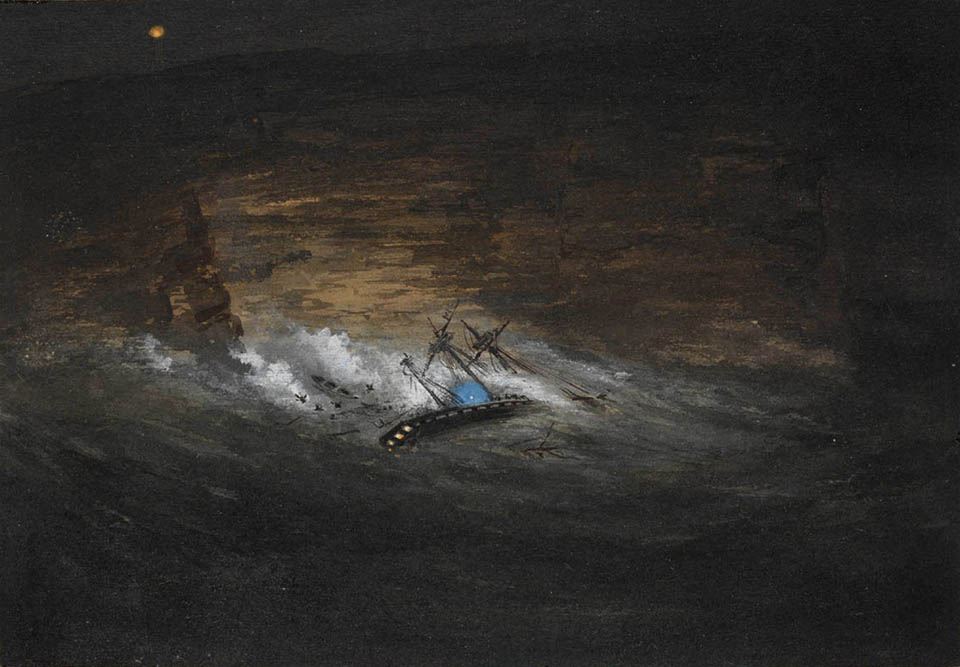
    The Dunbar shipwreck, by Samuel Thomas Gill, courtesy the State Library of New South Wales.

    The loss of the Dunbar in August 1857 was one of the more tragic and distressing shipwrecks to occur in Australian waters.   On the morning of Friday 21 August people living in Sydney’s East awoke to find wreckage and mutilated bodies dotted along the rugged coast and inside the harbour mouth.   A large ship had come to grief, but its identity would remain a mystery for much of that day.

    The weather on the night of 20 August was thick with heavy rain, strong winds and a powerful swell creating mountainous waves.    The Dunbar had sailed from London 81 days earlier and was making its way up the New South Wales coast nearing the end of its voyage.  

    She passed Botany Bay around 8.30 in the evening.  Then Captain James Green headed out to sea on a starboard tack under closely reefed sails.    They then changed course again heading towards the entrance to Sydney Harbour.   The captain sent the Second Mate to the forecastle and asked him to keep a good lookout for the North Head.  

    By Day and Son; Thomas Goldsworth Dutton; William Foster – http://collections.rmg.co.uk/collections/objects/140576, Public Domain, https://commons.wikimedia.org/w/index.php?curid=63202217

    Suddenly the Mate called out “breakers ahead,” as churning white water at the base of the cliffs materialised out of the inky gloom.   It was now a little after midnight.  Captain Green ordered the ship round but the surging seas drove her broadside onto the rocks before she could respond.  

    Passengers were jolted awake by the violent impact and streamed on deck in panic, most still dressed in their night attire.    But before any thought could be given to getting them into the lifeboats another wave smashed the Dunbar into the cliffs and she immediately started breaking up. 

    Passengers and crew alike were swept into the surging sea and dashed against the rocks.  Others were crushed between heavy timbers and splintering wood.  

    There were 122 people on the Dunbar as she neared Sydney Harbour.   She had a crew of 59 and was carrying 63 passengers.   Most of the passengers, including families with young children, were residents of Sydney returning home after spending time in England.  

    Incredibly, one of the crew managed to survive.    As the ship broke apart John Johnson grabbed hold of a plank with three other men to keep themselves afloat as they were tossed around in the turbulent white water.   Two of their number soon lost their hold but Johnson and the ship’s Boatswain were dumped high on the rocks by a large wave.    Johnson scrambled higher but before the other man could do likewise, he was caught by another wave and sucked back out to sea.    Johnson continued climbing until he reached a narrow ledge and could go no further.   

    The Sailor Rescued. Courtesy the National Library of Australia 211620415-22

    The next day he heard people on the clifftop above him and saw several ships pass by but failed to attract anyone’s attention.   He remained a second night on the ledge before a young lad spotted him from near Jacob’s Ladder.  The boy, Antonio Wollier, volunteered to be lowered down to the ledge by a rope to rescue the survivor.  

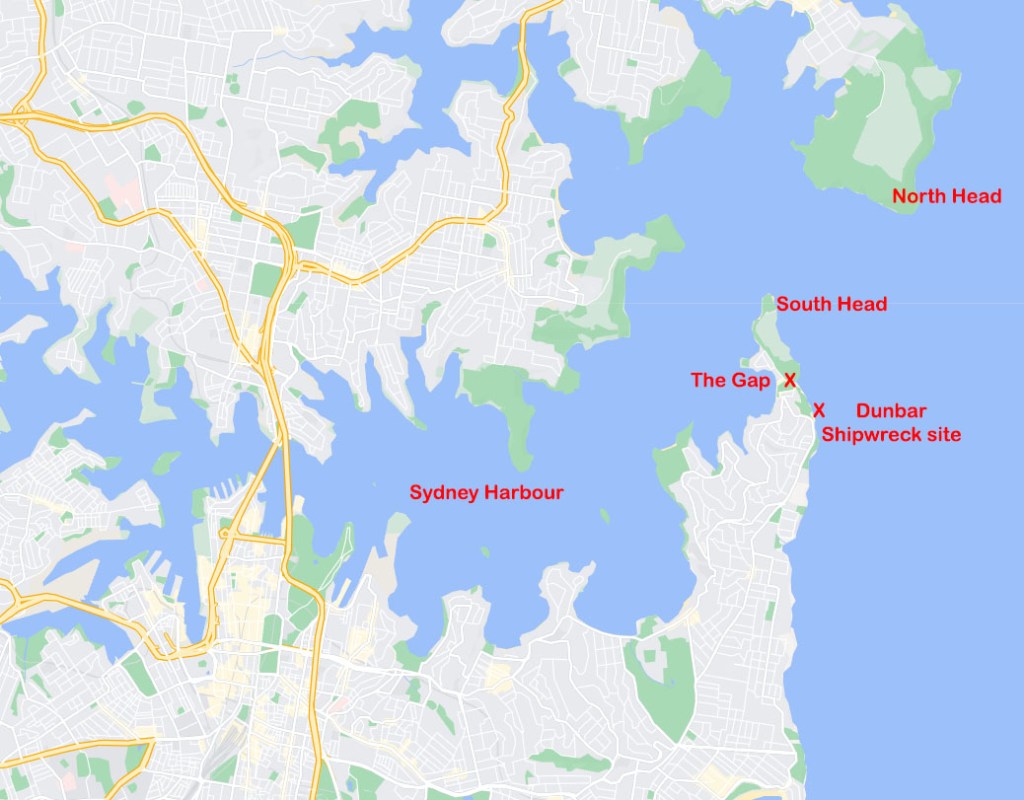
    Meanwhile, the grim work of recovering bodies began.    Some brave souls were lowered over the cliff at the Gap where as many as 20 bodies had collected among the rocks.   They had been so badly battered that none were ever identified.    Other bodies were found inside Sydney Harbour where they had been swept by the current.   Most were buried in a mass grave in the Newtown Cemetery.

    Sydney Harbour. Courtesy Google Maps.

    An inquiry concluded that Captain Green, hampered by the foul weather, had either thought he was approaching the North Head or mistook the Gap for the entrance to Sydney Harbour.   As a result of this catastrophe and another similar shipwreck nine weeks later a lighthouse marking South Head was built.       

    John Johnson was later employed as a lighthouse keeper in Newcastle and in 1866 he rescued the only survivor of the steamer Cawarra when it sank trying to enter that harbour.

    © Copyright C.J. Ison / Tales from the Quarterdeck, 2022.

    To be notified of future blogs, please enter your email address below.
  • The Mystery of the Zuydorp

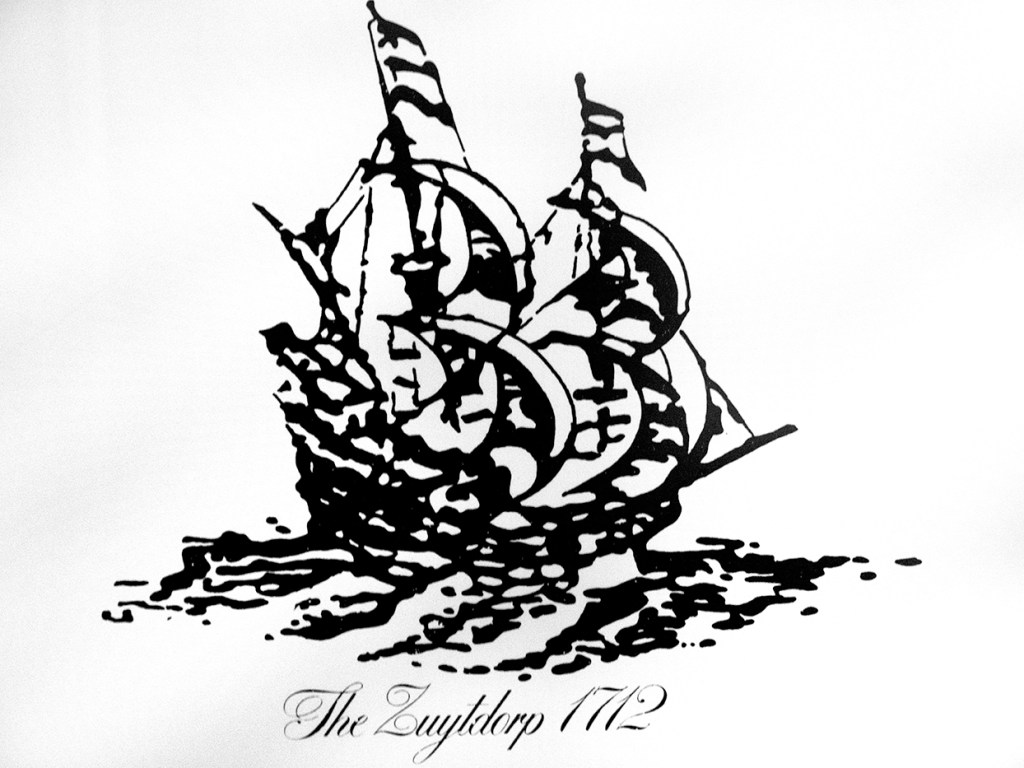
    Illustration of the Dutch ship Zuytdorp, 1712. Western Australian Shipwreck Museum.

    In August 1711 the Zuydorp sailed from the Netherlands bound for Batavia (Jakarta) in the Dutch East Indies (Indonesia).   However, after rounding the Cape of Good Hope, the ship vanished without a trace.    For more than 200 years the fate of the ship and all those on board her remained a mystery. 

    The Zuydorp was a large merchant ship around 30 to 50 metres long carrying 200 or more people and cargo including a large quantity of freshly minted silver coins.   Unlike other ships to come to grief on New Holland’s dangerous coast, no survivors made it to Batavia to tell what happened.

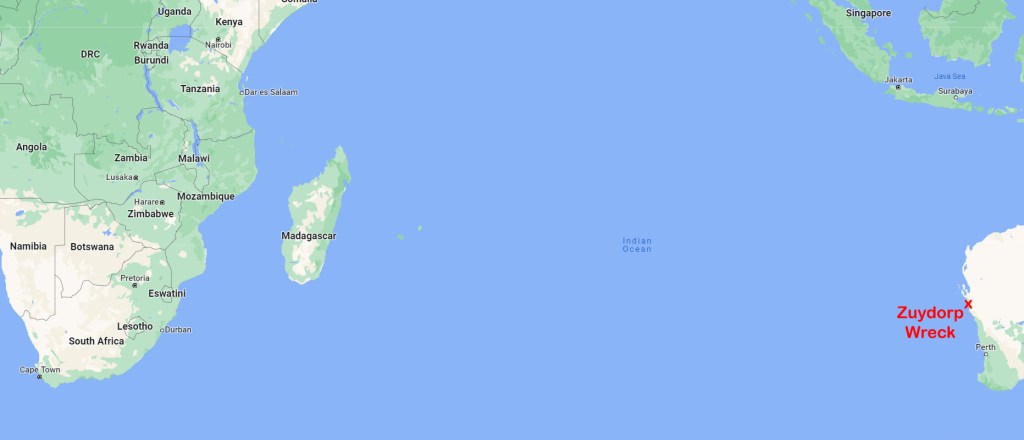
    It was not until 1927 when the head stockman at Tamala Station, Tom Pepper and his family discovered relics from the long-lost ship about 60kms north of Kalbarri on the Murchison River.   Some of the artefacts were silver coins minted in 1711 which helped identify the wreck.   By 1954 the site where the survivors had landed was examined in more detail, and a decade later divers finally found the wreck site and its trove of silver coins.

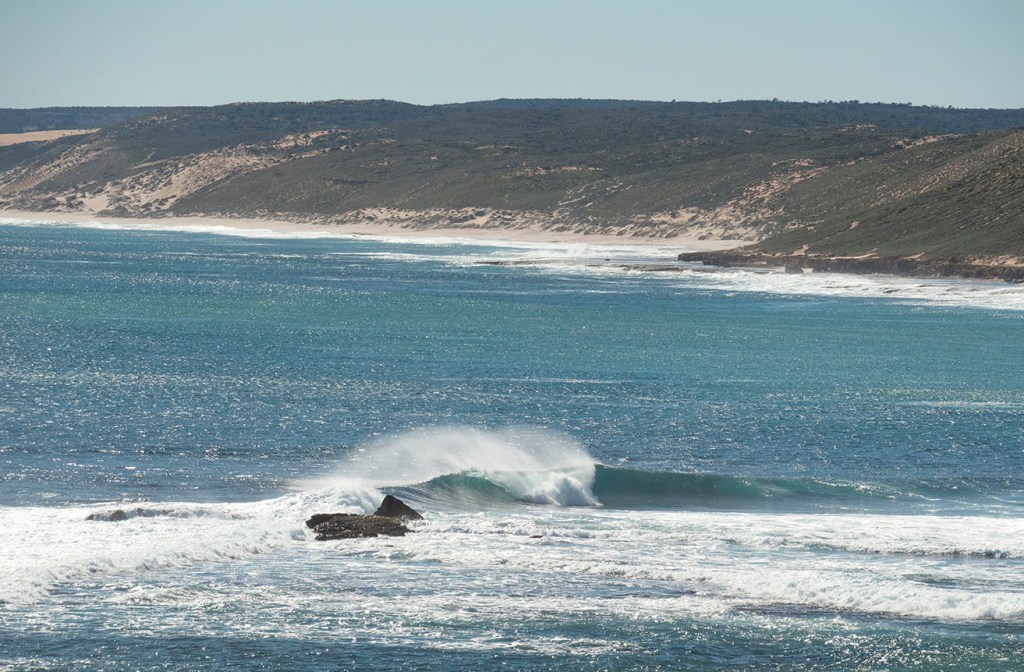
    Looking north from the mouth of the Murchison River towards the rugged coast where the Zuydorp was wrecked. Photo CJ Ison.

    At the time the Zuydorp was on her way to Batavia, ships were using the “Roaring Forties” to push them across the southern Indian Ocean before bearing north following the coast of New Holland to reach the East Indies.    It seems the captain misjudged his position and the Zuydorp struck the reef at the base of cliffs that now bear the ship’s name.

    The accident probably happened at night, the captain unaware of how close he was to land.   The archaeological evidence suggests that an unknown number of people survived the wreck and managed to get ashore.   The remains of what may have been signaling fires have been found on top of the cliffs but apart from a scattering of other artefact nothing remains to hint at what befell the survivors.    The place is devoid of fresh water for much of the year and no one could have lived long without the help of the local Nhanta people who inhabit that stretch of coast.    

    Interestingly in 1834, an Aboriginal man told settlers in Perth that there had been a ship wrecked far to the north of Perth.   From his description, it was thought to be somewhere in the vicinity of Shark Bay, a bit further north than where the Zuydorp was ultimately discovered, but they also thought the wreck he was referring to was recent.   A search party was dispatched to investigate but no wreck or survivors were found.   It is quite likely he was drawing on oral history passed down the generations which had recorded the loss of the Dutch ship.

    Courtesy Google Maps.

    © Copyright C.J. Ison / Tales from the Quarterdeck, 2022.

    To be notified of future blogs, please enter your email address below.

  • HMCS Protector 1884 – 1924

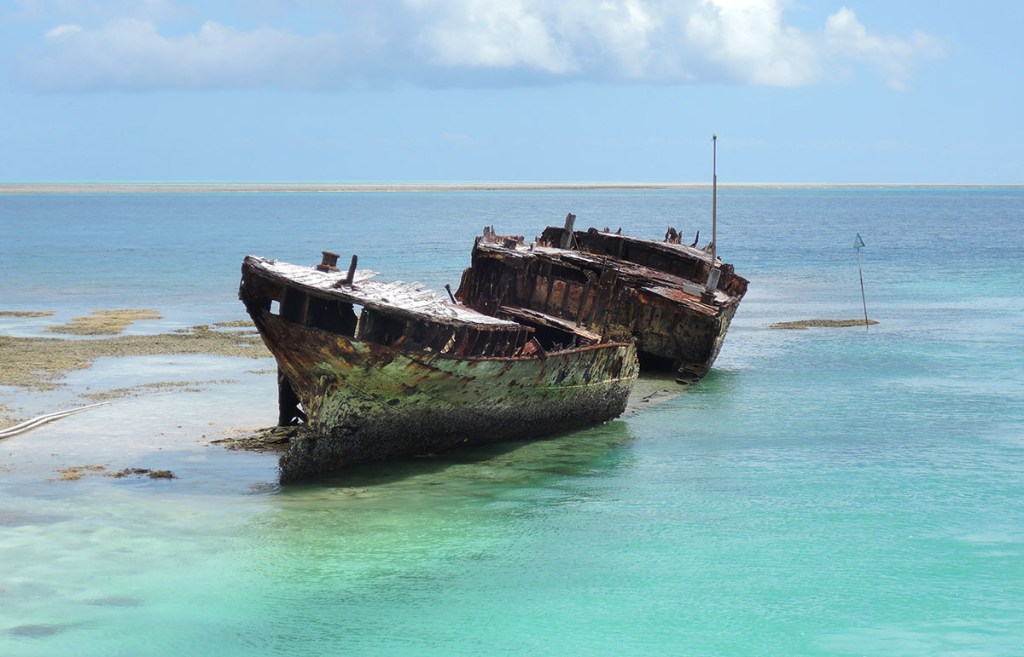
    HMCS Protector at Heron Island during low tide. Photo: C.J. Ison.

    There lie the remains of an old ship on the Southern Great Barrier Reef which holds a fascinating story spanning almost 140 years.    The rusting hull now serves as a breakwater protecting the entrance to the boating channel accessing Heron Island, but its history goes back to 1884.

    Her Majesties Colonial Ship (HMCS) Protector was launched at Newcastle on Tyne in 1884 to see service in South Australian waters.    The colonial government had sought the ship at a time when there were heightened fears of a Russian invasion.    The 55metre long F1 flat-iron gunboat displaced 920 tons and had a top speed of 14 knots (26km/h).   Originally she was crewed by about 90 men.   

    South Australian gunboat Protector circa 1885. Photo Courtesy SLV.

    Her armaments included one 8-in breech-loading gun on the bow, as well as five 6-in guns, four 3-pounder quick-firing (QF) guns and five Gatling machine guns.   From 1914 that was changed to three QF 4in MkIII guns, two QF 12-pounder guns and four QF 3-pounders.  

    HMCS Protector regularly patrolled the South Australian coast for the next fifteen years and not surprisingly made an uneventful time of it.   Then, on the eve of Federation, she was called upon to join the international force assembled to suppress the “Boxer Rebellion” in China.  

    HMCS Protector. Courtesy State Library of South Australia, B18116.

    In August 1900 she farewelled Adelaide and was commissioned as HMS Protector for the duration of her overseas service.   She arrived in Shanghai in late September but was not needed for combat operations.   She spent a few weeks carrying out surveys and running despatches between Shanghai and forces in Pechili Gulf further north.  Then, in November she was released to return home to Australia.   

    In January 1901 HMCS Protector was transferred to the Commonwealth Government and stationed in Sydney where she mainly functioned as a training ship for Naval Militia Forces.    Then, with the formation of the Royal Australian Navy in 1913, she was renamed HMAS Protector and for a period served as a tender to HMAS Cerberus stationed at Williamstown in Port Phillip Bay.

    With the outbreak of the First World War, HMAS Protector was sent to Sydney and served as a depot ship to Australia’s two submarines, AE1 and AE2.   In August 1914 she and her submarines were sent to help capture the German colonies in New Guinea.   HMAS Protector remained based at Rabaul until October when she was ordered to return to Sydney. 

    HMAS Protector after being rearmed in 1914. Photo Courtesy SLV.

    Then, in October 1915 she was dispatched to report on the wreck of the German cruiser Emden which had been destroyed by HMAS Sydney at the Cocos Islands almost a year earlier.   See my blog Australia’s first “ship on ship” naval action.

    On 1 April 1921, the Protector was briefly renamed HMAS Cerberus, before being decommissioned three years later.    Her guns and engines were removed and she was sold off.   In November 1929 she was converted to a lighter and renamed Sidney.    But her military service was not quite over yet. In July 1943 the Protector was brought back into service as a lighter for the U.S. Army in New Guinea.   However, as she was being towed north she collided with a tug off Gladstone, Queensland.  The wreck was abandoned on a beach until a local businessman bought it reputedly for £10.   He floated it off and towed it to Heron Island where it was used as a breakwater.   HMAS Protector’s rusting hull is still there today.

    HMCS Protector at Heron Island. Photo: C.J. Ison.

    © Copyright C.J. Ison / Tales from the Quarterdeck, 2022.

    To be notified of future blogs, please enter your email address below.

  • The Tryall: Australia’s earliest recorded shipwreck.

    Example of a fully rigged ship of the early 17th Century, similar to the Tryall. Source: Sailing Ships by Chatterton, 1909.

       Some people might be surprised to learn that the oldest recorded shipwreck off the Australian coast dates back to 1622. That predates Cook’s voyage up the east coast by 148 years. It occurred 20 years before Abel Tasman partially circumnavigated the island of Tasmania. Or just six years after the Dutch navigator Dirk Hartog nailed a pewter plate to a post near Shark Bay, recording his discovery of a big lump of land that had until then been unknown to anyone but its inhabitants.

       The Tryall* was a 500-ton East India Company merchant ship launched in 1621. Her maiden voyage was meant to take her from England to the East Indies to deliver cargo before returning home with her hold filled with spices. The East India Company chose a master mariner named John Brooke to command the vessel on this most important voyage.

       The Tryall departed from Plymouth on 4 September 1621 with a crew of about 140 men. Captain Brooke sailed down the west coast of Africa and pulled into Table Bay for water and fresh supplies. While there, he learned that a new route across the Indian Ocean had been established, cutting the sailing time to Batavia by several months. The traditional route to the East Indies had ships follow the coast around Africa’s southern tip, then pass through the Mozambique Channel. Once north of Madagascar, they would venture out into the Indian Ocean. The new “Brouwer Route,” as it was called, took full advantage of the roaring forties, which swirled around the bottom of the world unimpeded by any significant land mass.  Captain Brooke received orders to take the Tryall below 35 degrees South and use the Brouwer Route.    Brooke tried to hire a sailing master for this leg of the voyage, for neither he nor anyone else on the ship had sailed the southern route before. He was unable to recruit anyone, so on 19 March 1622, Captain Brooke sailed the Tryall out of Table Bay and into the unknown. Six weeks later, they were off the coast of Western Australia.

    Map of Western Australia coast. Courtesy Google Maps.

       Brooke likely sighted land in the vicinity of Point Cloates around 22.7 S 113.6 E, mistaking it for Barrow Island about 200 km further north. It would appear that he had underestimated the strength of the roaring forties and had been blown too far east before he turned his ship north, something easily done with the rudimentary navigation instruments of the day. But it was an error he would never admit to having made.

       For the next couple of weeks, the Tryall struggled to make progress against fresh northerly winds, but when the wind swung around to the south again, they got underway. Then, on the night of 25 May 1622, disaster struck.

       The Tryall slammed into submerged rocks near the Montebello Islands. Stuck fast on the reef and being smashed by powerful swells, the Tryall began to break apart. Brooke and a handful of men, including his son, managed to get a small skiff over the side and escaped the doomed ship, apparently leaving everyone else to their fate. Soon after, some of the crew were able to launch the ship’s longboat, and 35 sailors clambered aboard and got clear of the Tryall. They landed on one of the Montebello Islands, where they remained for about a week, preparing the boat for the 2,000 km-long voyage to Batavia. Ninety-three men lost their lives.    Captain Brooke reached Batavia on 5 July, where he penned a letter to the ship’s owners reporting the ship’s loss. In it, he claimed that he had followed the proscribed route precisely, but had struck a reef not laid down on his chart. Brooke probably thought that they were the only survivors, and his version of events would go unchallenged. His letter, he hoped, would absolve him of any blame for the loss of the ship, its valuable cargo, and so many lives.

    Translates to read “Here the English ship Trial was wrecked in June 1622” from copy of Hessel Gerritsz’ 1627 map of the north west coast of Australia. Source: National Library of Australia.

    When the longboat finally made it to Batavia, those survivors had a very different story to tell. One of them, a trader named Thomas Bright, wrote his own scathing letter to London condemning Captain Brooke. Bright blamed the wreck on Brooke’s poor navigation that had brought them so close to New Holland and the fact that he had not posted a lookout despite knowing he was in those dangerous waters. He also claimed that Brooke had abandoned the wreck as quickly as he could in the partially filled skiff, leaving the rest of the men to their fate.

       In his report to the ship’s owners, Brooke had also recorded that the wreck site was much further west than where it had occurred to mask his error in navigation.  For the next three centuries, the non-existent rocks caused some confusion and uncertainty among navigators sailing those waters. It was not until 1936 that the historian Ida Lee established that the wreck site was likely to be off the northwest of the Montebello Islands. Then, in 1969, amateur scuba divers found the wreck site where Lee had said it would be.

    * Tryall is also seen spelled as Tryal and Trial.

    © Copyright C.J. Ison / Tales from the Quarterdeck, 2022 (Updated 2025).

    To be notified of future blogs, please enter your email address below.
  • HMAS Sydney and the sinking of the Emden

    HMAS Sydney (I). Photo Courtesy Australian War Memorial.

    In late 1914 HMAS Sydney was accompanying the first convoy of AIF troops leaving Australia to fight in the First World War. However, a few days after the convoy left Albany WA, the Sydney was ordered to investigate the presence of a suspicious vessel near the Cocos Islands.  The ship turned out to be the German Cruiser Emden which had been terrorising Allied shipping across the Indian Ocean since the beginning of the war.

    On 9 November 1914 the Sydney found the Emden and immediately went into action.     A few days later Stoker Henry Nielsen wrote a letter to his mother living in Rockhampton, Queensland, telling her of their great victory.   The account below has been taken from his letter which appeared in the Morning Bulletin newspaper on 6 January the following year.

    Emden before she was destroyed by HMAS Sydney at Cocos Keeling Islands in Nov 1914.

    “Just a line to let you know I am still alive and kicking in spite of the Emden.   I have nothing to write about except our scrap with the Emden.   We got a wireless message from Cocos Islands about seven o’clock on the 9th instant saying that there was a German warship lying there with a collier.   We were about fifty or sixty miles away from there, and we altered course and made for Cocos at full speed.”

    “We came up with the Emden about 9.30 am and she let go a shot at us at 11,000 yards.   We let go a ranging shot immediately after, and then both ships went at it hammer and tongs. …  Our shots told far more than theirs as we were only slightly damaged and our shots carried away her bridge, foremast, and three funnels in quick succession. Early in the fight the Emden caught fire and continued to burn throughout.”

    “One of their shots wrecked our range-finder and killed the men who were working it.”

    Emden at Cocos Keeling Islands viewed from a HMAS Sydney boat dated 9 Nov 1914. Courtesy State Library of NSW, FL541160.

    “The action lasted an hour and thirty-six minutes.   The Emden got an awful doing and the captain beached her on South Keeling Island.   She continued to fire for a short time after she was aground, but we soon silenced her. …”

    “She was still flying the German flag, and when signalled would not reply so we put another broadside into her and she fired another couple of shots.   However, they did not want any more as they pulled the flag down. …  It was late in the afternoon when the Emden hauled down her flag and we went out to sea and cruised about outside until morning.  … We then went back to the Emden to see what we could do for the wounded.   We were there all the remainder of that day fetching off German wounded, and prisoners. …”

    “From mainmast to stern she is just a shell, there being only the deck and hull left, all the rest being burnt out.   Her three funnels are lying over the top of one another.   Her foremast is down and her bridge is blown away.   The starboard side of her deck is full of great holes, and she is torn up everywhere.   There are holes in the side that you could walk through. …”

    Postcard commemorating the Sydney’s victory..

    “During the action we made the best speed the Sydney ever did.   We got just on thirty knots out of her.   Pretty good going!.   …  When we had finished with the Emden’s wounded we came on to [Colombo, Sri Lanka], arriving here last Sunday.”

    Stoker Nielsen survived the war and was discharged from the Navy in 1919.

    © Copyright C.J. Ison / Tales from the Quarterdeck, 2022.

    To be notified of future blog posts, please enter your email address below.