Tag: Shipwreck

  • Bato to the Rescue – 1854

    Shipwreck survivors take to their boat.. Source: Tales of Shipwrecks and Adventures at Sea, 1856.

       In 1854, the fully-rigged Dutch ship Bato rescued not one, not two, but three separate parties of shipwreck survivors whose ships had come to grief in separate mishaps in Australia’s northern waters. In the space of a few weeks, these three ships all ran aground while attempting to navigate the treacherous waters of the Great Barrier Reef and the Torres Strait.

       The first casualty was the 521-ton ship Fatima. On 3 June, the Fatima left Melbourne bound for Singapore via Torres Strait. She made good time sailing up the east coast until, on 26 June, she was within sight of Raine Island. The low-lying island and its distinctive 20-metre-tall tower marked a channel through the Great Barrier Reef and the start of a well-charted passage through Torres Strait.

       Then, just 12nm (20 km) south of Raine Island, her voyage ended abruptly and violently when she crashed into the Great Detached Reef. The Fatima could not be saved, and her captain and crew were forced to take to the boats to save their lives. A refuge of sorts was close at hand, so they struck out for Raine Island off in the distance. There they remained, subsisting on a plentiful supply of seabird eggs while they waited to be rescued.

       A couple of days after the Fatima left Melbourne, the 391-ton barque Elizabeth also set sail from that same port. She was bound for Moulmein, Burma, and also intended to pass through Torres Strait by the Raine Island passage. However, disaster struck on 28 June when the barque ran aground on a small coral outcrop about 28nm (55 km) south of Raine Island. Fortunately, no lives were lost, and after a considerable amount of effort, the crew managed to get the ship off the reef and back into deep water. However, the hull had been breached, and Captain Churchill realised that his ship was taking on more water than the pumps could remove. Churchill made the difficult decision to abandon his ship, and he and his men took to the boats. They made their way through Torres Strait and arrived at Booby Island five days later. The island was marked on charts of the day as a haven for shipwrecked sailors where a supply of food and fresh water could be found.
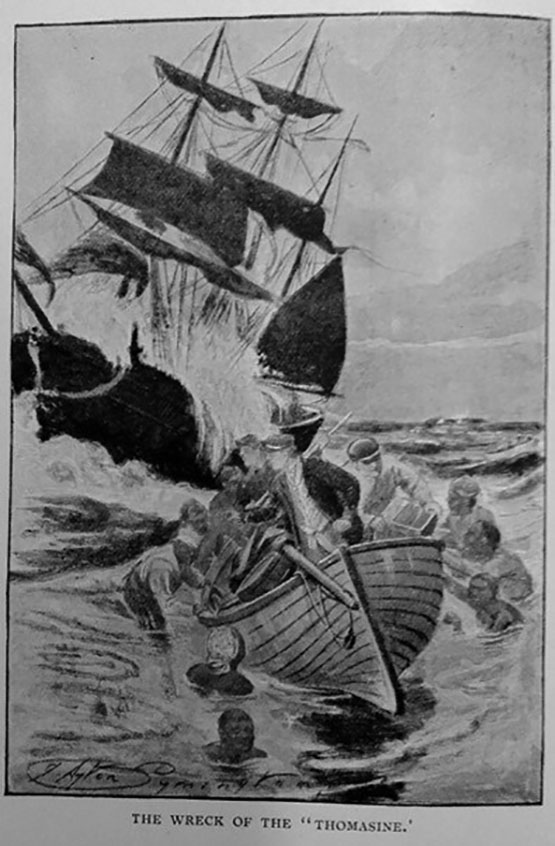
    The Wreck of the Thomasine. Courtesy State Library of Queensland.

       The third ship, the Thomasine, departed Sydney on 8 June bound for Batavia. She also intended to cross through the Torres Strait. But she ended her northerly run up the coast on 19 June when she struck an uncharted reef about 270 km east of present-day Port Douglas.

       Her master, Captain Holmes would later recall that around 8 o’clock on the evening of the 19th, the ship grazed a submerged reef where no such obstruction should have existed. He had been on deck at the time and had immediately gone to his cabin to consult his chart, to confirm what he suspected. While he was standing at his chart table, still consulting his map, the look-out called, “Breakers ahead.” Captain Holmes raced back on deck to the daunting sight of a long line of breaking waves ahead that extended around to his left and right, almost completely encircling the ship.

       Holmes and his crew kept the Thomasine from running aground during the night by tacking back and forth in the open water between the reefs. The next morning he saw how dire their situation was. The ship was trapped by an almost unbroken ring of breaking waves, denoting the presence of submerged coral reefs. Reefs that were absent from the charts but have since been added and bear the name Holmes Reefs.

       The wind began to rise and Holmes realised his only chance of escape was to try to make it through one of the narrow gaps he could see in the otherwise extended line of surf. He selected one, hoping it would allow his ship to reach the safety of deep water beyond. Unfortunately, the channel proved too shallow, and the Thomasine struck heavily, becoming stuck. Unable to get the Tomasine free, the captain made the difficult decision to abandon ship. The crew then readied two boats with as much food and water as they dared carry.

       Captain Holmes was doubly concerned as they tried to escape the ship and the surrounding reef. Not only did he feel responsible for his crew, but he was also accompanied by his wife and three children, the youngest of whom was just four months old. He divided his crew evenly between the two boats for the voyage north to Booby Island and a cache of stores. However, one sailor died during the struggle to get the boats through the roiling seas surging around the ship. Holmes   

    Over the next fortnight or so, the 18 castaways steadily made their way north, surviving on short rations and less than one litre of water per day from a small cask taken from the ship. But by 6 July, they had covered about 800 km and had reached Bird Island in the Torres Strait. Captain Holmes calculated that it would only take them another one or two days to reach Booby Island.  

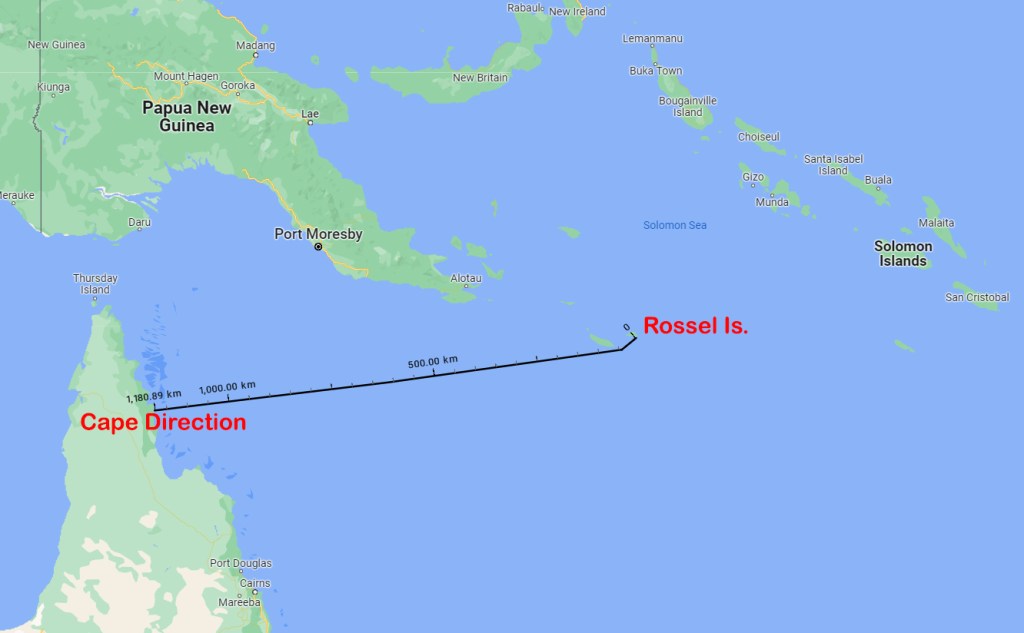
    Map showing location of the three shipwrecks in Torres Strait. Courtesy Google Maps.

       It was around this time, the Dutch ship Bato was passing through the same waters. She had sailed from Hobart on 10 June and steadily made her way up the east coast of Australia. As Captain Brocksmit approached the Raine Island entrance, he sighted the Fatima castaways camped on the island. Ten men were taken on board while the rest followed in the Bato’s wake in their own boat until they had reached the Middle Bank well inside the Great Barrier Reef.

       The next day, 6 July, the Bato’s captain came across the survivors from the Thomasine off Bird Island and made room for them on his ship as well. Finally, the following day, the castaways from the Elizabeth were spotted on Booby Island, where they had landed four days earlier.

       Now carrying as many as 60 additional people, the Bato put the dangerous waters of Torres Strait behind her. Captain Brocksmit made his way along the Indonesian archipelago, arriving in Batavia on 25 July 1854. The survivors were disembarked, and the captains were faced with the unenviable task of notifying their respective ship owners of their losses.

    © Copyright C.J. Ison / Tales from the Quarterdeck, 2023.

    To be notified of future blogs, please enter your email address below.
  • The Loss of the Convict Ship Neva – 1835

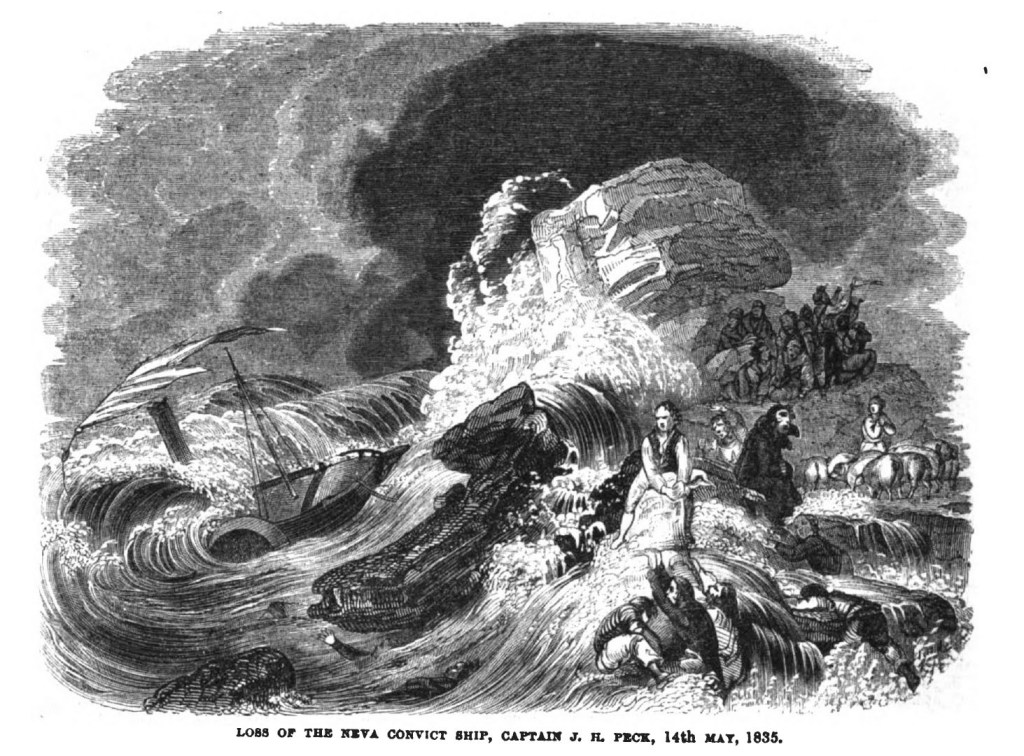
    Loss of the Neva. Source: Tales of Shipwrecks and Adventures at Sea, 1846.

       Between 1788 and 1868, more than 162,000 convicts were loaded onto transport ships and banished to the colonies to serve out their sentences. Such were the living conditions onboard some of these vessels, coupled with the hazards of sailing such vast distances in isolated waters, perhaps as many as one in one hundred perished before ever setting foot on Australian soil. When the Neva struck a reef in Bass Strait, of her 226 casualties, nearly 150 of them were convicts.

       The 337-ton barque Neva set sail from the Irish port of Cork on 8 January 1835, bound for Sydney, New South Wales. On board were 153 female prisoners of the crown, 55 children and nine free female emigrants. The crew, under the command of Captain Benjamin H. Peck, numbered 26. During the passage, three people died and one baby was born, so by the time they were nearing their destination, the ship’s complement numbered 241, passengers and crew.

       By 12 May, the Neva had rounded the Cape of Good Hope, stopped briefly at the island of St Paul for fresh supplies and was about to enter Bass Strait. At noon, Captain Peck calculated they were about 90nm (170 km) west of King Island. As daylight faded into night, he posted a lookout to warn of any dangers lying in their path. He would remain on deck through the night, but for a two-hour break, as his ship negotiated that dangerous stretch of water.   

    A stiff breeze was blowing, and the ship was being pushed along under double-reefed topsails. Around 2 o’clock in the morning, the lookout sighted the dark silhouette of land against the lighter night sky in the distance. Peck ordered the course altered a little to the north to ensure he safely cleared King Island. Then, about two or three hours later, the frantic call came from the lookout, “breakers ahead,” as a line of white water emerged from the pre-dawn gloom. 

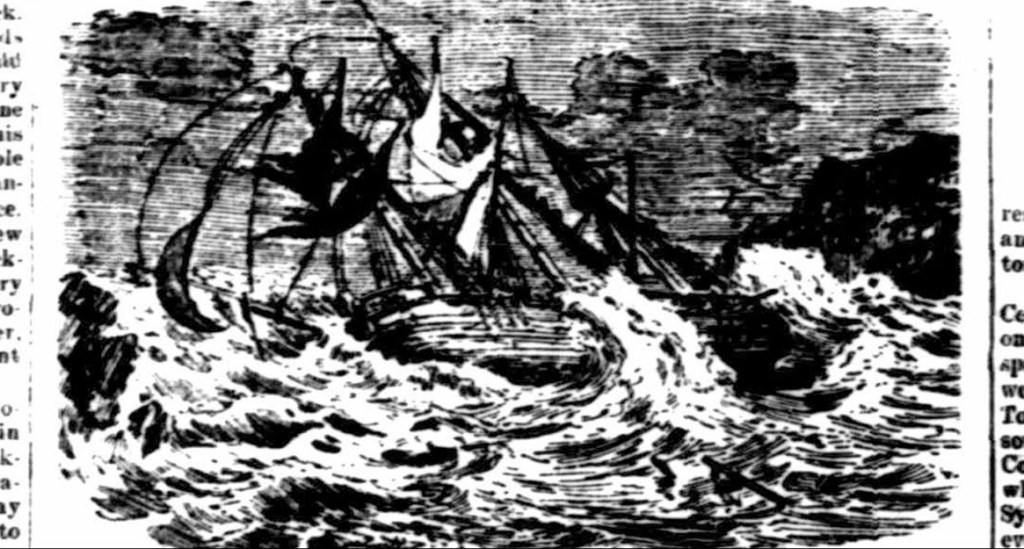
    Neva Shipwreck. illustration from The Capricornian, 26 May 1927.

       Captain Peck immediately gave the order to tack, but it came too late. As the Neva was turning into the wind, she struck a rock and lost her rudder. With the wheel spinning freely, the stricken ship was now at the mercy of the wind and current. They had likely struck Navarine Reef about three kilometres northeast of Cape Wickham, the northernmost point of King Island.

       Suddenly, the Neva struck hard a second time. She hit on her port bow and swung broadside against the reef and immediately started taking on water. Below decks, the prison cages collapsed under the violent force of the collision, and the terrified female convicts rushed on deck.

       The gig, one of the four available lifeboats, was lost as it was being lowered into the water. Captain Peck then ordered the pinnace over the side, and he, the ship’s surgeon, several sailors and some of the female passengers climbed in. But before they could put away, it was overwhelmed by a deluge of terrified women, frantically trying to escape the ship. The boat sank under their weight, and everyone was spilled into the churning water. Only Peck and the two seamen made it back to the ship alive.

       The captain then set about launching the longboat. However, this time, as he boarded, he made sure his panicking passengers were kept at bay. But this time, as soon as the boat was lowered, it was swamped by the surging seas crashing around the ship. Everyone was tossed into the water. Only Captain Peck and his first mate made it back to the ship this time.

       After the loss of three boats, the cutter was their only remaining lifeboat. It is not clear from reading survivor accounts why it was never launched. Considering the sea conditions it would likely have met with the same fate as the longboat. The most likely reason the cutter was never launched is that the Neva began to break up before it could be lowered.

    Account of the Neva shipwreck. Courtesy, State Library of NSW, FL3316306

       Part of the deck sprang away from the superstructure and then split in half, effectively forming two rafts. Captain Peck, some of the crew and several women made it onto one of them while the first mate and several other people were lucky enough to find themselves on the second. The two rafts drifted clear of the wreckage, leaving the remaining convict women clinging to those parts of the ship still jutting out of the surging seas.

       The rafts and several other pieces of wreckage with people clinging to them drifted with the currents for several hours before they came to ground in a sandy bay at the northern end of King Island. The mate’s raft rode the surf in and washed up high on the beach, and most of the people who had clung to it survived.

       The captain’s raft was not so lucky. The timber platform had come away with a large section of the foremast protruding below the surface. As they entered the shallows, the mast caught on the bottom some distance from the beach. Waves swept everyone from the raft, drowning anyone who could not swim. Only the captain, a seaman and one woman made it through the pounding surf to reach shore alive.

       Twenty-two people made it onto King Island, but seven of them died within 24 hours either from exposure or from injuries sustained during their escape from the wreck. The remaining 15 survivors used sails and spars washed ashore to build makeshift shelters, and then they began collecting what provisions had been washed ashore. Over 100 bodies were found scattered among the debris, and they were buried in several mass graves in the coming days.

       Having resigned to waiting it out until they could be rescued by the next passing ship, Peck and the others began foraging for food to supplement the provisions that had washed ashore from the Neva. But unbeknown to them, there was another party of castaways on King Island. They had been shipwrecked earlier on the south-eastern end of King Island and had come to investigate when they saw wreckage drifting down the coast. They eventually came upon the Neva survivors. A short time later all the survivors were discovered by a sealer and his Aboriginal wife who lived permanently on the island. They cared for the castaways until help finally arrived.

       After being marooned for a month, the castaways were found by Charles Friend, the master of the schooner Sarah Ann. He had touched at King Island on his way back to Launceston after delivering provisions to a whaling station elsewhere in Bass Strait. He took off all the survivors except two of the Neva’s sailors and a convict woman, who had been out foraging for food at the time. Unable to find a safe place to anchor, he was not prepared to risk losing his ship waiting for them to return.

       The Sarah Ann reached Launceston on 27 June, and a cutter was immediately dispatched to King Island to collect the remaining three castaways. In all, just fifteen of the 241 passengers and crew survived, making it one of Australia’s worst maritime disasters.

    © Copyright C.J. Ison / Tales from the Quarterdeck, 2023.

    To be notified of future blogs, please enter your email address below.
  • The Loss of the Saint Paul and its Horrific Aftermath– 1858

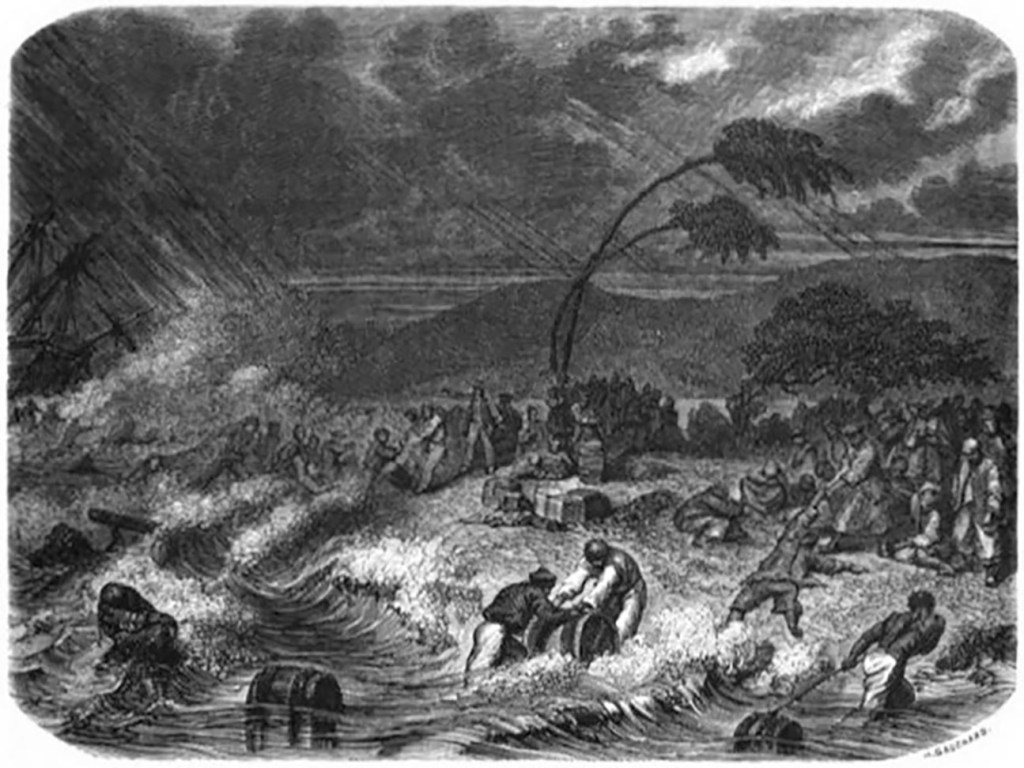
    Stranding of the Saint Paul, on Rossel Island. Auguste Hadamard, Le Tour du Monde, volume 4, 1861.

       In September 1858, the French ship Saint Paul was wrecked off Rossel Island, east of mainland New Guinea, with as many as 370 people on board. Of those, fewer than a dozen escaped with their lives. One of those was Narcisse Pelletier, who made it to Cape York, where he lived with the Uutaalnganu people for the next 17 years. His story is told in the next chapter. All the rest were massacred while they waited to be rescued.

       The Saint Paul was a French merchant ship of 620 tons under the command of Captain Emmanuel Pinard. In July 1858, she set sail from Hong Kong with an estimated 350 Chinese passengers bound for Sydney to try their luck on the New South Wales goldfields.

       The ship made slow progress from the outset due to adverse weather conditions. By the time she was somewhere north of New Guinea, the captain was concerned they would run out of food before reaching port. Rather than stick to the regular shipping route, east of the Solomon Islands, Captain Pinard chose to shorten his voyage and save time by sailing through the risky reef-strewn waters between the Solomons and New Guinea.

       Unfortunately, the gamble did not pay off. They were plagued by more bad weather, and thick mists enveloped the ship, barring Pinard from making any solar observations so he might accurately plot his position. The captain was sailing blind as he tried to thread his way through the treacherous Louisaide Archipelago when disaster finally struck.

    Saint Paul.

       On the night of 10/11 September, the Saint Paul struck a reef off Rossel Island on the eastern edge of the archipelago. The ship was beyond saving, so the next morning, the passengers were ferried ashore with what stores and provisions could be salvaged.

       They set up camp on a small rocky island about two or three kilometres off Rossel Island. A couple of days later, Pinard sent his first mate with half his crew across to Rossel to look for water. Islanders attacked the water party, and several of Pinard’s men were killed. The rest returned empty-handed.

       Pinard would later report that he then took the longboat crewed by most of the surviving seamen and set off for the Australian mainland to find help. He also claimed that he had only done so after consulting with his Chinese passengers and receiving their approval. Leaving behind most of the food, firearms and the second boat, he and his men set off. Years later, the cabin boy Narcisse Pelletier would contradict his captain’s statement, claiming they had fled in the dead of night, leaving the Chinese passengers to their fate.

       Pinard and his crew, including Pelletier, landed near Cape Direction after a nearly two-week passage. There, they received food and water from the local Uutaalnganu people before putting back out to sea in their boat. However, when they left, Pelletier was not with them. For some reason, he had been deliberately left behind.

    The crew of the Saint-Paul attacked by natives of Rossel Island. Auguste Hadamard, Le Tour du Monde, volume 4, 1861.

          Meanwhile, Captain Pinard and the Saint Paul’s crew were found by Captain McKellar of the schooner Prince of Denmark. He agreed to take them to the French settlement on New Caledonia, but he could only do so after he first delivered provisions to a party of beche-de-mer fishermen camped on a remote island. By now, the Chinese had been marooned for over a month, and it would be mid-December before the Prince of Denmark reached Port-de-France (Noumea).

       When Pinard finally reported the loss of his ship, the French immediately dispatched a warship to rescue the stranded passengers. The Styx reached Rossel Island on 5 January 1859, but when Lieutenant Grenoult and his men went ashore, they made a shocking discovery. Of the 350 or so people left on the island, they found only one survivor. Through sign language, he seemed to convey to Grenoult that everyone else had been massacred. Still, the shocking details would only come to light after they arrived in Sydney a few weeks later, and an interpreter could translate his story. What follows is drawn from the survivor’s own words and Lt. Grenoult’s official report.

       For a little while, the Islanders left the Saint Paul survivors alone. Then some of the Chinese ventured across to Rossel Island in the Saint Paul’s boat, and they were never seen again. A few days later, several Islanders paddled over to the castaways’ camp, offering food to anyone who returned to Rossel Island with them. When they also failed to return, the Chinese grew suspicious, and no amount of encouragement would compel them to leave their island despite their growing hunger.

    Detail from an 1829 Marine Chart showing Rossel Is. Courtesy NLA.

       Then, after the Chinese had been stranded for about a month and were in a feebly weak state, the Islanders descended on them in large numbers. Some of the castaways put up a fight, but they were easily overpowered. The camp was ransacked, and the Chinese were forced into canoes and taken to Rossel Island. The castaways would soon learn the grisly truth about what had become of those previously missing men.

       The Saint Paul survivors were corralled in a large clearing and carefully watched. Over the next several weeks, a few men at a time were separated from their comrades, beaten to death, butchered, and their flesh cooked over a fire. This horrific spectacle was apparently played out in full view of the dwindling number of survivors.

       By the time the Styx steamed into view, just half a dozen Saint Paul survivors were still alive. On seeing the French warship, the Islanders fled into the mountainous interior, taking with them four Chinese and a European sailor. Only the single man was left behind because he had been too weak to bother with. He had hidden among some rocks until the Styx’s boats landed and the French sailors stepped ashore.   

    Lt Grenoult and his men spent three days on Rossel Island trying to find the others, but without success. The Styx then delivered Captain Pinard, his men, and the young Chinese passenger to Sydney.   

     © Copyright C.J. Ison / Tales from the Quarterdeck, 2023.

    To be notified of future blogs, please enter your email address below.

  • Narcisse Pelletier: An Extraordinary Tale of Survival.

    Narcisse Pelletier and the Saint Paul.

       In April 1875, the pearling schooner John Bull’s crew encountered a man of clearly European descent living with a group of Aborigines on Cape York Peninsula. Mistakenly thinking that the man was being held against his will, they took him on board their vessel and delivered him to the nearest Government outpost at Somerset. His name was Narcisse Pelletier.

       Pelletier spent about two weeks at Somerset before being sent to Sydney on the steamer Brisbane. During his time at Somerset, Pelletier had spoken little, but on the voyage south, he was befriended by Lieutenant J.W. Ottley, a British Indian Army officer on leave in Australia. Using his rusty schoolboy French, Ottley coaxed Pelletier to tell him his remarkable story.

       Narcisse Pierre Pelletier was the son of a Saint Gilles shoemaker. At the age of 14, he went to sea as a cabin boy on the Saint Paul under the command of Captain Emmanuel Pinard. The ship sailed from Marseille in August 1857, bound for the Far East. The following year, the Saint Paul left Hong Kong for Sydney with 350 Chinese passengers drawn to New South Wales by the lure of gold. However, the ship was wrecked in the dangerous Louisiade Archipelago off the east coast of New Guinea.

    Stranding on the Saint Paul, on Rossel Island. Auguste Hadamard, Le Tour du Monde, volume 4, 1861.

       When some of the crew, including Pelletier, went in search of water on Rossel Island, they were attacked by the local inhabitants, and the mate and several sailors were killed. Pelletier himself was struck on the head and barely escaped with his life. He claimed that the captain had then decided their best chance of surviving was for the remaining crew to make for New Caledonia, leaving the Chinese passengers to their fate. This was at odds with Captain Pinard’s own account, in which he claimed to have gone in search of help at the behest of the passengers and that he had left them with most of the provisions and firearms. The story of the shipwreck and the gruesome aftermath is told in the preceding chapter.

       Pelletier recalled they suffered greatly in the longboat, surviving on a diet of flour and the raw flesh of a few seabirds that they were able to knock out of the sky when they flew too close to the boat. The sailors’ misery was amplified several days before reaching land when they ran out of drinking water. Pelletier was unsure how long they had been at sea, but they came ashore on the Australian mainland near Cape Direction, the land of the Uutaalnganu people.

       Nine of the Saint Paul’s crew reached land, including Captain Pinard and Pelletier. The first water hole they found was so small, according to Pelletier, that by the time everyone else had drunk their fill, there was none left for him. By now, he was half dead from hunger and thirst. He was suffering from exposure to the elements, and his feet had been lacerated from walking barefoot on coral.

       He told Ottley that Pinard and the rest of the men had reboarded the boat, intent on reaching the French settlement on New Caledonia, but they set out to sea without him. There he was, abandoned on an alien and possibly hostile stretch of coast far from anything familiar.

       Again, Pelletier’s version differs from Pinard’s. The captain claimed that he and all the others had stayed with the Uutaalnganu people for several weeks before they set off and were later picked up by the schooner Prince of Denmark, which eventually took them to New Caledonia. Regardless of the precise circumstances, when his shipmates left, Pelletier remained and was adopted by the Uutaalnganu people.   

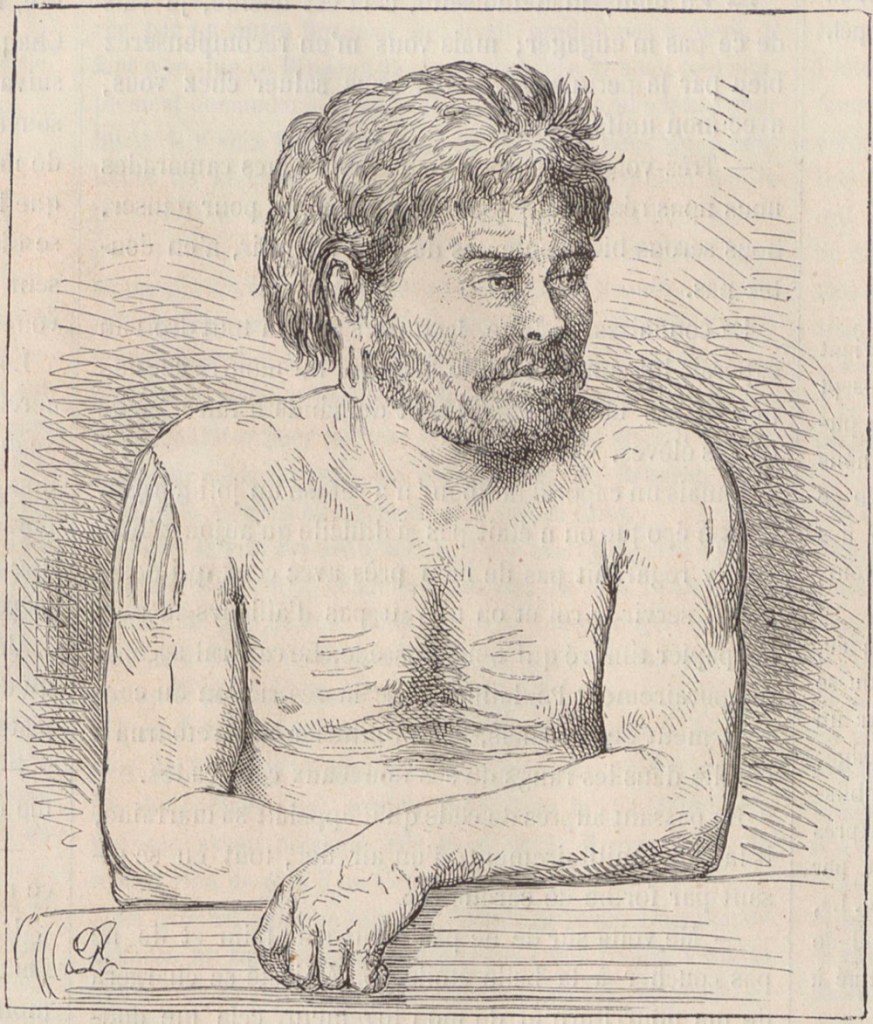
    They tended to his injuries and restored him back to good health. Pelletier said that for the first several years, he missed his parents and younger brothers and longed to return home to France. But as time wore on, those feelings faded and were replaced by a strong bond to his Uutaalnganu adopted family. From the ceremonial scars scored on his chest and arms, and the piercing of his earlobe, for which he felt great pride, it is clear he had been initiated into the society. According to a later French biography, Pelletier married an Aboriginal woman and they had several children. He would remain with the Uulaalnganu for 17 years.

    Narcisse Pelletier in 1875. Source: Wikicommons.

       Then, in 1875, his world was turned upside down for a second time. One day, the pearling lugger John Bull happened to anchor near Cape Direction. Several sailors came ashore for water and to trade with the Uutaalnganu. They noticed the white man among the local inhabitants and coaxed him to visit their ship. Pelletier told Ottley that he had only gone with them for fear of what the heavily armed sailors might do if he didn’t, rather than any desire to return to “civilisation.” What’s more, he had not expected to be taken away, never to see his family and friends again. Pelletier also confessed to Ottley that he would have preferred being returned to Cape Direction and “his people,” instead of being taken down to Sydney.

       Narcisse Pelletier never did return to his Uutaalnganu family. He was delivered to the French Consulate in Sydney, where officials organised passage for him back to France. When, in January 1876, he arrived at his parents’ home, the whole town turned out to greet him. He was given a job as a lighthouse keeper near Saint Nazaire and married for a second time a few years later. Narcisse Pelletier passed away on September 28, 1894, at the age of 50.

    © Copyright C.J. Ison / Tales from the Quarterdeck, 2023.

    To be notified of future blogs, please enter your email address below.

  • The Batavia Tragedy – 1629

    Shipwreck of the Batavia, F. Pelsaert, F., & Vliet, J. (1647). Courtesy State Library of NSW FL3726282

    On 4 June 1629, the Dutch East Indies Company (VOC) ship Batavia slammed into a reef off the Western Australian coast, stranding over 300 men, women and children far from any immediate hope of rescue. But that was just the beginning of one of maritime history’s most appalling chapters. About 40 died when the ship ran aground, or in the immediate aftermath, as waves pounded her until she broke apart. But a nightmare far, far worse awaited those survivors who thought they had escaped disaster by reaching ashore alive.

       The 650-ton merchant ship Batavia was launched in 1628 and was immediately adopted as the VOC’s flagship. She sailed from Texel, in Holland, on 29 October of the same year, with a flotilla of six other vessels, all bound for the Dutch East Indies (present-day Indonesia). The ship’s hold was filled with a general cargo, but also included a fortune in gold and silver coins. Passengers on board the Batavia included several women and children, all family members of VOC officials. Counting the sailing crew, a complement of soldiers, there were, in all, 341 souls.

       Shortly after setting off, the convoy became separated during a powerful storm. The Batavia and two other ships remained together as they sailed South until they reached the Cape of Good Hope. There, the Batavia was beset by a problem of a more human character.

       While stopped at the Cape of Good Hope, Francisco Pelsaert had cause to reprimand the Batavia’s captain, Adriaen Jacobsz for drunkenness. Pelsaert was the VOC’s most senior merchant in the flotilla and had overall command of the Batavia, including its captain, Adriaen Jacobsz. The incident would leave the captain with lingering bitterness toward Pelsaert. Another VOC official travelling to the East Indies was a man named Jeronimus Cornelisz, but more about him a little later.

    The Dutch VOC ship Batavia which was wrecked off the Abrohlos Islands off Geraldton, WA. Western Australian Shipwreck Museum

    After leaving Cape of Good Hope, Pelsaert fell ill and spent much of the time confined to his cabin. Meanwhile, Jacobsz and Cornelisz are thought to have formulated a plan to seize the ship and its treasure of gold and silver and do away with Pelsaert and anyone else who got in their way. The first step was to lose the two other VOC ships it was sailing with. One night in the middle of the Indian Ocean, Jacobsz bore away from them before returning to a westerly course. But, before he and Cornelisz could fully implement their plan and take control of the Batavia, she ran aground on Morning Reef in the Houtman Abrolhos Islands about 60 km off the Western Australia coast.

       Around two hours before dawn, Pelsaert was thrown from his bunk as the ship struck the reef. Shortly after sunrise, Pelsaert, Captain Jacobsz and about 40 others set up camp on what would later be known as Traitors Island by those who were left behind. Most of the passengers, the soldiers and the rest of the crew were ferried to nearby Beacon Island along with what food and water could be saved from the wreck. Cornelisz and about 70 or so sailors opted to remain on the Batavia now stranded high on the reef.

       Rather than consolidate the survivors in one place and provide leadership when it was most needed, Pelsaert decided he would take the Batavia’s longboat and go in search of water. With him went every senior officer, a small number of passengers, and several sailors to work the boat, leaving everyone else to fend for themselves.


    Batavia longboat replica moored in the Geraldton Marina. Photo: CJ. Ison.

    The longboat with 48 people crammed on board made for the mainland but failed to find fresh water. They then ventured north possibly as far as Northwest Cape before Pelsaert ordered the captain to make for the Dutch East Indies to seek help. The journey took 33 days, and they arrived without any loss of life, which, to be fair, was no small accomplishment. On reporting the loss of the Batavia, Pelsaert was provided with a vessel to go and rescue the remaining people and bring back the gold and silver and anything else of value that could be salvaged.

       Meanwhile, an unimaginable struggle was playing out among the castaways. Jeronimus Cornelisz had finally landed and taken control of the survivors. He had remained on the Batavia plundering its treasures and alcohol until it finally broke apart, spilling those still on board into the sea. Cornelisz spent two days adrift clinging to a timber plank before he was washed ashore on Beacon Island. Of the 70 or so who had remained on the ship, only 30 made it to dry land.

       Cornelisz was perhaps the worst possible person to lead the survivors. He was a follower of the heretic artist Johannes van der Beeck. Van der Beeck believed that God had put people on earth so they could enjoy their lives in sensual gratification and that religions, including Christianity, restricted those pleasures. It’s thought that Cornelisz may have fled Holland, fearing imminent arrest for his heretical beliefs. And, now that he was stranded on the Abrolhos Islands in the middle of nowhere and free of any moral constraints, he was determined to see out his life in hedonistic bliss. That was, of course, unless Pelsaert returned to rescue the survivors. In that case, Cornelisz planned to seize that ship and make his escape with the Batavia’s gold.

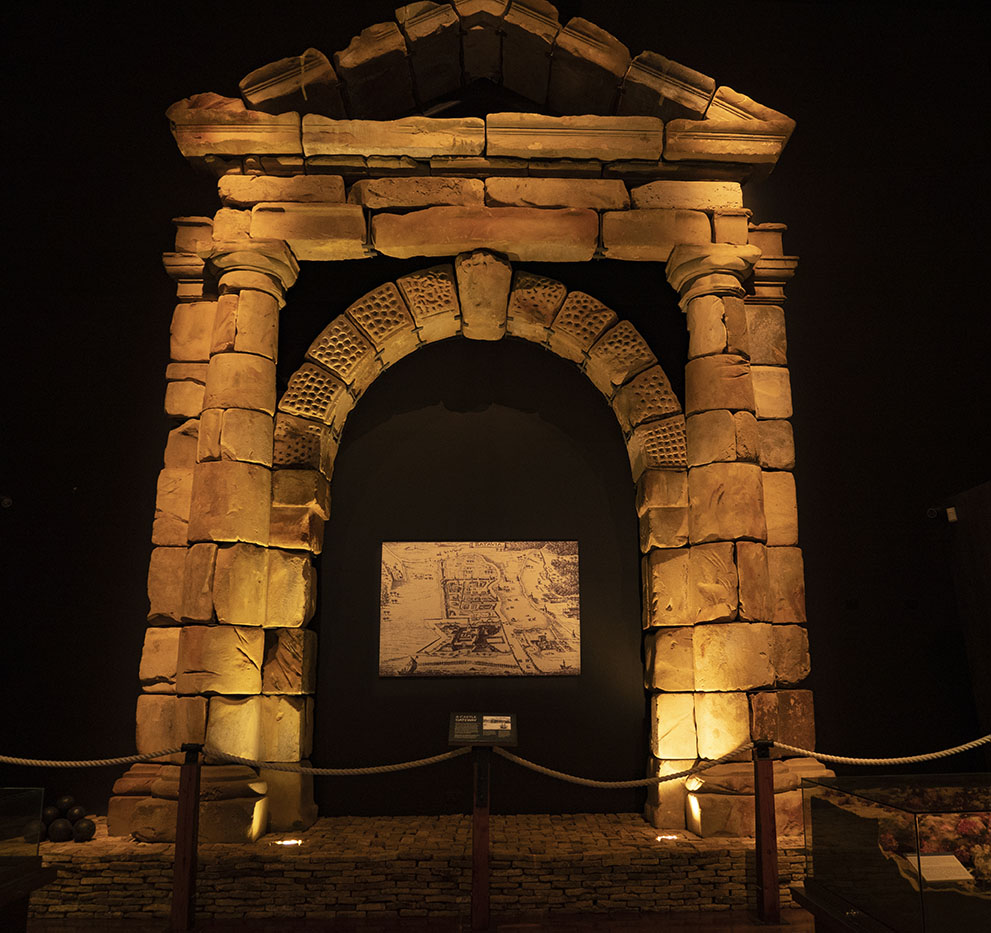
    Portico blocks recovered from the Batavia now housed at the Museum of Geraldton. Photo CJ Ison.

    As the most senior VOC official on the island, Cornelisz took charge and ordered the soldiers to hand in their weapons. He also placed all the food and other supplies under his control. Cornelisz ordered Corporal Wiebbe Hayes and about 20 soldiers to go across to West Wallabi Island to search for water, promising he would send the boat back for them in due course. Cornelisz didn’t expect them to find any water and had sent them on their way so they would no longer pose a threat to him and his plans. He assumed they would be unable to get back off the island and eventually die of thirst.

       He then sent his henchmen out to begin systematically murdering the survivors. Some of the castaways were taken to Long Island ostensibly to look for food and water, where they were abandoned. Others were taken out in boats where they were drowned, and yet other men, women and children were simply butchered in their camp. Interestingly, Cornelisz did not personally kill anyone, preferring to have others do his dirty work for him. Several of the women were kept as sex slaves, including the beautiful 27-year-old wife of a senior VOC official in Batavia named Lucretia Jansz. Cornelisz claimed her for himself. The massacres essentially had two aims. The first was to remove any challengers to his authority, and the second was to reduce the population to make their supplies last longer.

       To Cornelisz’s surprise, Hayes eventually signalled that they had found water on the island. The soldiers had also sustained themselves hunting wallabies, which they found in plentiful numbers. But before Cornelisz thought to send some of his men to investigate, Hayes had already been warned of the terror unfolding on Beacon Island by some of the survivors who had made the perilous passage to West Wallabi on pieces of wreckage.


    Houtman Abrolhos Islands. Courtesy Google Maps

    When Cornelisz and his men finally went to deal with the soldiers, they found that Hayes had organised his men, armed them with makeshift weapons and they had built a breast-high redoubt from which they could repel attackers.

       The skirmish proved disastrous for the mutineers. Several were killed by Hayes and his men when they tried to storm their fortification. The rest withdrew in defeat, abandoning the island to the soldiers.

       Cornelisz then went to meet with Hayes in person to try and persuade him to join the mutineers, but to no avail. In a second skirmish, Hayes took Cornelisz and several of his men prisoner, but the rest escaped in the boat they had come to West Wallabi Island on. From then on, the two parties were at an impasse; neither had the strength to defeat the other.    But in October, more than three months after abandoning the Batavia survivors, Pelsaert sailed into sight. The fate of the remaining survivors now rested on a race to reach the rescuers. It was a close-run affair, but Hayes got to Pelsaert first and reported what had taken place in his absence. Finally, the reign of terror came to an end, but not before more than 100 men, women, and children had been brutally murdered.

    Skeletal remains from the Batavia massacre now housed at the West Australian Shipwreck Museum in Fremantle. Photo CJ Ison.

    Cornelisz’s remaining men were quickly rounded up. Cornelisz and six others had their hands cut off and were then hanged on Long Island after confessing their crimes. Two more were left to their fate on the Australian mainland near present-day Kalbarri, and the rest were taken to Batavia, where they were tried and later executed. Captain Jacobsz steadfastly denied ever conspiring with Cornelisz to mutiny, but he appears to have seen out his days in Batavia’s prison.

       Far from emerging as a hero, Pelsaert was found partly responsible for the tragedy. A VOC inquiry condemned his decision to leave in the longboat, feeling he should have remained with the Batavia survivors, where his leadership could have prevented what took place. Pelsaert lost his entire life savings in fines, and less than twelve months later, he died a broken man. The true hero of the terrible tale was Corporal Wiebbe Hayes. He and some of his men were promoted in rank for their actions. A statue of Hayes stands on Geraldton’s foreshore, 90 km away from the islands, as a testament to his humanity, devotion to duty and courage.

    The Batavia Tragedy is one of the 60 stories that can be found in “Tales from the Quarterdeck.”

    Sun sets over Flinders and Stanley Islands in Bathurst Bay with a fishing boat in the forground at Cape Melville on Cape York Peninsular, Far North Queensland. Photo Chris Ison / Wildshot Images.

    © Copyright C.J. Ison / Tales from the Quarterdeck, 2023.

    To be notified of future blogs, please enter your email address below.