Tag: Shipwreck

  • A Tale of Shipwreck, Murder and Piracy in the South China Sea

    Macao circa early 1800s. By Bjoertvedt – Courtesy://commons.wikimedia.org.

    Edward Luttrell could not have imagined the ordeal he was about to face as he sailed out of Macao Harbour on his return to Sydney, NSW, in November 1805. What followed was a five-month ordeal that started with a shipwreck and included murder, piracy and starvation in one of the world’s most dangerous waterways.

    Luttrell was the son of Edward Luttrell Snr, the assistant colonial surgeon for Sydney and Parramatta. He was also the first mate of the 75-ton schooner Betsey under the command of Captain William Brooks.

    The Betsey departed Macau on 10 November, with a crew of 13, including the captain, Luttrell, and a crew comprising a mix of Portuguese, Filipino and Chinese mariners. But in the dead of night, just 11 days into her voyage, the Betsey struck a reef south of the Spratly Islands in the South China Sea.  

    Captain Brooks immediately sent some of the crew out in the jolly boat to set an anchor aft, hoping he could kedge the schooner back off the reef. However, the schooner would not budge, and eventually the cable snapped under the strain of trying. Huge swells surged over the stricken ship through the night pushing it further onto the reef. Once there was sufficient light to see their surroundings, Captain Brooks found that they were now stranded in two feet of water on a massive coral shelf that extended for miles in every direction.

    Captain Brooks and his men tried everything they could to get the schooner off the reef, but to no avail. After four gruelling days, the crew had been worked to exhaustion, and Brooks had no choice but to give up any hope of getting the schooner into deep water. On 24 November, they abandoned the Betsey in the jolly boat and a makeshift raft.  Brooks intended to make for Balambangan Island, about 200 km to the southeast.  But from the outset, they were hampered by a “brisk gale” blowing from the northwest. On that first day, the raft, with eight of the men, became separated from Brooks, Luttrell and the remaining three sailors in the jolly boat. They were never heard of again.

    For the next four days, it continued to blow hard, but as the sun rose on 29 November, land was sighted, which Brooks is reported to have supposed was “Balabae,” which might have been the northernmost point of Borneo south of their intended destination. By then, their supply of fresh water had been consumed, and they had been reduced to drinking their own urine to quench their burning thirst.

    The jolly boat was then becalmed before they could make landfall, and they spent the day under the burning sun.  That night, the wind came up again, and they were driven southeast again until they finally made landfall the next morning. Their first priority on landing was to find fresh water.  They soon found a stream and drank their fill, and then, while they were stumbling around in the forest looking for something to eat, they were met by a pair of Dayaks. The Dayaks gave them some fruit in exchange for a silver spoon, and the two parties each went their own way. Brooks, Luttrell and the rest of the castaways set up camp on the beach next to their boat, and the next morning, they were visited by more Dayaks. This time, they traded more silverware for fresh produce.

    According to Luttrell, the local men pointed at Balambangan visible in the distance and indicated that the British outpost there had been abandoned. They also promised to return the next day with more food to trade.  Brooks, Luttrell and the others prepared the boat for departure early the next morning, intending to set off as soon as they had obtained more supplies. This was around 4 December.

    True to their word, the Dyaks returned, only this time there were nearly a dozen of them. It seems that when the visitors arrived, the jolly boat was already in the water, under the control of two seamen, while Brooks, Luttrell and the third Portuguese sailor were still waiting on the beach.

    Loondoo Dayak from the northwest coast of Borneo, Illustration from “Borneo and the Indian Archipelago,” by Frank S Marryat, 1848.

    We have only Luttrell’s account of what happened next, but he later claimed they had been conversing with the Dayaks, and all seemed well when they were attacked without warning. Captain Brooks was speared through the torso, while Luttrell and the Portuguese sailor were set upon. Luttrell parried off his attackers with his cutlass, giving him the precious few seconds he needed to wade out to the waiting boat.  The sailor, covered in his own blood, also made it into the jolly boat, but Captain Brooks was not so lucky. He pulled the spear from his body and tried to make a run for it, but he was easily caught and hacked to death.

    Luttrell and the others got clear of land, but the injured Portuguese sailor died of his wounds about 15 minutes later. This left just the mate and two seamen from the Betsey’s 13-man crew.  When Luttrell tallied their provisions, he found they had 10 cobs of corn, three pumpkins, and two bottles of fresh water. That would have to last them until they reached the Malacca Strait, over 1500 km away.

    They made steady progress on a southwesterly course under sail for the next ten days. While their food quickly ran out, they were fortunately kept well supplied with drinking water from frequent squalls that passed over them. However, by 14 December, they were starving and exhausted from the constant vigilance needed to avoid another attack in those dangerous waters.

    On 15 December, they were passing through a small group of islands in the Malacca Strait around 3N 100W. If their intended destination was actually the European settlement at Malacca, they had overshot it by some 200 km. Otherwise, it is not clear where Luttrell intended to stop.

    Anyway, it was here that three Malayan praus intercepted them. They tried to flee, but as soon as the praus came within range, they unleashed a volley of spears, killing one of the Portuguese sailors and wounding the other. Luttrell had a lucky escape when a spear passed through the brim of his hat, narrowly missing him. Unable to outrun the attackers and too weak to resist, Luttrell surrendered. The pirates boarded the jolly boat and stripped it of everything of value. A few remaining pieces of silver plate taken off the Betsey, the ship’s logbook, the sextant and even the clothes they had been wearing were all taken. Luttrell could not have held out much hope that he would survive much longer. But survive he did.

    He and the wounded Portuguese sailor spent three days on one of the praus, exposed to the blistering tropical sun and kept alive on a meagre diet of sago. They were then landed at an island, Luttrell named Sube, but which today offers no real clue to where they had been taken.  Luttrell wrote that they remained there “in a state of slavery, entirely naked, and subsisting on sago,” for nearly four months.

    Illustration of a prau from “Borneo and the Indian Archipelago,” by Frank S Marryat, 1848.

    Then, in late April 1806, they were put aboard a prau and taken away. After 25 days at sea, they landed in the Riau Islands. Luttrell and his companion were nearly starved to death. But their fortunes were finally about to change for the better. Luttrell wrote that a Mr Kock of Malacca took them in. The circumstances of their coming under his protection are not recorded. However, when Mr Kock returned to Malacca on the Kaudree, Luttrell and the Portuguese sailor were with him.   Luttrell seemed to recover from his ordeal and, in time, returned to Sydney.

    The incident was first reported in the Prince of Wales Island Gazette, and later republished in the Sydney Gazette on 1 March 1807.

    © Copyright C.J. Ison / Tales from the Quarterdeck, 2025.

    Please enter your email address below to be notified of future blogs.

  • Tales from the Quarterdeck

    Sixty bite-sized stories from Australia’s maritime past

    The melancholy loss of H.M.S Sirius off Norfolk Island by George. Raper. Source National Library of Australia 136507434-1

    I have just launched a new book titled Tales from the Quarterdeck: Sixty bite-sized stories from Australia’s maritime past. Sixty of the most popular posts have been reedited. In some cases, I’ve rewritten a couple and updated a few where new information has come to light since first writing them.

    For those who would value ready access to the stories in their bookcase, Tales from the Quarterdeck is available in Kindle ebook and paperback formats through Amazon.

    The stories are organised in chronological order, starting with the Tryall shipwreck off the Western Australian coast in 1622, and finishing with the Second World War exploits of the Krait. See below for a full list of the stories covered in the book.

    Sydney Gazette 22 May 1808, p. 2.

    1622 – The Tryall: Australia’s earliest shipwreck

    1629 – The Batavia Tragedy

    1688 – William Dampier: Navigator, naturalist, writer, pirate

    1770  – The Endeavour’s Crappy Repair

    1788 – Loss of La Astrolabe and La Boussole, a 40-Year Mystery                        

    1789 – Bligh’s Epic Voyage to Timor

    1789 – HMS Guardian: All Hands to the Pumps

    1790 – The Loss of HMS Sirius

    1790 – Sydney’s First Desperate Escape

    1791 – HMS Pandora: Queensland’s earliest recorded Shipwreck

    1791 – William Bryant’s Great Escape

    1797 – The Loss of the Sydney Cove

    1803 – Loss of HMS Porpoise

    1808 – Robert Stewart and the Seizure of the Harrington

    1814 – Wreck of the Morning Star

    1816 – The Life and Loss of HMSC Mermaid

    1824 – The Brig Amity’s Amazing Career

    1829 – The Cyprus mutiny 

    1831 – The Caledonia’s perilous last voyage

    1833 – The Badger’s Textbook Escape

    1835 – The Loss of the Convict Ship Neva

    1835 – The Post Office in the middle of nowhere

    1835 – The Tragic Loss of George III

    1845 – The Cataraqui: Australia’s worst shipwreck

    1846 – The Peruvian’s Lone Survivor

    1847 – The Foundering of the Sovereign

    1850 – The Loss of the Enchantress: A first-hand account

    1851 – The Countess of Minto’s brush with Disaster

    1852 – The Bourneuf’s Tragic Last Voyage

    1852 – The Nelson Gold Heist

    Woodbury, Walter B. (Walter Bentley), 1834-1885. Hamlet’s Ghost, Sourabaya [Surabaya], Java [Boat with Passengers and Crew], ca. 1865. Walter B. Woodbury Photograph Collection (PH 003). Special Collections and University Archives, University of Massachusetts Amherst Libraries

    1854 – Bato to the Rescue 

    1854 – HMS Torch and the rescue of the Ningpo

    1856 – The Loss of the Duroc and the Rise of La Deliverance

    1858 – The Loss of the Saint Paul and its Horrific Aftermath

    1858 – Narcisse Pelletier, An Extraordinary Tale of Survival

    1859 – The Indian Queen’s Icy Encounter

    1859 – The Sapphire and Marina

    1863 – The loss of the Grafton: Marooned for twenty months

    1864 – The Invercauld shipwreck

    1865 – The CSS Shenandoah: Victoria’s link to the American Civil War

    1866 – The Loss of the SS Cawarra: Bad luck or an avoidable tragedy?

    1868 – The Bogus Count and Hamlet’s Ghost

    1871 – The Mystery of the Peri

    1872 – The Loss of the Maria, A Cautionary Tale

    1875 – The Tragedy behind the Gothenburg Medals

    1876 – The Catalpa rescue

    1876 – The Banshee’s Terrible Loss

    1878 – The Loch Ard Tragedy

    1884 – The Macabre case of the Mignonette

    1885 – The Douro and its Piratical Captain

    1889 – The Windjammer Grace Harwar

    1891 – The Spanish Silver of Torres Strait

    1893 – The Foundering of the SS Alert

    1895 – The Norna and the Conman Commodore

    1899 – Cyclone Mahina

    1911 – The Loss of the Mandalay

    1918 – The Orete’s Robinson Crusoe-like Castaway

    1935 – The Life and Loss of  the SS Maheno

    1943 – Surviving the Centaur Sinking

    1943 – The Amazing Krait

  • The 1909 Loss of the Norwegian barque Errol

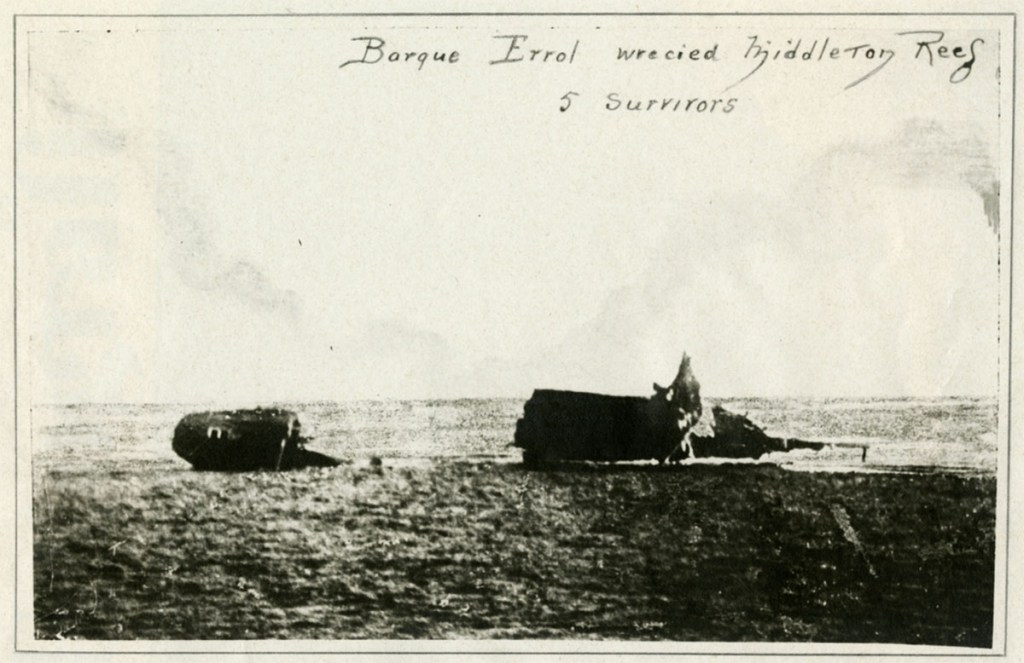
    The remains of the Errol on Middleton Reef. Courtesy: Norsk Maritim Museum.

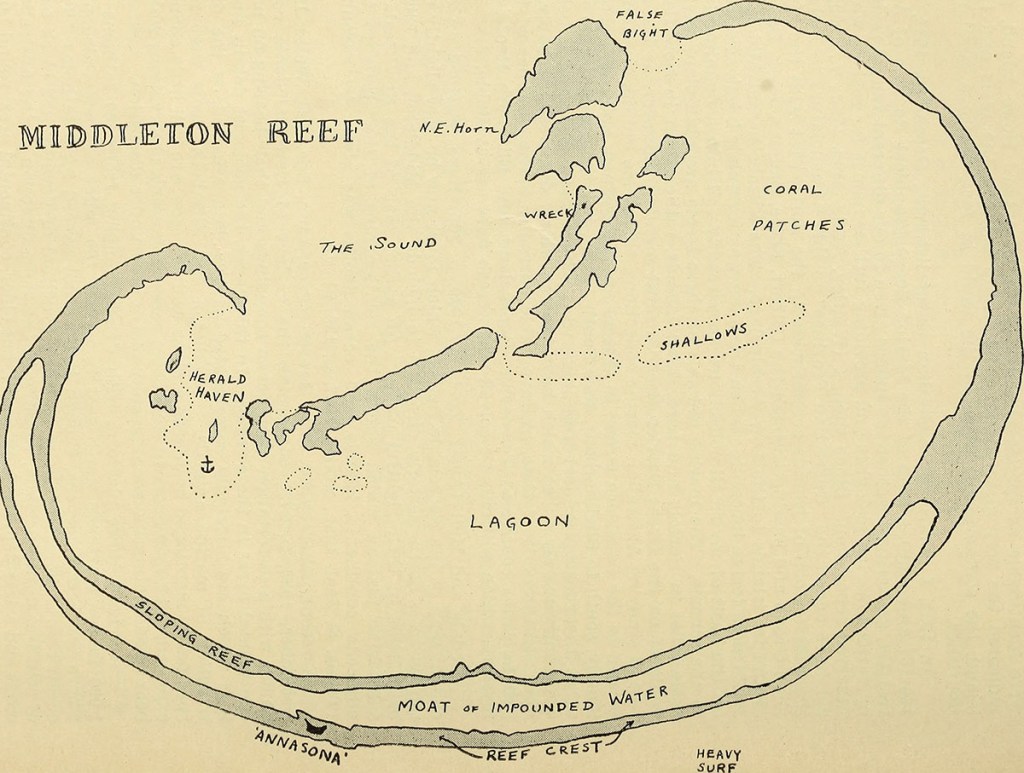
    On 12 July 1909, the mail steamer Tofua was passing Middleton Reef in the Coral Sea bound for Sydney.    Captain George Holford gave the order to steam close by as was his want every time he passed.   This time, he noticed a new ship’s carcass had been added to the dangerous reef since he had seen it last.     Since the Britannia Godspeed ran aground on Middleton Reef in 1806, it and neighbouring Elizabeth Reef have claimed over 30 ships and countless lives over the years.

    Captain Holford steamed as close as he dared, then had a boat lowered to go across and investigate.   As the steamer neared the reef, he also noticed that some rags were flying from the mast of another ship, the Annasona, which had been wrecked two years earlier.  

    The boat soon returned with five survivors from the Norwegian barque Errol, which had run aground a month earlier with 22 souls onboard.  They had a tragic tale to tell.

    Middleton Reef. Source: The Australian zoologist, 1934.

    The Errol had left the port of Chimote in Peru on 15 April, with a crew of 17 men and five passengers, comprising the Captain’s wife and four children.   The barque was headed to Newcastle to take on a cargo of coal.   However, disaster struck around midnight on 18 June when, without warning, the barque slammed into Middleton Reef.  

    The ship was swung broadside to the reef before there was even a chance to try and save her. The hull was torn out, and she rapidly settled with a heavy list to starboard.   Powerful waves swept over her, ripping apart the houses and washing away much of their stores along with the ship’s lifeboats.  She quickly succumbed to the pummelling and broke into four separate parts.    

    The First Mate was swept away and drowned as he and one of the crew tried vainly to clear one of the lifeboats.   Two more seamen also died that first night or on the second, the survivors could not recall.   Captain Andreason and the Second Mate were lost a couple of days later.   They had been on the reef, not far from the ship, building a raft comprised of spars and other timbers when they were caught by the rising tide.   Though they tried to swim back to the Errol, the current was too strong and they were washed away.  The Captain’s wife and children could only look on in horror. 

    The survivors were in dire straits.   The only food they had been able to salvage was a dozen loaves of bread, a few pounds of butter and a couple of tins of milk. What’s more, they had precious little fresh water.  A shelter of sorts was constructed on the exposed hull for the Captain’s wife and her children while the sailors made do with a canvas sail for protection from the elements. 

    Location of Middleton Reef. Courtesy Google Maps.

    Meanwhile, they continued to work on the raft.  After a few days, it was completed, and five of the crew set off for the Annasona, about 8 miles, 15 kilometres away, hoping they might find food and water.

    The raft barely held together long enough to reach the long-abandoned ship.  Fortunately, they found some fresh water, but the only sustenance available was shellfish clinging to the side of the wreck and the reef it stood on.  They spent 12 days on the Annasona building a more substantial craft to get them back to the Errol and their shipmates.  But before leaving, they hoisted a couple of shirts up the mast.   They had seen one ship pass by during their time there, but it had failed to see them or their signal of distress.   One of their number perished on the expedition across to the Annasona; however, a far greater tragedy had played out among those waiting on the Errol.

    When they climbed back aboard the Errol, they found only one man alive, Able Seaman Jack Lawrence, and he was barely clinging to life.   They had survived on a small amount of rain collected in the sails, but it proved almost as salt-laden as seawater.   Lawrence described how the others, including the Captain’s wife and children, had passed away one by one from thirst, starvation and exposure.  As each person died, their body was pushed over the side to splash in the sea. At least some of those corpses had been savaged by sharks, leaving the grisly spectacle of bones or body parts deposited on the reef at low tide.

    Photo of the Errol survivors. Daily Telegraph, 15 Jul 1909.

    All five men would likely have died on Middleton Reef had Captain Holford not made his customary search for castaways.   They were returned to his ship and cared for until they arrived in Sydney.   At a time before any sort of public safety net, the Tofua’s passengers generously donated over £100 to assist the shipwreck survivors get back on their feet.

    An inquiry into the tragedy heard that the Errol had experienced several days of overcast weather, where no astrological sightings could be made.   They were essentially sailing blind when they struck the reef.   One of the survivors also claimed that Captain Andreason had not taken the precaution of sending a lookout aloft to warn of any hazards in their path.

    For his act of humanity in rescuing the Errol survivors, Captain George Holford of the Tofua was later presented with an engraved silver coffee service by a grateful Norwegian Government.

    © Copyright C.J. Ison / Tales from the Quarterdeck, 2025.

    Sun sets over Flinders and Stanley Islands in Bathurst Bay with a fishing boat in the forground at Cape Melville on Cape York Peninsular, Far North Queensland. Photo Chris Ison / Wildshot Images.
  • Wreck of the Morning Star – 1814

    Example of a Brig. Source: Winston’s Cumulative Loose-Leaf Encyclopedia 1918

       On Sunday, 3 July 1814, the merchant ship Morning Star sailed out of Sydney Harbour bound for Calcutta by way of Torres Strait and Batavia.  However, her voyage north ended abruptly on a coral reef south of the Forbes Islands off the far north Queensland coast. The vessel was a 140-ton Calcutta-built brig owned by the Indian-based trading house Lackersteen and Co. When she left Sydney, the crew numbered 37 men, a mix of European and Indian seamen, all under the command of Captain Robert Smart. Only six of them would survive the ordeal.

       No account exists of how the ship was lost, but from the location of the wreck site, it appears that Captain Smart was sailing within the Great Barrier Reef when he ran aground and had to abandon ship.

       Lieutenant James Cook had charted the route back in 1770, and he had only narrowly avoided total disaster on what he would name Endeavour Reef, some 450 km south of where the Morning Star was lost.

       The passage was fraught with danger. Thousands of reefs, many hidden just below the surface, dotted the coastal waters inside the Great Barrier Reef. However, the route had two distinct advantages. Rarely did a ship have to stray far from land, so refuge could be sought should disaster strike. There were also ample safe anchorages where ships could lay up overnight or when the conditions made it difficult to detect hazards lying in their path. Later, mariners would prefer a route that took them far out into the Coral Sea as they made their way north. They would cross the Barrier Reef near Raine Island or other similar narrow passages to pass through Torres Strait. This “outer passage” avoided the labyrinth of reefs but came with its own set of dangers.

    Booby Island. Image courtesy National Library of Australia

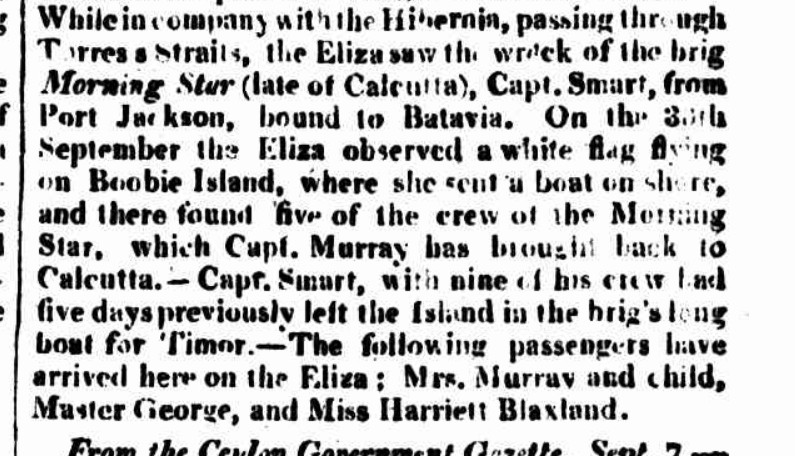
       On 30 September, the fully rigged Ship Eliza was sailing through Torres Strait when the lookout spotted a white flag flying from a staff on Booby Island.   The captain heaved to and sent a boat across to investigate. When it returned, she carried five marooned sailors from the Morning Star. This is the first recorded instance of shipwrecked sailors seeking refuge on Booby Island. Later, it would be stocked with food and water to assist shipwrecked sailors. A primitive post office with a logbook would also be established, so passing mariners could pass on the location of any uncharted reefs they may have discovered.

       The castaways had been among 15 men who had taken to the Morning Star’s longboat and made the perilous journey north after abandoning the wreck. They reported that Captain Smart and nine other sailors had left Booby Island five days earlier, intending to make for the Dutch port of Kupang on Timor Island. There is no record of them ever arriving there or anywhere else, for that matter.

    Morning Star reported wrecked on a reef south of Forbes Islands. Courtesy: Google Maps.

       The remaining 22 members of the Morning Star’s crew were thought to have perished as a result of the wreck or some calamity that befell them sometime afterwards. But four years later, another Morning Star survivor was found living with the Islanders on Murray Island on the Eastern entrance to Torres Strait.   

    The Claudine had anchored off Murray Island in September 1818 and sent a jolly boat ashore to meet with the islanders. To the astonishment of all, an Indian sailor was there to greet them in Hindustani. Fortunately, one of the sailors in the jolly boat spoke the language and was able to translate for the others. He told the sailors from the Claudine that he had been on the Morning Star when it ran aground and that since then he had been living with the Murray Islanders. He had learned their language and been accepted into their community, but the circumstances of his arrival on the island and the fate of his shipmates were not recorded. When the Claudine set sail, the Indian castaway was with them.

       The Morning Star is just one of many hundreds of vessels, large and small, that came to grief in Queensland’s northern waters from the late 18th and into the early part of the 20th Century.

    © Copyright C.J. Ison / Tales from the Quarterdeck, 2025.

    Please enter your email address below to be notified of future blogs.

  • The Frederick: Stealing the Ship That Never Was

    Example of a merchant Brig of the era. (Water colours by Frederic Roux 1827-1828)

    By December 1833, the penal settlement at Macquarie Harbour in southwest Tasmania was all but deserted.   Only a dozen convicts remained to complete the 120-ton brig Frederick.   She would be the last of nearly 100 vessels to be built there.   Once launched, they were supposed to sail her around to the newly established station at Port Arthur.   However, ten of the convicts had a much more distant destination in mind.

    But, to seize the ship involved overpowering the soldiers and officers left behind to watch over them.   Tackling armed men with just bare hands was daunting, but they had a plan.   One of the convicts, John Barker, happened to be a master blacksmith.   He manufactured two flintlock pistols using discarded scraps of metal and a musket barrel found in the blacksmith shop.   He also forged a pair of tomahawks to add to their small arsenal.  

    The Frederick was finished on 10 January 1834, and at 10 am the next day they set sail.   Captain Taw sailed down the length of Macquarie Harbour but dropped anchor inside the heads.   He judged the weather too foul to safely pass through the narrow passage of Hells Gate and out to sea.    So they waited.   Then, on Monday, 13 January, the wind eased, signalling their imminent departure.    

    For the ten convicts, the time to strike had arrived.    If they did not seize the ship now, they likely never would.    However, they were up against nine men, seven of whom were armed. 

    Then, good fortune smiled upon them, and the odds shifted in their favour.   Two of the soldiers went fishing and took a boat out with a convict at the oars.     He was one of two prisoners not in on the plan.   So, with them gone, nine had been reduced to six.     

    Boat building Yard on Sarah Island, Macquarie Harbour by William Gould, 1833, Courtesy State Library of NSW.

    Around 6 o’clock in the evening, a prisoner beckoned a sentry to join him by the forecastle hatchway.   When the unsuspecting soldier obliged, he was jabbed in the chest with one of Barker’s pistols and ordered down the ladder into the crew’s cabin.   Meanwhile, two other convicts armed with hatchets pounce on the only other two men on deck.  They subdued the remaining soldier and the terrified mate, bundling them too into the forecastle cabin.   A convict stood guard, and a heavy kedge anchor was dragged across the hatchway cover in case they tried to escape.   The convicts now had control of the deck.   Three men were confined in the forecastle, and another three were out fishing, oblivious to what was unfolding on the Frederick.    This just left Captain Taw, David Hoy the shipyard supervisor, and the convict steward William Nicholls.   All were in the captain’s cabin

    The convicts, now armed with the soldiers’ muskets, were ready to confront the last men standing between them and liberty.   Three men stormed down the ladder and attacked Captain Taw and the others, hoping to quickly get the best of them.   However, Taw and Hoy fought back.   Hoy wrestled a pistol from one of the convicts, and the attackers retreated back up the ladder, leaving Taw, Hoy and Nicholls trapped in the cabin, bloodied and bruised from the brief but violent encounter.

    Taw and Hoy were trapped in the cabin.   The convicts would pay dearly if they attacked again, but the captain knew he could not retake the ship.   They were at a stalemate.   But Captain Taw had one small bargaining chip.   He had possession of the Frederick’s navigation instruments, items the convicts would need to escape.  The impasse lasted about ninety minutes, with occasional shots fired through the cabin’s skylight and each side calling for the other to surrender.  

    The Globe (London), 9 Jul 1834, p. 4.

    Around 7.30 in the evening, someone called for the pitch pot to be brought over and threatened to empty its boiling contents into the cabin if the trio did not immediately surrender.    Hoy and Taw agreed there was nothing to be gained by holding out any longer and gave themselves up.  

    Meanwhile, the fishing party had returned to the brig after hearing gunfire, only to find the prisoners already in charge.   The rest of Frederick’s men joined them in the boat, and they were sent ashore with half the ship’s provisions.

    Taw and Hoy assessed their situation.    There was plenty of food, so they would not be going hungry any time soon.    However, how long would it be before a ship was sent to investigate the whereabouts of the Frederick?     Taw had no intention of waiting to find out.   They set off on foot for the nearest settlement, 150 kilometres away.  It would take Taw over two weeks to eventually reach Hobart to report the incident.

    In those two weeks, the mutineers did not waste any time making good their escape. James Porter, one of the convicts, wrote the only record of what happened to the Frederick next.  

    Porter was not a typical convict transported to Australia.    For a start, he was born into a respectable middle-class family.  When he was 12, he dropped out of school and, by his own account, began mixing with the wrong kind of people.   Porter soon got himself in trouble with the law, but his father pulled some strings, and the charges were dropped.   However, to prevent Porter from getting into any more trouble, he was sent to sea to serve an apprenticeship and found himself bound for Rio de Janeiro.   

    So began his career as a seaman.   After changing ships several times, Porter claimed he had spent 12 months on the armed schooner Liberta helping the Chileans win their independence from Spanish rule.   However, by late 1821, he had had enough of life in South America and returned to England. 

    A year later, Porter was caught breaking into a house and was transported to Van Diemen’s Land for life.   He landed in Hobart in January 1824 but was soon caught stealing and sent to Macquarie Harbour.   

    When he was chosen to remain behind to finish work on the Frederick, a plan started to take shape in his mind, and South America once again beckoned.   His companions comprised a mix of experienced seamen like himself, shipwrights and the blacksmith John   Barker who had been schooled in celestial navigation, though he proved to be no seafarer.

    The Frederick was sailed from Macquarie Harbour to South America where it was left to sink. Courtesy Google Maps.

    The Frederick no sooner made it out to sea when the wind freshened to a heavy gale.      It blew hard with mountainous seas for the next nine days as they bore south, then east under much-reduced canvas.   The burden of sailing fell heavily on the shoulders of the seasoned sailors.   The rest of the men, unused to such sea conditions, rarely left their bunks, suffering severely from sea sickness.    Barker was particularly prone to the malady, only coming on deck periodically to make observations and plot their course.  

    After being at sea for about three weeks with few opportunities to take observations, Barker found they had strayed too far south into the dangerous icy waters of the “Furious Fifties”.   He set a northeasterly course for the helmsmen and then retired to his quarters again.   Shortly after this, their voyage nearly came to an end when the Frederick was heeled over on her side by a powerful wind gust.  

    Fortunately, the ship righted herself once the canvas had been brought in.      Then, about six weeks out, they spotted land for the first time since leaving Tasmania.  They had sailed nearly 5,400 nautical miles (10,000 km) and arrived off the coast of South America.  

    On 27 February, they boarded the longboat and left the Frederick to sink as, by now, she was taking on a lot of water.    The next morning, they made landfall near the mouth of the Rio Bueno in Chile.       A week later, they arrived at the provincial capital of Valdivia, where they were promptly thrown in gaol for entering the country in a “clandestine manner.” 

    It was obvious to the Chilean officials that the men claiming to be shipwrecked sailors were not what they claimed to be.   Now that they were behind bars and facing an uncertain future, Porter and his comrades decided to admit to being runaway convicts and beg the Governor for asylum.  

    Illustration of a brig. Source: Nautical Dictionary by Arthur Young, published in 1863.

    They found a sympathetic ear in Governor Sanchez, and he agreed to petition the President of Chile in Santiago on their behalf.    They were released from gaol after promising not to leave town.   All ten men found work at the local shipbuilding yard, where their skills were much in demand.   As time passed, they settled into their new lives and felt their troubles had been put behind them.  

    But the British Consul in Santiago had learned of their presence in Valdivia unbeknownst to Porter and his colleagues.   He, in turn, had called on the Royal Navy to dispatch a ship to apprehend the runaways.   

    Eight months later, in February 1835, HMS Blonde dropped anchor at the mouth of the Valdivia River to collect the runaway convicts.   However, Governor Sanchez refused to hand them over, and the British warship left empty-handed.   While Porter and the others had avoided arrest this time, it was clear to them that the British knew where they were.  

    Life settled back into its regular routines until a few months later, when Governor Sanchez was replaced by a man far less sympathetic to the runaway convicts.    Within a month, three of the convicts departed on a merchant ship bound for North America.   Then Barker and two others left in the dead of night in a whaleboat they had been building for the new governor.    The governor was furious and gaoled Porter and the other three until they could be handed over to the Royal Navy.

    They were put on board the next British warship that stopped at Valdivia and returned to England.   As they had escaped from Van Diemen’s Land, it was decided to return them there to stand trial for piracy.   They arrived back in Hobart on 29 Mar 1837 after an absence of more than three years.  

    In a novel legal argument, Porter contended that because the Frederick had never been officially registered, it could not be considered a ship.  Instead, it was just a collection of timber, ropes, canvas and such like, which just happened to resemble a brig.    Consequently, he argued, they could not be found guilty of piracy.    The jury was unconvinced, and after 30 minutes of deliberation, they returned a guilty verdict, and the four men were banished to Norfolk Island for life.    

    © Copyright C.J. Ison / Tales from the Quarterdeck, 2025.

    Please enter your email address below to be notified of future blogs.