
William Dampier visited Australian shores twice in the 17th Century. The first time was when he served on the Cygnet in 1688, and the second, 11 years later, when he commanded HMS Roebuck. Dampier was the first Englishman to describe the land, its fauna, flora and people to a European audience. While his contribution to Australia’s history is relatively minor, his story is nonetheless a fascinating look into the golden age of exploration. Navigator, naturalist, writer, and pirate are all words that describe aspects of Dampier’s colourful life.
Born in Somerset in 1651, William was the son of a tenant farmer. He does not appear to have had any interest in following in his father’s footsteps. Instead, when he turned 17, he went to sea and began his apprenticeship as a mariner. He joined the Royal Navy around 1673 and saw action during the Third Anglo-Dutch War. When hostilities ceased, he left the navy and travelled to the West Indies. Then, when war broke out between England and Spain, he became a privateer, which could best be described as a state-sanctioned pirate. In 1678, now aged 27, he returned to England and married his fiancée. However, he would spend just one year with her before he put to sea again.
This time, he would be gone 12 long years. After hunting down Spanish ships off Central America, he joined another privateer and crossed the Pacific Ocean in search of plunder. He visited ports in the Philippines, China and Southeast Asia. Then, in January 1688, he was on the Cygnet when it stopped on Australia’s northwest coast. The ship had pulled in for repairs at King Sound north of present-day Broome and would remain there for a couple of months. Dampier spent his time documenting the unusual fauna and flora. He also wrote at some length about his observations on how the indigenous people lived, but not in particularly flattering terms. To his Eurocentric eye, they existed in appalling conditions, and he thought them to be the most miserable people he had ever encountered.

In 1691, Dampier joined a very exclusive club of men who had circled the globe when he returned to England via the Cape of Good Hope. His various exploits and adventures became the subject of his hugely successful book, “A New Voyage Round the World,” published in 1697. Through his book, Dampier came to the attention of both the Royal Society and the Admiralty. They commissioned him to chart the east coast of New Holland, some 70 years before James Cook would eventually do so. Had Dampier succeeded, he may well have changed the trajectory of modern Australian history. However, as will soon become evident, circumstances would conspire against him.
HMS Roebuck sailed from England on 14 January 1699 with a crew of 50 and provisions to last them 20 months. Dampier originally planned to sail around Cape Horn and then cross the Pacific Ocean until he reached Australia’s east coast. However, his ship was long past its glory days, and its refit for this hazardous voyage had taken far longer than anticipated. By the time he reached the southern tip of South America, it was winter, the worst time to try rounding Cape Horn. Instead, he decided to cross the South Atlantic and round the Cape of Good Hope. He would then cross the Indian Ocean to New Holland’s west coast and begin his survey there.

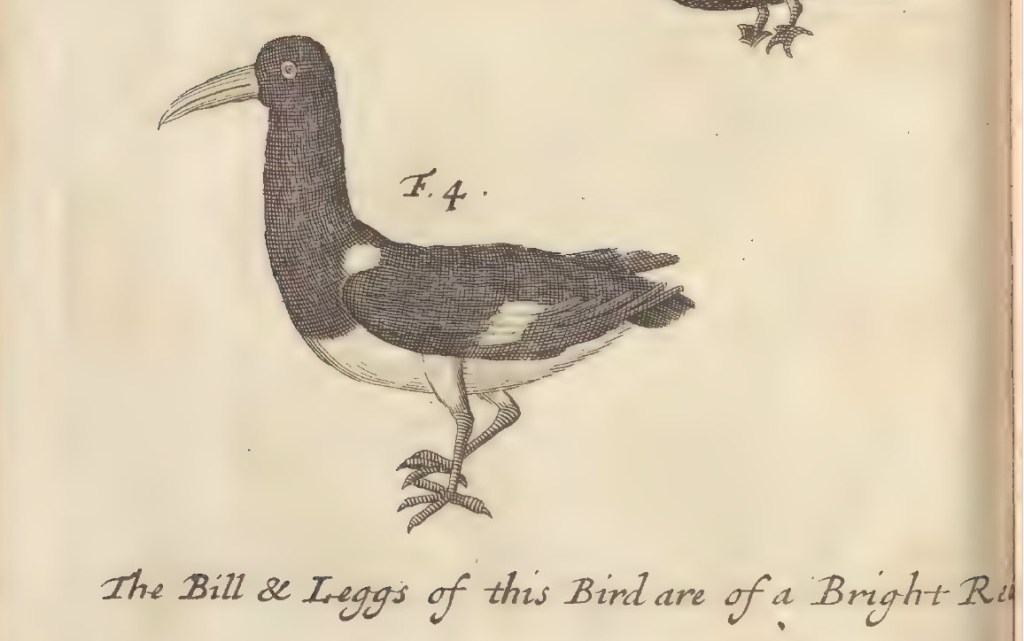
They made landfall near Dirk Hartog Island in early August 1699. On 7 August, he sailed past Cape Peron and into Shark Bay, where he spent a week exploring. Dampier named it for the abundance of sharks he found in those shallow, enclosed waters. He made a detailed chart of the bay and described many of the fish, birds and plants he saw there. Though fish, fowl, and turtles were easily procured and made a welcome addition to the men’s diet, they were unable to find a supply of fresh water. On 14 August, Dampier left Shark Bay by the same passage he entered after encountering shoals and dangerously shallow water between Dorre and Bernier Islands and the mainland.
They continued north along the coast for another 750 kilometres until they arrived at a small group of islands, now known as the Dampier Archipelago. Freshwater remained elusive, so they continued sailing north until they were at latitude 18° 21’ south, about 60 to 70 km south of present-day Broome. Again, they went in search of water. And, again, they returned empty-handed. Only this time, an encounter with the local inhabitants ended in violence. One of Dampier’s men was speared through his cheek while a Karajarri man was wounded by musket fire. In early September, Dampier resigned himself to temporarily abandoning New Holland and made for Timor to resupply.
From Timor, Dampier continued sailing northeast and charted the northern coast of New Guinea. By now, the Roebuck was in such poor shape that he abandoned his plan to locate New Holland’s east coast and turned back towards England. He stopped briefly at Batavia, then crossed the Indian Ocean, rounded the southern tip of Africa, and sailed north through the Atlantic. In February 1701, they reached Ascension Island, but HMS Roebuck would go no further. Her planking was riddled with seaworms. And she was taking on a lot of water. Dampier had to run her ashore to stop her from foundering in deep water. He and his crew would remain stranded there for five weeks until a passing East Indiaman rescued them. Dampier and his men returned to England in August 1701.

William Dampier was court-martialled on his return to England on a charge of ill-treating his first mate on the voyage out. Found guilty, he was stripped of the money the Admiralty owed him, and he was ruled unfit to command any of His Majesty’s ships in the future. Undeterred by the setback, he published a book about his most recent exploits and would go on to circumnavigate the world twice more. When Dampier died in London around 1715, he was the only person to have circled the globe three times.
© Copyright C.J. Ison / Tales from the Quarterdeck, 2024.
Please enter your email address below to be notified of future blogs.



 Tales from the Quarterdeck