Tag: Second World War

  • Surviving the Centaur sinking.

    A poster urging Australians to “Avenge the Nurses” after the sinking of the Centaur in 1943. Image courtesy Australian War Memorial.

       On a quiet Saturday afternoon on 15 May 1943, the senior Royal Australian Naval officer in Brisbane received a message reporting that a USN destroyer had picked up survivors from the Australian Hospital Ship (AHS) Centaur. This was the first anyone knew of the tragedy that had unfolded a short distance off the Queensland coast.

       The Centaur left Sydney bound for Port Moresby to pick up sick and wounded diggers and return them to Australia. Fighting had been raging in New Guinea for over a year, and casualties had been high. As she steamed north this time, she had a full crew, and she was also delivering members of the 2/14th Field Ambulance to Port Moresby. In all, there were 332 souls on board.

       Around 4 a.m. on Friday, 14 May, the Centaur was about 30 nm (55 km) off Moreton Island when she was struck by a torpedo fired by a Japanese submarine. Merchant seaman Alfred Ramage had just finished his watch and was climbing into his bunk when he was rocked by the powerful explosion. Ramage immediately knew what had happened, so he quickly donned his lifebelt and began making his way to the boat deck. Urgency spurred him along, for he had never learned to swim.

       The torpedo had hit the portside fuel bunker, which sent flames ripping through the ship, burning and trapping many people below decks. Those same flames soon engulfed the boat deck and then the bridge as the crew struggled to get the lifeboats away.    Steward Frank Drust was standing outside the ship’s pantry when the floor collapsed and a wall of flames separated him from the closest companionway leading to the deck. By now, the Centaur was sinking by the bow. He waded through swirling waist-deep water and eventually made it onto the deck. He and a few comrades began throwing hatch covers and life rafts over the side to help those already floundering in the water. They continued their efforts until they, too, were washed off their feet as the sea rose around them.
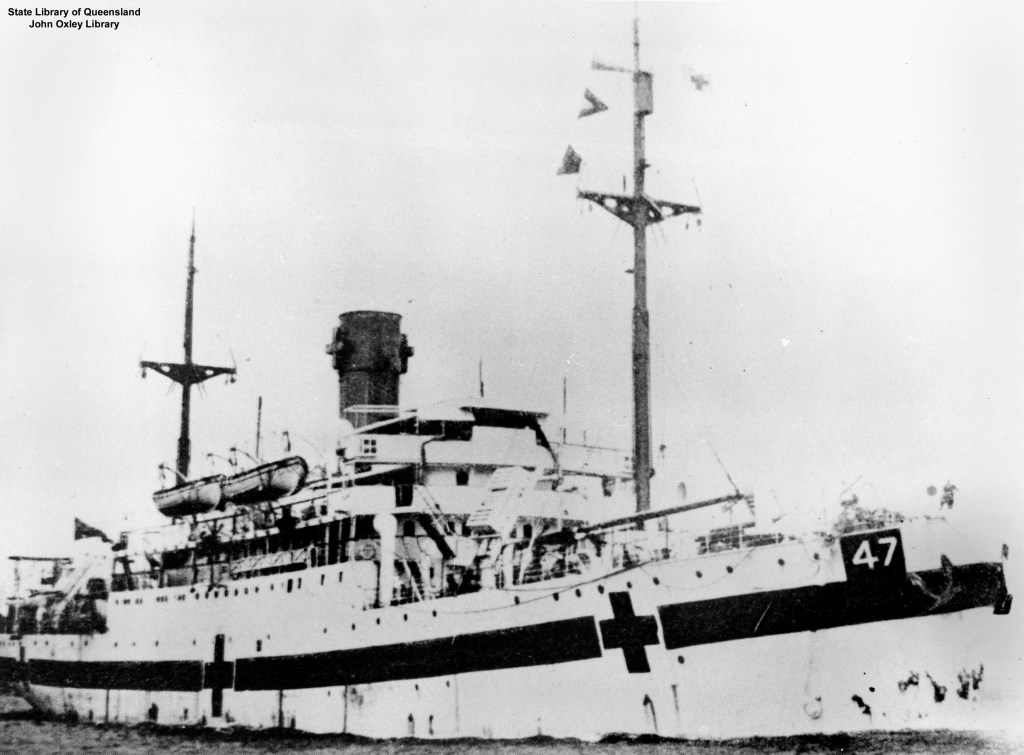
    AHS Centaur. Photo Courtesy State Library of Queensland

        Sister Ellen Savage, one of 12 nurses on board, was woken by the loud explosion reverberating through the ship. She and fellow nurse Merle Morton fled their cabin in their pyjamas and were told by their commanding officer to get topside as quickly as they could. They had no time to retrieve warm clothing or anything else from their cabin before they took flight.

       By the time they reached the deck, the Centaur was already sinking. The suction dragged Ellen Savage down into a maelstrom of whirling metal and timber, cracking her ribs, breaking her nose and bruising her all over. But suddenly, she found herself back on the surface in the middle of a thick oil slick. She never saw her cabinmate or her commanding officer again.

       Savage could see a large piece of wreckage a short distance away and swam for it. It turned out to be a portion of the ship’s wheelhouse where several others had already taken refuge. In time, as many as 30 survivors climbed onto the fragile floating island. Others who had escaped the ship kept themselves afloat on pieces of debris or the few rubber liferafts that had been deployed in the hectic minutes after the torpedo struck.
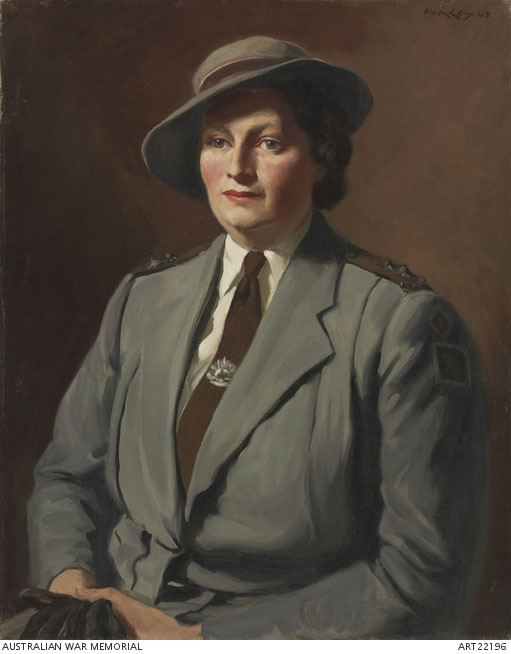
    Sister Ellen Savage GM. Image courtesy AWM.

          Ship’s cook Frank Martin survived by clinging to a single floating timber spar. For the next 36 hours he held on for dear life, half-naked and nothing to eat or drink until he was plucked from the water.

       Seaman Matthew Morris was a little luckier. At first, he found himself alone in the water, blinded by salt and oil. But when his vision returned, he spied a small raft a short distance away, so he swam over and climbed into it. Then he spotted his mate, Walter Tierney, and hauled him onboard. As daylight came, the pair saw something floating in the distance and paddled towards it. It turned out to be the wheelhouse, so they lashed their raft to it and joined the 30 or so people already there.

       The survivors spent all that day huddled on the makeshift raft. There was less than 10 litres of water on hand, and that was doled out sparingly. Several of the survivors had severe burns to their bodies. One was Captain Salt, a pilot from the Torres Strait Pilot Service, who had run through a wall of flame to escape the sinking ship. Despite his painful injuries, he kept morale up, reassuring everyone that help would soon be on the way.

       Matthew Morris led choruses of “Roll out the Barrel,” “Waltzing Matilda,” and other wartime favourites to keep people from thinking about their plight. Sister Savage tended to the wounded with what little she had on hand, never complaining of her own injuries. She kept her broken ribs to herself until after they had all been rescued.

       One poor man, Private Jack Walder, had been badly burned. He drifted in and out of consciousness until he passed away on the raft. Savage prayed over his body before it was gently pushed away to sink from sight.

    The Brisbane Telegraph front page, 18 May 1843.

        According to several survivors, sharks were constant and unwelcome companions, circling as they clung to wreckage or perched precariously on makeshift rafts.

       The survivors spent all of Friday, Friday night and Saturday morning hoping and praying that they would soon be rescued. Several said they heard aircraft flying overhead or saw ships passing in the distance, but the Centaur survivors went undiscovered. At one stage, those on the wheelhouse considered dispatching one of the rubber rafts to try to make landfall to raise the alarm. However, that idea was eventually discarded when it was decided that the chances of surviving the large ocean swells in the small craft were unlikely.    On Friday night, the Japanese submarine surfaced briefly near the wheelhouse, sending a chill through the survivors. Everyone remained quiet, and a short time later, the sub disappeared below the waves again. The survivors never gave up hope of being rescued. Then, on Saturday afternoon, an Australian Air Force aircraft on a routine flight saw something strange floating in the water. On investigation, the pilot realised it was wreckage and guided the US Navy destroyer, USS Mugford, to the location. They quickly began searching the surrounding waters for more survivors.
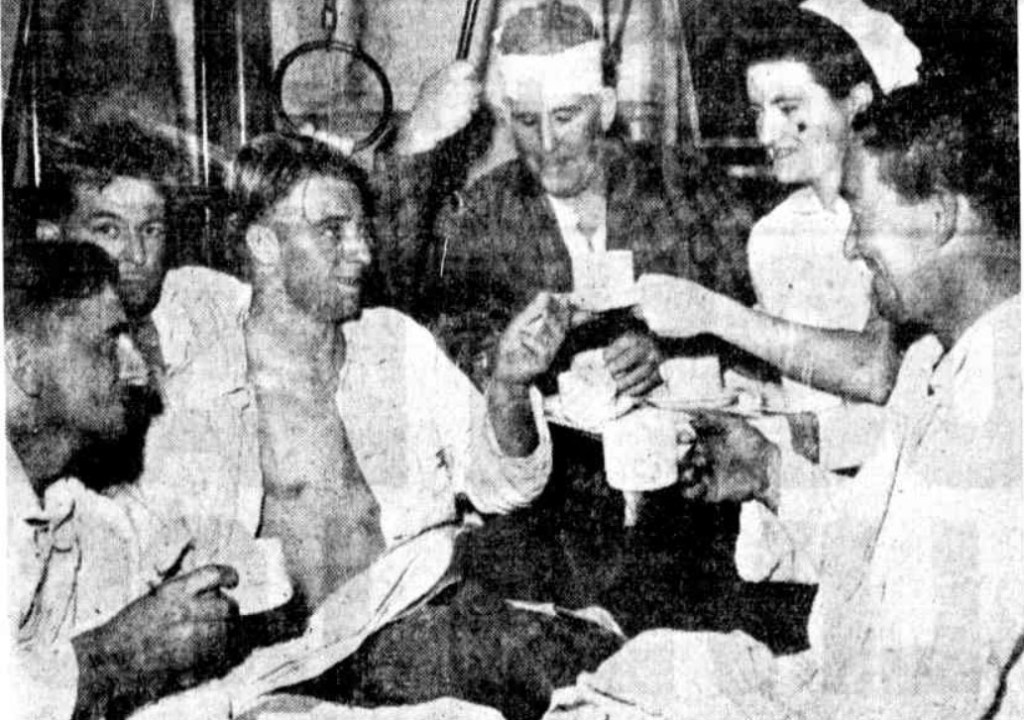
    AHS Centaur survivors being cared for in hospital. Telegraph, 18 May 1943, p. 2.

       In all, 64 people were saved, but another 268 were not so lucky. Sister Ellen Savage was awarded the George Medal for her devotion to duty, tending to the wounded despite her own injuries.

    Lest We Forget.

    © Copyright C.J. Ison / Tales from the Quarterdeck, 2023.

    To be notified of future blogs, please enter your email address below.

  • The Krait’s Remarkable Career

    MV Krait anchored at Darwin. Courtesy AWM.

       The small fishing vessel MV Krait holds a special place in Australian maritime and military history. Named after a small, deadly snake, it played an important part in Operation Jaywick, which saw commandoes sink several Japanese ships anchored in Singapore Harbour in September 1943.

       The MV Krait started life as a Japanese fishing vessel named the Kofuku Maru, which was launched in 1934. She was a motorised gaff-rigged ketch measuring 20 metres in length, with a two-metre draft and a displacement of 23 tonnes. At the outbreak of the Second World War, the Kofuku Maru was owned by a Japanese fishing company based in Singapore. They used the vessel to ferry water, food, and other supplies to fishermen working in the Riau Archipelago and to bring their catch back to the city’s seafood markets.   

    When Japan entered the war, the British authorities seized the Kofuku Maru. As Japanese troops advanced down the Malay Peninsula, an Australian merchant mariner, Bill Reynolds, used the fishing boat to evacuate over 1000 civilians to Sumatra in the Dutch East Indies (present-day Indonesia).

    Singapore shortly before the Japanese landed on the island. Photo Central Queensland Herald, 26 Mar 1942, p. 20.

        Then, in January 1942, when it was clear that Singapore was about to fall, Reynolds sailed the Kofuku Maru to Colombo in Ceylon (present-day Sri Lanka). There, some officers from the Allied Intelligence Bureau saw the potential of having a Japanese fishing vessel at their disposal. With any luck, they thought, the Kofuku Maru might be able to traverse enemy waters without raising suspicion. Reynolds had likely told them that Japanese aircraft had ignored the vessel while he had been operating around Singapore. The Kofuku Maru was then sent to Australia, where she was made ready to begin her clandestine career.

       The Krait, though still going by its Japanese name, Kofuku Maru, was chosen to take part in Operation Jaywick, an audacious mission to destroy enemy shipping moored in Singapore Harbour. It was a high-risk, high-reward mission, but with any luck, the Japanese would not suspect the Krait of being anything other than one of the numerous small Japanese fishing vessels plying the waters around Malaya and Indonesia.   

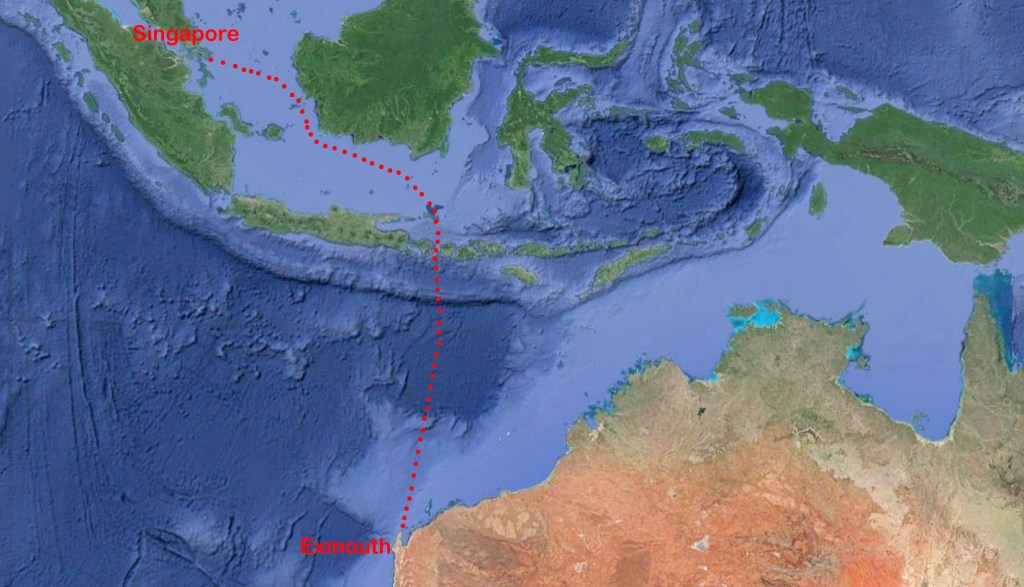
    A 14-man team was selected for the operation under the command of Major Ivan Lyons, a British Army officer attached to the Z Special Unit, better known simply as Z Force. The men chosen were a mix of British and Australian Army and Navy personnel. After completing specialised training and rehearsals at Refuge Bay north of Sydney, the Krait then made the long voyage up the east coast, through Torres Strait, past Darwin and down the Western Australia coast to Exmouth Gulf.

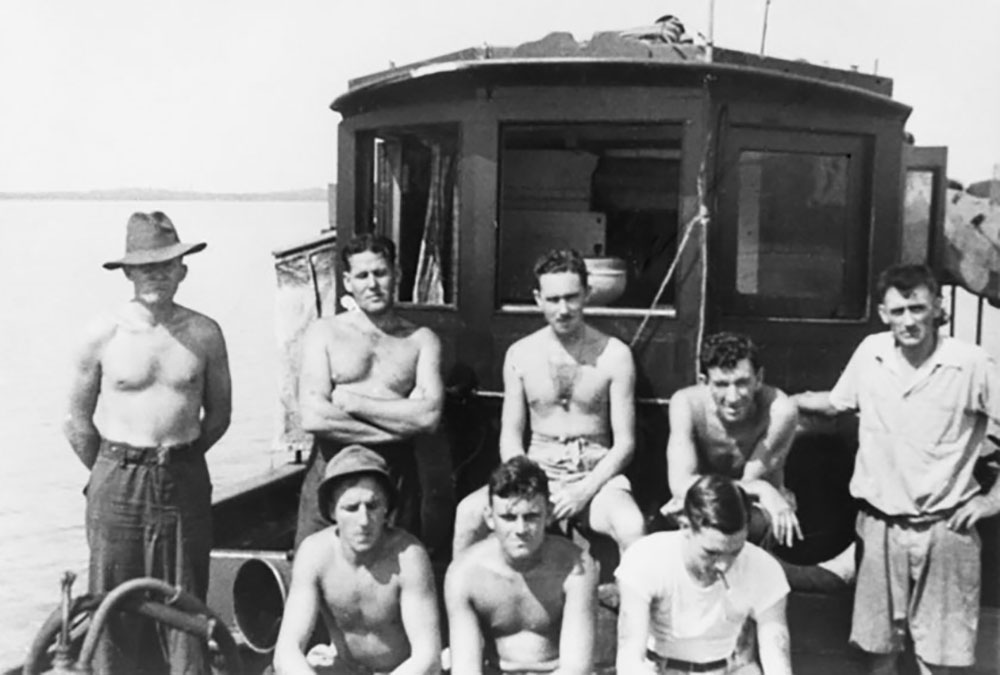
    A group on board MV Krait enroute to Singapore during Operation Jaywick. Courtesy AWM.

       The 7500 km long passage was not without problems. The engine quit while they were off Fraser Island, and the Krait had to be towed to Townsville, where she remained until a replacement could be found and installed. More repairs had to be made before they finally reached Exmouth Gulf, further delaying the operation.

       But on 2 September 1943, the Krait left Exmouth Gulf with the Z Special Unit men on board. The plan called for the eight-man naval contingent to sail the vessel to within striking distance of Singapore Harbour. Then six Army commandos would take to three folding kayaks, paddle into the harbour, and sink as much Japanese shipping as they could by attaching magnetic “limpet” mines to their hulls below the waterline.

       Four days after leaving Exmouth, the Krait motored through the narrow Lombok Strait with a Japanese ensign flying from her mast. Once clear of the strait, they bore west through the Java Sea towards their intended target. The men had stained their skin so they resembled local fishermen and were meticulous about what rubbish they threw overboard.   

    Towards the end of September, the Krait had made it to the small island of Pulau Panjang, just 30 km away from Singapore Harbour. The six commandos then set off in their two-man kayaks and island-hopped north to a small island where they could observe the entrance to the harbour. Meanwhile, the Krait made for safer waters near Borneo but not before agreeing on a rendezvous point with the commandos for the night of 2 October.

    MV Krait’s route from Exmouth Gulf to Singapore. Courtesy Google Maps.

       On 26 September, the six men paddled into the harbour and planted their mines on seven Japanese ships. Singapore’s early morning quiet was shattered by a series of loud explosions as the mines went off. One failed to detonate, but six ships were sunk or badly damaged. But by then, the commandos were long gone and were holed up on a small island to await the return of the Krait.

       The Japanese did not realise that the attack had come from the sea, thinking instead that it was the work of local saboteurs. Several local Chinese and Malays, along with some prisoners of war and European civilian internees, were suspected of the bombings. They were rounded up by the Japanese Military Police and interrogated. Most were tortured, and some were executed in the aftermath, an unfortunate and unforeseen consequence of the raid.

       Meanwhile, the commandos rendezvoused with the Krait as planned without incident. The Krait then set off for home. Two and a half weeks later, they were safely back in Exmouth Gulf. Major Lyons would lead a second similar raid on Singapore Harbour the following year, but Operation Rimau would end in disaster.

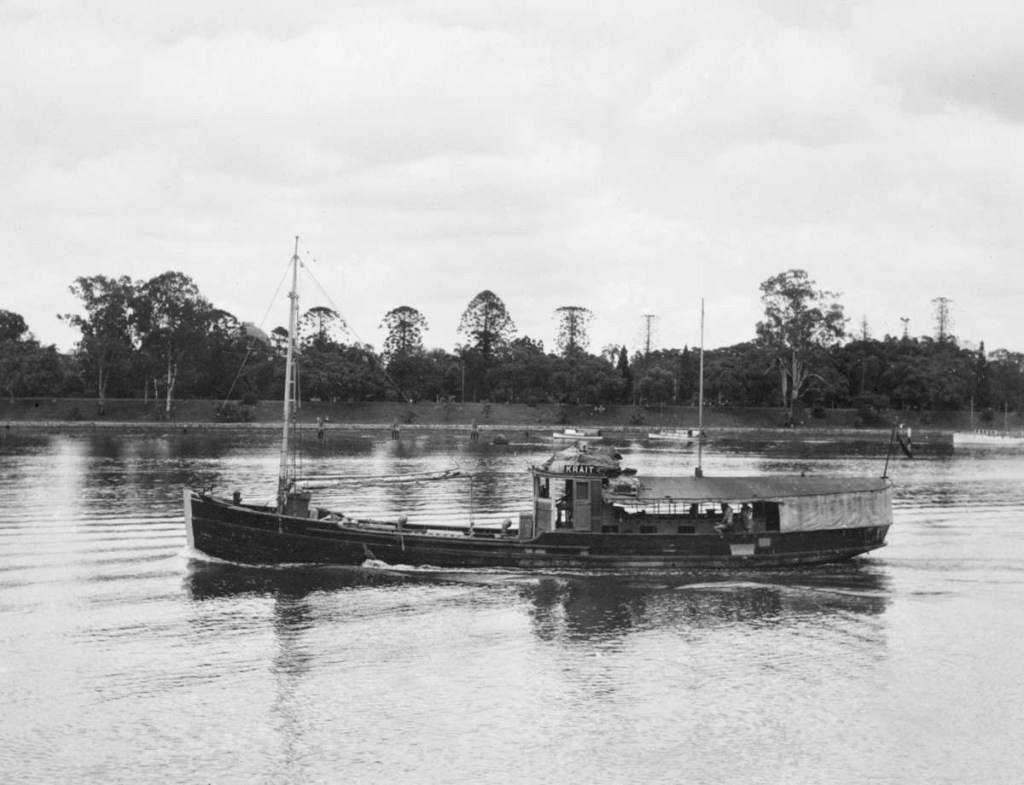
    MV Krait in Brisbane 1943. Courtesy AWM.

       Following the success of Operation Jaywick, the Krait was based in Darwin and used to support coast watchers and other intelligence operations, which reported on Japanese activities to Australia’s north. Commissioned into the Royal Australian Navy (RAN) in 1944, she was officially renamed HMAS Krait and, in September 1945, was present for the local Japanese surrender at Ambon.

       After the war, the Krait was employed by the British administration in Borneo until it was sold to a British-owned timber sawmill and renamed Pedang, meaning sword in Malay. In the late 1950s, a pair of Australian businessmen recognised the vessel’s historical significance and began fundraising to purchase her and have her returned to Australia.

       In 1964, the Krait came back to Australia, where it was operated and maintained by the Royal Volunteer Coastal Patrol. Then, in 1984, the Krait was handed over to the Australian War Memorial and berthed at the Sydney Maritime Museum. It is now on display at the Australian National Maritime Museum in Sydney.

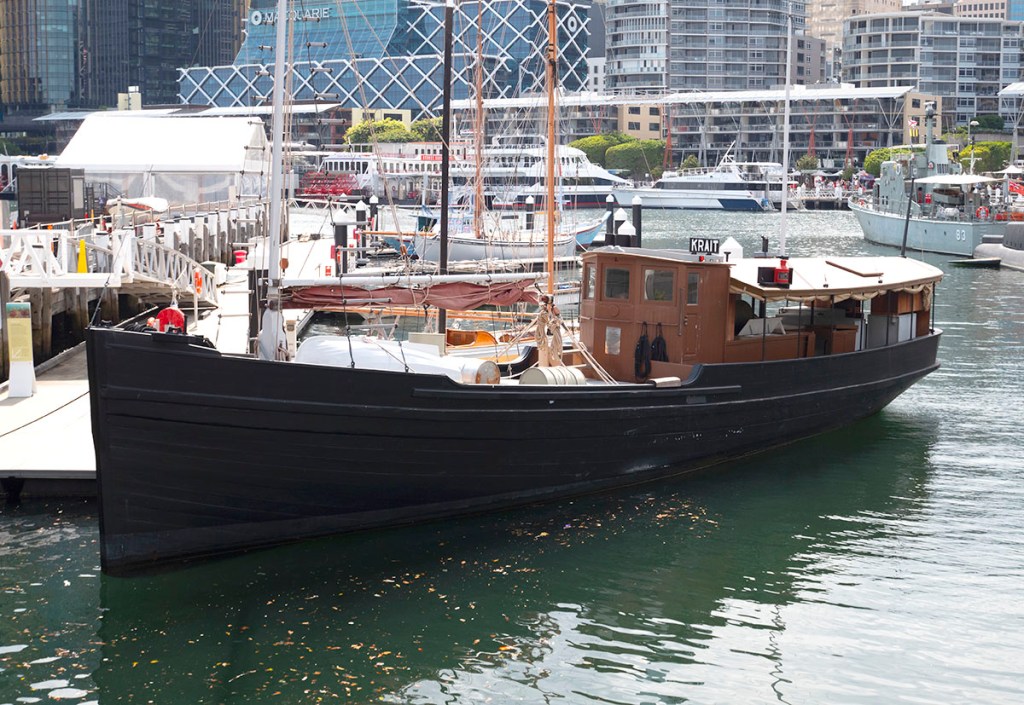
    MV Krait at the Australian National Maritime Museum, Sydney. Photo CJ Ison.

    Sources: 

    Australian National Maritime Museum: Articles on the Krait and Operation Jaywick.

    Royal Australian Navy: Article on the Krait and Operation Jaywick.

    Australian War Memorial: Article on Operation Jaywick.

    © Copyright C.J. Ison / Tales from the Quarterdeck, 2023.

    To be notified of future blogs, please enter your email address below.