Tag: Schooner

  • A Tale of Shipwreck, Murder and Piracy in the South China Sea

    Macao circa early 1800s. By Bjoertvedt – Courtesy://commons.wikimedia.org.

    Edward Luttrell could not have imagined the ordeal he was about to face as he sailed out of Macao Harbour on his return to Sydney, NSW, in November 1805. What followed was a five-month ordeal that started with a shipwreck and included murder, piracy and starvation in one of the world’s most dangerous waterways.

    Luttrell was the son of Edward Luttrell Snr, the assistant colonial surgeon for Sydney and Parramatta. He was also the first mate of the 75-ton schooner Betsey under the command of Captain William Brooks.

    The Betsey departed Macau on 10 November, with a crew of 13, including the captain, Luttrell, and a crew comprising a mix of Portuguese, Filipino and Chinese mariners. But in the dead of night, just 11 days into her voyage, the Betsey struck a reef south of the Spratly Islands in the South China Sea.  

    Captain Brooks immediately sent some of the crew out in the jolly boat to set an anchor aft, hoping he could kedge the schooner back off the reef. However, the schooner would not budge, and eventually the cable snapped under the strain of trying. Huge swells surged over the stricken ship through the night pushing it further onto the reef. Once there was sufficient light to see their surroundings, Captain Brooks found that they were now stranded in two feet of water on a massive coral shelf that extended for miles in every direction.

    Captain Brooks and his men tried everything they could to get the schooner off the reef, but to no avail. After four gruelling days, the crew had been worked to exhaustion, and Brooks had no choice but to give up any hope of getting the schooner into deep water. On 24 November, they abandoned the Betsey in the jolly boat and a makeshift raft.  Brooks intended to make for Balambangan Island, about 200 km to the southeast.  But from the outset, they were hampered by a “brisk gale” blowing from the northwest. On that first day, the raft, with eight of the men, became separated from Brooks, Luttrell and the remaining three sailors in the jolly boat. They were never heard of again.

    For the next four days, it continued to blow hard, but as the sun rose on 29 November, land was sighted, which Brooks is reported to have supposed was “Balabae,” which might have been the northernmost point of Borneo south of their intended destination. By then, their supply of fresh water had been consumed, and they had been reduced to drinking their own urine to quench their burning thirst.

    The jolly boat was then becalmed before they could make landfall, and they spent the day under the burning sun.  That night, the wind came up again, and they were driven southeast again until they finally made landfall the next morning. Their first priority on landing was to find fresh water.  They soon found a stream and drank their fill, and then, while they were stumbling around in the forest looking for something to eat, they were met by a pair of Dayaks. The Dayaks gave them some fruit in exchange for a silver spoon, and the two parties each went their own way. Brooks, Luttrell and the rest of the castaways set up camp on the beach next to their boat, and the next morning, they were visited by more Dayaks. This time, they traded more silverware for fresh produce.

    According to Luttrell, the local men pointed at Balambangan visible in the distance and indicated that the British outpost there had been abandoned. They also promised to return the next day with more food to trade.  Brooks, Luttrell and the others prepared the boat for departure early the next morning, intending to set off as soon as they had obtained more supplies. This was around 4 December.

    True to their word, the Dyaks returned, only this time there were nearly a dozen of them. It seems that when the visitors arrived, the jolly boat was already in the water, under the control of two seamen, while Brooks, Luttrell and the third Portuguese sailor were still waiting on the beach.

    Loondoo Dayak from the northwest coast of Borneo, Illustration from “Borneo and the Indian Archipelago,” by Frank S Marryat, 1848.

    We have only Luttrell’s account of what happened next, but he later claimed they had been conversing with the Dayaks, and all seemed well when they were attacked without warning. Captain Brooks was speared through the torso, while Luttrell and the Portuguese sailor were set upon. Luttrell parried off his attackers with his cutlass, giving him the precious few seconds he needed to wade out to the waiting boat.  The sailor, covered in his own blood, also made it into the jolly boat, but Captain Brooks was not so lucky. He pulled the spear from his body and tried to make a run for it, but he was easily caught and hacked to death.

    Luttrell and the others got clear of land, but the injured Portuguese sailor died of his wounds about 15 minutes later. This left just the mate and two seamen from the Betsey’s 13-man crew.  When Luttrell tallied their provisions, he found they had 10 cobs of corn, three pumpkins, and two bottles of fresh water. That would have to last them until they reached the Malacca Strait, over 1500 km away.

    They made steady progress on a southwesterly course under sail for the next ten days. While their food quickly ran out, they were fortunately kept well supplied with drinking water from frequent squalls that passed over them. However, by 14 December, they were starving and exhausted from the constant vigilance needed to avoid another attack in those dangerous waters.

    On 15 December, they were passing through a small group of islands in the Malacca Strait around 3N 100W. If their intended destination was actually the European settlement at Malacca, they had overshot it by some 200 km. Otherwise, it is not clear where Luttrell intended to stop.

    Anyway, it was here that three Malayan praus intercepted them. They tried to flee, but as soon as the praus came within range, they unleashed a volley of spears, killing one of the Portuguese sailors and wounding the other. Luttrell had a lucky escape when a spear passed through the brim of his hat, narrowly missing him. Unable to outrun the attackers and too weak to resist, Luttrell surrendered. The pirates boarded the jolly boat and stripped it of everything of value. A few remaining pieces of silver plate taken off the Betsey, the ship’s logbook, the sextant and even the clothes they had been wearing were all taken. Luttrell could not have held out much hope that he would survive much longer. But survive he did.

    He and the wounded Portuguese sailor spent three days on one of the praus, exposed to the blistering tropical sun and kept alive on a meagre diet of sago. They were then landed at an island, Luttrell named Sube, but which today offers no real clue to where they had been taken.  Luttrell wrote that they remained there “in a state of slavery, entirely naked, and subsisting on sago,” for nearly four months.

    Illustration of a prau from “Borneo and the Indian Archipelago,” by Frank S Marryat, 1848.

    Then, in late April 1806, they were put aboard a prau and taken away. After 25 days at sea, they landed in the Riau Islands. Luttrell and his companion were nearly starved to death. But their fortunes were finally about to change for the better. Luttrell wrote that a Mr Kock of Malacca took them in. The circumstances of their coming under his protection are not recorded. However, when Mr Kock returned to Malacca on the Kaudree, Luttrell and the Portuguese sailor were with him.   Luttrell seemed to recover from his ordeal and, in time, returned to Sydney.

    The incident was first reported in the Prince of Wales Island Gazette, and later republished in the Sydney Gazette on 1 March 1807.

    © Copyright C.J. Ison / Tales from the Quarterdeck, 2025.

    Please enter your email address below to be notified of future blogs.

  • The Loss of the Sydney Cove – 1797

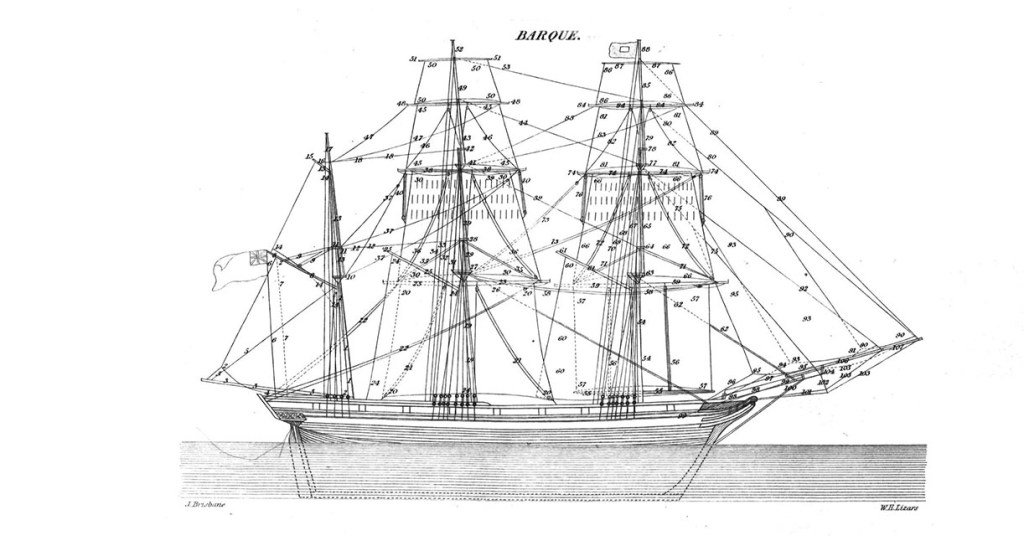
    A barque caught in heavy weather. Source: Tales of Shipwrecks and Adventures at Sea, 1856.

       In May 1797, a fishing party returned to Sydney with more than their daily catch. They had found three shipwreck survivors south of Botany Bay who told them that the merchant ship Sydney Cove had been wrecked somewhere far to the south. The survivors had trekked over 600 km along New South Wales’s rugged southern coast seeking help for their captain and shipmates who were still stranded with the ship.

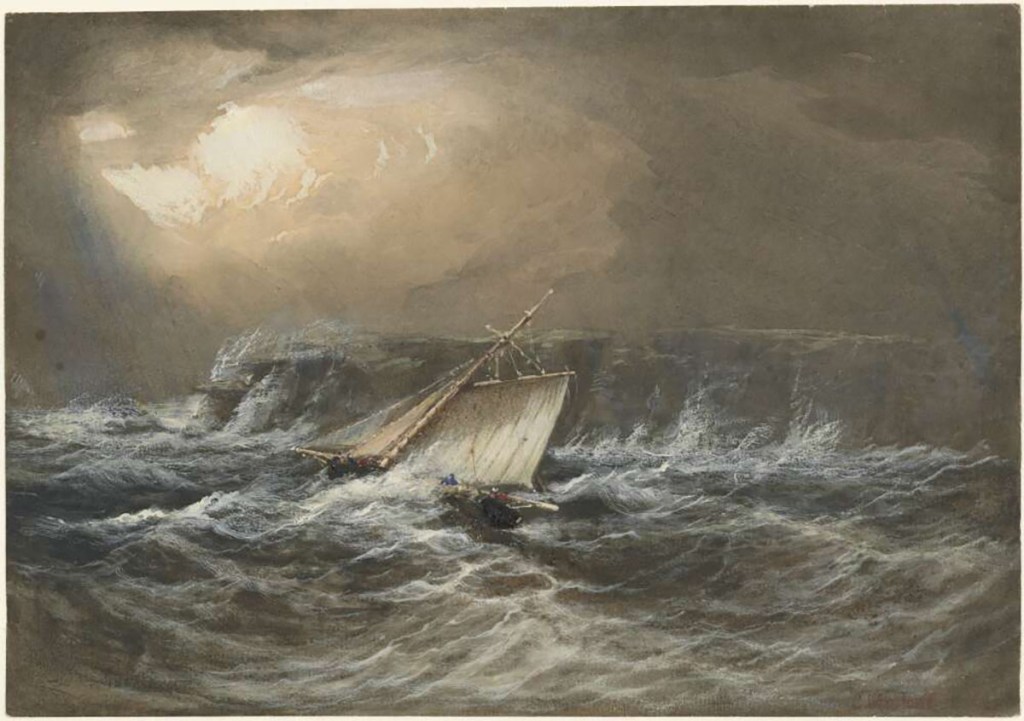
       On 10 November 1796, the 250-ton Sydney Cove had sailed from Calcutta with her hold full of Indian goods and produce the owners hoped to sell in Sydney. The crew, numbering close to fifty men, was a mix of Indian and European seamen under the command of Captain Guy Hamilton. About a month out, as she cleaved her way south through the Indian Ocean, the Sydney Cove was caught in a terrible storm and began taking on water. Initially, the leak was easily managed with the pumps, so Hamilton continued on his course to round Van Diemen’s Land (Tasmania) before heading north again and on up the New South Wales coast to Sydney.

       By January, as they sailed into the latitudes south of Tasmania, the ship was caught in the grip of another powerful storm. The leak began to worsen, and soon the pumps had to operate continuously to prevent the ship from sinking.

       As they headed up Tasmania’s east coast, they encountered yet more wild weather and heavy seas. By now, water was pouring into the hold faster than the men at the pumps could clear it. The barque was slowly filling with water. Captain Hamilton ordered all non-essential gear to be jettisoned to lighten the load, but that only put off the inevitable.   

    By 9 February, the water in the hold was lapping at the lower-deck hatches. Captain Hamilton realised he had no choice but to beach his ship to save her from foundering in deep water. If that were to happen, he would not only lose his ship and its precious cargo but also much of his crew, for they would not all fit on the Sydney Cove’s two boats. He found a sandy beach on what is today called Preservation Island in the Furneaux group and ran her ashore. Although Hamilton had saved the ship from sinking, his troubles were far from over.

    No illustration of the Sydney Cove exists but it likely looked similar to this example. Source: Nautical Dictionary by Arthur Young, published in 1863.

       Exhausted from constant bailing and battling through rough seas, Hamilton got the crew unloading much of the ship’s stores and cargo onto Preservation Island. But then the weary men discovered the casks of rum stacked among the cargo. Hamilton had to have the liquor taken to a neighbouring island to prevent his men from pillaging it. Captain Hamilton then organised his crew for a prolonged stay, for they had come ashore at a very remote part of the world. The crew erected shelters using sails and spars to give them refuge from the elements. Hamilton rationed everyone to one cup of rice per day, and though they sank a well and found water, it proved so brackish it was barely drinkable. However, their immediate needs were met. Then he turned his mind to their rescue.

       If they were ever to leave Preservation Island, they would have to send for help. It was agreed that the First Mate, Hugh Thomson, with 17 men, would sail north, keeping close to the New South Wales coast until they reached Sydney. Captain Hamilton and the remaining crew, numbering about 30, would remain with the ship.

       Several days after setting off, the longboat was driven ashore on Ninety-Mile Beach and smashed to pieces. Thomson and his men escaped with their lives, but they had little else. With no way to return to the Sydney Cove, their only chance of survival lay in continuing to Sydney, 600 km away, on foot.

       Thomson hugged the coast, knowing that as long as they kept the sea on their right, they would eventually arrive at the young settlement. However, that meant crossing many wide river mouths and scrambling over numerous rocky promontories along the way. The journey was gruelling and took a heavy toll on the men. Encounters with the indigenous peoples varied in nature. Some provided the castaways with food and water, while others were less sympathetic but allowed them to pass unhindered. Yet others set upon the interlopers on their land. Their numbers dwindled as some drowned crossing rivers or otherwise fell victim to the harsh and unforgiving terrain.

    The Sydney Cove party as depicted by Smiths’ Weekly in 1939. Smith’s Weekly 30 Sep 1939 p. 8.

       By late April, there were only three men left. However, they had managed to reach within 20 km of Botany Bay when fishermen finally discovered them. The fishermen took the survivors the rest of the way to Sydney in their boat. On learning of the loss of the Sydney Cove, Governor Hunter ordered vessels to be sent to rescue the remaining sailors and salvage the ship’s cargo.

       After being marooned for some four months, Captain Hamilton and the rest of the crew were in dire straits. Winter was fast approaching. Successive storms had mercilessly battered their shelters, and now they had gaping tears, offering the men little protection from the bitter weather. While they had been able to supplement their rice ration with seabirds nesting on the island, their diet still barely sustained life. To add to their sense of abandonment, they had seen several ships pass in the distance but had been unable to alert any of them to their presence.

       Then, on 10 June 1798, salvation arrived when the sloop Eliza sailed into view and dropped anchor a short distance off the beach. It was later joined by the schooner Francis, under the command of Lt Matthew Flinders. Both ships had left Sydney 10 days earlier under Governor Hunter’s orders. The crews loaded as much of the salvaged cargo as they dared, leaving five volunteers behind to watch over the remaining goods until it could be collected at a later date. Captain Hamilton and his men boarded the Francis and Eliza, and they headed for Sydney.   

    The weather was no less kind as the two small ships battled their way home. It took 15 days of hard sailing through storms and high seas for the Francis to reach Port Jackson. The Eliza never made it back to Sydney and was presumed to have sunk in the terrible weather with the loss of her own crew, plus eight shipwreck survivors. In total, about half of the crew of the Sydney Cove lost their lives.

       The shipwreck is historically significant for the trek undertaken by Thomson and the others. They were the first Europeans to note an outcrop of coal in the Illawarra, which has defined the region to this day. Also, Captain Hamilton recorded strong south-westerly currents during his time on Preservation Island, suggesting there was a large body of water separating Van Diemen’s Land and the Australian mainland. The existence of the strait would later be confirmed by Matthew Flinders and George Bass and named after the latter.

    © Copyright C.J. Ison / Tales from the Quarterdeck, 2023.

    To be notified of future blogs, please enter your email address below.

  • The Life and Loss of HMSC MERMAID

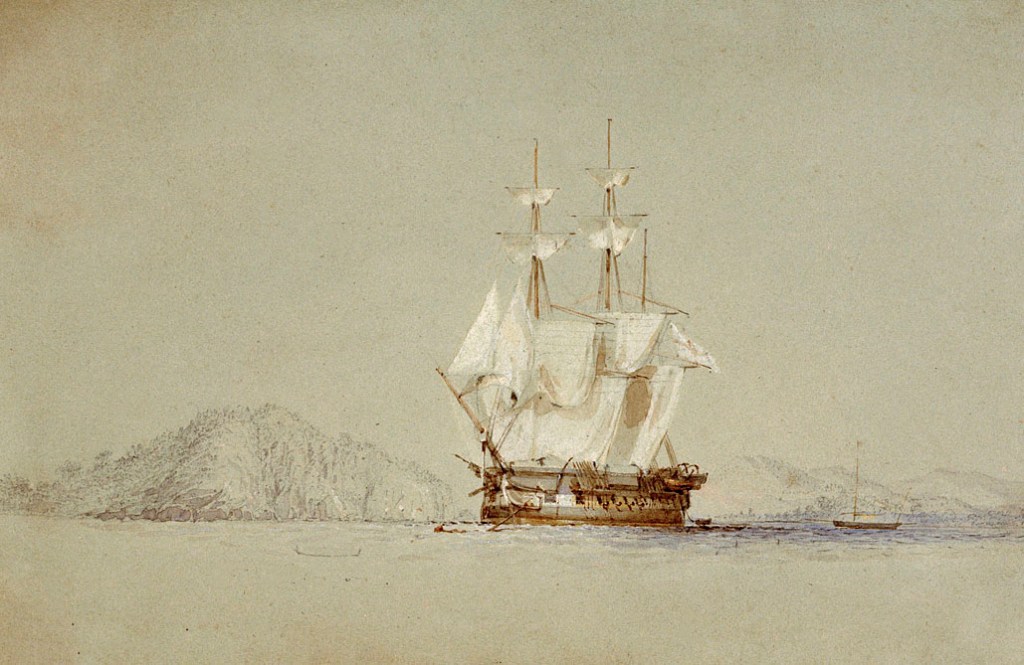
    HMSC Mermaid off Cape Banks, Dec. 4, 1820, by Conrad Martens. Image Courtesy National Library of Australia.

       Between 1818 and 1820, the small survey cutter HMSC Mermaid played an important role in charting Australia’s vast coastline. So, it is perhaps ironic that her last voyage should have been cut short on an uncharted reef off the north Queensland coast.

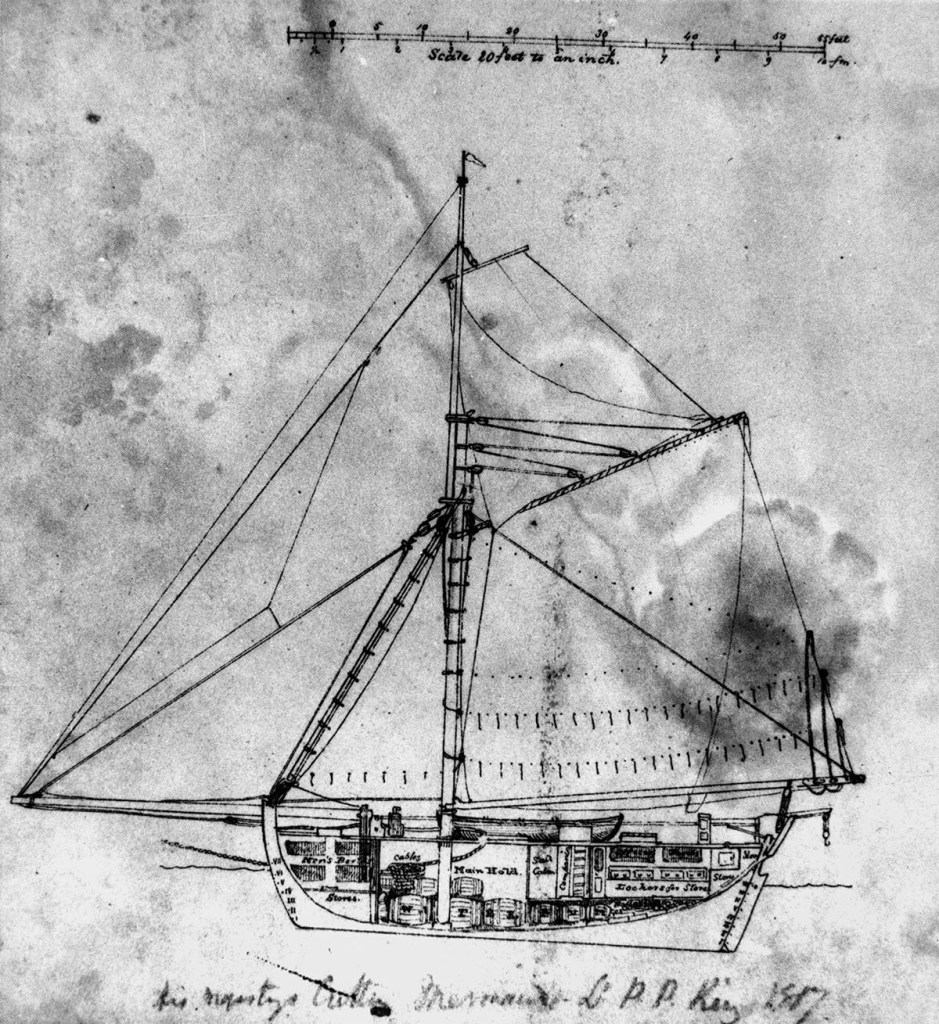
       The Mermaid was an 84-ton cutter launched in Calcutta in 1816. She arrived in New South Wales the following year and was soon purchased by the Government to undertake survey work requested by the British Admiralty.

       Lieutenant Phillip Parker King was dispatched to Australia to carry out a detailed survey of the Australian coastline, particularly those areas bypassed by Matthew Flinders. The son of former NSW Governor Phillip Gidley King, he had been born on Norfolk Island in 1791. On the family’s return to England and completion of his schooling, the young King joined the Royal Navy. He was given command of the Mermaid and got to work.

    Lt Phillip Parker King. Unknown artist. Courtesy State Library of NSW,

       HMSC Mermaid made three extensive voyages under King. They sailed from Sydney on 22 Dec 1817, bound for Australia’s northern and northwest coasts via Bass Strait and Cape Leeuwin. The crew included two sailing masters, 12 seamen and two boys. On board were also the botanist Allan Cunningham and Bungaree, a Kuring-gai man from Broken Bay who had also circumnavigated the continent with Matthew Flinders on the Investigator.

       At Northwest Cape, King surveyed and named Exmouth Gulf before continuing north along the coast until they reached Van Diemen’s Gulf and Cobourg Peninsula. From there, they sailed to Kupang on Timor Island to resupply, where they remained for two weeks. King then set sail for Sydney, returning down the West Australian coast. The return trip was marred by rough weather and a shortage of manpower. Several of the crew had become seriously ill shortly after leaving Timor, and one of them subsequently died. Despite the hardships, the Mermaid arrived back in Sydney on 29 July 1818 after an absence of seven months and seven days.

       Between December 1818 and January 1819, King sailed to Van Diemen’s Land and undertook a survey of Macquarie Harbour, which would soon become the site of one of the convict era’s most brutal places of punishment. Their work done there, the Mermaid was back in Sydney in late February, and in May she was off again.

    Lt King’s survey cutter ‘Mermaid’ Photo courtesy State Library of Queensland.

       The third voyage, and King’s last in the Mermaid, saw them sail up the east coast of Australia on a circumnavigation of the continent. On 20 July, while sheltering in a bay he named Port Bowen at latitude 22.5 S (not to be confused with the present-day township of Bowen), the Mermaid ran aground and became stuck. It was only after considerable effort that the crew were able to warp the vessel into deep water, but she sustained serious hull damage in the process. The full extent of the injury would only become apparent months later.

       The Mermaid continued north, passed through Torres Strait and King again started making a detailed survey of the north-west coast. However, the cutter had been taking on water ever since its beaching at Port Bowen. By September, she was leaking so badly that King was compelled to careen the vessel and attend to the leaking hull. With repairs completed as best they could, he then cut short his survey and ran down the west coast, across the Great Australian Bight, returning to Sydney in December. However, the Mermaid was very nearly wrecked within sight of her home port.

       As they passed Jervis Bay, the wind was blowing strongly from the east-south-east and visibility was much reduced by heavy rain. Lt King steered a course that he thought would find them off Sydney Heads the following morning. But at 2 o’clock in the morning, King, thinking they were still 30 km from land, was surprised when a bolt of lightning revealed they were sailing directly towards Botany Bay’s south head. The Mermaid only just cleared that hazard but lodged on a rock off the north head before being lifted off by a large wave. She ploughed through breakers within metres of the rocky promontory with the sea surging and foaming around them. It was a very close call, but they were soon safely inside Sydney Harbour without further incident.

       Lt King made his fourth and final survey in the Bathurst while the Mermaid underwent much-needed repairs.   But that was not the end of the little cutter’s adventures.   She was decommissioned from the Royal Navy and taken over by the NSW colonial government, where she continued to serve with distinction.

    Mermaid being repaired during King’s voyage. Engraving by John Murray 1825. Image courtesy National Library of Australia.

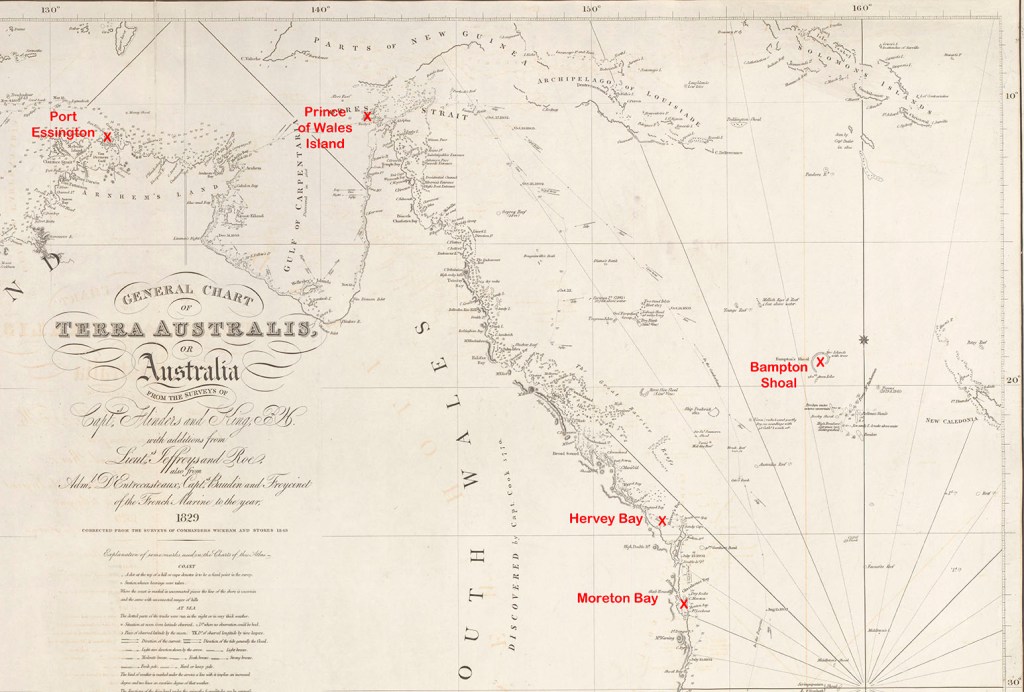
       In 1828, the Mermaid received a major overhaul, including re-planking, new copper sheathing, and, most importantly, being re-rigged as a two-masted schooner. Then, in early 1829, she was tasked with helping dismantle the failed settlement at Raffles Bay on the Cobourg Peninsula. Once done there, they were to make for the remote settlement of King George Sound (present-day Albany) to deliver stores and dispatches. Under the command of Captain Nolbrow, the Mermaid departed Sydney on 16 May and headed north, keeping to the inner passage inside the Great Barrier Reef.

       Tragedy struck at 6 o’clock in the morning on 13 June when, about 35 km south of present-day Cairns, the Mermaid ran grounded on a reef not recorded on King’s recently published naval chart. At 8 p.m., Captain Nolbrow and his crew, 13 men in all, took to the lifeboat with the hold bilged and water already over the cabin deck.

       Twelve days later, as they continued north towards Torres Strait, the castaways were picked up by the Admiral Gifford. The Admiral Gifford was a 34-ton schooner on a speculative voyage through Australia’s northern waters and was ill-equipped to carry so many additional passengers. On 3 July, Nolbrow and his crew were transferred to the much larger Swiftsure, possibly in the vicinity of Pipon Island. Unfortunately, the Swiftsure was wrecked two days later near Cape Sidmouth and her crew, along with the Mermaid’s, were rescued by the Brig Resource.

       Captain Nolbrow and his men eventually made it back to Sydney via the Swan River settlement (present-day Perth) in November 1829. The remains of the Mermaid were discovered on Flora Reef in 2009.

     © Copyright C.J. Ison / Tales from the Quarterdeck, 2023.

    To be notified of future blogs, please enter your email address below.

  • Elegant and Fast: The Huia schooner

    Huia topsail schooner

    The New Zealand topsail schooner Huia has long been heralded as the best-looking vessel of her type and one of the fastest sailing.  

    Launched at Kaipara Harbour New Zealand in 1894, the Huia was built using Kauri planks over a puriri timber frame.   Measuring 35 metres (115 ft) in length and registered at 196 tons, she was purpose built for the timber trade.   For the first few years of her long career she shipped lumber to Sydney and brought coal back from Newcastle.

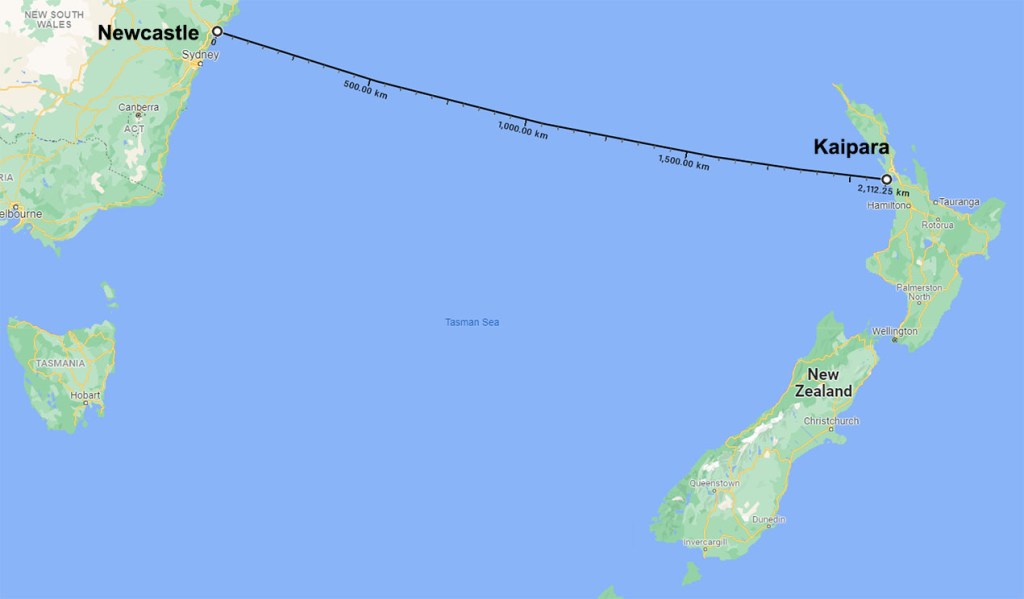
    The Huia soon earned a reputation as a very fast sailer on the notoriously dangerous Trans-Tasman route.   In 1895 Captain McKenzie reportedly made the run from Newcastle to Kaipara Harbour heads in four days and six hours.   For most of the passage she was pushed along by gale force winds while the seas continuously swept over her deck.   

    Topsail schooner HUIA

    On another voyage she was said to have logged 510 nautical miles (944 kms) in the first 48 hours after clearing Newcastle.   With every square inch of canvas out she clipped along at 14 to 16 knots.    That is a staggering 26-30 kilometres per hour.

    Her fast Tasman Sea crossings, however, did not come without risk.   After one “tempestuous passage” the Newcastle Herald reported, “the gales met by the little vessel were from south-west and south, and they were accompanied by heavy seas throughout, the decks being kept in a chronic state of flood.   Whilst diving bows into the seas on Tuesday last Huia lost her jibboom, and a day or two previous her fore shroud was carried away.”(1)

    In 1897 the little ship was fitted with an auxiliary engine and continued making record breaking passages between New Zealand ports and across the Tasman.   In 1912 she was sold to the Nobel Explosives Company.   And, through the first few decades of the 20th Century her classic lines made her a favourite vessel in many Australian ports from Cairns to Hobart, and from Melbourne to Fremantle.

    By the 1930s the age of sail had past. The beautiful “white-hulled” sailing vessel was one of only two top-sail schooners working out of Melbourne.

    Huia schooner. Photo courtesy State Library of Victoria.

    In 1950 the ship began carrying cargo and passengers between islands in the South Pacific.   Her time came to an end in 1951 when she was wrecked on a coral reef in New Caledonia.  

    © Copyright Tales from the Quarterdeck / C.J. Ison

    (1) Newcastle Herald, 8 June 1895, p. 4.

    To be notified of future blog posts please enter your email address below.