Tag: #Royal Navy

  • The Mystery of the Peri

    HMS Basilisk overhauls the Peri off the Queensland coast. Courtesy: National Maritime Museum, Greenwich London.

       In February 1872, the crew of HMS Basilisk found 14 men barely clinging to life on a derelict schooner adrift off the far north Queensland coast. The vessel’s name was not immediately apparent, and none of the survivors spoke English. It was a mystery as to how the ship came to be in those remote northern waters, and one that would take some time to solve.

       The side paddle steamer HMS Basilisk was steaming up the Queensland coast on a three-month cruise around Torres Strait. They were to deliver stores to the government settlement at Somerset, chart several recently reported navigation hazards and generally show the flag in that remote part of the continent.

       When the Basilisk was in the vicinity of Hinchinbrook Island, a lookout sighted a small fore-and-aft schooner off in the distance. It was rare to come upon another ship in those waters, so Captain John Moresby called for his telescope and examined the ship more closely. It was immediately clear to the master mariner that not all was as it should be with the strange vessel.

       Moresby noticed that the schooner sat heavily in the water as she sluggishly rode the long, smooth swells. His first thought was that her crew must have abandoned her for some reason. As the Basilisk drew closer, Moresby could see that her weather-beaten sails were poorly set and flapping loosely in the light breeze. The rigging was slack, and there was no sign of anyone on deck.

    Illustration of the Basilisk’s discovery of the Peri. Source: Illustrated Australian News for Home Readers, 29 Feb 1872, p. 53

       When the Basilisk raised her ensign, signalling to the strange vessel to identify itself, they got no response. But as they drew nearer still, a couple of Pacific Islanders armed with muskets staggered to their feet near the schooner’s stern. Moresby then spotted several more men lying scattered on the deck. He sent two boats across to investigate.

       What the sailors found is best summed up in Captain Moresby’s own words: “… they were living skeletons, creatures dazed with fear and mortal weakness. As our crews boarded, other half-dead wretches tottered to their feet, fumbling too at rusty, lockless muskets. … They were dreadful to look at – being in the last stage of famine, wasted to the bone; some were barely alive, and the sleeping figures were dead bodies fast losing the shape of humanity, on a deck foul with blood.”

       The boarding party found several dead and decomposing bodies on the deck. There was five feet of putrid water sloshing about in the hold. The cabin had been ransacked, and the deck bore the marks of numerous axe strokes. Parts of the deck were also stained brown by large pools of what appeared to be dried blood. And, there was no fresh water or food anywhere to be found. All the evidence, Captain Moresby later recalled, pointed to a violent and tragic incident having taken place on board the schooner.    Moresby held a funeral service for the dead and buried them at sea. He then steamed towards Cardwell, 40 km away with the schooner in tow. He landed the 14 survivors, none of whom spoke any English, but for the word “Solomon.” Moresby assumed they meant they were from the Solomon Islands. He then continued North towards Torres Strait, leaving Midshipman Sabben in charge of several sailors and the schooner. He would collect them in a couple of months on his return to Sydney.

    HMS Basilisk commander – Captain John Moresby. Photo sourced from his autobiography Two Admirals.

        The pieces of the puzzle would slowly come together over the next weeks and months. After Sabben’s men had scrubbed the headboards clean, they discovered the schooner was called the Peri. The Peri had recently been reported missing in Fijian waters. On 27 December 1871, she had sailed from Viti Levu with approximately 90 “indentured” Pacific Islanders bound for a cotton plantation on Taveuni, 100 km away, but she never arrived.

       About 30 of those 90 men had been kidnapped in the Solomon Islands and taken to Levuka in Fiji. At the time, the South Pacific was in the midst of a cotton boom, and the white plantation owners struggled to find enough field workers or kanakas to tend their crops. Many Islanders fell victim to more unscrupulous “recruiters” who stopped at nothing to fill their quotas.

       At Levuka, kanakas were disembarked and sold to plantation owners to serve three-year contracts. At the completion of their time, it was the plantation owners’ responsibility to pay off their workers and return them to their home islands. The kanakas themselves were supposed to have willingly agreed to the arrangements and be appropriately compensated for their labour; however, that was not always the case.

       In this instance, the kidnapped Solomon Islanders were sent to an Australian plantation owner on Taveuni Island. But while in transit, they seized control of the cutter and escaped. The vessel was later found aground on a small island in the Yasawa group, and most of the men were recaptured a couple of weeks later.

       The other 60 or so Islanders who had been on the Peri had likely also been recently kidnapped. They had fallen into the clutches of a notorious blackbirder named Captain McLever. By December 1871, both groups of kidnapped men had been transferred to the Peri and were about to be sent to work on a plantation on Taveuni Island.   

    It is not entirely clear what happened next, but it seems the 90 kanakas rebelled, killed the captain and crew and seized the ship. Over the next six weeks, they sailed or drifted nearly 3500 km west until they were found by the Basilisk off the Australian coast. From the water in the hold and the general state of the ship, Moresby believed they had weathered at least one severe tropical storm during their passage. And judging by their emaciated state, food and water had run out long before they were rescued. The blood stains and axe marks led some to speculate that the survivors may have resorted to cannibalism, but that was never conclusively proved, and none of the bodies found showed signs of having been butchered.
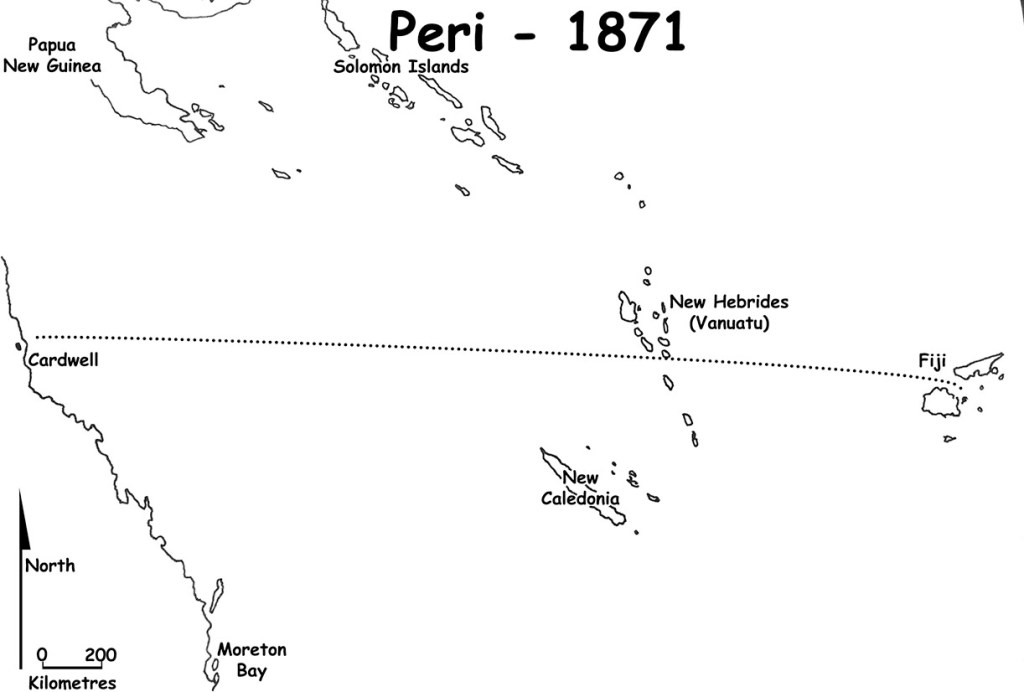
    Approx track of the Peri.

    By the time the Basilisks crew boarded the schooner, there were just 14 men still alive. One more would succumb soon after being put ashore at Cardwell.

       The remaining 13 Solomon Islanders were taken to Sydney by the Basilisk on her return from Torres Strait and eventually sent back to Fiji on HMS Cossack so they might be repatriated. However, eight jumped ship when the Cossack stopped briefly at Matuku Island, perhaps fearing they were being returned to Fiji to be punished. When the last five Peri survivors were finally questioned through an interpreter in Levuka, they told the British Consul that they had been kidnapped. They described how, when they paddled out to Captain McLever’s ship, their canoes were sunk and they had been beaten and locked in the hold.   

    McLever was arrested, and the Solomon Islanders were taken back to Sydney so they could testify at his trial. However, no one had thought to send a translator, and the case was dismissed for lack of evidence. The Islanders were sent back to Fiji, but what happened to them after that is unknown.

    1.Moresby. John RN, Discoveries and Surveys in New Guinea and D’Entrecasteaux Islands, John Murray, London, 1876, p.4.

    © Copyright C.J. Ison / Tales from the Quarterdeck, 2022.

    To be notified of future blogs, please enter your email address below.

  • Bligh’s Epic Open-Boat Voyage

    The Mutineers turning Lieut. Bligh and part of the officers and crew adrift from his Majesty’s Ship the Bounty / painted and engraved by Robert Dodd, 1790 London

    On 28 April 1789, Lt William Bligh was startled awake by his first mate, Fletcher Christian, and several other HMS Bounty sailors threatening his life. He, along with 18 members of his crew who wanted nothing to do with the unfolding mutiny, would soon be unceremoniously herded into a launch and set adrift. So began one of the great open-boat voyages in maritime history.

       To say the launch was overcrowded is an understatement. Measuring 23 feet (7 metres) in length, there was room for just half those on board. But, in addition to Bligh and his men, space had to be made for their provisions.

       The mutineers allowed them 70 kg of sea biscuits, 10 kg of salted pork, seven litres of rum, six bottles of wine, and 130 litres of water. For navigation, they were provided with only a quadrant and a compass. Fletcher Christian would not allow them to take a chronometer or any of the charts. A few clothes were thrown into the launch at the last moment, as well as four cutlasses for personal protection should they be foolish enough to venture onto any of the neighbouring islands. Lastly, the carpenter was allowed to take his toolbox, and the ship’s clerk had collected some of Bligh’s papers and belongings, including the captain’s nautical almanac. With the launch so heavily weighed down, it was in imminent danger of being swamped.


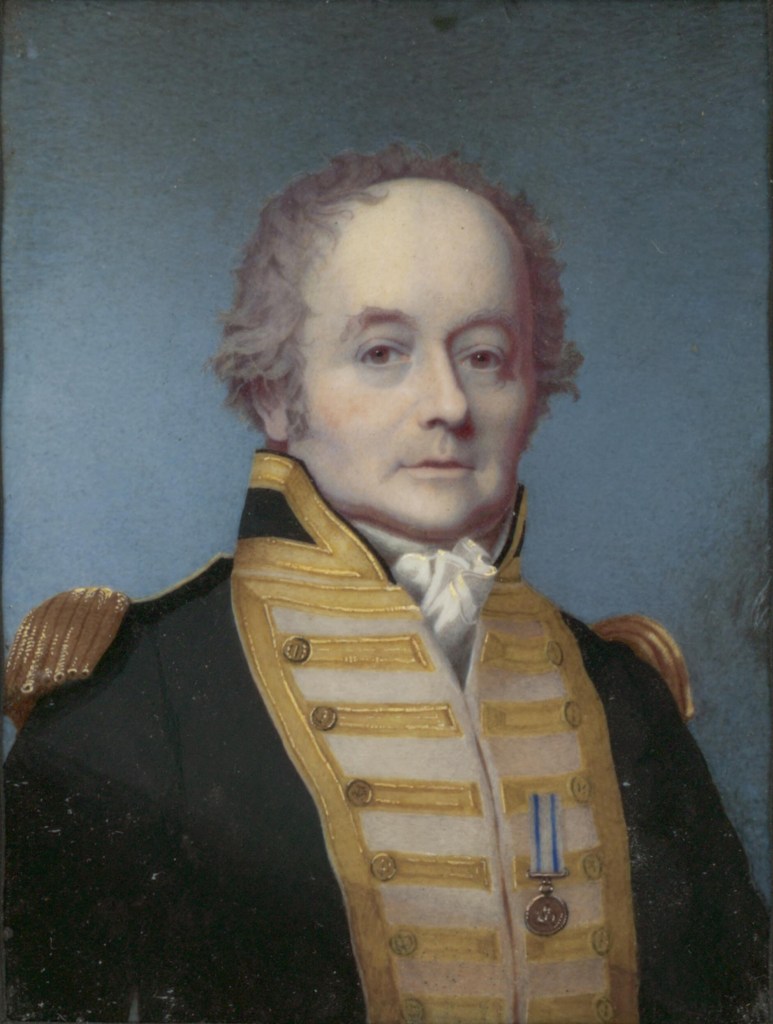
    Portrait of William Bligh By Alexander Huey – National Library of Australia, Public

    As the Bounty sailed away, Bligh and the others found themselves adrift in the South Pacific Ocean, a very long way from the nearest European settlements. With no viable alternatives, Bligh convinced his men that they should make for the Dutch settlement of Kupang on Timor Island, some 3,500nm (7,000 km) away. But before they could set off on the long voyage, Blight felt they needed to add to their stores. At first glance, the provisions might seem bountiful, but shared among so many people, they would last little more than a week without strict rationing.

       Bligh made for the nearest land, Tofua Island, about 50 km away, to stock up on fresh produce. Initially, the Islanders seemed friendly and happy to trade. But after a couple of days, the mood inexplicably changed. Bligh and his men suddenly found themselves fleeing for their lives under a hail of hurled rocks. One man was felled on the beach, but the rest managed to get away in the launch.   

    But the assault continued. Rocks still rained down among them, thrown by islanders who pursued them in a canoe. Reprieve only came when the launch finally outdistanced the attackers. Bligh noted in his journal that almost all of them had been injured to some extent from the barrage of stones. But they had escaped, though at the cost of one life. Bligh then set a course west through the South Pacific Islands towards New Holland (Australia). He decided that they would not risk stopping anywhere else along the way.

    A page from William Bligh’s logbook. Courtesy State Library of NSW.

    Sacrifices had to be made if they were ever to make it to Timor. Spare clothes, ropes and anything else not essential were tossed overboard to lighten the load and make more room. Even so, conditions remained so cramped in the boat that no one had room to stretch out their legs. Those not seated on the thwarts had to find room where they could, often on the floor with their backsides in a few inches of water. The carpenter’s chest was emptied of tools so it could be filled with sea biscuits to keep them out of the water sloshing around in the bottom of the boat.

       Bligh organised the men into two watches as they sailed west-north-west towards the Fijian Islands and beyond. Beginning on 4 May, they were battered by a powerful storm with gale-force winds and high seas. Water poured into the boat, forcing the men to bail continuously to keep afloat. The storm raged until the following evening, when the weather eased off for a short while.

       Over the next several days and weeks, they passed through the Fijian Islands and then the islands of Vanuatu as they steadily made their way west. The nights were brutally cold, but there was little let-up in the weather, and they remained soaked to the skin for days on end. The only reprieve from their misery came in the form of a small daily ration of rum.

       Even though Bligh had no chart, he was able to compare his observations, when he could make them, with known landmarks recorded in his almanac. Though they passed close to several islands, there was no appetite to go ashore for food despite their growing hunger. Their experience on Tofua was still fresh in their minds.

    Route sailed by the Bounty’s launch. Courtesy Google Maps.

    They began bearing more westerly as they crossed the Coral Sea and weathered several more powerful squalls. Mountainous seas and torrential rain again kept them bailing as hard as they could to remain afloat.

       Then, on 24 May, they were bathed in full sunshine for the first time in nearly two weeks. Over the following few days, they caught several seabirds. The precious little meat was shared out evenly and eagerly eaten raw. The birds also offered hope of another sort, for they signalled that they were approaching the Australian mainland.

       On 28 May, they reached the outer edge of the Great Barrier Reef, clearly delineated by a line of breaking white surf. Bligh pointed the bow towards a gap in the reef, and everyone hung on as they raced through the narrow passage. Once through the coral jaws, they found themselves in calm water in the vicinity of Cape Melville. Bligh then bore north, remaining close to the inside of the reef in hopes that they might catch some fish to supplement their diet.

       A couple of days later, they stepped ashore on what Bligh would name Restitution Island. After being confined to the boat for so long, they were all barely able to walk. Nonetheless, a fire was started using Bligh’s magnifying glass to focus the sun’s rays, and a stew of sea biscuit and salted pork was augmented by some berries, oysters and other shellfish foraged from their surroundings.

       After several days recuperating, they reboarded the boat and island-hopped north until they reached Torres Strait. They then headed west again across open seas until Bligh estimated they were off the southern coast of Timor Island. On 14 June 1789, they sailed into Kupang Harbour, 47 days after the Bounty mutineers cast them adrift. Bligh noted that they were “nothing but skin and bones; our limbs were full of sores; [and] we were clothed in rags.” But they had survived a voyage few would have thought possible.

       The Dutch authorities tended to the survivors and arranged passage back to England; however, five would never see home, dying in their weakened state, probably from malaria, a disease not well understood at the time.     Bligh arrived back in the United Kingdom in March 1790, not to a hero’s welcome but to face a court-martial to explain the loss of his ship. The Court exonerated him and the incident had no noticeable impact on his career. Bligh eventually rose to the rank of Vice Admiral before retiring. He also served a tumultuous two years as the Governor of New South Wales until officers of the NSW Corps deposed him, but that’s a story for another occasion.

    © Copyright C.J. Ison / Tales from the Quarterdeck, 2023.

    To be notified of future blogs, please enter your email address below.

  • HMS Torch and the rescue of the Ningpo castaways

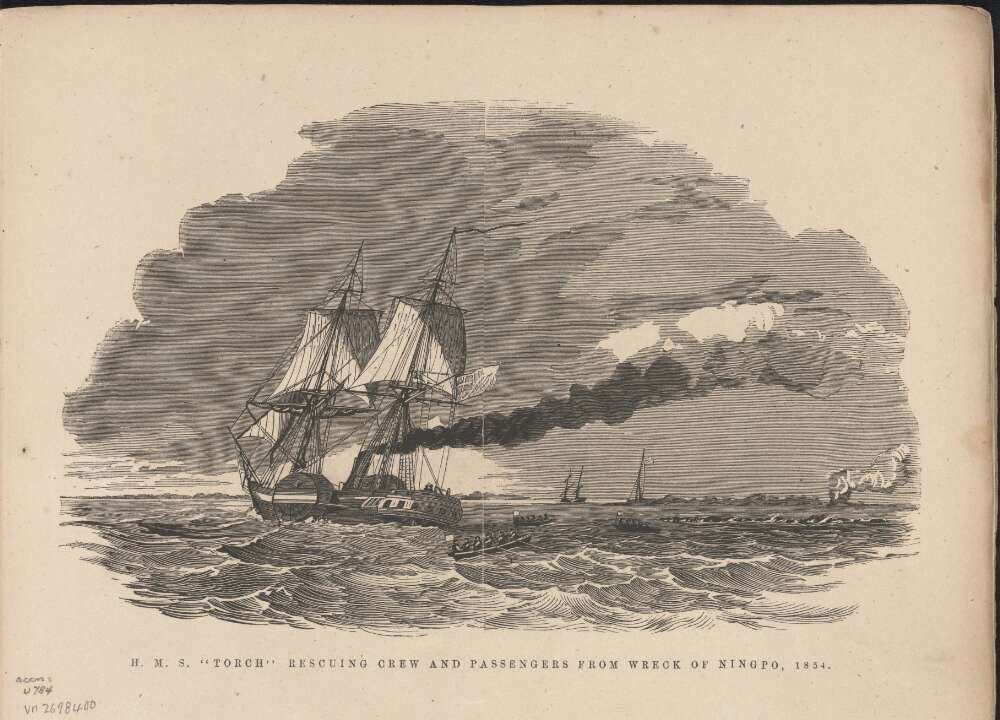
    HMS Torch rescuing crew and passengers from the wreck of the Ningpo, 1854. Illustration courtesy NLA.

       As Lieutenant William Chimmo was making HMS Torch ready for a return to sea, he was unexpectedly tasked with an urgent mission. Word had just reached Sydney that nearly 20 people had been marooned for two months on a remote island far out in the Coral Sea. By chance, his paddle steamer had just completed repairs and was eminently suited to the task at hand.

       Second Mate William Tough of the 150-ton junk-rigged schooner Ningpo had arrived in Sydney on 2 October 1854. He had staggered in to Moreton Bay with a tale of personal heroism and a plea for help to save his stranded shipmates, but there was no vessel there that could go to the Ningpo’s rescue. Tough was patched up and sent to Sydney on the next ship heading south.

       The Ningpo had departed Hong Kong on 15 April 1854, bound for Melbourne to take up new duties as a lighter in Hobson’s Bay. The voyage south had been a difficult one, plagued by storms, rough seas and a nagging leak which just kept getting worse. To add to Captain Billings’ woes, his chronometer stopped working. Unable to determine his longitude, accurate navigation had been reduced to nothing more than an aspirational stab in the dark. Billings decided they should pull into the French settlement at the Isle of Pines for repairs the Ningpo’s hull. But while still north of New Caledonia, he inexplicably changed his mind, opting to head for Moreton Bay instead.

       This meant sailing dangerously close to the D’Entrecasteaux Reef, a two-thousand-square-kilometre maze of submerged coral reefs, small islets, and sandbars. Its discoverer, French Admiral Antoine Bruni D’Entrecasteaux, called it “the most dangerous reef he ever saw.”

    Map of D’Entrecasteaux Reef

       By 8 p.m. on 28 July, Billings estimated that he was clear of those dangerous waters, but he was wrong. Minutes later, the Ningpo ran onto a submerged coral outcrop and began filling with water.

       Unable to get the Ningpo off, Captain Billings made the decision to abandon ship. He, his crew and two passengers made for a small sand island a few kilometres away. They set up camp using timber spars and canvas sails. They fabricated a still to distil fresh water from the sea. Food proved plentiful, as the waters surrounding the island teemed with fish, and the island itself was a nesting ground for turtles and was also home to thousands of seabirds.

       With their immediate necessities well catered for, thoughts turned to how they might escape. Their only means of leaving the island was a four-metre (13 ft) dinghy, the only lifeboat the Ningpo carried. Billings wanted to try to make the Isle of Pines about 600 km away, but his crew refused, fearing they would be killed by the inhabitants of New Caledonia long before they reached their destination. They wanted to send a small party to Moreton Bay, despite it being twice as far away. The captain and his crew were at an impasse.

       Even after they had been stranded for more than a month, they sill could not agree where they should go to seek help. Frustrated with the inaction, Tough and two others set off in the dinghy to make the perilous voyage to Moreton Bay without first seeking the captain’s permission. Billings was furious when he discovered that his boat, compass, and nautical chart were all missing. He was convinced that they would fail, and in so doing, Tough’s recklessness had condemned the rest of them to an endless stay on the island. However, most of the crew held on to the belief that they would soon be found by a passing ship. Billings was not so optimistic, for he knew he had taken his ship far from regular shipping routes and that no sailing ship would intentionally venture into these treacherous waters.

       But, despite Billings’ doubts, Tough and his companions reached Wide Bay on the Australian mainland 14 days later. As they beached their dinghy, a party of Aborigines attacked them, stole the boat and left them for dead. Ten days after that, however, the seriously injured Tough staggered into Brisbane, assisted by a couple of more hospitable Aborigines. Unfortunately, his companions were not so lucky, having died along the way. With no vessel available in Moreton Bay that could go to the rescue, Tough was sent to Sydney with a letter addressed to the Colonial Secretary, seeking assistance. After being stranded for more than 10 weeks, there was no guarantee that the Ningpo castaways would be found alive, but the authorities believed they were duty-bound to try.

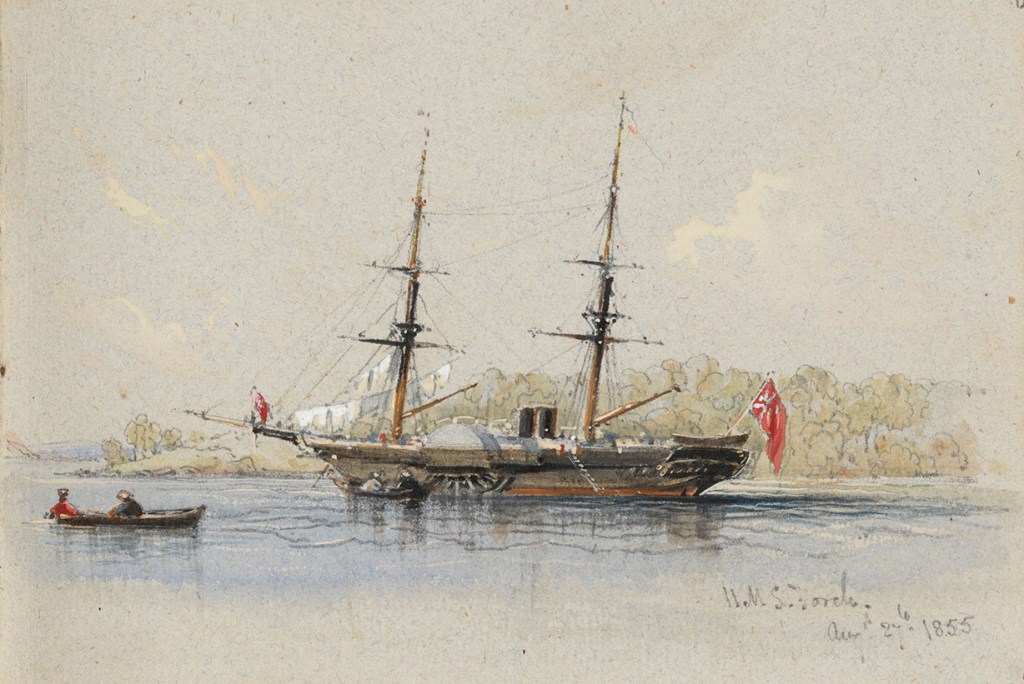
    HMS Torch at anchor, (probably in Sydney Harbour), by Conrad Martens. Courtesy State Library of NSW.

       Lt. Chimmo was ordered to steam out of port as soon as possible. Fortunately, his preparations to return to Fijian waters to continue his survey work were well advanced, so he was able to clear Sydney Heads the following night. He stopped in Newcastle only long enough to fill his coal bunkers before continuing north.

       Chimmo only knew that the Ningpo had run aground near a small island in the vicinity of latitude 18° 36’ South, the coordinate supplied by Tough and presumably recorded by Billings. The only charts available in Sydney that covered that stretch of ocean showed that the Ningpo was probably stranded somewhere near the Huon Islands. But the scale of the map offered little detail. HMS Torch would have to carefully pick its way through the reefs and shoals to find the castaways.

       The Torch battled unseasonal north-westerly winds for the first 11 days. Then the south-easterly trades finally resumed, and they made much faster progress. By mid-October, they had arrived at the search area, but then another delay beset them. Storm clouds began gathering, and Chimmo had no choice but to make for deeper waters until the weather cleared or risk the destruction of his ship.

       Meanwhile, Billings had finally convinced his men that they should wait no longer for help to arrive. After three months, it was clear that if they were ever to get off the island, it would be by their own means. He proposed building a boat from the remains of the Ningpo, and had already manufactured some rudimentary shipwright’s tools from cutlasses, knives and other metal objects they had salvaged from the schooner. Finally, his men realised they had a chance of success and embraced the idea. Unfortunately, the same storm that chased the Torch away also lashed their island, and Billings was forced to put their plans on hold for the time being.   

    When the storm finally cleared, Chimmo began his search of the Huon Islands. He sent search parties out in small boats to inspect each sandbar and islet they came across, but none showed any sign of recent habitation. Frequent rain squalls and strong winds hampered the search, and on one occasion, a boat capsized in the choppy seas, but no lives were lost. Then on the morning of 26 October, he spotted two islands in the distance.  

    The Ningpo wreck site. Map courtesy NLA.

       After the storm had passed, Billings and his men began preparing to go out to the Ningpo in a dugout canoe found in the bushy interior of the island. How it got there was a mystery, but it had been a godsend to the stranded sailors. But before they headed off to the wreck, a lookout spotted a ship in the distance, the first such sighting since they had landed. Signal fires were lit, and everyone lined the beach in anticipation of being rescued.

       As Lt Chimmo drew near to one of the islands, he saw two columns of smoke. Then, he spotted the stranded ship further off in the distance. Finally, he could make out people clustered on the beach. He fired a cannon to let them know they had been seen and gingerly made his way through the reef-strewn lagoon.

       Fearing the weather could deteriorate at any moment, boats were sent across the last couple of kilometres to collect the castaways. One of the first to step ashore was the Ningpo’s second mate, William Tough, who had volunteered to accompany the rescue. He had brought help, as promised, to the utter amazement of Captain Billings.   

    The whole boarding operation was completed that day. The Torch then sailed for Sydney, arriving on 10 December 1854, having completed a round trip of more than 4000 km.

    © Copyright C.J. Ison / Tales from the Quarterdeck, 2022.

    To be notified of future blogs, please enter your email address below.
  • HMS Guardian: All Hands to the Pumps

       In September 1789, HMS Guardian sailed from Portsmouth, England, with much-needed supplies for the newly established penal settlement in New South Wales. But its voyage was cut short when it struck an iceberg in the Southern Ocean and began filling with water.

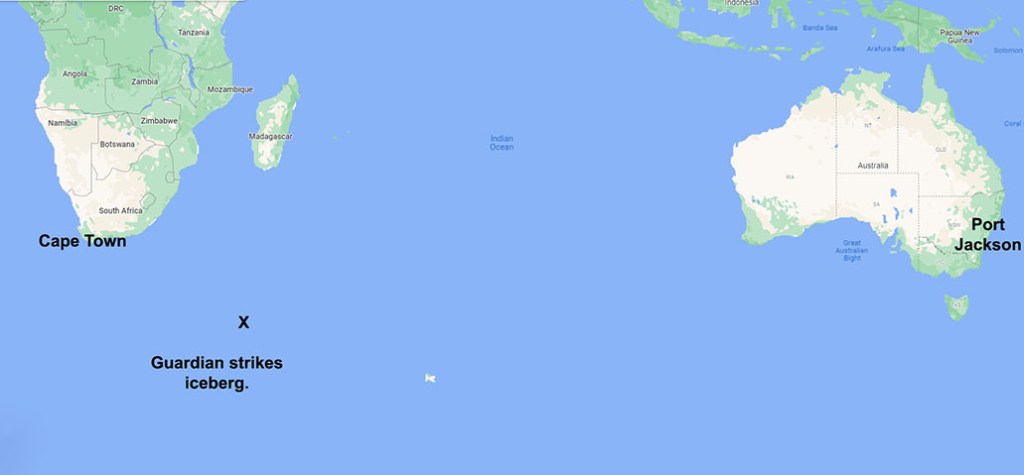
       After an uneventful passage south, the Guardian had stopped at Table Bay (present-day Cape Town) for a fortnight in early December. There, they took on board plants and livestock destined for the colony before setting off across the Southern Ocean for Australia.

       The sea conditions were almost ideal, except for a dense fog. There was little swell, and a gentle breeze filled the sails, pushing them east. Late on the afternoon of 24 December, when they were about 2,000 km away from the nearest land, the fog lifted, revealing an iceberg about six kilometres away.

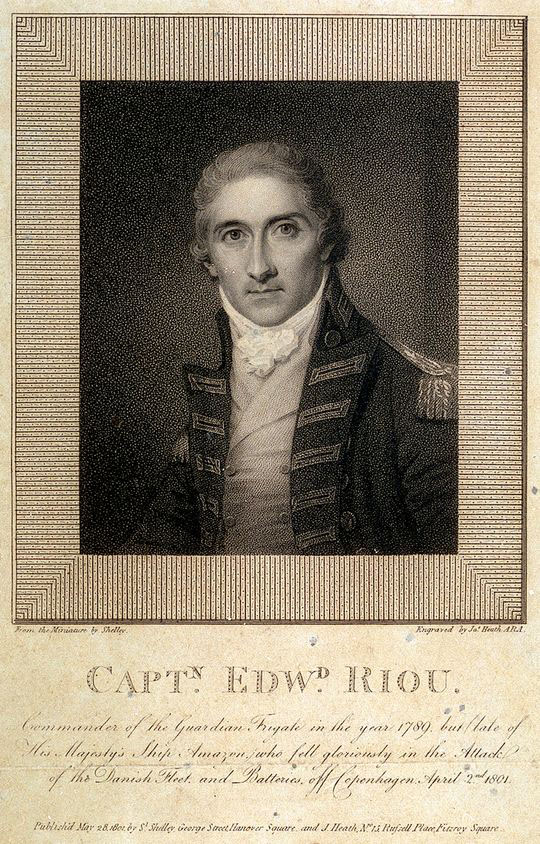
       After two weeks at sea, the ship’s water supply had been depleted by the additional animals and plants they were carrying. The captain, Lt. Edward Riou, seized the opportunity to resupply. He brought the Guardian to within 500 metres of the towering white mountain and sent two boats out to gather blocks of ice that were floating in the sea. 

    Captain Edward Riou, commander of the Guardian.

    By the time the heavily laden boats returned it was about 7 p.m. and the fog had once again enveloped the Guardian. By quarter to eight, Riou could barely see the length of his ship.

       Then, without warning, the Guardian crashed stern-first onto a submerged ice shelf projecting out from the berg. The force of the collision violently shook the vessel, causing the rudder to snap off. Riou was able to use the wind and the sails to back his ship off the ice, and for a brief moment, it seemed that disaster had been averted.

       However, upon sounding the wells, the carpenter reported that they were taking on a lot of water. The ship had sustained serious damage below the waterline. Riou ordered the pumps manned and the ship lightened. The crew started by throwing the livestock penned on deck over the side. They then began bringing stores up from the hold, and they were also tossed into the sea.

       By 10 p.m., it was clear that all the hard work was not going to save the ship. The water continued to gain on the pumps as the ship began to sit lower in the water. Soon she was so low that waves swept over the deck, threatening to pour into the hold through the open hatchways.

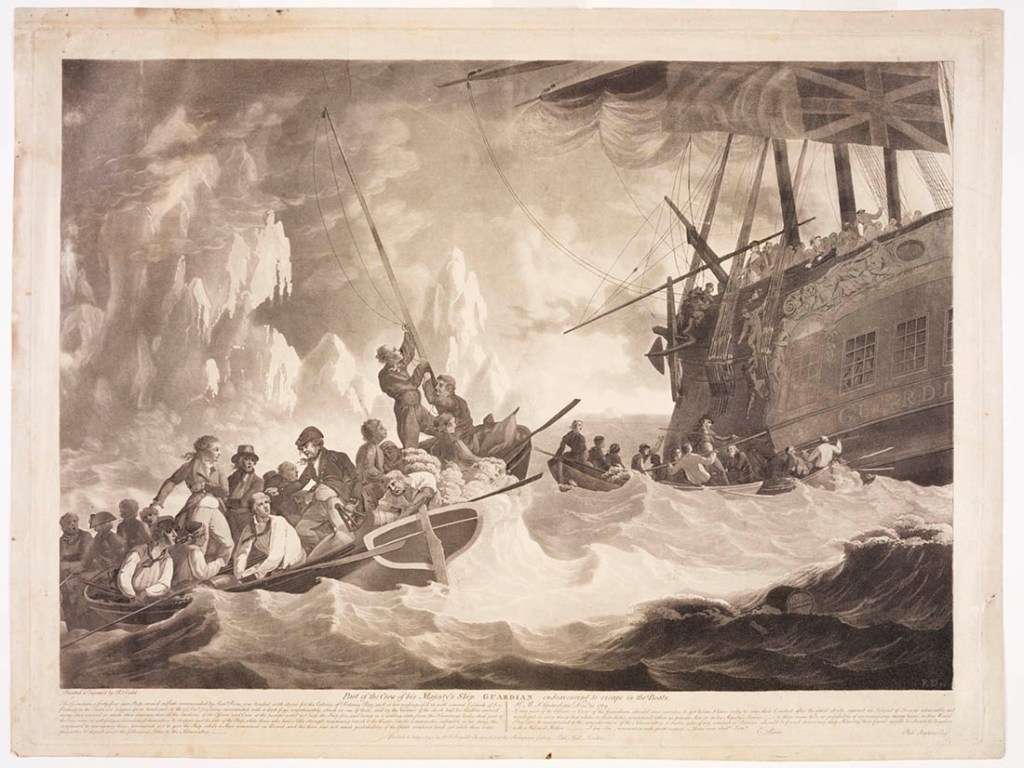
    Efforts to save the ship continued through the night and the next day. By now, the weather had deteriorated. The wind was raging around them, and mountainous seas rose, crashing into the stricken ship. By now, the crew were exhausted from their continuous exertions at the pumps and jettisoning cargo. Lt Riou finally accepted the inevitable and gave the order to abandon ship.

       There were 123 souls on board the ship, but the five lifeboats would only carry half that number. Riou, a maritime man to his core, had already decided he would remain with his ship to the end. But he encouraged anyone who wished to do so to take to the boats where they might stand some chance of surviving.   

    One lifeboat was lost immediately when it was lowered into the sea, but the other four got away and were soon out of sight. Sixty-two people chose to remain with the ship, including 21 of the 25 convicts being transported.

    Illustration titled “Part of the crew of his Majesty’s Ship Guardian endeavouring to escape in the boats.” Courtesy: State Library of NSW.

    To Riou’s and everyone else’s great surprise, the Guardian did not sink. Though she sat very low, her deck awash with frigid water, she remained afloat, barely. They would later learn that the cargo of barrels still trapped in the hold provided just enough buoyancy to keep the stricken vessel from sinking. Riou would also later discover that most of the ballast had been lost through a rent in the hull.

       A sail was draped under the ship to stem the inflow of water. The pumps were manned around the clock, and they slowly limped back to Table Bay. The relentless cold and wet conditions and sheer physical effort made the passage brutal. However, nine weeks later, they made it to False Bay, where the Guardian would soon break up on the beach.

       Of the 60 passengers and crew who had taken to the boats, only 15 survived. They were rescued by a passing ship after being adrift for nine days. The three other lifeboats that got away from the Guardian were never heard of again.

    Map courtesy Google Maps.

       Lt Riou was cleared of blame for the loss of his ship and was later promoted to the rank of Captain. He praised the performance of his officers and men and sought pardons for the convicts who had worked so resolutely to save the ship. But by the time the recommendation reached Port Jackson, one of the convicts had already been hanged for stealing, and six others had gone on to commit additional crimes and their pardons were revoked. But 14 men had their sentences overturned.

    (C) Copyright Tales from the Quarterdeck / C.J. Ison, 2022.

    To receive notifications of future blog posts enter your email address below.
  • HMS Boomerang 1891-1904

    HMS Boomerang 1891-1904

    HMS Boomerang anchored in the Fitzroy River at Rockhampton. Photo courtesy the State Library of Queensland.

    HMS Boomerang was a Sharpshooter-class torpedo gunboat which served at the Australia Station between 5 September 1891 and 22 August 1904.

    She was originally named HMS Whiting when construction began but renamed Boomerang shortly before sailing for Australia.   The Boomerang was 74 metres long, 8.2 metres beam, 2.59 metres draft and displaced 735 tons.  

    Crew on the deck of the HMS Boomerang firing a torpedo. Photo Courtesy State Library of Queensland.

    She was armed with five torpedo tubes and carried 15 torpedos, two quick firing 4.7 inch guns and four three-pounders. The Boomerang had a tops speed of 35 km/h (19 knots) and had a crew of 91.

    The Boomerang was part of the Royal Navy’s Australian Auxiliary Squadron which comprised 5 cruisers and two torpedo gunboats.   While there was no immediate or specified threat to Australia there was an underlying fear in this country of invasion from Russia dating back to the Crimean War.

    Sailors during training exercise on HMS Boomerang in 1892. Photo Courtesy State Library of Queensland.

    The Boomerang returned to England in August 1904 and was sold off in Plymouth the following year.

    © Copyright C.J. Ison, Tales from the Quarterdeck, 2022.

    To receive notification of future blog posts enter your email address below.