Tag: Rescue

  • HMS Torch and the rescue of the Ningpo castaways

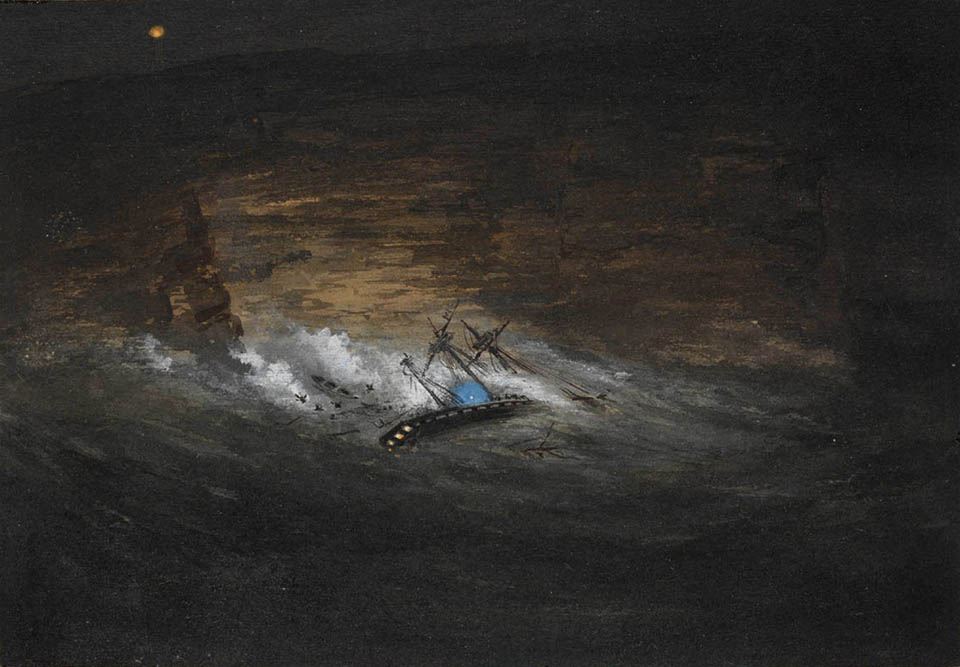
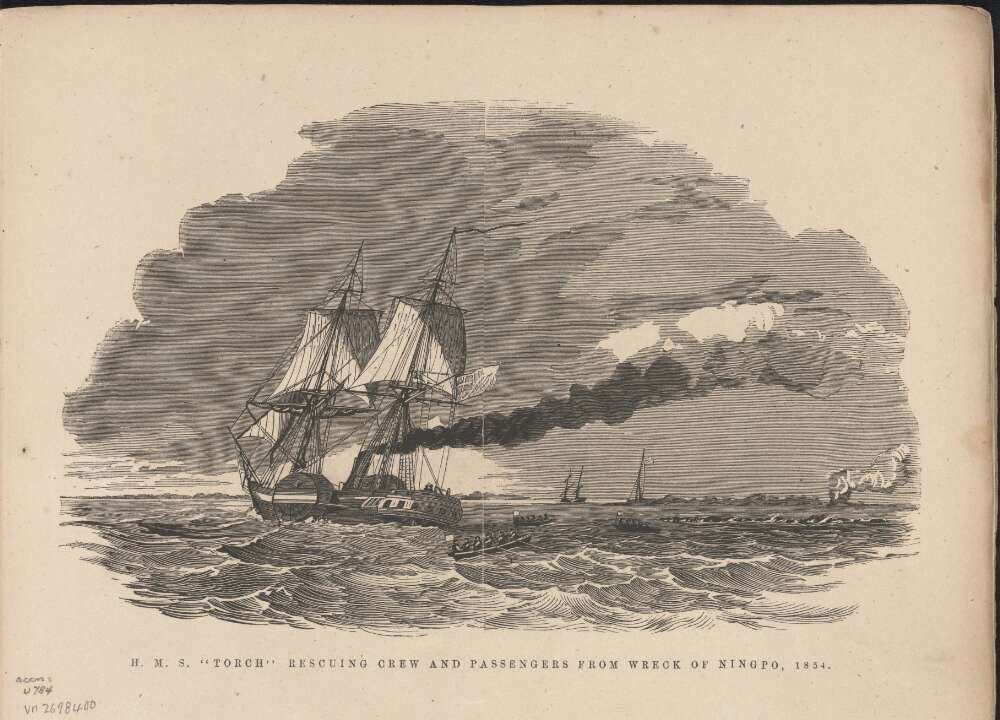
    HMS Torch rescuing crew and passengers from the wreck of the Ningpo, 1854. Illustration courtesy NLA.

       As Lieutenant William Chimmo was making HMS Torch ready for a return to sea, he was unexpectedly tasked with an urgent mission. Word had just reached Sydney that nearly 20 people had been marooned for two months on a remote island far out in the Coral Sea. By chance, his paddle steamer had just completed repairs and was eminently suited to the task at hand.

       Second Mate William Tough of the 150-ton junk-rigged schooner Ningpo had arrived in Sydney on 2 October 1854. He had staggered in to Moreton Bay with a tale of personal heroism and a plea for help to save his stranded shipmates, but there was no vessel there that could go to the Ningpo’s rescue. Tough was patched up and sent to Sydney on the next ship heading south.

       The Ningpo had departed Hong Kong on 15 April 1854, bound for Melbourne to take up new duties as a lighter in Hobson’s Bay. The voyage south had been a difficult one, plagued by storms, rough seas and a nagging leak which just kept getting worse. To add to Captain Billings’ woes, his chronometer stopped working. Unable to determine his longitude, accurate navigation had been reduced to nothing more than an aspirational stab in the dark. Billings decided they should pull into the French settlement at the Isle of Pines for repairs the Ningpo’s hull. But while still north of New Caledonia, he inexplicably changed his mind, opting to head for Moreton Bay instead.

       This meant sailing dangerously close to the D’Entrecasteaux Reef, a two-thousand-square-kilometre maze of submerged coral reefs, small islets, and sandbars. Its discoverer, French Admiral Antoine Bruni D’Entrecasteaux, called it “the most dangerous reef he ever saw.”

    Map of D’Entrecasteaux Reef

       By 8 p.m. on 28 July, Billings estimated that he was clear of those dangerous waters, but he was wrong. Minutes later, the Ningpo ran onto a submerged coral outcrop and began filling with water.

       Unable to get the Ningpo off, Captain Billings made the decision to abandon ship. He, his crew and two passengers made for a small sand island a few kilometres away. They set up camp using timber spars and canvas sails. They fabricated a still to distil fresh water from the sea. Food proved plentiful, as the waters surrounding the island teemed with fish, and the island itself was a nesting ground for turtles and was also home to thousands of seabirds.

       With their immediate necessities well catered for, thoughts turned to how they might escape. Their only means of leaving the island was a four-metre (13 ft) dinghy, the only lifeboat the Ningpo carried. Billings wanted to try to make the Isle of Pines about 600 km away, but his crew refused, fearing they would be killed by the inhabitants of New Caledonia long before they reached their destination. They wanted to send a small party to Moreton Bay, despite it being twice as far away. The captain and his crew were at an impasse.

       Even after they had been stranded for more than a month, they sill could not agree where they should go to seek help. Frustrated with the inaction, Tough and two others set off in the dinghy to make the perilous voyage to Moreton Bay without first seeking the captain’s permission. Billings was furious when he discovered that his boat, compass, and nautical chart were all missing. He was convinced that they would fail, and in so doing, Tough’s recklessness had condemned the rest of them to an endless stay on the island. However, most of the crew held on to the belief that they would soon be found by a passing ship. Billings was not so optimistic, for he knew he had taken his ship far from regular shipping routes and that no sailing ship would intentionally venture into these treacherous waters.

       But, despite Billings’ doubts, Tough and his companions reached Wide Bay on the Australian mainland 14 days later. As they beached their dinghy, a party of Aborigines attacked them, stole the boat and left them for dead. Ten days after that, however, the seriously injured Tough staggered into Brisbane, assisted by a couple of more hospitable Aborigines. Unfortunately, his companions were not so lucky, having died along the way. With no vessel available in Moreton Bay that could go to the rescue, Tough was sent to Sydney with a letter addressed to the Colonial Secretary, seeking assistance. After being stranded for more than 10 weeks, there was no guarantee that the Ningpo castaways would be found alive, but the authorities believed they were duty-bound to try.

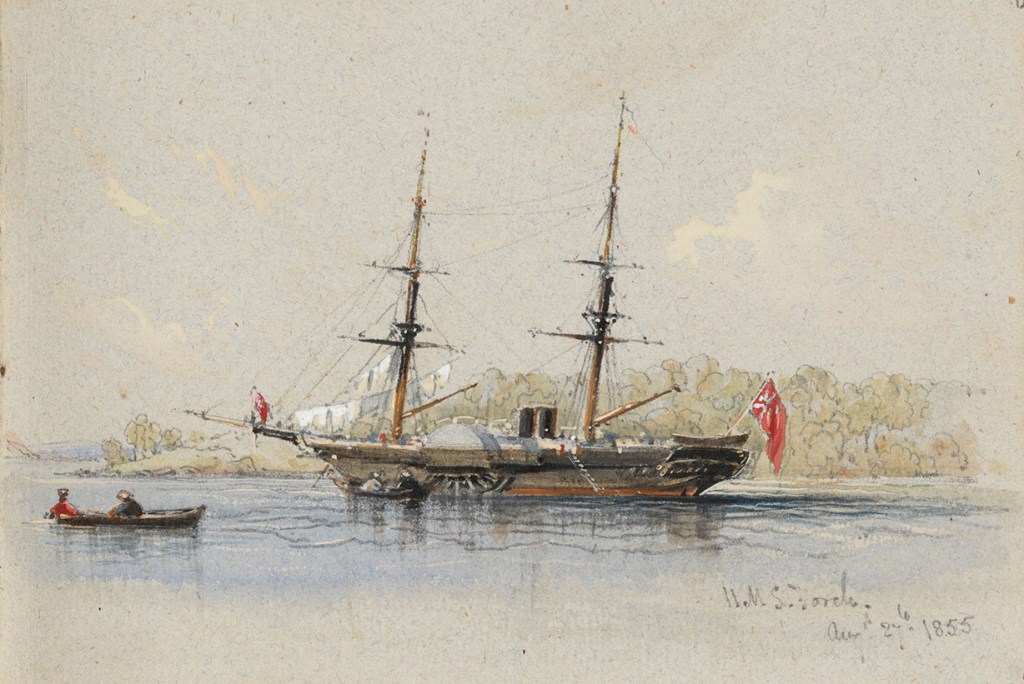
    HMS Torch at anchor, (probably in Sydney Harbour), by Conrad Martens. Courtesy State Library of NSW.

       Lt. Chimmo was ordered to steam out of port as soon as possible. Fortunately, his preparations to return to Fijian waters to continue his survey work were well advanced, so he was able to clear Sydney Heads the following night. He stopped in Newcastle only long enough to fill his coal bunkers before continuing north.

       Chimmo only knew that the Ningpo had run aground near a small island in the vicinity of latitude 18° 36’ South, the coordinate supplied by Tough and presumably recorded by Billings. The only charts available in Sydney that covered that stretch of ocean showed that the Ningpo was probably stranded somewhere near the Huon Islands. But the scale of the map offered little detail. HMS Torch would have to carefully pick its way through the reefs and shoals to find the castaways.

       The Torch battled unseasonal north-westerly winds for the first 11 days. Then the south-easterly trades finally resumed, and they made much faster progress. By mid-October, they had arrived at the search area, but then another delay beset them. Storm clouds began gathering, and Chimmo had no choice but to make for deeper waters until the weather cleared or risk the destruction of his ship.

       Meanwhile, Billings had finally convinced his men that they should wait no longer for help to arrive. After three months, it was clear that if they were ever to get off the island, it would be by their own means. He proposed building a boat from the remains of the Ningpo, and had already manufactured some rudimentary shipwright’s tools from cutlasses, knives and other metal objects they had salvaged from the schooner. Finally, his men realised they had a chance of success and embraced the idea. Unfortunately, the same storm that chased the Torch away also lashed their island, and Billings was forced to put their plans on hold for the time being.   

    When the storm finally cleared, Chimmo began his search of the Huon Islands. He sent search parties out in small boats to inspect each sandbar and islet they came across, but none showed any sign of recent habitation. Frequent rain squalls and strong winds hampered the search, and on one occasion, a boat capsized in the choppy seas, but no lives were lost. Then on the morning of 26 October, he spotted two islands in the distance.  

    The Ningpo wreck site. Map courtesy NLA.

       After the storm had passed, Billings and his men began preparing to go out to the Ningpo in a dugout canoe found in the bushy interior of the island. How it got there was a mystery, but it had been a godsend to the stranded sailors. But before they headed off to the wreck, a lookout spotted a ship in the distance, the first such sighting since they had landed. Signal fires were lit, and everyone lined the beach in anticipation of being rescued.

       As Lt Chimmo drew near to one of the islands, he saw two columns of smoke. Then, he spotted the stranded ship further off in the distance. Finally, he could make out people clustered on the beach. He fired a cannon to let them know they had been seen and gingerly made his way through the reef-strewn lagoon.

       Fearing the weather could deteriorate at any moment, boats were sent across the last couple of kilometres to collect the castaways. One of the first to step ashore was the Ningpo’s second mate, William Tough, who had volunteered to accompany the rescue. He had brought help, as promised, to the utter amazement of Captain Billings.   

    The whole boarding operation was completed that day. The Torch then sailed for Sydney, arriving on 10 December 1854, having completed a round trip of more than 4000 km.

    © Copyright C.J. Ison / Tales from the Quarterdeck, 2022.

    To be notified of future blogs, please enter your email address below.
  • Matthew Flinders and the loss of HMS Porpoise – 1803

    Loss of the Porpoise & Cato. Courtesy Wikipedia.


         Shortly after Matthew Flinders completed his historic circumnavigation of Australia, he was farewelled from Sydney to return to England as a passenger on board HMS Porpoise. To everyone’s astonishment, he returned to Sydney a month later to report that the Porpoise and another ship had run aground on a reef far out in the Coral Sea.

       HMS Porpoise, under the command of Lt Fowler, along with the merchant ships Cato and Bridgewater, departed Port Jackson on 10 August 1803, intending to remain together as they sailed north through the remote waters of north Australia. Ships regularly travelled in company, so one might come to the other’s aid should they get into difficulty. After all, the next European outpost after leaving Sydney was Kupang on Timor Island, 2,000 km west of Torres Strait and over 5,000 km from Sydney.

       On the afternoon of 17 August, the three ships passed a small island marked on the chart, which confirmed their position about 160nm (300 km) NE of Sandy Cape at the northern end of Fraser Island (K’gari). The chart showed no other obstacles in their path until they were ready to pass through the Great Barrier Reef, much further to the north.    As night took hold, they continued bearing NNE under reduced sail, pushed along by a southerly breeze. The Porpoise was out in front with the Cato and Bridgewater off her port and starboard quarters, respectively. Then, around 9.30 pm, the Porpoise’s lookout called “breakers ahead.” The Porpoise tried to veer off but without success, and she struck the uncharted reef. Likewise, the Cato attempted to steer away from the line of white water that indicated danger. However, she had insufficient room to manoeuvre and ran aground about 400m from where the Porpoise struck.

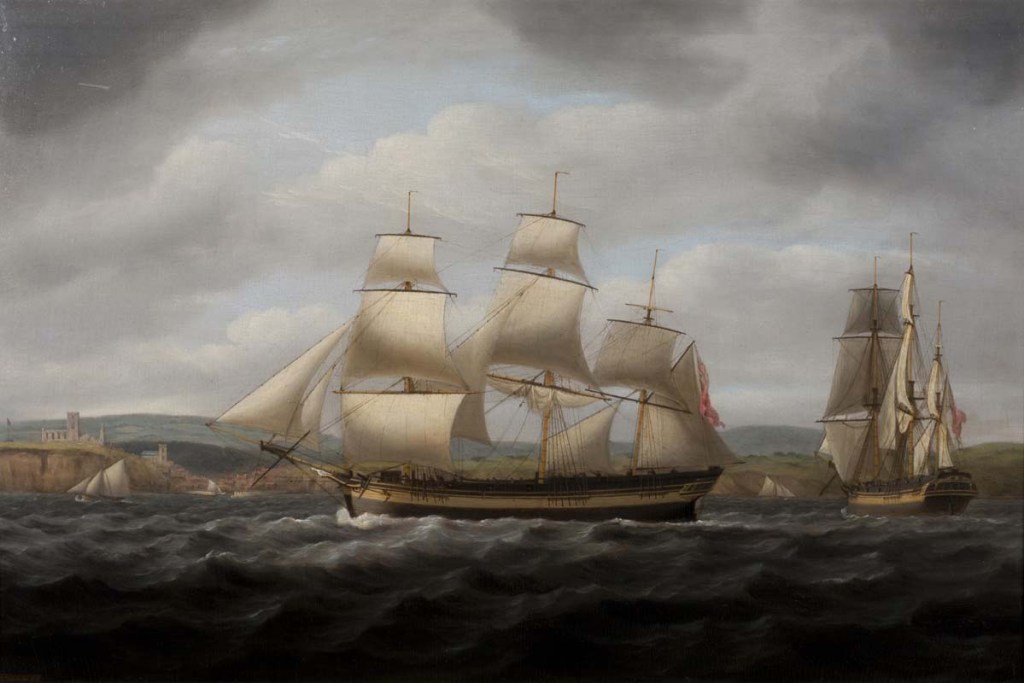
    The 430-ton Cato by Thomas Luny cira 1800.

         Fortunately, the Bridgewater missed the reef that claimed the other two ships. Her captain spent the rest of the night and the following morning trying to return so they might help any survivors. However, contrary winds and large seas hampered him, and he could not get close to the reef without risking his own vessel. He reluctantly continued on his way, leaving the survivors from the Porpoise and Cato to their fate.

       Meanwhile, the men on the stranded ships waited out the night. HMS Porpoise had gone aground broadside to the reef and heeled over so her strong hull took the brunt of the crashing waves. The Cato was not so lucky. She had also run aground broadside to the reef, only her deck lay exposed to the full force of the powerful waves, and she soon started breaking up. Her crew spent an anxious night clinging for dear life to the inner forechains.

       The next morning, the Porpoise’s small gig and a six-oar cutter were used to ferry the crews of both ships to a small sandy islet a short distance away. Over the next several days, they salvaged as much as they could from the two stranded wrecks. Casks of water, flour, salt meat, rice and spirits, along with live sheep and pigs were all brought ashore. They found they had sufficient provisions to feed the 94 castaways for the next three months. Most shipwreck survivors fared far worse.

    Captain Matthew Flinders, RN, by Toussaint Antoine DE CHAZAL DE Chamerel. Courtesy Wikipedia.

       On the morning of the 19th of August, Captain Matthew Flinders took command as the most senior naval officer present. Flinders, in consultation with Lt Fowler and the Cato’s captain, John Park, decided he should take the largest cutter and return to Sydney to get help. The three also agreed on a contingency plan should Flinders and his party fail to reach Sydney and alert the authorities. The ship’s carpenters would begin building two new boats from materials salvaged from the wrecks. If, after two months, the remaining survivors had not been rescued, Lt Fowler and the rest of the men should try to make for Sydney themselves in the new boats.   

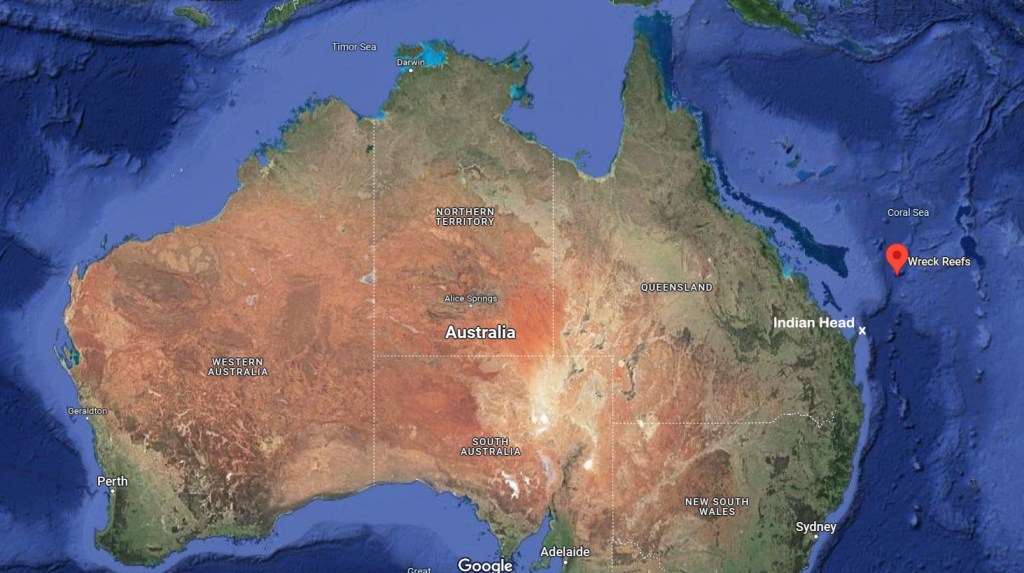
    Flinders’ cutter was fitted out with a deck to make it better handle the rough seas on the long voyage ahead. She was christened “Hope” and, on 26 August, nine days after striking the reef, Flinders, Park and twelve sailors set off to three loud cheers from their shipmates lining the shore.    They took sufficient provisions to last them three weeks, and Flinders set a course west so they would strike the Australian coast. On the evening of 28 August, they made land near Indian Head on K’gari Island and headed south, hugging the coast until they reached Sydney ten days later.

    Map showing Wreck Reefs where the Cato and Porpoise were wrecked in 1803. Courtesy Google Maps.

       Meanwhile, the carpenters got to work building the first of the two new boats. They named it Resource and had her afloat in about two weeks.  However, as they were working on the second boat, their supply of coal for the armourer’s forge ran out, halting construction. Lt. Fowler ordered that the Resource be sent with a work party to an island to the south to produce sufficient charcoal to complete the second boat.

    But, before they set off, the welcome sight of three rescue ships sailed into view. Flinders had made it to Sydney and returned with the fully-rigged ship Rolla, and the colonial schooners Cumberland and Francis, to rescue the survivors. Flinders might have got there a little earlier, but he had spent a couple of anxious days trying to find the uncharted reef. Most of the men were put on to the Rolla, which was on its way to China, while Flinders returned to Sydney on the Cumberland. Much of the stores and salvage from the wrecked ships were taken back to Sydney on the Francis and the newly built Resource. Remarkably, only three men were lost during the ordeal. The site of the disaster is now known as Wreck Reefs.

       Captain Flinders’ adventures did not end there. By the time he next left for England, Britain was at war with France. When his ship stopped at Mauritius, he was placed in detention until the end of hostilities. Flinders did not return to England until 1810. His book “A Voyage to Terra Australis”, detailing his voyages, was published in 1814.

    © Copyright C.J. Ison / Tales from the Quarterdeck, 2022.

    To be notified of future blogs, please enter your email address below.

  • The Dunbar Tragedy – 1857

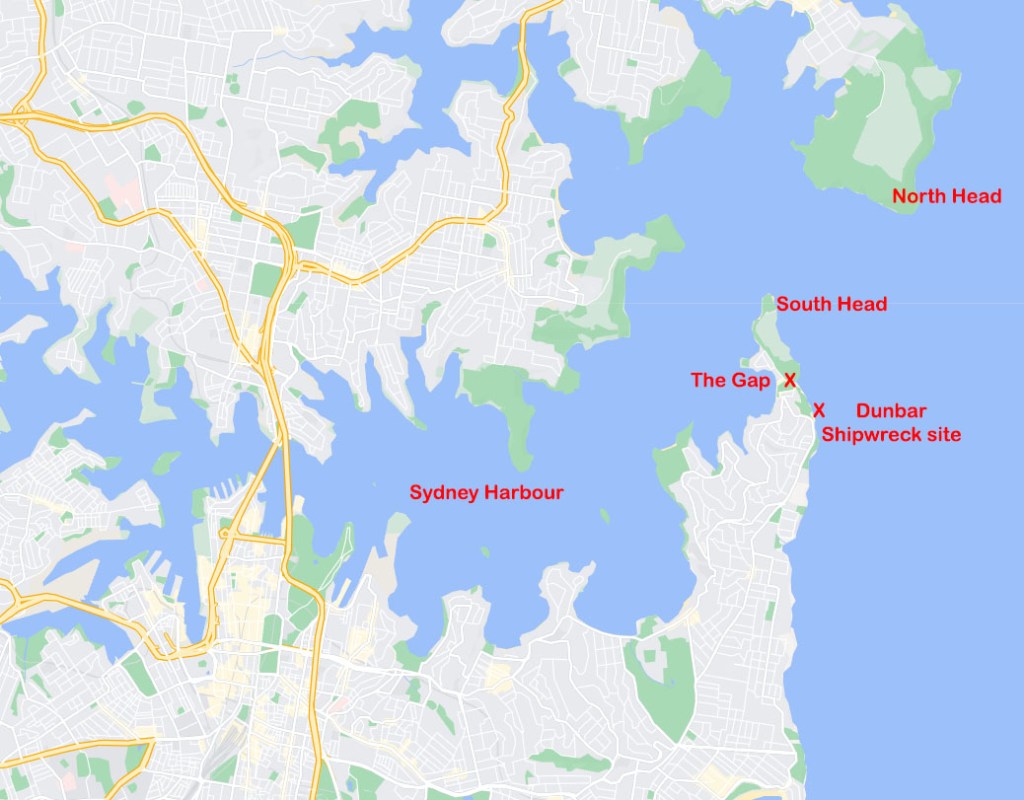
    The Dunbar shipwreck, by Samuel Thomas Gill, courtesy the State Library of New South Wales.

    The loss of the Dunbar in August 1857 was one of the more tragic and distressing shipwrecks to occur in Australian waters.   On the morning of Friday 21 August people living in Sydney’s East awoke to find wreckage and mutilated bodies dotted along the rugged coast and inside the harbour mouth.   A large ship had come to grief, but its identity would remain a mystery for much of that day.

    The weather on the night of 20 August was thick with heavy rain, strong winds and a powerful swell creating mountainous waves.    The Dunbar had sailed from London 81 days earlier and was making its way up the New South Wales coast nearing the end of its voyage.  

    She passed Botany Bay around 8.30 in the evening.  Then Captain James Green headed out to sea on a starboard tack under closely reefed sails.    They then changed course again heading towards the entrance to Sydney Harbour.   The captain sent the Second Mate to the forecastle and asked him to keep a good lookout for the North Head.  

    By Day and Son; Thomas Goldsworth Dutton; William Foster – http://collections.rmg.co.uk/collections/objects/140576, Public Domain, https://commons.wikimedia.org/w/index.php?curid=63202217

    Suddenly the Mate called out “breakers ahead,” as churning white water at the base of the cliffs materialised out of the inky gloom.   It was now a little after midnight.  Captain Green ordered the ship round but the surging seas drove her broadside onto the rocks before she could respond.  

    Passengers were jolted awake by the violent impact and streamed on deck in panic, most still dressed in their night attire.    But before any thought could be given to getting them into the lifeboats another wave smashed the Dunbar into the cliffs and she immediately started breaking up. 

    Passengers and crew alike were swept into the surging sea and dashed against the rocks.  Others were crushed between heavy timbers and splintering wood.  

    There were 122 people on the Dunbar as she neared Sydney Harbour.   She had a crew of 59 and was carrying 63 passengers.   Most of the passengers, including families with young children, were residents of Sydney returning home after spending time in England.  

    Incredibly, one of the crew managed to survive.    As the ship broke apart John Johnson grabbed hold of a plank with three other men to keep themselves afloat as they were tossed around in the turbulent white water.   Two of their number soon lost their hold but Johnson and the ship’s Boatswain were dumped high on the rocks by a large wave.    Johnson scrambled higher but before the other man could do likewise, he was caught by another wave and sucked back out to sea.    Johnson continued climbing until he reached a narrow ledge and could go no further.   

    The Sailor Rescued. Courtesy the National Library of Australia 211620415-22

    The next day he heard people on the clifftop above him and saw several ships pass by but failed to attract anyone’s attention.   He remained a second night on the ledge before a young lad spotted him from near Jacob’s Ladder.  The boy, Antonio Wollier, volunteered to be lowered down to the ledge by a rope to rescue the survivor.  

    Meanwhile, the grim work of recovering bodies began.    Some brave souls were lowered over the cliff at the Gap where as many as 20 bodies had collected among the rocks.   They had been so badly battered that none were ever identified.    Other bodies were found inside Sydney Harbour where they had been swept by the current.   Most were buried in a mass grave in the Newtown Cemetery.

    Sydney Harbour. Courtesy Google Maps.

    An inquiry concluded that Captain Green, hampered by the foul weather, had either thought he was approaching the North Head or mistook the Gap for the entrance to Sydney Harbour.   As a result of this catastrophe and another similar shipwreck nine weeks later a lighthouse marking South Head was built.       

    John Johnson was later employed as a lighthouse keeper in Newcastle and in 1866 he rescued the only survivor of the steamer Cawarra when it sank trying to enter that harbour.

    © Copyright C.J. Ison / Tales from the Quarterdeck, 2022.

    To be notified of future blogs, please enter your email address below.
  • The Wanderer and a Miraculous Rescue

    Schooner Wanderer. Painting by Oswald Brierly From the collections of the State Library of New South Wales, a128927.

    Far out in the middle of the Pacific Ocean, a seaman on board a small schooner thought his imagination was getting the better of him.     It was daybreak on 5 February 1850.   His ship, the 140-ton schooner Wanderer was en route from Sydney to San Francisco and still under storm canvas having just survived a powerful storm.  

    They had sailed from Sydney three months earlier and were slowly island-hopping across the Pacific.   The ship’s owner, Scottish entrepreneur Benjamin Boyd, was in no great hurry.   He was still licking his wounds after the spectacular failure of his grandiose enterprises centred around Boydtown at Twofold Bay (near present-day Eden on the NSW south coast).   He now hoped to turn his luck around on the booming California goldfields.     

    Most recently the Wanderer had departed Papeete in the Society Islands (French Polynesia) bound for Hawaii.  It was on this leg of their voyage that they weathered the cyclonic conditions and performed a miraculous rescue.

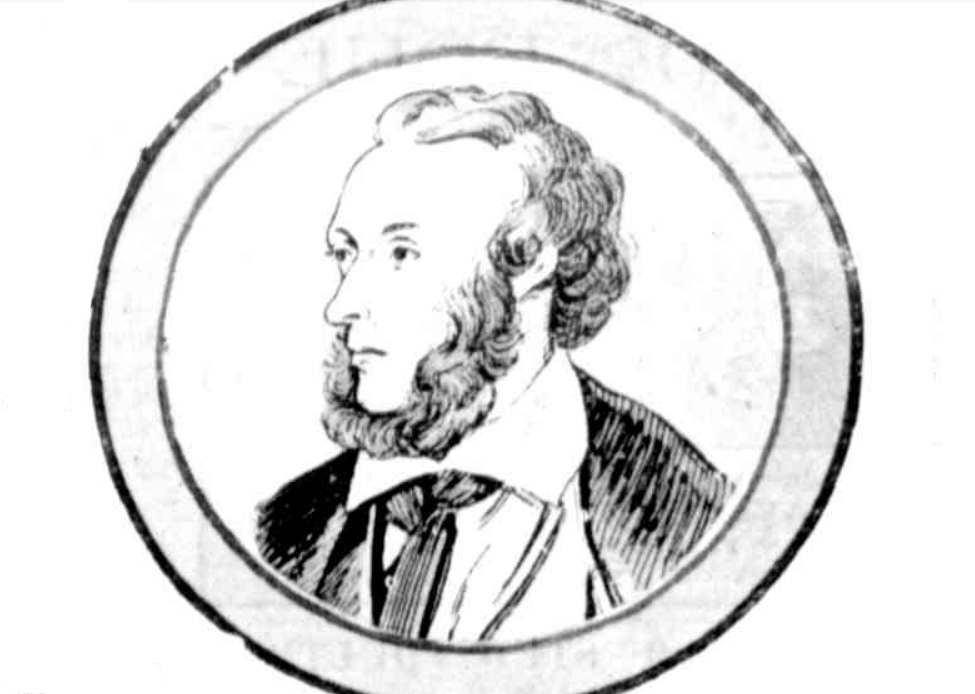
    Benjamin Boyd portrait. Source: Australian Town and Country Journal 29 Aug 1906 Page 28.

    The sailor reported that he thought he had glimpsed something bobbing in the mountainous seas even though they were hundreds of miles from land.   A man was sent aloft with a telescope and after a few minutes he called down that there was a whaleboat in distress several miles to windward.   The Wanderer bore down on the stricken craft and discovered it contained six occupants.     

    The seas were still running high and it was not until their third attempt that a line was got across to the boat.   The only words the men on the Wanderer could discern were plaintive cries for water.   Then all six passengers, three men, and three women were hauled across and safely got aboard the schooner, very lucky to be alive.

    It turned out the whaleboat belonged to Jose Davis, “a Brazilian man-of-colour”1 who had since resided in Hawaii for the past 17 years.   With his wife and four others, (all South Pacific Islanders) he had set off from Oahu nine days earlier intending to reach Maui.    They were only about 50kms from home when disaster struck.

    The whaleboat was caught in a severe storm that raged for days.   The sail was ripped to shreds and they lost their rudder during the tempest which made the whaleboat uncontrollable.   What’s more, the planking had sprung so they were also taking on water.    The boat drifted at the mercy of the wind and waves for nine days and it was ultimately pushed some 600kms south.   They had no drinking water and the only food Davis and his comrades had was a few pumpkins.  

    Map of the Pacific Ocean showing where the whaleboat was found.

    But Jose was not one to give up hope.   Once the weather abated, he planned to use the women’s dresses to make a new sail and then bear east towards the South American coast using the sun and stars to guide him.  

    With the new passengers on board and being cared for, the Wanderer continued north to Hawaii.   The whaleboat sank shortly after it was abandoned.   In time Jose and the others were landed at Maui to be reunited with their astonished and grateful families and friends who had since given them up for dead.

    The Wanderer continued on to San Francisco, but Boyd failed to strike it rich on the goldfields and decided to return to Australia.   On the homeward voyage, they stopped at Guadalcanal where he vanished while out hunting.   His body was never found.

    1.      Colonial Times, 31 May 1850, p. 4.

    © Copyright C.J. Ison / Tales from the Quarterdeck, 2022.

    Please enter your email address below to be notified of future blog posts.