Tag: Rescue

  • Marooned for twenty months: the loss of the Grafton 1863.

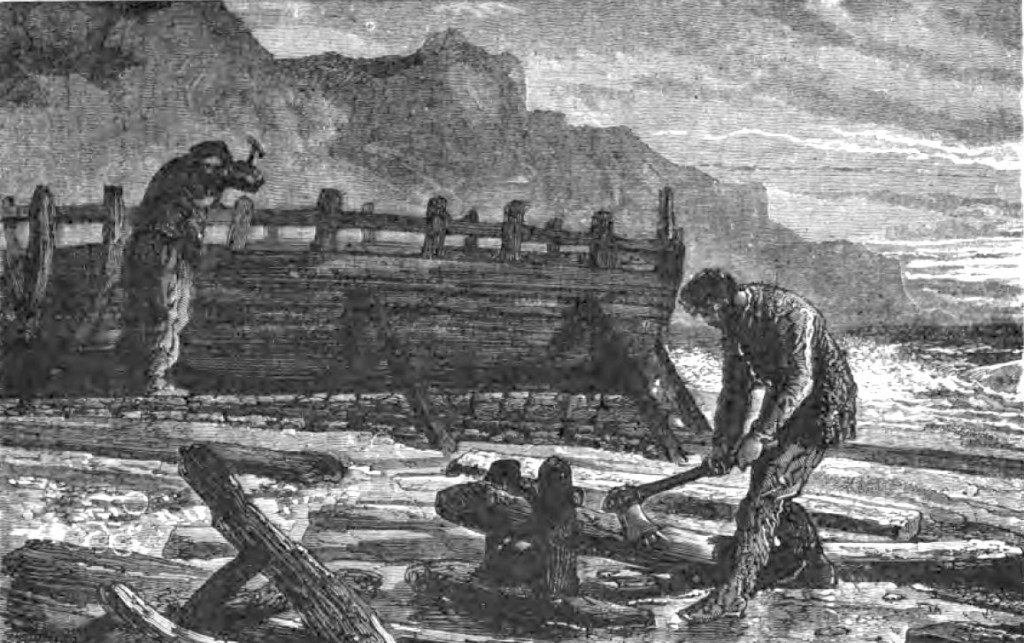
    The last of the Grafton castaways are rescued. Source: Wrecked on a Reef, Raynal, 1874..

    On 12 November 1863, the 56-ton schooner Grafton sailed from Sydney on a sealing expedition among the islands of the Southern Ocean. Six months, 12 months, then 18 months passed without any sighting of the ship or its crew. Most people had given up hope of seeing them again, presuming they had been lost in that vast expanse of freezing ocean wilderness to Australia’s south. Then, on 27 July 1865, three of the lost mariners stepped ashore at Invercargill, New Zealand. Their leader was the missing ship’s captain, and he reported that his other two shipmates were still stranded on a remote island to the south. This is their remarkable tale of endurance and survival against the odds.

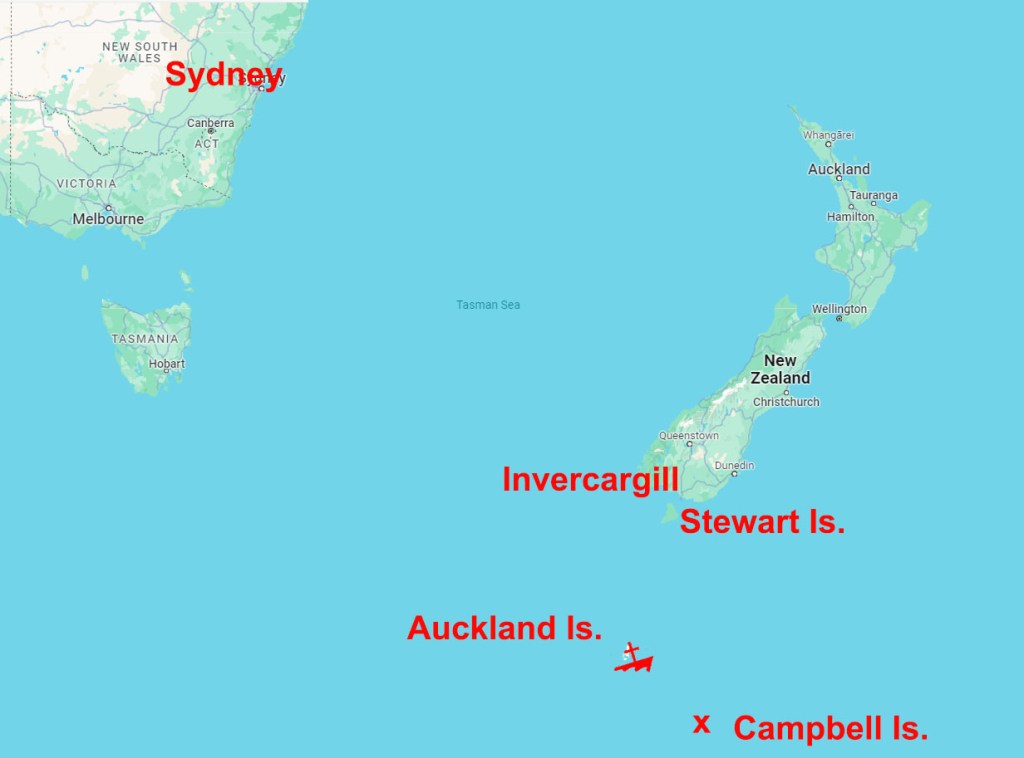
       The Grafton was ostensibly on a sealing expedition funded by a consortium of Sydney businessmen. But it also had a more secretive mission to investigate if tin could be found on Campbell Island. The Grafton was to visit the isolated scrap of land some 650 km south of New Zealand and determine if the rumoured tin was there in mineable quantity. An experienced master mariner named Thomas Musgrave was appointed captain of the Grafton, and one of the business partners, Francois Raynal, served as his first mate. Two seamen and a cook rounded out the five-mancrew.

       The weather was atrocious for most of the voyage south through the roaring forties and then into the furious fifties. During one particularly heavy gale, the Grafton was laid over on her side by the force of the wind. But after three weeks of hard sailing, they finally reached Campbell Island, at latitude 52.6°S.  

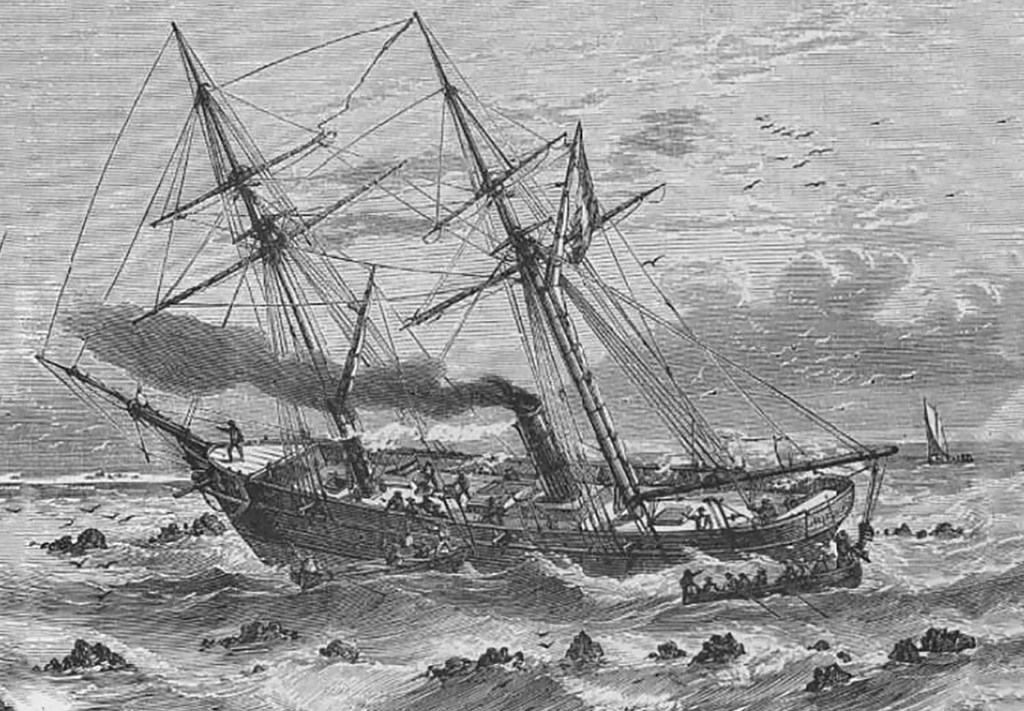
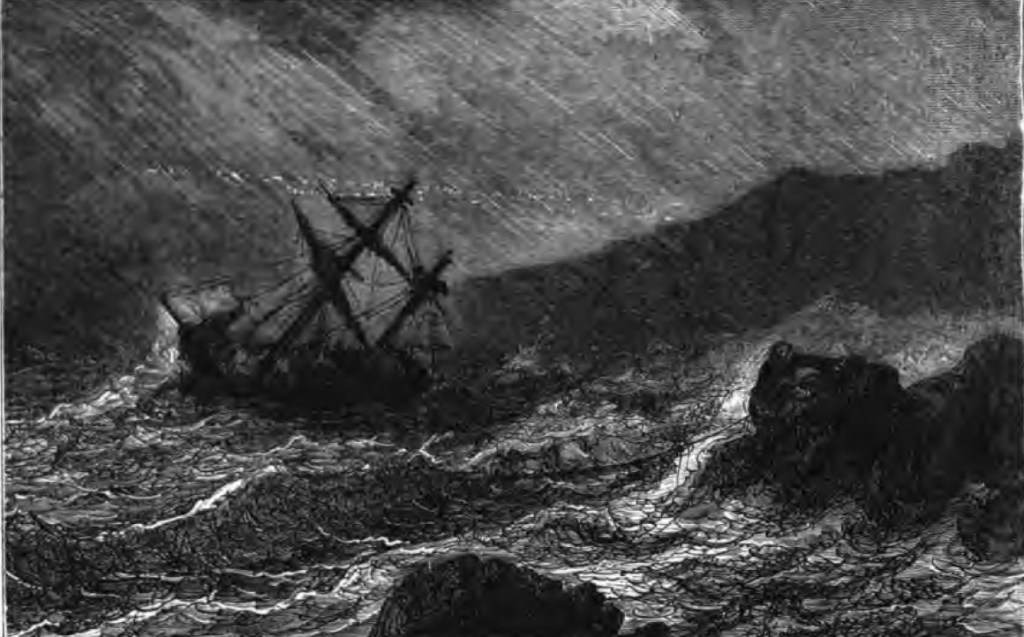
    Illustration of the Loss of the Grafton on Auckland Island, 1863. Source: Wrecked on a Reef, Raynal, 1874.

       Prospecting for tin came to nothing, and there were few seals to be had. After a month, they had little to show for their time there. They had been gone for almost two months and had consumed nearly half of the four months’ worth of rations they had left with. Captain Musgrave decided it was time to start heading for home. No one disagreed. They departed Campbell Island on 27 December 1863 with the wind blowing hard from the northwest. As they approached the Auckland Islands, Musgrave found that he could not sail past them without getting dangerously close to land. He decided the safest course of action would be to find shelter in one of the inlets and wait for the wind to shift. They dropped anchor in what they would later learn was Carnley Harbour on 31 December. But soon after arriving, their haven turned out to be anything but when it was lashed by a powerful storm. On the night of January 2, the wind shifted and blew at hurricane strength, as the seas foamed and grew mountainous around them.  

    Site of the Grafton wreck site, Auckland Island. Courtesy, Google Maps.

        For a time, the Grafton rode out the maelstrom. Then one anchor chain snapped, and the second anchor began to drag. At midnight, the schooner was driven up onto a rocky beach. “Within fifteen minutes, she was nearly full of water, with heavy sea breaking over her,” Musgrave later wrote of the ordeal.   

    The crew gathered provisions and warm clothing and piled it all on deck. Then everyone found shelter where they could, and waited for daylight as the storm raged around them. Francois Raynal had fallen ill sometime earlier, but his shipmates looked out for him during that bleak night. In the morning, they climbed into their small dinghy, which was already filled with supplies. Captain Musgrave tied a rope to the Grafton and slowly let it run out as the overloaded dinghy was pushed towards land. When they were close to the beach, one of the seamen, Alexander McLaren, jumped into the surf holding a rope tied off to the boat’s bow. He waded ashore and then wrapped the rope around a tree. As Musgrave let his line out, McLaren pulled his in, and the boat made it through the surf to land safely on the beach. It was that level of simple cooperating that would stand them in good stead during the months that followed.

    Captain Thomas Musgrave. Source: Castaway on the Auckland Islands, 1866.

        The castaways spent that night sleeping on the cold, wet ground, but were no doubt grateful that they had made it off the wrecked schooner alive. As for the Grafton, she was pounded to pieces, with no prospect of being repaired and refloated. After the weather had cleared sufficiently, they returned to the wreck. Their priority was to salvage the sails and timber spars, enough to build a small hut so they had shelter from the harsh elements. Despite being marooned on a remote island, Captain Musgrave and the others believed it would only be a matter of time before a ship passed by and they would be rescued.

       But as the months rolled by, their hopes of being found ebbed away and finally vanished completely. The small amount of water-damaged sea biscuit and salted pork they had saved from the schooner had run out long ago. Then, for the next 18 months, they survived on a diet comprised mainly of seal meat. Raynal, who over time recovered his strength, was able to brew a passable ale, which he believed would help keep scurvy at bay.

    Inside the hut on Auckland Island. Source: Wrecked on a Reef, Raynal, 1874.

         The castaways strengthened their hut, built a fireplace and chimney, and furnished it with stretchers, a table, and stools. Lanterns fuelled with seal oil gave the interior a warm, comforting glow. When not out procuring food and water or keeping vigil for any ship that might pass by, Musgrave taught his illiterate sailors how to read. The castaways also passed their time playing chess and dominoes with bone pieces Raynal had carved by hand. They also played cards for a time, but Raynal eventually destroyed the pack when it became evident that Musgrave was a poor loser. As their clothes deteriorated, they were replaced with seal-skin garments. In short, they made their home as comfortable as circumstances would allow.   

    After spending a second summer on Auckland Island without ever seeing another soul, the castaways decided to wait no longer to be rescued. It was now around March 1865, and another freezing winter was fast approaching. They considered constructing a new vessel from the Grafton’s wreckage, and they even built a forge to assist them. However, the venture was abandoned for want of an auger to drill holes through the timbers. Instead, they turned to making their twelve-foot (3.6 metre) dinghy more seaworthy. They extended its length by 76 cm, built up the sides and furnished it with a deck. When it was finished, Musgrave found it was so unstable that it would have been too dangerous to call all five of them to safety.


    Preparing the dinghy to escape from Auckland Island. Source: Wrecked on a Reef, Raynal, 1874.

       On 19 July 1865, Captain Musgrave set off in the dinghy with only two men, Francois Raynal and Alexander McLaren, promising to return quickly to rescue George Harris and the cook, Henry Brown. After five days of hard sailing through foul weather, they reached Stewart Island, 450 kilometres to their north. They put into Port Adventure and fell in with the Flying Scud. The next morning, Musgrave and his mates were taken the final 50 km across Foveaux Strait to Invercargill on New Zealand’s South Island.   

    After sufficient funds were raised by the good folk of Invercargill, a ship was chartered to take Captain Musgrave back to Auckland Island to retrieve his two shipmates. The Grafton’s story is a testament to what can be accomplished when a group of resourceful individuals, aided by a measure of good fortune, work together for their common good.

    As chance would have it, the survivors of another ship, the Invercauld, had washed up on the northern end of Auckland Island around the same time.   Unfortunately, theirs is a far different story and is the subject of a future blog.

    © Copyright C.J. Ison / Tales from the Quarterdeck, 2024.

    Please enter your email address below to be notified of future blogs.

  • The Loss of the Duroc and the rise of la Deliverance

    The French steamer Duroc wrecked on Mellish Reef. Source: Wikicommons.

       On the night of 12-13 August 1856, the French Naval steam corvette Duroc was wrecked on Mellish Reef about 800 km off the Queensland coast. After the ship ran aground, her passengers and crew, numbering 70 people, made it onto a small sand cay where they were safe for the time being. However, they were stranded far from regular shipping channels, and the chance of their being rescued was remote. Captain Vissiere thought their only chance of getting off the islet was to build a new boat from the wreckage of the old.

       The Duroc had set off from Port de France (Noumea), New Caledonia, five days earlier, but on that night she ran aground on a submerged coral reef and could not get off. Each passing swell pounded the hull onto the reef, and she began taking on water. Fearing the ship might break apart during the night, Captain Vissiere ordered the crew to start bringing all stores, provisions, and water casks up on deck. He also had the four lifeboats prepared in case they had to abandon ship during the night. Then Vissiere had an anxious wait until morning, when he could better assess their situation.   

    Daylight revealed the ship was well and truly lodged on the reef, and they were surrounded by breaking seas. But about four kilometres away, there was a small, low-lying sandy islet which seemed to offer a place of refuge. So began the laborious task of ferrying all the ship’s stores and personnel to dry land. Over the next 10 days, they stripped the Duroc of its masts, bowsprit, sails, spars, blacksmith’s forge, a water distillation plant and the cook’s oven. By 23 August, they had emptied the stranded vessel of anything useful and established a comfortable camp on the tiny cay. Captain Vissiere was satisfied that their immediate survival was assured, but they were stranded nearly 800 km from the nearest land, and rescue seemed unlikely.

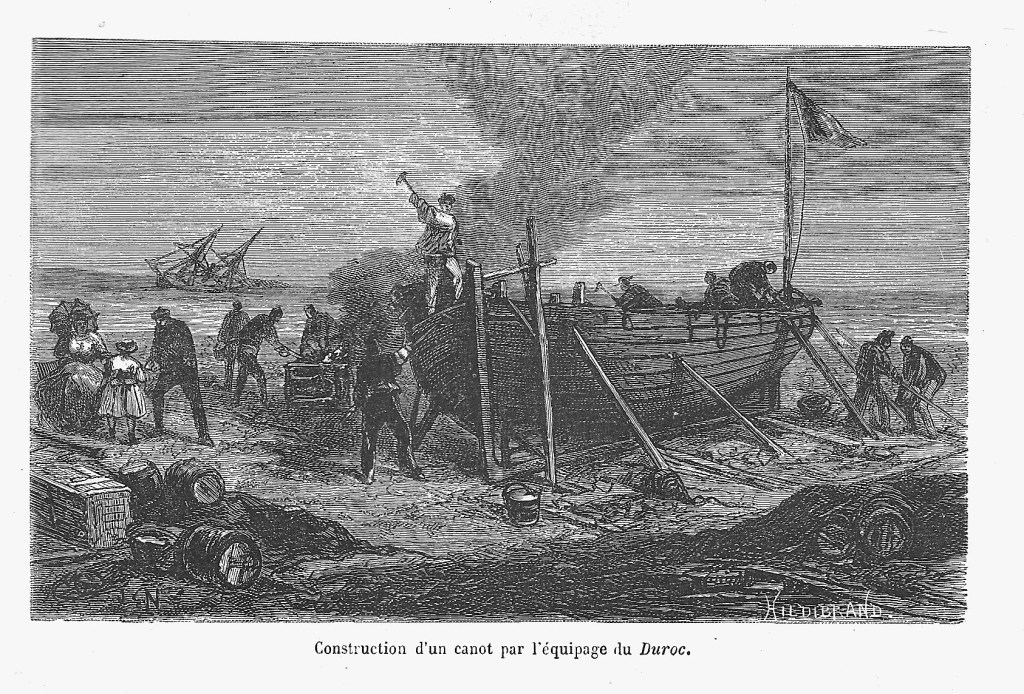
    Survivors of the wrecked Duroc on Mellish Reef building the La Deliverance. Source: Wikicommons.

       Vissiere prided himself on being a competent master mariner, and he could not account for how his ship had run aground. He took several unhurried astrological observations on the island and would later claim that the reef he had struck was, in fact, some distance from where it was laid down on his chart. Feeling vindicated, the captain then turned his mind to finding a way back to civilisation, for not only was he responsible for his crew, but his wife and baby daughter accompanied him.

       Captain Vissiere felt that his best course of action would be to make for Australia’s east coast, where he could expect to find help from a passing ship. However, the lifeboats could carry only a fraction of those stranded on the small island. So, Captain Vissiere opted to send his First Mate, Lieutenant Vaisseau, off with the three largest boats and about half the crew. He would remain on the island with his wife, daughter, and about 30 others. They would construct a new vessel from the timber they had salvaged from the Duroc and make their escape if no one had come for them in the interim.   

    The three boats set off on 25 August with instructions to make for Cape Tribulation, where, with any luck, they would meet a British ship sailing the Great Barrier Reef’s inner passage. Cape Tribulation was probably chosen because it was easily recognisable and it was where the reef pinched in close to the coast, funnelling any passing ships close to land.

    Mellish Reef. Courtesy Google Maps

       After setting off from Mellish Reef, the three boats encountered rough weather, which threatened to capsize the heavily overloaded craft. Lt Vaisseau tried tethering the three boats together so they would not become separated, but in the rough seas, this proved dangerous, and the lines were cut. After weathering the conditions for two days, Vaisseau decided they should jettison everything non-essential to lighten the load and raise their freeboard.

       Then, one day, while Lt Vaisseau was taking his noon observation, his boat was struck by a rogue wave, tossing him into the sea. Unable to swim against the current to make it back on board his lifeboat, he would have drowned had another boat trailing astern not been able to come close enough to rescue him. Vaisseau had a lucky escape, for he was only plucked from the water as his strength was beginning to fail him.

       After five days at sea, on the evening of 30 August, they crossed through the Great Barrier Reef near Cape Tribulation and anchored in calm waters for the night. The men thought the worst of the ordeal was behind them, and they would soon fall in with a passing ship. Lt Vaisseau noted they still had 72 kgs of sea biscuits, 20 litres of brandy and 60 litres of wine when they reached the Australian coast. However, shared among 36 hungry men, that would last them only another few days.

       The next day, they made land, filled their water casks, and then bore north, hugging the shore, pushed along by the prevailing southerly winds. They stopped each night in the lee of islands, foraged for roots, greens and shellfish, and cast out lines hoping to catch fish. They only delved into the supply of sea biscuits when their efforts failed to find enough food.

       By 9 September, they had reached Albany Island in the Torres Strait. They continued sailing past Booby Island, unaware that there was an emergency store of food and water there to aid shipwrecked sailors. Having sighted not a single ship while off the Australian coast, they ventured out into the Arafura Sea. Lt Vaisseau decided they should head for the Dutch settlement of Kupang on Timor Island. The three boats finally arrived on the evening of 22 September, and not a moment too soon, for their food had run out several days earlier.

    Construction of a new vessel La Deliverance from the wreckage of the Duroc on Mellish Reef. Source: Wikicommons.

        Meanwhile, Captain Vissiere and the remaining men had been kept busy constructing the new vessel, which they named La Deliverance. Under the directions from the ship’s master carpenter, they sawed the Duroc’s lower masts into planks and fixed them to a frame. The new craft measured 14 metres in length and was completed around the time Lt Vaisseau and his party reached Timor Island.

       On 2 October, La Deliverance was launched, and they sailed away from the island they had called home for the past six weeks. Captain Vissiere intended to make for the Australian mainland, just as his lieutenant and the three boats had done. Once off land, he would decide whether they should head north, through Torres Strait and on to Kupang, or turn south towards Port Curtis (Gladstone), which was the most northerly settlement on the east coast at the time. When he reached the Australian coast, he found the same southerly trade winds that Lt Vaisseau had.

       Despite the seemingly optimistic start, the passage was arduous, hampered as it was by unpredictable weather. Prolonged calms left them stranded for days at a time. The doldrums were only relieved by violent storms that lashed them mercilessly and threatened the safety of the vessel. By the time they were rounding Cape York, the boat was leaking alarmingly. Captain Vissiere pulled in at Albany Island so urgent repairs could be made before they left the relative safety of the Australian mainland. Once the leaks were plugged, they got underway, ready to cross the Arafura Sea. On 30 October, four weeks after setting off from Mellish Reef, La Deliverance sailed into Kupang harbour.   

    Though they suffered greatly during the ordeal, Captain Vissiere did not lose a single person as a result of the wreck or the 4000 km voyages undertaken by the survivors to reach Kupang.

    © Copyright C.J. Ison / Tales from the Quarterdeck, 2023.

    To be notified of future blogs, please enter your email address below.

  • Bato to the Rescue – 1854

    Shipwreck survivors take to their boat.. Source: Tales of Shipwrecks and Adventures at Sea, 1856.

       In 1854, the fully-rigged Dutch ship Bato rescued not one, not two, but three separate parties of shipwreck survivors whose ships had come to grief in separate mishaps in Australia’s northern waters. In the space of a few weeks, these three ships all ran aground while attempting to navigate the treacherous waters of the Great Barrier Reef and the Torres Strait.

       The first casualty was the 521-ton ship Fatima. On 3 June, the Fatima left Melbourne bound for Singapore via Torres Strait. She made good time sailing up the east coast until, on 26 June, she was within sight of Raine Island. The low-lying island and its distinctive 20-metre-tall tower marked a channel through the Great Barrier Reef and the start of a well-charted passage through Torres Strait.

       Then, just 12nm (20 km) south of Raine Island, her voyage ended abruptly and violently when she crashed into the Great Detached Reef. The Fatima could not be saved, and her captain and crew were forced to take to the boats to save their lives. A refuge of sorts was close at hand, so they struck out for Raine Island off in the distance. There they remained, subsisting on a plentiful supply of seabird eggs while they waited to be rescued.

       A couple of days after the Fatima left Melbourne, the 391-ton barque Elizabeth also set sail from that same port. She was bound for Moulmein, Burma, and also intended to pass through Torres Strait by the Raine Island passage. However, disaster struck on 28 June when the barque ran aground on a small coral outcrop about 28nm (55 km) south of Raine Island. Fortunately, no lives were lost, and after a considerable amount of effort, the crew managed to get the ship off the reef and back into deep water. However, the hull had been breached, and Captain Churchill realised that his ship was taking on more water than the pumps could remove. Churchill made the difficult decision to abandon his ship, and he and his men took to the boats. They made their way through Torres Strait and arrived at Booby Island five days later. The island was marked on charts of the day as a haven for shipwrecked sailors where a supply of food and fresh water could be found.

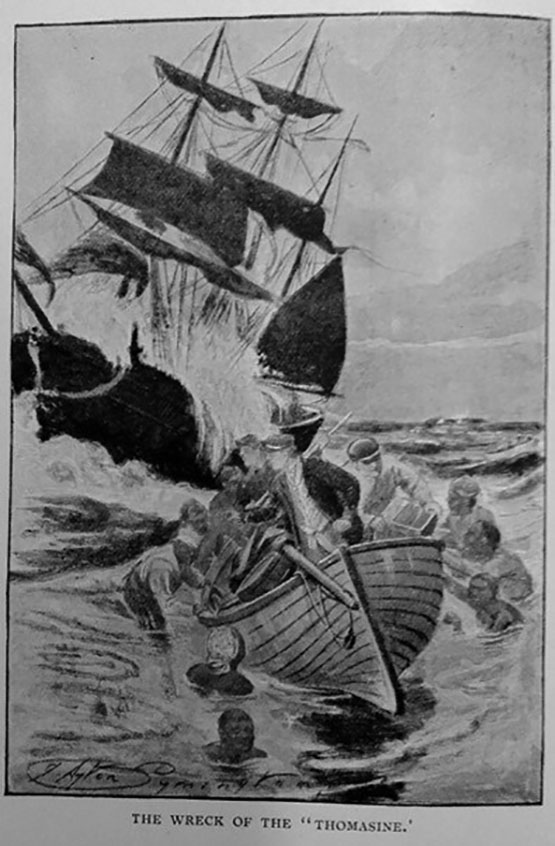
    The Wreck of the Thomasine. Courtesy State Library of Queensland.

       The third ship, the Thomasine, departed Sydney on 8 June bound for Batavia. She also intended to cross through the Torres Strait. But she ended her northerly run up the coast on 19 June when she struck an uncharted reef about 270 km east of present-day Port Douglas.

       Her master, Captain Holmes would later recall that around 8 o’clock on the evening of the 19th, the ship grazed a submerged reef where no such obstruction should have existed. He had been on deck at the time and had immediately gone to his cabin to consult his chart, to confirm what he suspected. While he was standing at his chart table, still consulting his map, the look-out called, “Breakers ahead.” Captain Holmes raced back on deck to the daunting sight of a long line of breaking waves ahead that extended around to his left and right, almost completely encircling the ship.

       Holmes and his crew kept the Thomasine from running aground during the night by tacking back and forth in the open water between the reefs. The next morning he saw how dire their situation was. The ship was trapped by an almost unbroken ring of breaking waves, denoting the presence of submerged coral reefs. Reefs that were absent from the charts but have since been added and bear the name Holmes Reefs.

       The wind began to rise and Holmes realised his only chance of escape was to try to make it through one of the narrow gaps he could see in the otherwise extended line of surf. He selected one, hoping it would allow his ship to reach the safety of deep water beyond. Unfortunately, the channel proved too shallow, and the Thomasine struck heavily, becoming stuck. Unable to get the Tomasine free, the captain made the difficult decision to abandon ship. The crew then readied two boats with as much food and water as they dared carry.

       Captain Holmes was doubly concerned as they tried to escape the ship and the surrounding reef. Not only did he feel responsible for his crew, but he was also accompanied by his wife and three children, the youngest of whom was just four months old. He divided his crew evenly between the two boats for the voyage north to Booby Island and a cache of stores. However, one sailor died during the struggle to get the boats through the roiling seas surging around the ship. Holmes   

    Over the next fortnight or so, the 18 castaways steadily made their way north, surviving on short rations and less than one litre of water per day from a small cask taken from the ship. But by 6 July, they had covered about 800 km and had reached Bird Island in the Torres Strait. Captain Holmes calculated that it would only take them another one or two days to reach Booby Island.  

    Map showing location of the three shipwrecks in Torres Strait. Courtesy Google Maps.

       It was around this time, the Dutch ship Bato was passing through the same waters. She had sailed from Hobart on 10 June and steadily made her way up the east coast of Australia. As Captain Brocksmit approached the Raine Island entrance, he sighted the Fatima castaways camped on the island. Ten men were taken on board while the rest followed in the Bato’s wake in their own boat until they had reached the Middle Bank well inside the Great Barrier Reef.

       The next day, 6 July, the Bato’s captain came across the survivors from the Thomasine off Bird Island and made room for them on his ship as well. Finally, the following day, the castaways from the Elizabeth were spotted on Booby Island, where they had landed four days earlier.

       Now carrying as many as 60 additional people, the Bato put the dangerous waters of Torres Strait behind her. Captain Brocksmit made his way along the Indonesian archipelago, arriving in Batavia on 25 July 1854. The survivors were disembarked, and the captains were faced with the unenviable task of notifying their respective ship owners of their losses.

    © Copyright C.J. Ison / Tales from the Quarterdeck, 2023.

    To be notified of future blogs, please enter your email address below.
  • The Mystery of the Peri

    HMS Basilisk overhauls the Peri off the Queensland coast. Courtesy: National Maritime Museum, Greenwich London.

       In February 1872, the crew of HMS Basilisk found 14 men barely clinging to life on a derelict schooner adrift off the far north Queensland coast. The vessel’s name was not immediately apparent, and none of the survivors spoke English. It was a mystery as to how the ship came to be in those remote northern waters, and one that would take some time to solve.

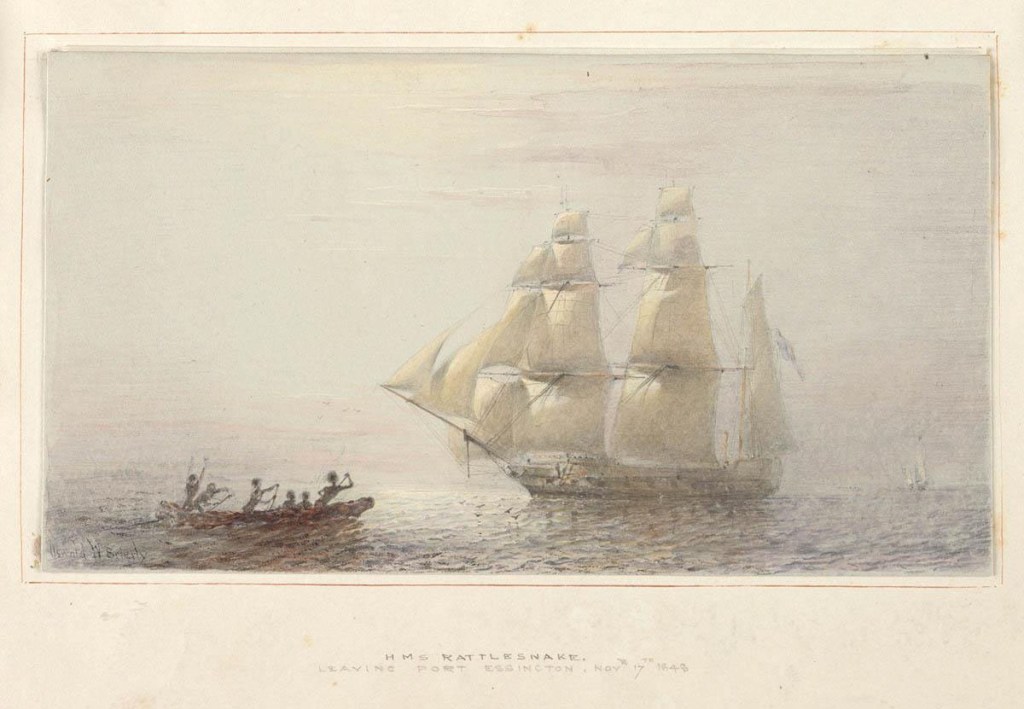
       The side paddle steamer HMS Basilisk was steaming up the Queensland coast on a three-month cruise around Torres Strait. They were to deliver stores to the government settlement at Somerset, chart several recently reported navigation hazards and generally show the flag in that remote part of the continent.

       When the Basilisk was in the vicinity of Hinchinbrook Island, a lookout sighted a small fore-and-aft schooner off in the distance. It was rare to come upon another ship in those waters, so Captain John Moresby called for his telescope and examined the ship more closely. It was immediately clear to the master mariner that not all was as it should be with the strange vessel.

       Moresby noticed that the schooner sat heavily in the water as she sluggishly rode the long, smooth swells. His first thought was that her crew must have abandoned her for some reason. As the Basilisk drew closer, Moresby could see that her weather-beaten sails were poorly set and flapping loosely in the light breeze. The rigging was slack, and there was no sign of anyone on deck.

    Illustration of the Basilisk’s discovery of the Peri. Source: Illustrated Australian News for Home Readers, 29 Feb 1872, p. 53

       When the Basilisk raised her ensign, signalling to the strange vessel to identify itself, they got no response. But as they drew nearer still, a couple of Pacific Islanders armed with muskets staggered to their feet near the schooner’s stern. Moresby then spotted several more men lying scattered on the deck. He sent two boats across to investigate.

       What the sailors found is best summed up in Captain Moresby’s own words: “… they were living skeletons, creatures dazed with fear and mortal weakness. As our crews boarded, other half-dead wretches tottered to their feet, fumbling too at rusty, lockless muskets. … They were dreadful to look at – being in the last stage of famine, wasted to the bone; some were barely alive, and the sleeping figures were dead bodies fast losing the shape of humanity, on a deck foul with blood.”

       The boarding party found several dead and decomposing bodies on the deck. There was five feet of putrid water sloshing about in the hold. The cabin had been ransacked, and the deck bore the marks of numerous axe strokes. Parts of the deck were also stained brown by large pools of what appeared to be dried blood. And, there was no fresh water or food anywhere to be found. All the evidence, Captain Moresby later recalled, pointed to a violent and tragic incident having taken place on board the schooner.    Moresby held a funeral service for the dead and buried them at sea. He then steamed towards Cardwell, 40 km away with the schooner in tow. He landed the 14 survivors, none of whom spoke any English, but for the word “Solomon.” Moresby assumed they meant they were from the Solomon Islands. He then continued North towards Torres Strait, leaving Midshipman Sabben in charge of several sailors and the schooner. He would collect them in a couple of months on his return to Sydney.

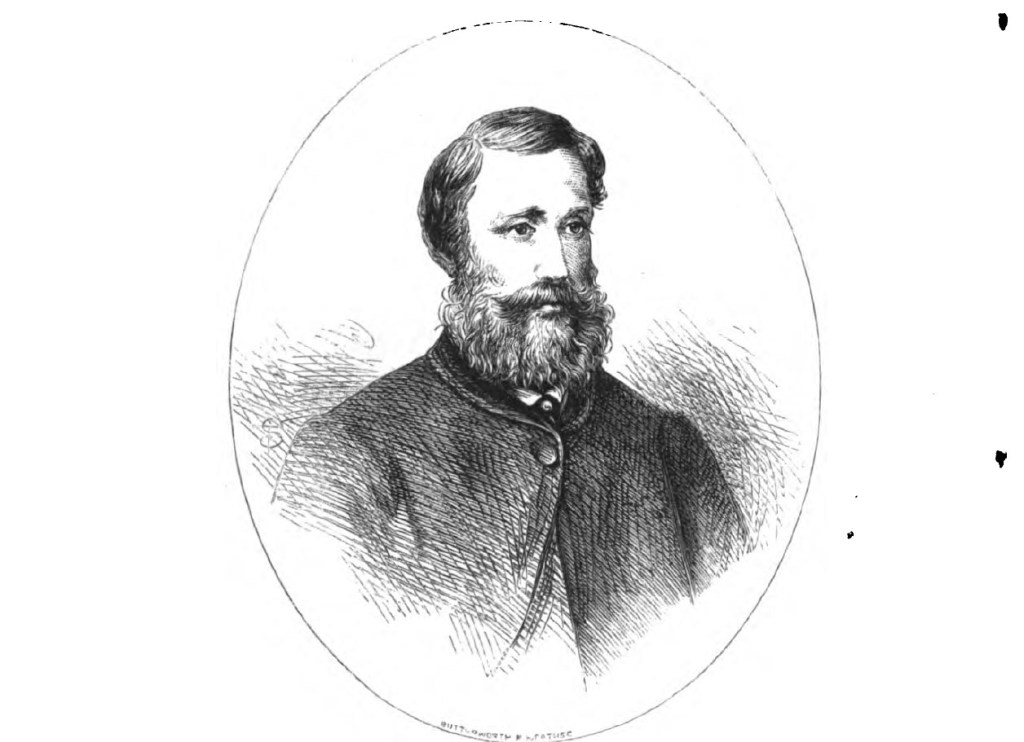
    HMS Basilisk commander – Captain John Moresby. Photo sourced from his autobiography Two Admirals.

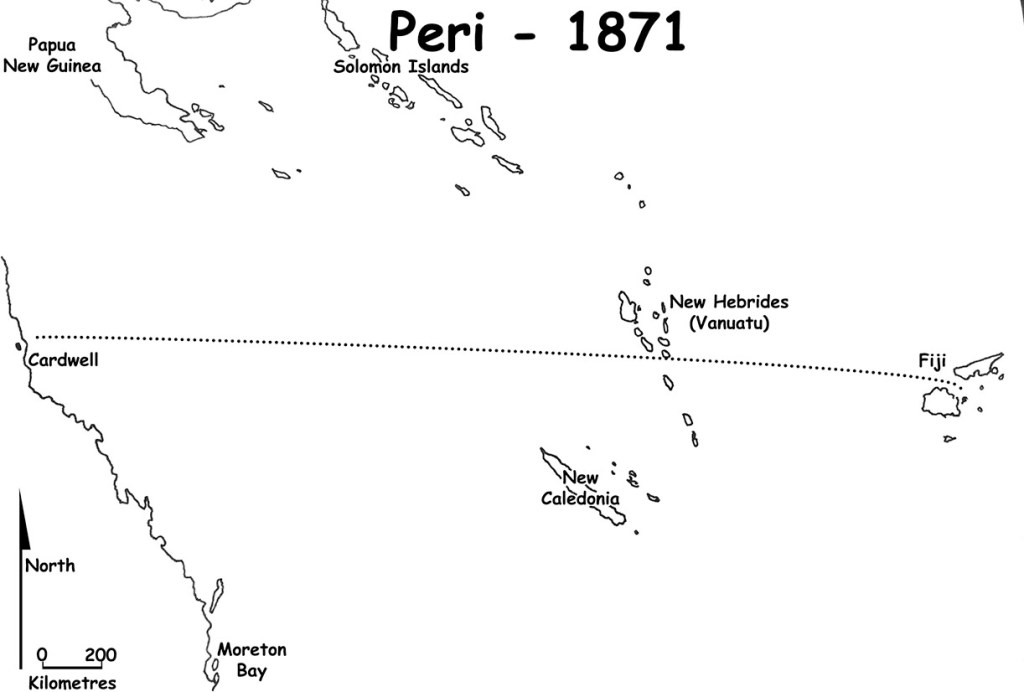
        The pieces of the puzzle would slowly come together over the next weeks and months. After Sabben’s men had scrubbed the headboards clean, they discovered the schooner was called the Peri. The Peri had recently been reported missing in Fijian waters. On 27 December 1871, she had sailed from Viti Levu with approximately 90 “indentured” Pacific Islanders bound for a cotton plantation on Taveuni, 100 km away, but she never arrived.

       About 30 of those 90 men had been kidnapped in the Solomon Islands and taken to Levuka in Fiji. At the time, the South Pacific was in the midst of a cotton boom, and the white plantation owners struggled to find enough field workers or kanakas to tend their crops. Many Islanders fell victim to more unscrupulous “recruiters” who stopped at nothing to fill their quotas.

       At Levuka, kanakas were disembarked and sold to plantation owners to serve three-year contracts. At the completion of their time, it was the plantation owners’ responsibility to pay off their workers and return them to their home islands. The kanakas themselves were supposed to have willingly agreed to the arrangements and be appropriately compensated for their labour; however, that was not always the case.

       In this instance, the kidnapped Solomon Islanders were sent to an Australian plantation owner on Taveuni Island. But while in transit, they seized control of the cutter and escaped. The vessel was later found aground on a small island in the Yasawa group, and most of the men were recaptured a couple of weeks later.

       The other 60 or so Islanders who had been on the Peri had likely also been recently kidnapped. They had fallen into the clutches of a notorious blackbirder named Captain McLever. By December 1871, both groups of kidnapped men had been transferred to the Peri and were about to be sent to work on a plantation on Taveuni Island.   

    It is not entirely clear what happened next, but it seems the 90 kanakas rebelled, killed the captain and crew and seized the ship. Over the next six weeks, they sailed or drifted nearly 3500 km west until they were found by the Basilisk off the Australian coast. From the water in the hold and the general state of the ship, Moresby believed they had weathered at least one severe tropical storm during their passage. And judging by their emaciated state, food and water had run out long before they were rescued. The blood stains and axe marks led some to speculate that the survivors may have resorted to cannibalism, but that was never conclusively proved, and none of the bodies found showed signs of having been butchered.

    Approx track of the Peri.

    By the time the Basilisks crew boarded the schooner, there were just 14 men still alive. One more would succumb soon after being put ashore at Cardwell.

       The remaining 13 Solomon Islanders were taken to Sydney by the Basilisk on her return from Torres Strait and eventually sent back to Fiji on HMS Cossack so they might be repatriated. However, eight jumped ship when the Cossack stopped briefly at Matuku Island, perhaps fearing they were being returned to Fiji to be punished. When the last five Peri survivors were finally questioned through an interpreter in Levuka, they told the British Consul that they had been kidnapped. They described how, when they paddled out to Captain McLever’s ship, their canoes were sunk and they had been beaten and locked in the hold.   

    McLever was arrested, and the Solomon Islanders were taken back to Sydney so they could testify at his trial. However, no one had thought to send a translator, and the case was dismissed for lack of evidence. The Islanders were sent back to Fiji, but what happened to them after that is unknown.

    1.Moresby. John RN, Discoveries and Surveys in New Guinea and D’Entrecasteaux Islands, John Murray, London, 1876, p.4.

    © Copyright C.J. Ison / Tales from the Quarterdeck, 2022.

    To be notified of future blogs, please enter your email address below.
  • The Loss of the Sydney Cove – 1797

    A barque caught in heavy weather. Source: Tales of Shipwrecks and Adventures at Sea, 1856.

       In May 1797, a fishing party returned to Sydney with more than their daily catch. They had found three shipwreck survivors south of Botany Bay who told them that the merchant ship Sydney Cove had been wrecked somewhere far to the south. The survivors had trekked over 600 km along New South Wales’s rugged southern coast seeking help for their captain and shipmates who were still stranded with the ship.

       On 10 November 1796, the 250-ton Sydney Cove had sailed from Calcutta with her hold full of Indian goods and produce the owners hoped to sell in Sydney. The crew, numbering close to fifty men, was a mix of Indian and European seamen under the command of Captain Guy Hamilton. About a month out, as she cleaved her way south through the Indian Ocean, the Sydney Cove was caught in a terrible storm and began taking on water. Initially, the leak was easily managed with the pumps, so Hamilton continued on his course to round Van Diemen’s Land (Tasmania) before heading north again and on up the New South Wales coast to Sydney.

       By January, as they sailed into the latitudes south of Tasmania, the ship was caught in the grip of another powerful storm. The leak began to worsen, and soon the pumps had to operate continuously to prevent the ship from sinking.

       As they headed up Tasmania’s east coast, they encountered yet more wild weather and heavy seas. By now, water was pouring into the hold faster than the men at the pumps could clear it. The barque was slowly filling with water. Captain Hamilton ordered all non-essential gear to be jettisoned to lighten the load, but that only put off the inevitable.   

    By 9 February, the water in the hold was lapping at the lower-deck hatches. Captain Hamilton realised he had no choice but to beach his ship to save her from foundering in deep water. If that were to happen, he would not only lose his ship and its precious cargo but also much of his crew, for they would not all fit on the Sydney Cove’s two boats. He found a sandy beach on what is today called Preservation Island in the Furneaux group and ran her ashore. Although Hamilton had saved the ship from sinking, his troubles were far from over.

    No illustration of the Sydney Cove exists but it likely looked similar to this example. Source: Nautical Dictionary by Arthur Young, published in 1863.

       Exhausted from constant bailing and battling through rough seas, Hamilton got the crew unloading much of the ship’s stores and cargo onto Preservation Island. But then the weary men discovered the casks of rum stacked among the cargo. Hamilton had to have the liquor taken to a neighbouring island to prevent his men from pillaging it. Captain Hamilton then organised his crew for a prolonged stay, for they had come ashore at a very remote part of the world. The crew erected shelters using sails and spars to give them refuge from the elements. Hamilton rationed everyone to one cup of rice per day, and though they sank a well and found water, it proved so brackish it was barely drinkable. However, their immediate needs were met. Then he turned his mind to their rescue.

       If they were ever to leave Preservation Island, they would have to send for help. It was agreed that the First Mate, Hugh Thomson, with 17 men, would sail north, keeping close to the New South Wales coast until they reached Sydney. Captain Hamilton and the remaining crew, numbering about 30, would remain with the ship.

       Several days after setting off, the longboat was driven ashore on Ninety-Mile Beach and smashed to pieces. Thomson and his men escaped with their lives, but they had little else. With no way to return to the Sydney Cove, their only chance of survival lay in continuing to Sydney, 600 km away, on foot.

       Thomson hugged the coast, knowing that as long as they kept the sea on their right, they would eventually arrive at the young settlement. However, that meant crossing many wide river mouths and scrambling over numerous rocky promontories along the way. The journey was gruelling and took a heavy toll on the men. Encounters with the indigenous peoples varied in nature. Some provided the castaways with food and water, while others were less sympathetic but allowed them to pass unhindered. Yet others set upon the interlopers on their land. Their numbers dwindled as some drowned crossing rivers or otherwise fell victim to the harsh and unforgiving terrain.

    The Sydney Cove party as depicted by Smiths’ Weekly in 1939. Smith’s Weekly 30 Sep 1939 p. 8.

       By late April, there were only three men left. However, they had managed to reach within 20 km of Botany Bay when fishermen finally discovered them. The fishermen took the survivors the rest of the way to Sydney in their boat. On learning of the loss of the Sydney Cove, Governor Hunter ordered vessels to be sent to rescue the remaining sailors and salvage the ship’s cargo.

       After being marooned for some four months, Captain Hamilton and the rest of the crew were in dire straits. Winter was fast approaching. Successive storms had mercilessly battered their shelters, and now they had gaping tears, offering the men little protection from the bitter weather. While they had been able to supplement their rice ration with seabirds nesting on the island, their diet still barely sustained life. To add to their sense of abandonment, they had seen several ships pass in the distance but had been unable to alert any of them to their presence.

       Then, on 10 June 1798, salvation arrived when the sloop Eliza sailed into view and dropped anchor a short distance off the beach. It was later joined by the schooner Francis, under the command of Lt Matthew Flinders. Both ships had left Sydney 10 days earlier under Governor Hunter’s orders. The crews loaded as much of the salvaged cargo as they dared, leaving five volunteers behind to watch over the remaining goods until it could be collected at a later date. Captain Hamilton and his men boarded the Francis and Eliza, and they headed for Sydney.   

    The weather was no less kind as the two small ships battled their way home. It took 15 days of hard sailing through storms and high seas for the Francis to reach Port Jackson. The Eliza never made it back to Sydney and was presumed to have sunk in the terrible weather with the loss of her own crew, plus eight shipwreck survivors. In total, about half of the crew of the Sydney Cove lost their lives.

       The shipwreck is historically significant for the trek undertaken by Thomson and the others. They were the first Europeans to note an outcrop of coal in the Illawarra, which has defined the region to this day. Also, Captain Hamilton recorded strong south-westerly currents during his time on Preservation Island, suggesting there was a large body of water separating Van Diemen’s Land and the Australian mainland. The existence of the strait would later be confirmed by Matthew Flinders and George Bass and named after the latter.

    © Copyright C.J. Ison / Tales from the Quarterdeck, 2023.

    To be notified of future blogs, please enter your email address below.