Tag: Raine Island

  • An 1829 Narrative of a Voyage Through Torres Strait

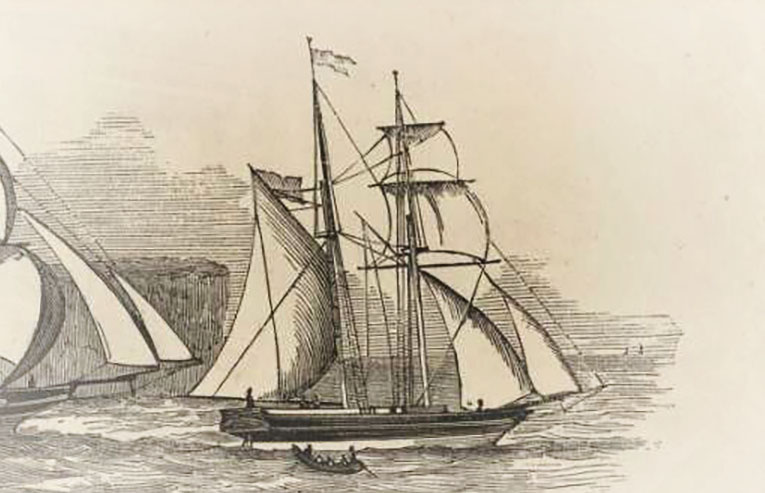
    A ship passing through the Great Barrier Reef at Raine Island. Illustrated Australian News for Home Readers.

    Passing through the Great Barrier Reef during the age of sail must have been both terrifying and exhilarating in equal parts.    The following account, written by an anonymous passenger on a ship sailing through Torres Strait in 1829, was published in the Sydney Times on 19 Sept 1834.   It is a fascinating read and has been posted with only minor alterations to improve readability.

    A Narrative of a Voyage Through Torres Strait – 1829

    “Perhaps there is no part of the navigable world which offers the adventurous mariner a more terrific picture than the passage through Torres Strait — none more mis-represented — and none contemplated with greater horror. … There are three routes by which the passage through Torres Strait can be made, known among nautical men as the Inner, Middle, and Outer passages.

    Of these, the preference is generally given to the first, both because it affords convenient anchorage for the night, when it would be dangerous for a vessel to continue her course among the reefs, and because the mainland of New Holland is constantly in sight, and consequently easily attainable in case of wreck. Yet this of all is the most dangerous and intricate, and never could be preferred were it not for the reasons just mentioned.

    The middle passage was that through which the writer of these remarks passed in 1829, and if ever a satisfaction from disappointment were realised, it was in the accomplishment of this voyage, which had been before regarded as holding out but a mere chance of escape from the miseries of shipwreck.

    Detail of the 1846 Barrier Reef chart showing Pandora, and Raine Island Entrances – Courtesy: National Library of Australia.

    On the fourteenth day after our departure from Sydney, the man at the mast head called out reefs on the “starboard bow.”   Everyone was anxiously looking for this intelligence, for on that morning, the altitude of the sun proved we were within a few leagues of them.

    The reef soon proved to be the “great barrier” in latitude 11° 54 south, reaching across the ocean in a direction from the N. W. to the S. E. until the surf created by its breakers was lost to the sight beneath the horizon.

    All sail was immediately crowded on the vessel in order to make the entrance of the reef by noon, when the sun would not prevent the bed of the shoals from being distinctly marked.

    By noon, we had reached the spot we had desired and were within half a mile of the reef, which from its immense extent seemed to shut out all intercourse with the opposite part of the ocean.

    As we approached it more closely, we discovered that it contained two or three small openings, or passages of about a cable’s length in breadth, and through one of which our course was directed.

    The wind, was high, and there was a considerable swell, but beyond the wall-edge of the mighty reef, which served as a breakwater to the ocean, and upon which the whole volume of water was thrown, all was calm as a basin; — upon its broad surface there was but a ripple, while the rush and roar of waters, breaking as it were in anger on its side, presented a scene of mingled horror and beauty.
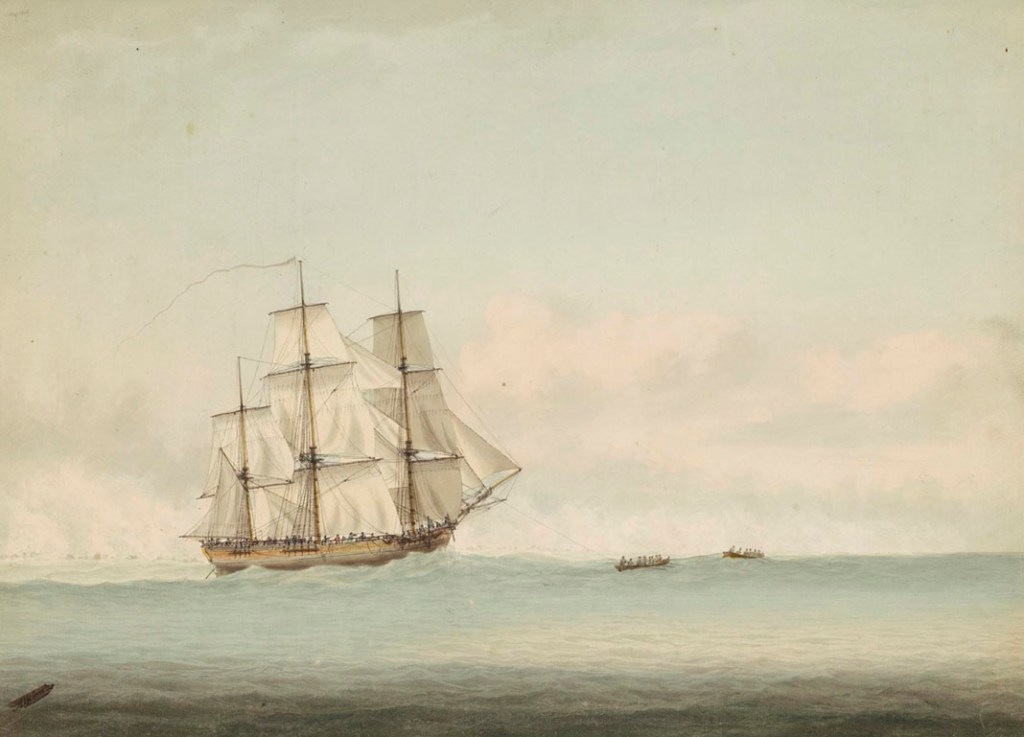
    In 1770, Cook charted what would become known as the Inner Passage. The Endeavour was nearly lost in the attempt. Painting by Samuel Atkins (1787-1808). National Library of Australia.

    We sailed on, we were close upon it and could fully discover the small opening through which our vessel was to pass. There was a breathless silence throughout the ship, save at intervals the voice of the captain giving instructions to the man at the helm.

    A deviation of a hair’s breadth and we might be lost forever. On either side the narrow passage was total and instant destruction; our vessel entered, and as she glided into the smooth channel, she felt the force of the current more powerfully, which being concentrated and brought into so close a space, swept her through with a velocity that no wind, however violent, could effect.

    It occupied but a quarter of an hour to pass through this channel, which formed the great danger of our voyage; but during that time, I had gone to the main top with a military officer who was on board to look upon the reefs.

    What a splendid scene was there; I had seen nothing like it before in nature or art, and perhaps never shall again. As far as the eye could reach, the sea was filled with white coral reefs, whose surface was just covered with water, and partaking of its hue, presented to the view the appearance of beautiful meadows so slightly inundated as to preserve their colouring.

    HMS Pandora came to grief when it tried to pass through the Great Barrier Reef in 1791. Photo courtesy SLQ.

    The shades of green produced by the sea flowing upon the white coral were most beautiful and variegated, and in proportion as the reefs deepened or became shallow, the colouring was diversified.

    But the most striking feature in the scene was the snow-like bordering which encompassed the whole, keeping out as it appeared, all influx of the ruder wave, while that upon the surface of the reef was as a calm lake. This was produced by the breaking of the sea on the sides of the reefs, and became more conspicuous in proportion as the coral approached the surface of the water.

    What a field was here for the contemplation of the artist or the philosopher, whether their time were given to look on Nature’s beauty, girt as it was with desolation, or in searching on the reefs, amid the conflux of currents, for the materials of science, they would be alike repaid for the anxiety the anticipated danger of such a route might produce.

    For myself, I can say that the impression of that picture is fresh upon me, and rests alone within a memory filled with the recollections of that beautiful voyage.”

    © Copyright C.J. Ison / Tales from the Quarterdeck, 2025. If you wish to be notified when new stories are posted, please enter your email address below.

  • Bato to the Rescue – 1854

    Shipwreck survivors take to their boat.. Source: Tales of Shipwrecks and Adventures at Sea, 1856.

       In 1854, the fully-rigged Dutch ship Bato rescued not one, not two, but three separate parties of shipwreck survivors whose ships had come to grief in separate mishaps in Australia’s northern waters. In the space of a few weeks, these three ships all ran aground while attempting to navigate the treacherous waters of the Great Barrier Reef and the Torres Strait.

       The first casualty was the 521-ton ship Fatima. On 3 June, the Fatima left Melbourne bound for Singapore via Torres Strait. She made good time sailing up the east coast until, on 26 June, she was within sight of Raine Island. The low-lying island and its distinctive 20-metre-tall tower marked a channel through the Great Barrier Reef and the start of a well-charted passage through Torres Strait.

       Then, just 12nm (20 km) south of Raine Island, her voyage ended abruptly and violently when she crashed into the Great Detached Reef. The Fatima could not be saved, and her captain and crew were forced to take to the boats to save their lives. A refuge of sorts was close at hand, so they struck out for Raine Island off in the distance. There they remained, subsisting on a plentiful supply of seabird eggs while they waited to be rescued.

       A couple of days after the Fatima left Melbourne, the 391-ton barque Elizabeth also set sail from that same port. She was bound for Moulmein, Burma, and also intended to pass through Torres Strait by the Raine Island passage. However, disaster struck on 28 June when the barque ran aground on a small coral outcrop about 28nm (55 km) south of Raine Island. Fortunately, no lives were lost, and after a considerable amount of effort, the crew managed to get the ship off the reef and back into deep water. However, the hull had been breached, and Captain Churchill realised that his ship was taking on more water than the pumps could remove. Churchill made the difficult decision to abandon his ship, and he and his men took to the boats. They made their way through Torres Strait and arrived at Booby Island five days later. The island was marked on charts of the day as a haven for shipwrecked sailors where a supply of food and fresh water could be found.

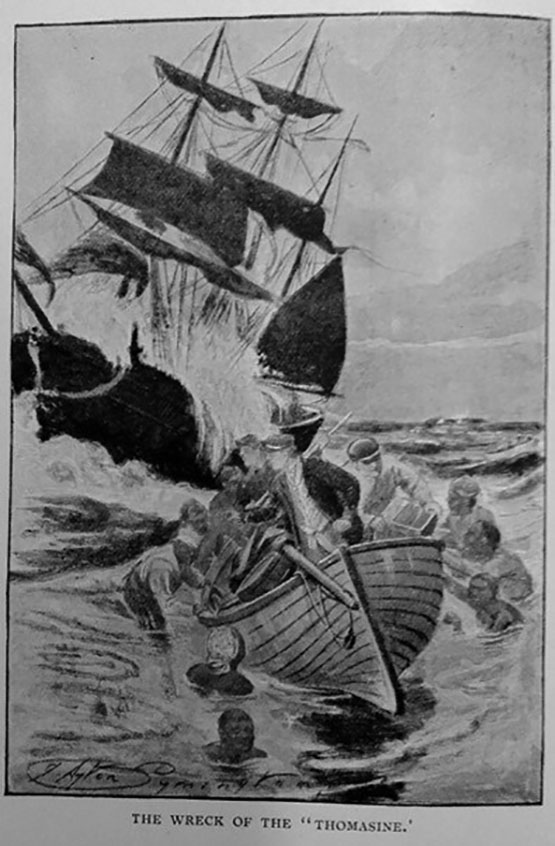
    The Wreck of the Thomasine. Courtesy State Library of Queensland.

       The third ship, the Thomasine, departed Sydney on 8 June bound for Batavia. She also intended to cross through the Torres Strait. But she ended her northerly run up the coast on 19 June when she struck an uncharted reef about 270 km east of present-day Port Douglas.

       Her master, Captain Holmes would later recall that around 8 o’clock on the evening of the 19th, the ship grazed a submerged reef where no such obstruction should have existed. He had been on deck at the time and had immediately gone to his cabin to consult his chart, to confirm what he suspected. While he was standing at his chart table, still consulting his map, the look-out called, “Breakers ahead.” Captain Holmes raced back on deck to the daunting sight of a long line of breaking waves ahead that extended around to his left and right, almost completely encircling the ship.

       Holmes and his crew kept the Thomasine from running aground during the night by tacking back and forth in the open water between the reefs. The next morning he saw how dire their situation was. The ship was trapped by an almost unbroken ring of breaking waves, denoting the presence of submerged coral reefs. Reefs that were absent from the charts but have since been added and bear the name Holmes Reefs.

       The wind began to rise and Holmes realised his only chance of escape was to try to make it through one of the narrow gaps he could see in the otherwise extended line of surf. He selected one, hoping it would allow his ship to reach the safety of deep water beyond. Unfortunately, the channel proved too shallow, and the Thomasine struck heavily, becoming stuck. Unable to get the Tomasine free, the captain made the difficult decision to abandon ship. The crew then readied two boats with as much food and water as they dared carry.

       Captain Holmes was doubly concerned as they tried to escape the ship and the surrounding reef. Not only did he feel responsible for his crew, but he was also accompanied by his wife and three children, the youngest of whom was just four months old. He divided his crew evenly between the two boats for the voyage north to Booby Island and a cache of stores. However, one sailor died during the struggle to get the boats through the roiling seas surging around the ship. Holmes   

    Over the next fortnight or so, the 18 castaways steadily made their way north, surviving on short rations and less than one litre of water per day from a small cask taken from the ship. But by 6 July, they had covered about 800 km and had reached Bird Island in the Torres Strait. Captain Holmes calculated that it would only take them another one or two days to reach Booby Island.  

    Map showing location of the three shipwrecks in Torres Strait. Courtesy Google Maps.

       It was around this time, the Dutch ship Bato was passing through the same waters. She had sailed from Hobart on 10 June and steadily made her way up the east coast of Australia. As Captain Brocksmit approached the Raine Island entrance, he sighted the Fatima castaways camped on the island. Ten men were taken on board while the rest followed in the Bato’s wake in their own boat until they had reached the Middle Bank well inside the Great Barrier Reef.

       The next day, 6 July, the Bato’s captain came across the survivors from the Thomasine off Bird Island and made room for them on his ship as well. Finally, the following day, the castaways from the Elizabeth were spotted on Booby Island, where they had landed four days earlier.

       Now carrying as many as 60 additional people, the Bato put the dangerous waters of Torres Strait behind her. Captain Brocksmit made his way along the Indonesian archipelago, arriving in Batavia on 25 July 1854. The survivors were disembarked, and the captains were faced with the unenviable task of notifying their respective ship owners of their losses.

    © Copyright C.J. Ison / Tales from the Quarterdeck, 2023.

    To be notified of future blogs, please enter your email address below.

  • The Loss of the Enchantress: A first-hand account.

    A Brig leaving Port Jackson in the 1850s.. Image courtesy National Library of Australia.

        The loss of some ships plying Australian waters was only ever noted by a brief paragraph in newspaper shipping columns. Months after leaving port, they would be reported as having never arrived at their destination. The exact circumstances of their loss and what might have happened to the souls on board will never be known. But far more often, people did survive, even if the ship did not. Captains had the grim duty to report the loss of the vessel to its owners, while passengers often wrote to loved ones about their unanticipated adventure. Such records are the sources for many a shipwreck tale.

       On 24 July 1850, the 146-ton brig Enchantress was wrecked near Raine Island while trying to pass through the Great Barrier Reef. Navigating the tricky passages leading to Torres Strait could prove challenging in those early days. Between 1791 and 1887, no less than 37 ships came to grief near Raine Island. Many more were lost on reefs and shoals dotting Queensland’s northern waters.

       Mr B. Buchanan was a passenger on the Enchantress and also an employee of the company that owned the vessel. While en route to Kupang in the Dutch East Indies (present-day Indonesia), after being rescued, he penned a letter to his employers, notifying them of the loss of their ship. This letter, written 175 years ago, provides a firsthand account of the incident.

    A ship off Raine Island, Torres Strait. Illustrated Australian News for Home Readers Thu 30 Jan 1873 Page 9.

       Messrs. Smith, Campbell, and Co., Sydney.

       At Sea, approaching Kupang,

       August 3rd, 1850.

       Dear Sirs, – It is my unpleasant task to inform you of the loss of the brig Enchantress. She struck and grounded on the reef running out from Raine’s Island, on the afternoon of the 24th July.

       From the time of leaving Sydney, the weather was favourable. We joined company with the brig Lady Margaret off Newcastle. On the 24th, about noon, being a little ahead of our companion, we sighted the Barrier below the detached reef, between it and Yule’s Reef. We hauled up to the eastward, and made out the beacon on Raine’s Island between two and three pm.

       Captain L’Anson then stood in for the southern passage, but unfortunately got too near the reef running out from the island. He tried to put her about, but she missed stays; he filled on her again, and again tried it, but a second time she missed. There was no room to wear, the wind being fresh and the current strong, and we tried a third time to stay her, but to no purpose. The strong northerly set and flood tide prevented her [from] coming round, and we were driven on the point of the reef.

       Every sea sent us further on, the surf washing the lower masts’ heads. An attempt was made to take off the sails, but it was becoming dark, we had the reef to cross to get to the island, and the brig was thrown more over by every wave.

       We therefore got out the longboat, saving the chronometer, my papers, and some clothes. The jolly boat was washed away. We crossed the reef without difficulty and took shelter in the beacon.

    Map showing location of wreck at Raine Island. Courtesy Google Maps.

       At three a.m. of Thursday, the 25th, Captain L’Anson, it being low tide, started with the boat, manned by the majority of the crew, with the intention of saving all he could from the wreck. He got the boat alongside, but the sea was breaking so heavily that it was not possible to remain; they brought away some provisions, cooking utensils, and nearly all my things, but could save nothing pertaining to the ship. They were afraid of the boat being swamped.

       At the time of our first attempting to stay the brig, the Lady Margaret was following close, but immediately went about. Captain Grant stood off that night, bore down again in the morning, and worked on and off all day.

       We knew that it would be out of all reason to expect him to bring up after having once entered, before he got to anchorage ground, about twenty-five miles from Raine’s Island; and saw also that he was unwilling to pass without communicating with us (we learnt afterwards that he was afraid we were without provisions or water).

       Meanwhile, the weather had assumed a threatening aspect, we therefore dispatched the boat with five of the people, under Mr Wood, the chief officer, to the Lady Margaret; they succeeded in reaching her after a very long and laborious pull.

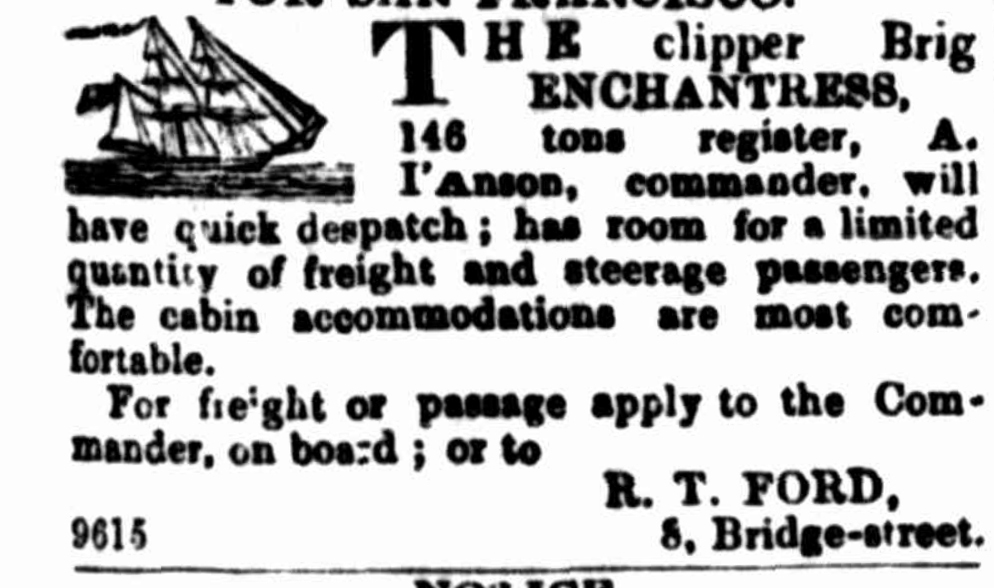
    Advertisement for passage on the Enhantress. SMH 30 May 1850, p. 1.

       I had written to Captain Grant, with suggestions for relieving us, but his position was one of such danger that he could give no attention thereto; his anxiety was to get us on board at once, and be off, and to attain this he despatched his second officer with his jolly boat to the island immediately, our own boat returning at the same time to aid in bringing what clothes we had saved.

       We left the island at four p.m., and were taken on board the Lady Margaret at dusk. She stood out to sea, and in the morning entered by the Southern Passage.

       The poor Enchantress when last seen by us was being between twenty and thirty yards from the point of the reef – bows on the water, masts standing.

    [The letter was published in the Sydney Morning Herald newspaper on 3 December 1850. Here, it is re-published as it first appeared in print, but for a few minor changes to spelling and punctuation.]

    [The letter was first published in the Sydney Morning Herald newspaper on 3 December 1850.   Here, it is reproduced as it appeared in the newspaper, but for a few minor changes to spelling and punctuation.]

    © Copyright C.J. Ison / Tales from the Quarterdeck, 2022.

    To be notified of future blogs, please enter your email address below.

  • The Bourneuf’s Tragic Last Voyage

    Cross section of emigrant ship Bourneuf. From Illustrated London News 10 July 1852.

       On 3 August 1853, the 1500-ton Bourneuf sank in Torres Strait as she was returning to England. It was ironic that her return was cut short, for her voyage out to Melbourne, Victoria, had been no less tragic. She had left Liverpool in mid-July the year before carrying some 800 impoverished emigrants keen to start new lives in Australia. But one in ten would never make it.

       Convict transportation to New South Wales had ceased two years earlier, and the recently constituted Victorian Government had introduced an assisted migration program to try to solve a chronic labour shortage. The colony had long been short of domestic servants, farm labourers, and other workers, but the recent discovery of gold had only exacerbated the problem. Meanwhile, England was still grappling with the social dislocation brought about by the Industrial Revolution. There were more people than there was jobs. On the surface, the migration program appeared to solve both intractable problems; however, transporting the migrants halfway around the world proved costly. Not surprisingly, there was an incentive to transport the largest number of people at the lowest cost to the Government.

    Emigration Depot at Birkenhead, Liverpool. A ship, possibly the Bourneuf, about to depart for Australia in 1852.

       The emigrants, many of them families with young children, were crammed into the Bourneuf’s two tiers of tiny cabins. Passengers were required to prepare their own meals in tightly packed communal kitchens. Bathing and toilet arrangements were rudimentary at best and maintaining good hygiene was impossible from the outset in the overcrowded confines of the ship. The close, fetid conditions were the ideal environment for the spread of communicable diseases. And, it was not long before people started coming down with dysentery. By mid-voyage, measles and scarlet fever were sweeping unchecked through the ship, taking a terrible toll.

       Isolating the sick proved impossible, and for much of the passage, ten or more people, mostly children, died every week. By the time the Bourneuf dropped anchor off Geelong on 20 September, disease had claimed the lives of 83 passengers. The ship was immediately placed in quarantine while 20 desperately ill passengers recovered.

       It would be nice to think that this had been an incident, but that was not the case. Four ships packed with assisted migrants made the long passage out to Victoria in 1852; the Wanota, the Marco Polo, the Ticonderoga and, of course, the Bourneuf. All were grossly overcrowded, even by the standards of the day. Disease outbreaks raged on all four ships with terrible consequences. No fewer than 279 passengers died on the four voyages. Many more passengers had to be hospitalised and quarantined on arrival. However, the lesson was eventually learned, and the Emigration Commissioners limited future migrant ships to carrying no more than 350 passengers.

    Example of immigrant accommodation on the 1874 James Craig barque at the Maritime Museum in Sydney, New South Wales, Australia. Photo C.J. Ison.

       The Bourneuf remained in Port Phillip Bay for ten months, eventually setting sail on 18 July 1853 divested of her passengers. She sailed from Melbourne bound for Bombay before continuing back to England.

       Captain Bibby made his way up Australia’s east coast, pushed along by a south-easterly trade wind. After first passing through the Tasman Sea, he continued north into the warm tropical waters of the Coral Sea. The Bourneuf remained several hundred kilometres off the coast and well outside the Great Barrier Reef. This had become known as the “outer passage” and was considered by mariners to be safer than navigating close to land inside the reef. Captain Biddy intended to cross through the Great Barrier Reef at the Raine Island entrance so he could carefully pick his way through the labyrinth of shoals that lay in Torres Strait.

       Unfortunately, it appears that Captain Biddy had miscalculated his run towards the entrance. At 1 a.m. on 3 August 1853, a lookout spotted a thin white line of breaking surf looming out of the darkness. By the time the danger had been seen, it was too late to take evasive action. The ship slammed into the Great Detached Reef about 15 kilometres south of the Raine Island entrance. Unrelenting swells from the Pacific Ocean pounded the stranded vessel. Captain Bibby gave the order to abandon ship. Thirty-nine people took to three lifeboats that night.

       Two of the boats managed to get clear of the stricken vessel, and the survivors were later rescued by the Dutch ship Everdina Elizabeth. Captain Biddy, his wife, sister-in-law, and five crew drowned when huge waves capsized their lifeboat while they were still alongside the Bourneuf.

       The Bourneuf is just one of 37 ships known to have been lost in or near the Raine Island Entrance during the 19th Century.

    © C.J. Ison/Tales from the Quarterdeck, 2020.

    To receive notifications of future blog posts please enter your email below.