Tag: #Queensland

  • HMS Pandora: Queensland’s earliest recorded shipwreck – 1791

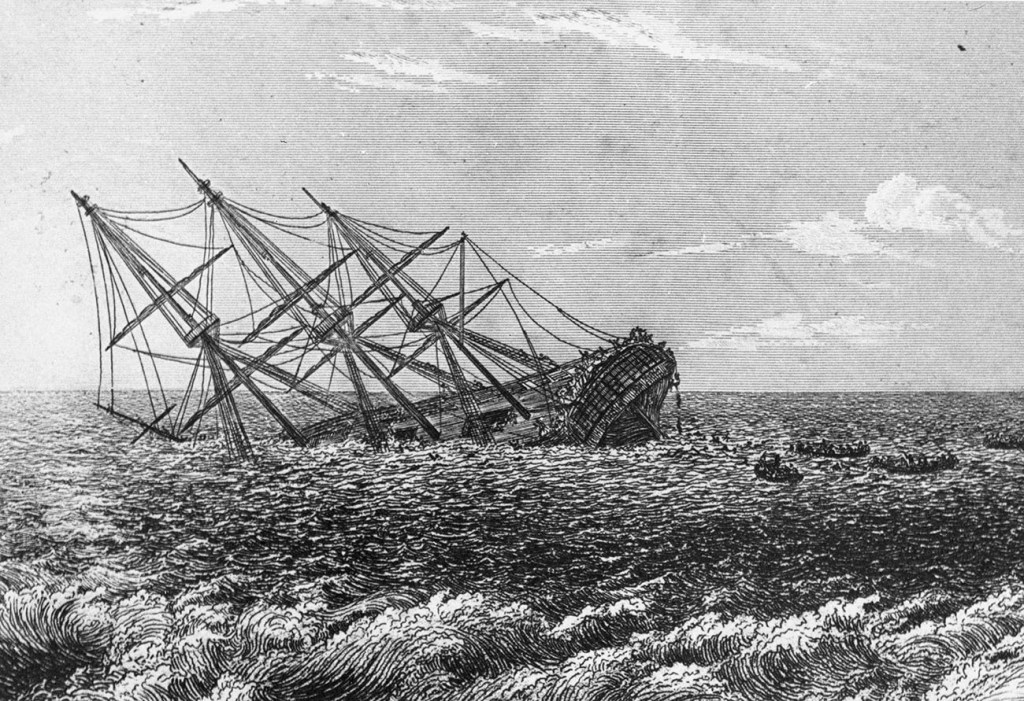
    H.M.S. Pandora in the act of foundering’ . An etching by Lt-Col. Batty after a sketch by Peter Heywood from ‘The Mutiny and Piratical Seizure of H.M.S Bounty’ first edition 1831. Photo courtesy SLQ.

    In August 1791, HMS Pandora was returning to England, having tracked down and captured 14 of the Bounty mutineers in Tahiti. But disaster struck on the night of the 29th, as the Pandora was trying to find a way through the Great Barrier Reef. The ship’s surgeon, George Hamilton, left a nerve-wracking account of the incident in his memoir, “A Voyage Round the World in His Majesty’s Frigate Pandora”, published in 1793 after his return to England.

       Hamilton wrote that on the night of 29 August, a boat sent earlier in the day by the Pandora’s captain, Edward Edwards, to scout for a passage through the maze of reefs had finally returned to the ship. As the crew was hauling it out of the water, the 24-gun frigate unexpectedly struck a submerged coral reef. Captain Edwards immediately ordered the crew to set the sails as he tried to back off the outcrop, hoping to use wind power alone. When that failed to dislodge his ship, he ordered a boat to be made ready to take an anchor out so he might kedge the vessel off. But by the time the anchor was in place and the crew ready to winch, it was already too late.

       The carpenter had examined the hold and found that the Pandora’s hull had sprung a serious leak. In the 20 minutes they had been aground, the water had risen to nine feet (2.7 m). All hands were immediately engaged in efforts to save the ship from sinking. Sailors began bailing at each of the hatchways, and several of the Bounty mutineers were unshackled to help man the bilge pumps.

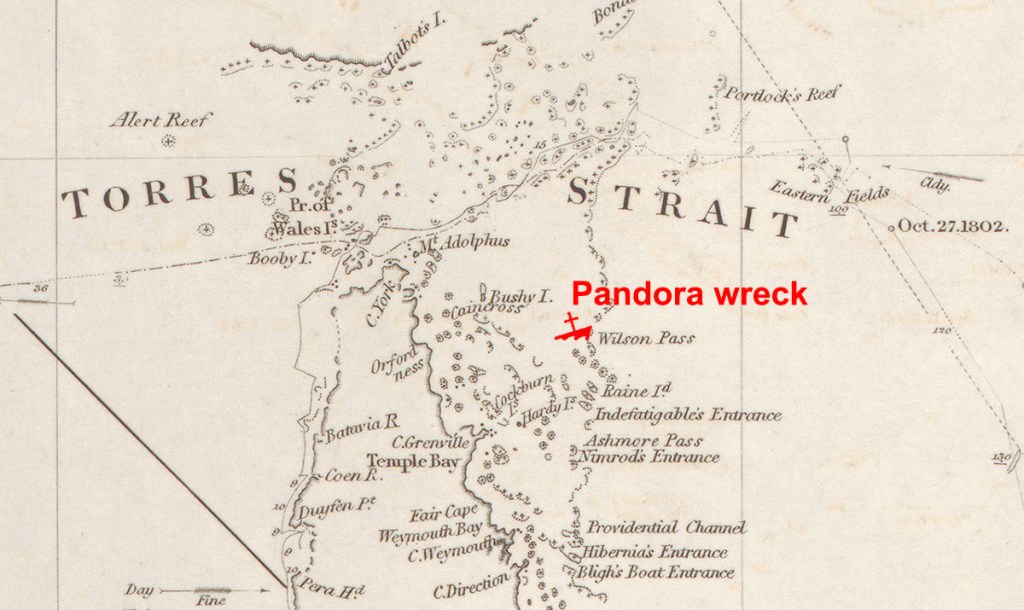
    Map showing HMS Pandora wreck location (approx).

       “It blew very violently, and she beat so hard upon the rocks, that we expected her, every minute, to go to pieces,” Hamilton recalled. “It was an exceedingly dark, stormy night, and the gloomy horrors of death presented us all around, being everywhere encompassed with rocks, shoals, and broken water. About ten [o’clock] she beat over the reef, and we let go the anchor in fifteen fathoms of water.

       Not yet ready to give up on his ship, Captain Edwards ordered the guns thrown overboard and, at the same time, had some of his men prepared the topsail to be hauled under the ship’s bottom in a vain effort to stem the leak. But before they could get the sheet of canvas over the side, one of the bilge pumps failed, and the water began flowing into the hold faster than it could be bailed out. The topsail was abandoned as every hand was set to work, baling to stop the ship from sinking.

       Soon the Pandora began listing, and the crew experienced their first casualties. A canon broke loose and rolled across the deck, crushing a sailor, while a topmast came crashing down on deck, killing another. The crew laboured at the pumps and bailed with buckets through the night to keep the ship afloat. An ale cask was tapped, and its contents were regularly served out to the men to keep their spirits up.

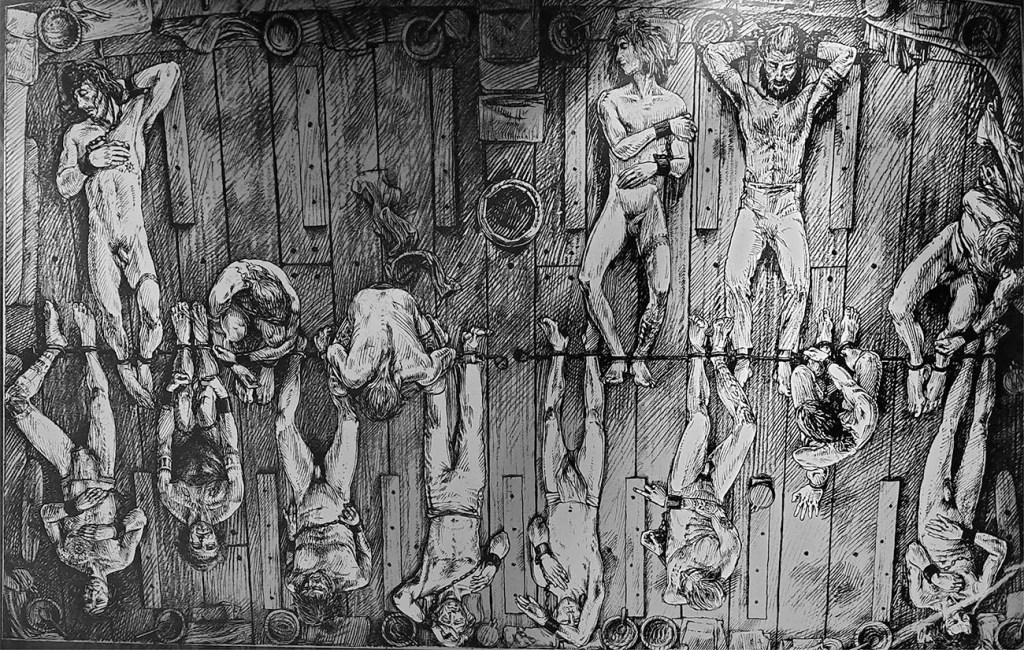
    Bounty Mutineers accommodation on HMS Pandora. Source: Museum of Tropical Queensland, Townsville.

       Then, about half an hour before dawn, Captain Edwards called his officers together to discuss their next move. It was clear to all that the ship was doomed and that their efforts should shift from saving the ship to preserving the lives of the crew. The Pandora’s four boats had been put over the side earlier in the night, and they were sheltering in the lee of the reef, their coxswains awaiting further orders. Spars, booms, hen-coops and anything else that floated were cut free so that the men might find something to keep themselves from drowning when the ship inevitably sank.

       Hamilton wrote that Captain Edwards ordered that the remaining prisoners be released from their irons. However, it came too late for some of the mutineers who were still shackled in place in their makeshift prison they called “Pandora’s Box.” They went down with the ship.   

    The water began pouring in through the gun ports, causing the frigate to list even further. As the captain and crew scrambled to jump overboard, the Pandora heeled over and sank almost immediately. The boats came to the rescue of the sailors clinging to the wreckage in the water, but for many help came too late. “The cries of the men drowning in the water was at first awful in the extreme,” Hamilton wrote. But as the men disappeared below the surface, the screams faded and then died away entirely.

    Loss of the Pandora on the Great Barrier Reef. Source: Tales of Shipwrecks and Adventures at Sea, 1856.

       As morning heralded a new day, a small sandy cay could be seen about two and a half nautical miles (5 km) to the southeast. Edwards ordered the boats to make for the one tiny speck of land in that vast expanse of sea. The captain took stock of their provisions and ordered a guard to be placed over the remaining surviving mutineers. Fortunately, someone had the forethought to load a barrel of water, a small keg of wine, and some sea biscuits onto one of the boats. To that haul of supplies could be added a few muskets and cartouche boxes of ammunition, along with a hammer and a saw. Not much to preserve life in such remote and hostile waters. Edwards thought their only chance of survival would be to make for the Dutch trading outpost on Timor Island, some 1200 nautical miles (1400 km) away.

       Edwards forbade anyone from drinking on that first day, calculating that they would have only enough water to last 16 days at two small cups per person per diem. They spent two days on the cay preparing the boats for the voyage that lay ahead. Floorboards were torn out and affixed to the sides of the boats, around which canvas was wrapped to increase the freeboard.

       Before leaving, the sailing master, George Passmore, was sent back to the wreck site to see if anything might have floated free in their absence.   He returned two hours later with a small assortment of salvaged materials and a cat that he found clinging to the top-gallant mast-head.

       On the third morning, they set off west towards Torres Strait and beyond to the Dutch settlement of Kupang. Edwards had hoped to refill their water cask at one of the islands dotting Torres Strait before they headed into the expanse of the Arafura Sea. However, an encounter with Islanders, which began friendly enough, inexplicably ended abruptly with a volley of arrows and musket fire being exchanged. They stopped again at Prince of Wales Island (Muralag), where this time they were able to fill their water cask without incident. On 16 September, after an arduous voyage lasting about a fortnight, the four boats pulled into Kupang Harbour. From there, they were taken to Batavia (present-day Jakarta), where Edwards purchased a ship for the return to England.

    Canon recovered from HMS Pandora wrecked on the Great Barrier Reef on display at the Museum of Tropical Queensland, Townsville.

       The shipwreck directly cost the lives of 31 sailors and four mutineers. Another 16 died from disease during or after their stay in Batavia. Of the 134 men who left England on the Pandora, only 78 made it home alive. The ten prisoners who survived the wreck were tried for mutiny. Four were acquitted, two received pardons, one got off on a technicality, and three were hanged. Captain Edwards faced a court-martial to answer for the loss of his ship, but he was found not to have been at fault.   

    The Museum of Tropical Queensland in Townsville has a world-class exhibition of artefacts recovered from the wreck.

    © Copyright C.J. Ison / Tales from the Quarterdeck, 2024.

    Please enter your email address below to be notified of future blogs.
  • Cyclone Mahina & the loss of the North Queensland Pearling Fleet, 1899.

    Pearling luggers at Thursday Island. Courtesy State Library of Queensland.

       On 2 March 1899, Cyclone Mahina formed near the Solomon Islands and began tracking south-west towards the Queensland coast. On the same day, a second weather system formed in the Arafura Sea northwest of Darwin. This “monsoonal disturbance” was named Nachon and began moving towards the southwest. Unbeknown to the Thursday Island pearling fleet anchored in Bathurst Bay, 400 kilometres down the Queensland coast, both of these powerful weather systems were bearing down on them. Mahina and Nachon would collide over Bathurst Bay, wreaking havoc on the fleet, resulting in the loss of as many as 400 lives.

    Cyclone tracks for Cyclone Mahina which devastated the Thursday Island Pearling fleet at Cape Melville on 5 March 1899

       The pearling fleet was based at Thursday Island in Torres Strait, but the pearlers regularly ventured across Queensland’s warm tropical waters in search of shells. Pearling schooners served as floating processing stations for their fleet of ten to 15 luggers and diving boats. It was those smaller vessels that ranged out over nearby reefs, collecting the lucrative shells from the sea floor.

       March 4 was a Saturday and, for the pearlers, the much-anticipated start to the weekend. After they had delivered their pearl shells to their respective station schooner, tending to any repairs and restocking with provisions for the next week, it was time to relax and catch up with friends and family whom they had not seen all week.

       The schooners Sagitta, Silvery Wave, and Crest of the Wave were anchored near Cape Melville just inside Bathurst Bay. As the prevailing winds had been blowing from the southeast for the previous three weeks, everyone was anchored close to shore where the mountains extending inland protected them from the worst of the wind.

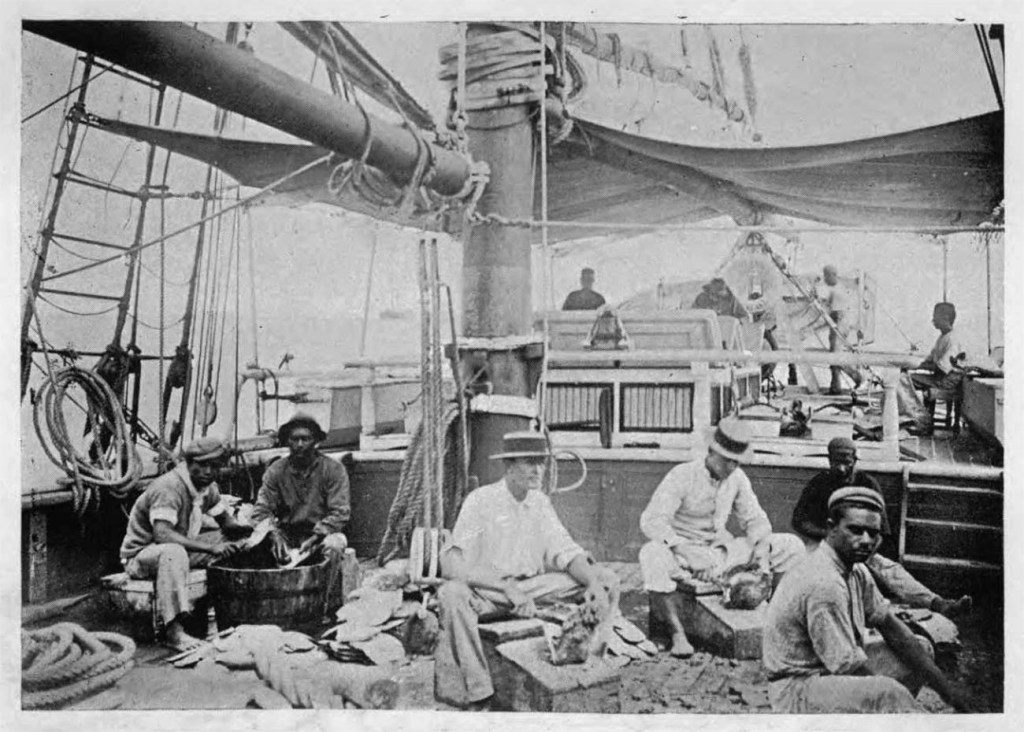
    Opening and cleaning shell on the schooner Olive. Source: The Pearling Disaster, 1899.

       The schooners Tarawa, Meg Merrilees, Olive and Aladin were anchored about 75 kilometres away near Pelican Island on the northwestern end of Princess Charlotte Bay. The manned Channel Rock lightship and several other pearling vessels were scattered along the Great Barrier Reef in the path of the approaching storm. No one, including the local Aboriginal people, could imagine the violent mayhem about to be unleashed upon them.

       At 7 o’clock on Saturday evening, only a moderate breeze was blowing from the southeast. However, just four hours later, the wind had increased to hurricane strength. It had also begun shifting direction from the southeast to the southwest. As Cyclone Mahina tore towards Bathurst Bay, the wind continued shifting further to the west, and eventually it blew from the northwest. For much of the early hours of Sunday, 5 March, the pearling fleet was exposed to the cyclone’s full fury. Torrential rain lashed the vessels. Streaks of angry lightning arced across the night sky while peals of thunder, howling wind and crashing waves competed to drown each other out. The hundreds of men and women trapped on their boats could do nothing but pray that they survived the ordeal.   

    Then, around 4 a.m., a massive storm surge swept through the bay. By 10 o’clock on Sunday morning, the tempest had moved inland, and some sanity returned to the world. It was only then that the few survivors would learn the full devastating impact of the storm.

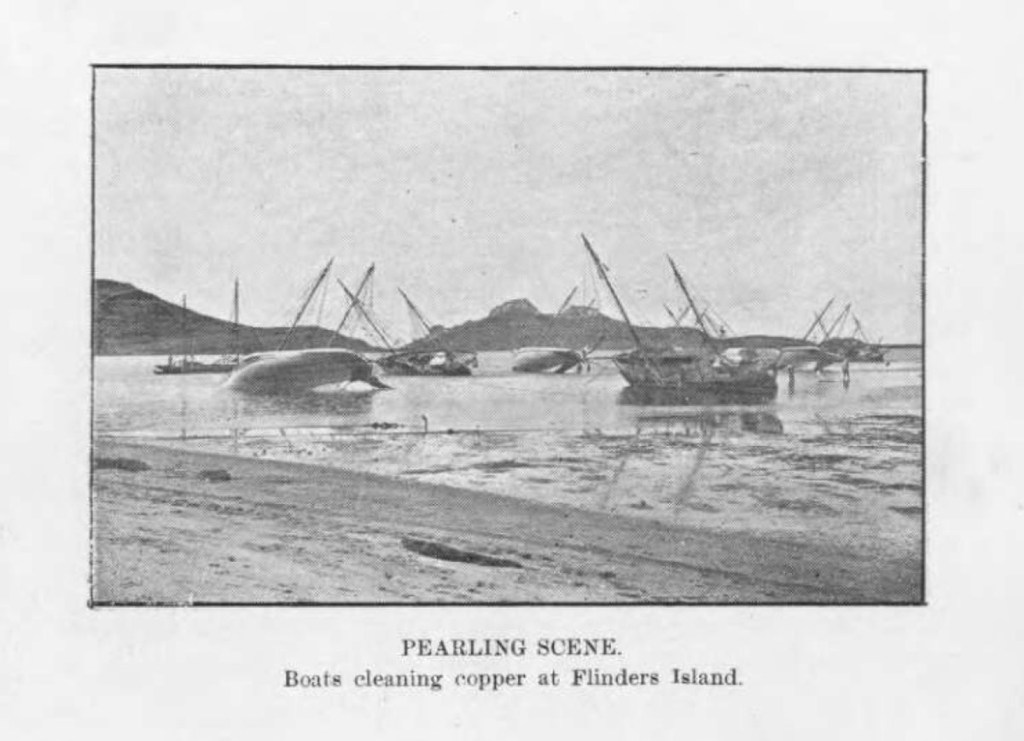
    Boats cleaning copper at Flinders Island. Source: The Pearling Disaster 1899.

       The Tarawa’s anchor cables had parted around 3 a.m., and she was swept onto Pelican Island. However, she was lucky for the damage would be easily patched, and she would limp back to Thursday Island. The Meg Merrilees dragged her anchors and ran onto a coral reef. All hands survived the wild night, but attempts to refloat the schooner were unsuccessful. The tender Weiwera was also lost. Of the 30 or so luggers anchored nearby, one-third sank with the loss of nine lives. The schooners Olive and the Aladin were more fortunate. Their anchors held, and they survived the night.

       The vessels lying off Cape Melville fared far worse. The 25-ton tender Admiral had only arrived in Bathurst Bay on the morning of the cyclone. She foundered at the storm’s height with the loss of her five crew and an unknown number of passengers brought down from Thursday Island to join the fleet. The Silvery Wave likewise was lost. Only a Japanese crew member named Sugimoto survived. The Sagitta was thought to have collided with the Silvery Wave and went to the bottom of Bathurst Bay with nearly 20 hands.   

    Captain W. Field Porter survived to give a harrowing account of that terrible night.  He recounted that his schooner, Crest of the Wave, was anchored near the other vessels off Cape Melville while about 40 luggers were in shallower water close to the beach. As the storm intensified, his anchors began dragging. Fortunately, the wind and current pushed the schooner into deeper water. “The intense darkness and driving rain prevented anything [from] being seen of the other boats or the land. The sea by this time was very rough, and enormous waves broke time after time on board,” Porter later wrote of his experience.

    “Mr Outridge, preparing for deep sea diving and assisted by Captain Porter of the Crest of the Wave.” Source: The Pearling disaster of 1899.

       The eye of the cyclone passed over his ship around 4.30 in the morning. After ten or fifteen minutes of dead calm, Captain Porter recalled, the wind suddenly came from the north-west, “with such terrific force that the schooner was thrown on her beam ends and [was] almost buried in the raging sea.” With much difficulty, the masts were cut away, and the ship righted itself. But by then, she had taken on a lot of water. The bilge pump was manned, and every spare hand bailed with buckets to keep the ship from sinking. Eventually, it was discovered that the water was entering through the rudder trunk. The leak was plugged with blankets and bags of flour, and the ship was saved. However, for 12 long and terrifying hours, the crew battled the elements, not knowing if each moment would be their last. Finally, the wind and seas started to ease, and Captain Porter and his men began to think they might just survive. As for the luggers, they either foundered at their anchorage or were driven ashore, where most were smashed to pieces. Some wreckage was found almost half a kilometre from the beach, taken there by the massive storm surge which swept several kilometres inland in places. Only a handful of the luggers were able to be refloated.

       The Channel Rock Lightship, moored between Cape Melville and Pipon Island, was nowhere to be seen after the storm passed and was believed to have sunk at her moorings with the loss of four lives. The bodies of Captain Gustaf Fuhrman and the mate Douglass Lee were later found near Cape Melville amongst debris from the lightship.

    Wreck of the Zanoni at Cape Melville, Source: The Pearling Disaster, 1899.

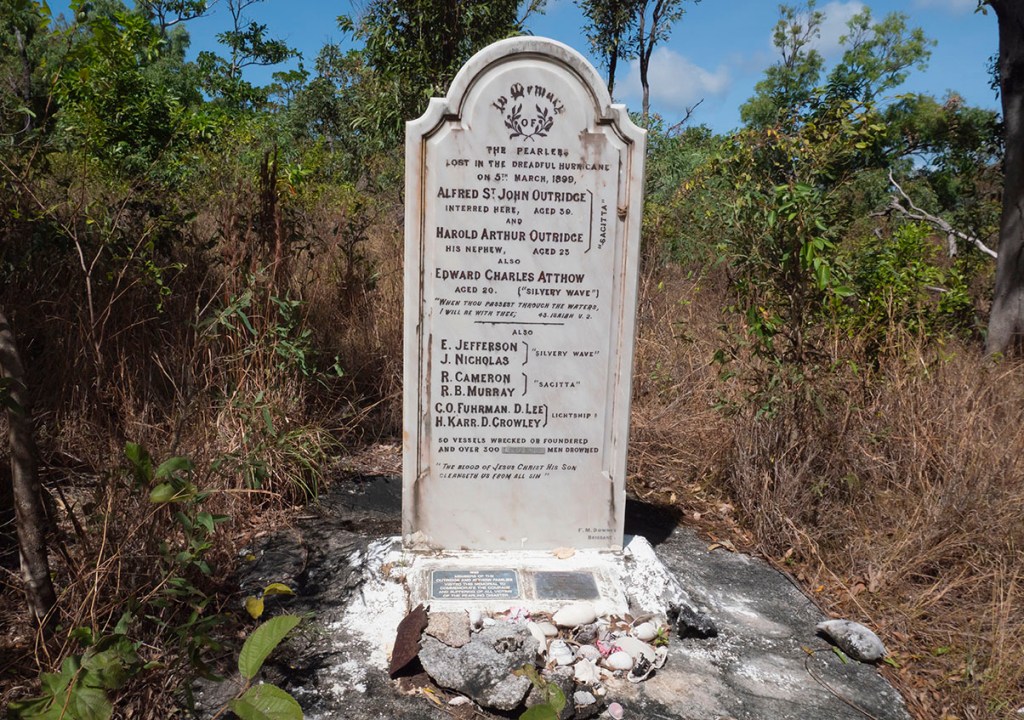
       It is estimated that some 300 pearlers lost their lives that night in Queensland’s most deadly natural disaster. While a dozen Europeans perished, most of the casualties were men and women from Torres Strait, the South Pacific, Japan and Malaya. Most were buried where their bodies were found with simple timber markers noting their final resting place. It was thought that as many as 100 local Aborigines were also killed during the storm and its massive tidal surge.

       On Flinders Island, several dolphins were found washed up on rocks almost five metres above the high tide mark. One witness painted a vivid picture of the destruction at Bathurst Bay. “There is quite a forest of mastheads and floating wreckage, the boats having evidently sunk at the anchorage. There are tons of dead fish, fowl, and reptiles of all descriptions, and the place presents the appearance of a large cemetery. All the trees have been stripped of their leaves.”

       Four schooners and 54 luggers were wrecked beyond repair, which devastated Thursday Island’s pearling industry. The human cost was even higher. With so many casualties, barely a family on Thursday Island escaped losing a loved one.

    Cyclone Mahina memorial at Cape Melville which marks the loss of 300 people during the storm. Photo: CJ Ison.

    © Copyright C.J. Ison / Tales from the Quarterdeck, 2024.

    Please enter your email address below to be notified of future blogs.
  • Surviving the Centaur sinking.

    A poster urging Australians to “Avenge the Nurses” after the sinking of the Centaur in 1943. Image courtesy Australian War Memorial.

       On a quiet Saturday afternoon on 15 May 1943, the senior Royal Australian Naval officer in Brisbane received a message reporting that a USN destroyer had picked up survivors from the Australian Hospital Ship (AHS) Centaur. This was the first anyone knew of the tragedy that had unfolded a short distance off the Queensland coast.

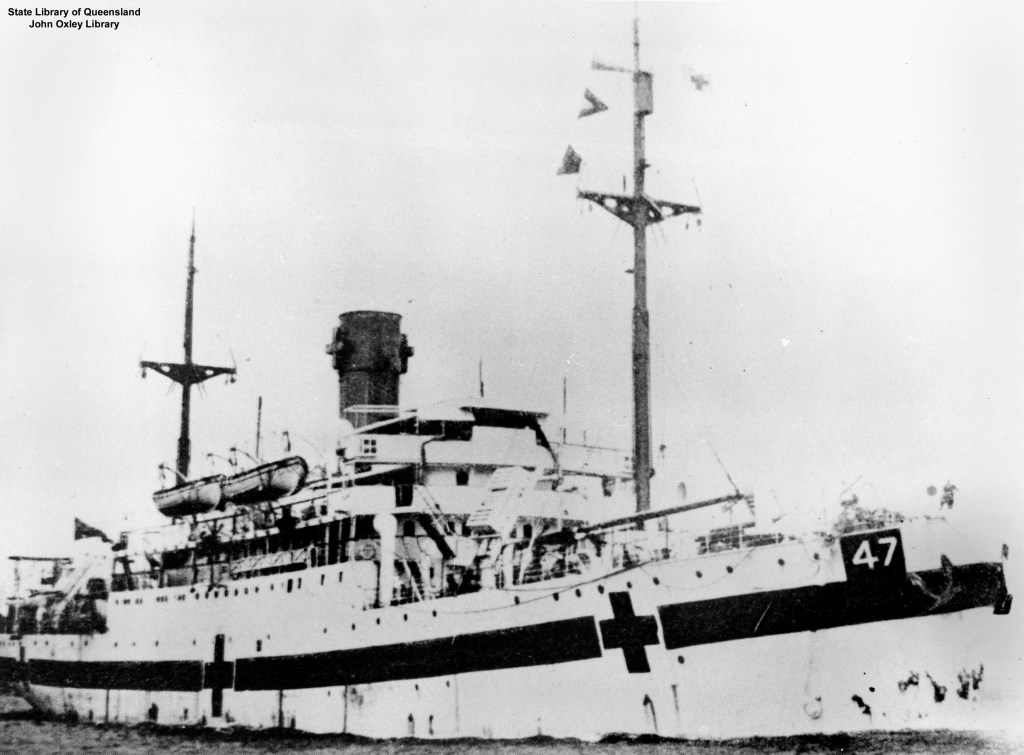
       The Centaur left Sydney bound for Port Moresby to pick up sick and wounded diggers and return them to Australia. Fighting had been raging in New Guinea for over a year, and casualties had been high. As she steamed north this time, she had a full crew, and she was also delivering members of the 2/14th Field Ambulance to Port Moresby. In all, there were 332 souls on board.

       Around 4 a.m. on Friday, 14 May, the Centaur was about 30 nm (55 km) off Moreton Island when she was struck by a torpedo fired by a Japanese submarine. Merchant seaman Alfred Ramage had just finished his watch and was climbing into his bunk when he was rocked by the powerful explosion. Ramage immediately knew what had happened, so he quickly donned his lifebelt and began making his way to the boat deck. Urgency spurred him along, for he had never learned to swim.

       The torpedo had hit the portside fuel bunker, which sent flames ripping through the ship, burning and trapping many people below decks. Those same flames soon engulfed the boat deck and then the bridge as the crew struggled to get the lifeboats away.    Steward Frank Drust was standing outside the ship’s pantry when the floor collapsed and a wall of flames separated him from the closest companionway leading to the deck. By now, the Centaur was sinking by the bow. He waded through swirling waist-deep water and eventually made it onto the deck. He and a few comrades began throwing hatch covers and life rafts over the side to help those already floundering in the water. They continued their efforts until they, too, were washed off their feet as the sea rose around them.

    AHS Centaur. Photo Courtesy State Library of Queensland

        Sister Ellen Savage, one of 12 nurses on board, was woken by the loud explosion reverberating through the ship. She and fellow nurse Merle Morton fled their cabin in their pyjamas and were told by their commanding officer to get topside as quickly as they could. They had no time to retrieve warm clothing or anything else from their cabin before they took flight.

       By the time they reached the deck, the Centaur was already sinking. The suction dragged Ellen Savage down into a maelstrom of whirling metal and timber, cracking her ribs, breaking her nose and bruising her all over. But suddenly, she found herself back on the surface in the middle of a thick oil slick. She never saw her cabinmate or her commanding officer again.

       Savage could see a large piece of wreckage a short distance away and swam for it. It turned out to be a portion of the ship’s wheelhouse where several others had already taken refuge. In time, as many as 30 survivors climbed onto the fragile floating island. Others who had escaped the ship kept themselves afloat on pieces of debris or the few rubber liferafts that had been deployed in the hectic minutes after the torpedo struck.

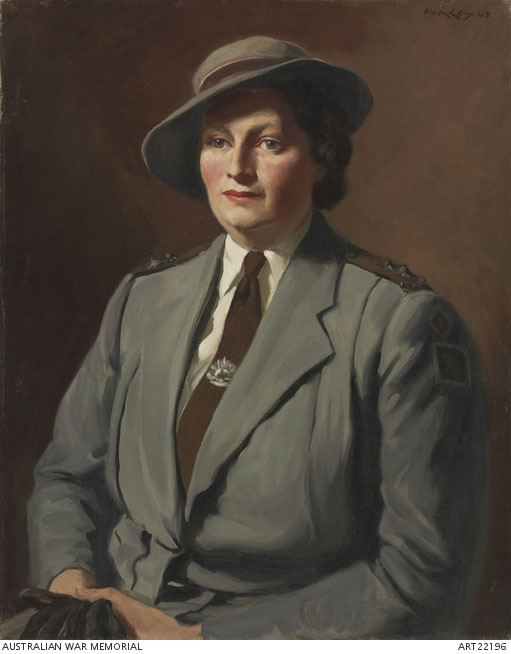
    Sister Ellen Savage GM. Image courtesy AWM.

          Ship’s cook Frank Martin survived by clinging to a single floating timber spar. For the next 36 hours he held on for dear life, half-naked and nothing to eat or drink until he was plucked from the water.

       Seaman Matthew Morris was a little luckier. At first, he found himself alone in the water, blinded by salt and oil. But when his vision returned, he spied a small raft a short distance away, so he swam over and climbed into it. Then he spotted his mate, Walter Tierney, and hauled him onboard. As daylight came, the pair saw something floating in the distance and paddled towards it. It turned out to be the wheelhouse, so they lashed their raft to it and joined the 30 or so people already there.

       The survivors spent all that day huddled on the makeshift raft. There was less than 10 litres of water on hand, and that was doled out sparingly. Several of the survivors had severe burns to their bodies. One was Captain Salt, a pilot from the Torres Strait Pilot Service, who had run through a wall of flame to escape the sinking ship. Despite his painful injuries, he kept morale up, reassuring everyone that help would soon be on the way.

       Matthew Morris led choruses of “Roll out the Barrel,” “Waltzing Matilda,” and other wartime favourites to keep people from thinking about their plight. Sister Savage tended to the wounded with what little she had on hand, never complaining of her own injuries. She kept her broken ribs to herself until after they had all been rescued.

       One poor man, Private Jack Walder, had been badly burned. He drifted in and out of consciousness until he passed away on the raft. Savage prayed over his body before it was gently pushed away to sink from sight.

    The Brisbane Telegraph front page, 18 May 1843.

        According to several survivors, sharks were constant and unwelcome companions, circling as they clung to wreckage or perched precariously on makeshift rafts.

       The survivors spent all of Friday, Friday night and Saturday morning hoping and praying that they would soon be rescued. Several said they heard aircraft flying overhead or saw ships passing in the distance, but the Centaur survivors went undiscovered. At one stage, those on the wheelhouse considered dispatching one of the rubber rafts to try to make landfall to raise the alarm. However, that idea was eventually discarded when it was decided that the chances of surviving the large ocean swells in the small craft were unlikely.    On Friday night, the Japanese submarine surfaced briefly near the wheelhouse, sending a chill through the survivors. Everyone remained quiet, and a short time later, the sub disappeared below the waves again. The survivors never gave up hope of being rescued. Then, on Saturday afternoon, an Australian Air Force aircraft on a routine flight saw something strange floating in the water. On investigation, the pilot realised it was wreckage and guided the US Navy destroyer, USS Mugford, to the location. They quickly began searching the surrounding waters for more survivors.

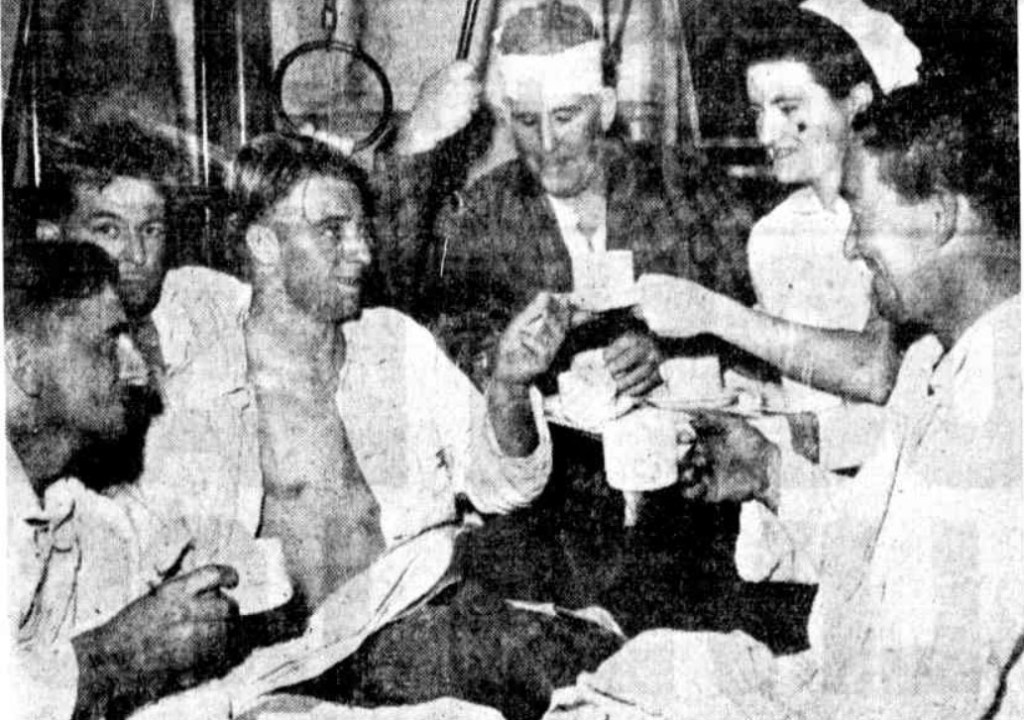
    AHS Centaur survivors being cared for in hospital. Telegraph, 18 May 1943, p. 2.

       In all, 64 people were saved, but another 268 were not so lucky. Sister Ellen Savage was awarded the George Medal for her devotion to duty, tending to the wounded despite her own injuries.

    Lest We Forget.

    © Copyright C.J. Ison / Tales from the Quarterdeck, 2023.

    To be notified of future blogs, please enter your email address below.

  • The Loss of the Duroc and the rise of la Deliverance

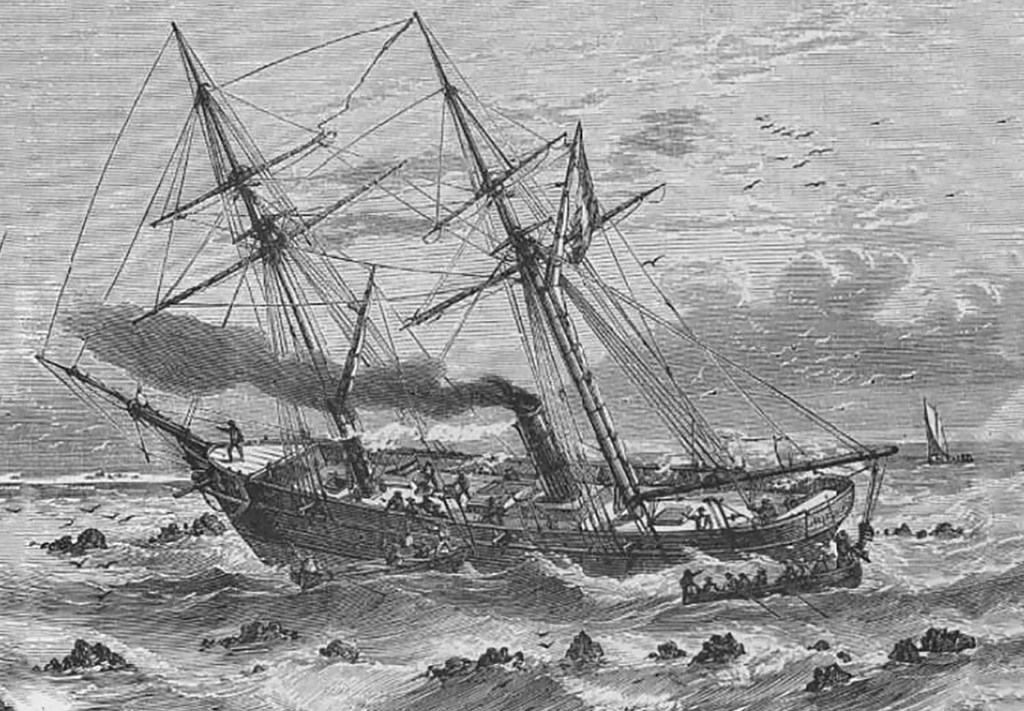
    The French steamer Duroc wrecked on Mellish Reef. Source: Wikicommons.

       On the night of 12-13 August 1856, the French Naval steam corvette Duroc was wrecked on Mellish Reef about 800 km off the Queensland coast. After the ship ran aground, her passengers and crew, numbering 70 people, made it onto a small sand cay where they were safe for the time being. However, they were stranded far from regular shipping channels, and the chance of their being rescued was remote. Captain Vissiere thought their only chance of getting off the islet was to build a new boat from the wreckage of the old.

       The Duroc had set off from Port de France (Noumea), New Caledonia, five days earlier, but on that night she ran aground on a submerged coral reef and could not get off. Each passing swell pounded the hull onto the reef, and she began taking on water. Fearing the ship might break apart during the night, Captain Vissiere ordered the crew to start bringing all stores, provisions, and water casks up on deck. He also had the four lifeboats prepared in case they had to abandon ship during the night. Then Vissiere had an anxious wait until morning, when he could better assess their situation.   

    Daylight revealed the ship was well and truly lodged on the reef, and they were surrounded by breaking seas. But about four kilometres away, there was a small, low-lying sandy islet which seemed to offer a place of refuge. So began the laborious task of ferrying all the ship’s stores and personnel to dry land. Over the next 10 days, they stripped the Duroc of its masts, bowsprit, sails, spars, blacksmith’s forge, a water distillation plant and the cook’s oven. By 23 August, they had emptied the stranded vessel of anything useful and established a comfortable camp on the tiny cay. Captain Vissiere was satisfied that their immediate survival was assured, but they were stranded nearly 800 km from the nearest land, and rescue seemed unlikely.

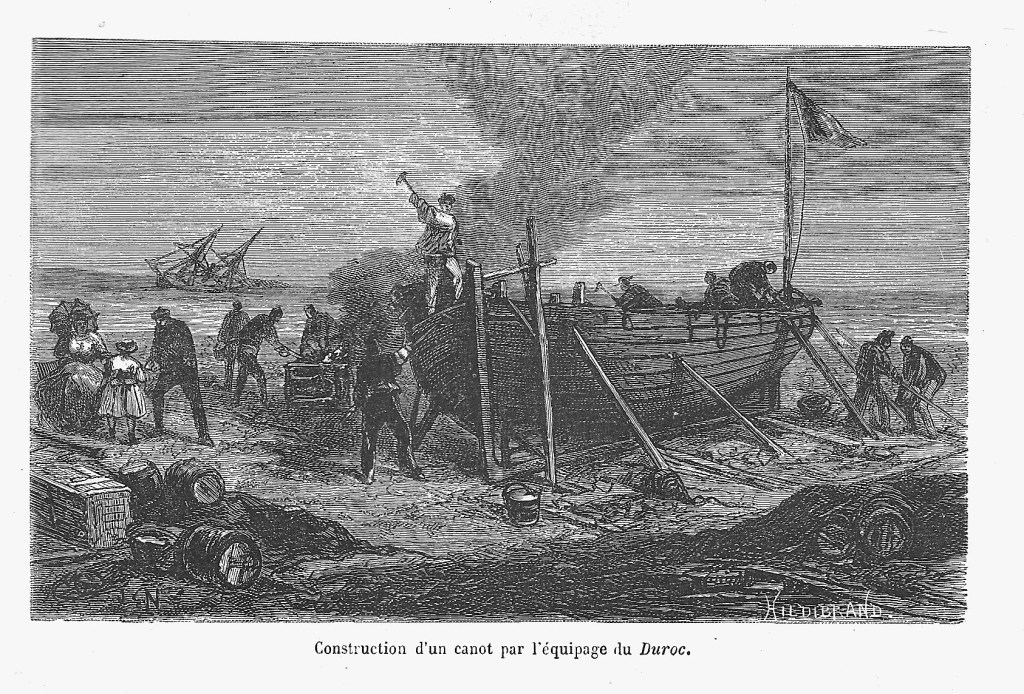
    Survivors of the wrecked Duroc on Mellish Reef building the La Deliverance. Source: Wikicommons.

       Vissiere prided himself on being a competent master mariner, and he could not account for how his ship had run aground. He took several unhurried astrological observations on the island and would later claim that the reef he had struck was, in fact, some distance from where it was laid down on his chart. Feeling vindicated, the captain then turned his mind to finding a way back to civilisation, for not only was he responsible for his crew, but his wife and baby daughter accompanied him.

       Captain Vissiere felt that his best course of action would be to make for Australia’s east coast, where he could expect to find help from a passing ship. However, the lifeboats could carry only a fraction of those stranded on the small island. So, Captain Vissiere opted to send his First Mate, Lieutenant Vaisseau, off with the three largest boats and about half the crew. He would remain on the island with his wife, daughter, and about 30 others. They would construct a new vessel from the timber they had salvaged from the Duroc and make their escape if no one had come for them in the interim.   

    The three boats set off on 25 August with instructions to make for Cape Tribulation, where, with any luck, they would meet a British ship sailing the Great Barrier Reef’s inner passage. Cape Tribulation was probably chosen because it was easily recognisable and it was where the reef pinched in close to the coast, funnelling any passing ships close to land.

    Mellish Reef. Courtesy Google Maps

       After setting off from Mellish Reef, the three boats encountered rough weather, which threatened to capsize the heavily overloaded craft. Lt Vaisseau tried tethering the three boats together so they would not become separated, but in the rough seas, this proved dangerous, and the lines were cut. After weathering the conditions for two days, Vaisseau decided they should jettison everything non-essential to lighten the load and raise their freeboard.

       Then, one day, while Lt Vaisseau was taking his noon observation, his boat was struck by a rogue wave, tossing him into the sea. Unable to swim against the current to make it back on board his lifeboat, he would have drowned had another boat trailing astern not been able to come close enough to rescue him. Vaisseau had a lucky escape, for he was only plucked from the water as his strength was beginning to fail him.

       After five days at sea, on the evening of 30 August, they crossed through the Great Barrier Reef near Cape Tribulation and anchored in calm waters for the night. The men thought the worst of the ordeal was behind them, and they would soon fall in with a passing ship. Lt Vaisseau noted they still had 72 kgs of sea biscuits, 20 litres of brandy and 60 litres of wine when they reached the Australian coast. However, shared among 36 hungry men, that would last them only another few days.

       The next day, they made land, filled their water casks, and then bore north, hugging the shore, pushed along by the prevailing southerly winds. They stopped each night in the lee of islands, foraged for roots, greens and shellfish, and cast out lines hoping to catch fish. They only delved into the supply of sea biscuits when their efforts failed to find enough food.

       By 9 September, they had reached Albany Island in the Torres Strait. They continued sailing past Booby Island, unaware that there was an emergency store of food and water there to aid shipwrecked sailors. Having sighted not a single ship while off the Australian coast, they ventured out into the Arafura Sea. Lt Vaisseau decided they should head for the Dutch settlement of Kupang on Timor Island. The three boats finally arrived on the evening of 22 September, and not a moment too soon, for their food had run out several days earlier.

    Construction of a new vessel La Deliverance from the wreckage of the Duroc on Mellish Reef. Source: Wikicommons.

        Meanwhile, Captain Vissiere and the remaining men had been kept busy constructing the new vessel, which they named La Deliverance. Under the directions from the ship’s master carpenter, they sawed the Duroc’s lower masts into planks and fixed them to a frame. The new craft measured 14 metres in length and was completed around the time Lt Vaisseau and his party reached Timor Island.

       On 2 October, La Deliverance was launched, and they sailed away from the island they had called home for the past six weeks. Captain Vissiere intended to make for the Australian mainland, just as his lieutenant and the three boats had done. Once off land, he would decide whether they should head north, through Torres Strait and on to Kupang, or turn south towards Port Curtis (Gladstone), which was the most northerly settlement on the east coast at the time. When he reached the Australian coast, he found the same southerly trade winds that Lt Vaisseau had.

       Despite the seemingly optimistic start, the passage was arduous, hampered as it was by unpredictable weather. Prolonged calms left them stranded for days at a time. The doldrums were only relieved by violent storms that lashed them mercilessly and threatened the safety of the vessel. By the time they were rounding Cape York, the boat was leaking alarmingly. Captain Vissiere pulled in at Albany Island so urgent repairs could be made before they left the relative safety of the Australian mainland. Once the leaks were plugged, they got underway, ready to cross the Arafura Sea. On 30 October, four weeks after setting off from Mellish Reef, La Deliverance sailed into Kupang harbour.   

    Though they suffered greatly during the ordeal, Captain Vissiere did not lose a single person as a result of the wreck or the 4000 km voyages undertaken by the survivors to reach Kupang.

    © Copyright C.J. Ison / Tales from the Quarterdeck, 2023.

    To be notified of future blogs, please enter your email address below.

  • Bato to the Rescue – 1854

    Shipwreck survivors take to their boat.. Source: Tales of Shipwrecks and Adventures at Sea, 1856.

       In 1854, the fully-rigged Dutch ship Bato rescued not one, not two, but three separate parties of shipwreck survivors whose ships had come to grief in separate mishaps in Australia’s northern waters. In the space of a few weeks, these three ships all ran aground while attempting to navigate the treacherous waters of the Great Barrier Reef and the Torres Strait.

       The first casualty was the 521-ton ship Fatima. On 3 June, the Fatima left Melbourne bound for Singapore via Torres Strait. She made good time sailing up the east coast until, on 26 June, she was within sight of Raine Island. The low-lying island and its distinctive 20-metre-tall tower marked a channel through the Great Barrier Reef and the start of a well-charted passage through Torres Strait.

       Then, just 12nm (20 km) south of Raine Island, her voyage ended abruptly and violently when she crashed into the Great Detached Reef. The Fatima could not be saved, and her captain and crew were forced to take to the boats to save their lives. A refuge of sorts was close at hand, so they struck out for Raine Island off in the distance. There they remained, subsisting on a plentiful supply of seabird eggs while they waited to be rescued.

       A couple of days after the Fatima left Melbourne, the 391-ton barque Elizabeth also set sail from that same port. She was bound for Moulmein, Burma, and also intended to pass through Torres Strait by the Raine Island passage. However, disaster struck on 28 June when the barque ran aground on a small coral outcrop about 28nm (55 km) south of Raine Island. Fortunately, no lives were lost, and after a considerable amount of effort, the crew managed to get the ship off the reef and back into deep water. However, the hull had been breached, and Captain Churchill realised that his ship was taking on more water than the pumps could remove. Churchill made the difficult decision to abandon his ship, and he and his men took to the boats. They made their way through Torres Strait and arrived at Booby Island five days later. The island was marked on charts of the day as a haven for shipwrecked sailors where a supply of food and fresh water could be found.

    The Wreck of the Thomasine. Courtesy State Library of Queensland.

       The third ship, the Thomasine, departed Sydney on 8 June bound for Batavia. She also intended to cross through the Torres Strait. But she ended her northerly run up the coast on 19 June when she struck an uncharted reef about 270 km east of present-day Port Douglas.

       Her master, Captain Holmes would later recall that around 8 o’clock on the evening of the 19th, the ship grazed a submerged reef where no such obstruction should have existed. He had been on deck at the time and had immediately gone to his cabin to consult his chart, to confirm what he suspected. While he was standing at his chart table, still consulting his map, the look-out called, “Breakers ahead.” Captain Holmes raced back on deck to the daunting sight of a long line of breaking waves ahead that extended around to his left and right, almost completely encircling the ship.

       Holmes and his crew kept the Thomasine from running aground during the night by tacking back and forth in the open water between the reefs. The next morning he saw how dire their situation was. The ship was trapped by an almost unbroken ring of breaking waves, denoting the presence of submerged coral reefs. Reefs that were absent from the charts but have since been added and bear the name Holmes Reefs.

       The wind began to rise and Holmes realised his only chance of escape was to try to make it through one of the narrow gaps he could see in the otherwise extended line of surf. He selected one, hoping it would allow his ship to reach the safety of deep water beyond. Unfortunately, the channel proved too shallow, and the Thomasine struck heavily, becoming stuck. Unable to get the Tomasine free, the captain made the difficult decision to abandon ship. The crew then readied two boats with as much food and water as they dared carry.

       Captain Holmes was doubly concerned as they tried to escape the ship and the surrounding reef. Not only did he feel responsible for his crew, but he was also accompanied by his wife and three children, the youngest of whom was just four months old. He divided his crew evenly between the two boats for the voyage north to Booby Island and a cache of stores. However, one sailor died during the struggle to get the boats through the roiling seas surging around the ship. Holmes   

    Over the next fortnight or so, the 18 castaways steadily made their way north, surviving on short rations and less than one litre of water per day from a small cask taken from the ship. But by 6 July, they had covered about 800 km and had reached Bird Island in the Torres Strait. Captain Holmes calculated that it would only take them another one or two days to reach Booby Island.  

    Map showing location of the three shipwrecks in Torres Strait. Courtesy Google Maps.

       It was around this time, the Dutch ship Bato was passing through the same waters. She had sailed from Hobart on 10 June and steadily made her way up the east coast of Australia. As Captain Brocksmit approached the Raine Island entrance, he sighted the Fatima castaways camped on the island. Ten men were taken on board while the rest followed in the Bato’s wake in their own boat until they had reached the Middle Bank well inside the Great Barrier Reef.

       The next day, 6 July, the Bato’s captain came across the survivors from the Thomasine off Bird Island and made room for them on his ship as well. Finally, the following day, the castaways from the Elizabeth were spotted on Booby Island, where they had landed four days earlier.

       Now carrying as many as 60 additional people, the Bato put the dangerous waters of Torres Strait behind her. Captain Brocksmit made his way along the Indonesian archipelago, arriving in Batavia on 25 July 1854. The survivors were disembarked, and the captains were faced with the unenviable task of notifying their respective ship owners of their losses.

    © Copyright C.J. Ison / Tales from the Quarterdeck, 2023.

    To be notified of future blogs, please enter your email address below.