Tag: quarantine

  • The Plague Ship Ticonderoga

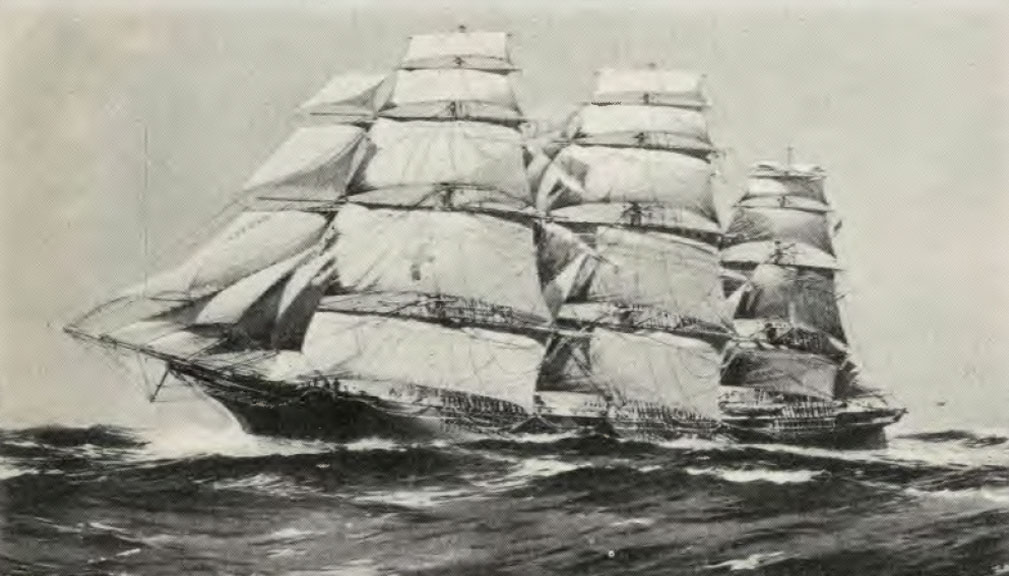
    Example of an American Clipper similar to the Ticonderoga.

    In November 1852 a migrant ship dropped anchor in Port Phillip Bay with some 700 passengers, many of them gravely ill.   The 1,200-ton American Clipper Ticonderoga had been chartered to bring immigrants out to start a new life in Australia, but the three-month journey to their new home proved a nightmare for many of the mostly Scottish passengers.  

    Victoria was experiencing a labour shortage and had started offering assisted passage for workers to come and settle in the colony.   Most of the passengers comprised of farmhands and their young families.  But, not surprisingly, there was an incentive to get the most people out at the lowest cost to the Government.

    When the Ticonderoga left Liverpool she was overcrowded, even by the standards of Victorian England.    Not long into the voyage passengers, many of them young children, started developing a red rash, high fever and sore throat.   At the time the disease was sometimes called scarlet fever or Scarlatina, but it is generally thought today that it was Typhus that wreaked so much havoc on the passengers.    Easily treated with antibiotics today, it had a devastating effect on those trapped onboard the ship.
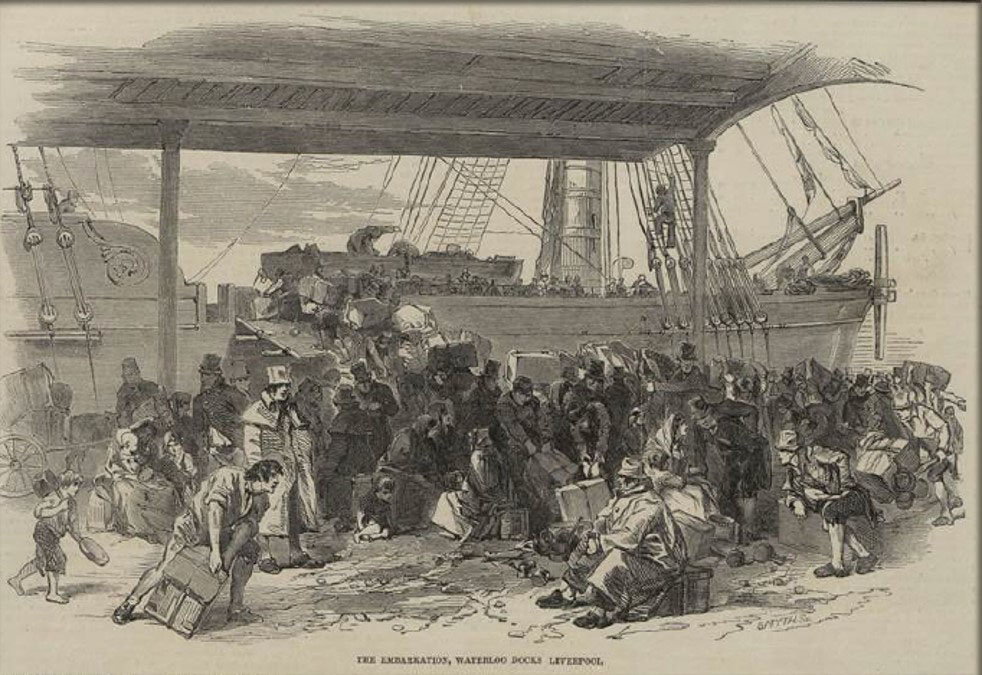
    The Embarkation, Waterloo Docks. Illustrated London News, 6 July 1850.

    It was impossible to separate the sick from the healthy passengers in the overcrowded, poorly ventilated and unsanitary passenger accommodation spread across two decks.    Consequently, the disease spread unchecked.  

    Passengers died in such numbers that as many as ten would be bundled together into a sheet of canvas for burial at sea.   By the time they reached the port city of Melbourne more than 100 people had lost their lives.   Another 150 were sick and in desperate need of medical attention, for they had long run out of medical comforts and the ship’s surgeon had been felled by the disease while attending to his patients. Many of those, 82 to be precise, died in the days and weeks that followed.
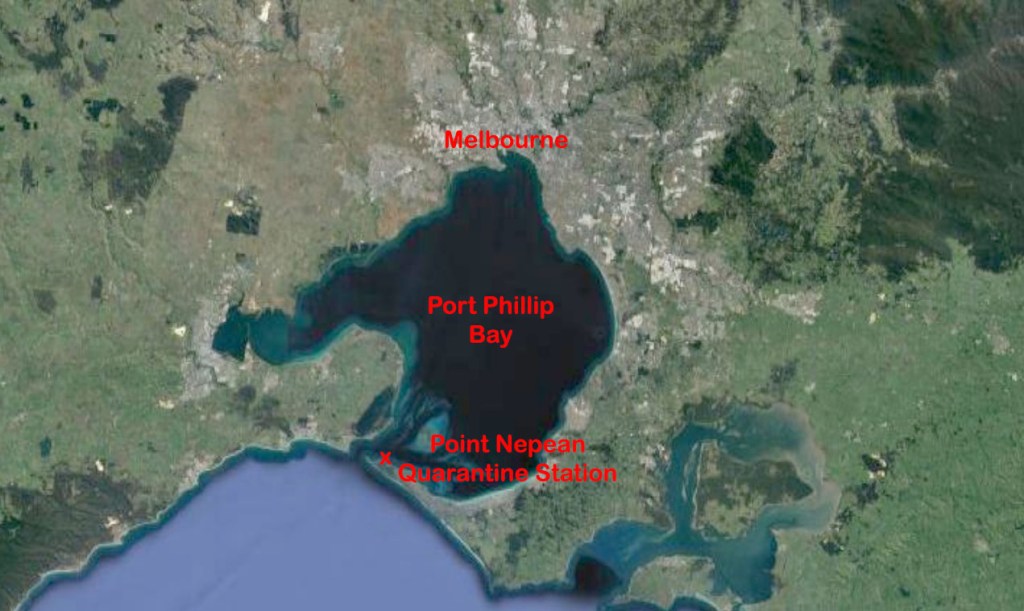
    Port Phillip Bay. Source: Google Maps.

    The passengers and crew were quarantined at Point Nepean just inside the Port Phillip Bay heads for the newly formed Victorian Government had already earmarked a parcel of land there to build a quarantine station.   Tents were hastily erected using spars and ship’s sails and two nearby houses owned by lime burners were used as makeshift hospitals and staffed with medical men brought out from Melbourne.   A ship was also dispatched to the Quarantine Station to serve as a hospital for the more serious cases.   

    The quick response contained the highly infectious disease and kept it from spreading to the general population.   By January 1853 the epidemic had run its course.   The surviving passengers were taken to Melbourne and the Ticonderoga was released to go on its way but not before being thoroughly fumigated. 

    Empire, 15 Nov 1852 Page 2.

    The Emigration Commissioners who had chartered the ship in the first place were roundly condemned for allowing so many migrants, especially families with young children, to be sent out in such unhealthy conditions.    The Ticonderoga was just the last and worst of several recent migrant ships coming to Australia to suffer such an appalling loss of life.    

    Between the Bourneuf, the Wanota, Marco Polo, and Ticonderoga, 279 passengers had died at sea as a result of infectious diseases on the passage out to Melbourne.    The lesson was learned and future migrant ships were reduced to carrying no more than 350 passengers.

    © Copyright C.J. Ison / Tales from the Quarterdeck, 2022.

    To be notified of future blogs, please enter your email address below.

  • The Bourneuf’s Tragic Last Voyage

    Cross section of emigrant ship Bourneuf. From Illustrated London News 10 July 1852.

       On 3 August 1853, the 1500-ton Bourneuf sank in Torres Strait as she was returning to England. It was ironic that her return was cut short, for her voyage out to Melbourne, Victoria, had been no less tragic. She had left Liverpool in mid-July the year before carrying some 800 impoverished emigrants keen to start new lives in Australia. But one in ten would never make it.

       Convict transportation to New South Wales had ceased two years earlier, and the recently constituted Victorian Government had introduced an assisted migration program to try to solve a chronic labour shortage. The colony had long been short of domestic servants, farm labourers, and other workers, but the recent discovery of gold had only exacerbated the problem. Meanwhile, England was still grappling with the social dislocation brought about by the Industrial Revolution. There were more people than there was jobs. On the surface, the migration program appeared to solve both intractable problems; however, transporting the migrants halfway around the world proved costly. Not surprisingly, there was an incentive to transport the largest number of people at the lowest cost to the Government.

    Emigration Depot at Birkenhead, Liverpool. A ship, possibly the Bourneuf, about to depart for Australia in 1852.

       The emigrants, many of them families with young children, were crammed into the Bourneuf’s two tiers of tiny cabins. Passengers were required to prepare their own meals in tightly packed communal kitchens. Bathing and toilet arrangements were rudimentary at best and maintaining good hygiene was impossible from the outset in the overcrowded confines of the ship. The close, fetid conditions were the ideal environment for the spread of communicable diseases. And, it was not long before people started coming down with dysentery. By mid-voyage, measles and scarlet fever were sweeping unchecked through the ship, taking a terrible toll.

       Isolating the sick proved impossible, and for much of the passage, ten or more people, mostly children, died every week. By the time the Bourneuf dropped anchor off Geelong on 20 September, disease had claimed the lives of 83 passengers. The ship was immediately placed in quarantine while 20 desperately ill passengers recovered.

       It would be nice to think that this had been an incident, but that was not the case. Four ships packed with assisted migrants made the long passage out to Victoria in 1852; the Wanota, the Marco Polo, the Ticonderoga and, of course, the Bourneuf. All were grossly overcrowded, even by the standards of the day. Disease outbreaks raged on all four ships with terrible consequences. No fewer than 279 passengers died on the four voyages. Many more passengers had to be hospitalised and quarantined on arrival. However, the lesson was eventually learned, and the Emigration Commissioners limited future migrant ships to carrying no more than 350 passengers.

    Example of immigrant accommodation on the 1874 James Craig barque at the Maritime Museum in Sydney, New South Wales, Australia. Photo C.J. Ison.

       The Bourneuf remained in Port Phillip Bay for ten months, eventually setting sail on 18 July 1853 divested of her passengers. She sailed from Melbourne bound for Bombay before continuing back to England.

       Captain Bibby made his way up Australia’s east coast, pushed along by a south-easterly trade wind. After first passing through the Tasman Sea, he continued north into the warm tropical waters of the Coral Sea. The Bourneuf remained several hundred kilometres off the coast and well outside the Great Barrier Reef. This had become known as the “outer passage” and was considered by mariners to be safer than navigating close to land inside the reef. Captain Biddy intended to cross through the Great Barrier Reef at the Raine Island entrance so he could carefully pick his way through the labyrinth of shoals that lay in Torres Strait.

       Unfortunately, it appears that Captain Biddy had miscalculated his run towards the entrance. At 1 a.m. on 3 August 1853, a lookout spotted a thin white line of breaking surf looming out of the darkness. By the time the danger had been seen, it was too late to take evasive action. The ship slammed into the Great Detached Reef about 15 kilometres south of the Raine Island entrance. Unrelenting swells from the Pacific Ocean pounded the stranded vessel. Captain Bibby gave the order to abandon ship. Thirty-nine people took to three lifeboats that night.

       Two of the boats managed to get clear of the stricken vessel, and the survivors were later rescued by the Dutch ship Everdina Elizabeth. Captain Biddy, his wife, sister-in-law, and five crew drowned when huge waves capsized their lifeboat while they were still alongside the Bourneuf.

       The Bourneuf is just one of 37 ships known to have been lost in or near the Raine Island Entrance during the 19th Century.

    © C.J. Ison/Tales from the Quarterdeck, 2020.

    To receive notifications of future blog posts please enter your email below.