Tag: Orete

  • Tales from the Quarterdeck

    Sixty bite-sized stories from Australia’s maritime past

    The melancholy loss of H.M.S Sirius off Norfolk Island by George. Raper. Source National Library of Australia 136507434-1

    I have just launched a new book titled Tales from the Quarterdeck: Sixty bite-sized stories from Australia’s maritime past. Sixty of the most popular posts have been reedited. In some cases, I’ve rewritten a couple and updated a few where new information has come to light since first writing them.

    For those who would value ready access to the stories in their bookcase, Tales from the Quarterdeck is available in Kindle ebook and paperback formats through Amazon.

    The stories are organised in chronological order, starting with the Tryall shipwreck off the Western Australian coast in 1622, and finishing with the Second World War exploits of the Krait. See below for a full list of the stories covered in the book.
    Sydney Gazette 22 May 1808, p. 2.

    1622 – The Tryall: Australia’s earliest shipwreck

    1629 – The Batavia Tragedy

    1688 – William Dampier: Navigator, naturalist, writer, pirate

    1770  – The Endeavour’s Crappy Repair

    1788 – Loss of La Astrolabe and La Boussole, a 40-Year Mystery                        

    1789 – Bligh’s Epic Voyage to Timor

    1789 – HMS Guardian: All Hands to the Pumps

    1790 – The Loss of HMS Sirius

    1790 – Sydney’s First Desperate Escape

    1791 – HMS Pandora: Queensland’s earliest recorded Shipwreck

    1791 – William Bryant’s Great Escape

    1797 – The Loss of the Sydney Cove

    1803 – Loss of HMS Porpoise

    1808 – Robert Stewart and the Seizure of the Harrington

    1814 – Wreck of the Morning Star

    1816 – The Life and Loss of HMSC Mermaid

    1824 – The Brig Amity’s Amazing Career

    1829 – The Cyprus mutiny 

    1831 – The Caledonia’s perilous last voyage

    1833 – The Badger’s Textbook Escape

    1835 – The Loss of the Convict Ship Neva

    1835 – The Post Office in the middle of nowhere

    1835 – The Tragic Loss of George III

    1845 – The Cataraqui: Australia’s worst shipwreck

    1846 – The Peruvian’s Lone Survivor

    1847 – The Foundering of the Sovereign

    1850 – The Loss of the Enchantress: A first-hand account

    1851 – The Countess of Minto’s brush with Disaster

    1852 – The Bourneuf’s Tragic Last Voyage

    1852 – The Nelson Gold Heist

    Woodbury, Walter B. (Walter Bentley), 1834-1885. Hamlet’s Ghost, Sourabaya [Surabaya], Java [Boat with Passengers and Crew], ca. 1865. Walter B. Woodbury Photograph Collection (PH 003). Special Collections and University Archives, University of Massachusetts Amherst Libraries

    1854 – Bato to the Rescue 

    1854 – HMS Torch and the rescue of the Ningpo

    1856 – The Loss of the Duroc and the Rise of La Deliverance

    1858 – The Loss of the Saint Paul and its Horrific Aftermath

    1858 – Narcisse Pelletier, An Extraordinary Tale of Survival

    1859 – The Indian Queen’s Icy Encounter

    1859 – The Sapphire and Marina

    1863 – The loss of the Grafton: Marooned for twenty months

    1864 – The Invercauld shipwreck

    1865 – The CSS Shenandoah: Victoria’s link to the American Civil War

    1866 – The Loss of the SS Cawarra: Bad luck or an avoidable tragedy?

    1868 – The Bogus Count and Hamlet’s Ghost

    1871 – The Mystery of the Peri

    1872 – The Loss of the Maria, A Cautionary Tale

    1875 – The Tragedy behind the Gothenburg Medals

    1876 – The Catalpa rescue

    1876 – The Banshee’s Terrible Loss

    1878 – The Loch Ard Tragedy

    1884 – The Macabre case of the Mignonette

    1885 – The Douro and its Piratical Captain

    1889 – The Windjammer Grace Harwar

    1891 – The Spanish Silver of Torres Strait

    1893 – The Foundering of the SS Alert

    1895 – The Norna and the Conman Commodore

    1899 – Cyclone Mahina

    1911 – The Loss of the Mandalay

    1918 – The Orete’s Robinson Crusoe-like Castaway

    1935 – The Life and Loss of  the SS Maheno

    1943 – Surviving the Centaur Sinking

    1943 – The Amazing Krait

  • The Orete’s Robinson Crusoe-like Castaway

    Schooner Orete (left), Donald Mackenzie (right)

       In January 1918, Donald Mackenzie found himself marooned on a tiny uninhabited island after his vessel sank during one of the most powerful cyclones to cross the Central Queensland coast.

       The tough 56-year-old Scott was a seaman on the coastal auxiliary schooner Orete, which had sailed from Maryborough bound for Mackay with a cargo of sawn timber. She was heavily laden. Once the hold had been filled, more timber had been stacked on deck, pushing her deeper in the water. The captain thought the tough little vessel could handle it and set off down the Mary River, where its mouth opened into Hervey Bay. Even as they crossed the usually calm waters protected by Fraser Island (K’Gari), they could see that the weather was deteriorating. As they bore north, the sea conditions got progressively worse. These were the days before ships carried radios, and little did they know a massive cyclone was forming ahead of them. By the time they reached the Percy Islands, and were only 200 km from their destination, the barometer plummeted. Huge seas pummelled the overloaded vessel. Rather than continue to sail into the encroaching storm, the captain decided to anchor in the lee of Pine Islet to ride it out.   

    However, as the cyclone approached the coast, the wind shifted, and the anchors began to drag. The Orete was blown from her anchorage under bare poles. They tried cutting away the deck cargo to lighten the load, but in the process, the captain broke his leg when the timbers moved. Then the mate tried to launch their lifeboat, but it was washed away before they could board it. In the end, the captain, the mate and two crewmen huddled below deck to see out the storm. Unfortunately, the schooner soon foundered, trapping all four men in the cabin to go down with the ship. Mackenzie and another sailor were only spared because they had been on deck when the schooner capsized. Both men were plunged into the heaving sea, but Mackenzie wore a life belt tied around his waist. He swam to a floating cabin door and held on as the storm raged around him. His mate was not so lucky and was never seen again. After four or five hours, Mackenzie washed up on a beach surrounded by flotsam from the wrecked ship.

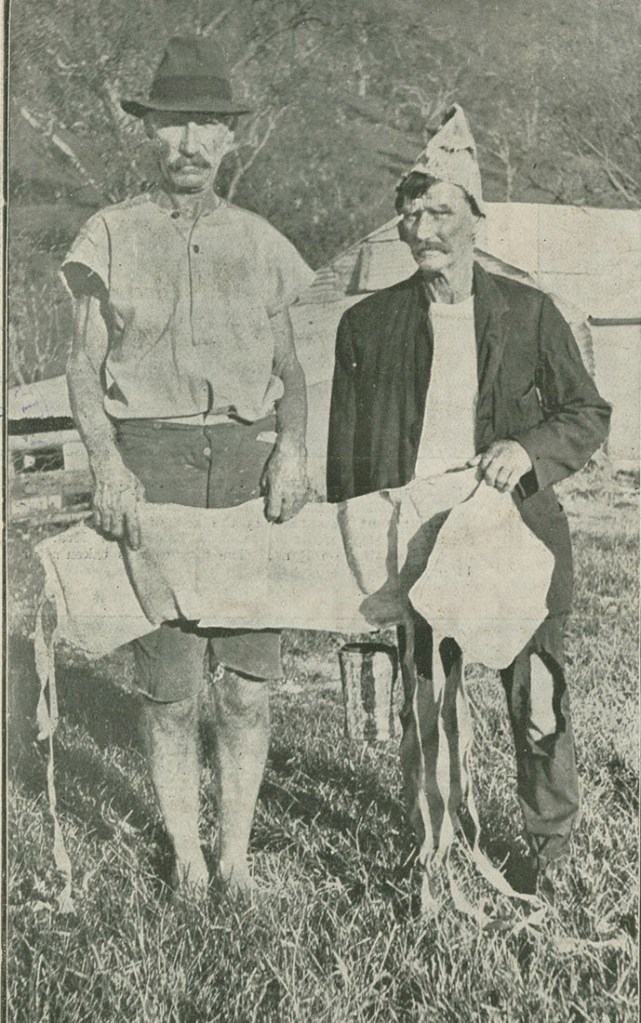
    Orete survivor, Donald Mackenzie (right) holding his life preserver. Source: The Queenslander Pictorial Supplement, 9 March 1918.

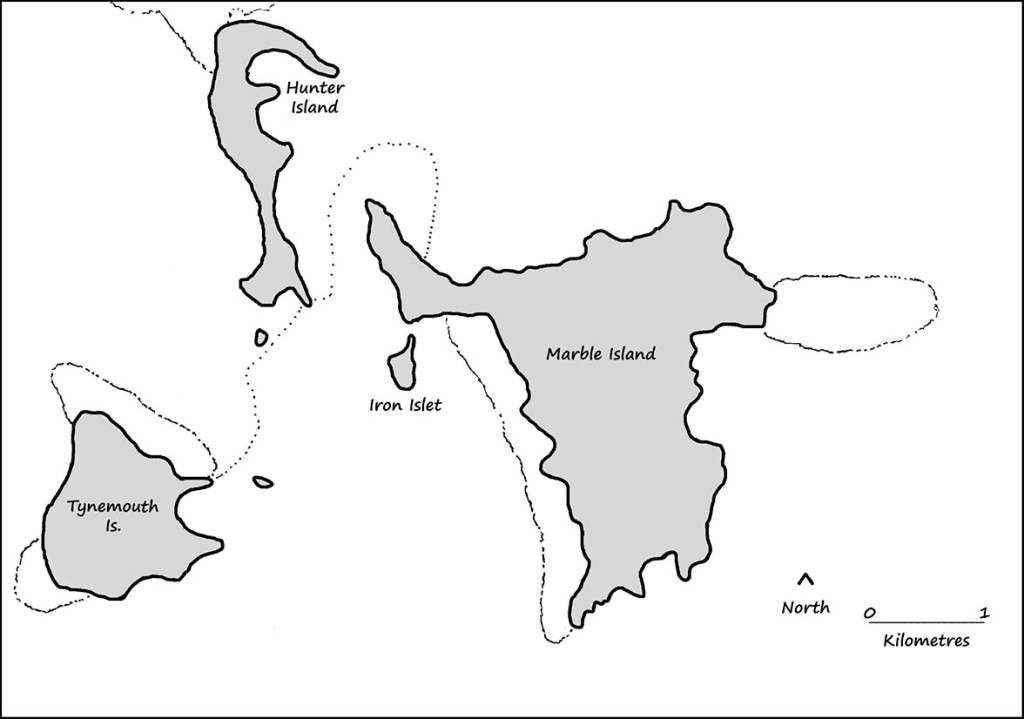
       When the weather subsided, Mackenzie took stock of his situation. He had no idea where he had landed; he would later learn it was Tynemouth Island. The foreshore was littered with timber and other debris, but among the mess of litter, he found a few onions and pumpkins. They would be his sole source of food for the coming days. Perhaps key to his ultimate survival, he also found a crate of kerosene cans.

       A quick search of the small uninhabited island had revealed no permanent supply of water. So he emptied the kerosene cans of their contents and filled them with fresh water before the puddles dried up. Looking out from the east coast, Mackenzie could see another island, and he thought he could see several buildings. That would later prove to be Iron Islet.

       Without the means to make a fire or attract attention, Mackenzie resolved to build a raft to cross the expanse of water. He broke apart the kerosene crate and salvaged the nails. He then used them to fix long planks together to form a raft. After ten days, Mackenzie was ready to make the crossing to Iron Islet.   

    That time had not come soon enough. Hunger and the blazing hot conditions were taking their toll on him. Several days had passed since he had eaten the last of the raw vegetables, and he had been subsisting on shellfish smashed from the rocks ever since. During the day, there was no respite from the searing tropical sun. And, at night, he was tormented ceaselessly by mosquitoes and ants, making sleep all but impossible.

    Donald Mackenzie’s raft. Source: The Queenslander Pictorial Supplement, 9 March 1918.

       Mackenzie dragged his raft into the water and started towards Iron Islet using a broad timber plank for a paddle. But he was soon caught in a strong current ripping through the passage separating the two islands. He was swept along by the current, which threatened to take him out into the vastness of the Coral Sea. Mackenzie made the difficult decision to abandon his raft and swim back to Tynemouth Island while he still had a chance of reaching land.

       Disheartened as Mackenzie was, he knew he was growing weaker by the day. If he was ever going to survive, he had to build another raft. This one took him eight days to complete. Then, on Sunday, 10 February, he dragged his cumbersome craft into the water, straddled it, and started paddling away from shore.

       He was caught in the strong current for a second time. He used every ounce of strength his fatigued muscles could give him and inched the raft across the passage. After an almost super-human effort, Mackenzie reached the southern end of Hunter Island, north of Iron islet. There, he rested before setting off again to cross the one-kilometre channel that now separated him from his destination.    Again, he was caught in a powerful current. This one was even stronger than the last. He paddled furiously, but it was hopeless. He had no control over the craft, and as he looked back he could see the buildings of Iron Islet disappearing from sight.

    Mackenzie’s approximate course,

       At one time or another, most people experience that sinking feeling when success—so close at hand—slips away and all seems lost. This was Mackenzie’s darkest moment. He had survived the wreck that had claimed the lives of his shipmates. He had been cast away, Robinson Crusoe-like, on a deserted island for 19 days, suffering from hunger and exposure. He had built two rafts with his bare hands and escaped. But it had all been for nothing. Mackenzie was rocketing out into the vast Pacific Ocean, and there was nothing he could do to stop it. He was mentally exhausted, and the most recent frenzied paddling had left him physically spent. But as the channel widened, the current slackened and the raft’s headlong progress slowed.   

    Mackenzie looked towards an island to his right and could not believe his eyes.  There he saw sheep grazing in a field. With renewed spirit, he drew on his last reserves of energy and paddled towards shore. As he got closer, he saw the distinctive outline of a cottage roof partly obscured by trees. He kept paddling until the prow of the raft ran up onto a sandy beach, where he waded ashore on unsteady legs. He would soon learn he had landed on Marble Island. Most importantly, he had survived; his ordeal was over.

    The full story is told in A Treacherous Coast: Ten Tales of Shipwreck and Survival from Queensland Waters available through Amazon.

    © Copyright C.J. Ison / Tales from the Quarterdeck, 2022.

    To be notified of future blog posts, please enter your email address below.