Tag: NSW

  • Betrayal in Paradise: The Phoebe’s Final Voyage

    In August 1828, the then Governor of NSW, Ralph Darling, received a tersely worded letter from the paramount chief of Huahine in the Society Islands, present-day French Polynesia. In it, Queen Maihara, through missionary intermediaries, implored him to send a ship and “fetch these thieves and take them back again to Botany Bay.”1

    The thieves she referred to were escaped convicts who had fled New South Wales on the 24-ton cutter Phoebe. And they were quite likely the first escaped convicts to reach any of the Pacific Islands.

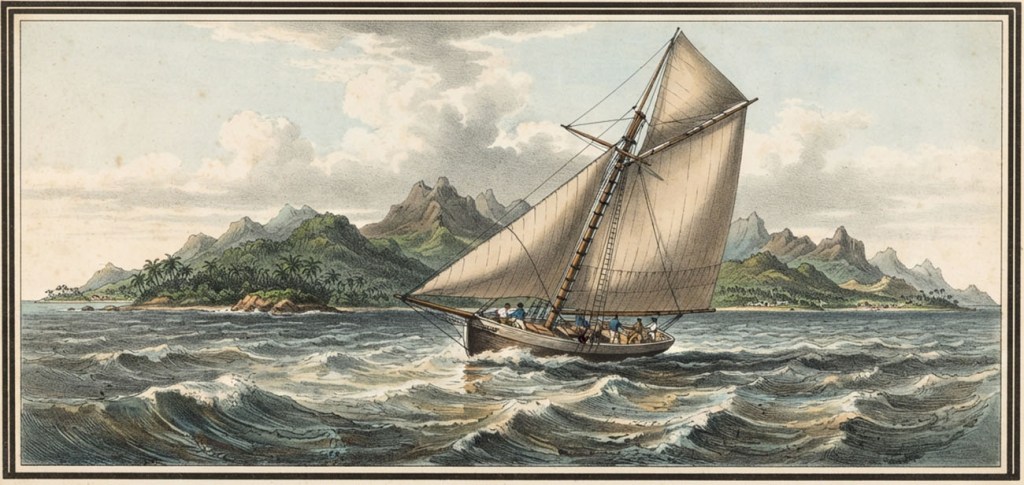
    Early on the morning of 15 December 1827, fifteen convicts boarded the small cutter moored in the Shoalhaven River and forced the three-man crew to sail her out the heads into open water. The crew were then ordered into a dinghy and returned to shore.  

    The runaway’s leader was a prisoner named Frederick Hunter, who had been sent to New South Wales for housebreaking. A former seaman, he assured his comrades they could cross the Pacific Ocean and reach North America, 12,000 km away, in as little as 15 days. Then, relying on just a hand compass and a small-scale nautical chart covering the entire Pacific Ocean, they set out to sea.
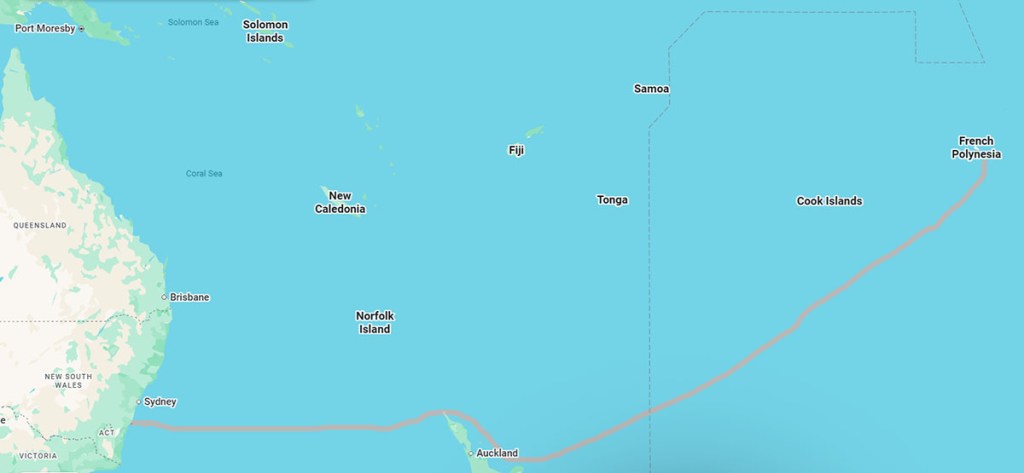
    First, they bore due east, bound for New Zealand. There they stopped briefly to add several pigs and a quantity of potatoes to their supplies before setting off on a north-easterly course to cross the Pacific.

    There is no record of their voyage from New Zealand to the Society Islands (French Polynesia).   However, it was likely slow and arduous for it seems most, if not all, with the exception of Hunter himself, had any sailing experience. By the time they reached the Leeward Islands, 4,000 km away, provisions were running low. To extend their remaining rations, Hunter forced six of the runaways ashore. One of those was John Smith, who later said he was thrown overboard near the island of Rioteri, (most likely Raiatea).

    At Maupiti Island, Hunter and his eight remaining men traded the cutter’s cargo of cedar logs for food. But rather than continue on their way to North America, they appear to have remained among the islands of French Polynesia. Their voyage finally ended off Mai’ao Island when the cutter crashed onto a reef and had to be abandoned.   From there, the runaways broke into smaller groups and dispersed themselves across several neighbouring islands.2
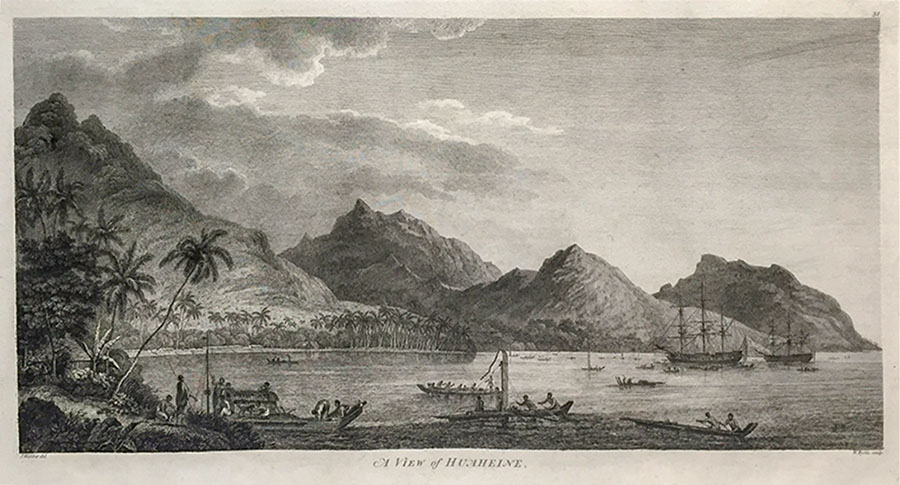
    Four of them, possibly including Hunter, made it to Huahine Island where they were made welcome by the Islanders, many of whom were recent converts to Christianity.   But that hospitality ended around July or August 1828 after the convicts ransacked the paramount chief’s home and stole everything of value, including several muskets, a cask of gunpowder and lead shot. They fled the island with their haul in a whaleboat belonging to Reverend Barff, the island’s missionary. A canoe carrying over a dozen men was dispatched to chase down the thieves. But when they caught up to the whaleboat and demanded the return of the stolen property, the runaways opened fire, killing two and wounding six others.3
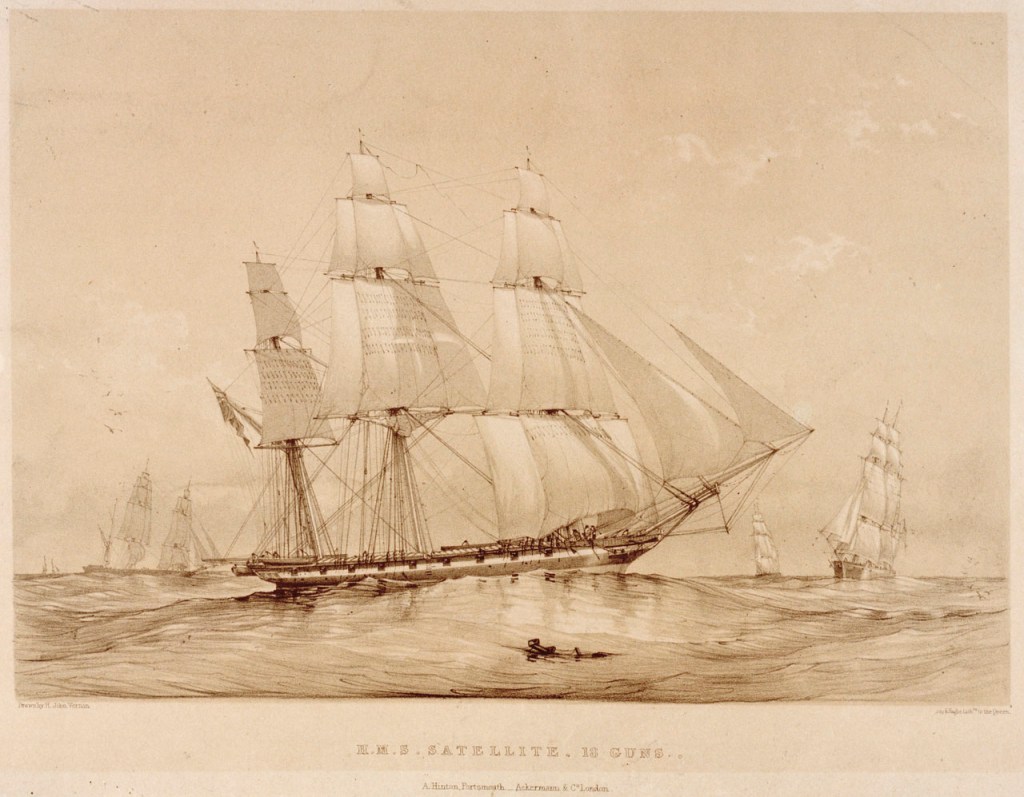
    HMS Satellite. Courtesy: Royal Museums Greenwich.

    Queen Maihara had had enough.   She wrote to Governor Darling, calling on him to apprehend the escaped convicts terrorising her people.    In December, Darling dispatched Commander John Laws and HMS Satellite to the South Pacific to round up the troublemakers.      The Satellite found six of the runaways and took them into custody.   As for the men who ransacked Queen Maihara’s house, killed two of her people and wounded six others, they were reported to have made for Tongatabu, present-day Tonga, some 2,000 kilometres away.   However, when the Satellite pulled in there, Captain Law learned that a boat and men matching their description had landed in “great distress” on one of the Navigator Islands, present-day Samoa.   He was also told that two of the men he was looking for had already been killed and there was little likelihood that the other two would have left the island alive.    With his mission complete, Commander Law returned to Sydney with his six prisoners in chains to stand trial.4

    As the trial date approached, the Attorney General decided not to charge the prisoners with the capital crime of piracy as they had not seized the Phoebe “on the high seas,” but in the sheltered waters of the Shoalhaven River.    He felt there was a chance the prosecution would not get a conviction based on that technicality. So, instead, the authorities charged them with the lesser crime of stealing the cutter and its cargo of 8,000 feet of cedar logs. Found guilty, five were sentenced to seven years’ transportation. The sixth prisoner, John Smith, who claimed to have been forced to join the bolters, was released after testifying against the others.

    SOURCES

    1.    Letter from Maihara, Queen of Huahine to Gov. Darling dated 25 Aug 1828, 1/14 HRA, p. 738.

    2.   Evidence provided by John Smith during the trial of other runaways. Sydney Monitor, 8 Jun 1829, p. 8.

    3.   Letter from Maihara, Queen of Huahine to Gov. Darling dated 25 Aug 1828, 1/14 HRA, p. 738.

    4.   Letter from Commander Laws HMS Satellite to Secretary Croker dated 11 Mar 1829, 1/14 HRA, p. 741.

    © Copyright C.J. Ison / Tales from the Quarterdeck, 2026.

    Please enter your email address below to be notified of future blogs.
  • The Loss of the SS Cawarra: Bad luck or an avoidable tragedy?

    “Foundering of the S.S. Cawarra off Newcastle.’ Source: Australian News for Home Readers, 27 Aug 1866, p. 4.

       When, in 1866, the Board of Inquiry into the Loss of the Steam Ship Cawarra handed down its report, it was met with much incredulity. After poring over the evidence for six weeks, the commissioners could only conclude that the catastrophe was simply the result of bad luck. That was despite evidence presented to them that the steamer had been grossly overloaded when she had left port.

       The SS Cawarra was a 439-ton side paddle steamer owned and operated by the Australian Steam Navigation Company, and regularly made the passage between Sydney and Brisbane. On what would be her last voyage, she had a crew of 36 and 25 passengers. In all, there were 61 souls on board. Around 6 p.m. on Wednesday, 11 July 1866, she passed through Sydney Heads on her way to Rockhampton via Brisbane. The northern settlement of Rockhampton had not been visited for some time, and basic provisions had run low. So, when the Cawarra’s hold was packed to capacity and no more would fit below, the remaining cargo was stowed on deck.

       As soon as the steamer was heading north through open seas, she was assisted on her way by a strong south-easterly breeze. But during that first night, the weather steadily worsened. By morning, the winds were shrieking at gale force, the seas were mountainous, and the ship was being lashed by torrential rain. In the face of such foul weather, Captain Henry Chatfield decided to take shelter at Newcastle until it was safe to resume his journey.

       Chatfield sighted the distinctive outline of Nobby Head at 2 o’clock in the afternoon, and shortly after that, the steamer rounded the headland to enter the port. However, as the Cawarra was approaching the mouth of the Hunter River, she was struck by a series of large waves that swept over her deck and pushed her around so she was now facing back out towards Nobby Head.

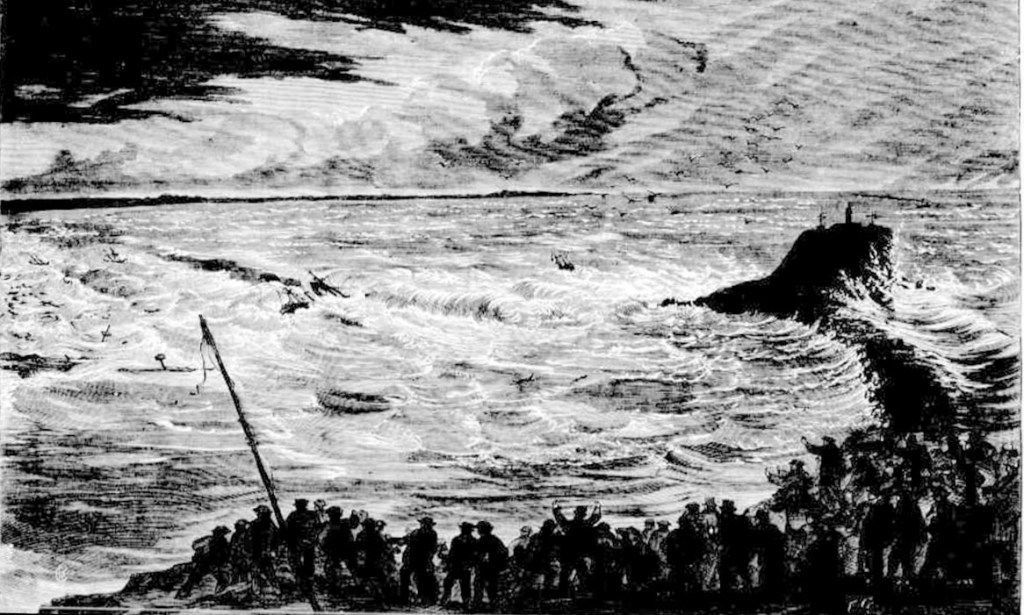
    “Position of Cawarra previous to foundering …” Source: Illustrated Sydney News, 16 Aug 1866, p. 5.

       It is thought that when Captain Chatfield realised his ship was in grave peril, he ordered the foresail to be set and tried to steam back out to sea. However, before he could do so, the Cawarra was hit by several more huge waves. They would spell her end. Water poured through the hatchways snuffing out the steamers’ fires. Now she was dead in the water at the mercy of the large seas. The ship then began to sink by the bow. Chatfield ordered the lifeboats to be made ready, but the treacherous seas swirling around the steamer made abandoning the ship impossible.

       Around 3 o’clock, the Cawarra was driven onto Oyster Bank. The foredeck soon disappeared below the waves, and everyone had gathered on the poop deck or had climbed into the rigging to escape the rising water. Fifteen minutes later, the mainmast and funnel toppled into the sea, taking with them all those sheltering on the poop. The foremast went a few minutes later, tossing the remaining three or four men into the water, and the Cawarra quickly sank from sight. It was as if she had never been there to observers watching the horror unfold from Nobby Head. Only a few pieces of wreckage and cargo washed ashore to testify that a ship had been lost.

       Sixty people died, while one man somehow managed to survive. Frederick Valliant Hedges had only joined the Cawarra eight months earlier. As the steamer began sinking by the bow, he had climbed high into the mainmast rigging only to be flung into the sea when the mast came crashing down. Hedges was later found clinging to a red buoy by a boat sent out from the lighthouse. Ironically, one of the rescuers was a man named John Johnson, who had himself been the sole survivor of the Dunbar when it sank off Sydney nine years earlier.

    The Rescue of F.V. Hedges, the only survivor from the Cawarra. Source: Illustrated Sydney News, 16 Aug 1866, p. 4.

        The violent storm wreaked havoc on shipping up and down the coast between Sydney and Port Stephens. Four more vessels foundered or were driven ashore at Newcastle, and another was wrecked near Port Stephens, further north. Several more were lost around Sydney. In all, 15 vessels were wrecked or driven ashore, adding another 17 fatalities to the grim final tally.

       It is perhaps easy to blame the weather for the Cawarra’s loss. In fact, the commission established to investigate the circumstances found just that. Its report concluded: “We are of the opinion that the catastrophe was one of those lamentable occurrences which befall at times the best ships and the most experienced commanders, and which human efforts are powerless to avert.”

       However, that explanation did not sit well with many folk. It had the whiff of a cover-up. Accusations that the Cawarra had been overladen when she left Sydney flew around maritime circles. She was reportedly carrying 450 tons of coal and cargo, which was 50 tons more than recommended by the ship’s builders. An engineer and surveyor from the Steam Navigation Board testified at the inquiry that when he had seen the Cawarra shortly before her departure, he thought she was sitting lower in the water than usual and believed she had been overloaded. But when he had raised his concerns with his superior and the ship’s owners, they both dismissed his concerns, telling him the Cawarra was a strong ship.    The possibility that overloading could have contributed to the loss was even raised in the New South Wales parliament. The outspoken former clergyman and politician, Dr J.D. Lang, called for the Commission’s findings to be rejected, pointing out the contradictory evidence presented at the inquest. But it was all to no avail. The findings stood, and the loss was attributed to bad luck.

    Samuel Plimsoll. Wikimedia/creative commons.

       However, there were calls for a line to be marked on the hull of cargo ships to show when they were fully loaded. It would take another ten years before British parliamentarian Samuel Plimsoll was able to persuade his colleagues to take action. He was appalled by the number of ships and lives lost due to overloading. In 1876, the British Parliament passed legislation requiring markings on the sides of cargo ships, which would be submerged below the surface if the vessel was overloaded. This became known as the Plimsoll Line and is still in use today.

    © Copyright C.J. Ison / Tales from the Quarterdeck, 2023.

    To be notified of future blogs, please enter your email address below.