Tag: Norna

  • Tales from the Quarterdeck

    Sixty bite-sized stories from Australia’s maritime past

    The melancholy loss of H.M.S Sirius off Norfolk Island by George. Raper. Source National Library of Australia 136507434-1

    I have just launched a new book titled Tales from the Quarterdeck: Sixty bite-sized stories from Australia’s maritime past. Sixty of the most popular posts have been reedited. In some cases, I’ve rewritten a couple and updated a few where new information has come to light since first writing them.

    For those who would value ready access to the stories in their bookcase, Tales from the Quarterdeck is available in Kindle ebook and paperback formats through Amazon.

    The stories are organised in chronological order, starting with the Tryall shipwreck off the Western Australian coast in 1622, and finishing with the Second World War exploits of the Krait. See below for a full list of the stories covered in the book.
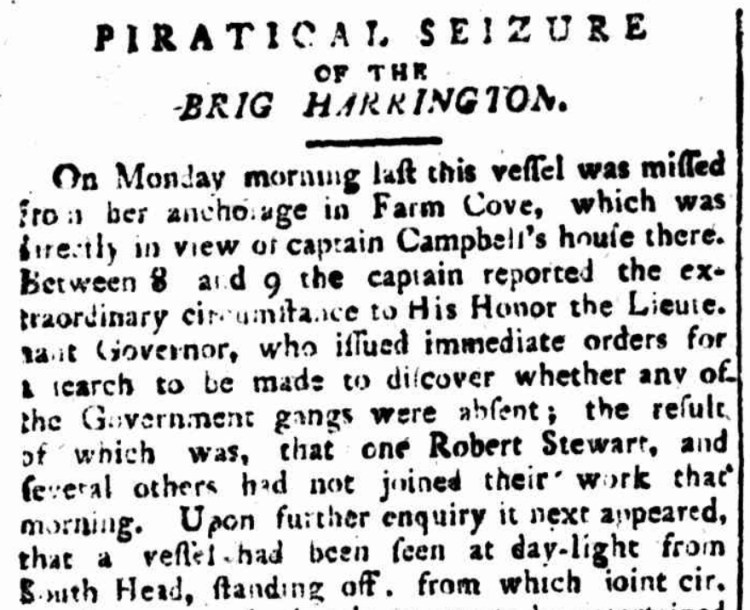
    Sydney Gazette 22 May 1808, p. 2.

    1622 – The Tryall: Australia’s earliest shipwreck

    1629 – The Batavia Tragedy

    1688 – William Dampier: Navigator, naturalist, writer, pirate

    1770  – The Endeavour’s Crappy Repair

    1788 – Loss of La Astrolabe and La Boussole, a 40-Year Mystery                        

    1789 – Bligh’s Epic Voyage to Timor

    1789 – HMS Guardian: All Hands to the Pumps

    1790 – The Loss of HMS Sirius

    1790 – Sydney’s First Desperate Escape

    1791 – HMS Pandora: Queensland’s earliest recorded Shipwreck

    1791 – William Bryant’s Great Escape

    1797 – The Loss of the Sydney Cove

    1803 – Loss of HMS Porpoise

    1808 – Robert Stewart and the Seizure of the Harrington

    1814 – Wreck of the Morning Star

    1816 – The Life and Loss of HMSC Mermaid

    1824 – The Brig Amity’s Amazing Career

    1829 – The Cyprus mutiny 

    1831 – The Caledonia’s perilous last voyage

    1833 – The Badger’s Textbook Escape

    1835 – The Loss of the Convict Ship Neva

    1835 – The Post Office in the middle of nowhere

    1835 – The Tragic Loss of George III

    1845 – The Cataraqui: Australia’s worst shipwreck

    1846 – The Peruvian’s Lone Survivor

    1847 – The Foundering of the Sovereign

    1850 – The Loss of the Enchantress: A first-hand account

    1851 – The Countess of Minto’s brush with Disaster

    1852 – The Bourneuf’s Tragic Last Voyage

    1852 – The Nelson Gold Heist

    Woodbury, Walter B. (Walter Bentley), 1834-1885. Hamlet’s Ghost, Sourabaya [Surabaya], Java [Boat with Passengers and Crew], ca. 1865. Walter B. Woodbury Photograph Collection (PH 003). Special Collections and University Archives, University of Massachusetts Amherst Libraries

    1854 – Bato to the Rescue 

    1854 – HMS Torch and the rescue of the Ningpo

    1856 – The Loss of the Duroc and the Rise of La Deliverance

    1858 – The Loss of the Saint Paul and its Horrific Aftermath

    1858 – Narcisse Pelletier, An Extraordinary Tale of Survival

    1859 – The Indian Queen’s Icy Encounter

    1859 – The Sapphire and Marina

    1863 – The loss of the Grafton: Marooned for twenty months

    1864 – The Invercauld shipwreck

    1865 – The CSS Shenandoah: Victoria’s link to the American Civil War

    1866 – The Loss of the SS Cawarra: Bad luck or an avoidable tragedy?

    1868 – The Bogus Count and Hamlet’s Ghost

    1871 – The Mystery of the Peri

    1872 – The Loss of the Maria, A Cautionary Tale

    1875 – The Tragedy behind the Gothenburg Medals

    1876 – The Catalpa rescue

    1876 – The Banshee’s Terrible Loss

    1878 – The Loch Ard Tragedy

    1884 – The Macabre case of the Mignonette

    1885 – The Douro and its Piratical Captain

    1889 – The Windjammer Grace Harwar

    1891 – The Spanish Silver of Torres Strait

    1893 – The Foundering of the SS Alert

    1895 – The Norna and the Conman Commodore

    1899 – Cyclone Mahina

    1911 – The Loss of the Mandalay

    1918 – The Orete’s Robinson Crusoe-like Castaway

    1935 – The Life and Loss of  the SS Maheno

    1943 – Surviving the Centaur Sinking

    1943 – The Amazing Krait

  • The Long Search for the Yongala

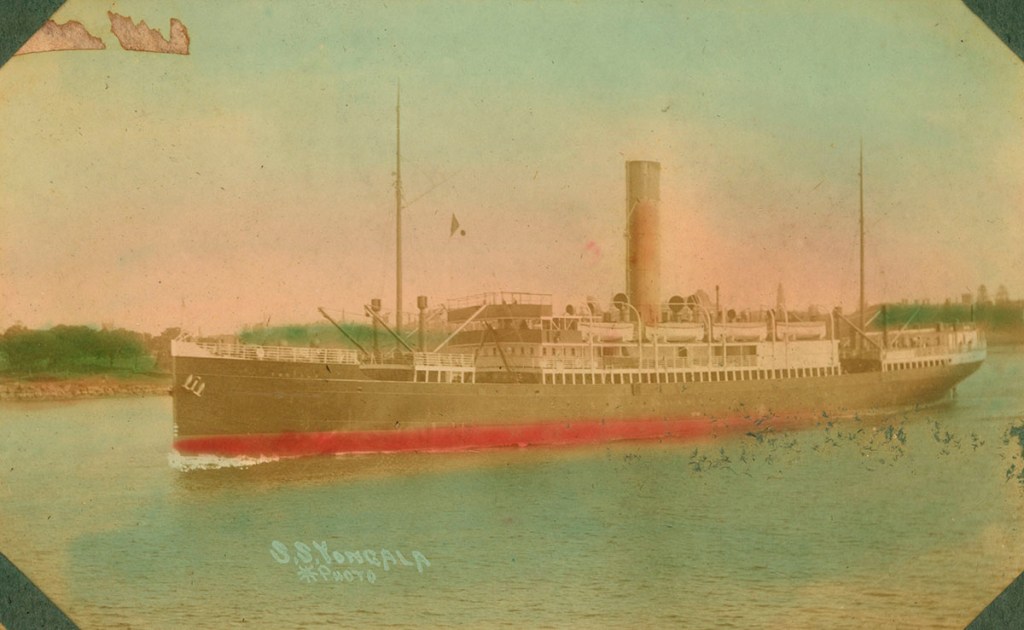
    Postcard showing the SS Yongala, circa 1905. Courtesy State Library of Queensland.

    In March 1911 the SS Yongala sank during a powerful cyclone with the loss of 122 lives making it one of Queensland’s worst maritime disasters.   Despite efforts to locate the wreck, the ship’s final resting place would remain a mystery for almost half a century.

    The Yongala departed Brisbane on 21 March bound for Townsville.   On 23 March she stopped briefly at Mackay to disembark passengers but by now the weather was rapidly deteriorating.   When she got under way again, she unwittingly carried 50 passengers and 72 crew towards a powerful storm brewing somewhere to the north.    

    Later the same day the Dent Island lighthouse keeper noted the Yongala passing through the Whitsunday Passage.     She soon faded from sight, enveloped by a curtain of rain and sea mist, as she ploughed towards Townsville.

    When the Yongala failed to arrive as scheduled there was no immediate concern.   It was assumed the captain had sought shelter to escape the cyclone and the ship would soon make its appearance.   But then reports reached Townsville of wreckage washed ashore on Palm and Hinchinbrook Islands 50 and 100 kilometres to the north.

    “The Missing Steamer Yongala” The Australasian, 1 Apr 1811, p. 41.

    It was clear the debris, including hatch covers, parts of lifeboats, ornate cabin fittings and other miscellanea, had come from the Yongala.   It spoke of a terrible tragedy having befallen the passenger steamer and all those onboard.   Oddly, not a single body was ever recovered.

    The waters and coastline between Townsville and the Whitsunday’s were scoured in hopes of finding survivors or the wreck but nothing but more debris was found.  A Marine Board Inquiry investigated the loss of the ship as best it could under the circumstances. With no eyewitnesses to what happened and no wreck to inspect, they had little to go on.   The Inquiry concluded that rumours about the ship’s stability were groundless and it found no fault with the ship’s construction or the competency of its captain.    A £1,000 reward was even offered for anyone who could pinpoint the wreck.

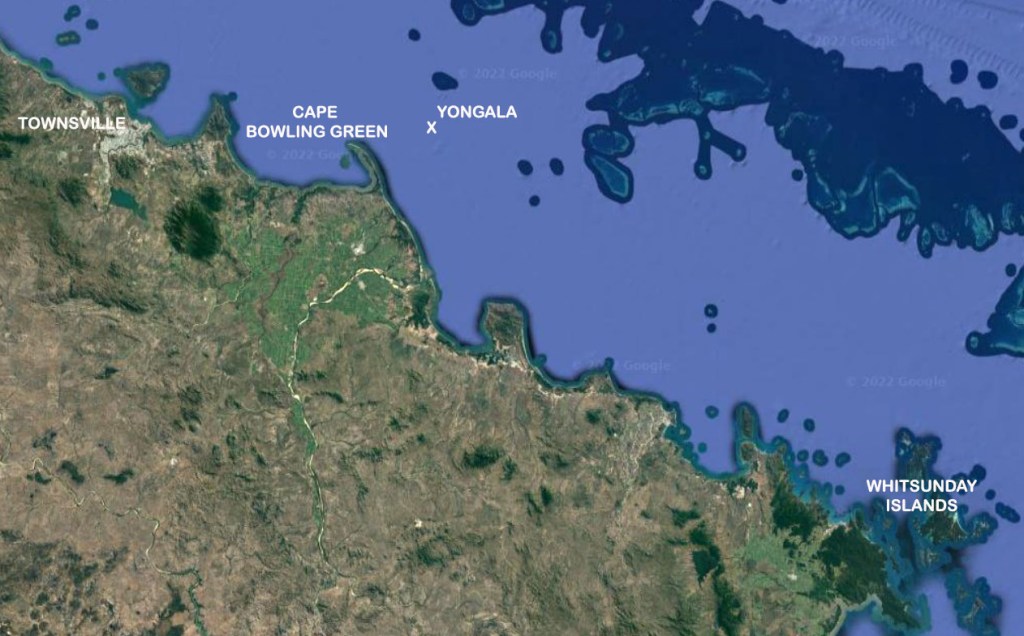
    In October 1911 Dr Cassidy believed he and his crew on the salvage schooner Norna had located the Yongala in deep water about 20kms off Cape Bowling Green.   They had discovered traces of oil bubbling up from the depths and believed that marked the resting place of the lost ship.   However, owing to the depth of the water and strong currents, they were unable to put a diver down to confirm the find or collect the reward.  

    Map showing location of the Yongala wreck. Courtesy Google Maps.

    For decades mystery surrounded the disappearance of the ship.   There were even far-fetched sightings of a “ghost ship” steaming through North Queensland waters periodically reported in the tabloid press.  

    Then in 1947, the navy survey ship HMAS Lachlan located the wreck using “anti-submarine instruments,” more commonly known today as sonar.    Three years earlier a minesweeper had snagged something they thought to be a reef rising steeply from the seabed in the middle of the regular shipping lane south of Townsville.   They had marked the spot on their chart as an unknown obstruction and reported it to Naval Headquarters.   They were about 20kms east of Cape Bowling Green where the Norna had found the oil slick all those years ago.

    After HMAS Lachlan made several passes over the “obstruction” the sonar operators were convinced they had found the remains of a “fair-sized steamer.”   It was thought to be the Yongala for it was the only such vessel to have been lost in the vicinity.  

    HMAS Lachlan. By Allan C. Green, Courtesy State Library of Victoria.

    However, it would be another 11 years before anyone visually confirmed that what the Lachlan had found was in fact a shipwreck.   In 1958 a diver named George Konrat finally descended into the deep and found the ship sitting on its keel in 30 metres of water with a distinct list to starboard.   He recovered a Chubb safe with part of the serial number still evident which would later prove to have been installed in the Yongala during her construction.

    Konrat speculated that the steamer had struck another vessel during the storm and sank for he also saw the remains of an old sailing ship nearby.   However, with the passage of so many years and no survivors to recount what happened, the actual reason why the ship foundered during the cyclone will likely never be known.

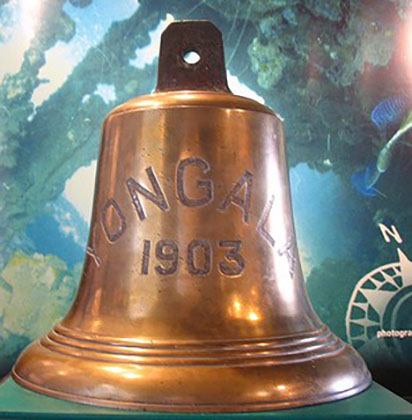
    Yongala Bell, Courtesy wikimedia commons.

    Today, some artifacts collected from the wreck and other memorabilia can be found in the Townsville Maritime Museum which is well worth a visit.   The Yongala, itself, is a popular dive site.

    © Copyright C.J. Ison / Tales from the Quarterdeck, 2022.

    To be notified of future blogs, please enter your email address below.

  • The Norna and the Conman Commodore

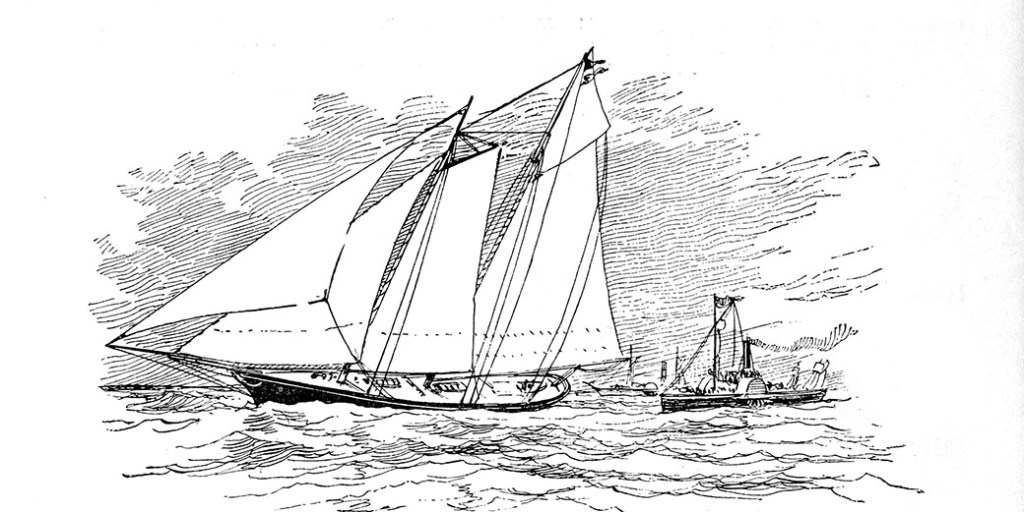
    The Norna’s sister ship Cornet.

       In the early 1900s, many hard-working sailing vessels saw out their days plying the waters between Australia and the islands of the South Pacific. Few, however, would have had such a fascinating history as that of the Norna.

       The Norna was built in New York in 1879 as a luxury ocean-going schooner rigged yacht. She was lavishly fitted out and built to be a fleet-footed racer. For the next decade or more, she held her own in many long-distance ocean races.

       Then, in 1895, she was purchased by self-styled “Commander” Nicholas Weaver, who claimed to represent a Boston newspaper empire seeking to establish a presence in New York. He was, in fact, a brazen conman.

       A few years earlier, Weaver had fallen foul of the law and only escaped gaol by testifying against his partner. He then hustled himself off to the West Coast, where he no doubt perfected his craft.

    Nicholas J Weaver, The Pacific Commercial Advertiser (Honolulu), 17 April 1900, p. 7.

       Now back in New York, he planned to take the Norna on a round-the-world cruise, sending back stories of his adventures which would be syndicated in America’s Sunday newspapers. He found several financial backers willing to cover his expenses in exchange for a share of the syndication fees. They founded a company, and Weaver sailed for the warm climes of the Caribbean.

       There, he made himself a favourite among the members of the Royal Bermuda Yacht Club, representing himself as the “Acting Commodore” of the prestigious Atlantic Yacht Club. The good people of Bermuda were not necessarily any more gullible than anyone else whom Weaver had separated from their money. But when someone sails into harbour aboard a 115-foot luxury yacht with a sailing crew of ten plus a cook and steward, few questions are likely to be raised. It also helped that Weaver himself was handsome, self-assured, and very charismatic.

       Weaver lived life to the full and spared himself no expense. He began hosting poker parties on his yacht, inviting only Bermuda’s most well-heeled residents. Though he proved to be uncannily lucky at cards, the winnings could not have covered his expenses. He funded his lavish lifestyle by chalking up credit with local merchants where possible, passing dud cheques if necessary, or forwarding invoices to his financial backers in New York.

       However, it was only a matter of time before things began to unravel. But before the inevitable day of reckoning, Bermudans awoke one fine morning to find the Norna and its flamboyant owner had cleared out in the dead of night.

    Yacht Norna leaving Honolulu. The Pacific Commercial Advertiser (Honolulu), 17 April 1900, p. 7.

       Weavers’ backers eventually realised they had been scammed and that they would never recoup their money. They wound up the company and stopped sending him money. But that did not deter Weaver from continuing on his round-the-world cruise.

       He visited many ports over the next couple of years, where he dazzled the wealthy with his largesse, while taking them to the cleaners at the poker table. He cruised around the Mediterranean, stopping long enough to run his con but always skipping out before debts became due.

       At the outbreak of the Spanish-American War, in April 1898, he and his American-flagged Norna found themselves in hostile waters. Realising his yacht might be seized, he set sail at his best speed with the Spanish navy in hot pursuit. Despite Weaver’s many character flaws, he was a superb mariner. Thanks to his skill and the luxury yacht’s fast sailing lines, the Norna outpaced the Spaniards, crossing into the safe waters of British-owned Gibraltar. There, he repaid his welcome by passing a fraudulent cheque for $5,000 and was once again on his way.

       During his travels around Europe, Weaver made the acquaintance of a man named Petersen, a fellow grifter. Together, they would prove a formidable team.

       Weaver and Pedersen would arrive in a new city independently, only to be introduced to one another by someone local, or they would fabricate a chance meeting as if they were strangers. Regardless of how they met, the result was always the same. They would get a high-stakes poker game going where one or the other would clean up.

       When Weaver reached Ceylon (present-day Sri Lanka), he was introduced to Petersen, who just happened to have recently arrived by steamer. They quickly got to work separating the wealthy from their wealth before moving on again. The pair repeated the same stunt in Sumatra, in the Dutch East Indies (now Indonesia), as well as in Hong Kong and Yokohama, Japan. At each port, they fleeced the local high society and vanished before alarm bells rang.    In Yokohama, Weaver passed himself off as the commodore of the New York Yacht Club and flew its pennant from his vessel. Weaver and Pedersen befriended each other and enjoyed many an evening with others playing poker on the Norna. Then, one morning, the yacht was gone. Pedersen joined the chorus baying for Weaver’s blood, claiming he, too, had been taken for a fortune. He then quietly slipped away on the next steamer leaving port.

    Schooner Norna circa 1911 now sporting a cabin on her aft deck. The Sun, 17 July 1911, p. 1.

       From Yokohama, the Norna made its way to Honolulu, where Weaver and Petersen briefly reunited. But when Weaver left Hawaii, Petersen remained. It seems as though the partnership had come to an end. The Norna stopped at Samoa long enough for Weaver to fleece the locals, then sailed on to New Zealand. At Auckland, Weaver began his now well-honed con, though this time without the able assistance of Petersen.

       Weaver racked up considerable debts, but before he could make his departure, the Norna was seized as surety. Realising the game was up, Weaver caught the next steamer bound for Sydney, vowing he would return to Auckland with the necessary funds to have his beloved yacht released. Not surprisingly, he vanished, and the yacht was put up for sale. It was purchased by a Sydney merchant and brought across the Tasman in June 1900.

       The Norna was stripped of her luxurious fittings, and the cabins were removed to make way for a spacious hold more fitting for her new working life. The Norna passed through several hands over the next 13 years. She served as a pearling lugger in Torres Strait and a trading vessel among the Pacific Islands. One owner even used her to salvage copper and other valuables from old shipwrecks far out in the Coral Sea. But, in June 1913, she, herself, was wrecked on Masthead Reef 50 km northeast of Gladstone Harbour. So ended the Norna’s fascinating and colourful career.

    © Copyright Tales from the Quarterdeck / C.J. Ison, 2022.

    To be notified of future blog posts, enter your email address below.