Tag: #New South Wales

  • Betrayal in Paradise: The Phoebe’s Final Voyage

    In August 1828, the then Governor of NSW, Ralph Darling, received a tersely worded letter from the paramount chief of Huahine in the Society Islands, present-day French Polynesia. In it, Queen Maihara, through missionary intermediaries, implored him to send a ship and “fetch these thieves and take them back again to Botany Bay.”1

    The thieves she referred to were escaped convicts who had fled New South Wales on the 24-ton cutter Phoebe. And they were quite likely the first escaped convicts to reach any of the Pacific Islands.

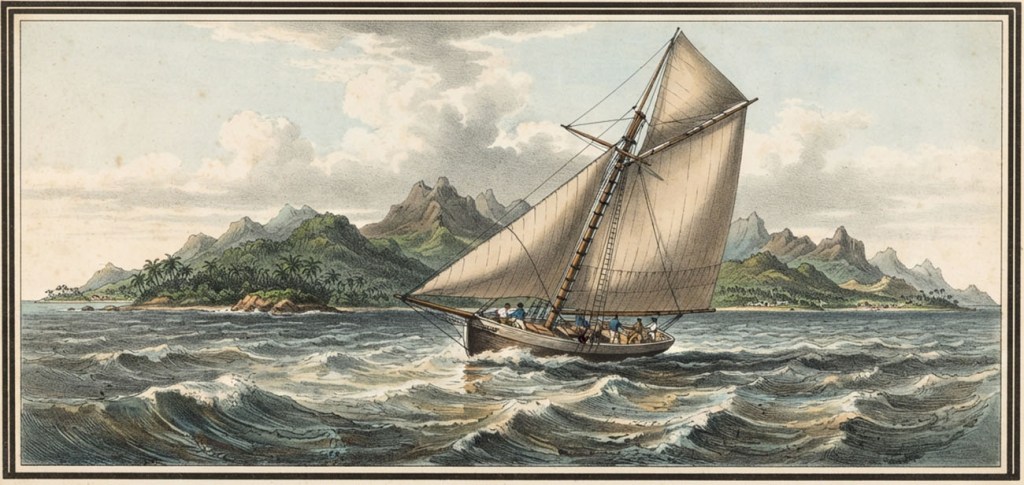
    Early on the morning of 15 December 1827, fifteen convicts boarded the small cutter moored in the Shoalhaven River and forced the three-man crew to sail her out the heads into open water. The crew were then ordered into a dinghy and returned to shore.  

    The runaway’s leader was a prisoner named Frederick Hunter, who had been sent to New South Wales for housebreaking. A former seaman, he assured his comrades they could cross the Pacific Ocean and reach North America, 12,000 km away, in as little as 15 days. Then, relying on just a hand compass and a small-scale nautical chart covering the entire Pacific Ocean, they set out to sea.
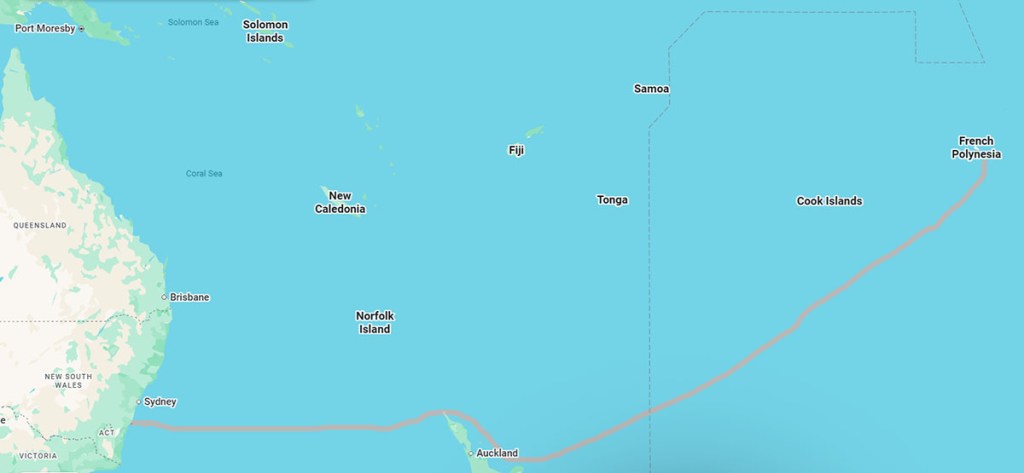
    First, they bore due east, bound for New Zealand. There they stopped briefly to add several pigs and a quantity of potatoes to their supplies before setting off on a north-easterly course to cross the Pacific.

    There is no record of their voyage from New Zealand to the Society Islands (French Polynesia).   However, it was likely slow and arduous for it seems most, if not all, with the exception of Hunter himself, had any sailing experience. By the time they reached the Leeward Islands, 4,000 km away, provisions were running low. To extend their remaining rations, Hunter forced six of the runaways ashore. One of those was John Smith, who later said he was thrown overboard near the island of Rioteri, (most likely Raiatea).

    At Maupiti Island, Hunter and his eight remaining men traded the cutter’s cargo of cedar logs for food. But rather than continue on their way to North America, they appear to have remained among the islands of French Polynesia. Their voyage finally ended off Mai’ao Island when the cutter crashed onto a reef and had to be abandoned.   From there, the runaways broke into smaller groups and dispersed themselves across several neighbouring islands.2
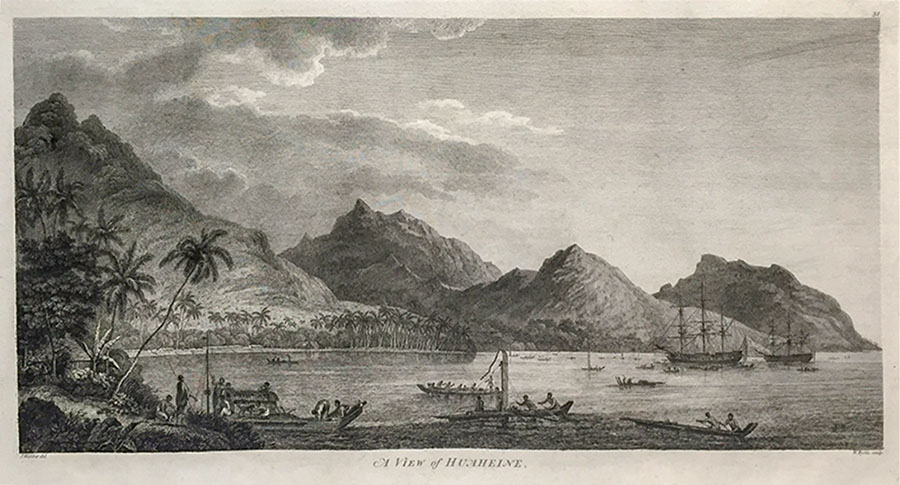
    Four of them, possibly including Hunter, made it to Huahine Island where they were made welcome by the Islanders, many of whom were recent converts to Christianity.   But that hospitality ended around July or August 1828 after the convicts ransacked the paramount chief’s home and stole everything of value, including several muskets, a cask of gunpowder and lead shot. They fled the island with their haul in a whaleboat belonging to Reverend Barff, the island’s missionary. A canoe carrying over a dozen men was dispatched to chase down the thieves. But when they caught up to the whaleboat and demanded the return of the stolen property, the runaways opened fire, killing two and wounding six others.3
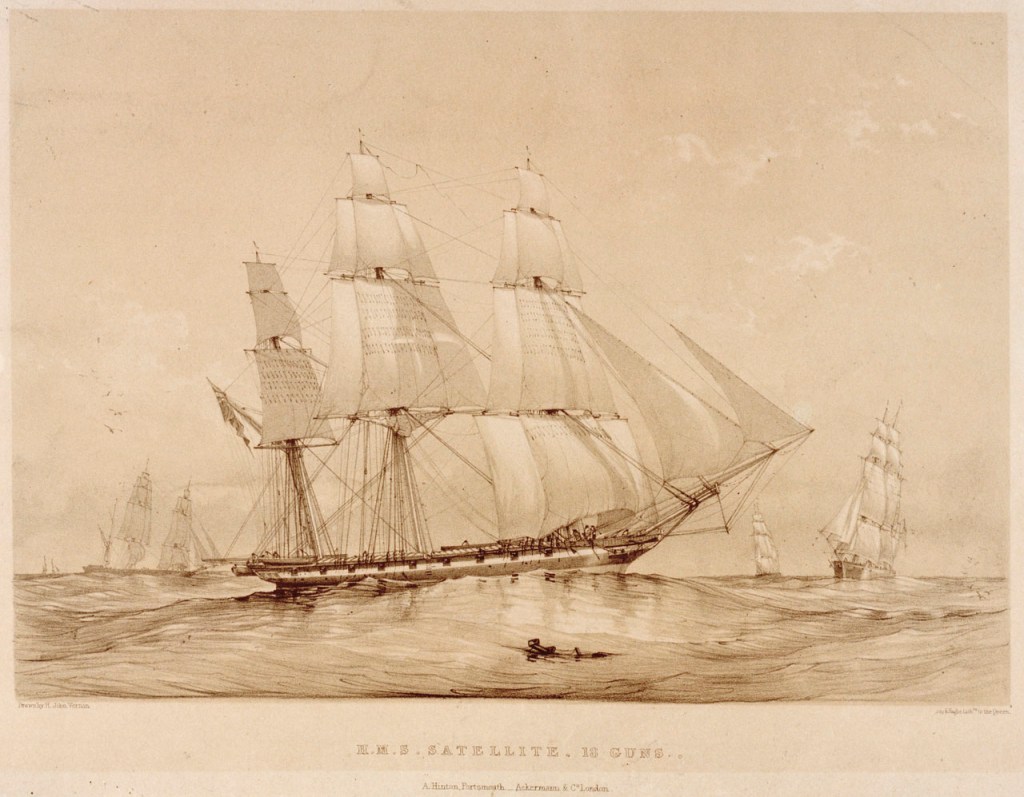
    HMS Satellite. Courtesy: Royal Museums Greenwich.

    Queen Maihara had had enough.   She wrote to Governor Darling, calling on him to apprehend the escaped convicts terrorising her people.    In December, Darling dispatched Commander John Laws and HMS Satellite to the South Pacific to round up the troublemakers.      The Satellite found six of the runaways and took them into custody.   As for the men who ransacked Queen Maihara’s house, killed two of her people and wounded six others, they were reported to have made for Tongatabu, present-day Tonga, some 2,000 kilometres away.   However, when the Satellite pulled in there, Captain Law learned that a boat and men matching their description had landed in “great distress” on one of the Navigator Islands, present-day Samoa.   He was also told that two of the men he was looking for had already been killed and there was little likelihood that the other two would have left the island alive.    With his mission complete, Commander Law returned to Sydney with his six prisoners in chains to stand trial.4

    As the trial date approached, the Attorney General decided not to charge the prisoners with the capital crime of piracy as they had not seized the Phoebe “on the high seas,” but in the sheltered waters of the Shoalhaven River.    He felt there was a chance the prosecution would not get a conviction based on that technicality. So, instead, the authorities charged them with the lesser crime of stealing the cutter and its cargo of 8,000 feet of cedar logs. Found guilty, five were sentenced to seven years’ transportation. The sixth prisoner, John Smith, who claimed to have been forced to join the bolters, was released after testifying against the others.

    SOURCES

    1.    Letter from Maihara, Queen of Huahine to Gov. Darling dated 25 Aug 1828, 1/14 HRA, p. 738.

    2.   Evidence provided by John Smith during the trial of other runaways. Sydney Monitor, 8 Jun 1829, p. 8.

    3.   Letter from Maihara, Queen of Huahine to Gov. Darling dated 25 Aug 1828, 1/14 HRA, p. 738.

    4.   Letter from Commander Laws HMS Satellite to Secretary Croker dated 11 Mar 1829, 1/14 HRA, p. 741.

    © Copyright C.J. Ison / Tales from the Quarterdeck, 2026.

    Please enter your email address below to be notified of future blogs.

  • Sydney’s First Convict Escape by Sea – 1790

    One of the first concerted efforts to escape from Sydney that did not involve trying to stow away on a homeward-bound ship took place in the latter part of 1790. Convicts, John Turwood, George Lee, George Connaway, John Watson, and John Strutton stole a boat and headed out to sea.

       Turwood and his mates had endured unimaginable hardships since leaving England, for they had come out on the infamous Second Fleet. Unsanitary living conditions and malnutrition had taken their toll on the voyage out. One-quarter of the 1006 convicts who left England died before ever reaching New South Wales. Of those who were put ashore, nearly 500 were immediately hospitalised. Of those, 124 would soon be dead. By September 1790, Turwood and his mates had been in the penal settlement for just eight weeks, but they had no desire to remain any longer to see if their fortunes might improve.

       Strutton had tried to escape once already. He had been smuggled aboard the Neptune and hidden among the firewood shortly before she was to sail back to England. However, sentries found his hiding place, and he was taken off the ship. He was flogged for trying to abscond, but the punishment only made him more determined to try again.

    Map of Sydney Cove Port Jackson, April 1788. Published by R. Cribb, London, 1789 original attributed to Fowkes, Francis – National Library of Australia, http://nla.gov.au/nla.map-nk276

    Soon after sunset on the night of 26 September, the five convicts stole a small flat-bottomed punt at Rose Hill and rowed down the Parramatta River into Sydney Harbour. Crammed in the small boat with them was one week’s supply of food, some cooking pots and other utensils, a few spare clothes and some bedding. At Watson’s Bay, just inside Sydney Heads, they put ashore and found another, much larger boat. Though it did not look particularly sturdy, it did have a mast and sail. Despite its shortcomings, the runaways thought they would have a better chance of surviving the open ocean in the larger boat. They transferred their belongings and headed out through Sydney Heads. By the time the bolters were reported missing and the two boats stolen, they were well on their way.

       Turwood had told friends before he had set off that they were going to sail to Tahiti, a place elevated in his mind to a tropical paradise where they could live freely among the Islanders. Tales from sailors who had visited Tahiti and other Pacific Islands had returned to England with fanciful stories about their time spent there. However, just how he intended to accomplish the 6,000-kilometre voyage without a sextant, charts, a compass, or any other navigation aids is a mystery.

       John Turwood was serving a life sentence for highway robbery. George Lee and George Connaway had stolen a pair of bullocks valued at £20. They had been sentenced to death, but that was later commuted to transportation for life. Watson and Strutton were each serving seven-year terms for stealing. Though nothing in their convict records suggests any of them had a nautical background, at least one of them knew how to handle a small vessel under sail.

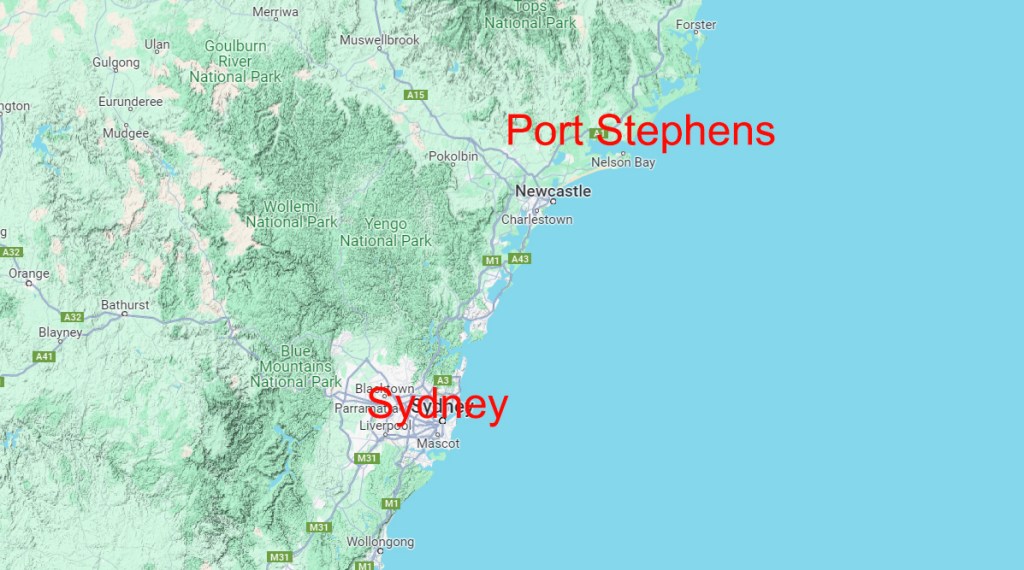
        After leaving Sydney Harbour, they set a course north, always remaining close to the coastline. When the sheltered waters of Port Stephens beckoned, they pulled in, and that’s where they stayed. After sailing 150 km, that was as close as they got to Tahiti. The local Aboriginal people, the Worimi, made them welcome and adopted them into their community. Over time, Turwood and the others learned to speak their language and were given Worimi names. They also seem to have undertaken formal initiation rituals, and at least a couple of the men took wives and began raising their own families. However, life was a constant struggle for the men, who were unaccustomed to the diet and customs of the Worimi people, especially in the beginning. Strutton died, although the circumstances and date of death were never recorded. Nonetheless, the other four lived there for five years and would have remained longer had a British warship not shown up.

       HMS Providence pulled into Port Stephens in mid-August 1795. She had just crossed the Pacific Ocean but had been unable to enter the Heads because of a strong westerly wind blowing off the land. Captain Broughton thought he would wait a few days in these sheltered waters before trying again. While there, he discovered Turwood and the other three white men living with the Aborigines. Broughton described them in his log as “miserable, half-starved objects, depending on the hospitality of the natives for their subsistence …” He offered to return them to Sydney, assuring them that they would likely not face punishment. Lee, Connaway and Watson immediately accepted the offer; however, Turwood was initially reluctant, but Broughton was eventually able to convince him to return as well. The arrival back in Sydney after a five-year absence was met with considerable surprise and of the runaway convicts in Sydney caused some consternation among the authorities, for they had long been given up for dead. But, true to Broughton’s word, they appear to have escaped punishment. Perhaps the Governor thought five years in the wilderness had been punishment enough.

    Families camped in the Port Stephens area, New South Wales, 1826 by Augustus Earle. Courtesy National Library of Australia.

       John Turwood and George Lee would flee from Sydney again in September 1797. They joined 13 other runaways who seized the small colonial cutter Cumberland near the mouth of the Hawkesbury River. After putting the captain and crew ashore, they headed out to sea. Neither the Cumberland nor the runaway convicts were ever seen again.

      © Copyright C.J. Ison / Tales from the Quarterdeck, 2025.

    Please enter your email address below to be notified of future blogs.