Tag: New Guinea

  • The Loss of the Saint Paul and its Horrific Aftermath– 1858

    Stranding of the Saint Paul, on Rossel Island. Auguste Hadamard, Le Tour du Monde, volume 4, 1861.

       In September 1858, the French ship Saint Paul was wrecked off Rossel Island, east of mainland New Guinea, with as many as 370 people on board. Of those, fewer than a dozen escaped with their lives. One of those was Narcisse Pelletier, who made it to Cape York, where he lived with the Uutaalnganu people for the next 17 years. His story is told in the next chapter. All the rest were massacred while they waited to be rescued.

       The Saint Paul was a French merchant ship of 620 tons under the command of Captain Emmanuel Pinard. In July 1858, she set sail from Hong Kong with an estimated 350 Chinese passengers bound for Sydney to try their luck on the New South Wales goldfields.

       The ship made slow progress from the outset due to adverse weather conditions. By the time she was somewhere north of New Guinea, the captain was concerned they would run out of food before reaching port. Rather than stick to the regular shipping route, east of the Solomon Islands, Captain Pinard chose to shorten his voyage and save time by sailing through the risky reef-strewn waters between the Solomons and New Guinea.

       Unfortunately, the gamble did not pay off. They were plagued by more bad weather, and thick mists enveloped the ship, barring Pinard from making any solar observations so he might accurately plot his position. The captain was sailing blind as he tried to thread his way through the treacherous Louisaide Archipelago when disaster finally struck.

    Saint Paul.

       On the night of 10/11 September, the Saint Paul struck a reef off Rossel Island on the eastern edge of the archipelago. The ship was beyond saving, so the next morning, the passengers were ferried ashore with what stores and provisions could be salvaged.

       They set up camp on a small rocky island about two or three kilometres off Rossel Island. A couple of days later, Pinard sent his first mate with half his crew across to Rossel to look for water. Islanders attacked the water party, and several of Pinard’s men were killed. The rest returned empty-handed.

       Pinard would later report that he then took the longboat crewed by most of the surviving seamen and set off for the Australian mainland to find help. He also claimed that he had only done so after consulting with his Chinese passengers and receiving their approval. Leaving behind most of the food, firearms and the second boat, he and his men set off. Years later, the cabin boy Narcisse Pelletier would contradict his captain’s statement, claiming they had fled in the dead of night, leaving the Chinese passengers to their fate.

       Pinard and his crew, including Pelletier, landed near Cape Direction after a nearly two-week passage. There, they received food and water from the local Uutaalnganu people before putting back out to sea in their boat. However, when they left, Pelletier was not with them. For some reason, he had been deliberately left behind.

    The crew of the Saint-Paul attacked by natives of Rossel Island. Auguste Hadamard, Le Tour du Monde, volume 4, 1861.

          Meanwhile, Captain Pinard and the Saint Paul’s crew were found by Captain McKellar of the schooner Prince of Denmark. He agreed to take them to the French settlement on New Caledonia, but he could only do so after he first delivered provisions to a party of beche-de-mer fishermen camped on a remote island. By now, the Chinese had been marooned for over a month, and it would be mid-December before the Prince of Denmark reached Port-de-France (Noumea).

       When Pinard finally reported the loss of his ship, the French immediately dispatched a warship to rescue the stranded passengers. The Styx reached Rossel Island on 5 January 1859, but when Lieutenant Grenoult and his men went ashore, they made a shocking discovery. Of the 350 or so people left on the island, they found only one survivor. Through sign language, he seemed to convey to Grenoult that everyone else had been massacred. Still, the shocking details would only come to light after they arrived in Sydney a few weeks later, and an interpreter could translate his story. What follows is drawn from the survivor’s own words and Lt. Grenoult’s official report.

       For a little while, the Islanders left the Saint Paul survivors alone. Then some of the Chinese ventured across to Rossel Island in the Saint Paul’s boat, and they were never seen again. A few days later, several Islanders paddled over to the castaways’ camp, offering food to anyone who returned to Rossel Island with them. When they also failed to return, the Chinese grew suspicious, and no amount of encouragement would compel them to leave their island despite their growing hunger.

    Detail from an 1829 Marine Chart showing Rossel Is. Courtesy NLA.

       Then, after the Chinese had been stranded for about a month and were in a feebly weak state, the Islanders descended on them in large numbers. Some of the castaways put up a fight, but they were easily overpowered. The camp was ransacked, and the Chinese were forced into canoes and taken to Rossel Island. The castaways would soon learn the grisly truth about what had become of those previously missing men.

       The Saint Paul survivors were corralled in a large clearing and carefully watched. Over the next several weeks, a few men at a time were separated from their comrades, beaten to death, butchered, and their flesh cooked over a fire. This horrific spectacle was apparently played out in full view of the dwindling number of survivors.

       By the time the Styx steamed into view, just half a dozen Saint Paul survivors were still alive. On seeing the French warship, the Islanders fled into the mountainous interior, taking with them four Chinese and a European sailor. Only the single man was left behind because he had been too weak to bother with. He had hidden among some rocks until the Styx’s boats landed and the French sailors stepped ashore.   

    Lt Grenoult and his men spent three days on Rossel Island trying to find the others, but without success. The Styx then delivered Captain Pinard, his men, and the young Chinese passenger to Sydney.   

     © Copyright C.J. Ison / Tales from the Quarterdeck, 2023.

    To be notified of future blogs, please enter your email address below.

  • The Loss of the Maria: A Cautionary Tale

    Wreck of the Brig Maria with the New Guinea Expedition. Source: Australian Town and Country, 9 Mar 1872, p. 17.

       If ever there was a cautionary tale warning of the perils of going to sea ill-prepared, it is that of the tragic loss of the Maria in 1872.

       A Marine Board inquiry would blame the captain’s poor navigation and equally poor character for the loss of the ship and so many lives. However, the underlying causes of the disaster dated back to the ship’s purchase and a litany of poorly thought-through decisions made by a committee of young and ambitious men. They had become fixated on seeking adventure and fortune in the wilds of New Guinea and were willing to cut whatever corners necessary to see their plan come to fruition.

       In late 1871, the more adventurous sons of some of Sydney’s leading families banded together to travel to New Guinea, where it was said that gold could be found in abundance. Brought up on stories of Australia’s earlier gold rushes, they wanted to leave their mark on the new frontier. They formed a committee and founded the New Guinea Gold Prospecting Association, charging newcomers £10 to go towards the expedition’s costs. Eventually, they signed up 70 men eager to try their luck.

       The committee’s first task was to find a ship that would take them to New Guinea so they could prospect for gold in that largely unexplored part of the world. When no one would lease them a ship for the amount of money they could afford, they purchased an aging brig called Maria.

    Expedition members onboard the Maria before sailing from Sydney. Photo Courtesy SLQ.

         The Maria was over 25 years old, and her glory days were long behind her. She had been seeing out her final days hauling Newcastle coal down the coast to Sydney. Her only redeeming quality was her price. In fact, after a month of searching, she was the only ship they could afford. William Forster, one of the expedition’s survivors, later summed up the state of the vessel thus. “It would, perhaps, have been difficult to find a more unseaworthy old tub anywhere in the southern waters.”

       When they were eventually ready to sail the Maria out of Sydney, the port authorities refused them clearance to sail under the Passenger Act because she was overcrowded, unseaworthy, and the passengers, all paid-up members of the prospecting association, were not adequately provided with safety equipment or provisions. Things might have turned out differently had the young men heeded the warning and remedied the shortcomings. But rather than do that, the committee signed on most of the passengers as members of the crew, so the Passenger Act no longer applied.

       Alarm bells should have rung out loud and clear when, at the last moment, the captain they had hired refused to take the ship to sea. Feigning illness, it seems he had begun to doubt the wisdom of taking the overcrowded, unseaworthy  old tub on a 3700 km passage through the Coral Sea during the North Australian cyclone season.

       Then, rather than waste any more time recruiting another qualified master mariner, the committee accepted the first mate’s offer to captain the ship. It was put to a vote, and he was immediately elected to the post with barely a moment’s thought given to whether he was actually up to the task. Though he was officially the Maria’s captain he was more of a sailing master, unable to make decisions without first getting approval from the committee.   

    The Maria finally sailed out through Sydney Heads on 25 January 1872 with 75 people crammed on board. The first few days passed uneventfully, except for some emerging friction between the prospecting association’s members. They broadly fell into one of two groups: well-heeled, well-educated adventurous young gentlemen from some of the colonies’ leading families, and working-class miners and labourers hoping to make money on the new goldfields. It was probably the first time either group of men had spent time with the other, more or less as equals, and the mix proved volatile at times.

    Wreck of the Maria. Image Courtesy SLQ.

        Then, when they were only a few days away from reaching New Guinea, the Maria was caught in a ferocious storm. She was tossed around for five days and sustained serious damage. Water poured through gaps in the deck down into the accommodation, soaking everyone and everything. Her old sails were torn to shreds, rotted rigging snapped under the strain, and a rogue wave tore away a length of the bulwark. They lost all control of the ship for a time after a second rogue wave unshipped the tiller and destroyed the associated steering gear.  After one-third of the expedition members signed a petition pleading to be put ashore, the majority voted to turn around and head for Moreton Bay to disembark those who had had enough and make repairs.

       But, the badly damaged Maria struggled to make headway against the prevailing southerly trade winds. Captain Stratman decided to make for Cleveland Bay (present-day Townsville) instead. However, he would need to find his way through the Great Barrier Reef guided only by a general coastal chart with a scale of one inch to 50 nautical miles (approx. 1 cm to 40 km). Such a small scale would have provided him with little detail and no doubt less comfort that they would reach Townsville unscathed.   

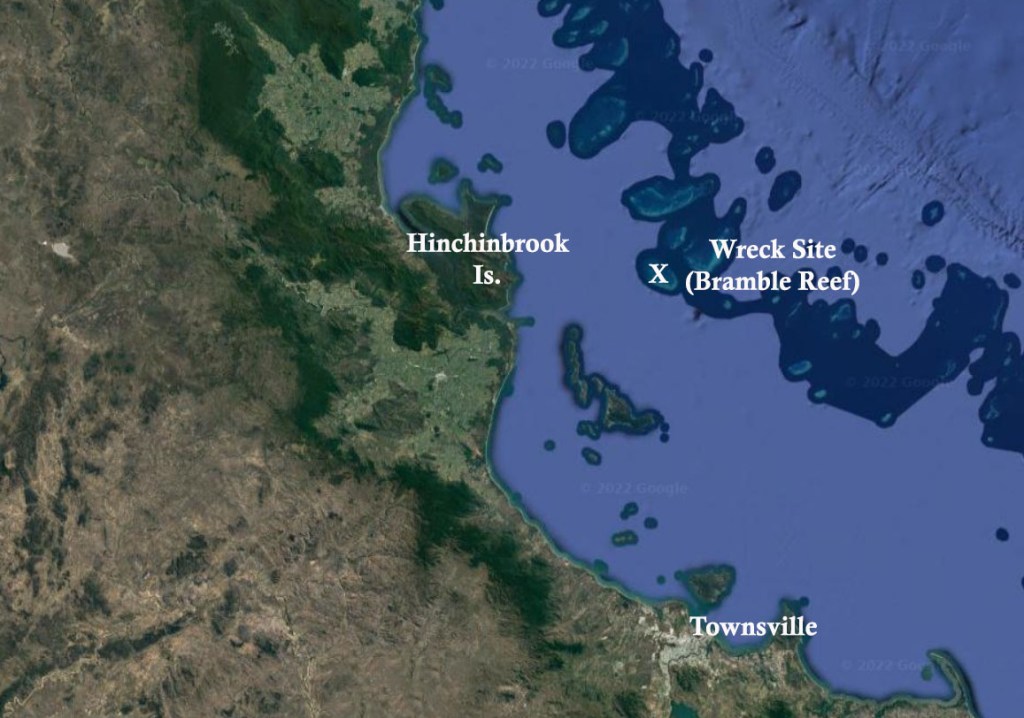
    With a lookout stationed high on a mast above, watching for submerged hazards, the Maria gingerly made her way west and soon became entangled in the giant maze of coral reefs and shoals. Thinking they were approaching Magnetic Island and the safety of Cleveland Bay, the captain was unknowingly approaching the coast some 90 km further north. Then, in the early hours of 26 February, their luck finally ran out. The Maria ran onto Bramble Reef off Hinchinbrook Island and began taking on water. A few hours later, she sank to the bottom until just her masts showed above the surface of the water.


       Before that happened, Captain Stratman, with a handful of others, had already abandoned the ship in one of their three boats, leaving everyone else to their fate. The class divide separating the expedition members made it almost impossible for anyone to coordinate their efforts. No one would take orders from anyone else. Some eventually made it to Cardwell in the two remaining lifeboats. About a dozen men were last seen clinging to the rigging but they had vanished before rescuers finally found the wreck.

       Others had taken to two makeshift rafts, but many of them drowned, and of those who reached land, half were massacred by local Aborigines. Of the 75 people who sailed out of Sydney on the Maria, almost half, 35, lost their lives.

    The full story is told in A Treacherous Coast: Ten Tales of Shipwreck and Survival from Queensland Waters available through Amazon.

    © Copyright C.J. Ison / Tales from the Quarterdeck, 2022.

    To be notified of future blog posts, please enter your email address below.