Tag: Narcisse Pelletier

  • Tales from the Quarterdeck

    Sixty bite-sized stories from Australia’s maritime past

    The melancholy loss of H.M.S Sirius off Norfolk Island by George. Raper. Source National Library of Australia 136507434-1

    I have just launched a new book titled Tales from the Quarterdeck: Sixty bite-sized stories from Australia’s maritime past. Sixty of the most popular posts have been reedited. In some cases, I’ve rewritten a couple and updated a few where new information has come to light since first writing them.

    For those who would value ready access to the stories in their bookcase, Tales from the Quarterdeck is available in Kindle ebook and paperback formats through Amazon.

    The stories are organised in chronological order, starting with the Tryall shipwreck off the Western Australian coast in 1622, and finishing with the Second World War exploits of the Krait. See below for a full list of the stories covered in the book.
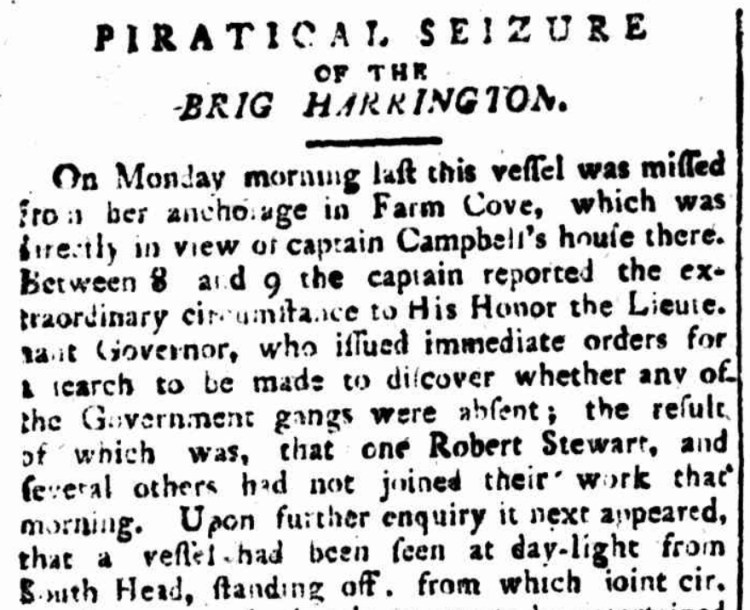
    Sydney Gazette 22 May 1808, p. 2.

    1622 – The Tryall: Australia’s earliest shipwreck

    1629 – The Batavia Tragedy

    1688 – William Dampier: Navigator, naturalist, writer, pirate

    1770  – The Endeavour’s Crappy Repair

    1788 – Loss of La Astrolabe and La Boussole, a 40-Year Mystery                        

    1789 – Bligh’s Epic Voyage to Timor

    1789 – HMS Guardian: All Hands to the Pumps

    1790 – The Loss of HMS Sirius

    1790 – Sydney’s First Desperate Escape

    1791 – HMS Pandora: Queensland’s earliest recorded Shipwreck

    1791 – William Bryant’s Great Escape

    1797 – The Loss of the Sydney Cove

    1803 – Loss of HMS Porpoise

    1808 – Robert Stewart and the Seizure of the Harrington

    1814 – Wreck of the Morning Star

    1816 – The Life and Loss of HMSC Mermaid

    1824 – The Brig Amity’s Amazing Career

    1829 – The Cyprus mutiny 

    1831 – The Caledonia’s perilous last voyage

    1833 – The Badger’s Textbook Escape

    1835 – The Loss of the Convict Ship Neva

    1835 – The Post Office in the middle of nowhere

    1835 – The Tragic Loss of George III

    1845 – The Cataraqui: Australia’s worst shipwreck

    1846 – The Peruvian’s Lone Survivor

    1847 – The Foundering of the Sovereign

    1850 – The Loss of the Enchantress: A first-hand account

    1851 – The Countess of Minto’s brush with Disaster

    1852 – The Bourneuf’s Tragic Last Voyage

    1852 – The Nelson Gold Heist

    Woodbury, Walter B. (Walter Bentley), 1834-1885. Hamlet’s Ghost, Sourabaya [Surabaya], Java [Boat with Passengers and Crew], ca. 1865. Walter B. Woodbury Photograph Collection (PH 003). Special Collections and University Archives, University of Massachusetts Amherst Libraries

    1854 – Bato to the Rescue 

    1854 – HMS Torch and the rescue of the Ningpo

    1856 – The Loss of the Duroc and the Rise of La Deliverance

    1858 – The Loss of the Saint Paul and its Horrific Aftermath

    1858 – Narcisse Pelletier, An Extraordinary Tale of Survival

    1859 – The Indian Queen’s Icy Encounter

    1859 – The Sapphire and Marina

    1863 – The loss of the Grafton: Marooned for twenty months

    1864 – The Invercauld shipwreck

    1865 – The CSS Shenandoah: Victoria’s link to the American Civil War

    1866 – The Loss of the SS Cawarra: Bad luck or an avoidable tragedy?

    1868 – The Bogus Count and Hamlet’s Ghost

    1871 – The Mystery of the Peri

    1872 – The Loss of the Maria, A Cautionary Tale

    1875 – The Tragedy behind the Gothenburg Medals

    1876 – The Catalpa rescue

    1876 – The Banshee’s Terrible Loss

    1878 – The Loch Ard Tragedy

    1884 – The Macabre case of the Mignonette

    1885 – The Douro and its Piratical Captain

    1889 – The Windjammer Grace Harwar

    1891 – The Spanish Silver of Torres Strait

    1893 – The Foundering of the SS Alert

    1895 – The Norna and the Conman Commodore

    1899 – Cyclone Mahina

    1911 – The Loss of the Mandalay

    1918 – The Orete’s Robinson Crusoe-like Castaway

    1935 – The Life and Loss of  the SS Maheno

    1943 – Surviving the Centaur Sinking

    1943 – The Amazing Krait

  • The Loss of the Saint Paul and its Horrific Aftermath– 1858

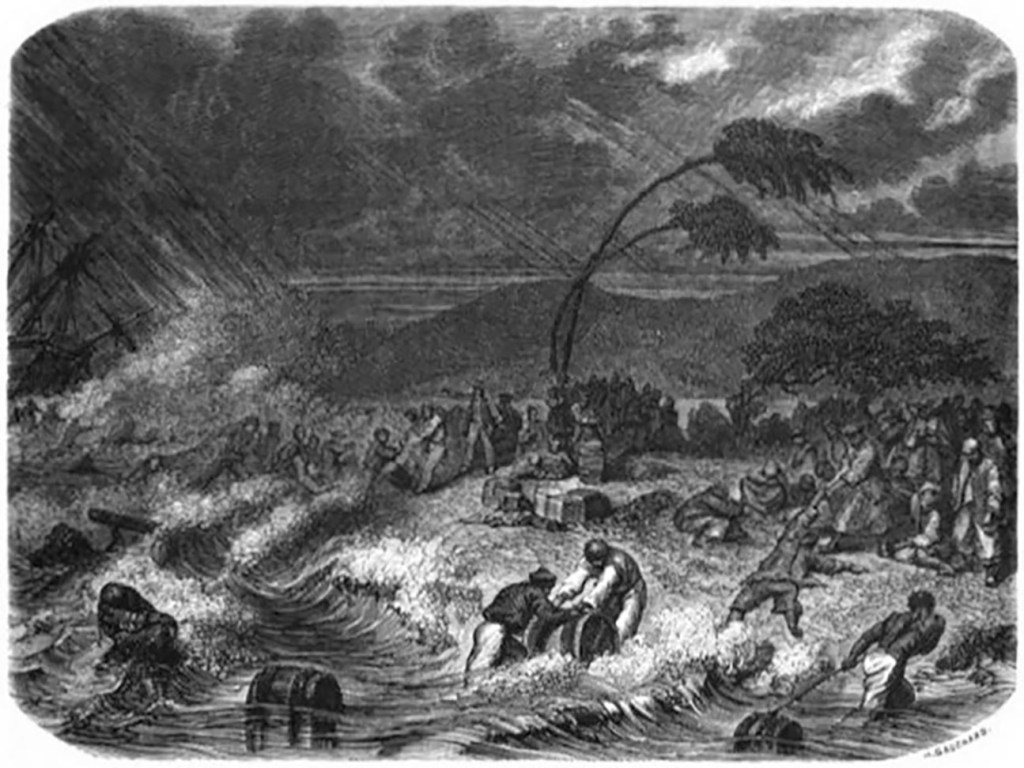
    Stranding of the Saint Paul, on Rossel Island. Auguste Hadamard, Le Tour du Monde, volume 4, 1861.

       In September 1858, the French ship Saint Paul was wrecked off Rossel Island, east of mainland New Guinea, with as many as 370 people on board. Of those, fewer than a dozen escaped with their lives. One of those was Narcisse Pelletier, who made it to Cape York, where he lived with the Uutaalnganu people for the next 17 years. His story is told in the next chapter. All the rest were massacred while they waited to be rescued.

       The Saint Paul was a French merchant ship of 620 tons under the command of Captain Emmanuel Pinard. In July 1858, she set sail from Hong Kong with an estimated 350 Chinese passengers bound for Sydney to try their luck on the New South Wales goldfields.

       The ship made slow progress from the outset due to adverse weather conditions. By the time she was somewhere north of New Guinea, the captain was concerned they would run out of food before reaching port. Rather than stick to the regular shipping route, east of the Solomon Islands, Captain Pinard chose to shorten his voyage and save time by sailing through the risky reef-strewn waters between the Solomons and New Guinea.

       Unfortunately, the gamble did not pay off. They were plagued by more bad weather, and thick mists enveloped the ship, barring Pinard from making any solar observations so he might accurately plot his position. The captain was sailing blind as he tried to thread his way through the treacherous Louisaide Archipelago when disaster finally struck.

    Saint Paul.

       On the night of 10/11 September, the Saint Paul struck a reef off Rossel Island on the eastern edge of the archipelago. The ship was beyond saving, so the next morning, the passengers were ferried ashore with what stores and provisions could be salvaged.

       They set up camp on a small rocky island about two or three kilometres off Rossel Island. A couple of days later, Pinard sent his first mate with half his crew across to Rossel to look for water. Islanders attacked the water party, and several of Pinard’s men were killed. The rest returned empty-handed.

       Pinard would later report that he then took the longboat crewed by most of the surviving seamen and set off for the Australian mainland to find help. He also claimed that he had only done so after consulting with his Chinese passengers and receiving their approval. Leaving behind most of the food, firearms and the second boat, he and his men set off. Years later, the cabin boy Narcisse Pelletier would contradict his captain’s statement, claiming they had fled in the dead of night, leaving the Chinese passengers to their fate.

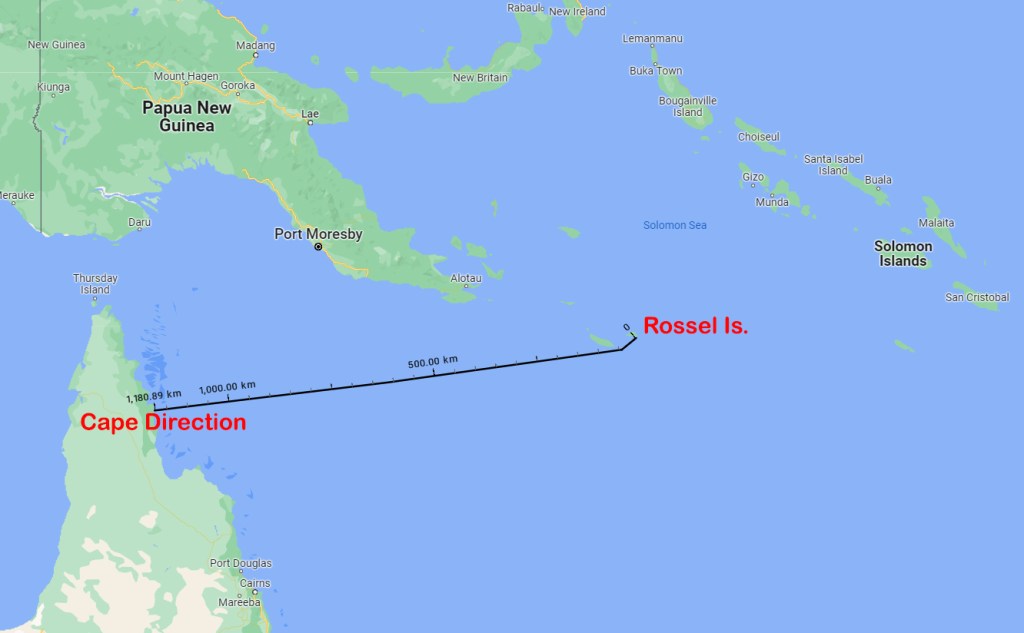
       Pinard and his crew, including Pelletier, landed near Cape Direction after a nearly two-week passage. There, they received food and water from the local Uutaalnganu people before putting back out to sea in their boat. However, when they left, Pelletier was not with them. For some reason, he had been deliberately left behind.

    The crew of the Saint-Paul attacked by natives of Rossel Island. Auguste Hadamard, Le Tour du Monde, volume 4, 1861.

          Meanwhile, Captain Pinard and the Saint Paul’s crew were found by Captain McKellar of the schooner Prince of Denmark. He agreed to take them to the French settlement on New Caledonia, but he could only do so after he first delivered provisions to a party of beche-de-mer fishermen camped on a remote island. By now, the Chinese had been marooned for over a month, and it would be mid-December before the Prince of Denmark reached Port-de-France (Noumea).

       When Pinard finally reported the loss of his ship, the French immediately dispatched a warship to rescue the stranded passengers. The Styx reached Rossel Island on 5 January 1859, but when Lieutenant Grenoult and his men went ashore, they made a shocking discovery. Of the 350 or so people left on the island, they found only one survivor. Through sign language, he seemed to convey to Grenoult that everyone else had been massacred. Still, the shocking details would only come to light after they arrived in Sydney a few weeks later, and an interpreter could translate his story. What follows is drawn from the survivor’s own words and Lt. Grenoult’s official report.

       For a little while, the Islanders left the Saint Paul survivors alone. Then some of the Chinese ventured across to Rossel Island in the Saint Paul’s boat, and they were never seen again. A few days later, several Islanders paddled over to the castaways’ camp, offering food to anyone who returned to Rossel Island with them. When they also failed to return, the Chinese grew suspicious, and no amount of encouragement would compel them to leave their island despite their growing hunger.

    Detail from an 1829 Marine Chart showing Rossel Is. Courtesy NLA.

       Then, after the Chinese had been stranded for about a month and were in a feebly weak state, the Islanders descended on them in large numbers. Some of the castaways put up a fight, but they were easily overpowered. The camp was ransacked, and the Chinese were forced into canoes and taken to Rossel Island. The castaways would soon learn the grisly truth about what had become of those previously missing men.

       The Saint Paul survivors were corralled in a large clearing and carefully watched. Over the next several weeks, a few men at a time were separated from their comrades, beaten to death, butchered, and their flesh cooked over a fire. This horrific spectacle was apparently played out in full view of the dwindling number of survivors.

       By the time the Styx steamed into view, just half a dozen Saint Paul survivors were still alive. On seeing the French warship, the Islanders fled into the mountainous interior, taking with them four Chinese and a European sailor. Only the single man was left behind because he had been too weak to bother with. He had hidden among some rocks until the Styx’s boats landed and the French sailors stepped ashore.   

    Lt Grenoult and his men spent three days on Rossel Island trying to find the others, but without success. The Styx then delivered Captain Pinard, his men, and the young Chinese passenger to Sydney.   

     © Copyright C.J. Ison / Tales from the Quarterdeck, 2023.

    To be notified of future blogs, please enter your email address below.

  • Narcisse Pelletier: An Extraordinary Tale of Survival.

    Narcisse Pelletier and the Saint Paul.

       In April 1875, the pearling schooner John Bull’s crew encountered a man of clearly European descent living with a group of Aborigines on Cape York Peninsula. Mistakenly thinking that the man was being held against his will, they took him on board their vessel and delivered him to the nearest Government outpost at Somerset. His name was Narcisse Pelletier.

       Pelletier spent about two weeks at Somerset before being sent to Sydney on the steamer Brisbane. During his time at Somerset, Pelletier had spoken little, but on the voyage south, he was befriended by Lieutenant J.W. Ottley, a British Indian Army officer on leave in Australia. Using his rusty schoolboy French, Ottley coaxed Pelletier to tell him his remarkable story.

       Narcisse Pierre Pelletier was the son of a Saint Gilles shoemaker. At the age of 14, he went to sea as a cabin boy on the Saint Paul under the command of Captain Emmanuel Pinard. The ship sailed from Marseille in August 1857, bound for the Far East. The following year, the Saint Paul left Hong Kong for Sydney with 350 Chinese passengers drawn to New South Wales by the lure of gold. However, the ship was wrecked in the dangerous Louisiade Archipelago off the east coast of New Guinea.

    Stranding on the Saint Paul, on Rossel Island. Auguste Hadamard, Le Tour du Monde, volume 4, 1861.

       When some of the crew, including Pelletier, went in search of water on Rossel Island, they were attacked by the local inhabitants, and the mate and several sailors were killed. Pelletier himself was struck on the head and barely escaped with his life. He claimed that the captain had then decided their best chance of surviving was for the remaining crew to make for New Caledonia, leaving the Chinese passengers to their fate. This was at odds with Captain Pinard’s own account, in which he claimed to have gone in search of help at the behest of the passengers and that he had left them with most of the provisions and firearms. The story of the shipwreck and the gruesome aftermath is told in the preceding chapter.

       Pelletier recalled they suffered greatly in the longboat, surviving on a diet of flour and the raw flesh of a few seabirds that they were able to knock out of the sky when they flew too close to the boat. The sailors’ misery was amplified several days before reaching land when they ran out of drinking water. Pelletier was unsure how long they had been at sea, but they came ashore on the Australian mainland near Cape Direction, the land of the Uutaalnganu people.

       Nine of the Saint Paul’s crew reached land, including Captain Pinard and Pelletier. The first water hole they found was so small, according to Pelletier, that by the time everyone else had drunk their fill, there was none left for him. By now, he was half dead from hunger and thirst. He was suffering from exposure to the elements, and his feet had been lacerated from walking barefoot on coral.

       He told Ottley that Pinard and the rest of the men had reboarded the boat, intent on reaching the French settlement on New Caledonia, but they set out to sea without him. There he was, abandoned on an alien and possibly hostile stretch of coast far from anything familiar.

       Again, Pelletier’s version differs from Pinard’s. The captain claimed that he and all the others had stayed with the Uutaalnganu people for several weeks before they set off and were later picked up by the schooner Prince of Denmark, which eventually took them to New Caledonia. Regardless of the precise circumstances, when his shipmates left, Pelletier remained and was adopted by the Uutaalnganu people.   

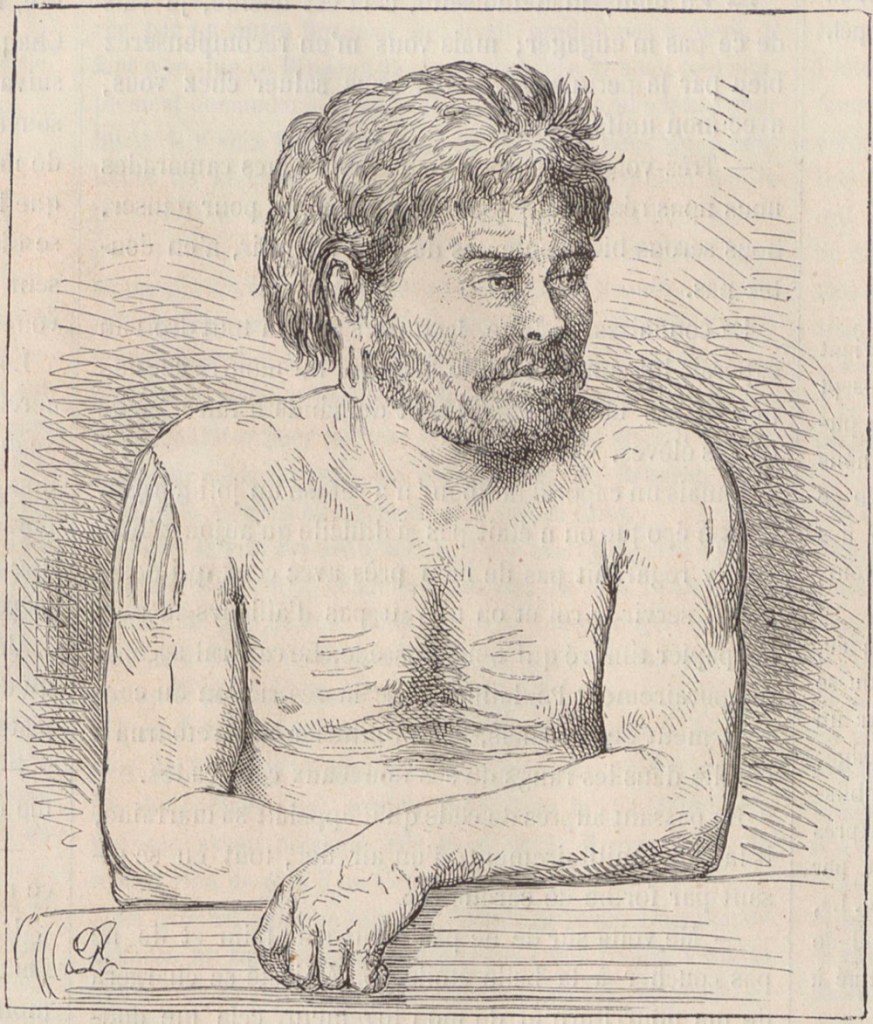
    They tended to his injuries and restored him back to good health. Pelletier said that for the first several years, he missed his parents and younger brothers and longed to return home to France. But as time wore on, those feelings faded and were replaced by a strong bond to his Uutaalnganu adopted family. From the ceremonial scars scored on his chest and arms, and the piercing of his earlobe, for which he felt great pride, it is clear he had been initiated into the society. According to a later French biography, Pelletier married an Aboriginal woman and they had several children. He would remain with the Uulaalnganu for 17 years.

    Narcisse Pelletier in 1875. Source: Wikicommons.

       Then, in 1875, his world was turned upside down for a second time. One day, the pearling lugger John Bull happened to anchor near Cape Direction. Several sailors came ashore for water and to trade with the Uutaalnganu. They noticed the white man among the local inhabitants and coaxed him to visit their ship. Pelletier told Ottley that he had only gone with them for fear of what the heavily armed sailors might do if he didn’t, rather than any desire to return to “civilisation.” What’s more, he had not expected to be taken away, never to see his family and friends again. Pelletier also confessed to Ottley that he would have preferred being returned to Cape Direction and “his people,” instead of being taken down to Sydney.

       Narcisse Pelletier never did return to his Uutaalnganu family. He was delivered to the French Consulate in Sydney, where officials organised passage for him back to France. When, in January 1876, he arrived at his parents’ home, the whole town turned out to greet him. He was given a job as a lighthouse keeper near Saint Nazaire and married for a second time a few years later. Narcisse Pelletier passed away on September 28, 1894, at the age of 50.

    © Copyright C.J. Ison / Tales from the Quarterdeck, 2023.

    To be notified of future blogs, please enter your email address below.