Tag: Murray Island

  • Wreck of the Morning Star – 1814

    Example of a Brig. Source: Winston’s Cumulative Loose-Leaf Encyclopedia 1918

       On Sunday, 3 July 1814, the merchant ship Morning Star sailed out of Sydney Harbour bound for Calcutta by way of Torres Strait and Batavia.  However, her voyage north ended abruptly on a coral reef south of the Forbes Islands off the far north Queensland coast. The vessel was a 140-ton Calcutta-built brig owned by the Indian-based trading house Lackersteen and Co. When she left Sydney, the crew numbered 37 men, a mix of European and Indian seamen, all under the command of Captain Robert Smart. Only six of them would survive the ordeal.

       No account exists of how the ship was lost, but from the location of the wreck site, it appears that Captain Smart was sailing within the Great Barrier Reef when he ran aground and had to abandon ship.

       Lieutenant James Cook had charted the route back in 1770, and he had only narrowly avoided total disaster on what he would name Endeavour Reef, some 450 km south of where the Morning Star was lost.

       The passage was fraught with danger. Thousands of reefs, many hidden just below the surface, dotted the coastal waters inside the Great Barrier Reef. However, the route had two distinct advantages. Rarely did a ship have to stray far from land, so refuge could be sought should disaster strike. There were also ample safe anchorages where ships could lay up overnight or when the conditions made it difficult to detect hazards lying in their path. Later, mariners would prefer a route that took them far out into the Coral Sea as they made their way north. They would cross the Barrier Reef near Raine Island or other similar narrow passages to pass through Torres Strait. This “outer passage” avoided the labyrinth of reefs but came with its own set of dangers.

    Booby Island. Image courtesy National Library of Australia

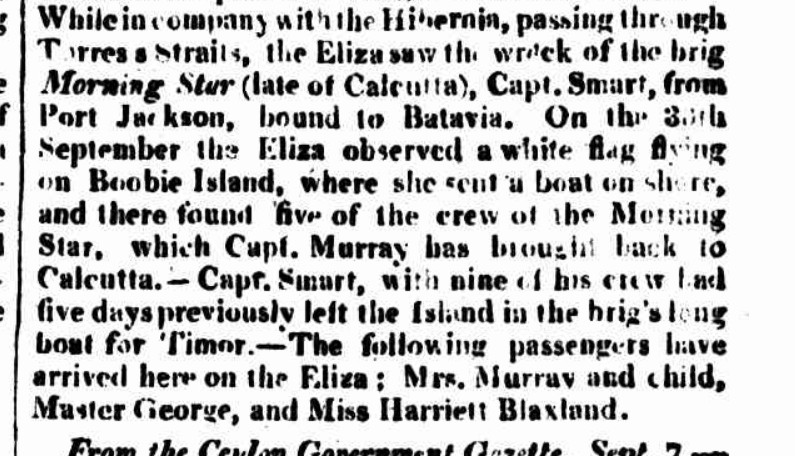
       On 30 September, the fully rigged Ship Eliza was sailing through Torres Strait when the lookout spotted a white flag flying from a staff on Booby Island.   The captain heaved to and sent a boat across to investigate. When it returned, she carried five marooned sailors from the Morning Star. This is the first recorded instance of shipwrecked sailors seeking refuge on Booby Island. Later, it would be stocked with food and water to assist shipwrecked sailors. A primitive post office with a logbook would also be established, so passing mariners could pass on the location of any uncharted reefs they may have discovered.

       The castaways had been among 15 men who had taken to the Morning Star’s longboat and made the perilous journey north after abandoning the wreck. They reported that Captain Smart and nine other sailors had left Booby Island five days earlier, intending to make for the Dutch port of Kupang on Timor Island. There is no record of them ever arriving there or anywhere else, for that matter.

    Morning Star reported wrecked on a reef south of Forbes Islands. Courtesy: Google Maps.

       The remaining 22 members of the Morning Star’s crew were thought to have perished as a result of the wreck or some calamity that befell them sometime afterwards. But four years later, another Morning Star survivor was found living with the Islanders on Murray Island on the Eastern entrance to Torres Strait.   

    The Claudine had anchored off Murray Island in September 1818 and sent a jolly boat ashore to meet with the islanders. To the astonishment of all, an Indian sailor was there to greet them in Hindustani. Fortunately, one of the sailors in the jolly boat spoke the language and was able to translate for the others. He told the sailors from the Claudine that he had been on the Morning Star when it ran aground and that since then he had been living with the Murray Islanders. He had learned their language and been accepted into their community, but the circumstances of his arrival on the island and the fate of his shipmates were not recorded. When the Claudine set sail, the Indian castaway was with them.
       The Morning Star is just one of many hundreds of vessels, large and small, that came to grief in Queensland’s northern waters from the late 18th and into the early part of the 20th Century.

    © Copyright C.J. Ison / Tales from the Quarterdeck, 2025.

    Please enter your email address below to be notified of future blogs.
  • Loss of La Astrolabe and La Boussole: a 40 Year Mystery

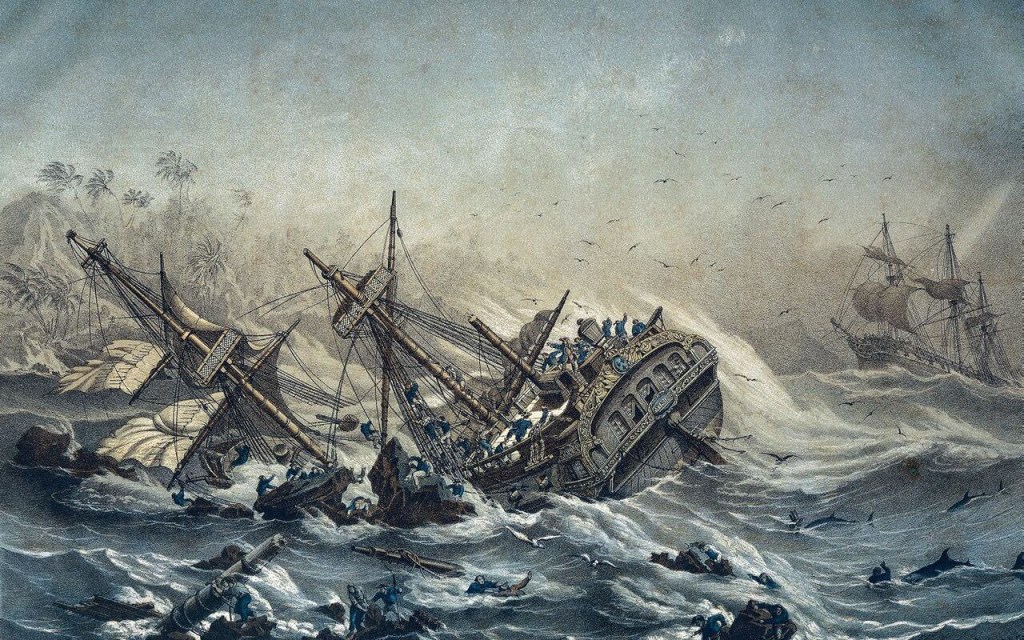
    19th Century lithograph of the sinking of La Astrolabe at Vanikoro by Louis Le Breton. Courtesy Public domain, Wikimedia commons.

    One of the great maritime mysteries of the late 18th and early 19th centuries was the disappearance of the French ships La Astrolabe and La Boussole under the command of La Perouse. They were last sighted leaving Botany Bay in 1788 but it would be another 40 years before the world discovered what became of them.   

    In 1785, Louis XVI appointed Jean-François Comte de La Perouse to lead an expedition of discovery to the far reaches of the world. The objectives were primarily scientific, but La Perouse was also to look out for economic opportunities that might benefit France. He was given two ships, La Astrolabe and La Boussole, with a total complement of some 220 men. The expedition included a botanist, geologist, physicist, astronomer, and several naturalists and illustrators – ten men of science in all. Even the ships’ two chaplains had received scientific training. Rarely had such a body of learned men been assembled for such a voyage.


    Louis XVI giving La Pérouse his instructions on 29 June 1785, by Nicolas-André Monsiau – Chateau de Versailles, Public Domain, https://commons.wikimedia.org

    The La Astrolabe and La Boussole sailed from Brest on 1 August 1785 and bore south into the Atlantic Ocean to round Cape Horn. They stopped briefly in Chile and then proceeded to the Sandwich Islands (now known as Hawaii). From there, they continued north as far as Alaska and then traced the North American coast south to a point that is now Monterey in California. La Perouse then took his two ships across the Pacific Ocean to the Portuguese colony of Macau and then headed north again. They arrived at the Russian outpost of Petropavlovsk on the Kamchatka Peninsula in September 1787 to find fresh orders awaiting them. The French Court was aware that the British had assembled a fleet of ships to sail for New South Wales. La Perouse was instructed to make directly for Botany Bay to investigate the new settlement being established there.   

    La Perouse arrived at Botany Bay on 24 January 1788, only days after the First Fleet under Governor Phillip had arrived from England. The French mariners spent six weeks there, resting and replenishing their food and water supplies. Before sailing, La Perouse left a package of letters, journals and charts with the captain of a returning British convict transport to be forwarded to Paris. In his correspondence, La Perouse wrote that he intended to sail to New Caledonia and the Santa Cruz Islands before turning back for home. They had been gone for two and a half years when they sailed from Botany Bay. He also anticipated that they would be back in France by June the following year. On 10 March 1788, the two French ships set sail and were never seen again, at least not by any Europeans.

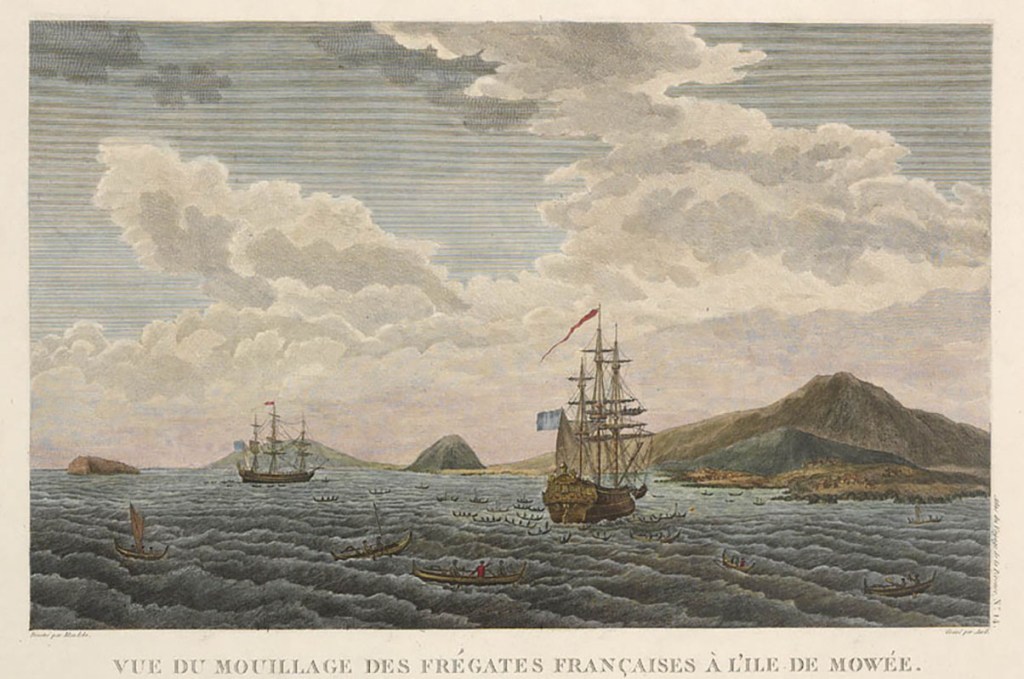
    French frigates La Astrolabe and La Boussole in Hawaii. Image courtesy State Library of NSW.

    Then, in 1826, an Irish mariner, Peter Dillon, made a startling discovery. While at Vanikoro, he came into possession of some artifacts clearly of French origin. He learned that relics from the French ships had been circulating among the inhabitants of Santa Cruz and neighbouring islands for years. On inquiring about the origin of the pieces, he was told that they had come from two large ships that had been wrecked there many years earlier.

       Dillon was sure the artifacts, one of which was a sword guard of French design, had come from La Perouse’s expedition. Upon returning to India, he reported his discoveries to the East India Company, which provided him with a ship to explore the waters around Vanikoro more closely.   

    In 1827, Dillon found the wreck site and retrieved several artefacts, including a bell which had clearly belonged to a French ship. He also learned from the older villagers on Vanikoro that the two French ships had run aground on a coral reef during a violent storm with great loss of life. The survivors had built a new vessel from timbers salvaged from the wrecks and sailed away. They had probably tried making for Kupang in the Dutch East Indies (Indonesia). That would have been the closest port where they might find help and passage back home. It would, however, require them to cross the Great Barrier Reef and pass through Torres Strait. Most of the French seamen left in the new ship, but a few men opted to remain on Vanikoro, where they lived out their days. By the time Dillon visited the island, they had all since passed away.

    Map showing Vanikoro and Murray Island. Courtesy Google Maps.

    There is a final clue as to what may have happened to La Perouse’s men who sailed away from Vanikoro. An Indian seaman had been found living among the inhabitants of Murray Island (Mer) in 1818. His name was Shaik Jumaul, a seaman on the Morning Star, which had been wrecked in Torres Strait four years earlier, while on a voyage from Sydney to Batavia.

       He said that he had come across many items of European manufacture, including muskets, cutlasses, a compass, and even a gold watch, while visiting nearby islands. When he asked where they had come from, he was told that about 30 years earlier, a large ship had been wrecked near Murray Island. Several boatloads of men came ashore, but a fight ensued, and most were killed. Some fled to other islands where they met the same fate. The only survivor was a young boy. He lived among the Islanders for many years and rose to be held in high esteem in his adopted community.

    Jean Francois Comte de La Perouse. Image: public domain, https://commons.wikimedia.org.

    More recently, ANU academic Dr Garrick Hitchcock came across the original newspaper article published in the Madras Courier in 1818. Jumaul’s story was later republished in the Sydney Gazette in July 1819. The Sydney Gazette article even speculated that the ship might have been one of La Perouse’s, but it appears that possibility was never seriously followed up.   

    Hitchcock thinks the vessel might have been the one constructed from salvage on Vanikoro. The timing certainly fits. After some detective work, Hitchcock discovered that a boy named Francois Mordelle had accompanied the expedition, and it was possible that he was the one who had lived among the Torres Strait Islanders for all those years.

    © Copyright C.J. Ison / Tales from the Quarterdeck, 2022.

    To be notified of future blogs, please enter your email address below.