Tag: Moreton Island

  • Surviving the Centaur sinking.

    A poster urging Australians to “Avenge the Nurses” after the sinking of the Centaur in 1943. Image courtesy Australian War Memorial.

       On a quiet Saturday afternoon on 15 May 1943, the senior Royal Australian Naval officer in Brisbane received a message reporting that a USN destroyer had picked up survivors from the Australian Hospital Ship (AHS) Centaur. This was the first anyone knew of the tragedy that had unfolded a short distance off the Queensland coast.

       The Centaur left Sydney bound for Port Moresby to pick up sick and wounded diggers and return them to Australia. Fighting had been raging in New Guinea for over a year, and casualties had been high. As she steamed north this time, she had a full crew, and she was also delivering members of the 2/14th Field Ambulance to Port Moresby. In all, there were 332 souls on board.

       Around 4 a.m. on Friday, 14 May, the Centaur was about 30 nm (55 km) off Moreton Island when she was struck by a torpedo fired by a Japanese submarine. Merchant seaman Alfred Ramage had just finished his watch and was climbing into his bunk when he was rocked by the powerful explosion. Ramage immediately knew what had happened, so he quickly donned his lifebelt and began making his way to the boat deck. Urgency spurred him along, for he had never learned to swim.

       The torpedo had hit the portside fuel bunker, which sent flames ripping through the ship, burning and trapping many people below decks. Those same flames soon engulfed the boat deck and then the bridge as the crew struggled to get the lifeboats away.    Steward Frank Drust was standing outside the ship’s pantry when the floor collapsed and a wall of flames separated him from the closest companionway leading to the deck. By now, the Centaur was sinking by the bow. He waded through swirling waist-deep water and eventually made it onto the deck. He and a few comrades began throwing hatch covers and life rafts over the side to help those already floundering in the water. They continued their efforts until they, too, were washed off their feet as the sea rose around them.
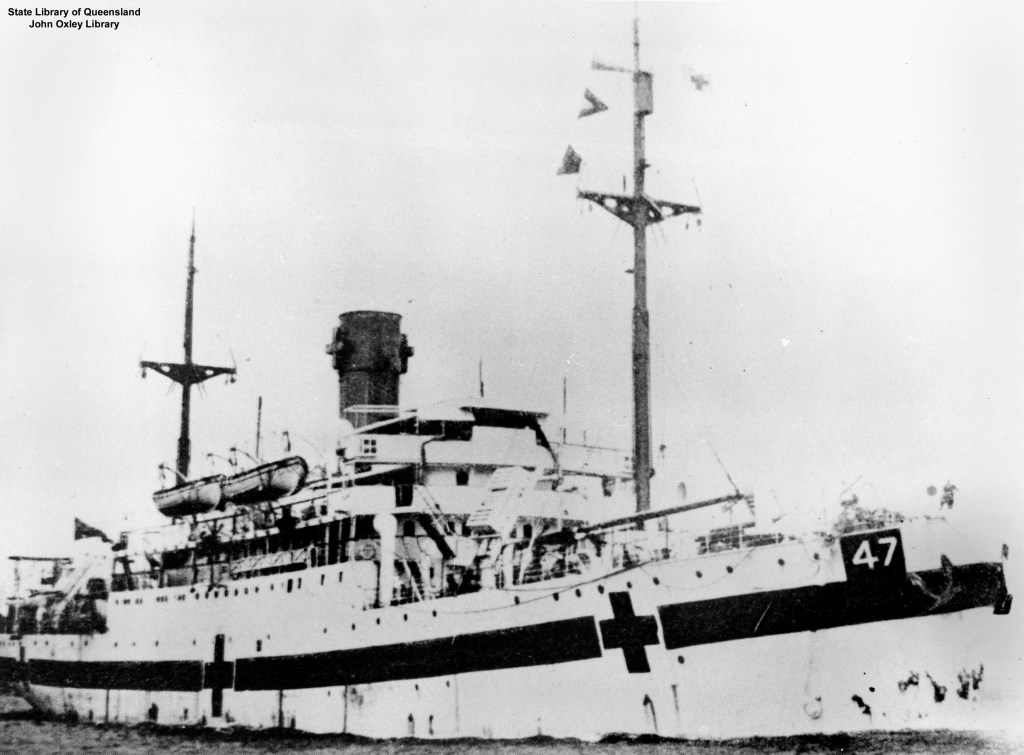
    AHS Centaur. Photo Courtesy State Library of Queensland

        Sister Ellen Savage, one of 12 nurses on board, was woken by the loud explosion reverberating through the ship. She and fellow nurse Merle Morton fled their cabin in their pyjamas and were told by their commanding officer to get topside as quickly as they could. They had no time to retrieve warm clothing or anything else from their cabin before they took flight.

       By the time they reached the deck, the Centaur was already sinking. The suction dragged Ellen Savage down into a maelstrom of whirling metal and timber, cracking her ribs, breaking her nose and bruising her all over. But suddenly, she found herself back on the surface in the middle of a thick oil slick. She never saw her cabinmate or her commanding officer again.

       Savage could see a large piece of wreckage a short distance away and swam for it. It turned out to be a portion of the ship’s wheelhouse where several others had already taken refuge. In time, as many as 30 survivors climbed onto the fragile floating island. Others who had escaped the ship kept themselves afloat on pieces of debris or the few rubber liferafts that had been deployed in the hectic minutes after the torpedo struck.
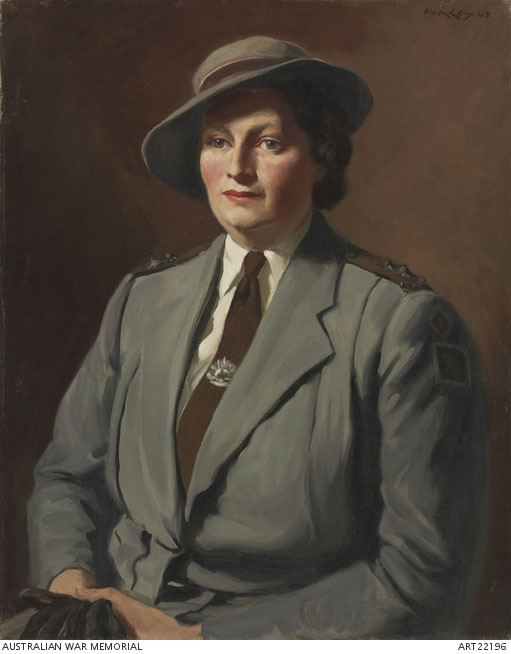
    Sister Ellen Savage GM. Image courtesy AWM.

          Ship’s cook Frank Martin survived by clinging to a single floating timber spar. For the next 36 hours he held on for dear life, half-naked and nothing to eat or drink until he was plucked from the water.

       Seaman Matthew Morris was a little luckier. At first, he found himself alone in the water, blinded by salt and oil. But when his vision returned, he spied a small raft a short distance away, so he swam over and climbed into it. Then he spotted his mate, Walter Tierney, and hauled him onboard. As daylight came, the pair saw something floating in the distance and paddled towards it. It turned out to be the wheelhouse, so they lashed their raft to it and joined the 30 or so people already there.

       The survivors spent all that day huddled on the makeshift raft. There was less than 10 litres of water on hand, and that was doled out sparingly. Several of the survivors had severe burns to their bodies. One was Captain Salt, a pilot from the Torres Strait Pilot Service, who had run through a wall of flame to escape the sinking ship. Despite his painful injuries, he kept morale up, reassuring everyone that help would soon be on the way.

       Matthew Morris led choruses of “Roll out the Barrel,” “Waltzing Matilda,” and other wartime favourites to keep people from thinking about their plight. Sister Savage tended to the wounded with what little she had on hand, never complaining of her own injuries. She kept her broken ribs to herself until after they had all been rescued.

       One poor man, Private Jack Walder, had been badly burned. He drifted in and out of consciousness until he passed away on the raft. Savage prayed over his body before it was gently pushed away to sink from sight.

    The Brisbane Telegraph front page, 18 May 1843.

        According to several survivors, sharks were constant and unwelcome companions, circling as they clung to wreckage or perched precariously on makeshift rafts.

       The survivors spent all of Friday, Friday night and Saturday morning hoping and praying that they would soon be rescued. Several said they heard aircraft flying overhead or saw ships passing in the distance, but the Centaur survivors went undiscovered. At one stage, those on the wheelhouse considered dispatching one of the rubber rafts to try to make landfall to raise the alarm. However, that idea was eventually discarded when it was decided that the chances of surviving the large ocean swells in the small craft were unlikely.    On Friday night, the Japanese submarine surfaced briefly near the wheelhouse, sending a chill through the survivors. Everyone remained quiet, and a short time later, the sub disappeared below the waves again. The survivors never gave up hope of being rescued. Then, on Saturday afternoon, an Australian Air Force aircraft on a routine flight saw something strange floating in the water. On investigation, the pilot realised it was wreckage and guided the US Navy destroyer, USS Mugford, to the location. They quickly began searching the surrounding waters for more survivors.
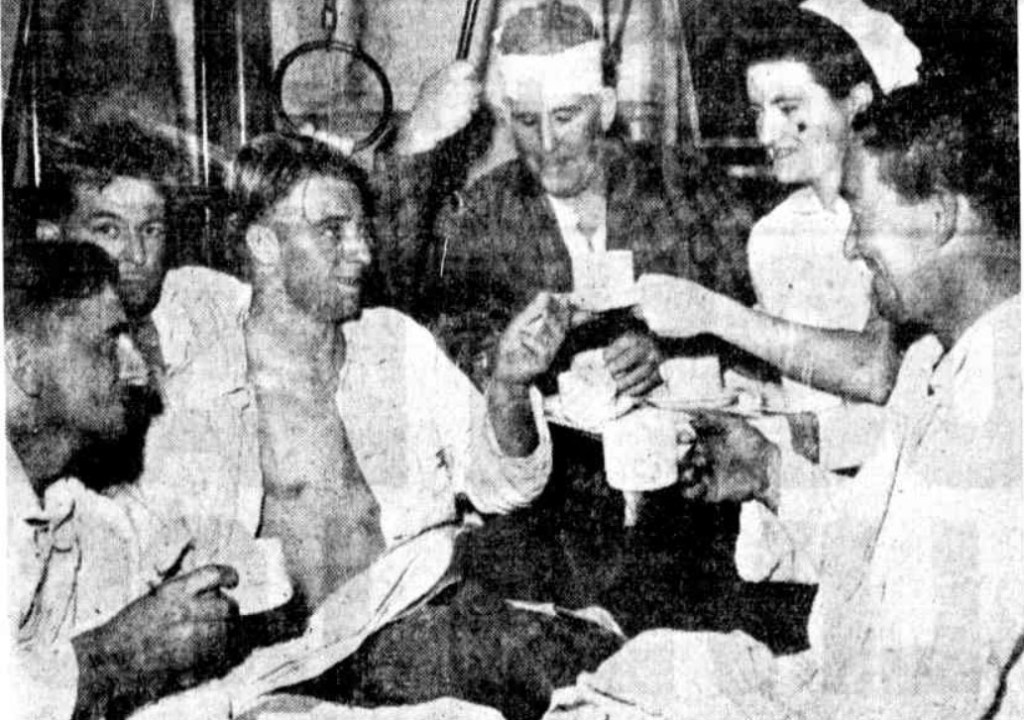
    AHS Centaur survivors being cared for in hospital. Telegraph, 18 May 1943, p. 2.

       In all, 64 people were saved, but another 268 were not so lucky. Sister Ellen Savage was awarded the George Medal for her devotion to duty, tending to the wounded despite her own injuries.

    Lest We Forget.

    © Copyright C.J. Ison / Tales from the Quarterdeck, 2023.

    To be notified of future blogs, please enter your email address below.
  • The Loss of the Sovereign – 1847.

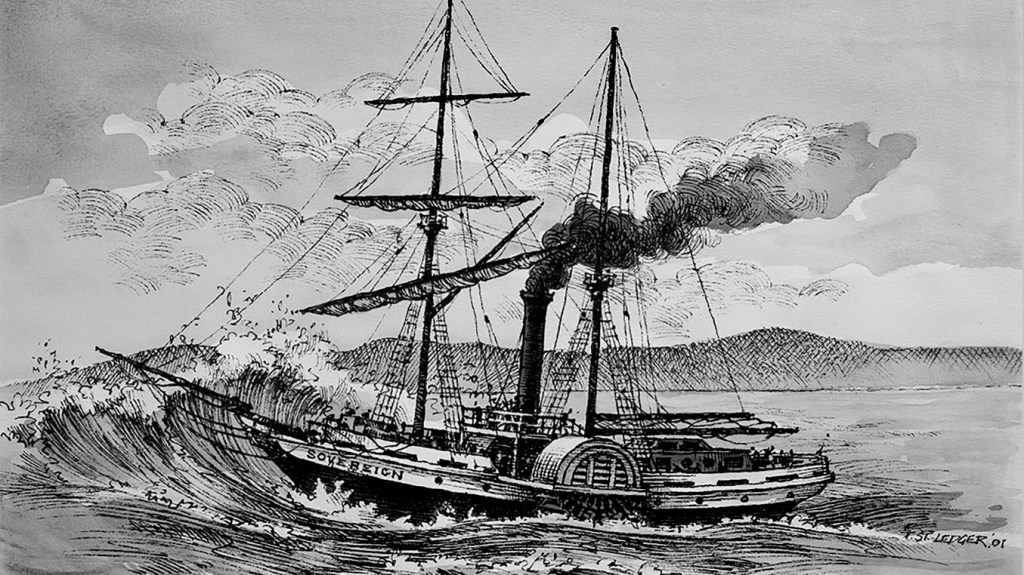
    The Sovereign Side Paddle Steamer moments before disaster. Courtesy North Stradbroke Island Museum.

       When the 119-ton paddle steamer Sovereign foundered in Moreton Bay, resulting in the loss of 44 lives, it was inevitable that people would want someone to blame. The most convenient shoulders to heap that criticism on were the steamer’s master, Captain Henry Cape. But was it deserved, or was the tragic accident a result of the steamer’s owners using her in the open ocean, a role for which she was never built?

       On 3 March 1847, the Sovereign steamed down the Brisbane River. Captain Cape had intended to cross Moreton Bay and head out to sea before bearing south on her regularly scheduled service to Sydney. She had a crew of 24 and there were also 30 passengers. The Sovereign was also loaded down with 140 bales of wool and other cargo. What did not fit in the hold had been stowed on deck, making her sit low in the water.

       By the time the Sovereign reached Amity Point near the southern passage leading from Moreton Bay out into the open ocean, it was too late in the day to cross the bar. Captain Cape anchored for the night off the pilot station so he could set off when the conditions were safe. However, for the next seven days, the winds blew strongly from the south, and he had to wait for the weather to ease off.    Late on the 10th of March, he thought it was safe enough to make the passage between Moreton and Stradbroke Islands. However, as he approached the bar, he realised it was far too dangerous to try crossing. He returned to his anchorage, hoping the next day might prove calmer.

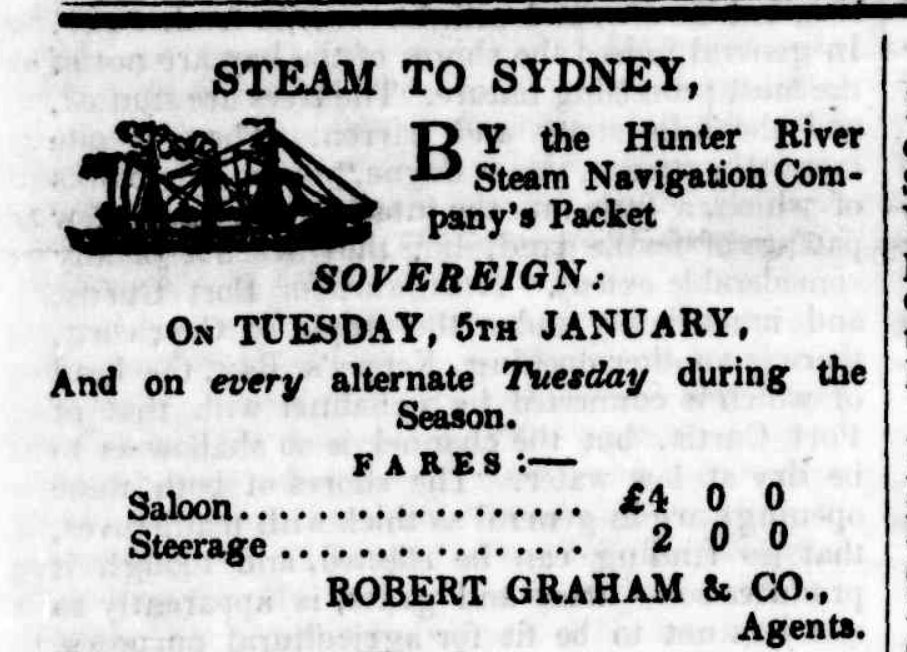
    Advertisement for the paddle steamer Sovereign. Source: Moreton Bay Courier, 26 Dec 1846.

       By 6 o’clock the next morning, 11 March, the wind had dropped to a light south-westerly breeze, so the captain got underway again. When he got to the bar, the Sovereign encountered a heavy swell rolling in from the ocean. Captain Cape had made it through in much worse conditions and was confident he could safely get out to sea that day.

       And, he almost made it. After riding over most of the rolling swells, he failed to climb one huge wave that broke over the Sovereign, smashing the frames that supported the two paddle wheel shafts. The steamer lost propulsion and was instantly at the mercy of the powerful swells. Captain Cape could only rely on his sails at this stage, and with little wind to fill them, they were close to useless.

       Waves swept across the deck, carrying away the cargo. The lifeboats were lost before anyone had a chance to climb aboard them.

       Captain Cape dropped his anchors as the steamer drifted towards the sand spit extending from the southern end of Moreton Island. While they kept the ship’s head to the sea, they dragged along the seabed. The Sovereign was doomed from that moment on. She was inexorably being driven towards disaster.

       Passengers and crew heaved the remaining wool bales overboard in a desperate attempt to lighten the load. Meanwhile, hatch covers leading below decks were washed away, and the sea poured in, filling the hold. The crew and several desperate passengers furiously worked the pumps to keep control of the water, but to no avail.

       The Sovereign began to sink. From the time the engines stopped to that dreadful moment, about 45 minutes had elapsed. In the next five minutes, the ship was pounded to pieces as she wallowed in the breaking surf. 

       Several people clung to wool bales as they floated free, but they were soon left floundering in the tumultuous seas when the sodden bales sank. As a portion of the paddle box broke away, Captain Cape and several others found refuge on it. They held on for dear life and were swept towards Moreton Island, where the paddle box was smashed to pieces in the surf.

    Map of Moreton Bay and approximate site of where the Sovereign foundered. Courtesy Google Maps

       Several Aborigines who had witnessed the disaster waded into the pounding seas and pulled Cape and several others to safety on the beach. Those acts of bravery would later be justly rewarded. Several passengers found debris from the wreck, which had kept them afloat long enough to be picked up by some fishermen and a pilot boat that had been sent out from Amity Point. They had all risked their own lives to come to the rescue. In all, just ten people from the Sovereign survived. Forty-four others drowned.

       Allegations soon circulated that the steamer was ill-suited for the Brisbane – Sydney run and should never have been used for such a long and arduous ocean voyage. Built in Sydney seven years earlier, the Sovereign had begun regularly steaming between Newcastle and Sydney, then between Sydney and Brisbane. But she was thought by some to be ill-suited for the dangerous bar crossing at the entrance to Moreton Bay.

       In response to the criticism, warranted or otherwise, the Sovereign’s owners, the Hunter River Steam Navigation Company, promptly sacked Captain Cape and released a statement absolving themselves of any blame.

       They disputed that any fault lay with the design, build or maintenance of their steamer. Instead, they rejected Captain Cape’s claim that the frames supporting the paddlewheel shafts had failed as he described. Instead, they felt it was Captain Cape’s decision to go to sea under such dangerous conditions or his subsequent handling of the vessel that had resulted in the appalling loss of life.

       Cape was so incensed with his treatment that he challenged his former employer’s report with sworn statements made by the Amity Point pilot and one of the surviving passengers. They swore they had observed the damage to the housings, which ultimately left the paddle steamer dead in the water. Regardless, a marine board inquiry found Captain Cape at fault. To this day, the loss of the Sovereign remains among the worst maritime disasters to occur in Queensland waters.

    © Copyright C.J. Ison / Tales from the Quarterdeck, 2023.

    To be notified of future blogs, please enter your email address below.