Tag: Military history

  • The Krait’s Remarkable Career

    MV Krait anchored at Darwin. Courtesy AWM.

       The small fishing vessel MV Krait holds a special place in Australian maritime and military history. Named after a small, deadly snake, it played an important part in Operation Jaywick, which saw commandoes sink several Japanese ships anchored in Singapore Harbour in September 1943.

       The MV Krait started life as a Japanese fishing vessel named the Kofuku Maru, which was launched in 1934. She was a motorised gaff-rigged ketch measuring 20 metres in length, with a two-metre draft and a displacement of 23 tonnes. At the outbreak of the Second World War, the Kofuku Maru was owned by a Japanese fishing company based in Singapore. They used the vessel to ferry water, food, and other supplies to fishermen working in the Riau Archipelago and to bring their catch back to the city’s seafood markets.   

    When Japan entered the war, the British authorities seized the Kofuku Maru. As Japanese troops advanced down the Malay Peninsula, an Australian merchant mariner, Bill Reynolds, used the fishing boat to evacuate over 1000 civilians to Sumatra in the Dutch East Indies (present-day Indonesia).
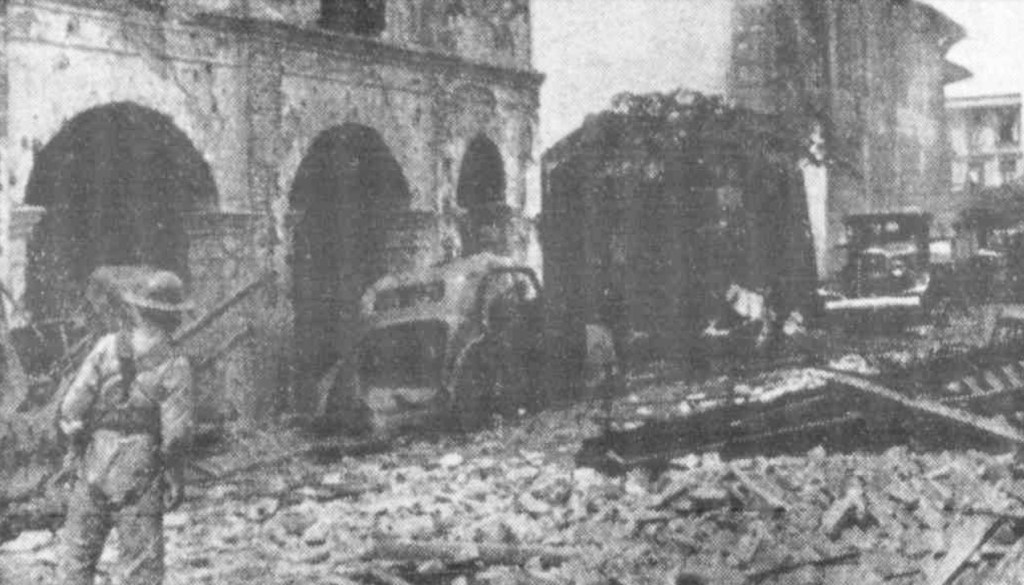
    Singapore shortly before the Japanese landed on the island. Photo Central Queensland Herald, 26 Mar 1942, p. 20.

        Then, in January 1942, when it was clear that Singapore was about to fall, Reynolds sailed the Kofuku Maru to Colombo in Ceylon (present-day Sri Lanka). There, some officers from the Allied Intelligence Bureau saw the potential of having a Japanese fishing vessel at their disposal. With any luck, they thought, the Kofuku Maru might be able to traverse enemy waters without raising suspicion. Reynolds had likely told them that Japanese aircraft had ignored the vessel while he had been operating around Singapore. The Kofuku Maru was then sent to Australia, where she was made ready to begin her clandestine career.

       The Krait, though still going by its Japanese name, Kofuku Maru, was chosen to take part in Operation Jaywick, an audacious mission to destroy enemy shipping moored in Singapore Harbour. It was a high-risk, high-reward mission, but with any luck, the Japanese would not suspect the Krait of being anything other than one of the numerous small Japanese fishing vessels plying the waters around Malaya and Indonesia.   

    A 14-man team was selected for the operation under the command of Major Ivan Lyons, a British Army officer attached to the Z Special Unit, better known simply as Z Force. The men chosen were a mix of British and Australian Army and Navy personnel. After completing specialised training and rehearsals at Refuge Bay north of Sydney, the Krait then made the long voyage up the east coast, through Torres Strait, past Darwin and down the Western Australia coast to Exmouth Gulf.
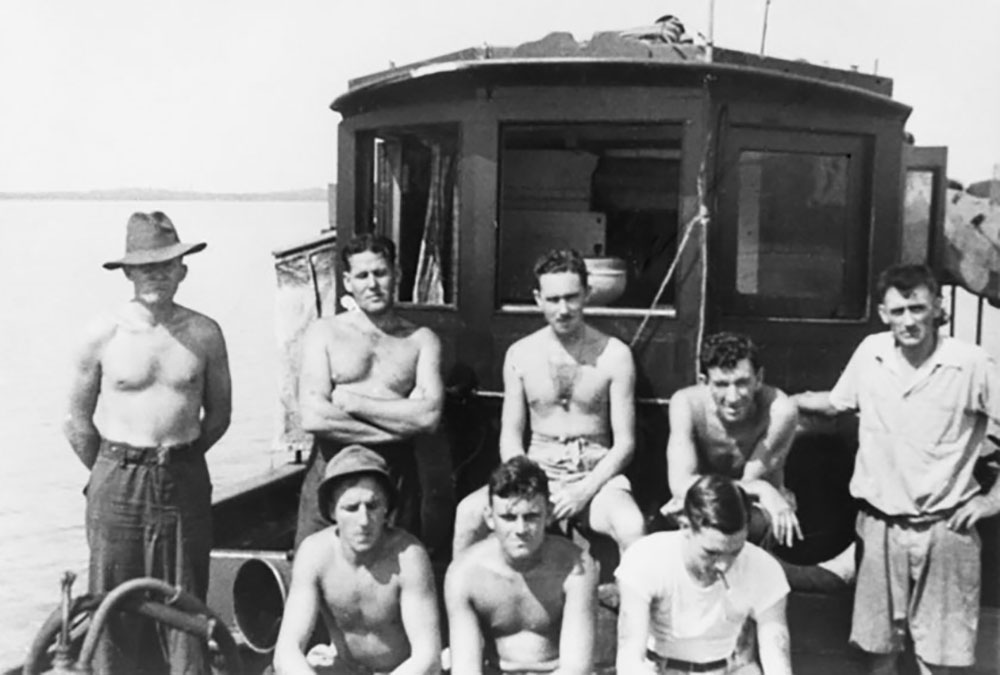
    A group on board MV Krait enroute to Singapore during Operation Jaywick. Courtesy AWM.

       The 7500 km long passage was not without problems. The engine quit while they were off Fraser Island, and the Krait had to be towed to Townsville, where she remained until a replacement could be found and installed. More repairs had to be made before they finally reached Exmouth Gulf, further delaying the operation.

       But on 2 September 1943, the Krait left Exmouth Gulf with the Z Special Unit men on board. The plan called for the eight-man naval contingent to sail the vessel to within striking distance of Singapore Harbour. Then six Army commandos would take to three folding kayaks, paddle into the harbour, and sink as much Japanese shipping as they could by attaching magnetic “limpet” mines to their hulls below the waterline.

       Four days after leaving Exmouth, the Krait motored through the narrow Lombok Strait with a Japanese ensign flying from her mast. Once clear of the strait, they bore west through the Java Sea towards their intended target. The men had stained their skin so they resembled local fishermen and were meticulous about what rubbish they threw overboard.   

    Towards the end of September, the Krait had made it to the small island of Pulau Panjang, just 30 km away from Singapore Harbour. The six commandos then set off in their two-man kayaks and island-hopped north to a small island where they could observe the entrance to the harbour. Meanwhile, the Krait made for safer waters near Borneo but not before agreeing on a rendezvous point with the commandos for the night of 2 October.
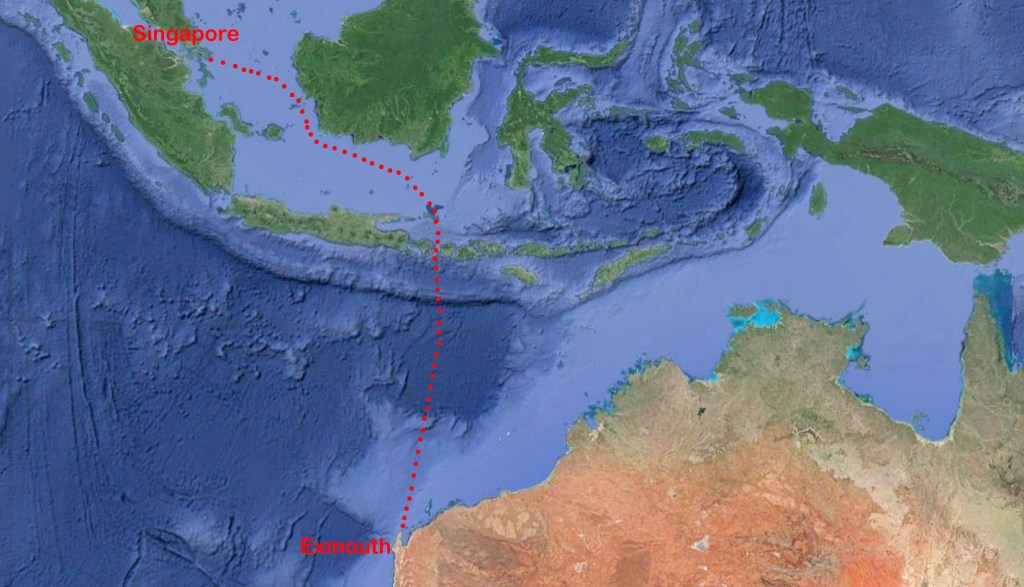
    MV Krait’s route from Exmouth Gulf to Singapore. Courtesy Google Maps.

       On 26 September, the six men paddled into the harbour and planted their mines on seven Japanese ships. Singapore’s early morning quiet was shattered by a series of loud explosions as the mines went off. One failed to detonate, but six ships were sunk or badly damaged. But by then, the commandos were long gone and were holed up on a small island to await the return of the Krait.

       The Japanese did not realise that the attack had come from the sea, thinking instead that it was the work of local saboteurs. Several local Chinese and Malays, along with some prisoners of war and European civilian internees, were suspected of the bombings. They were rounded up by the Japanese Military Police and interrogated. Most were tortured, and some were executed in the aftermath, an unfortunate and unforeseen consequence of the raid.

       Meanwhile, the commandos rendezvoused with the Krait as planned without incident. The Krait then set off for home. Two and a half weeks later, they were safely back in Exmouth Gulf. Major Lyons would lead a second similar raid on Singapore Harbour the following year, but Operation Rimau would end in disaster.
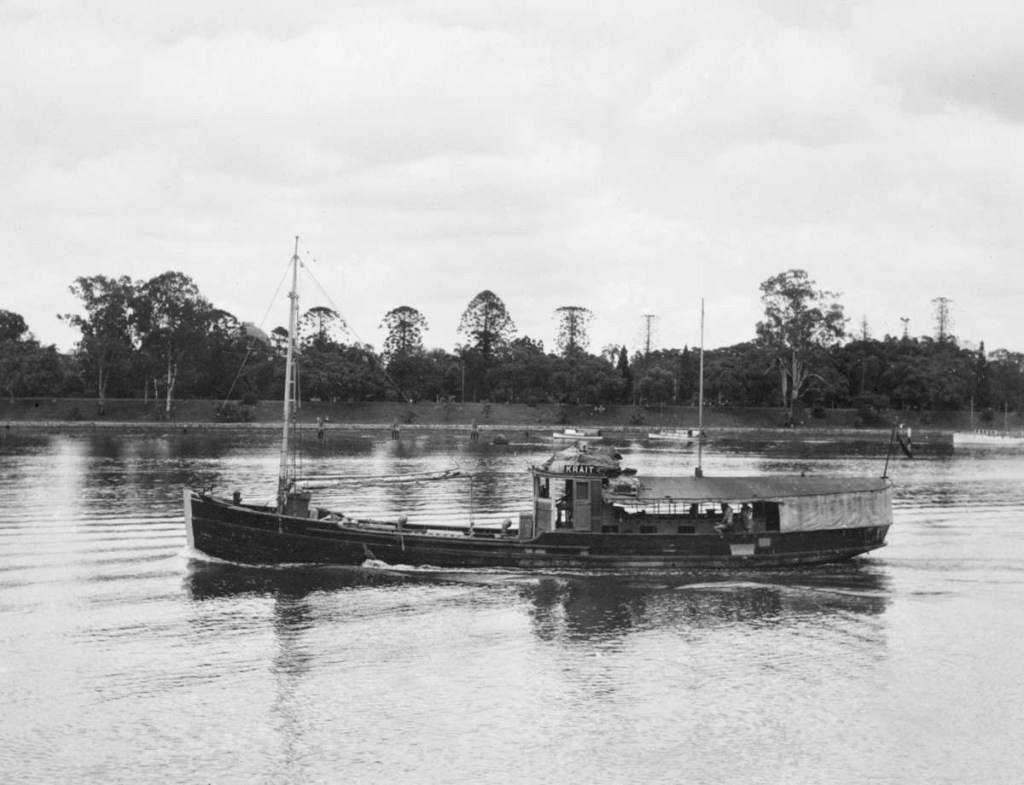
    MV Krait in Brisbane 1943. Courtesy AWM.

       Following the success of Operation Jaywick, the Krait was based in Darwin and used to support coast watchers and other intelligence operations, which reported on Japanese activities to Australia’s north. Commissioned into the Royal Australian Navy (RAN) in 1944, she was officially renamed HMAS Krait and, in September 1945, was present for the local Japanese surrender at Ambon.

       After the war, the Krait was employed by the British administration in Borneo until it was sold to a British-owned timber sawmill and renamed Pedang, meaning sword in Malay. In the late 1950s, a pair of Australian businessmen recognised the vessel’s historical significance and began fundraising to purchase her and have her returned to Australia.

       In 1964, the Krait came back to Australia, where it was operated and maintained by the Royal Volunteer Coastal Patrol. Then, in 1984, the Krait was handed over to the Australian War Memorial and berthed at the Sydney Maritime Museum. It is now on display at the Australian National Maritime Museum in Sydney.
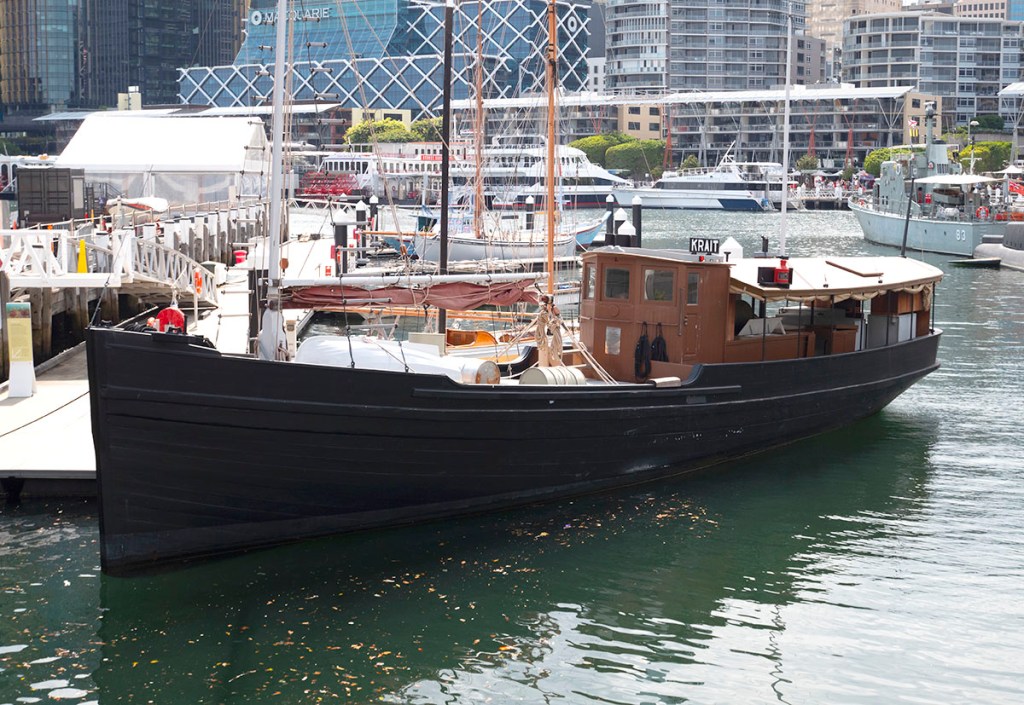
    MV Krait at the Australian National Maritime Museum, Sydney. Photo CJ Ison.

    Sources: 

    Australian National Maritime Museum: Articles on the Krait and Operation Jaywick.

    Royal Australian Navy: Article on the Krait and Operation Jaywick.

    Australian War Memorial: Article on Operation Jaywick.

    © Copyright C.J. Ison / Tales from the Quarterdeck, 2023.

    To be notified of future blogs, please enter your email address below.
  • Von Mucke’s Great Escape

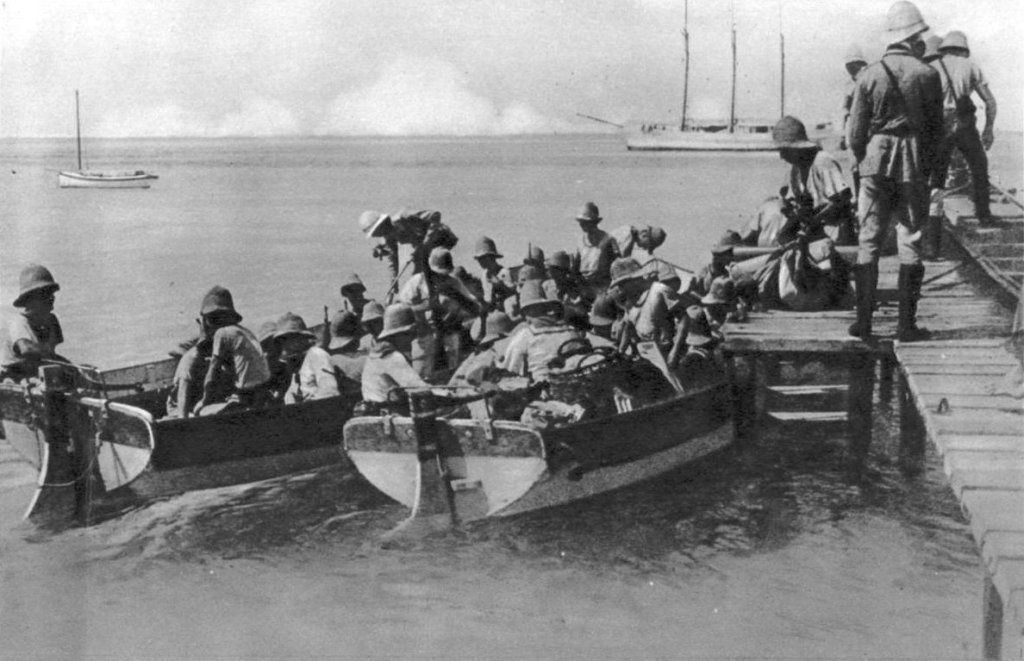
    The Emden shore party at Cocos Island with the Ayesha moored in the distance. Photo courtesy Australian War Memorial.

    Before the German Cruiser Emden was engaged by HMAS Sydney, a fifty-strong party was sent ashore at Cocos Island to destroy the telegraph station linking Australia to South Africa.   As the two ships exchanged shells in a battle that lasted ten hours, the shore party could do little but watch on and hope for the best.  

    On 9 November 1914 Lt von Mucke had been ordered to lead a party ashore to disable the cable station on Cocos Island.   But shortly after the Germans had disabled the station and rounded up the telegraph operators, the Emden signalled for them to return to the ship.   Then von Mucke saw the Emden raise its battle flag and fire a salvo at a target then hidden from his sight.  

    The Emden then steamed off leaving the shore party stranded on the island.   They had no chance of catching up to the fast-moving cruiser then fighting for its life.    As the Emden continued to engage HMAS Sydney, von Mucke immediately declared Martial Law over the island and deployed his four machine guns and 30 or so sailors to defend against any landing.

    Lt. Hellmuth von Mucke. Photo by Oscar Brockhus, Novitas Verlag Berlin.

    At one time German sailors and Australian telegraph operators stood together watching the naval battle play out in front of them.   But eventually, the two ships disappeared over the horizon, the Emden clearly the worse for the ongoing encounter.  

    Von Mucke held out little hope that his ship would return for them victorious.   The mortally damaged Emden was deliberately run aground the next day and the survivors surrendered to HMAS Sydney.   Von Mucke also realised that he and his men would eventually have no choice but to surrender should they remain on the island.   He decided to leave while they still could, seizing the schooner Ayesha.

    The three-masted schooner was the property of John Clunies-Ross, who also happened to own the Cocos Islands themselves.   His Great Grandfather had claimed the uninhabited islands in the 1820s and began a coconut plantation using workers brought from Malaya.

    Von Mucke requisitioned provisions to last his men 8 weeks at sea and had them loaded onboard.    The departure had an oddly festive quality to it.   Residents asked for autographs from the Germans, and also had them pose for photographs.   Then, as the sun set in the west, von Mucke bid the residents “auf wiedersehen” and sailed out of the harbour to three resounding cheers.

    Schooner Ayesha.

    Before leaving he hinted they were bound for East Africa to throw any pursuers off his scent.   However, his real intention was to head north to the Dutch port of Padang on the island of Sumatra.    Von Mucke and his men arrived at Padang on 26 November after 17 days sailing.   There, he hoped to get help from any German ships in port while he planned the next leg of his return to Germany.    While the Dutch were neutral during the First World War, that meant they would neither hinder nor aid any of the combatants.   “The master of the port declined to let us have, not only charts, but also clothing and toothbrushes,” as he rigorously enforced the port’s neutrality, von Mucke later lamented.    The Dutch authorities asked von Mucke and his men to surrender themselves to internment but the German officer declined and 24 hours later they left the harbour.   

    For two weeks they remained close to the Sumatran coast hoping to cross paths with a German ship while avoiding Allied naval vessels patrolling those waters.       Their luck held out and on 16 December the German merchant ship Choising, which had been undergoing repairs at Padang, came into sight.   

    Map showing von Mucke’s escape route. Source: The Story of the Great War, Vol 3.

    Von Mucke and his men transferred onto the ship and with heavy hearts, they scuttled the schooner which had been their home for the past six weeks.     The Choising to the port of Al Hudaydah in the Red Sea.   From there the men made their way to Damascus and then on to Constantinople in Turkey.   Von Mucke finally reported to the German Embassy there on 9 May 1915.    For his efforts, he was awarded an Iron Cross.

    Source: The Story of the Great War, Vol III, Chapter 31, “Story of the Emden.”

    © Copyright C.J. Ison / Tales from the Quarterdeck, 2022.

    To be notified of future blogs, please enter your email address below.

  • HMCS Protector 1884 – 1924

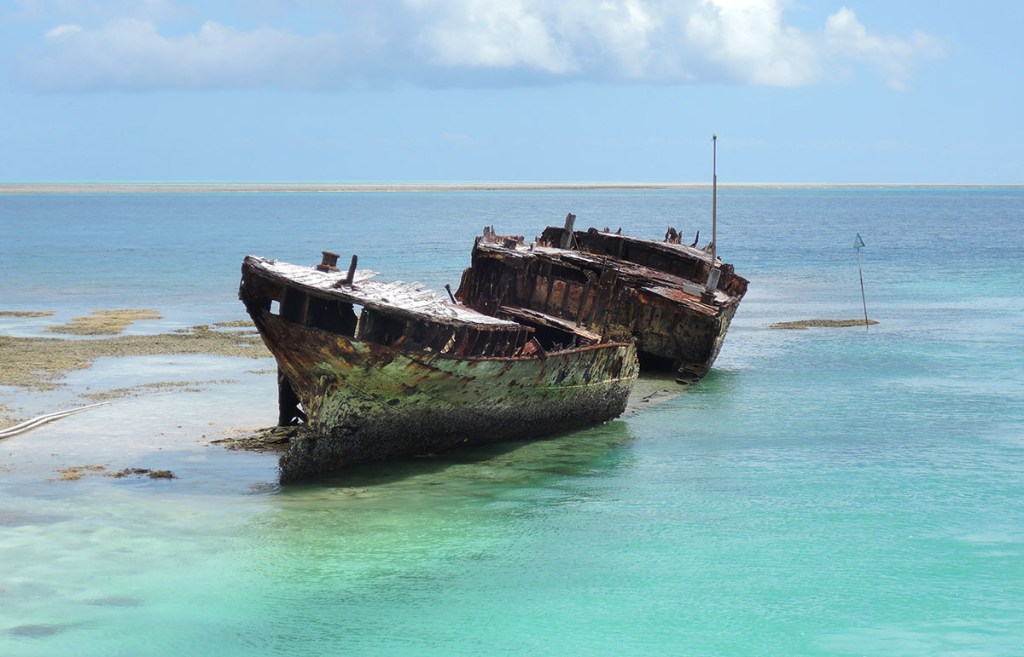
    HMCS Protector at Heron Island during low tide. Photo: C.J. Ison.

    There lie the remains of an old ship on the Southern Great Barrier Reef which holds a fascinating story spanning almost 140 years.    The rusting hull now serves as a breakwater protecting the entrance to the boating channel accessing Heron Island, but its history goes back to 1884.

    Her Majesties Colonial Ship (HMCS) Protector was launched at Newcastle on Tyne in 1884 to see service in South Australian waters.    The colonial government had sought the ship at a time when there were heightened fears of a Russian invasion.    The 55metre long F1 flat-iron gunboat displaced 920 tons and had a top speed of 14 knots (26km/h).   Originally she was crewed by about 90 men.   

    South Australian gunboat Protector circa 1885. Photo Courtesy SLV.

    Her armaments included one 8-in breech-loading gun on the bow, as well as five 6-in guns, four 3-pounder quick-firing (QF) guns and five Gatling machine guns.   From 1914 that was changed to three QF 4in MkIII guns, two QF 12-pounder guns and four QF 3-pounders.  

    HMCS Protector regularly patrolled the South Australian coast for the next fifteen years and not surprisingly made an uneventful time of it.   Then, on the eve of Federation, she was called upon to join the international force assembled to suppress the “Boxer Rebellion” in China.  

    HMCS Protector. Courtesy State Library of South Australia, B18116.

    In August 1900 she farewelled Adelaide and was commissioned as HMS Protector for the duration of her overseas service.   She arrived in Shanghai in late September but was not needed for combat operations.   She spent a few weeks carrying out surveys and running despatches between Shanghai and forces in Pechili Gulf further north.  Then, in November she was released to return home to Australia.   

    In January 1901 HMCS Protector was transferred to the Commonwealth Government and stationed in Sydney where she mainly functioned as a training ship for Naval Militia Forces.    Then, with the formation of the Royal Australian Navy in 1913, she was renamed HMAS Protector and for a period served as a tender to HMAS Cerberus stationed at Williamstown in Port Phillip Bay.

    With the outbreak of the First World War, HMAS Protector was sent to Sydney and served as a depot ship to Australia’s two submarines, AE1 and AE2.   In August 1914 she and her submarines were sent to help capture the German colonies in New Guinea.   HMAS Protector remained based at Rabaul until October when she was ordered to return to Sydney. 

    HMAS Protector after being rearmed in 1914. Photo Courtesy SLV.

    Then, in October 1915 she was dispatched to report on the wreck of the German cruiser Emden which had been destroyed by HMAS Sydney at the Cocos Islands almost a year earlier.   See my blog Australia’s first “ship on ship” naval action.

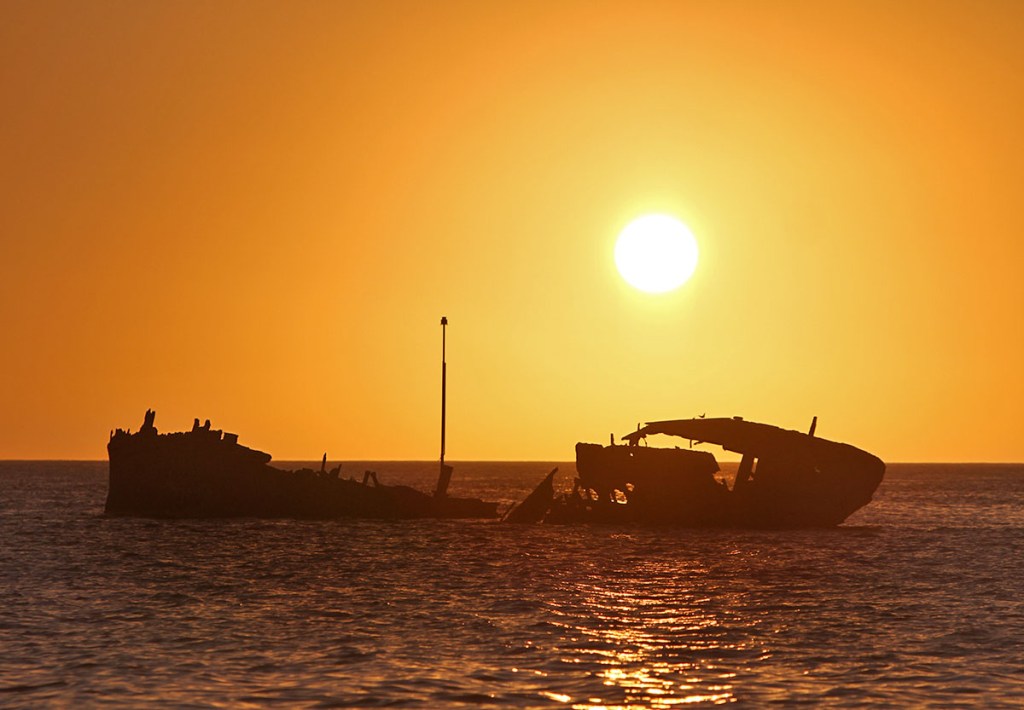
    On 1 April 1921, the Protector was briefly renamed HMAS Cerberus, before being decommissioned three years later.    Her guns and engines were removed and she was sold off.   In November 1929 she was converted to a lighter and renamed Sidney.    But her military service was not quite over yet. In July 1943 the Protector was brought back into service as a lighter for the U.S. Army in New Guinea.   However, as she was being towed north she collided with a tug off Gladstone, Queensland.  The wreck was abandoned on a beach until a local businessman bought it reputedly for £10.   He floated it off and towed it to Heron Island where it was used as a breakwater.   HMAS Protector’s rusting hull is still there today.

    HMCS Protector at Heron Island. Photo: C.J. Ison.

    © Copyright C.J. Ison / Tales from the Quarterdeck, 2022.

    To be notified of future blogs, please enter your email address below.