Tag: Mignonette

  • Tales from the Quarterdeck

    Sixty bite-sized stories from Australia’s maritime past

    The melancholy loss of H.M.S Sirius off Norfolk Island by George. Raper. Source National Library of Australia 136507434-1

    I have just launched a new book titled Tales from the Quarterdeck: Sixty bite-sized stories from Australia’s maritime past. Sixty of the most popular posts have been reedited. In some cases, I’ve rewritten a couple and updated a few where new information has come to light since first writing them.

    For those who would value ready access to the stories in their bookcase, Tales from the Quarterdeck is available in Kindle ebook and paperback formats through Amazon.

    The stories are organised in chronological order, starting with the Tryall shipwreck off the Western Australian coast in 1622, and finishing with the Second World War exploits of the Krait. See below for a full list of the stories covered in the book.
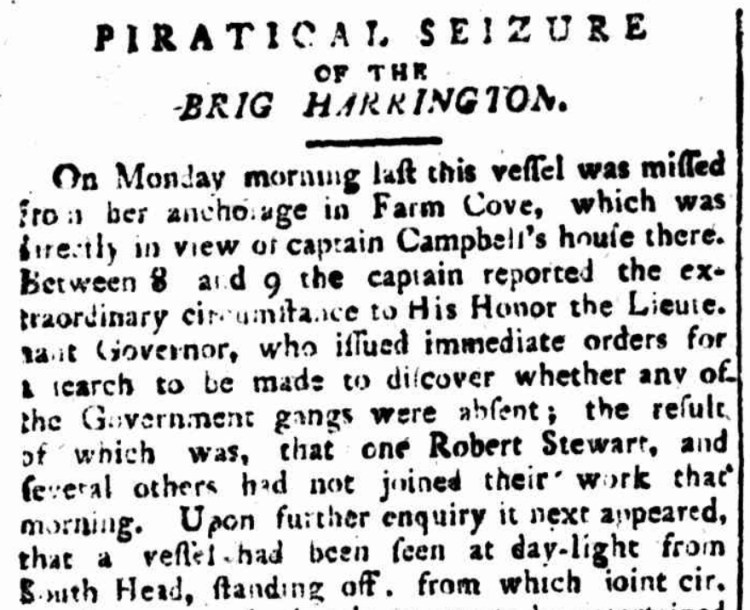
    Sydney Gazette 22 May 1808, p. 2.

    1622 – The Tryall: Australia’s earliest shipwreck

    1629 – The Batavia Tragedy

    1688 – William Dampier: Navigator, naturalist, writer, pirate

    1770  – The Endeavour’s Crappy Repair

    1788 – Loss of La Astrolabe and La Boussole, a 40-Year Mystery                        

    1789 – Bligh’s Epic Voyage to Timor

    1789 – HMS Guardian: All Hands to the Pumps

    1790 – The Loss of HMS Sirius

    1790 – Sydney’s First Desperate Escape

    1791 – HMS Pandora: Queensland’s earliest recorded Shipwreck

    1791 – William Bryant’s Great Escape

    1797 – The Loss of the Sydney Cove

    1803 – Loss of HMS Porpoise

    1808 – Robert Stewart and the Seizure of the Harrington

    1814 – Wreck of the Morning Star

    1816 – The Life and Loss of HMSC Mermaid

    1824 – The Brig Amity’s Amazing Career

    1829 – The Cyprus mutiny 

    1831 – The Caledonia’s perilous last voyage

    1833 – The Badger’s Textbook Escape

    1835 – The Loss of the Convict Ship Neva

    1835 – The Post Office in the middle of nowhere

    1835 – The Tragic Loss of George III

    1845 – The Cataraqui: Australia’s worst shipwreck

    1846 – The Peruvian’s Lone Survivor

    1847 – The Foundering of the Sovereign

    1850 – The Loss of the Enchantress: A first-hand account

    1851 – The Countess of Minto’s brush with Disaster

    1852 – The Bourneuf’s Tragic Last Voyage

    1852 – The Nelson Gold Heist

    Woodbury, Walter B. (Walter Bentley), 1834-1885. Hamlet’s Ghost, Sourabaya [Surabaya], Java [Boat with Passengers and Crew], ca. 1865. Walter B. Woodbury Photograph Collection (PH 003). Special Collections and University Archives, University of Massachusetts Amherst Libraries

    1854 – Bato to the Rescue 

    1854 – HMS Torch and the rescue of the Ningpo

    1856 – The Loss of the Duroc and the Rise of La Deliverance

    1858 – The Loss of the Saint Paul and its Horrific Aftermath

    1858 – Narcisse Pelletier, An Extraordinary Tale of Survival

    1859 – The Indian Queen’s Icy Encounter

    1859 – The Sapphire and Marina

    1863 – The loss of the Grafton: Marooned for twenty months

    1864 – The Invercauld shipwreck

    1865 – The CSS Shenandoah: Victoria’s link to the American Civil War

    1866 – The Loss of the SS Cawarra: Bad luck or an avoidable tragedy?

    1868 – The Bogus Count and Hamlet’s Ghost

    1871 – The Mystery of the Peri

    1872 – The Loss of the Maria, A Cautionary Tale

    1875 – The Tragedy behind the Gothenburg Medals

    1876 – The Catalpa rescue

    1876 – The Banshee’s Terrible Loss

    1878 – The Loch Ard Tragedy

    1884 – The Macabre case of the Mignonette

    1885 – The Douro and its Piratical Captain

    1889 – The Windjammer Grace Harwar

    1891 – The Spanish Silver of Torres Strait

    1893 – The Foundering of the SS Alert

    1895 – The Norna and the Conman Commodore

    1899 – Cyclone Mahina

    1911 – The Loss of the Mandalay

    1918 – The Orete’s Robinson Crusoe-like Castaway

    1935 – The Life and Loss of  the SS Maheno

    1943 – Surviving the Centaur Sinking

    1943 – The Amazing Krait

  • The Macabre case of the Mignonette

    Illustration of the yacht Mignonette.

       Genuine verifiable instances of cannibalism among shipwreck survivors are remarkably rare. But when they have occurred, those involved have often been met with revulsion and sympathy in equal measure. Such was the case with the survivors of the small yacht Mignonette, which foundered in the Atlantic Ocean on its way to Australia in 1884.

       The Mignonette was a small yacht of about 33 tons. It had been purchased in England by Sydney barrister and Commodore of the Sydney Yacht Club, John Want. He hired a respected master mariner named Thomas Dudley and a crew of three to sail the vessel to Australia while he returned home by a regular steamer service in more salubrious surroundings.

       The Mignonette sailed from Southampton on 19 May 1884 and briefly stopped at Madeira off the Moroccan coast around the middle of June. Then, nothing further was heard of her until 6 September, when Dudley and two of his crew returned to England after being rescued at sea by the German barque Montezuma.    The world then learned the horrifying truth of their ordeal. Six weeks after leaving England, they were far from land, some 3000 kilometres south of the equator and 2500 kilometres off the Namibian coast. By now, the weather had turned foul. The seas ran high, and Captain Dudley was running before a strong wind, taking them further south. On the afternoon of 5 July, the Mignonette was struck by a gigantic rogue wave that had risen from nowhere and crashed into her side. The yacht’s hull was stoved in.

    As the Mignonette went down, The Illustrated London News, 20 Sept 1884, p. 268.

       The mate, Edwin Stevens, was at the wheel and barely had time to call out a warning before the monster wave struck. Fortunately, Dudley grabbed hold of the boom and held on as a wall of water swept across the deck.

       The Mignonette immediately started filling with water. Dudley ordered the men to prepare to abandon ship. They got the lifeboat over the side while he went below to gather provisions. By then, seawater was already swirling around the cabin interior. He only had time to grab a couple of tins of what he thought was preserved meat, before he raced back on deck and leapt into the dinghy as the Mignonette sank below the waves.

       Dudley, Stevens, Edward Brooks, and seventeen-year-old Richard Parker spent a frightening night in the tiny four-metre dinghy as the storm raged around them. When Dudley opened the tinned provisions, he discovered they contained not meat but preserved turnips. Even worse, they had no fresh water.   

    For the next five days, they subsisted on morsels of turnip and tiny quantities of rainwater, but it was never enough. Then their luck improved, at least for a short while. They captured and killed a turtle that had been basking on the sea’s surface.

    “Sailing Before the Wind.” The Illustrated London News, 29 Sept 1884.

       By day 19, the last of the turnips and the turtle meat had long gone, and the young cabin boy, Parker, had started drinking seawater to quench his burning thirst. He was now lying in the bottom of the boat in a delirious state.

      Wracked with hunger and despair, that night, Thomas Dudley suggested drawing lots to see who should be killed to provide sustenance so the rest might live. Brooks wanted no part of it and told the others he believed they should all live or die together.

       Dudley and Stevens discussed their options and felt that, as they were both married men with families to support, it should be Parker they butchered, as he was already close to death. The matter was settled.

       Dudley prayed for forgiveness for what they were about to do, then, as Stephens held Parker down, Dudley pulled out his knife and slit the boy’s throat. Brooks turned away, covering his eyes with his hands, but he could not block out Parker’s feeble pleas for mercy.    As Parker’s blood drained from his body, they caught it in an empty turnip tin and drank it. Brooks, despite his horror, was unable to resist taking a share. The three men fed on Parker until they were rescued by the passing barque Montezuma, five days later.

    Newspaper illustration showing the “terrible tale of the sea. and the horrible sufferings,” of the shipwrecked sailors.

       When Captain Dudley returned to England, he reported the loss of his vessel and the hardships they had endured afterwards, including the death of the delirious Parker. As abhorrent as his actions were, he believed he had committed no crime. In his mind, he had sacrificed one life to save three. But the police saw it otherwise. He and Stephens were remanded in custody to stand trial for the capital crime of murder.

       There was widespread interest in the tragic story in both Britain and Australia. Many people were sympathetic towards the captain and his first mate. But there were also those who felt the pair had acted prematurely in killing the dying Parker.

       At their trial, Dudley and Stephens pleaded not guilty, their barrister arguing they had acted in self-defence. He used the analogy that if two shipwrecked men were on a plank that would only support one, one or the other could be excused for pushing away the other man to drown. For, he argued, were both men to remain on the plank, both would perish.

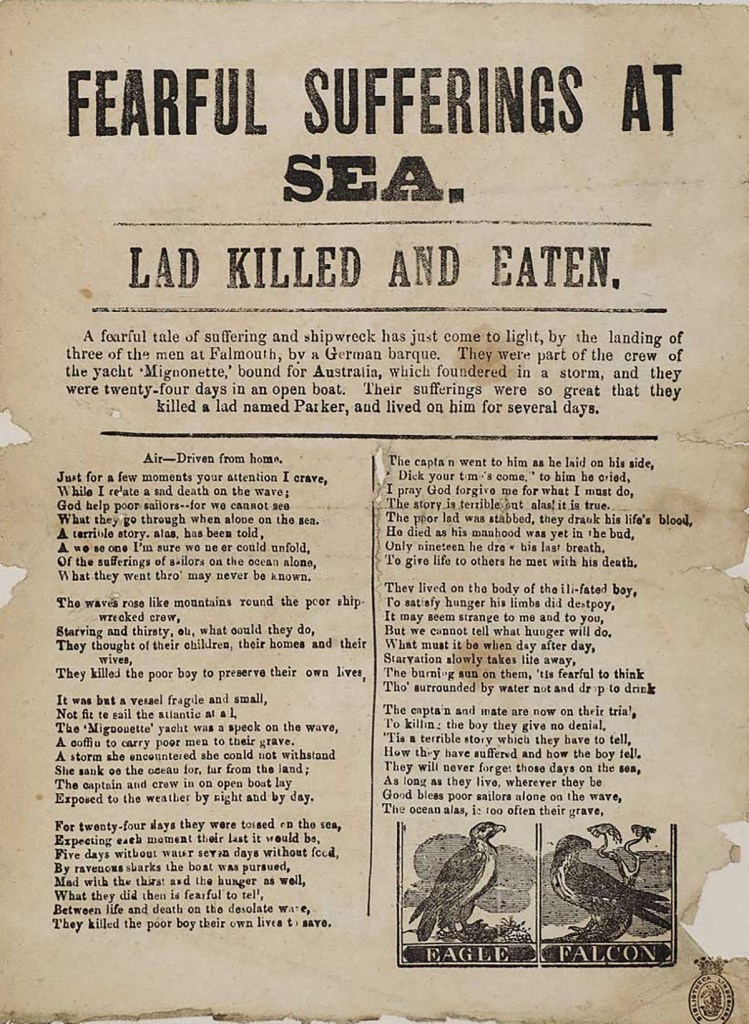
    FEARFUL SUFFERINGS AT SEA. LAD KILLED AND EATEN. Courtesy State Library of Scotland.

         The judge didn’t see things that way. In summing up the case, he told the jury:

       “It was impossible to say that the act of Dudley and Stephens was an act of self-defence. Parker at the bottom of the boat was not endangering their lives by any act of his. The boat could hold them all, and the motive for killing him was not for the purpose of lightening the boat, but for the purpose of eating him, which they could do when dead, but not while living. What really imperilled their lives was not the presence of Parker, but the absence of food and drink.”

       The jury found the pair guilty, and the judge sentenced them to death, but it appears there was little likelihood that the death sentence would ever be carried out. Even Parker’s family had forgiven the two men on trial. After waiting on death row for six months, both sentences were commuted to time served, and they were released from custody.   

    It was generally agreed that they had acted as they did under the extreme duress of being lost at sea for so long without food or water. No one felt that justice would be served by punishing the two men any more than they had already suffered.

    Copyright © C.J. Ison, Tales from the Quarterdeck, 2021.

    To be notified of future blog posts please enter your email address below.