Schooner Wanderer. Painting by Oswald Brierly From the collections of the State Library of New South Wales, a128927.
Far out in the middle of the Pacific Ocean, a seaman on board a small schooner thought his imagination was getting the better of him. It was daybreak on 5 February 1850. His ship, the 140-ton schooner Wanderer was en route from Sydney to San Francisco and still under storm canvas having just survived a powerful storm.
They had sailed from Sydney three months earlier and were slowly island-hopping across the Pacific. The ship’s owner, Scottish entrepreneur Benjamin Boyd, was in no great hurry. He was still licking his wounds after the spectacular failure of his grandiose enterprises centred around Boydtown at Twofold Bay (near present-day Eden on the NSW south coast). He now hoped to turn his luck around on the booming California goldfields.
Most recently the Wanderer had departed Papeete in the Society Islands (French Polynesia) bound for Hawaii. It was on this leg of their voyage that they weathered the cyclonic conditions and performed a miraculous rescue.
Benjamin Boyd portrait. Source: Australian Town and Country Journal 29 Aug 1906 Page 28.
The sailor reported that he thought he had glimpsed something bobbing in the mountainous seas even though they were hundreds of miles from land. A man was sent aloft with a telescope and after a few minutes he called down that there was a whaleboat in distress several miles to windward. The Wanderer bore down on the stricken craft and discovered it contained six occupants.
The seas were still running high and it was not until their third attempt that a line was got across to the boat. The only words the men on the Wanderer could discern were plaintive cries for water. Then all six passengers, three men, and three women were hauled across and safely got aboard the schooner, very lucky to be alive.
It turned out the whaleboat belonged to Jose Davis, “a Brazilian man-of-colour”1 who had since resided in Hawaii for the past 17 years. With his wife and four others, (all South Pacific Islanders) he had set off from Oahu nine days earlier intending to reach Maui. They were only about 50kms from home when disaster struck.
The whaleboat was caught in a severe storm that raged for days. The sail was ripped to shreds and they lost their rudder during the tempest which made the whaleboat uncontrollable. What’s more, the planking had sprung so they were also taking on water. The boat drifted at the mercy of the wind and waves for nine days and it was ultimately pushed some 600kms south. They had no drinking water and the only food Davis and his comrades had was a few pumpkins.
Map of the Pacific Ocean showing where the whaleboat was found.
But Jose was not one to give up hope. Once the weather abated, he planned to use the women’s dresses to make a new sail and then bear east towards the South American coast using the sun and stars to guide him.
With the new passengers on board and being cared for, the Wanderer continued north to Hawaii. The whaleboat sank shortly after it was abandoned. In time Jose and the others were landed at Maui to be reunited with their astonished and grateful families and friends who had since given them up for dead.
The Wanderer continued on to San Francisco, but Boyd failed to strike it rich on the goldfields and decided to return to Australia. On the homeward voyage, they stopped at Guadalcanal where he vanished while out hunting. His body was never found.
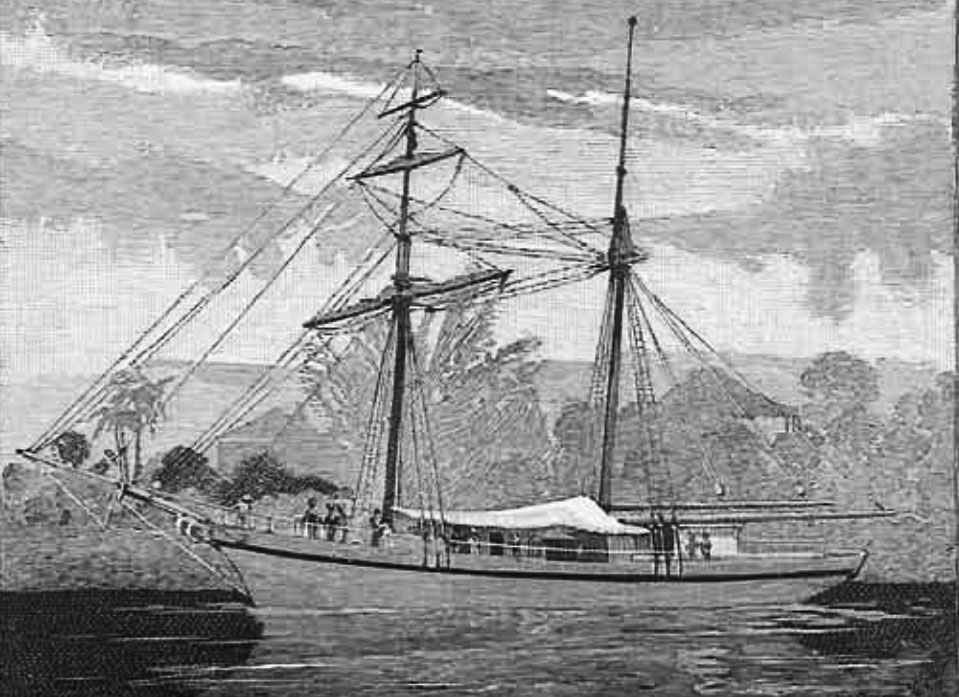
A typical trading schooner in the South Seas. Source: Picturesque atlas of Australasia, 1886.
In the 19th Century, the ship’s captain often considered himself the undisputed master of his vessel, especially when they were at sea. Most, to varying degrees, kept a rein on their power, while others ruled with an iron fist. Then there were those tyrannical few, like Neil Peter Sorensen, who went completely rogue. And, out among the South Pacific islands where the Royal Navy only sporadically patrolled, there were few restraints on those bent on causing trouble.
In August 1885, a portion of the crew from the schooner Douro put ashore in Cooktown with a harrowing tale of kidnapping and piracy. The culprit, they said, was their own former captain. The Douro’s first mate, Otto Ashe, and two other seamen told authorities that Captain Sorensen was out of control and terrorising communities in the Solomon Islands. They had grown so concerned with Sorensen’s behaviour that they preferred to risk being charged with deserting their ship than to be implicated in their captain’s depredations.
As he and the others had only joined the Douro in Sydney four months earlier, they had no idea what they were signing on for. Until recently, the Douro had been registered as a British vessel named the Albert, and as such, had been subject to British laws. The ship’s owner registered her as a Portuguese-flagged ship at that country’s Sydney Consulate. They claimed they had done so to save their ship from being seized in the event of war breaking out between Britain and Russia, a genuine concern at the time. In reality, the change in registration and name had more to do with placing the ship and its captain outside the bounds of the British legal system. Sorensen was installed as the Douro’s new captain. He was formerly the Albert’s first mate and was no stranger to the South Pacific or operating outside the law. But this would be his first taste of command.
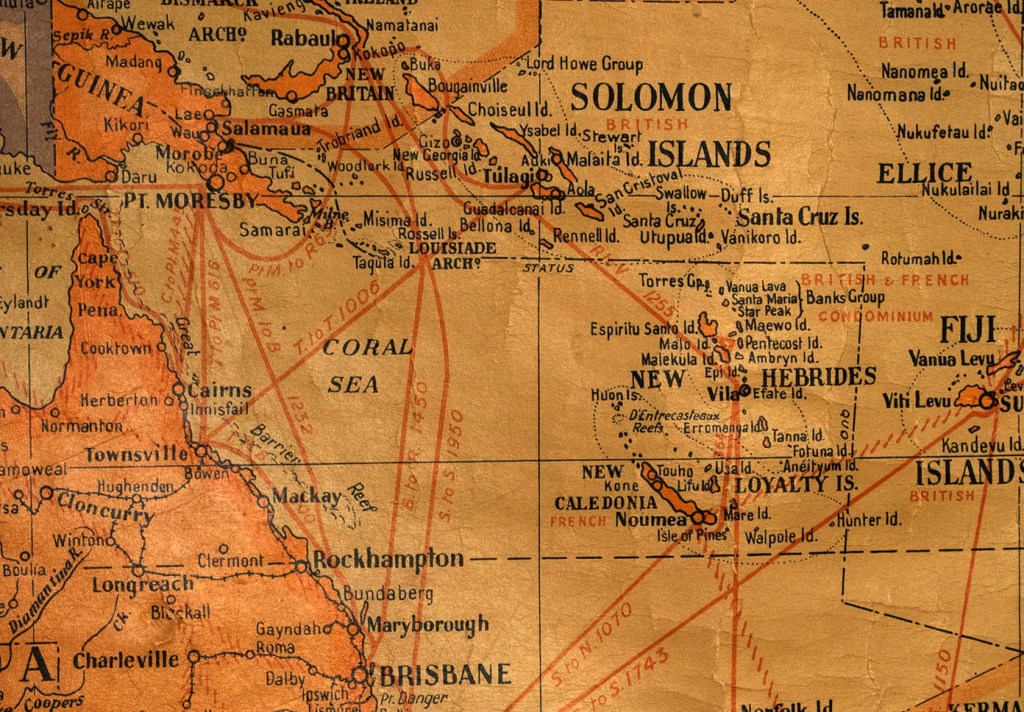
Map showing Australia and the Solomon Islands.
The Douro sailed from Sydney in late April, on a fishing venture around the Solomon Islands. Pearl shell and beche-de-mere both commanded high prices in Sydney, but Sorensen needed to hire local divers. Sorensen landed at a village on San Cristobal Island for recruits, but the village chiefs remembered him from a previous visit. Sorensen had promised to return the men at the end of his last fishing trip, but he never did. Now, no one trusted him.
Sorensen was forced to go further afield to find his much-needed divers and fishermen. The Douro stopped at a couple of other islands and was able to recruit men on the promise that they would be gone from their villages for only four or five months. This was a lie, for Sorensen expected to be away for at least a year and probably longer.
As time passed, the situation on the Douro became intolerable for the crew. Otto Ashe claimed that Sorensen relentlessly bullied and threatened his men. While anchored off Guadalcanal, he beat the schooner’s cook senseless over some perceived infraction of his rules. None of the crew was prepared to stand up to him, for Sorensen was always heavily armed. But as bad as the treatment of his white crew was, it was nothing compared to how he treated most of the Solomon Islanders.
Newspaper coverage at the time.
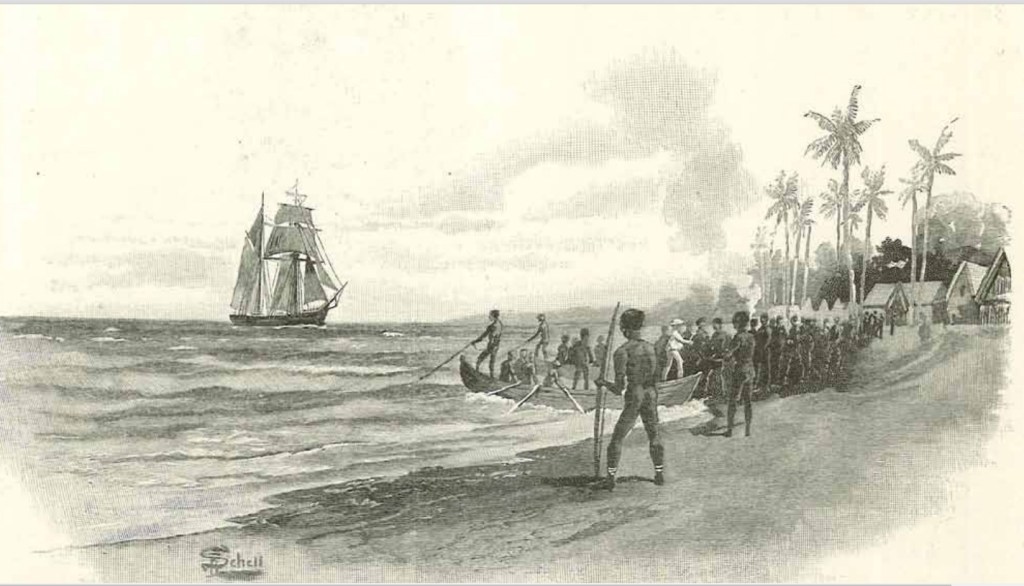
At Isobel Island, he had two chiefs forcibly brought out to the schooner and only released them in exchange for six recruits. Off Wagina Island, the Douro came across a chief and several of his men out fishing in their canoes. He welcomed them aboard and then invited the chief to dinner in his cabin. Sorensen clapped the chief in irons and kept him hostage. He then went back on deck armed with a rifle and ordered the rest of the Islanders to leave. Sorensen only released the village chief after his people had handed over 4000 beche-de-mer, 24 sea turtles, a pig and three “boys,” whom he would exploit as unpaid labour.
On one of the Carteret Islands, he took his plundering to a new level. Sorensen kidnapped four girls and brought them back to the schooner for the men’s entertainment. He then went ashore, armed to the teeth, at the head of a band of Solomon Islanders who had no qualms about following his orders. Sorensen forced the local chief to sign over possession of the island to him. Sorensen and his men then went from hut to hut, gathering up all the weapons. The haul included an assortment of traditional spears, clubs, and tomahawks, as well as an old Snider rifle and two shotguns. After everyone had been disarmed, he forced the menfolk to collect pearl shell and beche-de-mer on his behalf.
A typical South Sea Islands trading schooner circa 1885.
By now, the first mate had seen enough and wanted no part of it. Fearing that Sorensen would continue his reign of terror through the islands, he took the first opportunity to escape. On 23 June, he took off in the schooner’s longboat with two other white seamen and seven Solomon Islanders. They landed in New Britain and reported Sorensen’s crimes to the German Consul there. They then set off in the boat for Australia, eventually landing at Cooktown, where they told the Queensland authorities the same story.
When the Douro finally sailed into Brisbane in March the following year, the police were waiting. The schooner was seized, and Sorensen was charged with assault and robbery and placed under arrest. He was also charged with sodomy, but that was later dropped because the principal witness was “now in a lunatic asylum,” as the Brisbane Courier reported it at the time. Sorensen denied all the allegations, but a jury found him guilty, and he was sent to prison for ten years. While this episode was particularly heinous, it is a sad indictment that the conviction and hefty sentence were unusual for the times.
HMAS Sydney (I). Photo Courtesy Australian War Memorial.
In late 1914 HMAS Sydney was accompanying the first convoy of AIF troops leaving Australia to fight in the First World War. However, a few days after the convoy left Albany WA, the Sydney was ordered to investigate the presence of a suspicious vessel near the Cocos Islands. The ship turned out to be the German Cruiser Emden which had been terrorising Allied shipping across the Indian Ocean since the beginning of the war.
On 9 November 1914 the Sydney found the Emden and immediately went into action. A few days later Stoker Henry Nielsen wrote a letter to his mother living in Rockhampton, Queensland, telling her of their great victory. The account below has been taken from his letter which appeared in the Morning Bulletin newspaper on 6 January the following year.
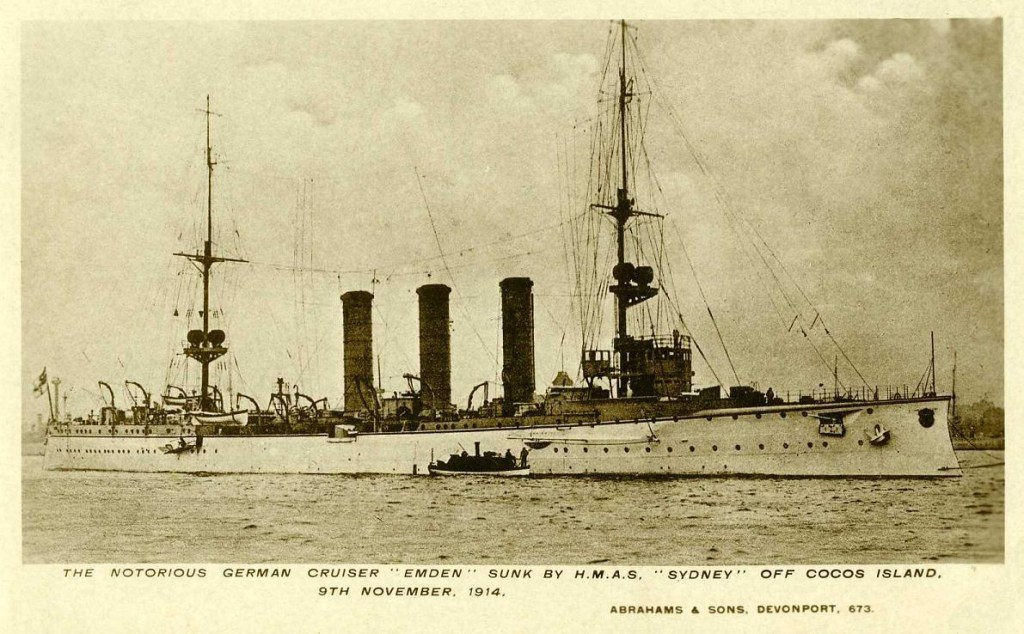
Emden before she was destroyed by HMAS Sydney at Cocos Keeling Islands in Nov 1914.
“Just a line to let you know I am still alive and kicking in spite of the Emden. I have nothing to write about except our scrap with the Emden. We got a wireless message from Cocos Islands about seven o’clock on the 9th instant saying that there was a German warship lying there with a collier. We were about fifty or sixty miles away from there, and we altered course and made for Cocos at full speed.”
“We came up with the Emden about 9.30 am and she let go a shot at us at 11,000 yards. We let go a ranging shot immediately after, and then both ships went at it hammer and tongs. … Our shots told far more than theirs as we were only slightly damaged and our shots carried away her bridge, foremast, and three funnels in quick succession. Early in the fight the Emden caught fire and continued to burn throughout.”
“One of their shots wrecked our range-finder and killed the men who were working it.”
Emden at Cocos Keeling Islands viewed from a HMAS Sydney boat dated 9 Nov 1914. Courtesy State Library of NSW, FL541160.
“The action lasted an hour and thirty-six minutes. The Emden got an awful doing and the captain beached her on South Keeling Island. She continued to fire for a short time after she was aground, but we soon silenced her. …”
“She was still flying the German flag, and when signalled would not reply so we put another broadside into her and she fired another couple of shots. However, they did not want any more as they pulled the flag down. … It was late in the afternoon when the Emden hauled down her flag and we went out to sea and cruised about outside until morning. … We then went back to the Emden to see what we could do for the wounded. We were there all the remainder of that day fetching off German wounded, and prisoners. …”
“From mainmast to stern she is just a shell, there being only the deck and hull left, all the rest being burnt out. Her three funnels are lying over the top of one another. Her foremast is down and her bridge is blown away. The starboard side of her deck is full of great holes, and she is torn up everywhere. There are holes in the side that you could walk through. …”
Postcard commemorating the Sydney’s victory..
“During the action we made the best speed the Sydney ever did. We got just on thirty knots out of her. Pretty good going!. … When we had finished with the Emden’s wounded we came on to [Colombo, Sri Lanka], arriving here last Sunday.”
Stoker Nielsen survived the war and was discharged from the Navy in 1919.
Wreck of the Brig Maria with the New Guinea Expedition. Source: Australian Town and Country, 9 Mar 1872, p. 17.
If ever there was a cautionary tale warning of the perils of going to sea ill-prepared, it is that of the tragic loss of the Maria in 1872.
A Marine Board inquiry would blame the captain’s poor navigation and equally poor character for the loss of the ship and so many lives. However, the underlying causes of the disaster dated back to the ship’s purchase and a litany of poorly thought-through decisions made by a committee of young and ambitious men. They had become fixated on seeking adventure and fortune in the wilds of New Guinea and were willing to cut whatever corners necessary to see their plan come to fruition.
In late 1871, the more adventurous sons of some of Sydney’s leading families banded together to travel to New Guinea, where it was said that gold could be found in abundance. Brought up on stories of Australia’s earlier gold rushes, they wanted to leave their mark on the new frontier. They formed a committee and founded the New Guinea Gold Prospecting Association, charging newcomers £10 to go towards the expedition’s costs. Eventually, they signed up 70 men eager to try their luck.
The committee’s first task was to find a ship that would take them to New Guinea so they could prospect for gold in that largely unexplored part of the world. When no one would lease them a ship for the amount of money they could afford, they purchased an aging brig called Maria.
Expedition members onboard the Maria before sailing from Sydney. Photo Courtesy SLQ.
The Maria was over 25 years old, and her glory days were long behind her. She had been seeing out her final days hauling Newcastle coal down the coast to Sydney. Her only redeeming quality was her price. In fact, after a month of searching, she was the only ship they could afford. William Forster, one of the expedition’s survivors, later summed up the state of the vessel thus. “It would, perhaps, have been difficult to find a more unseaworthy old tub anywhere in the southern waters.”
When they were eventually ready to sail the Maria out of Sydney, the port authorities refused them clearance to sail under the Passenger Act because she was overcrowded, unseaworthy, and the passengers, all paid-up members of the prospecting association, were not adequately provided with safety equipment or provisions. Things might have turned out differently had the young men heeded the warning and remedied the shortcomings. But rather than do that, the committee signed on most of the passengers as members of the crew, so the Passenger Act no longer applied.
Alarm bells should have rung out loud and clear when, at the last moment, the captain they had hired refused to take the ship to sea. Feigning illness, it seems he had begun to doubt the wisdom of taking the overcrowded, unseaworthy old tub on a 3700 km passage through the Coral Sea during the North Australian cyclone season.
Then, rather than waste any more time recruiting another qualified master mariner, the committee accepted the first mate’s offer to captain the ship. It was put to a vote, and he was immediately elected to the post with barely a moment’s thought given to whether he was actually up to the task. Though he was officially the Maria’s captain he was more of a sailing master, unable to make decisions without first getting approval from the committee.
The Maria finally sailed out through Sydney Heads on 25 January 1872 with 75 people crammed on board. The first few days passed uneventfully, except for some emerging friction between the prospecting association’s members. They broadly fell into one of two groups: well-heeled, well-educated adventurous young gentlemen from some of the colonies’ leading families, and working-class miners and labourers hoping to make money on the new goldfields. It was probably the first time either group of men had spent time with the other, more or less as equals, and the mix proved volatile at times.
Wreck of the Maria. Image Courtesy SLQ.
Then, when they were only a few days away from reaching New Guinea, the Maria was caught in a ferocious storm. She was tossed around for five days and sustained serious damage. Water poured through gaps in the deck down into the accommodation, soaking everyone and everything. Her old sails were torn to shreds, rotted rigging snapped under the strain, and a rogue wave tore away a length of the bulwark. They lost all control of the ship for a time after a second rogue wave unshipped the tiller and destroyed the associated steering gear. After one-third of the expedition members signed a petition pleading to be put ashore, the majority voted to turn around and head for Moreton Bay to disembark those who had had enough and make repairs.
But, the badly damaged Maria struggled to make headway against the prevailing southerly trade winds. Captain Stratman decided to make for Cleveland Bay (present-day Townsville) instead. However, he would need to find his way through the Great Barrier Reef guided only by a general coastal chart with a scale of one inch to 50 nautical miles (approx. 1 cm to 40 km). Such a small scale would have provided him with little detail and no doubt less comfort that they would reach Townsville unscathed.
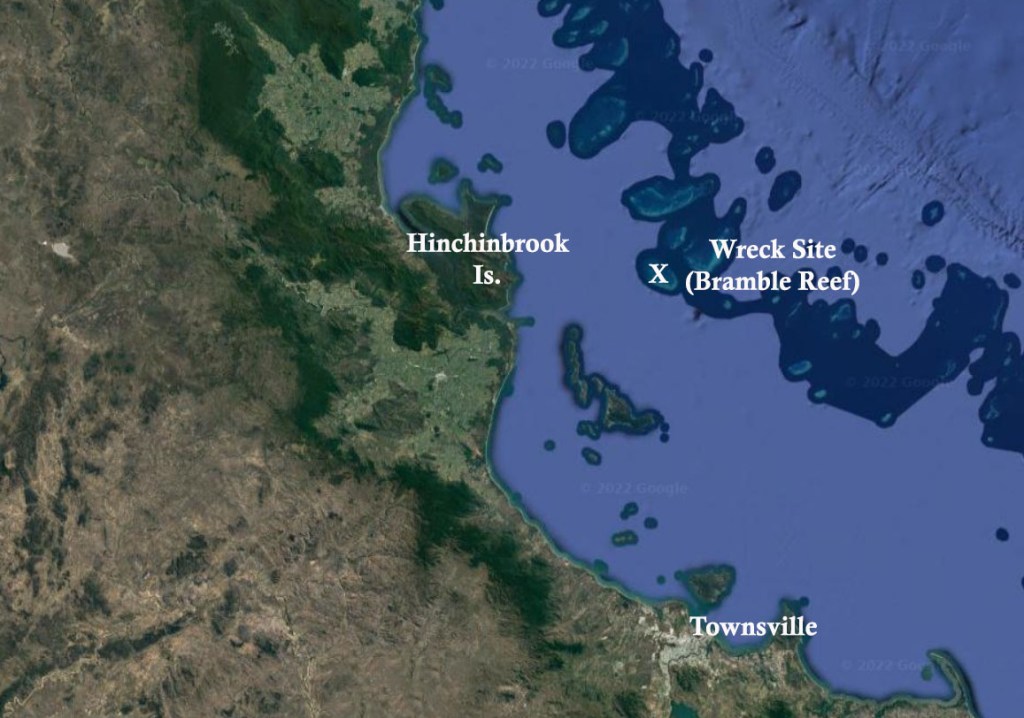
With a lookout stationed high on a mast above, watching for submerged hazards, the Maria gingerly made her way west and soon became entangled in the giant maze of coral reefs and shoals. Thinking they were approaching Magnetic Island and the safety of Cleveland Bay, the captain was unknowingly approaching the coast some 90 km further north. Then, in the early hours of 26 February, their luck finally ran out. The Maria ran onto Bramble Reef off Hinchinbrook Island and began taking on water. A few hours later, she sank to the bottom until just her masts showed above the surface of the water.
Before that happened, Captain Stratman, with a handful of others, had already abandoned the ship in one of their three boats, leaving everyone else to their fate. The class divide separating the expedition members made it almost impossible for anyone to coordinate their efforts. No one would take orders from anyone else. Some eventually made it to Cardwell in the two remaining lifeboats. About a dozen men were last seen clinging to the rigging but they had vanished before rescuers finally found the wreck.
Others had taken to two makeshift rafts, but many of them drowned, and of those who reached land, half were massacred by local Aborigines. Of the 75 people who sailed out of Sydney on the Maria, almost half, 35, lost their lives.
The full story is told in A Treacherous Coast: Ten Tales of Shipwreck and Survival from Queensland Waters available through Amazon.
A schooner of the early 1800s. Courtesy State Library of Queensland.
When Captain George Browning sailed the small schooner Caledonia from Sydney in December 1831, he intended to follow the coast north as far as the Tropic of Capricorn. There he was to collect salvage from a ship that had been wrecked in the Bunker Islands and return it to Sydney to be sold. But on the way, he was to call in at the Moreton Bay Penal Settlement to collect a whaleboat the crew had used to escape the wreck. That was where things began to go wrong for the young master mariner.
While anchored in Moreton Bay his ship was seized by a band of convicts who sent the crew ashore and ordered Browning to take them to the tiny South Pacific Island of Rotuma some 1,500 nautical miles or 3,000 kilometres away over open ocean. See my blog “The Caledonia’s perilous last voyage,” for a more detailed account.
Among the many challenges he faced, he had no charts covering the South Pacific. Yet, Browning had to find a way to deliver his unwanted passengers to their destination if he was to have any chance of saving his ship and preserving his own life. He consulted his “Epitome of Practical Navigation,” a book all master mariners kept close at hand. The regularly updated volume was considered the standard text on maritime navigation and was packed with charts and tables to help mariners navigate the world’s oceans.
Example from The American Practical Navigator, 1837. There were several such books used by master mariners.
Browning referred to a table of South Pacific Islands with their corresponding geographic coordinates. With this information, he flipped over one of his coastal charts and drew a grid labelling the key lines of longitudes and latitudes for the waters he would be sailing and marked the various known islands and features identified in the table, albeit with many reefs, shoals and other hazards left unrecorded. Notwithstanding its limitations, he could now take observations and plot his whereabouts and relate that to his destination – Rotuma – and any other islands in the course of his travels.
Using his makeshift chart, Browning navigated from Moreton Bay to New Caledonia where they stopped to collect fresh drinking water. From there he charted a course to Rotuma and when he was directed to leave that island at a moment’s notice and make for Wallis Island he did that too.
Perhaps the chart’s greatest value came as they sailed towards Wallis Island. A couple of the convicts warned Browning that their leader intended to scuttle the Caledonia and do away with its captain once they had arrived. He knew Wallis Island lay a short distance over the horizon and they would likely arrive late that afternoon.
He shaped the sails to slow the ship’s progress until nightfall. Then, during the hours of darkness, he picked up speed again and was able to slip by Wallis thereby prolonging his life a little longer. A couple of days later they pulled in at the Samoan island of Savai’i. There the Caledonia was scuttled but Browning was befriended by a local chief and escaped the convicts’ clutches. He eventually returned to Australia to tell his amazing story.
The full story is told in A Treacherous Coast: Ten Tales of Shipwreck and Survival from Queensland Waters available through Amazon.











 Tales from the Quarterdeck