Tag: #Maritime History

  • Loss of La Astrolabe and La Boussole: a 40 Year Mystery

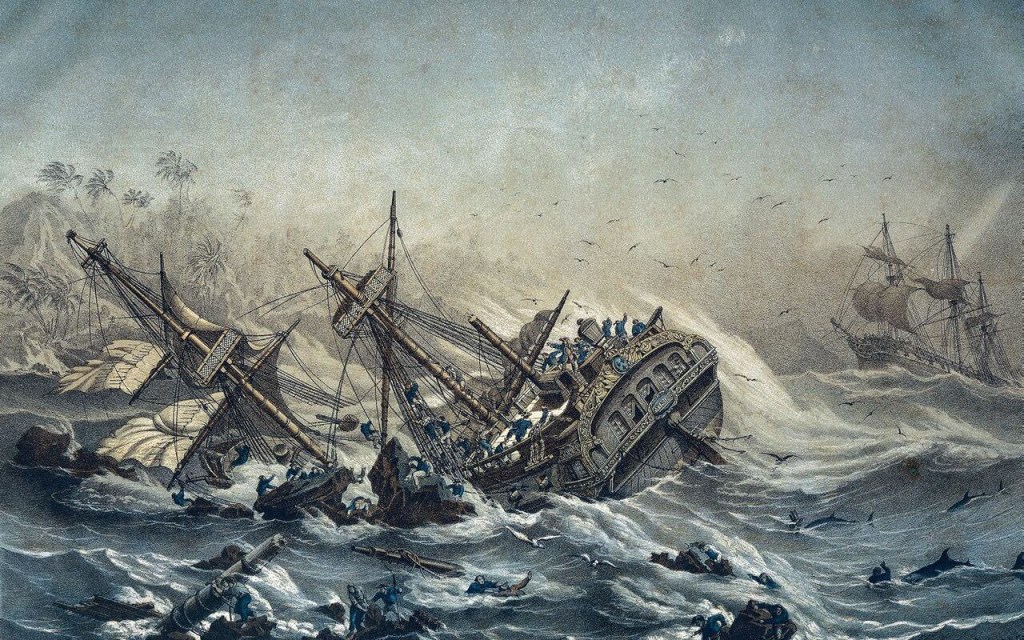
    19th Century lithograph of the sinking of La Astrolabe at Vanikoro by Louis Le Breton. Courtesy Public domain, Wikimedia commons.

    One of the great maritime mysteries of the late 18th and early 19th centuries was the disappearance of the French ships La Astrolabe and La Boussole under the command of La Perouse. They were last sighted leaving Botany Bay in 1788 but it would be another 40 years before the world discovered what became of them.   

    In 1785, Louis XVI appointed Jean-François Comte de La Perouse to lead an expedition of discovery to the far reaches of the world. The objectives were primarily scientific, but La Perouse was also to look out for economic opportunities that might benefit France. He was given two ships, La Astrolabe and La Boussole, with a total complement of some 220 men. The expedition included a botanist, geologist, physicist, astronomer, and several naturalists and illustrators – ten men of science in all. Even the ships’ two chaplains had received scientific training. Rarely had such a body of learned men been assembled for such a voyage.


    Louis XVI giving La Pérouse his instructions on 29 June 1785, by Nicolas-André Monsiau – Chateau de Versailles, Public Domain, https://commons.wikimedia.org

    The La Astrolabe and La Boussole sailed from Brest on 1 August 1785 and bore south into the Atlantic Ocean to round Cape Horn. They stopped briefly in Chile and then proceeded to the Sandwich Islands (now known as Hawaii). From there, they continued north as far as Alaska and then traced the North American coast south to a point that is now Monterey in California. La Perouse then took his two ships across the Pacific Ocean to the Portuguese colony of Macau and then headed north again. They arrived at the Russian outpost of Petropavlovsk on the Kamchatka Peninsula in September 1787 to find fresh orders awaiting them. The French Court was aware that the British had assembled a fleet of ships to sail for New South Wales. La Perouse was instructed to make directly for Botany Bay to investigate the new settlement being established there.   

    La Perouse arrived at Botany Bay on 24 January 1788, only days after the First Fleet under Governor Phillip had arrived from England. The French mariners spent six weeks there, resting and replenishing their food and water supplies. Before sailing, La Perouse left a package of letters, journals and charts with the captain of a returning British convict transport to be forwarded to Paris. In his correspondence, La Perouse wrote that he intended to sail to New Caledonia and the Santa Cruz Islands before turning back for home. They had been gone for two and a half years when they sailed from Botany Bay. He also anticipated that they would be back in France by June the following year. On 10 March 1788, the two French ships set sail and were never seen again, at least not by any Europeans.

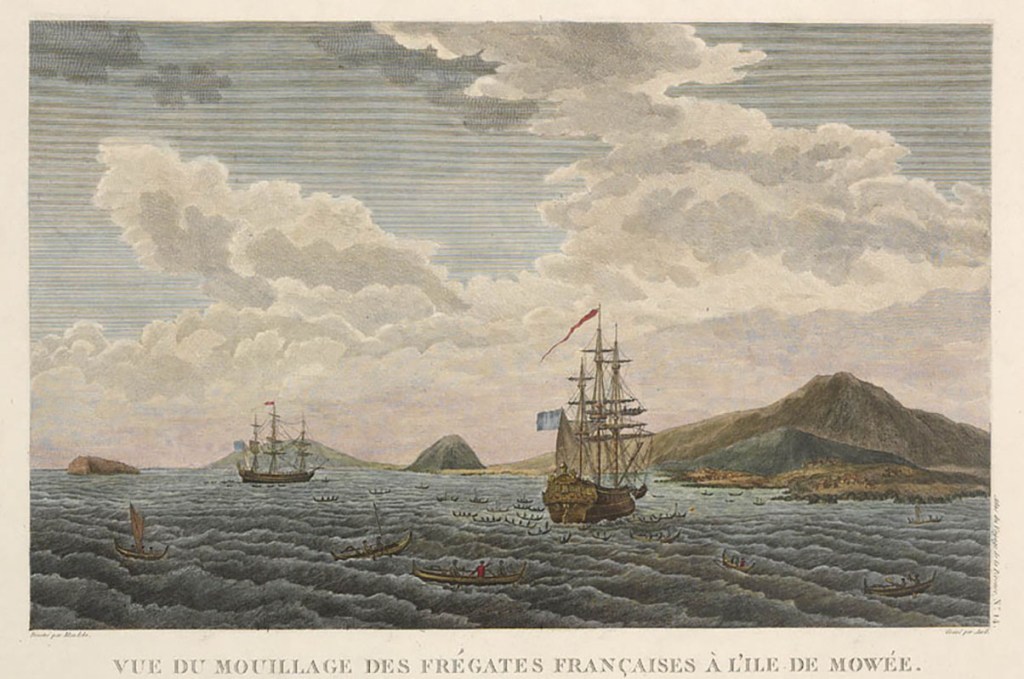
    French frigates La Astrolabe and La Boussole in Hawaii. Image courtesy State Library of NSW.

    Then, in 1826, an Irish mariner, Peter Dillon, made a startling discovery. While at Vanikoro, he came into possession of some artifacts clearly of French origin. He learned that relics from the French ships had been circulating among the inhabitants of Santa Cruz and neighbouring islands for years. On inquiring about the origin of the pieces, he was told that they had come from two large ships that had been wrecked there many years earlier.

       Dillon was sure the artifacts, one of which was a sword guard of French design, had come from La Perouse’s expedition. Upon returning to India, he reported his discoveries to the East India Company, which provided him with a ship to explore the waters around Vanikoro more closely.   

    In 1827, Dillon found the wreck site and retrieved several artefacts, including a bell which had clearly belonged to a French ship. He also learned from the older villagers on Vanikoro that the two French ships had run aground on a coral reef during a violent storm with great loss of life. The survivors had built a new vessel from timbers salvaged from the wrecks and sailed away. They had probably tried making for Kupang in the Dutch East Indies (Indonesia). That would have been the closest port where they might find help and passage back home. It would, however, require them to cross the Great Barrier Reef and pass through Torres Strait. Most of the French seamen left in the new ship, but a few men opted to remain on Vanikoro, where they lived out their days. By the time Dillon visited the island, they had all since passed away.

    Map showing Vanikoro and Murray Island. Courtesy Google Maps.

    There is a final clue as to what may have happened to La Perouse’s men who sailed away from Vanikoro. An Indian seaman had been found living among the inhabitants of Murray Island (Mer) in 1818. His name was Shaik Jumaul, a seaman on the Morning Star, which had been wrecked in Torres Strait four years earlier, while on a voyage from Sydney to Batavia.

       He said that he had come across many items of European manufacture, including muskets, cutlasses, a compass, and even a gold watch, while visiting nearby islands. When he asked where they had come from, he was told that about 30 years earlier, a large ship had been wrecked near Murray Island. Several boatloads of men came ashore, but a fight ensued, and most were killed. Some fled to other islands where they met the same fate. The only survivor was a young boy. He lived among the Islanders for many years and rose to be held in high esteem in his adopted community.

    Jean Francois Comte de La Perouse. Image: public domain, https://commons.wikimedia.org.

    More recently, ANU academic Dr Garrick Hitchcock came across the original newspaper article published in the Madras Courier in 1818. Jumaul’s story was later republished in the Sydney Gazette in July 1819. The Sydney Gazette article even speculated that the ship might have been one of La Perouse’s, but it appears that possibility was never seriously followed up.   

    Hitchcock thinks the vessel might have been the one constructed from salvage on Vanikoro. The timing certainly fits. After some detective work, Hitchcock discovered that a boy named Francois Mordelle had accompanied the expedition, and it was possible that he was the one who had lived among the Torres Strait Islanders for all those years.

    © Copyright C.J. Ison / Tales from the Quarterdeck, 2022.

    To be notified of future blogs, please enter your email address below.
  • The Long Search for the Yongala

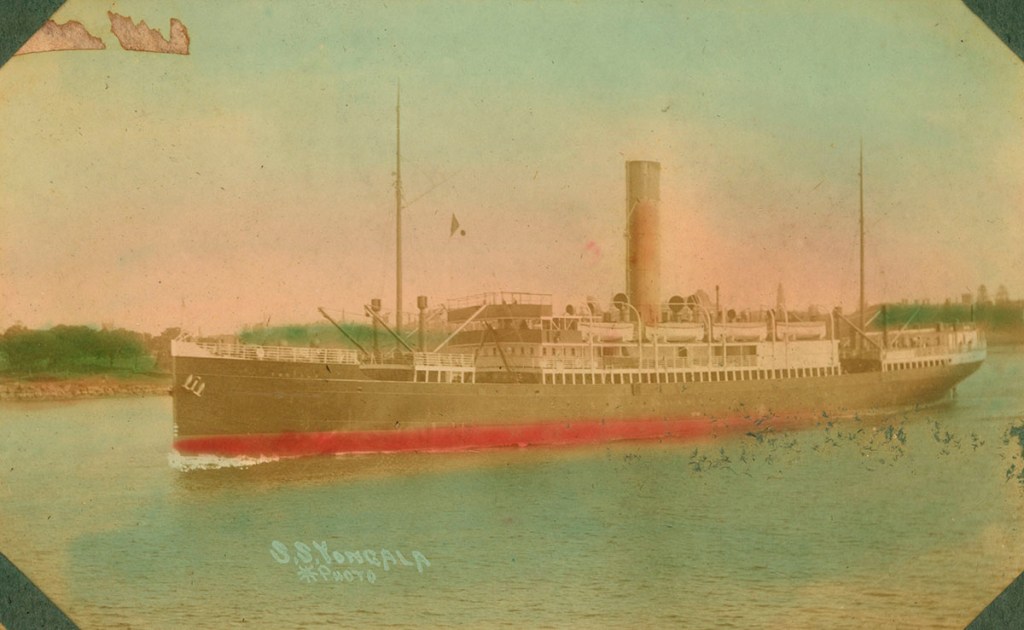
    Postcard showing the SS Yongala, circa 1905. Courtesy State Library of Queensland.

    In March 1911 the SS Yongala sank during a powerful cyclone with the loss of 122 lives making it one of Queensland’s worst maritime disasters.   Despite efforts to locate the wreck, the ship’s final resting place would remain a mystery for almost half a century.

    The Yongala departed Brisbane on 21 March bound for Townsville.   On 23 March she stopped briefly at Mackay to disembark passengers but by now the weather was rapidly deteriorating.   When she got under way again, she unwittingly carried 50 passengers and 72 crew towards a powerful storm brewing somewhere to the north.    

    Later the same day the Dent Island lighthouse keeper noted the Yongala passing through the Whitsunday Passage.     She soon faded from sight, enveloped by a curtain of rain and sea mist, as she ploughed towards Townsville.

    When the Yongala failed to arrive as scheduled there was no immediate concern.   It was assumed the captain had sought shelter to escape the cyclone and the ship would soon make its appearance.   But then reports reached Townsville of wreckage washed ashore on Palm and Hinchinbrook Islands 50 and 100 kilometres to the north.

    “The Missing Steamer Yongala” The Australasian, 1 Apr 1811, p. 41.

    It was clear the debris, including hatch covers, parts of lifeboats, ornate cabin fittings and other miscellanea, had come from the Yongala.   It spoke of a terrible tragedy having befallen the passenger steamer and all those onboard.   Oddly, not a single body was ever recovered.

    The waters and coastline between Townsville and the Whitsunday’s were scoured in hopes of finding survivors or the wreck but nothing but more debris was found.  A Marine Board Inquiry investigated the loss of the ship as best it could under the circumstances. With no eyewitnesses to what happened and no wreck to inspect, they had little to go on.   The Inquiry concluded that rumours about the ship’s stability were groundless and it found no fault with the ship’s construction or the competency of its captain.    A £1,000 reward was even offered for anyone who could pinpoint the wreck.

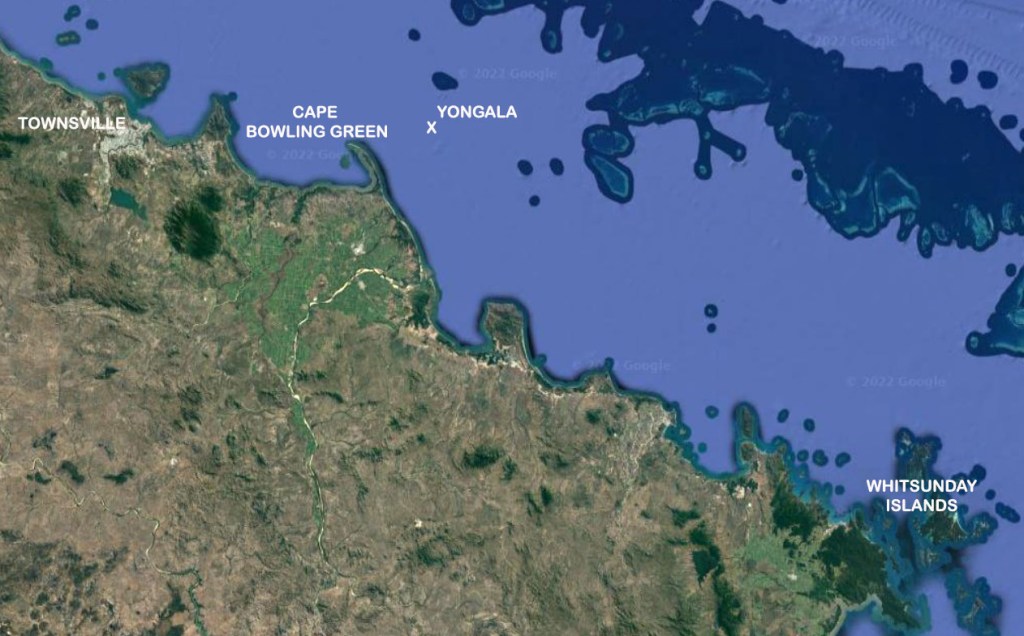
    In October 1911 Dr Cassidy believed he and his crew on the salvage schooner Norna had located the Yongala in deep water about 20kms off Cape Bowling Green.   They had discovered traces of oil bubbling up from the depths and believed that marked the resting place of the lost ship.   However, owing to the depth of the water and strong currents, they were unable to put a diver down to confirm the find or collect the reward.  

    Map showing location of the Yongala wreck. Courtesy Google Maps.

    For decades mystery surrounded the disappearance of the ship.   There were even far-fetched sightings of a “ghost ship” steaming through North Queensland waters periodically reported in the tabloid press.  

    Then in 1947, the navy survey ship HMAS Lachlan located the wreck using “anti-submarine instruments,” more commonly known today as sonar.    Three years earlier a minesweeper had snagged something they thought to be a reef rising steeply from the seabed in the middle of the regular shipping lane south of Townsville.   They had marked the spot on their chart as an unknown obstruction and reported it to Naval Headquarters.   They were about 20kms east of Cape Bowling Green where the Norna had found the oil slick all those years ago.

    After HMAS Lachlan made several passes over the “obstruction” the sonar operators were convinced they had found the remains of a “fair-sized steamer.”   It was thought to be the Yongala for it was the only such vessel to have been lost in the vicinity.  

    HMAS Lachlan. By Allan C. Green, Courtesy State Library of Victoria.

    However, it would be another 11 years before anyone visually confirmed that what the Lachlan had found was in fact a shipwreck.   In 1958 a diver named George Konrat finally descended into the deep and found the ship sitting on its keel in 30 metres of water with a distinct list to starboard.   He recovered a Chubb safe with part of the serial number still evident which would later prove to have been installed in the Yongala during her construction.

    Konrat speculated that the steamer had struck another vessel during the storm and sank for he also saw the remains of an old sailing ship nearby.   However, with the passage of so many years and no survivors to recount what happened, the actual reason why the ship foundered during the cyclone will likely never be known.

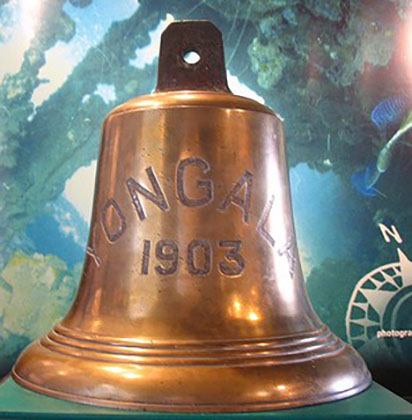
    Yongala Bell, Courtesy wikimedia commons.

    Today, some artifacts collected from the wreck and other memorabilia can be found in the Townsville Maritime Museum which is well worth a visit.   The Yongala, itself, is a popular dive site.

    © Copyright C.J. Ison / Tales from the Quarterdeck, 2022.

    To be notified of future blogs, please enter your email address below.

  • Matthew Flinders and the loss of HMS Porpoise – 1803

    Loss of the Porpoise & Cato. Courtesy Wikipedia.


         Shortly after Matthew Flinders completed his historic circumnavigation of Australia, he was farewelled from Sydney to return to England as a passenger on board HMS Porpoise. To everyone’s astonishment, he returned to Sydney a month later to report that the Porpoise and another ship had run aground on a reef far out in the Coral Sea.

       HMS Porpoise, under the command of Lt Fowler, along with the merchant ships Cato and Bridgewater, departed Port Jackson on 10 August 1803, intending to remain together as they sailed north through the remote waters of north Australia. Ships regularly travelled in company, so one might come to the other’s aid should they get into difficulty. After all, the next European outpost after leaving Sydney was Kupang on Timor Island, 2,000 km west of Torres Strait and over 5,000 km from Sydney.

       On the afternoon of 17 August, the three ships passed a small island marked on the chart, which confirmed their position about 160nm (300 km) NE of Sandy Cape at the northern end of Fraser Island (K’gari). The chart showed no other obstacles in their path until they were ready to pass through the Great Barrier Reef, much further to the north.    As night took hold, they continued bearing NNE under reduced sail, pushed along by a southerly breeze. The Porpoise was out in front with the Cato and Bridgewater off her port and starboard quarters, respectively. Then, around 9.30 pm, the Porpoise’s lookout called “breakers ahead.” The Porpoise tried to veer off but without success, and she struck the uncharted reef. Likewise, the Cato attempted to steer away from the line of white water that indicated danger. However, she had insufficient room to manoeuvre and ran aground about 400m from where the Porpoise struck.

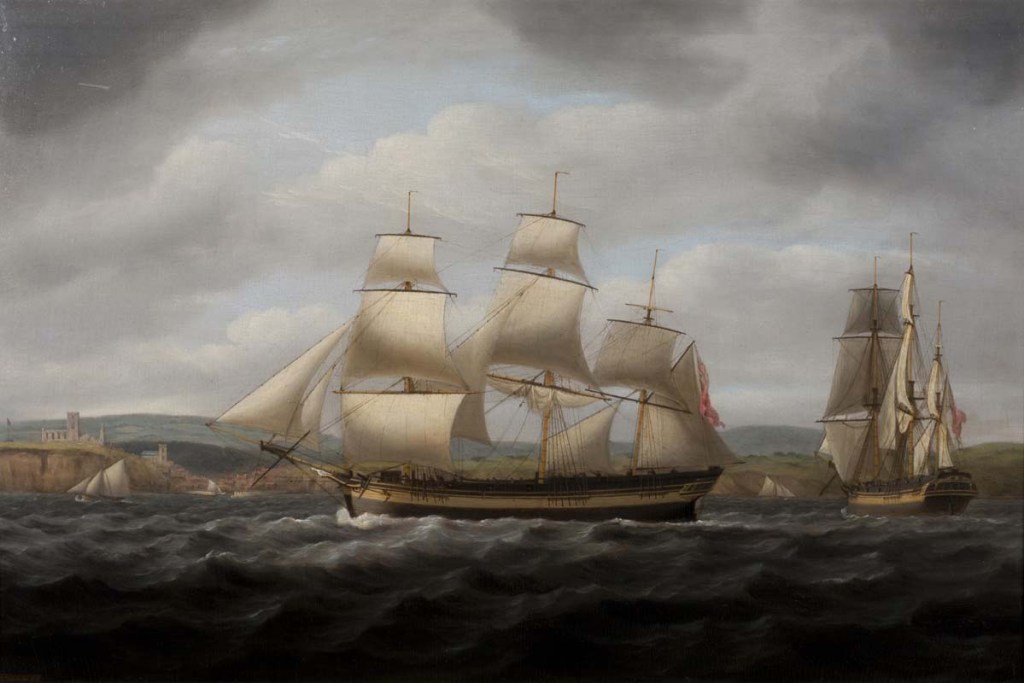
    The 430-ton Cato by Thomas Luny cira 1800.

         Fortunately, the Bridgewater missed the reef that claimed the other two ships. Her captain spent the rest of the night and the following morning trying to return so they might help any survivors. However, contrary winds and large seas hampered him, and he could not get close to the reef without risking his own vessel. He reluctantly continued on his way, leaving the survivors from the Porpoise and Cato to their fate.

       Meanwhile, the men on the stranded ships waited out the night. HMS Porpoise had gone aground broadside to the reef and heeled over so her strong hull took the brunt of the crashing waves. The Cato was not so lucky. She had also run aground broadside to the reef, only her deck lay exposed to the full force of the powerful waves, and she soon started breaking up. Her crew spent an anxious night clinging for dear life to the inner forechains.

       The next morning, the Porpoise’s small gig and a six-oar cutter were used to ferry the crews of both ships to a small sandy islet a short distance away. Over the next several days, they salvaged as much as they could from the two stranded wrecks. Casks of water, flour, salt meat, rice and spirits, along with live sheep and pigs were all brought ashore. They found they had sufficient provisions to feed the 94 castaways for the next three months. Most shipwreck survivors fared far worse.

    Captain Matthew Flinders, RN, by Toussaint Antoine DE CHAZAL DE Chamerel. Courtesy Wikipedia.

       On the morning of the 19th of August, Captain Matthew Flinders took command as the most senior naval officer present. Flinders, in consultation with Lt Fowler and the Cato’s captain, John Park, decided he should take the largest cutter and return to Sydney to get help. The three also agreed on a contingency plan should Flinders and his party fail to reach Sydney and alert the authorities. The ship’s carpenters would begin building two new boats from materials salvaged from the wrecks. If, after two months, the remaining survivors had not been rescued, Lt Fowler and the rest of the men should try to make for Sydney themselves in the new boats.   

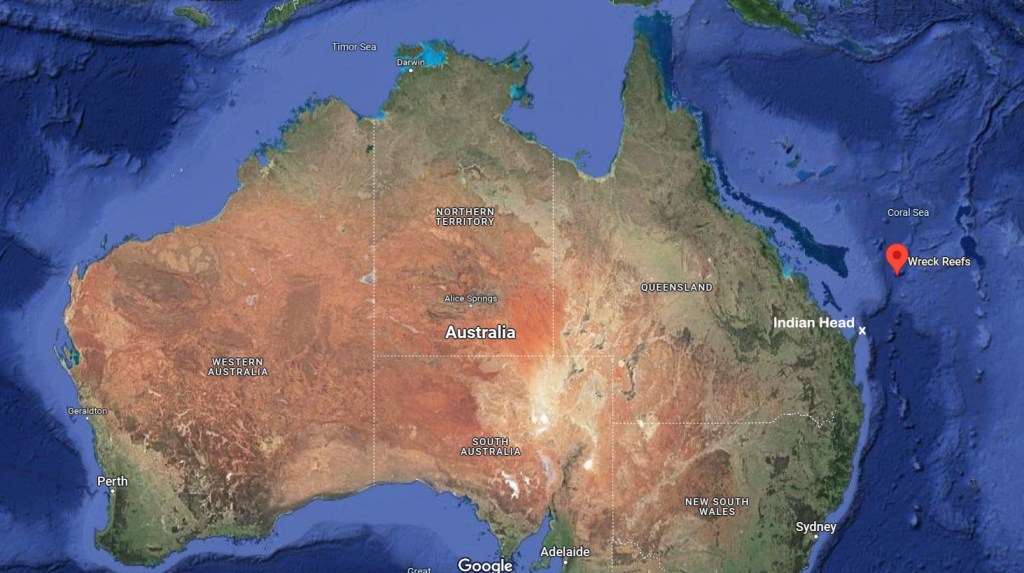
    Flinders’ cutter was fitted out with a deck to make it better handle the rough seas on the long voyage ahead. She was christened “Hope” and, on 26 August, nine days after striking the reef, Flinders, Park and twelve sailors set off to three loud cheers from their shipmates lining the shore.    They took sufficient provisions to last them three weeks, and Flinders set a course west so they would strike the Australian coast. On the evening of 28 August, they made land near Indian Head on K’gari Island and headed south, hugging the coast until they reached Sydney ten days later.

    Map showing Wreck Reefs where the Cato and Porpoise were wrecked in 1803. Courtesy Google Maps.

       Meanwhile, the carpenters got to work building the first of the two new boats. They named it Resource and had her afloat in about two weeks.  However, as they were working on the second boat, their supply of coal for the armourer’s forge ran out, halting construction. Lt. Fowler ordered that the Resource be sent with a work party to an island to the south to produce sufficient charcoal to complete the second boat.

    But, before they set off, the welcome sight of three rescue ships sailed into view. Flinders had made it to Sydney and returned with the fully-rigged ship Rolla, and the colonial schooners Cumberland and Francis, to rescue the survivors. Flinders might have got there a little earlier, but he had spent a couple of anxious days trying to find the uncharted reef. Most of the men were put on to the Rolla, which was on its way to China, while Flinders returned to Sydney on the Cumberland. Much of the stores and salvage from the wrecked ships were taken back to Sydney on the Francis and the newly built Resource. Remarkably, only three men were lost during the ordeal. The site of the disaster is now known as Wreck Reefs.

       Captain Flinders’ adventures did not end there. By the time he next left for England, Britain was at war with France. When his ship stopped at Mauritius, he was placed in detention until the end of hostilities. Flinders did not return to England until 1810. His book “A Voyage to Terra Australis”, detailing his voyages, was published in 1814.

    © Copyright C.J. Ison / Tales from the Quarterdeck, 2022.

    To be notified of future blogs, please enter your email address below.
  • The Tragic Loss of George III – 1835

    The Wreck of George III, by Knud Bull, wikimedia commons.

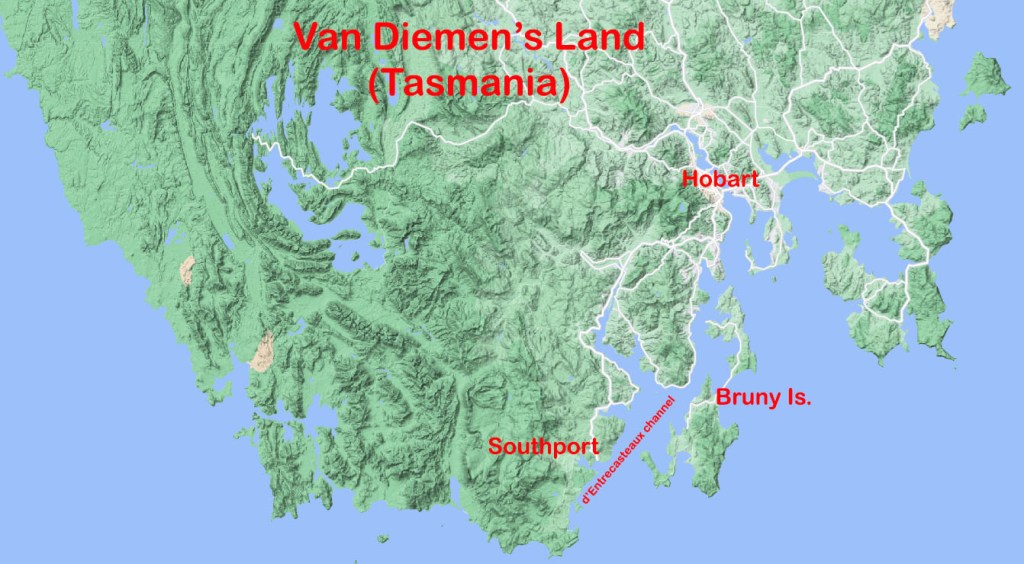
       The 400-ton ship George III sailed from England on 12 December 1834, bound for Van Diemen’s Land (Tasmania). She was carrying nearly 300 people, of whom 220 were convicts. When they were less than 80 km from Hobart, tragedy struck with a terrible loss of life.

       Around 11 a.m. on Sunday, 12 April 1835, the George III made land at South Cape, the southernmost point of Tasmania. By early evening, they had entered the D’entrecasteaux Channel to make the final run up the coast to the mouth of the Derwent River. From there, it would have been a short cruise up the river to Hobart Town. She put the dangerous Actaeon Islands behind her around 8.30 that night. The moon was out, the weather mild, and they were being pushed along at a modest 1 ½ to 2 knots (3 – 4 km/h) by a light breeze blowing off the land.   

    Captain William Moxey had a man in the chains sounding the passage as they made their way north. Repeated soundings showed they were in 20 fathoms (36m) of water, which was more than deep enough for safe passage. Then, shortly before nine o’clock, Moxey was stunned to hear the man call out “quarter less four,” meaning they were in less than four fathoms (7m) of water. He ordered the helm put hard to port. But before the ship could respond, she struck ground and came to a stop where the chart said there was clear passage.

    Southern Tasmania. Google Maps.

       The captain had soundings taken around the ship and found they were stranded on an uncharted rock with between three and five metres of water surrounding them. The initial collision was not particularly violent, but now that the ship was stuck fast, the ocean swells began lifting her up and dropping her back down on her rocky perch. Within minutes, the repeated pounding brought the main mast crashing down. The mizzen mast came down with it, littering the deck with a tangle of rope, canvas and timber spars.

       The crash brought everyone on deck, except for the prisoners. Seamen not on watch, passengers and the complement of soldiers hastily dressed and came up to see what had happened. Captain Moxey gave the order to abandon ship and oversaw the evacuation in the ship’s boats. However, efforts were severely hampered by the continued pounding and the mess of debris strewn across the deck and floating in the water.

       Moxley ordered one of his boats with a crew of seven to make for Hobart as quickly as possible to get help. Then he got the evacuation of the passengers and the rest of the crew underway. Meanwhile, the convicts were still locked below deck with armed guards stationed over the hatchway.

       The situation was becoming dire for the convicts trapped in their prison. They were already standing waist-deep in freezing water, and despite their pleas to the guards to be let out, the hatch covers remained locked. In genuine fear for their lives, several rushed forward and tried to force the hatch cover open with their bare hands. According to one of the surviving convicts, the guards opened fire to force them back, and at least one prisoner was struck by a bullet and killed. In a later inquiry, Moxey would dispute the claim, saying that the guards had only been stationed over the hatchways to keep the panicking prisoners contained below deck until the women and children had safely been evacuated. In fact, the inquiry reads like the minutes of a mutual appreciation society meeting, each officer praising the efforts of the others in saving so many lives.

    The Colonist, 7 May 1835, p. 5.

       Fifteen minutes after striking the rock, the deck was awash with water, and the last of the boats carrying 40 people had left the stranded vessel. Captain Moxley was among them, having been pulled from the water after he became trapped between floating timbers.

       By this time, the guards watching over the hatchways had left in the last boat. The trapped convicts were now able to force their way on deck to find it deserted.  But some 50 or so prisoners had been too ill to save themselves. Most had been suffering from scurvy and had drowned where they lay unable to escape the rising water.

       After putting the survivors ashore, Moxley returned to the ship and began taking off the convicts. By the time he had reached the George III for the third time, a schooner sent from Hobart had arrived and was taking off the last of the survivors.

       One hundred and thirty-four people lost their lives. Three of them were passengers – a woman and two children – and two were members of the ship’s crew. Convicts made up the remaining 128 fatalities. Most never had a chance, trapped in the hold as the water rose around them.

    The next morning, a convict named John Roberts was found dead, lashed to a ringbolt in the surgeon’s cabin. It seems he could not swim, so he had tied himself off, hoping to be washed ashore as the ship broke up.    Despite the heavy loss of life, 160 people were saved. They were all taken to Hobart, cold, wet, and thoroughly exhausted from the ordeal.

    View of Hobart Town by Samuel Davenport, circa 1835.

         The inquiry into the loss of the ship found no one was to blame. It concluded that the George III had struck a rock not recorded on the chart. Then it came time for the inquiry to consider the treatment of the convicts. No officer admitted to ordering the prisoners to be confined below deck as the hold flooded with water. The Corporal of the guard testified that the muskets were only used to “intimidate” the prisoners, and only one shot was fired, and that into the air. No one was held accountable for the loss of so many prisoners.

     © Copyright C.J. Ison / Tales from the Quarterdeck, 2022.

    To be notified of future blogs, please enter your email address below.

  • The Windjammer Grace Harwar 1889 – 1935

    Grace Harwar. View aft from the main crosstrees, 1929. Courtesy: National Maritime Museum Greenwich.

       The 1750-ton steel-hulled fully-rigged ship Grace Harwar was launched in Glasgow in 1889, and for the next 46 years, she crossed the world’s oceans carrying all manner of bulk cargoes. She became well-known to Australian mariners and dockworkers alike, regularly taking on coal, grain, and other goods bound for distant ports.

       Despite her fast lines and majestic presence, she gained a name for herself as a cursed ship among the more superstitious of sailors. On her 1889 maiden voyage, the bosun was lost when an upper yard was carried away during a gale while rounding Cape Horn. That might have been ignored, for Cape Horn was a notoriously dangerous stretch of water. But that was only the first of a string of deaths associated with the Grace Harwar.

       In December 1901, while on a passage from Cape Town to New Zealand, she was slammed by a powerful storm as she neared her destination. Heavy seas broke across her deck, sweeping away the lifeboats. The ballast shifted, and the Grace Harwar took on a dangerous list, which saw the lee rail submerged three feet underwater. The captain was washed overboard, but fortunately, another wave swept him back on deck, where he scrambled to safety. However, one of the seamen was not so lucky and drowned. The Grace Harwar survived the maelstrom to limp into Gisborne Harbour for repairs, but her reputation as a Jonah ship was growing.

    GRACE HARWAR CREW circa 1920s by A.C. Green, Courtesy State Library of Victoria.

       In 1907, while she was sailing from Australia to the Chilean port of Tocopilla, the captain’s young wife died from tuberculosis. Captain Hudson returned his wife’s body to Sydney in the hold and then shipped off the Grace Harwar, vowing he would never go to sea in her again. Three years later, in July 1910, a seaman was killed when the royal yard came crashing down on deck just as the men were congratulating themselves on making it around Cape Horn unscathed.   

    The following year, 1911, she was anchored at Coquimbo, Chile, when a freak storm blew out of nowhere, causing havoc among the ships anchored in the bay. The Grace Harwar lost her figurehead and bowsprit when she collided with another vessel as they both swung uncontrollably on the end of their anchor chains. Then her anchors began to drag, and she ran up against a German barque, causing yet more damage. During the same year, one of the mates was injured and later died during an operation to recover a lost anchor at the Chilean port of Iquique. But the bad luck did not end there.

    The Grace Harwar under sail. Photo by Allan C. Green , Courtesy: State Library of Victoria

       While she was anchored off Mobile, Alabama, in the Gulf of Mexico during a ferocious hurricane, one of her sailors was knocked overboard by a loose spar. He drowned before anyone could go to his aid. That was in 1916.

       By the late 1920s, the number of fully-rigged sailing ships plying the world’s oceans was in rapid decline. They were increasingly replaced by steam and even newer marine diesel-powered vessels that were no longer dependent on the wind.    Two young Australian journalists set out to record the passing of the sailing era. In 1929, they joined the Grace Harwar’s crew in South Australia and filmed the old windjammer’s voyage across the South Pacific, around Cape Horn and up through the Atlantic to deliver her cargo of wheat to England. She lived up to her deadly reputation, claiming the life of one of the reporters, Ronald Walker. He was struck by a falling yard while aloft during foul weather and died. However, the extraordinary footage he and his partner, Allan Villiers, captured using the large boxy cameras of the day was edited together to make the 1930 feature-length film “Windjammer.” Clips from the movie can still be viewed on YouTube.

    Photo of Allan Villiers on the Grace Harwar taken by Ronald Gregory Walker. Courtesy: National Library of Australia.

       During the first half of the 1930s, the Grace Harwar was a regular at the annual “Great Grain Race,” carrying wheat from ports in the Spencer Gulf, South Australia, to England. Strictly speaking, it was not an official race, but the captains of the windjammers that carried the annual harvest were known to wager bets on who would deliver their cargo in the fastest time. And of course, there were bragging rights at stake.

       In 1935 the Grace Harwar’s 46-year sailing career finally came to an end. She made one last 40 km voyage from Falmouth around to Charlestown, where she was broken up for scrap.

    Seas sweep over the Grace Harwar’s deck. Source: The Daily Telegraph, 4 Nov 1929, p. 13.

    © Copyright C.J. Ison / Tales from the Quarterdeck, 2022.

    To be notified of future blogs, please enter your email address below.