Tag: Mahina

  • Queensland’s Ten Worst Maritime Disasters

    The wreck of the Steamer Gothenburg. Source: Australasian Sketcher, 20 Mar 1875, p. 13.

    TEN: SOVEREIGN, 1847.
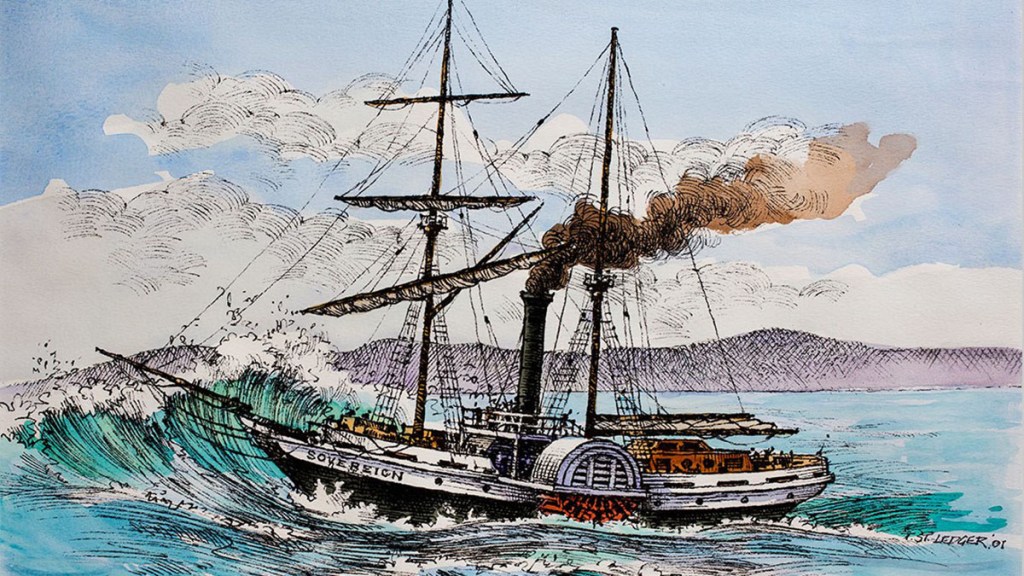
    The Sovereign. Image courtesy Stradbroke Island Heritage Museum.

    The paddle steamer Sovereign, with 54 persons on board, sailed from Moreton Bay via the southern channel on 11 March 1847.   As she ploughed through the large swells funnelled into the passage between Moreton and Stradbroke Islands, her engines failed at a critical moment.      The force of the breaking waves quickly drove her onto a sand spit projecting from the southern point of Moreton Island, where she broke up.    Forty-four people lost their lives.   The owners of the vessel would later claim the engines had been working fine and blamed the captain for the loss.     

    NINE: MERSEY, 1804.

    On 24 May 1804, the 350-ton merchant ship Mersey sailed from Sydney bound for Bengal, India, via Torres Strait.     In mid-June she was wrecked while trying to negotiate the dangerous waters of Torres Strait.   Neither the location or the circumstances of the tragedy are known, other than the captain and either 12 or 17 of the crew took to the longboat and made it safely to Timor Island to report the loss.   She reportedly sailed with 73 hands which means 56 or 61 people lost their lives.

    EIGHT: PERI, 1871.
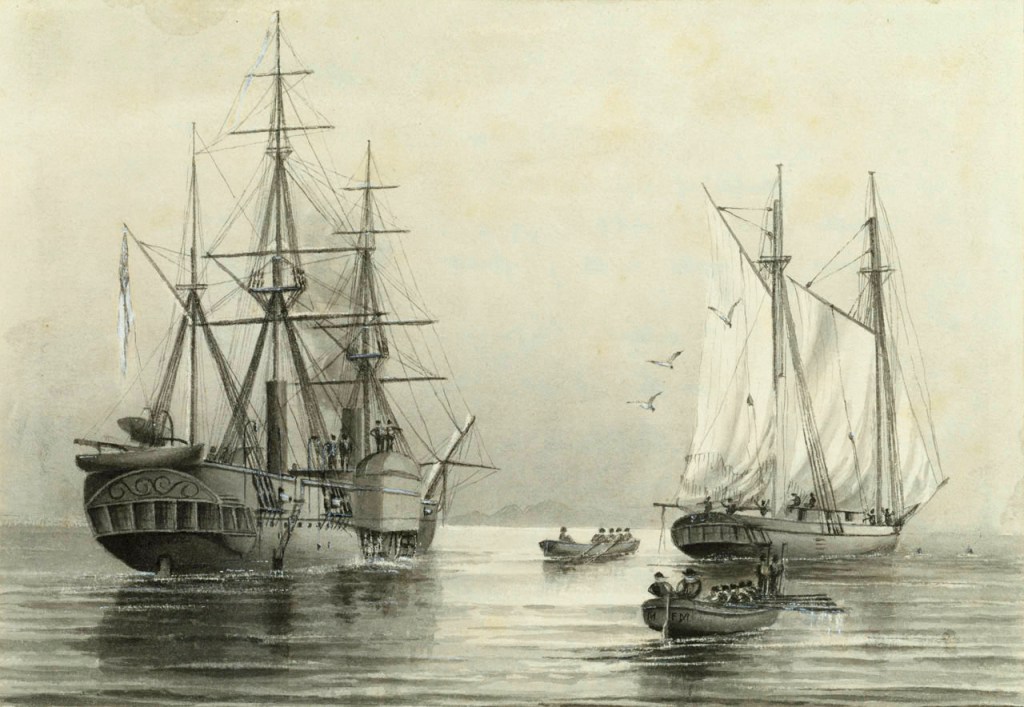
    HMS Basilisk and the Peri. Image Courtesy the British National Maritime Museum, Greenwich.

    In early February 1871 HMS Basilisk discovered a schooner, later identified as the Peri, adrift and seemingly abandoned a short distance off the Queensland near Cardwell.   When a boat was sent across to investigate, they discovered 14 emaciated Solomon Islanders, three corpses, no food or fresh water and five feet of putrid seawater in the hold. The Peri had last been seen about six weeks earlier in Fiji carrying around 80 or 90 blackbirded Islanders bound for Fijian cotton plantations.   It seems that the Islanders had overpowered their kidnappers and taken control of the schooner.   They then sailed or drifted west across almost 3,000 km of open ocean, withstood at least one severe tropical storm, and passed through a gap in the Great Barrier Reef before being found.      As many as 75 people likely died during the ordeal.

    Map showing 10 worst maritime disasters off Queensland. Courtesy Google Maps

    SEVEN: SYBIL, 1902.

    The labour schooner Sybil disappeared sometime after leaving the Solomon Islands on 19 April 1902 bound for Townsville with a fresh batch of South Seas labourers.    By August, grave fears were held for the Sybil, for the voyage should not have taken more than two or three weeks.    Searches were made of the islands along the outer Great Barrier Reef and in the Coral Sea but no trace of the vessel or any of those on board were found.   She had a crew of 12 and on the previous two voyages, she had carried 90 and 98 labour recruits, so it is thought no less than 100 lives were lost.

    SIX: GOTHENBURG, 1875

    Gothenburg. Photo Courtesy SLQ

    The steamer Gothenburg sailed from Darwin on 17 February 1875 bound for Adelaide via Australia’s east coast.   On 24 February the Gothenburg was steaming down the coast in the vicinity of Cape Bowling Green.   Bad weather meant they could not see the regular landmarks to aid their navigation. The captain was unaware strong currents were pushing the ship towards the Great Barrier Reef until it was too late. The Gothenburg ran aground on Old Reef.   The ship and all aboard her would likely have been saved but for a powerful cyclone bearing down on them.   As the storm worsened, the captain ordered the evacuation of the passengers, but as the women and children were being loaded into the lifeboats a succession of huge waves swept over the ship.    Only 22 people survived.  As many as 112 passengers and crew lost their lives.  

    FIVE: YONGALA, 1911
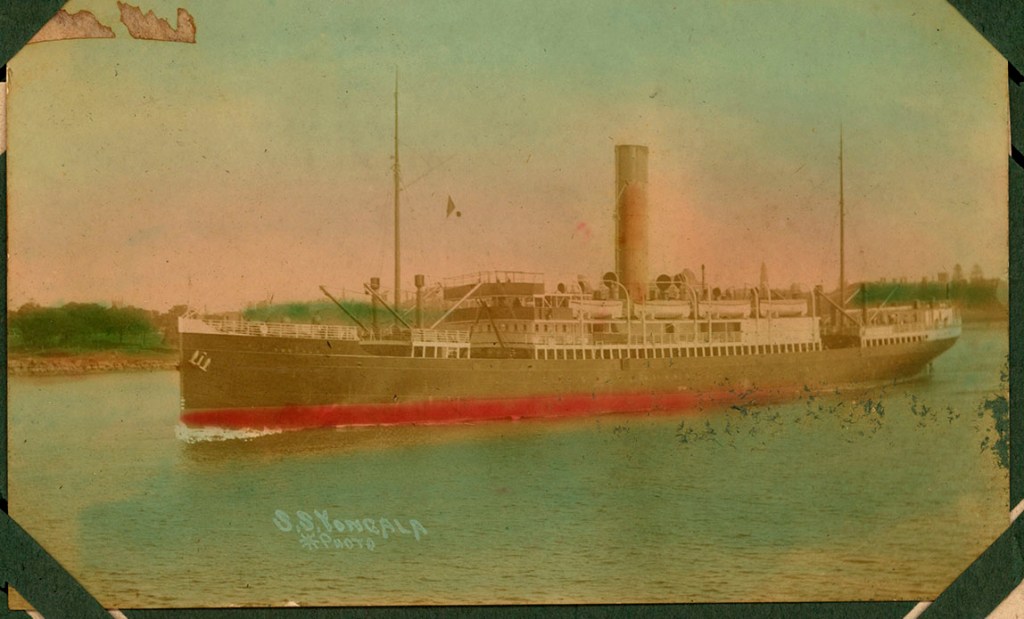
    S.S. Yongala. Photo Courtesy SLQ.

    The Yongala sank during a tropical cyclone near Cape Bowling Green on 11 March 1911 with the loss of all 122 people on board.    When the ship failed to arrive in Townsville as scheduled, concerns were raised.   Then, wreckage began washing ashore along the coast as far away as Hinchinbrook Island.   However, there was no sign of the ship or any hint as to where she might have sunk.   Nearly half a century would pass before the final resting place of the Yongala was conclusively located. 

    FOUR: QUETTA, 1890

    RMS Quetta. Photo courtesy SLQ

    While the Mail Steamer Quetta was steaming through Torres Strait on the night of 28 February 1890, it struck an uncharted rock pinnacle as it passed Adolphus Island.   The Quetta had departed from Brisbane bound for London carrying nearly 300 people comprising the passengers and crew when disaster struck.   The collision tore a gaping hole in the hull from bow to amidship, and the ship sank in just three minutes.    One hundred people made it safely to Little Adolphus Island where they were later rescued.   Dozens more were pulled from the water the following day.    133 people lost their lives in the tragedy.

    THREE: AHS CENTAUR, 1943

    AHS Centaur. Photo Courtesy State Library of Queensland

    At 4 am on 14 May 1943, the Australian Hospital Ship (AHS) Centaur was torpedoed and sunk by a Japanese submarine.    The Centaur was about 35km off Moreton Island having departed Sydney with medical staff from the Army’s 2/12 Field Ambulance bound for Port Moresby.   In all, there were 332 people on board.   268 lost their lives.   64 survived by clinging to debris and two damaged lifeboats until they were rescued 36 hours later.

    TWO: CYCLONE MAHINA, 1899

    Cyclone tracks for Cyclone Mahina.

    On the night of 4/5 March 1899, a powerful cyclone crossed the coast at Bathurst Bay on Cape York Peninsula. Lying directly in its path was the North Queensland pearling fleet which had sought shelter there.     Nearly 60 vessels – from large schooners to pearling luggers – were sunk or driven ashore with horrendous loss of life.    Between 300-400 people died in what is no doubt Queensland’s worst natural disaster.    The loss was most keenly felt on Thursday Island where the pearling fleet was based.

    ONE: GRIMENEZA, 1854

    Artists impression of the Grimeneza . Image Courtesy SLQ

    The worst shipwreck off the Queensland coast occurred on 3 July 1854.   The Peruvian ship Grimeneza was sailing from China with some 600 Chinese labourers bound for the Callao guano mines in Peru.   When they struck a reef at Bampton Shoals in the Coral Sea, the captain and six others immediately abandoned the ship leaving the rest of the crew and the passengers to their fate.  The rest of the crew tried to back the ship off, but when that failed, they too took to the lifeboats and were picked up 12 days later.   Miraculously, the Grimeneza floated off with the next high tide.   The labourers sailed the damaged ship west towards the Queensland coast with the pumps being worked around the clock.   But after three days of exhausting work, she foundered.   Six men were found clinging to a piece of wreckage 300 km off the coast a few days later.   The rest had all drowned or been taken by sharks.
    © Copyright, C.J. Ison / Tales from the Quarterdeck, 2024.

    If you would like to be notified of future blog posts, please enter your email address below.

  • Cyclone Mahina & the loss of the North Queensland Pearling Fleet, 1899.

    Pearling luggers at Thursday Island. Courtesy State Library of Queensland.

       On 2 March 1899, Cyclone Mahina formed near the Solomon Islands and began tracking south-west towards the Queensland coast. On the same day, a second weather system formed in the Arafura Sea northwest of Darwin. This “monsoonal disturbance” was named Nachon and began moving towards the southwest. Unbeknown to the Thursday Island pearling fleet anchored in Bathurst Bay, 400 kilometres down the Queensland coast, both of these powerful weather systems were bearing down on them. Mahina and Nachon would collide over Bathurst Bay, wreaking havoc on the fleet, resulting in the loss of as many as 400 lives.

    Cyclone tracks for Cyclone Mahina which devastated the Thursday Island Pearling fleet at Cape Melville on 5 March 1899

       The pearling fleet was based at Thursday Island in Torres Strait, but the pearlers regularly ventured across Queensland’s warm tropical waters in search of shells. Pearling schooners served as floating processing stations for their fleet of ten to 15 luggers and diving boats. It was those smaller vessels that ranged out over nearby reefs, collecting the lucrative shells from the sea floor.

       March 4 was a Saturday and, for the pearlers, the much-anticipated start to the weekend. After they had delivered their pearl shells to their respective station schooner, tending to any repairs and restocking with provisions for the next week, it was time to relax and catch up with friends and family whom they had not seen all week.

       The schooners Sagitta, Silvery Wave, and Crest of the Wave were anchored near Cape Melville just inside Bathurst Bay. As the prevailing winds had been blowing from the southeast for the previous three weeks, everyone was anchored close to shore where the mountains extending inland protected them from the worst of the wind.

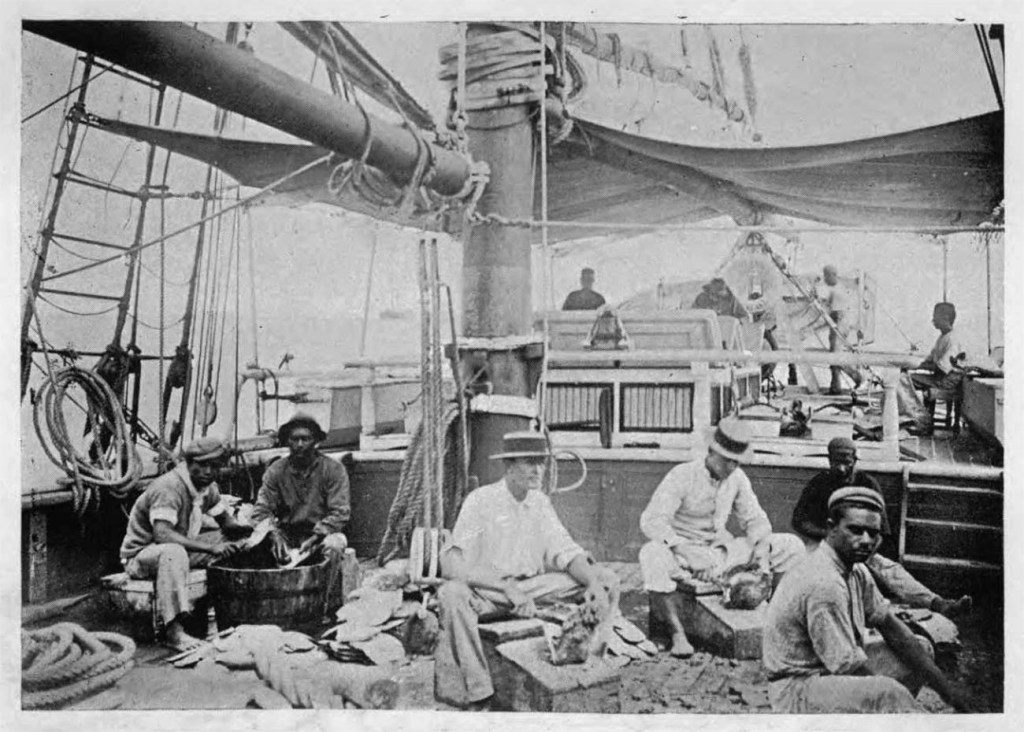
    Opening and cleaning shell on the schooner Olive. Source: The Pearling Disaster, 1899.

       The schooners Tarawa, Meg Merrilees, Olive and Aladin were anchored about 75 kilometres away near Pelican Island on the northwestern end of Princess Charlotte Bay. The manned Channel Rock lightship and several other pearling vessels were scattered along the Great Barrier Reef in the path of the approaching storm. No one, including the local Aboriginal people, could imagine the violent mayhem about to be unleashed upon them.

       At 7 o’clock on Saturday evening, only a moderate breeze was blowing from the southeast. However, just four hours later, the wind had increased to hurricane strength. It had also begun shifting direction from the southeast to the southwest. As Cyclone Mahina tore towards Bathurst Bay, the wind continued shifting further to the west, and eventually it blew from the northwest. For much of the early hours of Sunday, 5 March, the pearling fleet was exposed to the cyclone’s full fury. Torrential rain lashed the vessels. Streaks of angry lightning arced across the night sky while peals of thunder, howling wind and crashing waves competed to drown each other out. The hundreds of men and women trapped on their boats could do nothing but pray that they survived the ordeal.   

    Then, around 4 a.m., a massive storm surge swept through the bay. By 10 o’clock on Sunday morning, the tempest had moved inland, and some sanity returned to the world. It was only then that the few survivors would learn the full devastating impact of the storm.

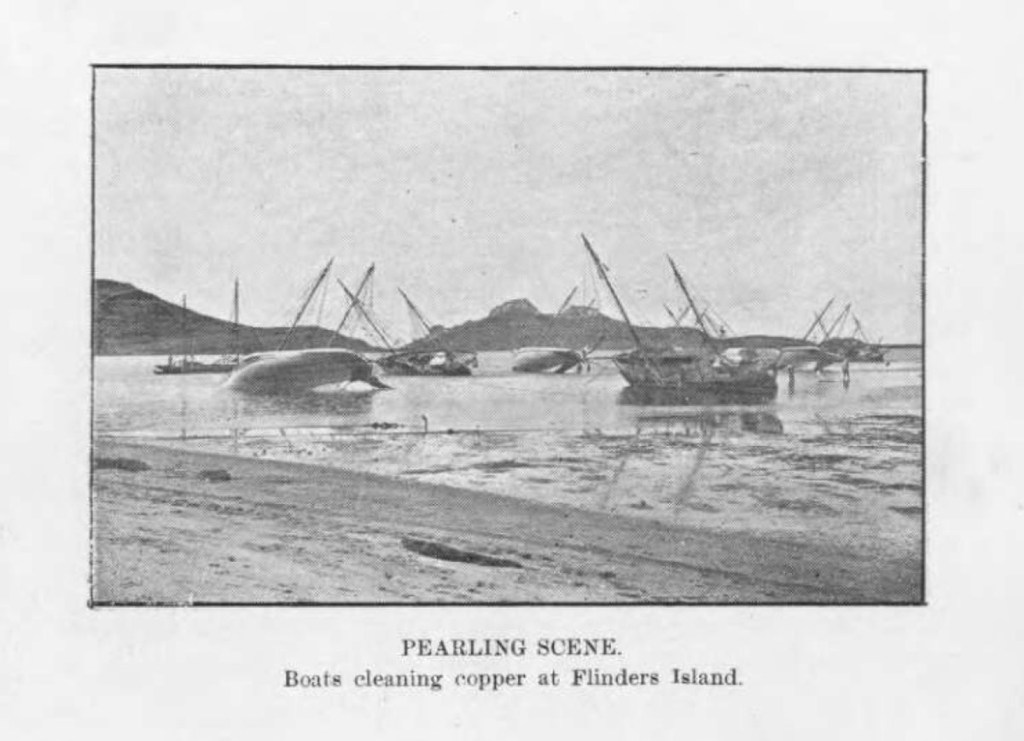
    Boats cleaning copper at Flinders Island. Source: The Pearling Disaster 1899.

       The Tarawa’s anchor cables had parted around 3 a.m., and she was swept onto Pelican Island. However, she was lucky for the damage would be easily patched, and she would limp back to Thursday Island. The Meg Merrilees dragged her anchors and ran onto a coral reef. All hands survived the wild night, but attempts to refloat the schooner were unsuccessful. The tender Weiwera was also lost. Of the 30 or so luggers anchored nearby, one-third sank with the loss of nine lives. The schooners Olive and the Aladin were more fortunate. Their anchors held, and they survived the night.

       The vessels lying off Cape Melville fared far worse. The 25-ton tender Admiral had only arrived in Bathurst Bay on the morning of the cyclone. She foundered at the storm’s height with the loss of her five crew and an unknown number of passengers brought down from Thursday Island to join the fleet. The Silvery Wave likewise was lost. Only a Japanese crew member named Sugimoto survived. The Sagitta was thought to have collided with the Silvery Wave and went to the bottom of Bathurst Bay with nearly 20 hands.   

    Captain W. Field Porter survived to give a harrowing account of that terrible night.  He recounted that his schooner, Crest of the Wave, was anchored near the other vessels off Cape Melville while about 40 luggers were in shallower water close to the beach. As the storm intensified, his anchors began dragging. Fortunately, the wind and current pushed the schooner into deeper water. “The intense darkness and driving rain prevented anything [from] being seen of the other boats or the land. The sea by this time was very rough, and enormous waves broke time after time on board,” Porter later wrote of his experience.

    “Mr Outridge, preparing for deep sea diving and assisted by Captain Porter of the Crest of the Wave.” Source: The Pearling disaster of 1899.

       The eye of the cyclone passed over his ship around 4.30 in the morning. After ten or fifteen minutes of dead calm, Captain Porter recalled, the wind suddenly came from the north-west, “with such terrific force that the schooner was thrown on her beam ends and [was] almost buried in the raging sea.” With much difficulty, the masts were cut away, and the ship righted itself. But by then, she had taken on a lot of water. The bilge pump was manned, and every spare hand bailed with buckets to keep the ship from sinking. Eventually, it was discovered that the water was entering through the rudder trunk. The leak was plugged with blankets and bags of flour, and the ship was saved. However, for 12 long and terrifying hours, the crew battled the elements, not knowing if each moment would be their last. Finally, the wind and seas started to ease, and Captain Porter and his men began to think they might just survive. As for the luggers, they either foundered at their anchorage or were driven ashore, where most were smashed to pieces. Some wreckage was found almost half a kilometre from the beach, taken there by the massive storm surge which swept several kilometres inland in places. Only a handful of the luggers were able to be refloated.

       The Channel Rock Lightship, moored between Cape Melville and Pipon Island, was nowhere to be seen after the storm passed and was believed to have sunk at her moorings with the loss of four lives. The bodies of Captain Gustaf Fuhrman and the mate Douglass Lee were later found near Cape Melville amongst debris from the lightship.

    Wreck of the Zanoni at Cape Melville, Source: The Pearling Disaster, 1899.

       It is estimated that some 300 pearlers lost their lives that night in Queensland’s most deadly natural disaster. While a dozen Europeans perished, most of the casualties were men and women from Torres Strait, the South Pacific, Japan and Malaya. Most were buried where their bodies were found with simple timber markers noting their final resting place. It was thought that as many as 100 local Aborigines were also killed during the storm and its massive tidal surge.

       On Flinders Island, several dolphins were found washed up on rocks almost five metres above the high tide mark. One witness painted a vivid picture of the destruction at Bathurst Bay. “There is quite a forest of mastheads and floating wreckage, the boats having evidently sunk at the anchorage. There are tons of dead fish, fowl, and reptiles of all descriptions, and the place presents the appearance of a large cemetery. All the trees have been stripped of their leaves.”

       Four schooners and 54 luggers were wrecked beyond repair, which devastated Thursday Island’s pearling industry. The human cost was even higher. With so many casualties, barely a family on Thursday Island escaped losing a loved one.

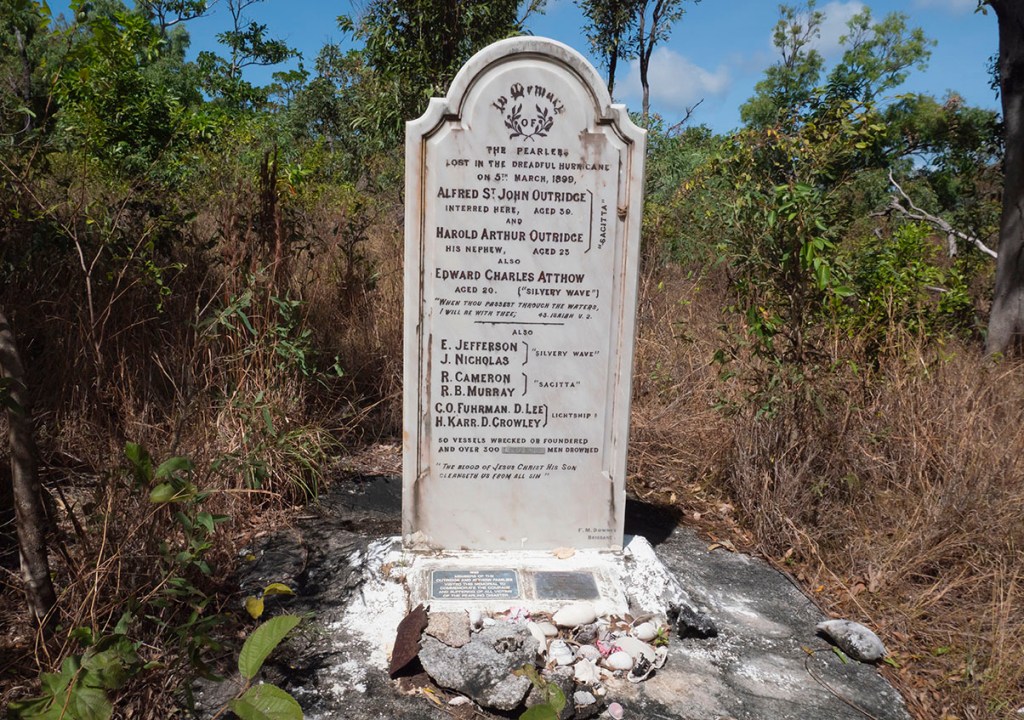
    Cyclone Mahina memorial at Cape Melville which marks the loss of 300 people during the storm. Photo: CJ Ison.

    © Copyright C.J. Ison / Tales from the Quarterdeck, 2024.

    Please enter your email address below to be notified of future blogs.