Tag: Maheno

  • Tales from the Quarterdeck

    Sixty bite-sized stories from Australia’s maritime past

    The melancholy loss of H.M.S Sirius off Norfolk Island by George. Raper. Source National Library of Australia 136507434-1

    I have just launched a new book titled Tales from the Quarterdeck: Sixty bite-sized stories from Australia’s maritime past. Sixty of the most popular posts have been reedited. In some cases, I’ve rewritten a couple and updated a few where new information has come to light since first writing them.

    For those who would value ready access to the stories in their bookcase, Tales from the Quarterdeck is available in Kindle ebook and paperback formats through Amazon.

    The stories are organised in chronological order, starting with the Tryall shipwreck off the Western Australian coast in 1622, and finishing with the Second World War exploits of the Krait. See below for a full list of the stories covered in the book.
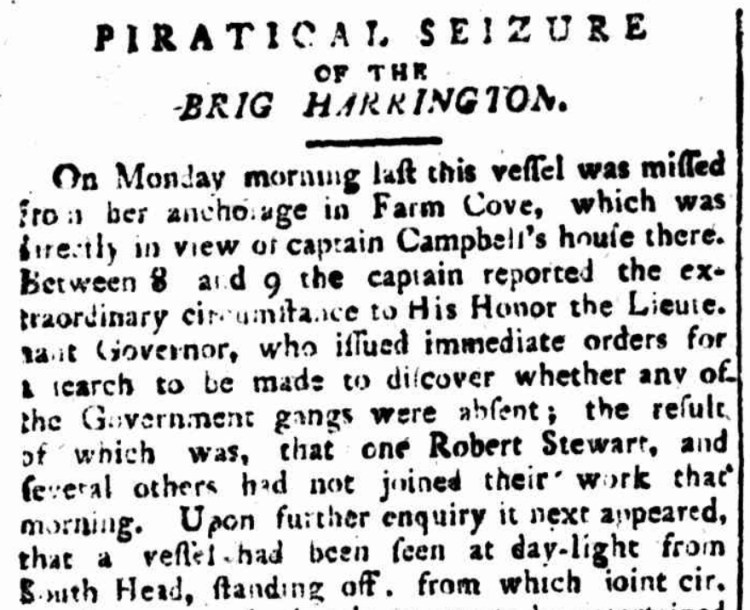
    Sydney Gazette 22 May 1808, p. 2.

    1622 – The Tryall: Australia’s earliest shipwreck

    1629 – The Batavia Tragedy

    1688 – William Dampier: Navigator, naturalist, writer, pirate

    1770  – The Endeavour’s Crappy Repair

    1788 – Loss of La Astrolabe and La Boussole, a 40-Year Mystery                        

    1789 – Bligh’s Epic Voyage to Timor

    1789 – HMS Guardian: All Hands to the Pumps

    1790 – The Loss of HMS Sirius

    1790 – Sydney’s First Desperate Escape

    1791 – HMS Pandora: Queensland’s earliest recorded Shipwreck

    1791 – William Bryant’s Great Escape

    1797 – The Loss of the Sydney Cove

    1803 – Loss of HMS Porpoise

    1808 – Robert Stewart and the Seizure of the Harrington

    1814 – Wreck of the Morning Star

    1816 – The Life and Loss of HMSC Mermaid

    1824 – The Brig Amity’s Amazing Career

    1829 – The Cyprus mutiny 

    1831 – The Caledonia’s perilous last voyage

    1833 – The Badger’s Textbook Escape

    1835 – The Loss of the Convict Ship Neva

    1835 – The Post Office in the middle of nowhere

    1835 – The Tragic Loss of George III

    1845 – The Cataraqui: Australia’s worst shipwreck

    1846 – The Peruvian’s Lone Survivor

    1847 – The Foundering of the Sovereign

    1850 – The Loss of the Enchantress: A first-hand account

    1851 – The Countess of Minto’s brush with Disaster

    1852 – The Bourneuf’s Tragic Last Voyage

    1852 – The Nelson Gold Heist

    Woodbury, Walter B. (Walter Bentley), 1834-1885. Hamlet’s Ghost, Sourabaya [Surabaya], Java [Boat with Passengers and Crew], ca. 1865. Walter B. Woodbury Photograph Collection (PH 003). Special Collections and University Archives, University of Massachusetts Amherst Libraries

    1854 – Bato to the Rescue 

    1854 – HMS Torch and the rescue of the Ningpo

    1856 – The Loss of the Duroc and the Rise of La Deliverance

    1858 – The Loss of the Saint Paul and its Horrific Aftermath

    1858 – Narcisse Pelletier, An Extraordinary Tale of Survival

    1859 – The Indian Queen’s Icy Encounter

    1859 – The Sapphire and Marina

    1863 – The loss of the Grafton: Marooned for twenty months

    1864 – The Invercauld shipwreck

    1865 – The CSS Shenandoah: Victoria’s link to the American Civil War

    1866 – The Loss of the SS Cawarra: Bad luck or an avoidable tragedy?

    1868 – The Bogus Count and Hamlet’s Ghost

    1871 – The Mystery of the Peri

    1872 – The Loss of the Maria, A Cautionary Tale

    1875 – The Tragedy behind the Gothenburg Medals

    1876 – The Catalpa rescue

    1876 – The Banshee’s Terrible Loss

    1878 – The Loch Ard Tragedy

    1884 – The Macabre case of the Mignonette

    1885 – The Douro and its Piratical Captain

    1889 – The Windjammer Grace Harwar

    1891 – The Spanish Silver of Torres Strait

    1893 – The Foundering of the SS Alert

    1895 – The Norna and the Conman Commodore

    1899 – Cyclone Mahina

    1911 – The Loss of the Mandalay

    1918 – The Orete’s Robinson Crusoe-like Castaway

    1935 – The Life and Loss of  the SS Maheno

    1943 – Surviving the Centaur Sinking

    1943 – The Amazing Krait

  • S.S. Maheno (1905 – 1935)

    The SS Maheno wrecked on K’Gari in 1935. Photo C.J. Ison..

       As anyone who has ventured across to K’Gari (Fraser Island) knows, the rusting wreck of the old luxury passenger liner SS Maheno makes an imposing presence on the long sandy beach, which serves as the island’s main highway. She had been swept ashore during a cyclone 90 years ago while on her way to be broken up in a Japanese scrapyard. It was an inglorious end for a steamer that was once one of the fastest luxury liners on the trans-Tasman run.

       The SS Maheno was built at William Denny and Brothers shipyards on the Clyde River in 1905 for the New Zealand-owned Union Steam Ship Company. She measured 122m in length and had a gross tonnage of 5,300 tons. The vessel was equipped with powerful steam turbine engines, which were revolutionary for the time. They could push her along at an impressive top speed of nearly 20 knots (36km/h).

    S.S. Maheno postcard. Courtesy State Library of Queensland.

       For much of her career, she carried cargo and passengers between Sydney, Melbourne, and Hobart in Australia, and Wellington, Auckland, and Dunedin in New Zealand. On one occasion, the Maheno made the dash from Sydney to Wellington in just under three days, a record that would remain unbeaten for 25 years. She also occasionally was called upon to carry passengers across the Pacific to San Francisco.

       The Maheno was not only fast, but she was also luxurious. She could accommodate 120 passengers in her sumptuous first-class cabins, 120 in second-class and 60 more passengers in third-class. The saloons, dining rooms and other public areas were beautifully appointed, harking back to a bygone era. She was a magnificent example of early 20th-century shipbuilding at its finest.

    SS Maheno, Saloon was luxuriously fitted out. Phot Courtesy State Library of Queensland.

       During the First World War, she served as a hospital ship for Australian and New Zealand forces. She ferried casualties from Anzac Cove to Malta for medical treatment during the Gallipoli Campaign. After the failure of Gallipoli she transported wounded New Zealanders back home before returning to Europe where the war raged on. Between 1915 and 1918, she made several trips back to New Zealand, returning wounded Kiwi soldiers home to their loved ones. She also carried thousands more sick and wounded men from the Western Front across the English Channel so they could receive attention in England.

       After the war, she returned to her regular duties crossing the waters between New Zealand and Australia. As she aged, newer ships took over her routes. However, she remained on the Melbourne – New Zealand run until the beginning of 1935 when she was finally retired. Throughout her 30 years of service, she was never involved in a serious accident, a testament to the ship and the captains who commanded her. But on her final voyage, that was about to change.   

    In July 1935, the Maheno left Sydney under tow by the steamer Oonah, another aging vessel destined for demolition in Japan. “Like a minnow towing a whale, the little Oonah set out to tow the Maheno, which towered above her like a giant,” is how the Daily Telegraph described the scene as the two tethered ships made their way down Sydney Harbour to begin their long voyage north.

    SS Maheno shortly after she ran aground. Photo Courtesy State Library of Queensland.

       The first few days were relatively uneventful as the Oonah towed the Maheno up the New South Wales coast.  But by the time they reached Queensland waters, the weather had turned nasty. The two ships were caught in a raging storm. Huge swells swept around them, howling gale-force winds ripped at the rigging, and the decks and superstructures were lashed by heavy rain. Despite the thick weather, the ships might have survived, but that was not to be.

       The Oonah reported via wireless that she was having problems with her steering. However, the message was garbled, and the call for help went unanswered. Then the captain of the Oonah sent another message reporting that the tow cable had parted and the Maheno was adrift. He also radioed that the two vessels were about 80 km off K’Gari when the Maheno was lost from sight.

       Efforts to save the two stricken ships swung into gear. The insurance underwriters dispatched a large salvage tug from Brisbane to assist the vessel, and the Oonah would be rescued without further incident. The Maheno, on the other hand, was now at the mercy of the storm without any means of propulsion. There were grave fears for the eight Japanese sailors on board. But they rode out the maelstrom, and eventually, the Maheno gently made landfall.

    The SS Maheno ship wreck on K’Gari. Photo: C.J. Ison.

       A search aircraft sent out from Maryborough spotted the former luxury liner driven broadside onto Fraser Island’s (K’Gari’s) long sandy beach about 30 km south of Indian Head. Her location was then relayed to the Oonah and the salvage tug heading up from Brisbane.

       The Japanese crew got ashore safely and were soon greeted by carloads of tourists, who had driven down from the nearby holiday village of Happy Valley to take a closer look at the beached ship.

       At first, there were some thoughts of refloating the Maheno, but they were swiftly abandoned, for she was firmly stuck in the sand. She remains there to this day, perhaps the most prominent and accessible shipwreck on the Australian coast.

    © Copyright C.J. Ison / Tales from the Quarterdeck, 2022.

    To be notified of future blogs, please enter your email address below.