Tag: Great Barrier Reef

  • Tales from the Quarterdeck

    Sixty bite-sized stories from Australia’s maritime past

    The melancholy loss of H.M.S Sirius off Norfolk Island by George. Raper. Source National Library of Australia 136507434-1

    I have just launched a new book titled Tales from the Quarterdeck: Sixty bite-sized stories from Australia’s maritime past. Sixty of the most popular posts have been reedited. In some cases, I’ve rewritten a couple and updated a few where new information has come to light since first writing them.

    For those who would value ready access to the stories in their bookcase, Tales from the Quarterdeck is available in Kindle ebook and paperback formats through Amazon.

    The stories are organised in chronological order, starting with the Tryall shipwreck off the Western Australian coast in 1622, and finishing with the Second World War exploits of the Krait. See below for a full list of the stories covered in the book.
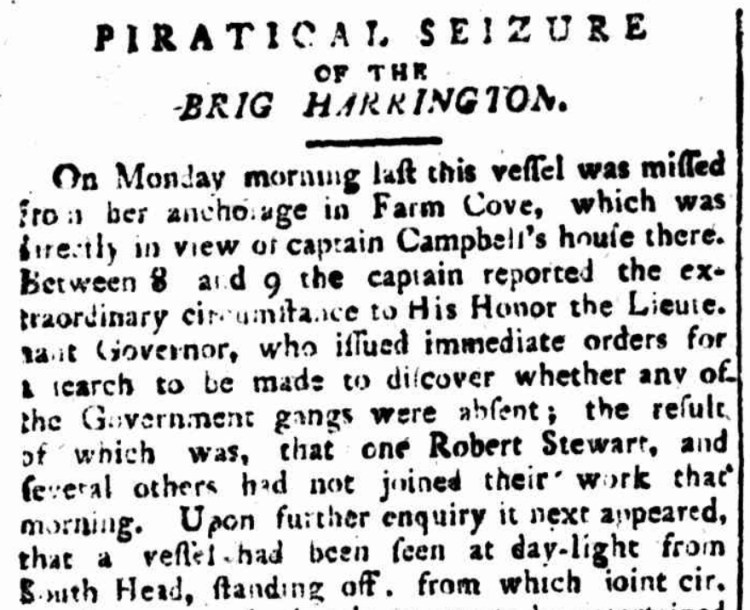
    Sydney Gazette 22 May 1808, p. 2.

    1622 – The Tryall: Australia’s earliest shipwreck

    1629 – The Batavia Tragedy

    1688 – William Dampier: Navigator, naturalist, writer, pirate

    1770  – The Endeavour’s Crappy Repair

    1788 – Loss of La Astrolabe and La Boussole, a 40-Year Mystery                        

    1789 – Bligh’s Epic Voyage to Timor

    1789 – HMS Guardian: All Hands to the Pumps

    1790 – The Loss of HMS Sirius

    1790 – Sydney’s First Desperate Escape

    1791 – HMS Pandora: Queensland’s earliest recorded Shipwreck

    1791 – William Bryant’s Great Escape

    1797 – The Loss of the Sydney Cove

    1803 – Loss of HMS Porpoise

    1808 – Robert Stewart and the Seizure of the Harrington

    1814 – Wreck of the Morning Star

    1816 – The Life and Loss of HMSC Mermaid

    1824 – The Brig Amity’s Amazing Career

    1829 – The Cyprus mutiny 

    1831 – The Caledonia’s perilous last voyage

    1833 – The Badger’s Textbook Escape

    1835 – The Loss of the Convict Ship Neva

    1835 – The Post Office in the middle of nowhere

    1835 – The Tragic Loss of George III

    1845 – The Cataraqui: Australia’s worst shipwreck

    1846 – The Peruvian’s Lone Survivor

    1847 – The Foundering of the Sovereign

    1850 – The Loss of the Enchantress: A first-hand account

    1851 – The Countess of Minto’s brush with Disaster

    1852 – The Bourneuf’s Tragic Last Voyage

    1852 – The Nelson Gold Heist

    Woodbury, Walter B. (Walter Bentley), 1834-1885. Hamlet’s Ghost, Sourabaya [Surabaya], Java [Boat with Passengers and Crew], ca. 1865. Walter B. Woodbury Photograph Collection (PH 003). Special Collections and University Archives, University of Massachusetts Amherst Libraries

    1854 – Bato to the Rescue 

    1854 – HMS Torch and the rescue of the Ningpo

    1856 – The Loss of the Duroc and the Rise of La Deliverance

    1858 – The Loss of the Saint Paul and its Horrific Aftermath

    1858 – Narcisse Pelletier, An Extraordinary Tale of Survival

    1859 – The Indian Queen’s Icy Encounter

    1859 – The Sapphire and Marina

    1863 – The loss of the Grafton: Marooned for twenty months

    1864 – The Invercauld shipwreck

    1865 – The CSS Shenandoah: Victoria’s link to the American Civil War

    1866 – The Loss of the SS Cawarra: Bad luck or an avoidable tragedy?

    1868 – The Bogus Count and Hamlet’s Ghost

    1871 – The Mystery of the Peri

    1872 – The Loss of the Maria, A Cautionary Tale

    1875 – The Tragedy behind the Gothenburg Medals

    1876 – The Catalpa rescue

    1876 – The Banshee’s Terrible Loss

    1878 – The Loch Ard Tragedy

    1884 – The Macabre case of the Mignonette

    1885 – The Douro and its Piratical Captain

    1889 – The Windjammer Grace Harwar

    1891 – The Spanish Silver of Torres Strait

    1893 – The Foundering of the SS Alert

    1895 – The Norna and the Conman Commodore

    1899 – Cyclone Mahina

    1911 – The Loss of the Mandalay

    1918 – The Orete’s Robinson Crusoe-like Castaway

    1935 – The Life and Loss of  the SS Maheno

    1943 – Surviving the Centaur Sinking

    1943 – The Amazing Krait

  • Wreck of the Morning Star – 1814

    Example of a Brig. Source: Winston’s Cumulative Loose-Leaf Encyclopedia 1918

       On Sunday, 3 July 1814, the merchant ship Morning Star sailed out of Sydney Harbour bound for Calcutta by way of Torres Strait and Batavia.  However, her voyage north ended abruptly on a coral reef south of the Forbes Islands off the far north Queensland coast. The vessel was a 140-ton Calcutta-built brig owned by the Indian-based trading house Lackersteen and Co. When she left Sydney, the crew numbered 37 men, a mix of European and Indian seamen, all under the command of Captain Robert Smart. Only six of them would survive the ordeal.

       No account exists of how the ship was lost, but from the location of the wreck site, it appears that Captain Smart was sailing within the Great Barrier Reef when he ran aground and had to abandon ship.

       Lieutenant James Cook had charted the route back in 1770, and he had only narrowly avoided total disaster on what he would name Endeavour Reef, some 450 km south of where the Morning Star was lost.

       The passage was fraught with danger. Thousands of reefs, many hidden just below the surface, dotted the coastal waters inside the Great Barrier Reef. However, the route had two distinct advantages. Rarely did a ship have to stray far from land, so refuge could be sought should disaster strike. There were also ample safe anchorages where ships could lay up overnight or when the conditions made it difficult to detect hazards lying in their path. Later, mariners would prefer a route that took them far out into the Coral Sea as they made their way north. They would cross the Barrier Reef near Raine Island or other similar narrow passages to pass through Torres Strait. This “outer passage” avoided the labyrinth of reefs but came with its own set of dangers.

    Booby Island. Image courtesy National Library of Australia

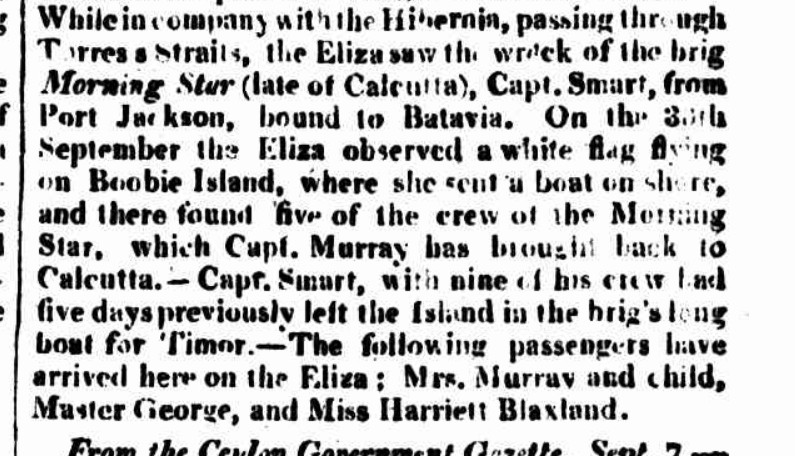
       On 30 September, the fully rigged Ship Eliza was sailing through Torres Strait when the lookout spotted a white flag flying from a staff on Booby Island.   The captain heaved to and sent a boat across to investigate. When it returned, she carried five marooned sailors from the Morning Star. This is the first recorded instance of shipwrecked sailors seeking refuge on Booby Island. Later, it would be stocked with food and water to assist shipwrecked sailors. A primitive post office with a logbook would also be established, so passing mariners could pass on the location of any uncharted reefs they may have discovered.

       The castaways had been among 15 men who had taken to the Morning Star’s longboat and made the perilous journey north after abandoning the wreck. They reported that Captain Smart and nine other sailors had left Booby Island five days earlier, intending to make for the Dutch port of Kupang on Timor Island. There is no record of them ever arriving there or anywhere else, for that matter.

    Morning Star reported wrecked on a reef south of Forbes Islands. Courtesy: Google Maps.

       The remaining 22 members of the Morning Star’s crew were thought to have perished as a result of the wreck or some calamity that befell them sometime afterwards. But four years later, another Morning Star survivor was found living with the Islanders on Murray Island on the Eastern entrance to Torres Strait.   

    The Claudine had anchored off Murray Island in September 1818 and sent a jolly boat ashore to meet with the islanders. To the astonishment of all, an Indian sailor was there to greet them in Hindustani. Fortunately, one of the sailors in the jolly boat spoke the language and was able to translate for the others. He told the sailors from the Claudine that he had been on the Morning Star when it ran aground and that since then he had been living with the Murray Islanders. He had learned their language and been accepted into their community, but the circumstances of his arrival on the island and the fate of his shipmates were not recorded. When the Claudine set sail, the Indian castaway was with them.

       The Morning Star is just one of many hundreds of vessels, large and small, that came to grief in Queensland’s northern waters from the late 18th and into the early part of the 20th Century.

    © Copyright C.J. Ison / Tales from the Quarterdeck, 2025.

    Please enter your email address below to be notified of future blogs.

  • An 1829 Narrative of a Voyage Through Torres Strait

    A ship passing through the Great Barrier Reef at Raine Island. Illustrated Australian News for Home Readers.

    Passing through the Great Barrier Reef during the age of sail must have been both terrifying and exhilarating in equal parts.    The following account, written by an anonymous passenger on a ship sailing through Torres Strait in 1829, was published in the Sydney Times on 19 Sept 1834.   It is a fascinating read and has been posted with only minor alterations to improve readability.

    A Narrative of a Voyage Through Torres Strait – 1829

    “Perhaps there is no part of the navigable world which offers the adventurous mariner a more terrific picture than the passage through Torres Strait — none more mis-represented — and none contemplated with greater horror. … There are three routes by which the passage through Torres Strait can be made, known among nautical men as the Inner, Middle, and Outer passages.

    Of these, the preference is generally given to the first, both because it affords convenient anchorage for the night, when it would be dangerous for a vessel to continue her course among the reefs, and because the mainland of New Holland is constantly in sight, and consequently easily attainable in case of wreck. Yet this of all is the most dangerous and intricate, and never could be preferred were it not for the reasons just mentioned.

    The middle passage was that through which the writer of these remarks passed in 1829, and if ever a satisfaction from disappointment were realised, it was in the accomplishment of this voyage, which had been before regarded as holding out but a mere chance of escape from the miseries of shipwreck.

    Detail of the 1846 Barrier Reef chart showing Pandora, and Raine Island Entrances – Courtesy: National Library of Australia.

    On the fourteenth day after our departure from Sydney, the man at the mast head called out reefs on the “starboard bow.”   Everyone was anxiously looking for this intelligence, for on that morning, the altitude of the sun proved we were within a few leagues of them.

    The reef soon proved to be the “great barrier” in latitude 11° 54 south, reaching across the ocean in a direction from the N. W. to the S. E. until the surf created by its breakers was lost to the sight beneath the horizon.

    All sail was immediately crowded on the vessel in order to make the entrance of the reef by noon, when the sun would not prevent the bed of the shoals from being distinctly marked.

    By noon, we had reached the spot we had desired and were within half a mile of the reef, which from its immense extent seemed to shut out all intercourse with the opposite part of the ocean.

    As we approached it more closely, we discovered that it contained two or three small openings, or passages of about a cable’s length in breadth, and through one of which our course was directed.

    The wind, was high, and there was a considerable swell, but beyond the wall-edge of the mighty reef, which served as a breakwater to the ocean, and upon which the whole volume of water was thrown, all was calm as a basin; — upon its broad surface there was but a ripple, while the rush and roar of waters, breaking as it were in anger on its side, presented a scene of mingled horror and beauty.

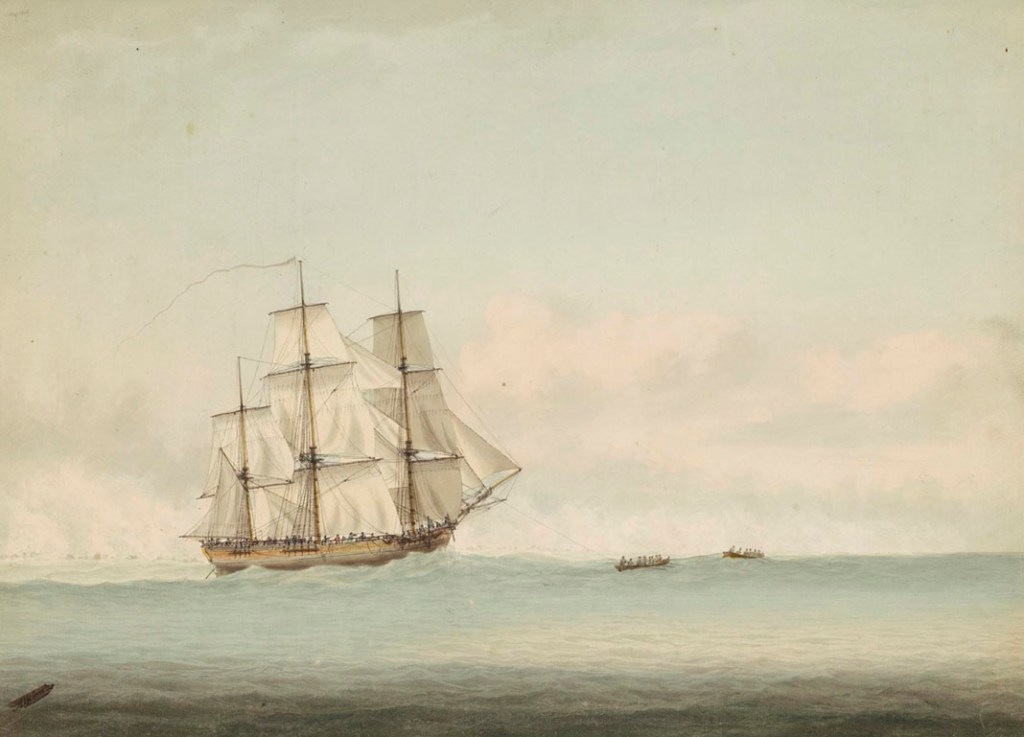
    In 1770, Cook charted what would become known as the Inner Passage. The Endeavour was nearly lost in the attempt. Painting by Samuel Atkins (1787-1808). National Library of Australia.

    We sailed on, we were close upon it and could fully discover the small opening through which our vessel was to pass. There was a breathless silence throughout the ship, save at intervals the voice of the captain giving instructions to the man at the helm.

    A deviation of a hair’s breadth and we might be lost forever. On either side the narrow passage was total and instant destruction; our vessel entered, and as she glided into the smooth channel, she felt the force of the current more powerfully, which being concentrated and brought into so close a space, swept her through with a velocity that no wind, however violent, could effect.

    It occupied but a quarter of an hour to pass through this channel, which formed the great danger of our voyage; but during that time, I had gone to the main top with a military officer who was on board to look upon the reefs.

    What a splendid scene was there; I had seen nothing like it before in nature or art, and perhaps never shall again. As far as the eye could reach, the sea was filled with white coral reefs, whose surface was just covered with water, and partaking of its hue, presented to the view the appearance of beautiful meadows so slightly inundated as to preserve their colouring.

    HMS Pandora came to grief when it tried to pass through the Great Barrier Reef in 1791. Photo courtesy SLQ.

    The shades of green produced by the sea flowing upon the white coral were most beautiful and variegated, and in proportion as the reefs deepened or became shallow, the colouring was diversified.

    But the most striking feature in the scene was the snow-like bordering which encompassed the whole, keeping out as it appeared, all influx of the ruder wave, while that upon the surface of the reef was as a calm lake. This was produced by the breaking of the sea on the sides of the reefs, and became more conspicuous in proportion as the coral approached the surface of the water.

    What a field was here for the contemplation of the artist or the philosopher, whether their time were given to look on Nature’s beauty, girt as it was with desolation, or in searching on the reefs, amid the conflux of currents, for the materials of science, they would be alike repaid for the anxiety the anticipated danger of such a route might produce.

    For myself, I can say that the impression of that picture is fresh upon me, and rests alone within a memory filled with the recollections of that beautiful voyage.”

    © Copyright C.J. Ison / Tales from the Quarterdeck, 2025. If you wish to be notified when new stories are posted, please enter your email address below.

  • HMS Pandora: Queensland’s earliest recorded shipwreck – 1791

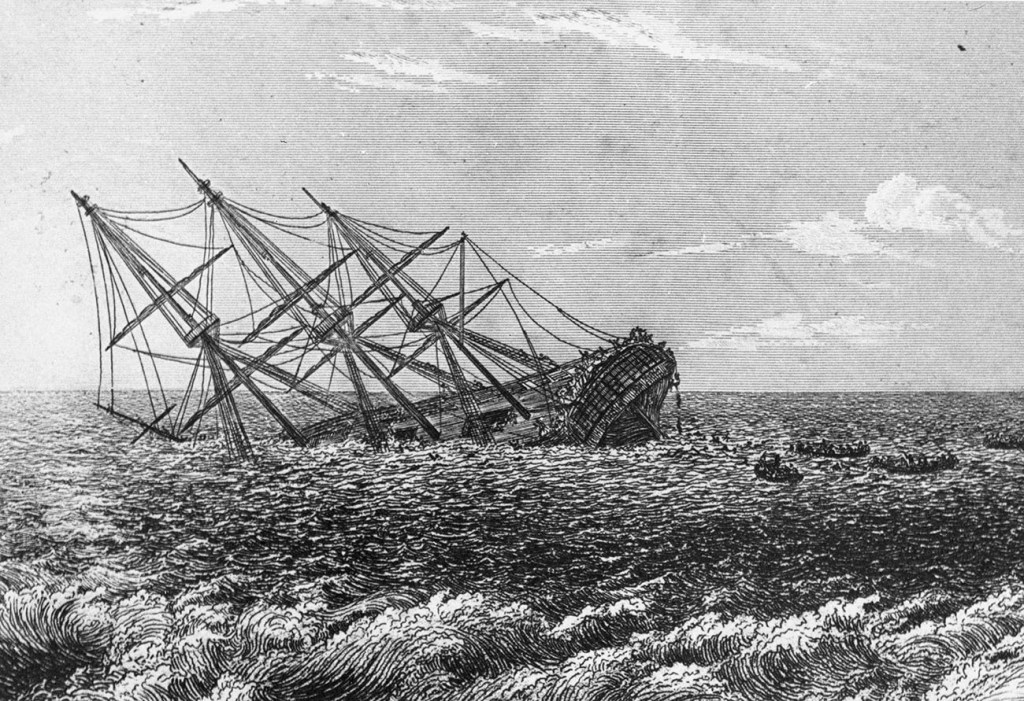
    H.M.S. Pandora in the act of foundering’ . An etching by Lt-Col. Batty after a sketch by Peter Heywood from ‘The Mutiny and Piratical Seizure of H.M.S Bounty’ first edition 1831. Photo courtesy SLQ.

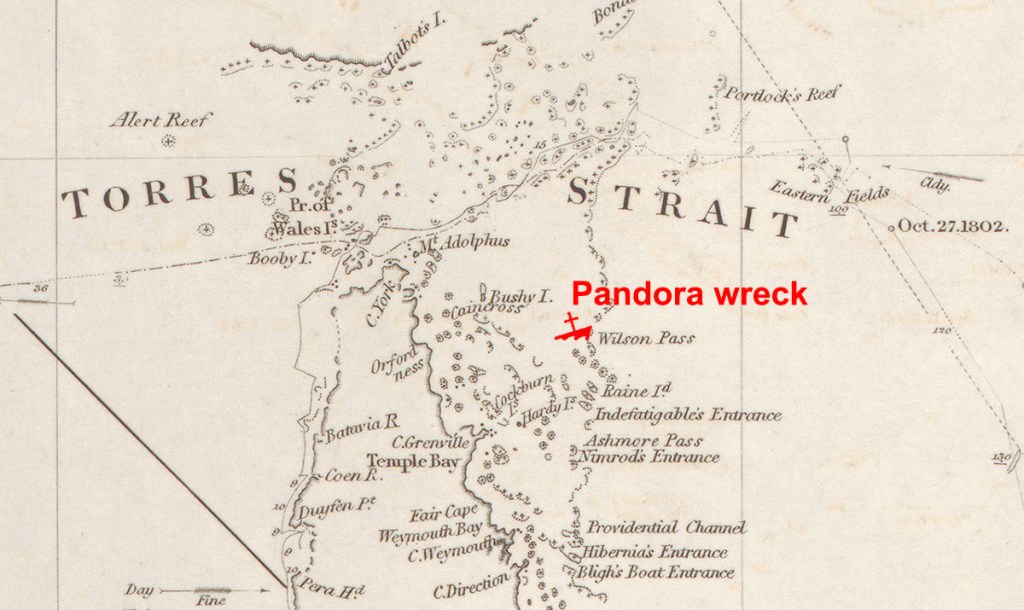
    In August 1791, HMS Pandora was returning to England, having tracked down and captured 14 of the Bounty mutineers in Tahiti. But disaster struck on the night of the 29th, as the Pandora was trying to find a way through the Great Barrier Reef. The ship’s surgeon, George Hamilton, left a nerve-wracking account of the incident in his memoir, “A Voyage Round the World in His Majesty’s Frigate Pandora”, published in 1793 after his return to England.

       Hamilton wrote that on the night of 29 August, a boat sent earlier in the day by the Pandora’s captain, Edward Edwards, to scout for a passage through the maze of reefs had finally returned to the ship. As the crew was hauling it out of the water, the 24-gun frigate unexpectedly struck a submerged coral reef. Captain Edwards immediately ordered the crew to set the sails as he tried to back off the outcrop, hoping to use wind power alone. When that failed to dislodge his ship, he ordered a boat to be made ready to take an anchor out so he might kedge the vessel off. But by the time the anchor was in place and the crew ready to winch, it was already too late.

       The carpenter had examined the hold and found that the Pandora’s hull had sprung a serious leak. In the 20 minutes they had been aground, the water had risen to nine feet (2.7 m). All hands were immediately engaged in efforts to save the ship from sinking. Sailors began bailing at each of the hatchways, and several of the Bounty mutineers were unshackled to help man the bilge pumps.

    Map showing HMS Pandora wreck location (approx).

       “It blew very violently, and she beat so hard upon the rocks, that we expected her, every minute, to go to pieces,” Hamilton recalled. “It was an exceedingly dark, stormy night, and the gloomy horrors of death presented us all around, being everywhere encompassed with rocks, shoals, and broken water. About ten [o’clock] she beat over the reef, and we let go the anchor in fifteen fathoms of water.

       Not yet ready to give up on his ship, Captain Edwards ordered the guns thrown overboard and, at the same time, had some of his men prepared the topsail to be hauled under the ship’s bottom in a vain effort to stem the leak. But before they could get the sheet of canvas over the side, one of the bilge pumps failed, and the water began flowing into the hold faster than it could be bailed out. The topsail was abandoned as every hand was set to work, baling to stop the ship from sinking.

       Soon the Pandora began listing, and the crew experienced their first casualties. A canon broke loose and rolled across the deck, crushing a sailor, while a topmast came crashing down on deck, killing another. The crew laboured at the pumps and bailed with buckets through the night to keep the ship afloat. An ale cask was tapped, and its contents were regularly served out to the men to keep their spirits up.

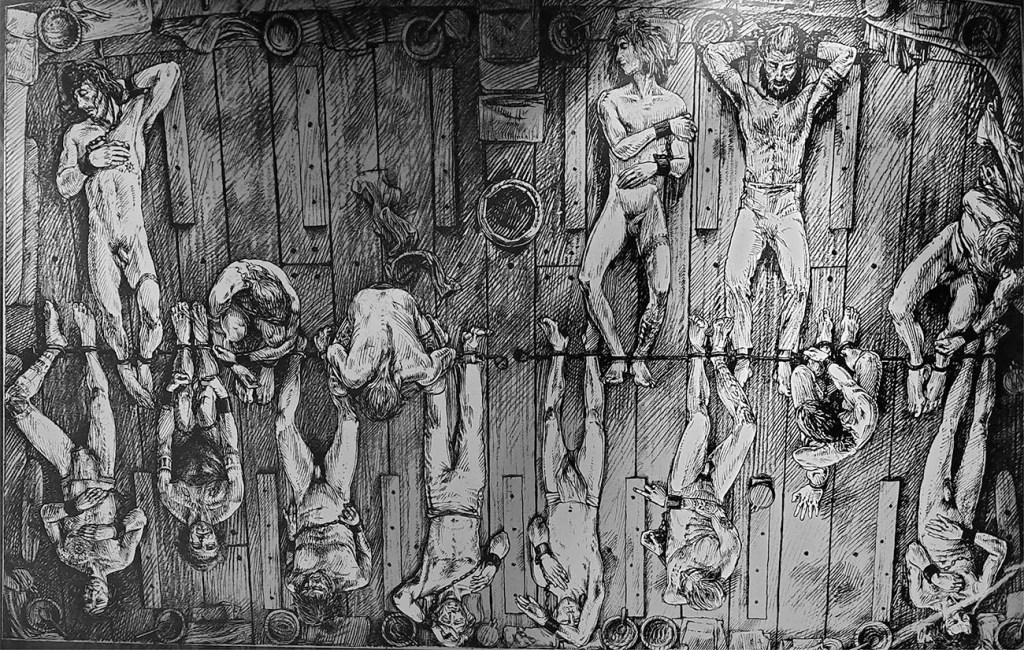
    Bounty Mutineers accommodation on HMS Pandora. Source: Museum of Tropical Queensland, Townsville.

       Then, about half an hour before dawn, Captain Edwards called his officers together to discuss their next move. It was clear to all that the ship was doomed and that their efforts should shift from saving the ship to preserving the lives of the crew. The Pandora’s four boats had been put over the side earlier in the night, and they were sheltering in the lee of the reef, their coxswains awaiting further orders. Spars, booms, hen-coops and anything else that floated were cut free so that the men might find something to keep themselves from drowning when the ship inevitably sank.

       Hamilton wrote that Captain Edwards ordered that the remaining prisoners be released from their irons. However, it came too late for some of the mutineers who were still shackled in place in their makeshift prison they called “Pandora’s Box.” They went down with the ship.   

    The water began pouring in through the gun ports, causing the frigate to list even further. As the captain and crew scrambled to jump overboard, the Pandora heeled over and sank almost immediately. The boats came to the rescue of the sailors clinging to the wreckage in the water, but for many help came too late. “The cries of the men drowning in the water was at first awful in the extreme,” Hamilton wrote. But as the men disappeared below the surface, the screams faded and then died away entirely.

    Loss of the Pandora on the Great Barrier Reef. Source: Tales of Shipwrecks and Adventures at Sea, 1856.

       As morning heralded a new day, a small sandy cay could be seen about two and a half nautical miles (5 km) to the southeast. Edwards ordered the boats to make for the one tiny speck of land in that vast expanse of sea. The captain took stock of their provisions and ordered a guard to be placed over the remaining surviving mutineers. Fortunately, someone had the forethought to load a barrel of water, a small keg of wine, and some sea biscuits onto one of the boats. To that haul of supplies could be added a few muskets and cartouche boxes of ammunition, along with a hammer and a saw. Not much to preserve life in such remote and hostile waters. Edwards thought their only chance of survival would be to make for the Dutch trading outpost on Timor Island, some 1200 nautical miles (1400 km) away.

       Edwards forbade anyone from drinking on that first day, calculating that they would have only enough water to last 16 days at two small cups per person per diem. They spent two days on the cay preparing the boats for the voyage that lay ahead. Floorboards were torn out and affixed to the sides of the boats, around which canvas was wrapped to increase the freeboard.

       Before leaving, the sailing master, George Passmore, was sent back to the wreck site to see if anything might have floated free in their absence.   He returned two hours later with a small assortment of salvaged materials and a cat that he found clinging to the top-gallant mast-head.

       On the third morning, they set off west towards Torres Strait and beyond to the Dutch settlement of Kupang. Edwards had hoped to refill their water cask at one of the islands dotting Torres Strait before they headed into the expanse of the Arafura Sea. However, an encounter with Islanders, which began friendly enough, inexplicably ended abruptly with a volley of arrows and musket fire being exchanged. They stopped again at Prince of Wales Island (Muralag), where this time they were able to fill their water cask without incident. On 16 September, after an arduous voyage lasting about a fortnight, the four boats pulled into Kupang Harbour. From there, they were taken to Batavia (present-day Jakarta), where Edwards purchased a ship for the return to England.

    Canon recovered from HMS Pandora wrecked on the Great Barrier Reef on display at the Museum of Tropical Queensland, Townsville.

       The shipwreck directly cost the lives of 31 sailors and four mutineers. Another 16 died from disease during or after their stay in Batavia. Of the 134 men who left England on the Pandora, only 78 made it home alive. The ten prisoners who survived the wreck were tried for mutiny. Four were acquitted, two received pardons, one got off on a technicality, and three were hanged. Captain Edwards faced a court-martial to answer for the loss of his ship, but he was found not to have been at fault.   

    The Museum of Tropical Queensland in Townsville has a world-class exhibition of artefacts recovered from the wreck.

    © Copyright C.J. Ison / Tales from the Quarterdeck, 2024.

    Please enter your email address below to be notified of future blogs.

  • Bato to the Rescue – 1854

    Shipwreck survivors take to their boat.. Source: Tales of Shipwrecks and Adventures at Sea, 1856.

       In 1854, the fully-rigged Dutch ship Bato rescued not one, not two, but three separate parties of shipwreck survivors whose ships had come to grief in separate mishaps in Australia’s northern waters. In the space of a few weeks, these three ships all ran aground while attempting to navigate the treacherous waters of the Great Barrier Reef and the Torres Strait.

       The first casualty was the 521-ton ship Fatima. On 3 June, the Fatima left Melbourne bound for Singapore via Torres Strait. She made good time sailing up the east coast until, on 26 June, she was within sight of Raine Island. The low-lying island and its distinctive 20-metre-tall tower marked a channel through the Great Barrier Reef and the start of a well-charted passage through Torres Strait.

       Then, just 12nm (20 km) south of Raine Island, her voyage ended abruptly and violently when she crashed into the Great Detached Reef. The Fatima could not be saved, and her captain and crew were forced to take to the boats to save their lives. A refuge of sorts was close at hand, so they struck out for Raine Island off in the distance. There they remained, subsisting on a plentiful supply of seabird eggs while they waited to be rescued.

       A couple of days after the Fatima left Melbourne, the 391-ton barque Elizabeth also set sail from that same port. She was bound for Moulmein, Burma, and also intended to pass through Torres Strait by the Raine Island passage. However, disaster struck on 28 June when the barque ran aground on a small coral outcrop about 28nm (55 km) south of Raine Island. Fortunately, no lives were lost, and after a considerable amount of effort, the crew managed to get the ship off the reef and back into deep water. However, the hull had been breached, and Captain Churchill realised that his ship was taking on more water than the pumps could remove. Churchill made the difficult decision to abandon his ship, and he and his men took to the boats. They made their way through Torres Strait and arrived at Booby Island five days later. The island was marked on charts of the day as a haven for shipwrecked sailors where a supply of food and fresh water could be found.

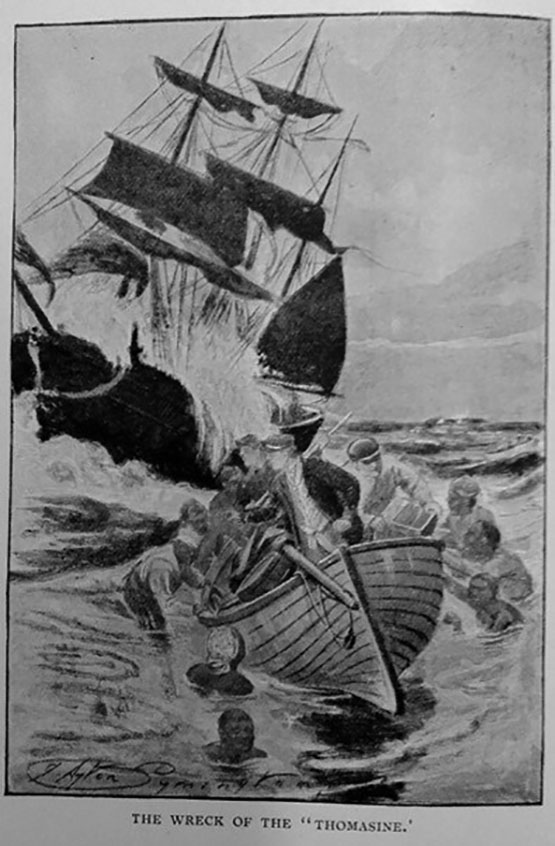
    The Wreck of the Thomasine. Courtesy State Library of Queensland.

       The third ship, the Thomasine, departed Sydney on 8 June bound for Batavia. She also intended to cross through the Torres Strait. But she ended her northerly run up the coast on 19 June when she struck an uncharted reef about 270 km east of present-day Port Douglas.

       Her master, Captain Holmes would later recall that around 8 o’clock on the evening of the 19th, the ship grazed a submerged reef where no such obstruction should have existed. He had been on deck at the time and had immediately gone to his cabin to consult his chart, to confirm what he suspected. While he was standing at his chart table, still consulting his map, the look-out called, “Breakers ahead.” Captain Holmes raced back on deck to the daunting sight of a long line of breaking waves ahead that extended around to his left and right, almost completely encircling the ship.

       Holmes and his crew kept the Thomasine from running aground during the night by tacking back and forth in the open water between the reefs. The next morning he saw how dire their situation was. The ship was trapped by an almost unbroken ring of breaking waves, denoting the presence of submerged coral reefs. Reefs that were absent from the charts but have since been added and bear the name Holmes Reefs.

       The wind began to rise and Holmes realised his only chance of escape was to try to make it through one of the narrow gaps he could see in the otherwise extended line of surf. He selected one, hoping it would allow his ship to reach the safety of deep water beyond. Unfortunately, the channel proved too shallow, and the Thomasine struck heavily, becoming stuck. Unable to get the Tomasine free, the captain made the difficult decision to abandon ship. The crew then readied two boats with as much food and water as they dared carry.

       Captain Holmes was doubly concerned as they tried to escape the ship and the surrounding reef. Not only did he feel responsible for his crew, but he was also accompanied by his wife and three children, the youngest of whom was just four months old. He divided his crew evenly between the two boats for the voyage north to Booby Island and a cache of stores. However, one sailor died during the struggle to get the boats through the roiling seas surging around the ship. Holmes   

    Over the next fortnight or so, the 18 castaways steadily made their way north, surviving on short rations and less than one litre of water per day from a small cask taken from the ship. But by 6 July, they had covered about 800 km and had reached Bird Island in the Torres Strait. Captain Holmes calculated that it would only take them another one or two days to reach Booby Island.  

    Map showing location of the three shipwrecks in Torres Strait. Courtesy Google Maps.

       It was around this time, the Dutch ship Bato was passing through the same waters. She had sailed from Hobart on 10 June and steadily made her way up the east coast of Australia. As Captain Brocksmit approached the Raine Island entrance, he sighted the Fatima castaways camped on the island. Ten men were taken on board while the rest followed in the Bato’s wake in their own boat until they had reached the Middle Bank well inside the Great Barrier Reef.

       The next day, 6 July, the Bato’s captain came across the survivors from the Thomasine off Bird Island and made room for them on his ship as well. Finally, the following day, the castaways from the Elizabeth were spotted on Booby Island, where they had landed four days earlier.

       Now carrying as many as 60 additional people, the Bato put the dangerous waters of Torres Strait behind her. Captain Brocksmit made his way along the Indonesian archipelago, arriving in Batavia on 25 July 1854. The survivors were disembarked, and the captains were faced with the unenviable task of notifying their respective ship owners of their losses.

    © Copyright C.J. Ison / Tales from the Quarterdeck, 2023.

    To be notified of future blogs, please enter your email address below.