Sixty bite-sized stories from Australia’s maritime past
The melancholy loss of H.M.S Sirius off Norfolk Island by George. Raper. Source National Library of Australia 136507434-1
I have just launched a new book titled Tales from the Quarterdeck: Sixty bite-sized stories from Australia’s maritime past. Sixty of the most popular posts have been reedited. In some cases, I’ve rewritten a couple and updated a few where new information has come to light since first writing them.
For those who would value ready access to the stories in their bookcase, Tales from the Quarterdeck is available in Kindle ebook and paperback formats through Amazon.
The stories are organised in chronological order, starting with the Tryall shipwreck off the Western Australian coast in 1622, and finishing with the Second World War exploits of the Krait. See below for a full list of the stories covered in the book.
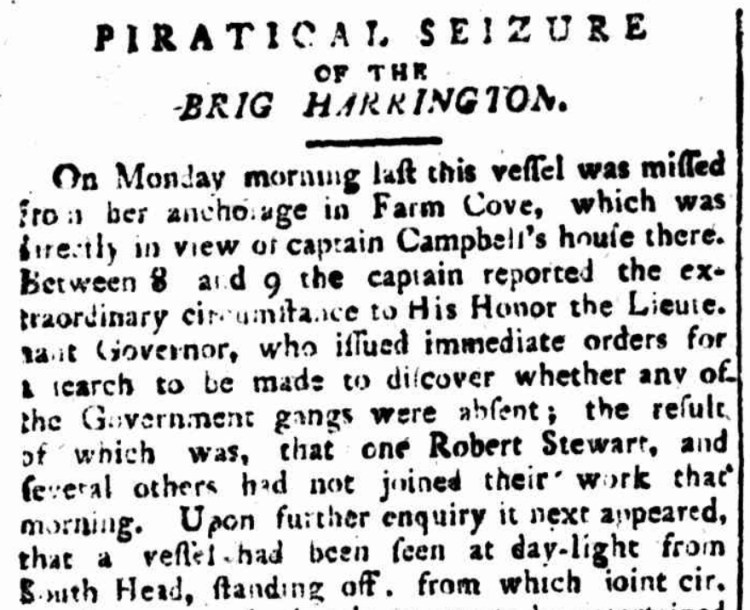
Sydney Gazette 22 May 1808, p. 2.
1622 – The Tryall: Australia’s earliest shipwreck
1629 – The Batavia Tragedy
1688 – William Dampier: Navigator, naturalist, writer, pirate
1770 – The Endeavour’s Crappy Repair
1788 – Loss of La Astrolabe and La Boussole, a 40-Year Mystery
1789 – Bligh’s Epic Voyage to Timor
1789 – HMS Guardian: All Hands to the Pumps
1790 – The Loss of HMS Sirius
1790 – Sydney’s First Desperate Escape
1791 – HMS Pandora: Queensland’s earliest recorded Shipwreck
1791 – William Bryant’s Great Escape
1797 – The Loss of the Sydney Cove
1803 – Loss of HMS Porpoise
1808 – Robert Stewart and the Seizure of the Harrington
1814 – Wreck of the Morning Star
1816 – The Life and Loss of HMSC Mermaid
1824 – The Brig Amity’s Amazing Career
1829 – The Cyprus mutiny
1831 – The Caledonia’s perilous last voyage
1833 – The Badger’s Textbook Escape
1835 – The Loss of the Convict Ship Neva
1835 – The Post Office in the middle of nowhere
1835 – The Tragic Loss of George III
1845 – The Cataraqui: Australia’s worst shipwreck
1846 – The Peruvian’s Lone Survivor
1847 – The Foundering of the Sovereign
1850 – The Loss of the Enchantress: A first-hand account
1851 – The Countess of Minto’s brush with Disaster
1852 – The Bourneuf’s Tragic Last Voyage
1852 – The Nelson Gold Heist
Woodbury, Walter B. (Walter Bentley), 1834-1885. Hamlet’s Ghost, Sourabaya [Surabaya], Java [Boat with Passengers and Crew], ca. 1865. Walter B. Woodbury Photograph Collection (PH 003). Special Collections and University Archives, University of Massachusetts Amherst Libraries
1854 – Bato to the Rescue
1854 – HMS Torch and the rescue of the Ningpo
1856 – The Loss of the Duroc and the Rise of La Deliverance
1858 – The Loss of the Saint Paul and its Horrific Aftermath
1858 – Narcisse Pelletier, An Extraordinary Tale of Survival
1859 – The Indian Queen’s Icy Encounter
1859 – The Sapphire and Marina
1863 – The loss of the Grafton: Marooned for twenty months
1864 – The Invercauld shipwreck
1865 – The CSS Shenandoah: Victoria’s link to the American Civil War
1866 – The Loss of the SS Cawarra: Bad luck or an avoidable tragedy?
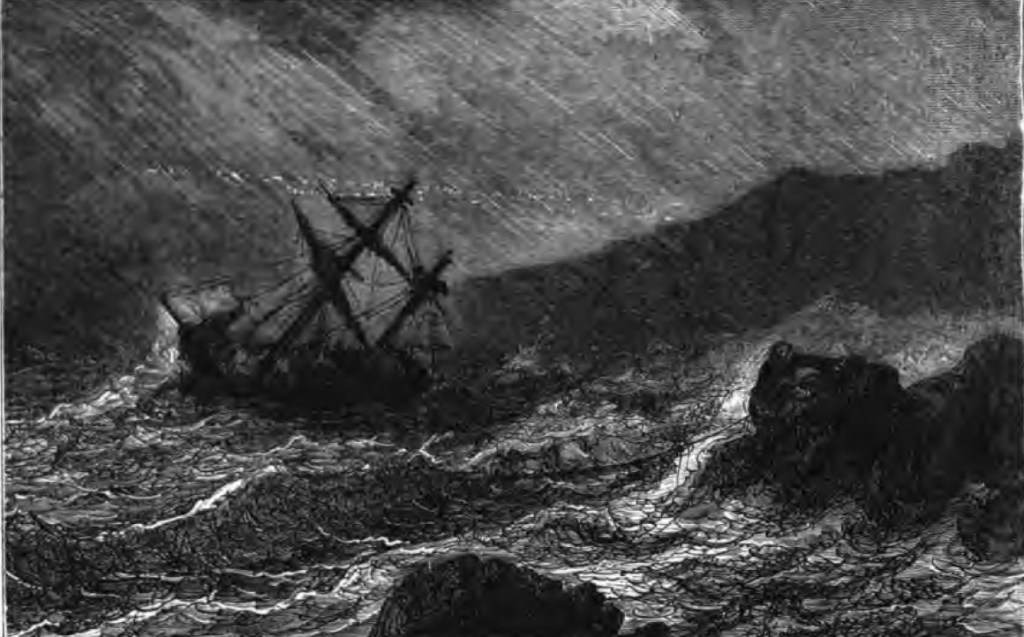
Illustration of the Invercauld. Source: The Castaways, Andrew Smith, 1866.
In recent years, the loss of the Invercauld and its tragic aftermath has been held up as an example of what can go horribly wrong when leadership fails. In contrast to the wreck of the Grafton, on the same island at the same time, where all five men survived, only three of the Invercauld’s 25-man crew lived through the ordeal. The considerable loss of life has sometimes been blamed on the captain’s failure of leadership. But that harsh criticism is based largely on a version of events contained in a memoir written by one of the survivors, some 60 years after the event. Robert Holding had little to say in praise of his captain, but his chronicle stands in stark contrast to the only contemporary account left by one of the other survivors. His story is one of grinding struggle against the elements, a hostile landscape, and a scarcity of food.
The Invercauld was a 888-ton merchant ship under the command of Captain George Dalgarno. She sailed from Melbourne on 3 May 1864, bound for the Peruvian port of Callao to load up with guano.
Almost from the outset, they were plagued by foul weather. As they bore southeast in a long, sweeping arc that would take them deep into the South Pacific, they battled strong winds, high seas, rain, sleet, and snow. Then, a week after leaving Melbourne, the lookout sighted the dim outline of land ahead through the pouring rain. Dalgarno took the sighting to be the Auckland Islands, south of New Zealand, at 61 degrees south. He had been unable to take any sightings due to the weather, but had calculated that he was likely approaching their southernmost point. He altered course a few degrees south to clear them with a safe margin. To Dalgarno’s great surprise and alarm, the lookout called land ahead again. Dalgarno’s navigation had been off more than he had anticipated. He realised, too late, that his ship was in mortal danger, for they were being blown towards a lee shore. By now, the sun had set as the storm continued to rage around them. He spied what he thought was a narrow passage separating two islands and decided that this was his best chance to save the ship. He brought the Invercauld around to the north and heaped on as much sail as he dared, hoping to pass unscathed through the channel into calmer waters beyond.
High cliffs loomed out of the inky darkness on the starboard side, and then they were caught in breaking surf. Dalgarno lost all control of the ship. She ran aground broadside on a rocky shore. Huge waves crashed over the deck. There was no time to get the lifeboat over the side, for the Invercauld almost immediately broke apart under the pounding. The men ditched their boots and heavy oilskins as the ship came apart under their feet. Twenty-five men were swept into the turbulent sea to be washed ashore in a small cove backed by towering cliffs. Only 19 men survived the sinking, and all were battered and bruised from being bashed against rocks and wreckage.
The sodden survivors huddled together for warmth during that first freezing night as the sea spray, rain, and sleet beat upon them. In the early hours, they gathered some of the wreckage to build a lean-to, which gave them some shelter from the worst of the elements. When the sun rose, they got their first proper look at where they had been tossed ashore. They were trapped on a narrow crescent of rocky beach hemmed in on three sides by towering cliffs. The only food they had been able to find washed ashore from the wreck was a kilogram of salt pork and a kilogram bag of sea biscuits, not much to sustain 19 cold and hungry men. One item that would aid them in the future, once it had dried out, was a soggy box of matches that the steward had found in his pocket.
To remain where they were would spell the end of them all. The only option they had was to scale the cliffs and see what lay at the top. The climb would claim another sailor who slipped and fell to his death. When Dalgarno and the 17 surviving crew reached the top, they found an inhospitable landscape of dense scrub and coarse grass as far as they could see. Dalgarno thought they would have a better chance of surviving on the more sheltered eastern side of the island. So, off they set, barefoot through the thick vegetation. It took them two weeks to cross the island. Two weeks of pushing through dense scrub, of being lashed by freezing wind and rain, of barely subsisting on a diet of roots and leaves, but for one day, when they caught a small pig.
Newcastle Journal, 1 Aug 1865, p. 3.
Four men died from fatigue and exposure during the long trek. Six others broke away from the main group led by Dalgarno, wanting to return to the shipwreck site. Holding was one of them, but he rejoined the main group a few days later. The other five were never seen again.
By the time they reached a bay on the eastern shore, the party had been reduced to just nine men. There, they found an abundance of limpets fixed to the rocky shore and feasted as only starving men could. But even that plentiful supply was eventually exhausted. They decided they would cross a ridge to the south, hoping they would find another bay filled with shellfish.
As they crested the ridge, Dalgarno saw two huts on the edge of a bay. They were the first signs of civilisation they had seen since being tossed ashore. When they reached the huts, they found them to have been abandoned, but they provided welcome shelter from the winter elements and the hope that someone might return during the summer months. In fact, the huts were the remains of Endeby’s short-lived whaling station on Ross Bay, which had lain abandoned for the past decade.
For a time, their fortunes improved. For men who had nothing, the huts were a treasure trove of rubbish that could be repurposed into useful tools of survival. Empty tin cans became boiling pots for limpets. A sheet of iron served as a hotplate over their cooking fire. The discovery of an old adze and hatchet made cutting firewood so much easier. On their first day, they caught a seal, which they feasted on that night. Unfortunately, that was the only one they found, so their diet primarily consisted of limpets, wild roots and greens.
When they had exhausted this bay of shellfish, remaining any longer seemed pointless. Dalgarno and three others remained at Ross Bay while Andrew Smith, the chief mate and narrator of the only contemporary account of the wreck and its aftermath, Robert Holding and the other two sailors set off to find a better source of food further along the coast. By the time they found a suitable cove and returned to collect the others, only Captain Dalgarno was still alive. The others had succumbed to the cold and starvation. Two more would die in the coming months, leaving just Dalgarno, Smith and Holding still alive.
Again, their fortunes seemed to improve, at least for a while. After hunting down a couple of seals, they constructed a canoe by stretching the skins over a sapling frame. Now they were able to venture further afield in their relentless search for food. Surviving on a diet of fish, sea birds and the occasional seal, they made it through to summer, but that brought a new set of miseries. Sandflies savaged them, and any seal meat or fish left uneaten for more than a day or so became fly blown.
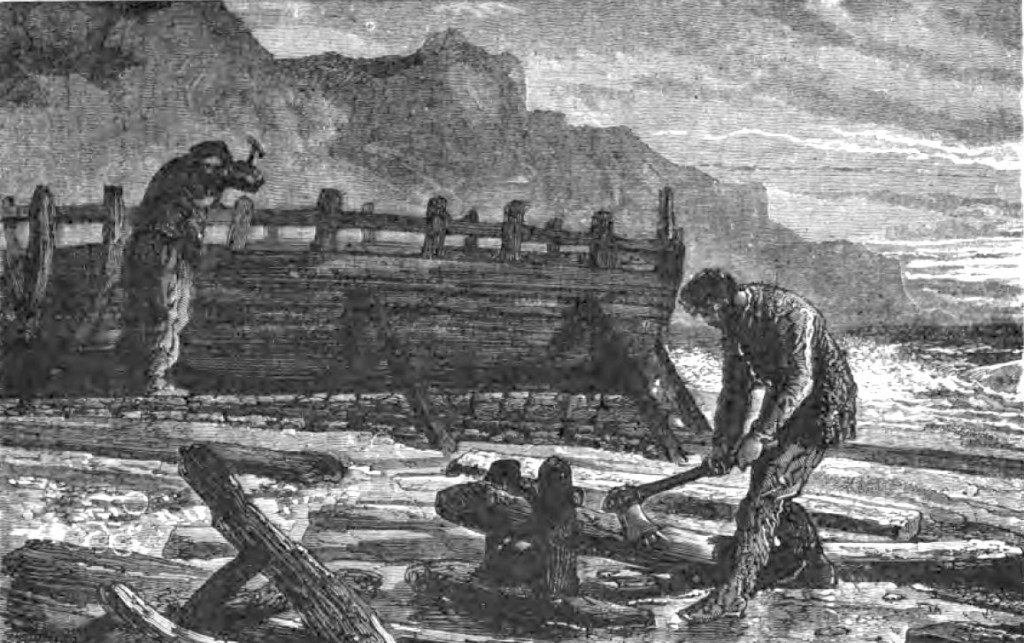
…With rescue looking unlikely, the trio realised their only chance of escape lay in building a boat. It was a move born of desperation, for the nearest port was Invercauld in New Zealand, nearly 500 km away. They returned to the huts and pulled them apart using the timbers to construct a boat. However, no sooner had they finished building it than a storm lashed the island and swept it out to sea. They built a second boat with the remaining timbers and, over the next couple of months, used it to travel around Ross Bay and to nearby islands in search of seals and other food sources. They found that one island was thickly populated with rabbits, which eventually proved to be an easy source of meat and skins.
As their second winter loomed, they built a sturdy sod-walled hut complete with a fireplace and chimney to see them through the coldest months. Then, on 21 May 1865, one year and ten days after being cast upon the island, a vessel dropped anchor in Ross Bay. It was the Portuguese ship Julian, which had pulled in for repairs while on a voyage from Macao to South America. The Julian’s captain had seen Endeby’s whaling station marked on his chart and had hoped to get some help repairing his badly leaking ship. All he found were the Invercauld’s three castaways. When the Julian set off for South America, Dalgarno, Smith, and Holding went with her.
Main sources: The Castaways: A Narrative of the Wreck and Sufferings of the Officers and Crew of the Ship “Invercauld” of Aberdeen on the Auckland Islands by Andrew Smith, 1866; Captain Dalgarno’s letter to the ship’s owners published in the Birmingham Daily Post, 31 July 1865, p. 8; and A Narrative of the wreck of the “Invercauld” among the Auckland Islands by Captain Dalgarno in Wrecked on a Reef by Francois Raynal, 1874.
The last of the Grafton castaways are rescued. Source: Wrecked on a Reef, Raynal, 1874..
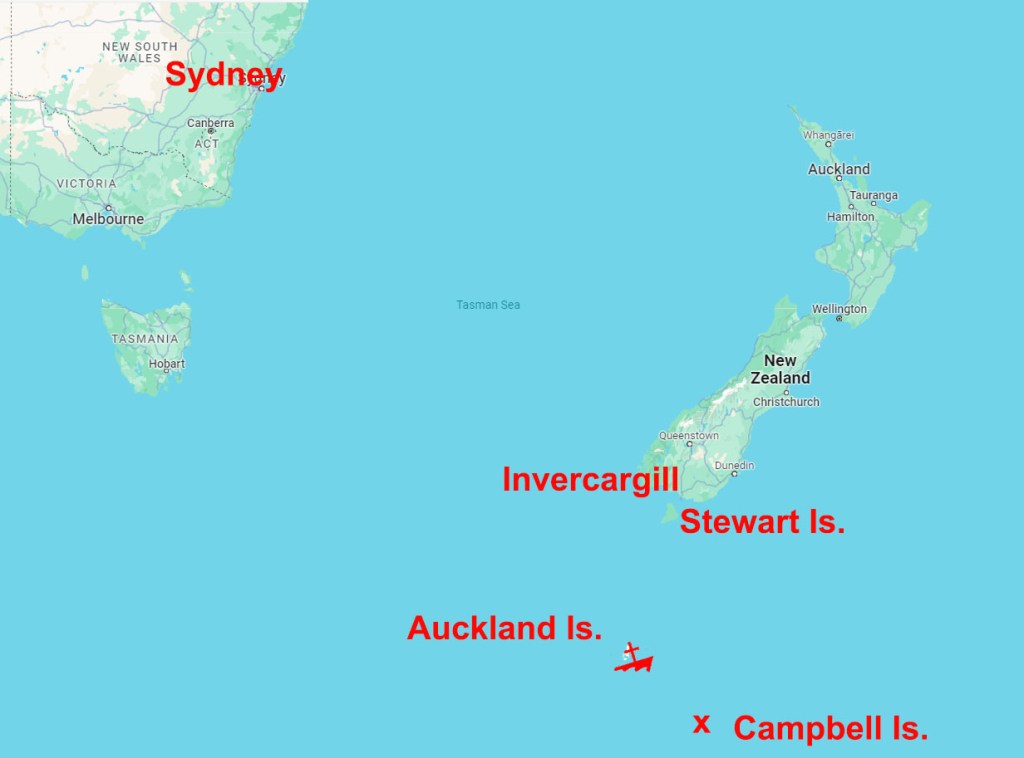
On 12 November 1863, the 56-ton schooner Grafton sailed from Sydney on a sealing expedition among the islands of the Southern Ocean. Six months, 12 months, then 18 months passed without any sighting of the ship or its crew. Most people had given up hope of seeing them again, presuming they had been lost in that vast expanse of freezing ocean wilderness to Australia’s south. Then, on 27 July 1865, three of the lost mariners stepped ashore at Invercargill, New Zealand. Their leader was the missing ship’s captain, and he reported that his other two shipmates were still stranded on a remote island to the south. This is their remarkable tale of endurance and survival against the odds.
The Grafton was ostensibly on a sealing expedition funded by a consortium of Sydney businessmen. But it also had a more secretive mission to investigate if tin could be found on Campbell Island. The Grafton was to visit the isolated scrap of land some 650 km south of New Zealand and determine if the rumoured tin was there in mineable quantity. An experienced master mariner named Thomas Musgrave was appointed captain of the Grafton, and one of the business partners, Francois Raynal, served as his first mate. Two seamen and a cook rounded out the five-mancrew.
The weather was atrocious for most of the voyage south through the roaring forties and then into the furious fifties. During one particularly heavy gale, the Grafton was laid over on her side by the force of the wind. But after three weeks of hard sailing, they finally reached Campbell Island, at latitude 52.6°S.
Illustration of the Loss of the Grafton on Auckland Island, 1863. Source: Wrecked on a Reef, Raynal, 1874.
Prospecting for tin came to nothing, and there were few seals to be had. After a month, they had little to show for their time there. They had been gone for almost two months and had consumed nearly half of the four months’ worth of rations they had left with. Captain Musgrave decided it was time to start heading for home. No one disagreed. They departed Campbell Island on 27 December 1863 with the wind blowing hard from the northwest. As they approached the Auckland Islands, Musgrave found that he could not sail past them without getting dangerously close to land. He decided the safest course of action would be to find shelter in one of the inlets and wait for the wind to shift. They dropped anchor in what they would later learn was Carnley Harbour on 31 December. But soon after arriving, their haven turned out to be anything but when it was lashed by a powerful storm. On the night of January 2, the wind shifted and blew at hurricane strength, as the seas foamed and grew mountainous around them.
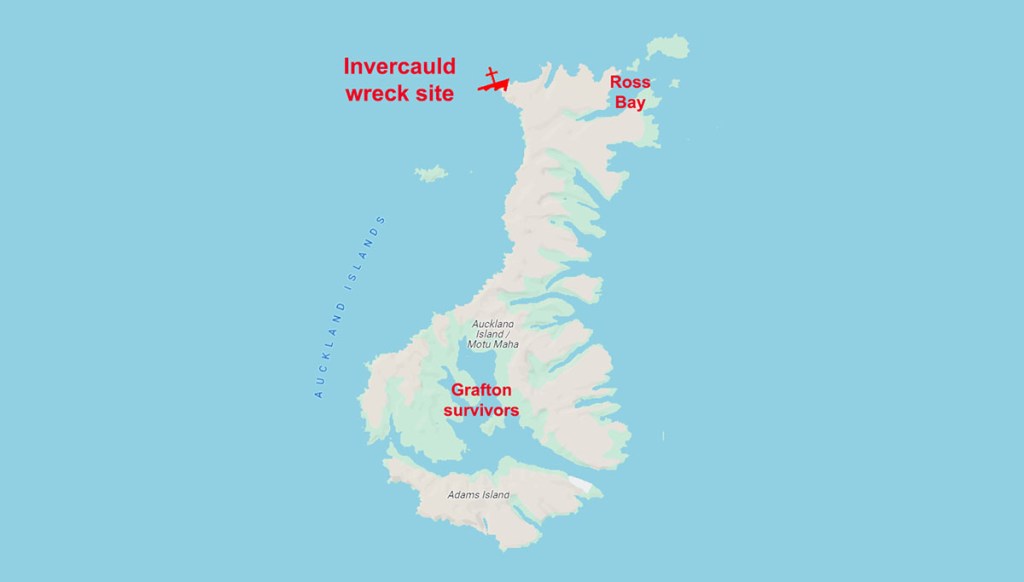
Site of the Grafton wreck site, Auckland Island. Courtesy, Google Maps.
For a time, the Grafton rode out the maelstrom. Then one anchor chain snapped, and the second anchor began to drag. At midnight, the schooner was driven up onto a rocky beach. “Within fifteen minutes, she was nearly full of water, with heavy sea breaking over her,” Musgrave later wrote of the ordeal.
The crew gathered provisions and warm clothing and piled it all on deck. Then everyone found shelter where they could, and waited for daylight as the storm raged around them. Francois Raynal had fallen ill sometime earlier, but his shipmates looked out for him during that bleak night. In the morning, they climbed into their small dinghy, which was already filled with supplies. Captain Musgrave tied a rope to the Grafton and slowly let it run out as the overloaded dinghy was pushed towards land. When they were close to the beach, one of the seamen, Alexander McLaren, jumped into the surf holding a rope tied off to the boat’s bow. He waded ashore and then wrapped the rope around a tree. As Musgrave let his line out, McLaren pulled his in, and the boat made it through the surf to land safely on the beach. It was that level of simple cooperating that would stand them in good stead during the months that followed.
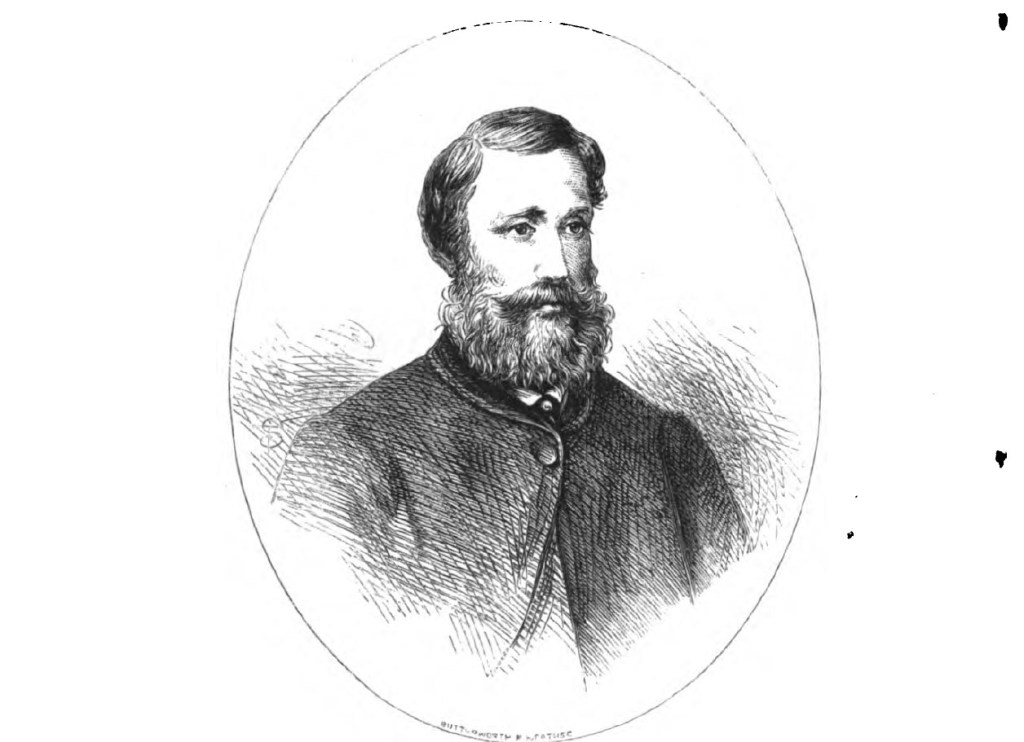
Captain Thomas Musgrave. Source: Castaway on the Auckland Islands, 1866.
The castaways spent that night sleeping on the cold, wet ground, but were no doubt grateful that they had made it off the wrecked schooner alive. As for the Grafton, she was pounded to pieces, with no prospect of being repaired and refloated. After the weather had cleared sufficiently, they returned to the wreck. Their priority was to salvage the sails and timber spars, enough to build a small hut so they had shelter from the harsh elements. Despite being marooned on a remote island, Captain Musgrave and the others believed it would only be a matter of time before a ship passed by and they would be rescued.
But as the months rolled by, their hopes of being found ebbed away and finally vanished completely. The small amount of water-damaged sea biscuit and salted pork they had saved from the schooner had run out long ago. Then, for the next 18 months, they survived on a diet comprised mainly of seal meat. Raynal, who over time recovered his strength, was able to brew a passable ale, which he believed would help keep scurvy at bay.
Inside the hut on Auckland Island. Source: Wrecked on a Reef, Raynal, 1874.
The castaways strengthened their hut, built a fireplace and chimney, and furnished it with stretchers, a table, and stools. Lanterns fuelled with seal oil gave the interior a warm, comforting glow. When not out procuring food and water or keeping vigil for any ship that might pass by, Musgrave taught his illiterate sailors how to read. The castaways also passed their time playing chess and dominoes with bone pieces Raynal had carved by hand. They also played cards for a time, but Raynal eventually destroyed the pack when it became evident that Musgrave was a poor loser. As their clothes deteriorated, they were replaced with seal-skin garments. In short, they made their home as comfortable as circumstances would allow.
After spending a second summer on Auckland Island without ever seeing another soul, the castaways decided to wait no longer to be rescued. It was now around March 1865, and another freezing winter was fast approaching. They considered constructing a new vessel from the Grafton’s wreckage, and they even built a forge to assist them. However, the venture was abandoned for want of an auger to drill holes through the timbers. Instead, they turned to making their twelve-foot (3.6 metre) dinghy more seaworthy. They extended its length by 76 cm, built up the sides and furnished it with a deck. When it was finished, Musgrave found it was so unstable that it would have been too dangerous to call all five of them to safety.
Preparing the dinghy to escape from Auckland Island. Source: Wrecked on a Reef, Raynal, 1874.
On 19 July 1865, Captain Musgrave set off in the dinghy with only two men, Francois Raynal and Alexander McLaren, promising to return quickly to rescue George Harris and the cook, Henry Brown. After five days of hard sailing through foul weather, they reached Stewart Island, 450 kilometres to their north. They put into Port Adventure and fell in with the Flying Scud. The next morning, Musgrave and his mates were taken the final 50 km across Foveaux Strait to Invercargill on New Zealand’s South Island.
After sufficient funds were raised by the good folk of Invercargill, a ship was chartered to take Captain Musgrave back to Auckland Island to retrieve his two shipmates. The Grafton’s story is a testament to what can be accomplished when a group of resourceful individuals, aided by a measure of good fortune, work together for their common good.
As chance would have it, the survivors of another ship, the Invercauld, had washed up on the northern end of Auckland Island around the same time. Unfortunately, theirs is a far different story and is the subject of a future blog.






 Tales from the Quarterdeck