Sixty bite-sized stories from Australia’s maritime past
The melancholy loss of H.M.S Sirius off Norfolk Island by George. Raper. Source National Library of Australia 136507434-1
I have just launched a new book titled Tales from the Quarterdeck: Sixty bite-sized stories from Australia’s maritime past. Sixty of the most popular posts have been reedited. In some cases, I’ve rewritten a couple and updated a few where new information has come to light since first writing them.
For those who would value ready access to the stories in their bookcase, Tales from the Quarterdeck is available in Kindle ebook and paperback formats through Amazon.
The stories are organised in chronological order, starting with the Tryall shipwreck off the Western Australian coast in 1622, and finishing with the Second World War exploits of the Krait. See below for a full list of the stories covered in the book.
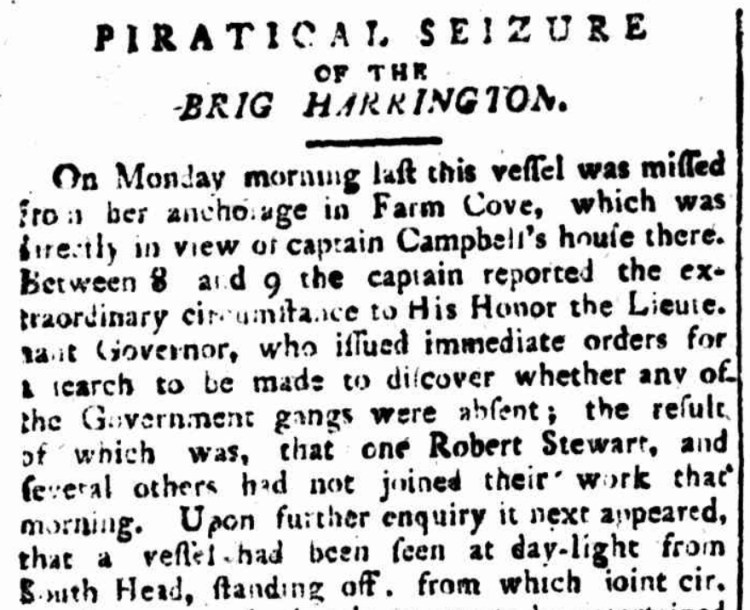
Sydney Gazette 22 May 1808, p. 2.
1622 – The Tryall: Australia’s earliest shipwreck
1629 – The Batavia Tragedy
1688 – William Dampier: Navigator, naturalist, writer, pirate
1770 – The Endeavour’s Crappy Repair
1788 – Loss of La Astrolabe and La Boussole, a 40-Year Mystery
1789 – Bligh’s Epic Voyage to Timor
1789 – HMS Guardian: All Hands to the Pumps
1790 – The Loss of HMS Sirius
1790 – Sydney’s First Desperate Escape
1791 – HMS Pandora: Queensland’s earliest recorded Shipwreck
1791 – William Bryant’s Great Escape
1797 – The Loss of the Sydney Cove
1803 – Loss of HMS Porpoise
1808 – Robert Stewart and the Seizure of the Harrington
1814 – Wreck of the Morning Star
1816 – The Life and Loss of HMSC Mermaid
1824 – The Brig Amity’s Amazing Career
1829 – The Cyprus mutiny
1831 – The Caledonia’s perilous last voyage
1833 – The Badger’s Textbook Escape
1835 – The Loss of the Convict Ship Neva
1835 – The Post Office in the middle of nowhere
1835 – The Tragic Loss of George III
1845 – The Cataraqui: Australia’s worst shipwreck
1846 – The Peruvian’s Lone Survivor
1847 – The Foundering of the Sovereign
1850 – The Loss of the Enchantress: A first-hand account
1851 – The Countess of Minto’s brush with Disaster
1852 – The Bourneuf’s Tragic Last Voyage
1852 – The Nelson Gold Heist
Woodbury, Walter B. (Walter Bentley), 1834-1885. Hamlet’s Ghost, Sourabaya [Surabaya], Java [Boat with Passengers and Crew], ca. 1865. Walter B. Woodbury Photograph Collection (PH 003). Special Collections and University Archives, University of Massachusetts Amherst Libraries
1854 – Bato to the Rescue
1854 – HMS Torch and the rescue of the Ningpo
1856 – The Loss of the Duroc and the Rise of La Deliverance
1858 – The Loss of the Saint Paul and its Horrific Aftermath
1858 – Narcisse Pelletier, An Extraordinary Tale of Survival
1859 – The Indian Queen’s Icy Encounter
1859 – The Sapphire and Marina
1863 – The loss of the Grafton: Marooned for twenty months
1864 – The Invercauld shipwreck
1865 – The CSS Shenandoah: Victoria’s link to the American Civil War
1866 – The Loss of the SS Cawarra: Bad luck or an avoidable tragedy?
The wreck of the Steamer Gothenburg. Source: Australasian Sketcher, 20 Mar 1875, p. 13.
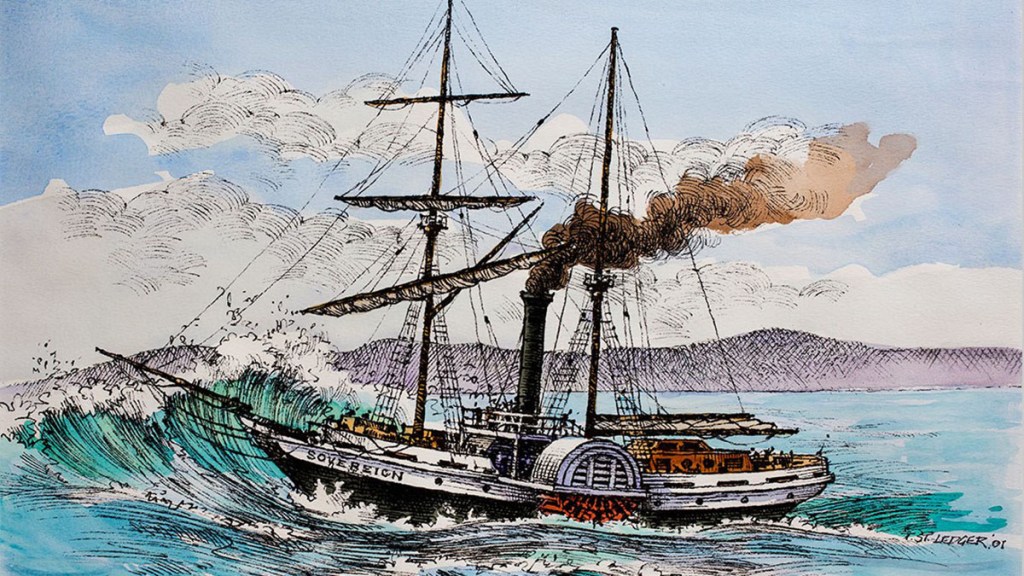
TEN: SOVEREIGN, 1847.
The Sovereign. Image courtesy Stradbroke Island Heritage Museum.
The paddle steamer Sovereign, with 54 persons on board, sailed from Moreton Bay via the southern channel on 11 March 1847. As she ploughed through the large swells funnelled into the passage between Moreton and Stradbroke Islands, her engines failed at a critical moment. The force of the breaking waves quickly drove her onto a sand spit projecting from the southern point of Moreton Island, where she broke up. Forty-four people lost their lives. The owners of the vessel would later claim the engines had been working fine and blamed the captain for the loss.
NINE: MERSEY, 1804.
On 24 May 1804, the 350-ton merchant ship Mersey sailed from Sydney bound for Bengal, India, via Torres Strait. In mid-June she was wrecked while trying to negotiate the dangerous waters of Torres Strait. Neither the location or the circumstances of the tragedy are known, other than the captain and either 12 or 17 of the crew took to the longboat and made it safely to Timor Island to report the loss. She reportedly sailed with 73 hands which means 56 or 61 people lost their lives.
EIGHT: PERI, 1871.
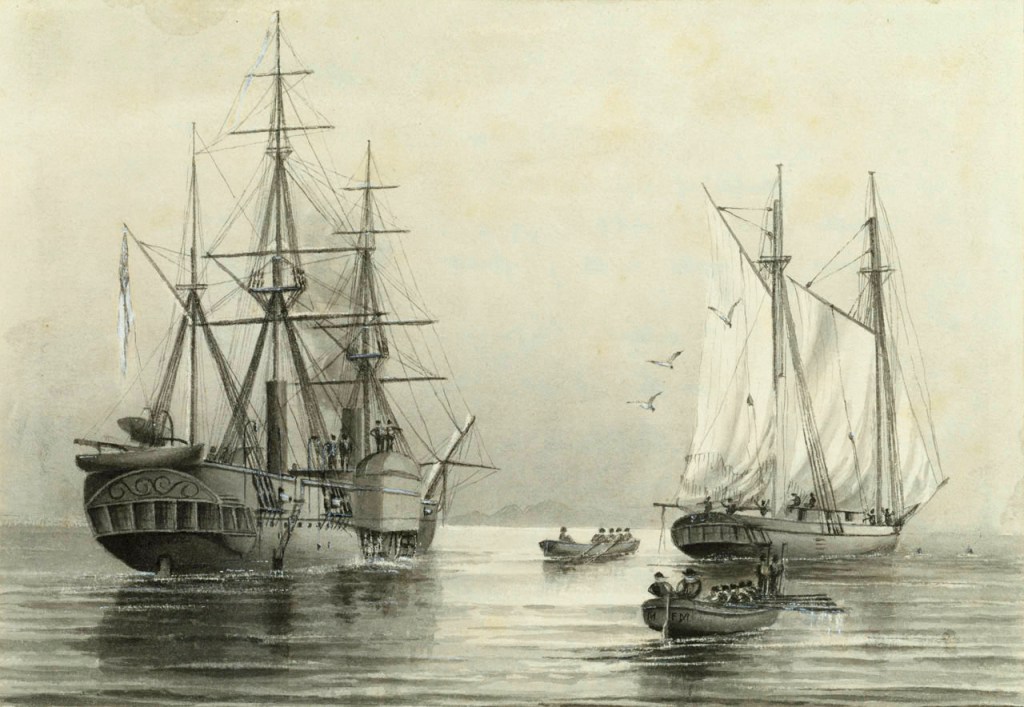
HMS Basilisk and the Peri. Image Courtesy the British National Maritime Museum, Greenwich.
In early February 1871 HMS Basilisk discovered a schooner, later identified as the Peri, adrift and seemingly abandoned a short distance off the Queensland near Cardwell. When a boat was sent across to investigate, they discovered 14 emaciated Solomon Islanders, three corpses, no food or fresh water and five feet of putrid seawater in the hold. The Peri had last been seen about six weeks earlier in Fiji carrying around 80 or 90 blackbirded Islanders bound for Fijian cotton plantations. It seems that the Islanders had overpowered their kidnappers and taken control of the schooner. They then sailed or drifted west across almost 3,000 km of open ocean, withstood at least one severe tropical storm, and passed through a gap in the Great Barrier Reef before being found. As many as 75 people likely died during the ordeal.
Map showing 10 worst maritime disasters off Queensland. Courtesy Google Maps
SEVEN: SYBIL, 1902.
The labour schooner Sybil disappeared sometime after leaving the Solomon Islands on 19 April 1902 bound for Townsville with a fresh batch of South Seas labourers. By August, grave fears were held for the Sybil, for the voyage should not have taken more than two or three weeks. Searches were made of the islands along the outer Great Barrier Reef and in the Coral Sea but no trace of the vessel or any of those on board were found. She had a crew of 12 and on the previous two voyages, she had carried 90 and 98 labour recruits, so it is thought no less than 100 lives were lost.
SIX: GOTHENBURG, 1875
Gothenburg. Photo Courtesy SLQ
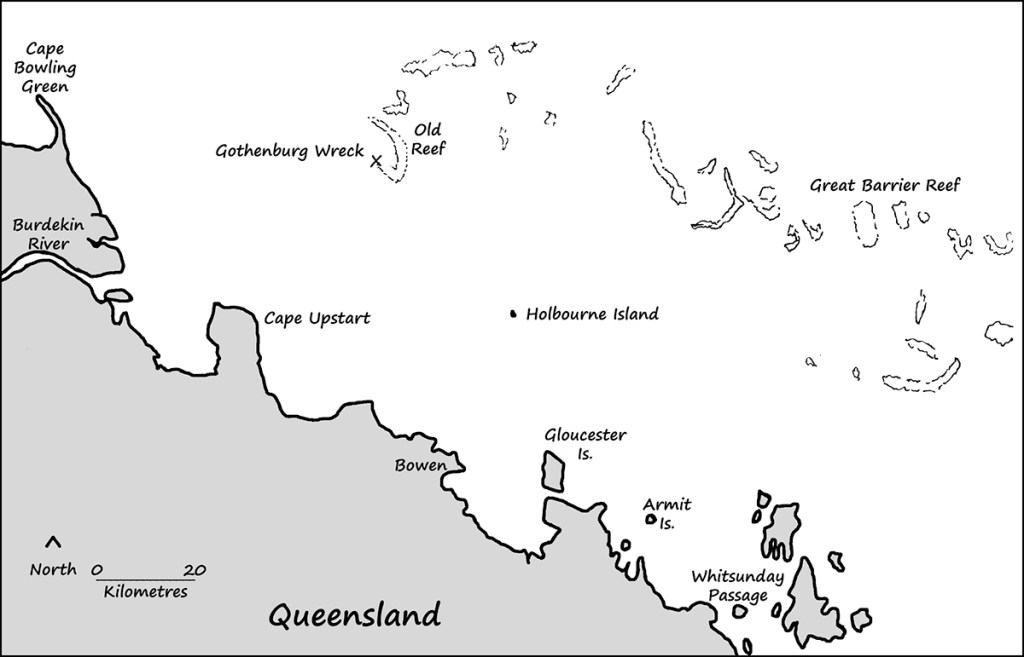
The steamer Gothenburg sailed from Darwin on 17 February 1875 bound for Adelaide via Australia’s east coast. On 24 February the Gothenburg was steaming down the coast in the vicinity of Cape Bowling Green. Bad weather meant they could not see the regular landmarks to aid their navigation. The captain was unaware strong currents were pushing the ship towards the Great Barrier Reef until it was too late. The Gothenburg ran aground on Old Reef. The ship and all aboard her would likely have been saved but for a powerful cyclone bearing down on them. As the storm worsened, the captain ordered the evacuation of the passengers, but as the women and children were being loaded into the lifeboats a succession of huge waves swept over the ship. Only 22 people survived. As many as 112 passengers and crew lost their lives.
FIVE: YONGALA, 1911
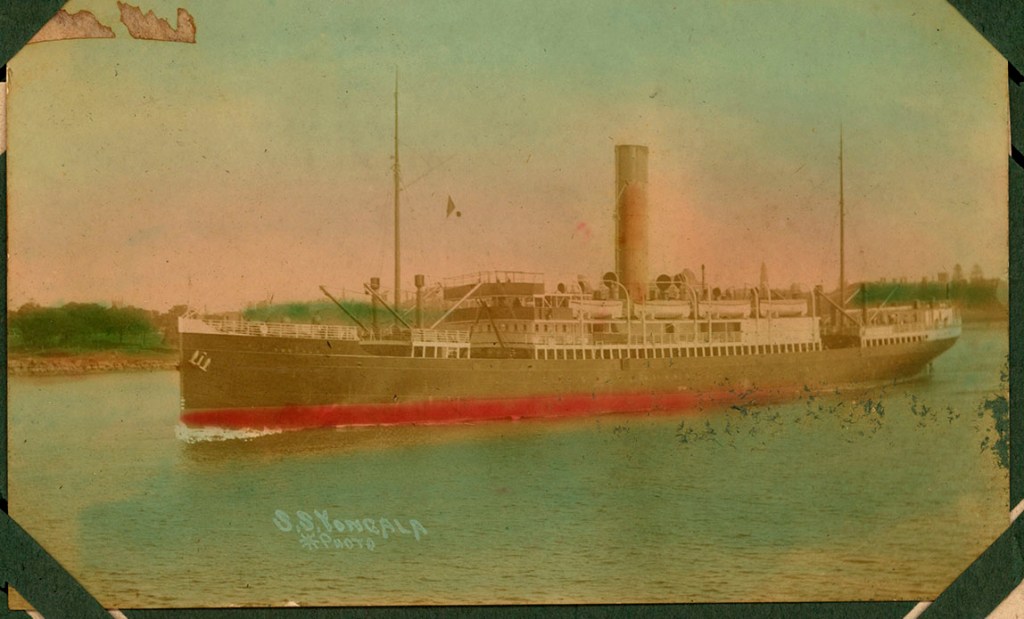
S.S. Yongala. Photo Courtesy SLQ.
The Yongala sank during a tropical cyclone near Cape Bowling Green on 11 March 1911 with the loss of all 122 people on board. When the ship failed to arrive in Townsville as scheduled, concerns were raised. Then, wreckage began washing ashore along the coast as far away as Hinchinbrook Island. However, there was no sign of the ship or any hint as to where she might have sunk. Nearly half a century would pass before the final resting place of the Yongala was conclusively located.
FOUR: QUETTA, 1890
RMS Quetta. Photo courtesy SLQ
While the Mail Steamer Quetta was steaming through Torres Strait on the night of 28 February 1890, it struck an uncharted rock pinnacle as it passed Adolphus Island. The Quetta had departed from Brisbane bound for London carrying nearly 300 people comprising the passengers and crew when disaster struck. The collision tore a gaping hole in the hull from bow to amidship, and the ship sank in just three minutes. One hundred people made it safely to Little Adolphus Island where they were later rescued. Dozens more were pulled from the water the following day. 133 people lost their lives in the tragedy.
THREE: AHS CENTAUR, 1943
AHS Centaur. Photo Courtesy State Library of Queensland
At 4 am on 14 May 1943, the Australian Hospital Ship (AHS) Centaur was torpedoed and sunk by a Japanese submarine. The Centaur was about 35km off Moreton Island having departed Sydney with medical staff from the Army’s 2/12 Field Ambulance bound for Port Moresby. In all, there were 332 people on board. 268 lost their lives. 64 survived by clinging to debris and two damaged lifeboats until they were rescued 36 hours later.
TWO: CYCLONE MAHINA, 1899
Cyclone tracks for Cyclone Mahina.
On the night of 4/5 March 1899, a powerful cyclone crossed the coast at Bathurst Bay on Cape York Peninsula. Lying directly in its path was the North Queensland pearling fleet which had sought shelter there. Nearly 60 vessels – from large schooners to pearling luggers – were sunk or driven ashore with horrendous loss of life. Between 300-400 people died in what is no doubt Queensland’s worst natural disaster. The loss was most keenly felt on Thursday Island where the pearling fleet was based.
ONE: GRIMENEZA, 1854
Artists impression of the Grimeneza . Image Courtesy SLQ
The worst shipwreck off the Queensland coast occurred on 3 July 1854. The Peruvian ship Grimeneza was sailing from China with some 600 Chinese labourers bound for the Callao guano mines in Peru. When they struck a reef at Bampton Shoals in the Coral Sea, the captain and six others immediately abandoned the ship leaving the rest of the crew and the passengers to their fate. The rest of the crew tried to back the ship off, but when that failed, they too took to the lifeboats and were picked up 12 days later. Miraculously, the Grimeneza floated off with the next high tide. The labourers sailed the damaged ship west towards the Queensland coast with the pumps being worked around the clock. But after three days of exhausting work, she foundered. Six men were found clinging to a piece of wreckage 300 km off the coast a few days later. The rest had all drowned or been taken by sharks.
Wood engraving published in The illustrated Australian news for home readers. Photo courtesy SLV.
On 24 February 1875 the steamer Gothenburg ran aground on the Great Barrier Reef and sank during a ferocious storm with the loss of over 100 lives. A fortune in gold also went to the bottom.
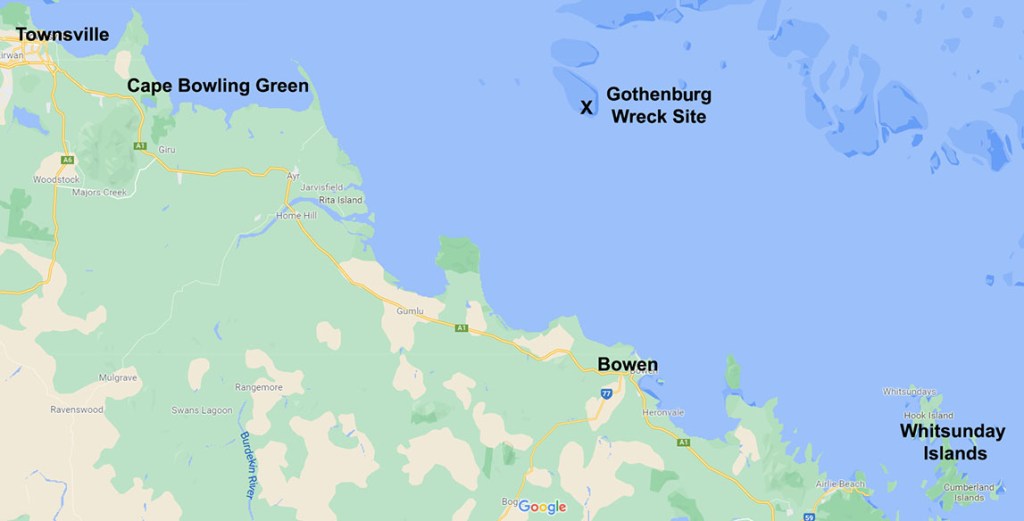
That the Gothenburg had sunk with 3,000 ounces (93 kgs) of gold belonging to the English, Scottish and Australian Chartered Bank did not go unnoticed when the ship was reported lost. Brisbane salvage diver James Putwain partnered with the owner of the small coastal steamer and the two started steaming towards Bowen as quickly as they could.
There, Putwain hired a small fishing boat and some local men to help with his air pump. By noon on 7 March, they were at the wreck site, only six days after hearing of the disaster. The steamer continued north, leaving Putwain and his team to bring up the gold.
Putwain first tried diving from the fishing boat but a strong current prevented him from reaching the wreck. He then built a platform attached to the wreck’s mainmast and set up his diving apparatus on that. Donning his heavy diving suit and helmet, he climbed down the rigging to the sunken ship’s deck and soon made entry into the captain’s cabin. On this first attempt his air hose became entangled in the wreckage. Putwain had some anxious moments until he cleared it and returned to the surface to give more explicit instructions to his new and inexperienced assistants.
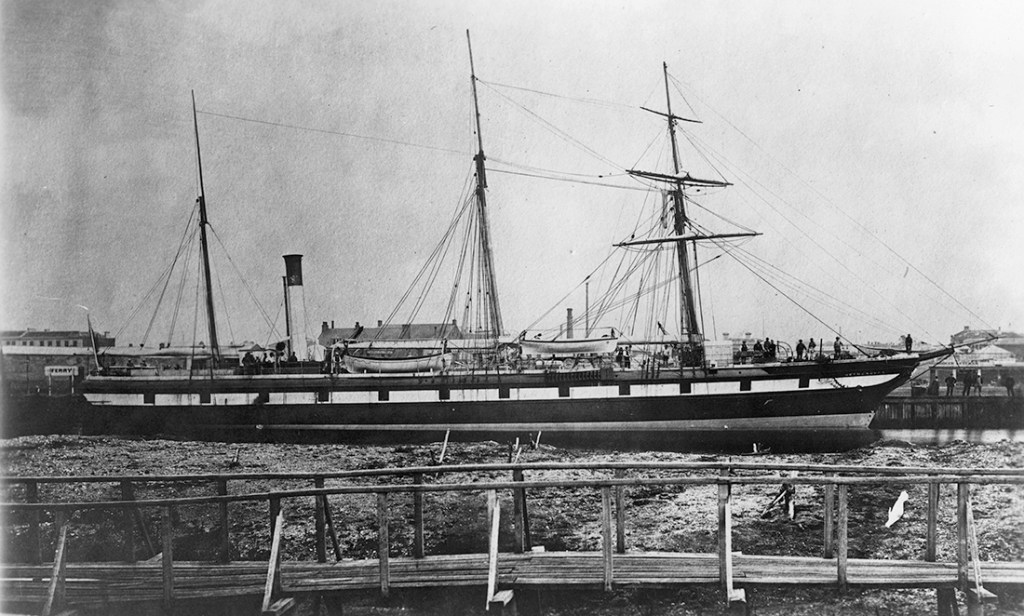
S.S. Gothenburg docked at a wharf. Photo Courtesy SLQ
His third descent met with success. Putwain found the safe containing the gold in the remains of the cabin and had it hoisted to the surface. Before leaving the wreck he tried descending further into the ship but only got a little way before running out of hose. But there, he saw the haunting vision of two women suspended in the water seemingly embracing. Unable to get close enough to identify the bodies, he returned to the surface with the macabre image burned into his memory.
With the gold secured he returned to Bowen to report his find to the Harbourmaster and deposit the precious metal in the local bank.
Then the enterprise got mired in legal wrangling. The English, Scottish and Australian Chartered Bank offered James Putwain and his partner £1,000 for retrieving the £9,000 worth of gold. Putwain and his partner felt £4,000 was more appropriate compensation. The case went to the Vice Admiralty Court in Brisbane, where Putwain claimed he had spent nearly £500 in the salvage operation, that it had been a risky endeavour and that the box was found in a precarious position where it could have easily plummeted into deeper, inaccessible, water to be lost for ever.
The bank argued that the amount demanded by the salvors was excessive and Putwain’s account of the salvage operation was exaggerated. Nonetheless, the judge found in favour of the salvors, awarding them approximately one third the value of the gold, £3,000.
Not happy with the verdict, the bank appealed the decision before the Privy Council in London. Almost two years after the Gothenburg sank the Privy Council found in favour of the salvors and upheld the original judgement, ordering the bank to pay Putwain and his partner.
A second salvage operation was mounted in the weeks after the Gothenburg was lost. The diver Samuel Dunwoodie arrived on the wreck on 14 March, a week after Putwain, unaware that the gold had already been retrieved. Nonetheless, Dunwoodie recovered much of the cabin luggage and many of the personal effects belonging to the passengers. His team also removed the ship’s two steam winches before the weather turned foul, forcing them to abandon the wreck.
The tragic story of the Gothenburg shipwreck is told in A Treacherous Coast: Ten Tales of Shipwreck and Survival from Queensland Waters, available as an eBook or paperback through Amazon.
L-R Robert Brazil, John Cleland, and James Fitzgerald. Photo: Adelaide School of Photography, 1876.
In September 1875, the South Australian Government honoured three men for the courage they displayed when the Gothenburg sank with fearsome loss of life. James Fitzgerald, John Cleland and Robert Brazil had risked their lives to save other survivors from the ill-fated steamer.
The Gothenburg was a 501-ton steamer, and on this, her final voyage, she carried 37 crew and 88 passengers, 25 of whom were women or children. She departed Darwin on Tuesday, 16 February 1875, bound for Adelaide via Australia’s east coast. By the evening of the 24th, Cape Bowling Green just south of Townsville, would have been visible off the starboard side had it not been obscured by thick weather.
The steamer had been followed by bad weather for most of the voyage down the Queensland coast. With usual landmarks hidden from view, the captain, James Pearce, was relying on his patent log to plot their progress. He thought he now had open seas ahead of him until they reached Flinders Passage, where he would pass through the Great Barrier Reef. It was early evening, and the Gothenburg was cutting through the water at 10 knots (19 km/h). Large swells made the ship roll uncomfortably, upsetting many of the passengers. But then the seas flattened. It should have alerted the captain that they were in the lee of a large reef. But before any action could be taken, the Gothenburg ran onto a vast coral shoal hidden just under the sea’s surface.
Illustration a the Human Society medal awarded to survivors of the Gothenburg shipwreck. Source: The Illustrated Adelaide News 1 Sep 1875, page 8.
The impact was not particularly violent. The iron-hulled steamer had glided along the top of the reef, coming to a halt in less than her own length. By the time she stopped, her stern was still hanging out over deep water. It would transpire that the Gothenburg had drifted further east than Pearce had reckoned on, and they had struck Old Reef just north of Flinders Passage.
Pearce was not particularly concerned at first; the hull had not been breached, and he thought he would be able to back the steamer off. However, when the engines were put in reverse, the ship didn’t budge. Pearce ordered the crew to move cargo from the fore hold and bring it aft. He also asked all the passengers to congregate on the stern. With the bow raised and the stern lowered, he hoped the ship would easily slide back off the reef. As the tide peaked, the engines were turning at maximum speed, but the vessel remained firmly stuck. The passengers and most of the crew retired for the night, expecting they would try again on the next high tide.
Meanwhile, the weather continued to deteriorate. A powerful storm was fast approaching over the northern horizon. Through the rest of the night, the Gothenburg was lashed by high seas, torrential rain, and a gale-force wind.The steamer bumped and ground on the hard coral until the hull sprang leaks and she began taking on water, a lot of water.
In just a few short hours, the situation became dire. Captain Pearce began preparations to abandon the ship, starting with the evacuation of women and children. It was now around 3 a.m., and pitch-black. Most of the passengers were already up on deck despite the atrocious weather. Few wished to remain in their cabins below.
Pearce only had four lifeboats at his disposal, but two of them were swept away before he could get a single passenger off the ship. The third boat, only partly filled with passengers, capsized and broke apart as soon as it was lowered into the water. Then the ship heeled over, and a mountainous wave swept many of the passengers from the deck to drown in the turbulent sea.
The wreck of the Steamer Gothenburg. Source: Australasian Sketcher, 20 Mar 1875, p. 13.
A lucky few managed to swim back to the ship and were rescued by those who had climbed into the ship’s rigging before the wave struck. There they clung, hoping to ride out the storm. James Fitzgerald, John Cleland, both passengers, and one of the crew, Robert Brazil, were among the survivors.
Fitzgerald would later recall, “We had seen illustrations of shipwrecks, but on this frightful morning … before daybreak, we saw the dreadful reality of its horrors. The ship was lying over on the port side, awfully listing, a hurricane was blowing, rain was coming down as it does in the tropics, and unmerciful breakers were rushing over the unfortunate vessel, seldom without taking some of the people with them.”
John Cleland, a gold miner returning to Adelaide, spotted the fourth lifeboat floating upside down, still attached to its davits. He knew that if they were to have any chance of survival, they needed that boat. He climbed down from the rigging, tied a rope around his waist and swam through the breaking waves to better secure it.
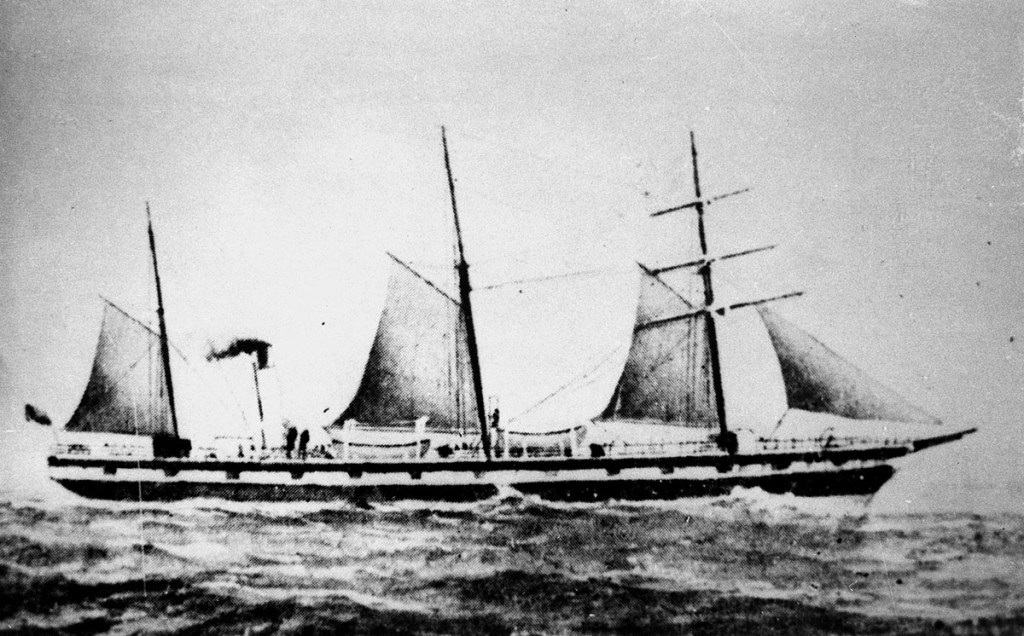
The Gothenburg. Photo Courtesy State Library of Queensland.
Cleland’s first attempt failed, and he swam back through the surging seas to the relative safety of the main mast. James Fitzgerald then joined him, and together they repeatedly swam out to the boat, cut away at the tangled mess of ropes, and then swam back to the mast to rest. Finally, they cut through the last of the ropes securing the boat to the davits. They then tied it off again with a length of rope attached to the mast. But the boat still floated upside down. They had been unable to right the craft on their own.
Seeing the pair struggling, Robert Brazil swam out and joined them, and with their combined weight, they were able to flip the lifeboat over. Cleland and the others were relieved to see that the oars were still securely locked in place.
The trio then returned to the mast and tied themselves to the rigging high above the waves. They stayed there all that day and the following night, tied to rigging so they would not fall when they dozed off. Then, the following morning, the weather began to ease.
The three men returned to the boat and bailed it out. Cleland, Fitzgerald, Brazil and eleven other men climbed into the lifeboat and eventually made it to the safety of Holbourne Island. They were rescued by boats sent out from Bowen to search for survivors the next day. Over one hundred people lost their lives in the disaster, Captain Pearce among them.
A marine board enquiry found that the captain had not exercised sufficient care in the navigation of his ship. They felt that had he made the effort to sight Cape Bowling Green lighthouse or Cape Upstart as he steamed south, he might have more accurately fixed his position, and the disaster could have been averted.
The full story of the Gothenburg shipwreck is told in A Treacherous Coast: Ten Tales of Shipwreck and Survival from Queensland Waters, available as a Kindle eBook or paperback through Amazon.












 Tales from the Quarterdeck