Tag: gold

  • The Mystery of the Missing Madagascar

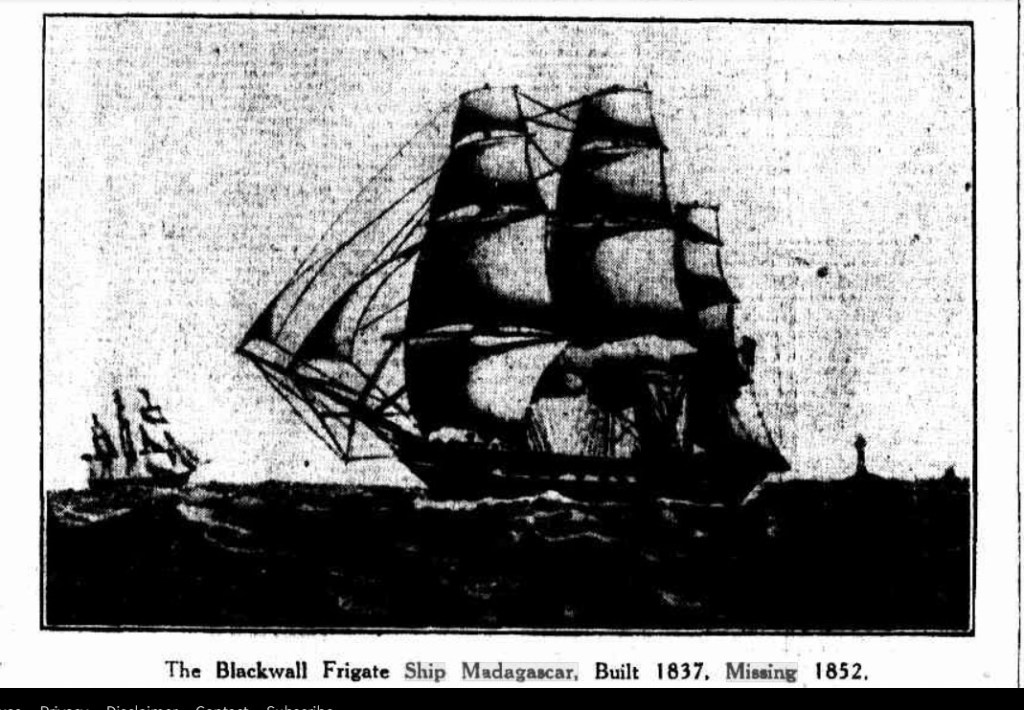
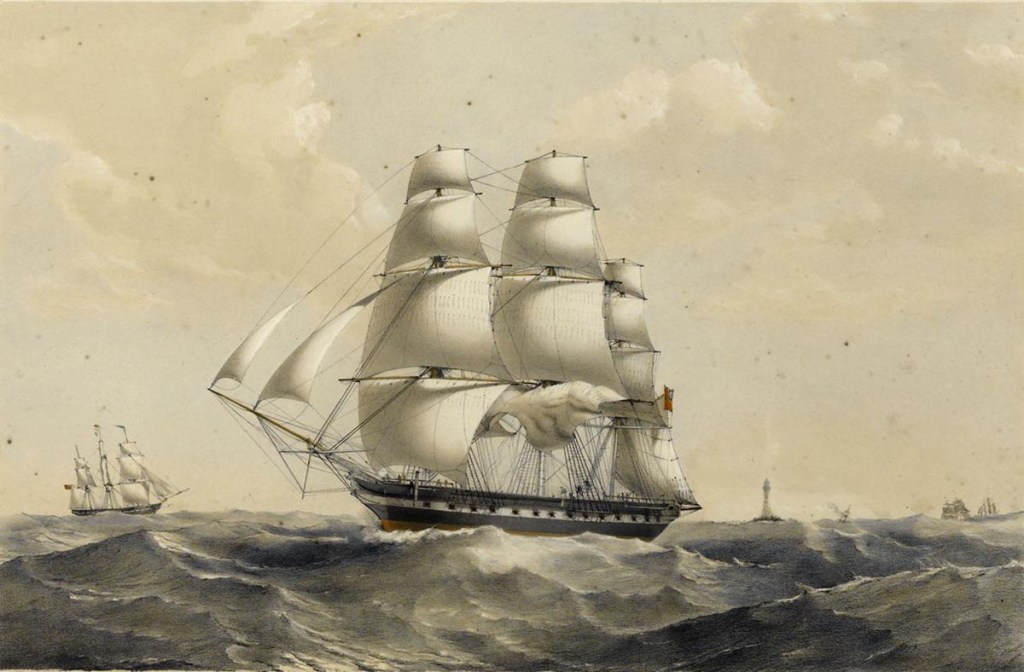
    By Thomas Goldsworth Dutton (fl 1840) – National Maritime Museum Greenwich, London [1], Public Domain, https://commons.wikimedia.org/w/index.php?curid=30836816

    In August 1853, the Madagascar set sail from Melbourne, Australia, and was never seen again.  On board were her full complement of crew and 62 passengers. Men, women and children all bound for England. She was not the first to vanish at sea, and she would not be the last. But her disappearance has fuelled keen interest over the years, not because of the tragic loss of life, but for her large and valuable cargo of gold.

    The Victorian gold rush was in its third year and was showing no signs of slowing. As well as wool and other cargo, the Madagascar had carried consignments of gold from gold traders and banks, totalling over 68,000 ounces, worth at least a quarter of a million pounds at the time.   Today, the missing fortune would be worth nearly half a billion Australian dollars.

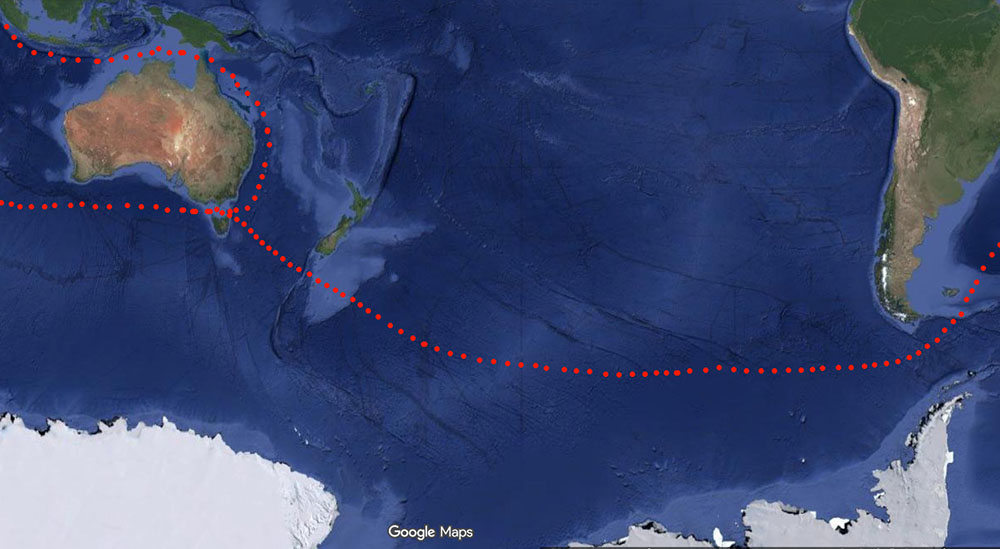
    The Madagascar was a 950-ton fully rigged sailing ship commanded by an experienced and highly respected master mariner named Captain Fortescue W. Harris. He had a choice of three routes he could take on his return voyage to London.   Once clear of Port Phillip, he could have turned his vessel west to cross the Great Australian Bight and the Indian Ocean, then round the Cape of Good Hope before turning north up the East African coast towards home.  He could also have turned to port to cross the South Pacific, round Cape Horn, before again turning north through the Atlantic. Or he might have followed Australia’s east coast north, through the Coral Sea, Torres Strait, and on to Singapore, India, the Cape of Good Hope, and home.   Unfortunately, he left no clue as to which route he intended to take.

    The ship was only 15 years old, solidly built, well-maintained, and had made the passage out to Australia in just 87 days without incident. There was no reason to think the ship would not make the routine passage home in a similar time. But after six months had passed with no sign of the ship, people grew anxious, for she was now long overdue.

    In February 1854, a report reached London via the captain of the Jessica in Calla, Chile, that the Madagascar had put into Rio de Janeiro “in a very leaky state, near upon foundering.” It was thought that her passengers and the gold would have been loaded onto another vessel to complete the remainder of their voyage. However, nothing further was heard, and the report ultimately proved to be an unfounded rumour.

    Word that the ship was missing finally reached Melbourne nearly ten months after she had made her departure. Several theories immediately emerged.   Some thought her cargo of wool might have spontaneously combusted and engulfed the ship in fire. Others thought she might have been sunk by a Russian frigate operating in the southern seas. One experienced mariner dismissed both of these theories. He believed it was more likely that she had struck an iceberg in those freezing latitudes of the Southern Ocean.

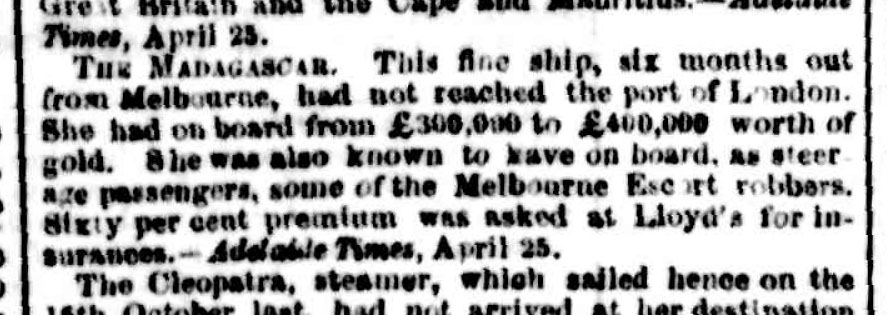
    There were also fears that her disappearance might have been at the hands of a ruthless gang of bandits.  Three bushrangers had been taken off the Madagascar the day before she departed. They, and their mates, had robbed the McIvor Gold Escort of £10,000 worth of gold, shooting four troopers in the process.  It was widely believed that other dangerous outlaws had left on the missing ship as paying passengers or members of the crew. Once they were far from land, it was argued, they had plundered the ship and sank her, before taking to the boats with their ill-got gains.    Of course, there is no way to prove or disprove if this actually happened.

    Then, a year later, in May 1855, a gentleman in Geelong received a letter from an acquaintance in Cape Town telling him that the missing Madagascar had been found safe and sound. According to the letter writer, she had become trapped in ice while trying to round Cape Horn and had been stranded for some six months in those remote Antarctic waters. No other corroborating news came out of Cape Town or anywhere else, for that matter, and the rumour was dismissed. What’s more, Lloyds had since listed the ship as missing and had paid out on its insurance liability.

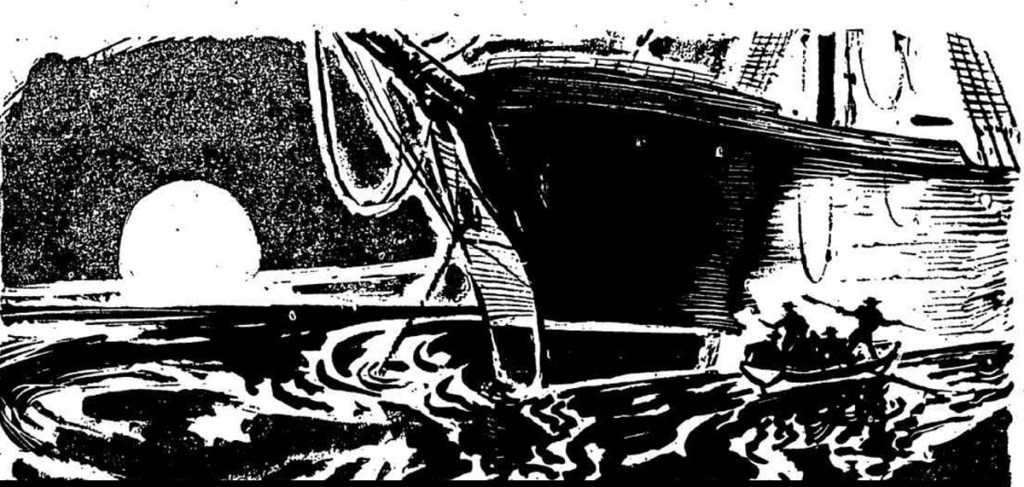
    The Madagascar, The Age, 6 APr 1929, p. 7.

    But some people never gave up hope of finding out what happened to the ship and their loved ones. Twenty-seven years after the ship had vanished, the crew of the ketch Rosebud found 15 skeletons on Bountiful Island in the Gulf of Carpentaria. On learning of the discovery, the nephew of one of the Madagascar’s missing passengers begged the Queensland government to find out if the remains might be linked to the missing ship.   An expedition was sent to Bountiful Island, and concluded the skeletons were likely those of Aborigines or Malay fishermen rather than survivors from the Madagascar. The report also noted that the island was some 350 miles (650 km) away from the regular shipping channel through Torres Strait.

    In 1889, the remains of an old ship were discovered off the New Zealand coast. So sure were some Sydney treasure hunters that they raised sufficient money to send an expedition, including an experienced diver, to New Zealand to examine the wreck. Needless to say, they did not come back with the gold or anything else that shed light on the fate of the Madagascar.

    But the most enduring theory as to the loss of the Madagascar centred on it being seized by desperate robbers who made off with the gold and sank the ship. Some stories came with elaborate details, although they were impossible to verify.

    In 1914, a New Zealand newspaper published a story claiming the Madagascar had been lost off the South American coast.  In a recently discovered written statement made to the police in 1867, a sailor named “Bully” Hayes said he had survived the wreck of a treasure ship off Peru.  Hayes claimed the ship was seized and set on fire by a band of robbers who escaped in the boats laden with thousands of pounds of stolen gold.  He had somehow managed to secure a seat on one of the boats, which later struck a reef. The gold was lost, and he was the only survivor.  Though he would not be drawn on the name of the ship, the man who took his statement believed he was referring to the Madagascar.

    Fifteen years later, another tale emerged regarding the missing ship. Supposedly, a clergyman said that years earlier, he had taken a deathbed statement from a woman who claimed to have survived the sinking of the Madagascar. Her story went thus. The Madagascar had been seized by mutineers who had locked everyone below deck, set fire to the ship, and taken to the boats with the gold and several young women, herself included. The boat was swamped by surf as they tried to land somewhere on the South American coast, and the gold was lost.   A handful of mutineers survived only to die of yellow fever on reaching a small town. Only she and one man survived, and he would later abandon her.   Unfortunately, the story makes no mention of her name or the priest who took her final confession, making it impossible to verify.

    After the passage of some 175 years, it seems likely that we will never know what befell the Madagascar.  Perhaps she struck an iceberg in the deep reaches of the Southern Ocean or perished in a powerful storm. Perhaps her cargo of wool did catch fire and she sank. It would not be the first time a ship had succumbed to such a tragedy. Or maybe an attempt was made to seize the gold, which ended with the loss of the ship. But one thing is for sure: piled among what remains of the ship and the final resting place of her passengers and crew, there is nearly half a billion dollars of gold sitting somewhere on the ocean floor.

    © Copyright C.J. Ison / Tales from the Quarterdeck, 2026.

    Please enter your email address below to be notified of future blogs.
  • The Nelson Gold Heist – 1852

    The Nelson Gold Robbery. The World’s News, 5 Aug 1950, p. 9.

       In the early hours of Friday, 2nd April 1852, a band of villains climbed aboard the barque Nelson while moored in Melbourne’s Hobsons Bay and made off with over 8,000 ounces of pure gold, worth tens of millions of dollars in today’s money. The heist was as simple as it was audacious and ranks among the largest robberies in Australian history. Most of the thieves never saw the inside of prison, and only a fraction of the gold was ever recovered.

       The 603-ton barque Nelson had sailed from London on 4 July 1851, around the same time that prospectors discovered a vast quantity of alluvial gold near Mount Alexander. The barque dropped anchor in Hobsons Bay on 11 October, only for its captain, Walter Wright, to learn Victoria was in the midst of a gold rush.

       The Nelson disembarked its passengers and unloaded merchandise at Williamstown, then sailed across to nearby Geelong. There, the crew deserted the ship and headed off to the gold fields to try their luck, leaving just the captain and first mate behind. Over the next couple of months, the Nelson’s hold was filled with bales of wool, casks of tallow, and, most importantly to this story, 11 boxes of gold totalling 2083 ounces, all bound for London. By March 1852, the barque was once again anchored off Melbourne in Hobsons Bay, ready to return home as soon as enough men could be found to crew her.

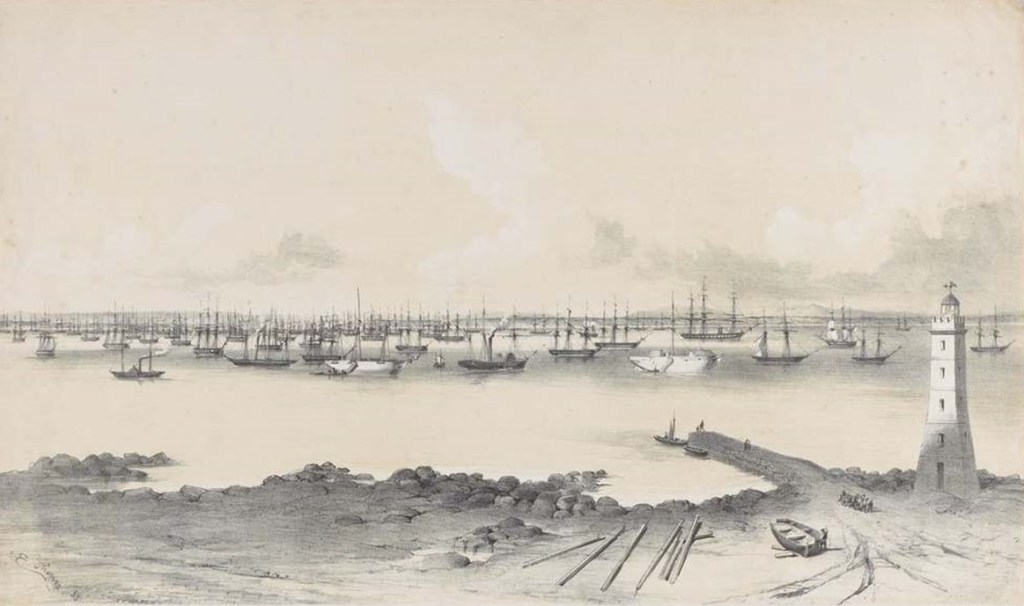
    Ships, deserted by their crews, lying in Hobson’s Bay, By E Thomas.

       On Thursday night, 1 April, the Nelson was still anchored a short distance off the Point Gellibrand Lighthouse, along with scores of other ships stranded for lack of crew. Captain Wright was ashore for the night, leaving his chief mate, Henry Draper, in charge. With him were the second mate Carr Dudley, an officer from a neighbouring ship, plus a handful of seamen they had managed to recruit.

       Despite a fortune in gold being on board, no watch had been posted. The crew had refused Draper’s order to stand guard through the night, saying there were too few of them to do so, and besides, they had not signed on as night watchmen. All Draper could do was lock the boxes of gold in the lazarette, (a storeroom of sorts) for safekeeping. By now, the number of boxes had grown to over twenty as the captain continued to accept new consignments.

       Henry Draper, Carr Dudley, and two officers from nearby ships spent the evening playing cards and drinking. Then, sometime around 11 p.m., the card game wrapped up, and one of the visiting officers returned to his ship. Draper and Dudley tottered off to their cabin, leaving William Davis, the Royal George’s second mate, to sleep off the evening’s entertainment on the cabin’s lounge. Meanwhile, the rest of the crew had long since retired to their berths in the forecastle.

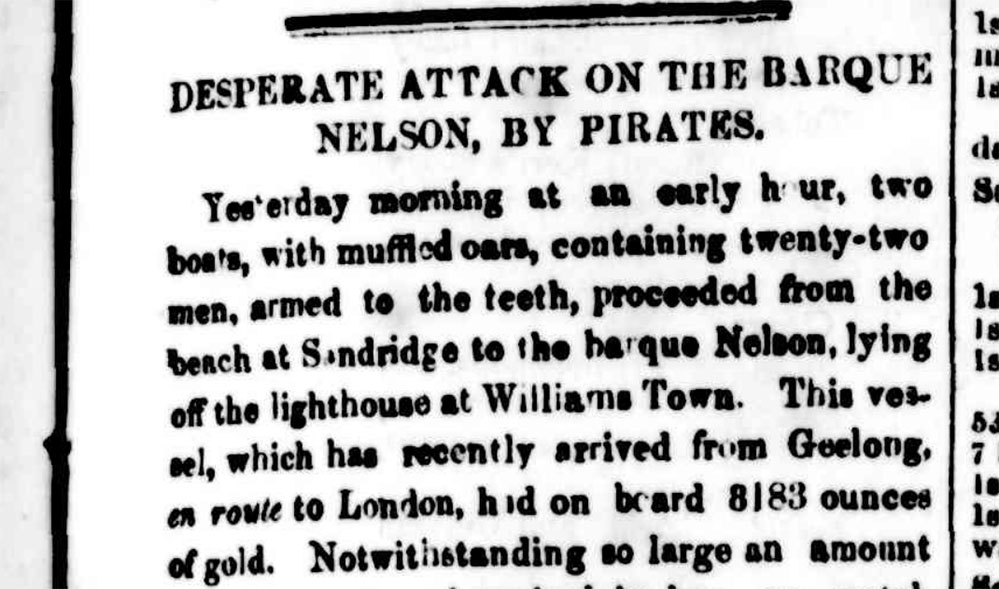
       Around two hours later, two boats carrying 22 men rowed up to the Nelson, the sound oftheir oars muffled by blankets to mask their approach. They pulled alongside, and a dozen of them, armed with pistols and swords, climbed onto the deck.

       Some went forward and secured the crew in the forecastle while the rest poured into the main cabin aft. As they swarmed onto the deck, Carr Dudley woke Draper up to tell him he thought he could hear movement above. Draper went on deck to investigate and was confronted by several well-armed men, all dressed in black with hats pulled low over their heads and handkerchiefs covering the lower portions of their faces.   

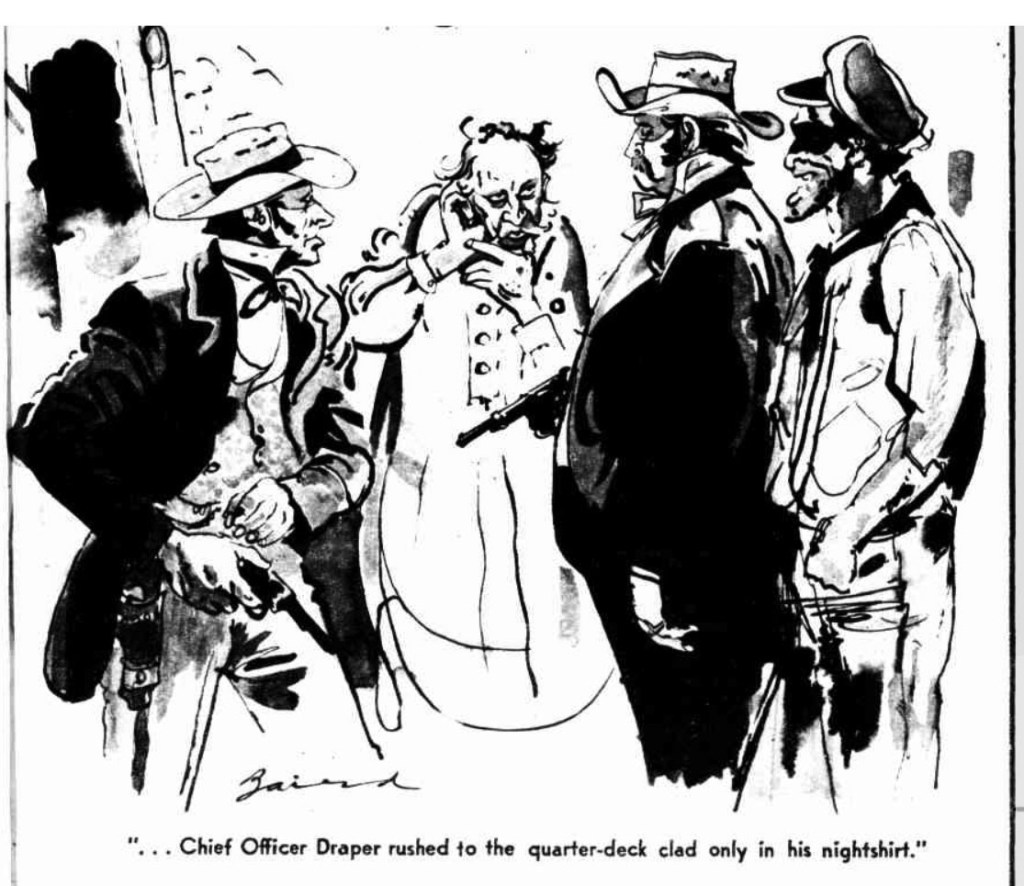
    “We’ve come for the gold,” the ringleader told Draper, “And the gold we’ll bloody well have.” Draper had gone on deck dressed only in his nightshirt and asked if he could return to his cabin to put on a pair of trousers. While he was fumbling to get dressed, a robber, still pointing a pistol at him, warned, “We’ve not come here to be played with, so make haste. ”Draper and Dudley were forced into the main cabin to join Davis, who had been rudely awoken with a gun pointed at his head. They were eventually joined by the rest of the crew brought aft from the forecastle.

    The Sun, 30 May 1948, p. 3.

       Draper was forced to unlock the lazarette, and the thieves helped themselves to 23 cedar boxes containing over 200 kilograms of gold. During the proceedings, one of the robbers’ pistols accidentally discharged, and the bullet grazed Draper’s thigh. Once the gold was loaded onto the boats, the slightly wounded Draper and the rest of the crew were locked in the lazarette. The robbers then hopped in their boats and were rowed back to shore.

       Draper and the others would have remained imprisoned in the lazarette until well into the day had they not had a minor stroke of luck. The cook had been woken by the noise of the thieves climbing on deck, and he had hidden in a dark recess under his bunk, remaining undiscovered during the robbery. He resurfaced once he saw that the robbers had left and went aft to find his shipmates locked in the lazarette. Once released, Draper wasted no time reporting the heist to the Williamstown water police office.

       Boats were sent out to scour Hobson’s Bay, but they were too late. The robbers had got away. Shortly after daylight, the water police found one of the whaleboats pulled up on the beach at Williamstown and the other across the bay near Sandridge (present day South Melbourne). Tracks were seen leading off the beach where the boat had been abandoned.   

    The police were galvanised into action. Mounted officers and constables fanned out across Melbourne looking for the robbers and the missing gold. The robbery was a severe embarrassment to the police and the colonial government, and both were widely condemned in the newspapers when it became public. The Governor offered a £250 reward, and that was matched pound for pound by the Nelson’s shipping agents.

    The Argus 3 Apr 1852, p. 5.

       The empty gold boxes were discovered by an employee of the Argus newspaper a few days later, hidden in scrubland not far from the beach at Sandridge, but most of the gold was long gone. Only some slight traces of gold dust could be seen mixed in the sand where the boxes had been busted open. Over the next several days, police rounded up anyone who looked remotely suspicious, and the watchhouses were filled to bursting.

       The police finally got a lucky break when a band of men turned up at a hotel in Geelong late one night wanting a room. They were dressed far beyond their station in life and spent their money freely. The publican alerted the Geelong police, and they were arrested a couple of days later. These seven men were detained while the police searched for evidence of their involvement in the Nelson robbery. Two more men were captured in Portland on Victoria’s western coast. Most of the individual suspects were found to possess more than £500, five times the average yearly wage at the time.

       Of these nine men, only three were found guilty of the robbery and sentenced to long terms in prison. The most compelling evidence against them was that they had been recognised by Henry Draper, or the Royal George’s second mate, William Davis. Drape and Davis claimed they recognised the robbers because their handkerchiefs had slipped down, revealing their faces. Draper and Davis also claimed they recognised two other men who likely had nothing to do with the robbery. One had a slew of witnesses testify at his trial that he had been on the gold fields at the time, but the jury did not believe them. However, he was quietly released a couple of months later when it was clear he and his witnesses had been telling the truth. The other hapless soul spent many years at hard labour for a crime he never committed.

       For years, rumours circulated around Melbourne about who might have been involved. Ongoing interest was fuelled by the fact that most of the gold was never recovered. But it remained a baffling mystery.

       Writing in the Sydney Morning Herald 30 years later, Marcus Clarke pondered some of the many rumours associated with the heist. It was often said that a gentleman of standing in Melbourne society had masterminded the robbery and paid thugs to steal the gold on his behalf. It was also rumoured that several prominent men about town had benefited financially from the robbery. Yet another rumour had it that a notorious publican had fenced the gold and then left the colony a very wealthy man. Clarke finally concluded that after the passing of so many years, the whole story would never be known.

       But was he right? Since first writing this blog post in April 2024, I have unearthed some tantalising clues that point to the identity of the brazen thieves. But more about that some other time.

    © Copyright C.J. Ison / Tales from the Quarterdeck, 2024.

    Please enter your email address below to be notified of future blogs.
  • Diving for the Gothenburg Gold

    Wood engraving published in The illustrated Australian news for home readers. Photo courtesy SLV.

    On 24 February 1875 the steamer Gothenburg ran aground on the Great Barrier Reef and sank during a ferocious storm with the loss of over 100 lives.   A fortune in gold also went to the bottom.

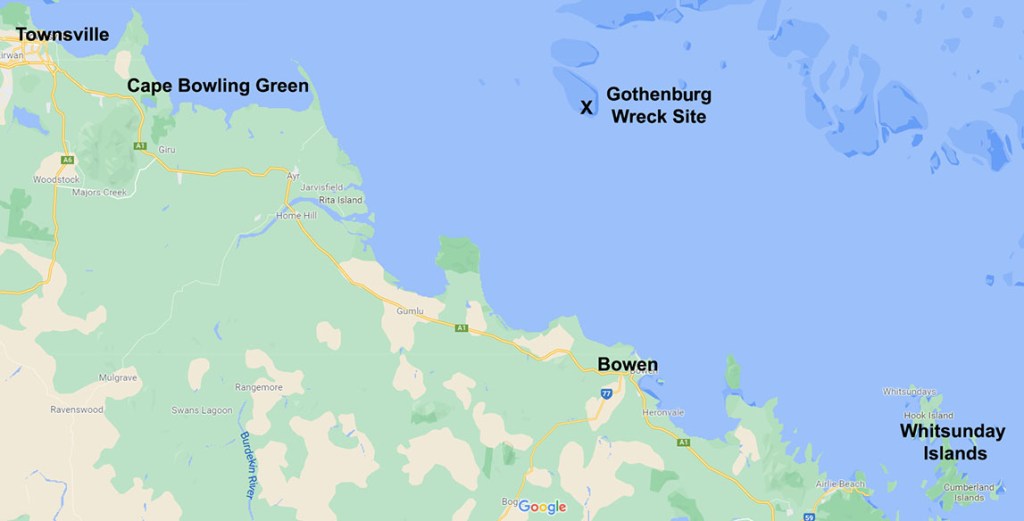
    That the Gothenburg had sunk with 3,000 ounces (93 kgs) of gold belonging to the English, Scottish and Australian Chartered Bank did not go unnoticed when the ship was reported lost.   Brisbane salvage diver James Putwain partnered with the owner of the small coastal steamer and the two started steaming towards Bowen as quickly as they could.  

    There, Putwain hired a small fishing boat and some local men to help with his air pump.   By noon on 7 March, they were at the wreck site, only six days after hearing of the disaster.  The steamer continued north, leaving Putwain and his team to bring up the gold. 

    Putwain first tried diving from the fishing boat but a strong current prevented him from reaching the wreck.   He then built a platform attached to the wreck’s mainmast and set up his diving apparatus on that.   Donning his heavy diving suit and helmet, he climbed down the rigging to the sunken ship’s deck and soon made entry into the captain’s cabin.   On this first attempt his air hose became entangled in the wreckage.   Putwain had some anxious moments until he cleared it and returned to the surface to give more explicit instructions to his new and inexperienced assistants.  

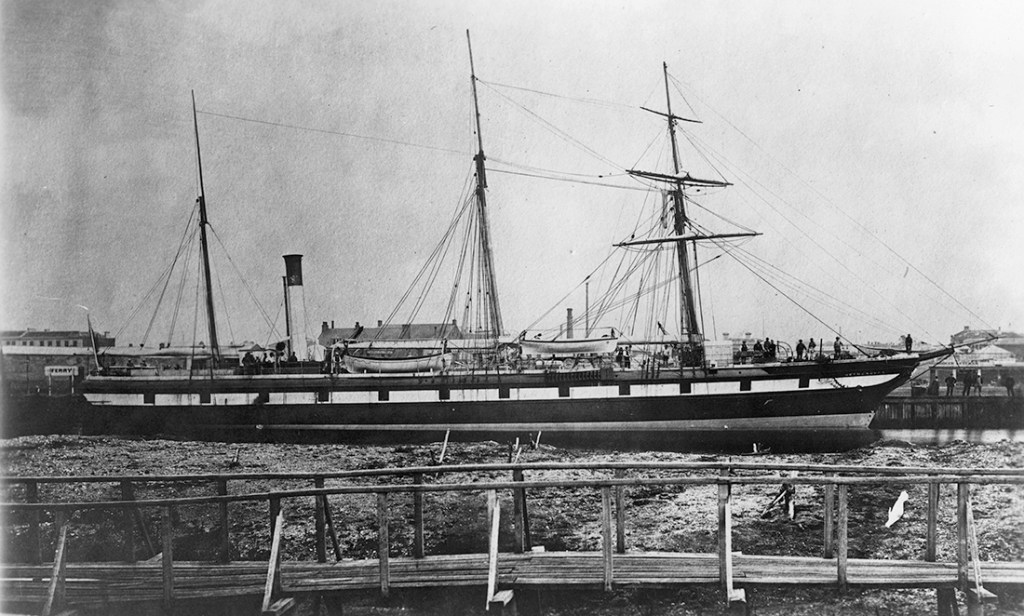
    S.S. Gothenburg docked at a wharf. Photo Courtesy SLQ

    His third descent met with success.   Putwain found the safe containing the gold in the remains of the  cabin and had it hoisted to the surface.   Before leaving the wreck he tried descending further into the ship but only got a little way before running out of hose.   But there, he saw the haunting vision of two women suspended in the water seemingly embracing.   Unable to get close enough to identify the bodies, he returned to the surface with the macabre image burned into his memory. 

    With the gold secured he returned to Bowen to report his find to the Harbourmaster and deposit the precious metal in the local bank.

    Then the enterprise got mired in legal wrangling.   The English, Scottish and Australian Chartered Bank offered James Putwain and his partner £1,000 for retrieving the £9,000 worth of gold.   Putwain and his partner felt £4,000 was more appropriate compensation.   The case went to the Vice Admiralty Court in Brisbane, where Putwain claimed he had spent nearly £500 in the salvage operation, that it had been a risky endeavour and that the box was found in a precarious position where it could have easily plummeted into deeper, inaccessible, water to be lost for ever. 

    The bank argued that the amount demanded by the salvors was excessive and Putwain’s account of the salvage operation was exaggerated.     Nonetheless, the judge found in favour of the salvors, awarding them approximately one third the value of the gold, £3,000.   

    Not happy with the verdict, the bank appealed the decision before the Privy Council in London.    Almost two years after the Gothenburg sank the Privy Council found in favour of the salvors and upheld the original judgement, ordering the bank to pay Putwain and his partner.

    A second salvage operation was mounted in the weeks after the Gothenburg was lost.     The diver Samuel Dunwoodie arrived on the wreck on 14 March, a week after Putwain, unaware that the gold had already been retrieved.    Nonetheless, Dunwoodie recovered much of the cabin luggage and many of the personal effects belonging to the passengers.   His team also removed the ship’s two steam winches before the weather turned foul, forcing them to abandon the wreck.

    The tragic story of the Gothenburg shipwreck is told in A Treacherous Coast: Ten Tales of Shipwreck and Survival from Queensland Waters, available as an eBook or paperback through Amazon.

    © Copyright C.J. Ison, Tales from the Quarterdeck, 2022.

    To be notified when a new blog is posted please enter your email address below.