Tag: George III

  • Tales from the Quarterdeck

    Sixty bite-sized stories from Australia’s maritime past

    The melancholy loss of H.M.S Sirius off Norfolk Island by George. Raper. Source National Library of Australia 136507434-1

    I have just launched a new book titled Tales from the Quarterdeck: Sixty bite-sized stories from Australia’s maritime past. Sixty of the most popular posts have been reedited. In some cases, I’ve rewritten a couple and updated a few where new information has come to light since first writing them.

    For those who would value ready access to the stories in their bookcase, Tales from the Quarterdeck is available in Kindle ebook and paperback formats through Amazon.

    The stories are organised in chronological order, starting with the Tryall shipwreck off the Western Australian coast in 1622, and finishing with the Second World War exploits of the Krait. See below for a full list of the stories covered in the book.
    Sydney Gazette 22 May 1808, p. 2.

    1622 – The Tryall: Australia’s earliest shipwreck

    1629 – The Batavia Tragedy

    1688 – William Dampier: Navigator, naturalist, writer, pirate

    1770  – The Endeavour’s Crappy Repair

    1788 – Loss of La Astrolabe and La Boussole, a 40-Year Mystery                        

    1789 – Bligh’s Epic Voyage to Timor

    1789 – HMS Guardian: All Hands to the Pumps

    1790 – The Loss of HMS Sirius

    1790 – Sydney’s First Desperate Escape

    1791 – HMS Pandora: Queensland’s earliest recorded Shipwreck

    1791 – William Bryant’s Great Escape

    1797 – The Loss of the Sydney Cove

    1803 – Loss of HMS Porpoise

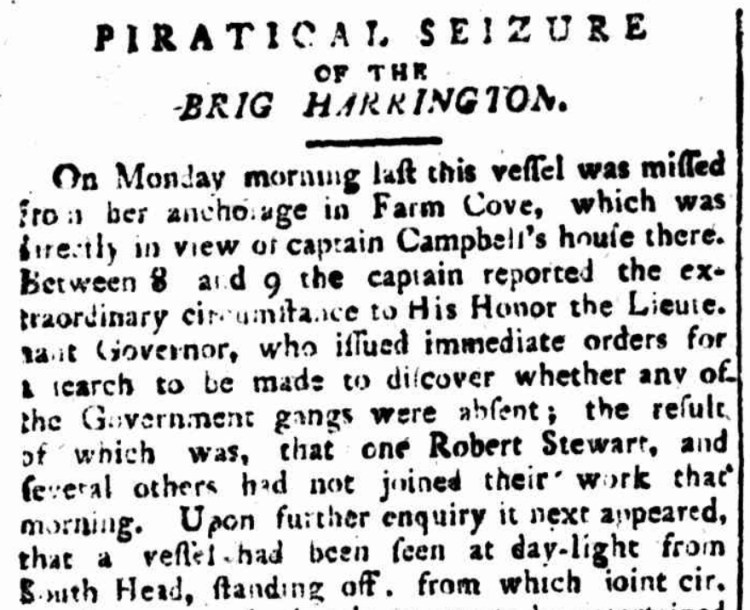
    1808 – Robert Stewart and the Seizure of the Harrington

    1814 – Wreck of the Morning Star

    1816 – The Life and Loss of HMSC Mermaid

    1824 – The Brig Amity’s Amazing Career

    1829 – The Cyprus mutiny 

    1831 – The Caledonia’s perilous last voyage

    1833 – The Badger’s Textbook Escape

    1835 – The Loss of the Convict Ship Neva

    1835 – The Post Office in the middle of nowhere

    1835 – The Tragic Loss of George III

    1845 – The Cataraqui: Australia’s worst shipwreck

    1846 – The Peruvian’s Lone Survivor

    1847 – The Foundering of the Sovereign

    1850 – The Loss of the Enchantress: A first-hand account

    1851 – The Countess of Minto’s brush with Disaster

    1852 – The Bourneuf’s Tragic Last Voyage

    1852 – The Nelson Gold Heist

    Woodbury, Walter B. (Walter Bentley), 1834-1885. Hamlet’s Ghost, Sourabaya [Surabaya], Java [Boat with Passengers and Crew], ca. 1865. Walter B. Woodbury Photograph Collection (PH 003). Special Collections and University Archives, University of Massachusetts Amherst Libraries

    1854 – Bato to the Rescue 

    1854 – HMS Torch and the rescue of the Ningpo

    1856 – The Loss of the Duroc and the Rise of La Deliverance

    1858 – The Loss of the Saint Paul and its Horrific Aftermath

    1858 – Narcisse Pelletier, An Extraordinary Tale of Survival

    1859 – The Indian Queen’s Icy Encounter

    1859 – The Sapphire and Marina

    1863 – The loss of the Grafton: Marooned for twenty months

    1864 – The Invercauld shipwreck

    1865 – The CSS Shenandoah: Victoria’s link to the American Civil War

    1866 – The Loss of the SS Cawarra: Bad luck or an avoidable tragedy?

    1868 – The Bogus Count and Hamlet’s Ghost

    1871 – The Mystery of the Peri

    1872 – The Loss of the Maria, A Cautionary Tale

    1875 – The Tragedy behind the Gothenburg Medals

    1876 – The Catalpa rescue

    1876 – The Banshee’s Terrible Loss

    1878 – The Loch Ard Tragedy

    1884 – The Macabre case of the Mignonette

    1885 – The Douro and its Piratical Captain

    1889 – The Windjammer Grace Harwar

    1891 – The Spanish Silver of Torres Strait

    1893 – The Foundering of the SS Alert

    1895 – The Norna and the Conman Commodore

    1899 – Cyclone Mahina

    1911 – The Loss of the Mandalay

    1918 – The Orete’s Robinson Crusoe-like Castaway

    1935 – The Life and Loss of  the SS Maheno

    1943 – Surviving the Centaur Sinking

    1943 – The Amazing Krait

  • The Tragic Loss of George III – 1835

    The Wreck of George III, by Knud Bull, wikimedia commons.

       The 400-ton ship George III sailed from England on 12 December 1834, bound for Van Diemen’s Land (Tasmania). She was carrying nearly 300 people, of whom 220 were convicts. When they were less than 80 km from Hobart, tragedy struck with a terrible loss of life.

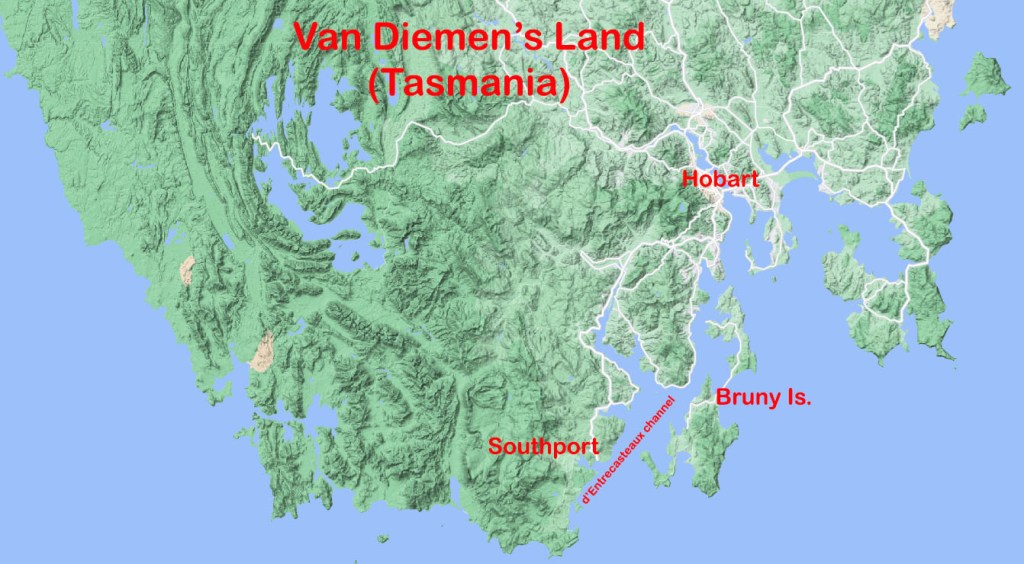
       Around 11 a.m. on Sunday, 12 April 1835, the George III made land at South Cape, the southernmost point of Tasmania. By early evening, they had entered the D’entrecasteaux Channel to make the final run up the coast to the mouth of the Derwent River. From there, it would have been a short cruise up the river to Hobart Town. She put the dangerous Actaeon Islands behind her around 8.30 that night. The moon was out, the weather mild, and they were being pushed along at a modest 1 ½ to 2 knots (3 – 4 km/h) by a light breeze blowing off the land.   

    Captain William Moxey had a man in the chains sounding the passage as they made their way north. Repeated soundings showed they were in 20 fathoms (36m) of water, which was more than deep enough for safe passage. Then, shortly before nine o’clock, Moxey was stunned to hear the man call out “quarter less four,” meaning they were in less than four fathoms (7m) of water. He ordered the helm put hard to port. But before the ship could respond, she struck ground and came to a stop where the chart said there was clear passage.

    Southern Tasmania. Google Maps.

       The captain had soundings taken around the ship and found they were stranded on an uncharted rock with between three and five metres of water surrounding them. The initial collision was not particularly violent, but now that the ship was stuck fast, the ocean swells began lifting her up and dropping her back down on her rocky perch. Within minutes, the repeated pounding brought the main mast crashing down. The mizzen mast came down with it, littering the deck with a tangle of rope, canvas and timber spars.

       The crash brought everyone on deck, except for the prisoners. Seamen not on watch, passengers and the complement of soldiers hastily dressed and came up to see what had happened. Captain Moxey gave the order to abandon ship and oversaw the evacuation in the ship’s boats. However, efforts were severely hampered by the continued pounding and the mess of debris strewn across the deck and floating in the water.

       Moxley ordered one of his boats with a crew of seven to make for Hobart as quickly as possible to get help. Then he got the evacuation of the passengers and the rest of the crew underway. Meanwhile, the convicts were still locked below deck with armed guards stationed over the hatchway.

       The situation was becoming dire for the convicts trapped in their prison. They were already standing waist-deep in freezing water, and despite their pleas to the guards to be let out, the hatch covers remained locked. In genuine fear for their lives, several rushed forward and tried to force the hatch cover open with their bare hands. According to one of the surviving convicts, the guards opened fire to force them back, and at least one prisoner was struck by a bullet and killed. In a later inquiry, Moxey would dispute the claim, saying that the guards had only been stationed over the hatchways to keep the panicking prisoners contained below deck until the women and children had safely been evacuated. In fact, the inquiry reads like the minutes of a mutual appreciation society meeting, each officer praising the efforts of the others in saving so many lives.

    The Colonist, 7 May 1835, p. 5.

       Fifteen minutes after striking the rock, the deck was awash with water, and the last of the boats carrying 40 people had left the stranded vessel. Captain Moxley was among them, having been pulled from the water after he became trapped between floating timbers.

       By this time, the guards watching over the hatchways had left in the last boat. The trapped convicts were now able to force their way on deck to find it deserted.  But some 50 or so prisoners had been too ill to save themselves. Most had been suffering from scurvy and had drowned where they lay unable to escape the rising water.

       After putting the survivors ashore, Moxley returned to the ship and began taking off the convicts. By the time he had reached the George III for the third time, a schooner sent from Hobart had arrived and was taking off the last of the survivors.

       One hundred and thirty-four people lost their lives. Three of them were passengers – a woman and two children – and two were members of the ship’s crew. Convicts made up the remaining 128 fatalities. Most never had a chance, trapped in the hold as the water rose around them.

    The next morning, a convict named John Roberts was found dead, lashed to a ringbolt in the surgeon’s cabin. It seems he could not swim, so he had tied himself off, hoping to be washed ashore as the ship broke up.    Despite the heavy loss of life, 160 people were saved. They were all taken to Hobart, cold, wet, and thoroughly exhausted from the ordeal.

    View of Hobart Town by Samuel Davenport, circa 1835.

         The inquiry into the loss of the ship found no one was to blame. It concluded that the George III had struck a rock not recorded on the chart. Then it came time for the inquiry to consider the treatment of the convicts. No officer admitted to ordering the prisoners to be confined below deck as the hold flooded with water. The Corporal of the guard testified that the muskets were only used to “intimidate” the prisoners, and only one shot was fired, and that into the air. No one was held accountable for the loss of so many prisoners.

     © Copyright C.J. Ison / Tales from the Quarterdeck, 2022.

    To be notified of future blogs, please enter your email address below.