
One September afternoon in 1874, Miss Bessie Wright cracked a bottle of champagne across the bow of a new steamer and sent it gliding into the Humber River. Thus, one of the strangest vessels ever to come off a naval architect’s drawing board was launched.
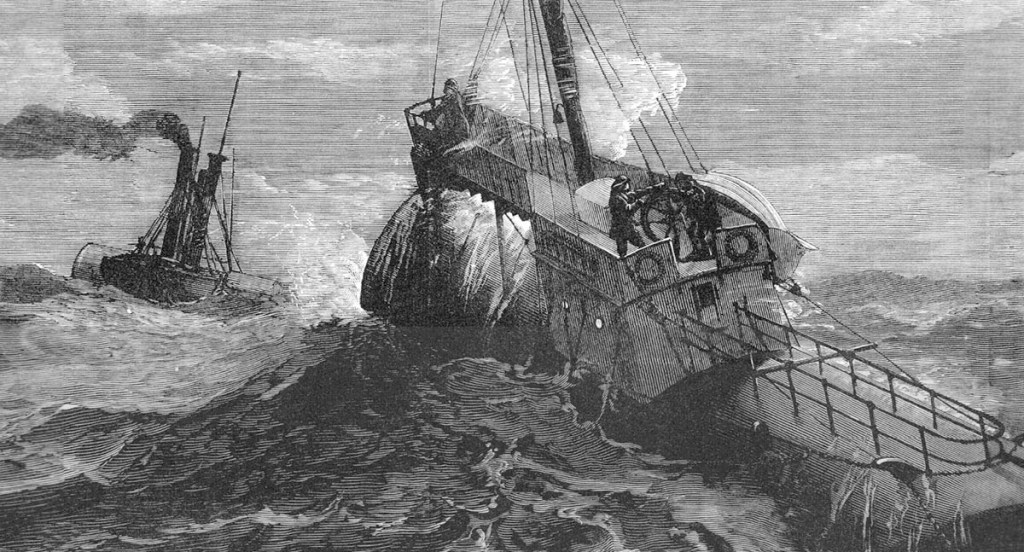
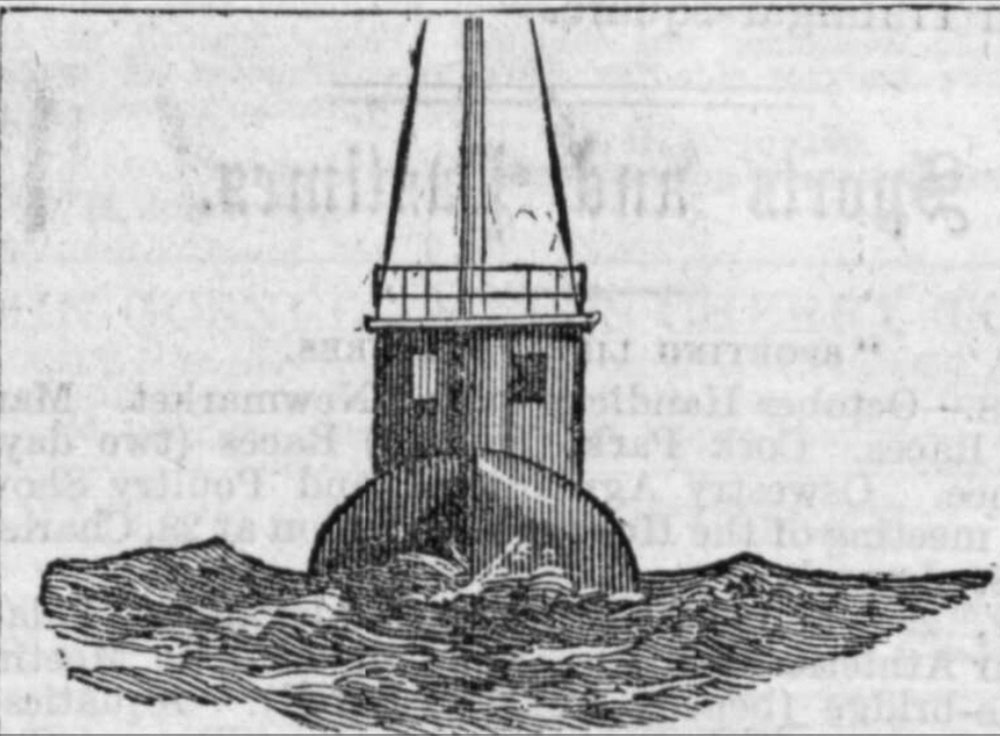
S.S. Bessemer Saloon Steamship was the brainchild of little Bessie’s grandfather, Sir Henry Bessemer. He had found investors who stumped up some £250,000 to make his vision a reality. The resulting paddle steamer measuring 350 ft (106.6m) at the waterline and had four paddle wheels, two on the port side and two starboard. The fore and aft were identical, and there were two bridges and two helms meaning she could travel as quickly in either direction at an anticipated top speed of 20 miles per hour. But what set the Bessemer apart from any other steamer was her swinging saloon.
Positioned in the middle of the ship was a 70 ft (21m) cabin, which would remain stable regardless of the pitch and roll of the rest of the vessel. The gyroscopic apparatus powered by a dedicated steam turbine had been designed and patented by Henry Bessemer himself. This complex piece of engineering was to ensure that the steamers’ first-class passengers were spared the indignity of mal de mer or seasickness in all but the roughest of sea conditions. Second-class passengers were not so well catered for. They would occupy a separate, more conventional cabin mounted upon the ship’s superstructure.

The Bessemer was purpose-built to negotiate the lumpy waters of the English Channel. She would travel between Dover and Calais, and at her top speed, it would take just one hour to cross the 20-nautical mile gap. Henry Bessemer was convinced that the first-class passengers would disembark as hail and hearty as they had boarded his modern marvel. Nonetheless, the designers had thought to include two “retiring rooms” for ladies and gentlemen to “withdraw from the public gaze,” should anyone still feel the ill effects of the sea.
Not surprisingly, the novel design attracted its fair share of sceptics. Some naval architects felt the gyroscopic apparatus would do little to stop the saloon from pitching and rolling in rough seas. Their main concern was that the mechanism would be unable to respond fast enough to the sea to ensure the saloon maintained its equilibrium.
After the Bessemer had been launched it was moored in the Hull Roads while her plush interior was fitted out. A Daily News reporter would later describe the Bressemer’s saloon akin to a “superbly furnished floating clubhouse.” The steamer was furnished with a large smoking saloon, several staterooms on the upper deck, refreshment bars, an office for small parcels, umbrella and cloakrooms, and “delightful promenades high above the reach of ocean spray.”

The only hiccup while the steamer was being fitted out was when she dragged her anchors during a mighty gale that battered much of the UK on 21 October. The Bessemer was driven onto a mudflat on the northern bank of the Humber River, but she was easily floated off at high tide on that same day.
By late January 1875, the Bessemer had completed her first set of sea trials on the Humber. She reportedly steered well and reached a top speed of 18 knots (33 km/h). Her gyroscopic apparatus was said to have performed splendidly, but that assertion would soon be brought into question.
In March, the Bessemer made the voyage from Hull to Gravesend on the Thames in 24 hours while steaming into a strong headwind. There, she underwent more sea trials, and on 12 April, the Bessemer Saloon Steamship made her much-anticipated first crossing to Calais. As the steamer had yet to receive her passenger certification from the Board of Trade, the only people on board were the crew and a handful of men connected with the company.

She left Gravesend at 8.30 on Saturday morning and made her way down the Thames and out into the English Channel. There, she was buffeted by a strong easterly wind and heavy seas. Despite the inclement weather, the passage was reported to have been “remarkably steady”, and there had been no opportunity to test the ship’s swinging saloon. She averaged 11 knots (20km/h) for the 75 nm (145 km) passage and arrived in that French port at 3.30 in the afternoon. There, a great many of Calais’ residents gathered on the pier to witness the arrival of the unique ship. Unfortunately, as she was docking, one of her paddles was damaged when it struck the pier.
Finally, the big day arrived on 12 April 1875. The Bessemer steamed out of Dover with 350 invited guests onboard anticipating being the first to see the swinging saloon in action. Several members of the press were among them, no doubt there to extol the virtues of the fine new vessel. However, the Observer’s correspondent, for one, was clearly underwhelmed by the experience.
He reported that the screws fastening the moveable saloon were never loosened, which would have allowed the passengers to witness for themselves the effect of Henry Bessemer’s invention. Several reasons were put forward for why the gyroscopic apparatus was not employed, but the reporter wrote that he had been reliably informed that the equipment simply did not work. It could shift the saloon from side to side, but it was not up to the task of “regulating the rise and fall of the saloon with sufficient precision to secure stable equilibrium.”

To cap off the 90-minute non-event, the Bessemer entered Calais’s harbour far too quickly to manoeuvrer safely around the small, enclosed port. The collision with the pier on her last visit to Calais had been attributed to the Bessemer’s poor response to her helm when travelling at low speed. This time, the captain came in a little faster. However, the steamer was caught in a tidal current and spun around. The Bessemer struck the pier with considerable force but sustained little damage to itself.
However, the same could not be said for the wharf. “When at last the Bessemer was stopped, some 50 or 60 yards of the pier were knocked down like nine-pins in a skittle alley, and the water of the harbour was covered with broken planks and beams.”
“The Bessemer is too long a vessel for Calais harbour,” the reporter opined, “there must always be a certain amount of risk in her entering so narrow a port with the velocity required to carry her across the bars.” A month later, the Calais Municipality sent the Saloon Ship Company a bill for £2,800 to cover the cost of repairing the pier.

That was the Bessemer’s final voyage but for her return to England. The investors cut their losses, and the company was wound up. The engines, the swinging saloon and other fittings were removed, and by the end of the following year, the remainder of the ship was sold off as scrap. So ended the short but lively career of the Bessemer Saloon Steamship.

© Copyright C.J. Ison / Tales from the Quarterdeck, 2024.
Please enter your email address below to be notified of future blogs.

 Tales from the Quarterdeck