Tag: Enchantress

  • Tales from the Quarterdeck

    Sixty bite-sized stories from Australia’s maritime past

    The melancholy loss of H.M.S Sirius off Norfolk Island by George. Raper. Source National Library of Australia 136507434-1

    I have just launched a new book titled Tales from the Quarterdeck: Sixty bite-sized stories from Australia’s maritime past. Sixty of the most popular posts have been reedited. In some cases, I’ve rewritten a couple and updated a few where new information has come to light since first writing them.

    For those who would value ready access to the stories in their bookcase, Tales from the Quarterdeck is available in Kindle ebook and paperback formats through Amazon.

    The stories are organised in chronological order, starting with the Tryall shipwreck off the Western Australian coast in 1622, and finishing with the Second World War exploits of the Krait. See below for a full list of the stories covered in the book.
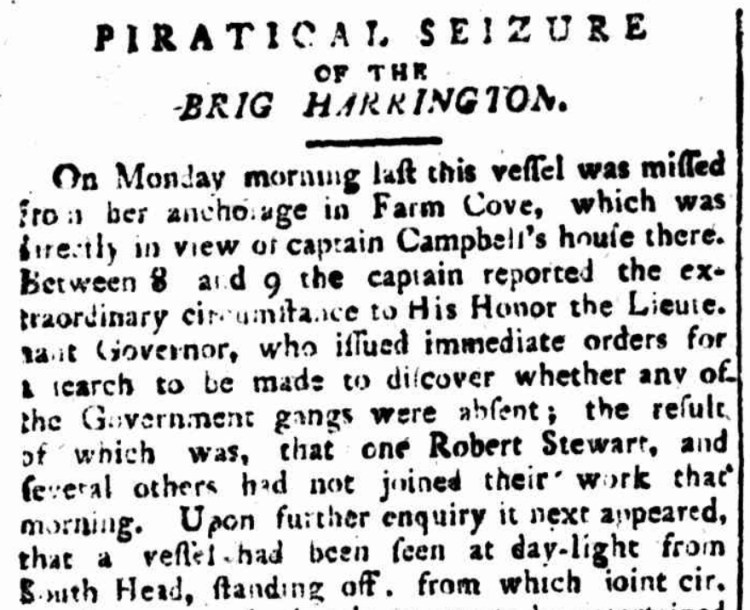
    Sydney Gazette 22 May 1808, p. 2.

    1622 – The Tryall: Australia’s earliest shipwreck

    1629 – The Batavia Tragedy

    1688 – William Dampier: Navigator, naturalist, writer, pirate

    1770  – The Endeavour’s Crappy Repair

    1788 – Loss of La Astrolabe and La Boussole, a 40-Year Mystery                        

    1789 – Bligh’s Epic Voyage to Timor

    1789 – HMS Guardian: All Hands to the Pumps

    1790 – The Loss of HMS Sirius

    1790 – Sydney’s First Desperate Escape

    1791 – HMS Pandora: Queensland’s earliest recorded Shipwreck

    1791 – William Bryant’s Great Escape

    1797 – The Loss of the Sydney Cove

    1803 – Loss of HMS Porpoise

    1808 – Robert Stewart and the Seizure of the Harrington

    1814 – Wreck of the Morning Star

    1816 – The Life and Loss of HMSC Mermaid

    1824 – The Brig Amity’s Amazing Career

    1829 – The Cyprus mutiny 

    1831 – The Caledonia’s perilous last voyage

    1833 – The Badger’s Textbook Escape

    1835 – The Loss of the Convict Ship Neva

    1835 – The Post Office in the middle of nowhere

    1835 – The Tragic Loss of George III

    1845 – The Cataraqui: Australia’s worst shipwreck

    1846 – The Peruvian’s Lone Survivor

    1847 – The Foundering of the Sovereign

    1850 – The Loss of the Enchantress: A first-hand account

    1851 – The Countess of Minto’s brush with Disaster

    1852 – The Bourneuf’s Tragic Last Voyage

    1852 – The Nelson Gold Heist

    Woodbury, Walter B. (Walter Bentley), 1834-1885. Hamlet’s Ghost, Sourabaya [Surabaya], Java [Boat with Passengers and Crew], ca. 1865. Walter B. Woodbury Photograph Collection (PH 003). Special Collections and University Archives, University of Massachusetts Amherst Libraries

    1854 – Bato to the Rescue 

    1854 – HMS Torch and the rescue of the Ningpo

    1856 – The Loss of the Duroc and the Rise of La Deliverance

    1858 – The Loss of the Saint Paul and its Horrific Aftermath

    1858 – Narcisse Pelletier, An Extraordinary Tale of Survival

    1859 – The Indian Queen’s Icy Encounter

    1859 – The Sapphire and Marina

    1863 – The loss of the Grafton: Marooned for twenty months

    1864 – The Invercauld shipwreck

    1865 – The CSS Shenandoah: Victoria’s link to the American Civil War

    1866 – The Loss of the SS Cawarra: Bad luck or an avoidable tragedy?

    1868 – The Bogus Count and Hamlet’s Ghost

    1871 – The Mystery of the Peri

    1872 – The Loss of the Maria, A Cautionary Tale

    1875 – The Tragedy behind the Gothenburg Medals

    1876 – The Catalpa rescue

    1876 – The Banshee’s Terrible Loss

    1878 – The Loch Ard Tragedy

    1884 – The Macabre case of the Mignonette

    1885 – The Douro and its Piratical Captain

    1889 – The Windjammer Grace Harwar

    1891 – The Spanish Silver of Torres Strait

    1893 – The Foundering of the SS Alert

    1895 – The Norna and the Conman Commodore

    1899 – Cyclone Mahina

    1911 – The Loss of the Mandalay

    1918 – The Orete’s Robinson Crusoe-like Castaway

    1935 – The Life and Loss of  the SS Maheno

    1943 – Surviving the Centaur Sinking

    1943 – The Amazing Krait

  • The Loss of the Enchantress: A first-hand account.

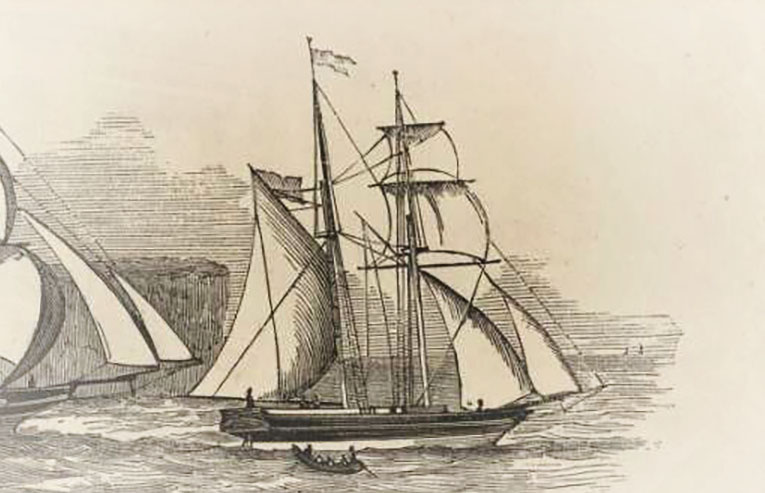
    A Brig leaving Port Jackson in the 1850s.. Image courtesy National Library of Australia.

        The loss of some ships plying Australian waters was only ever noted by a brief paragraph in newspaper shipping columns. Months after leaving port, they would be reported as having never arrived at their destination. The exact circumstances of their loss and what might have happened to the souls on board will never be known. But far more often, people did survive, even if the ship did not. Captains had the grim duty to report the loss of the vessel to its owners, while passengers often wrote to loved ones about their unanticipated adventure. Such records are the sources for many a shipwreck tale.

       On 24 July 1850, the 146-ton brig Enchantress was wrecked near Raine Island while trying to pass through the Great Barrier Reef. Navigating the tricky passages leading to Torres Strait could prove challenging in those early days. Between 1791 and 1887, no less than 37 ships came to grief near Raine Island. Many more were lost on reefs and shoals dotting Queensland’s northern waters.

       Mr B. Buchanan was a passenger on the Enchantress and also an employee of the company that owned the vessel. While en route to Kupang in the Dutch East Indies (present-day Indonesia), after being rescued, he penned a letter to his employers, notifying them of the loss of their ship. This letter, written 175 years ago, provides a firsthand account of the incident.

    A ship off Raine Island, Torres Strait. Illustrated Australian News for Home Readers Thu 30 Jan 1873 Page 9.

       Messrs. Smith, Campbell, and Co., Sydney.

       At Sea, approaching Kupang,

       August 3rd, 1850.

       Dear Sirs, – It is my unpleasant task to inform you of the loss of the brig Enchantress. She struck and grounded on the reef running out from Raine’s Island, on the afternoon of the 24th July.

       From the time of leaving Sydney, the weather was favourable. We joined company with the brig Lady Margaret off Newcastle. On the 24th, about noon, being a little ahead of our companion, we sighted the Barrier below the detached reef, between it and Yule’s Reef. We hauled up to the eastward, and made out the beacon on Raine’s Island between two and three pm.

       Captain L’Anson then stood in for the southern passage, but unfortunately got too near the reef running out from the island. He tried to put her about, but she missed stays; he filled on her again, and again tried it, but a second time she missed. There was no room to wear, the wind being fresh and the current strong, and we tried a third time to stay her, but to no purpose. The strong northerly set and flood tide prevented her [from] coming round, and we were driven on the point of the reef.

       Every sea sent us further on, the surf washing the lower masts’ heads. An attempt was made to take off the sails, but it was becoming dark, we had the reef to cross to get to the island, and the brig was thrown more over by every wave.

       We therefore got out the longboat, saving the chronometer, my papers, and some clothes. The jolly boat was washed away. We crossed the reef without difficulty and took shelter in the beacon.

    Map showing location of wreck at Raine Island. Courtesy Google Maps.

       At three a.m. of Thursday, the 25th, Captain L’Anson, it being low tide, started with the boat, manned by the majority of the crew, with the intention of saving all he could from the wreck. He got the boat alongside, but the sea was breaking so heavily that it was not possible to remain; they brought away some provisions, cooking utensils, and nearly all my things, but could save nothing pertaining to the ship. They were afraid of the boat being swamped.

       At the time of our first attempting to stay the brig, the Lady Margaret was following close, but immediately went about. Captain Grant stood off that night, bore down again in the morning, and worked on and off all day.

       We knew that it would be out of all reason to expect him to bring up after having once entered, before he got to anchorage ground, about twenty-five miles from Raine’s Island; and saw also that he was unwilling to pass without communicating with us (we learnt afterwards that he was afraid we were without provisions or water).

       Meanwhile, the weather had assumed a threatening aspect, we therefore dispatched the boat with five of the people, under Mr Wood, the chief officer, to the Lady Margaret; they succeeded in reaching her after a very long and laborious pull.

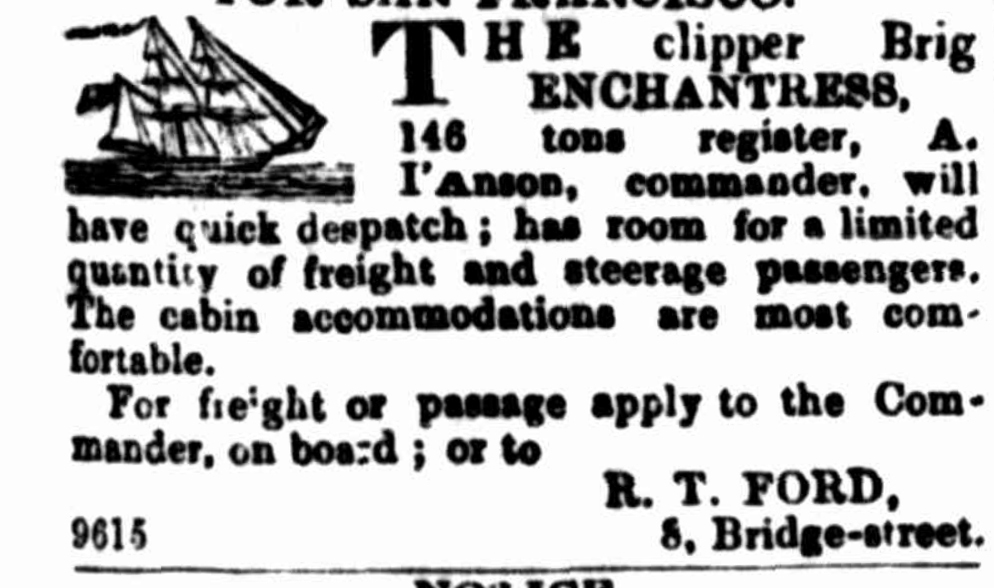
    Advertisement for passage on the Enhantress. SMH 30 May 1850, p. 1.

       I had written to Captain Grant, with suggestions for relieving us, but his position was one of such danger that he could give no attention thereto; his anxiety was to get us on board at once, and be off, and to attain this he despatched his second officer with his jolly boat to the island immediately, our own boat returning at the same time to aid in bringing what clothes we had saved.

       We left the island at four p.m., and were taken on board the Lady Margaret at dusk. She stood out to sea, and in the morning entered by the Southern Passage.

       The poor Enchantress when last seen by us was being between twenty and thirty yards from the point of the reef – bows on the water, masts standing.

    [The letter was published in the Sydney Morning Herald newspaper on 3 December 1850. Here, it is re-published as it first appeared in print, but for a few minor changes to spelling and punctuation.]

    [The letter was first published in the Sydney Morning Herald newspaper on 3 December 1850.   Here, it is reproduced as it appeared in the newspaper, but for a few minor changes to spelling and punctuation.]

    © Copyright C.J. Ison / Tales from the Quarterdeck, 2022.

    To be notified of future blogs, please enter your email address below.